
7 Core Concepts Every Modern Salesforce Lightning Web Developer Should Know
Last updated on Sep 3, 2026
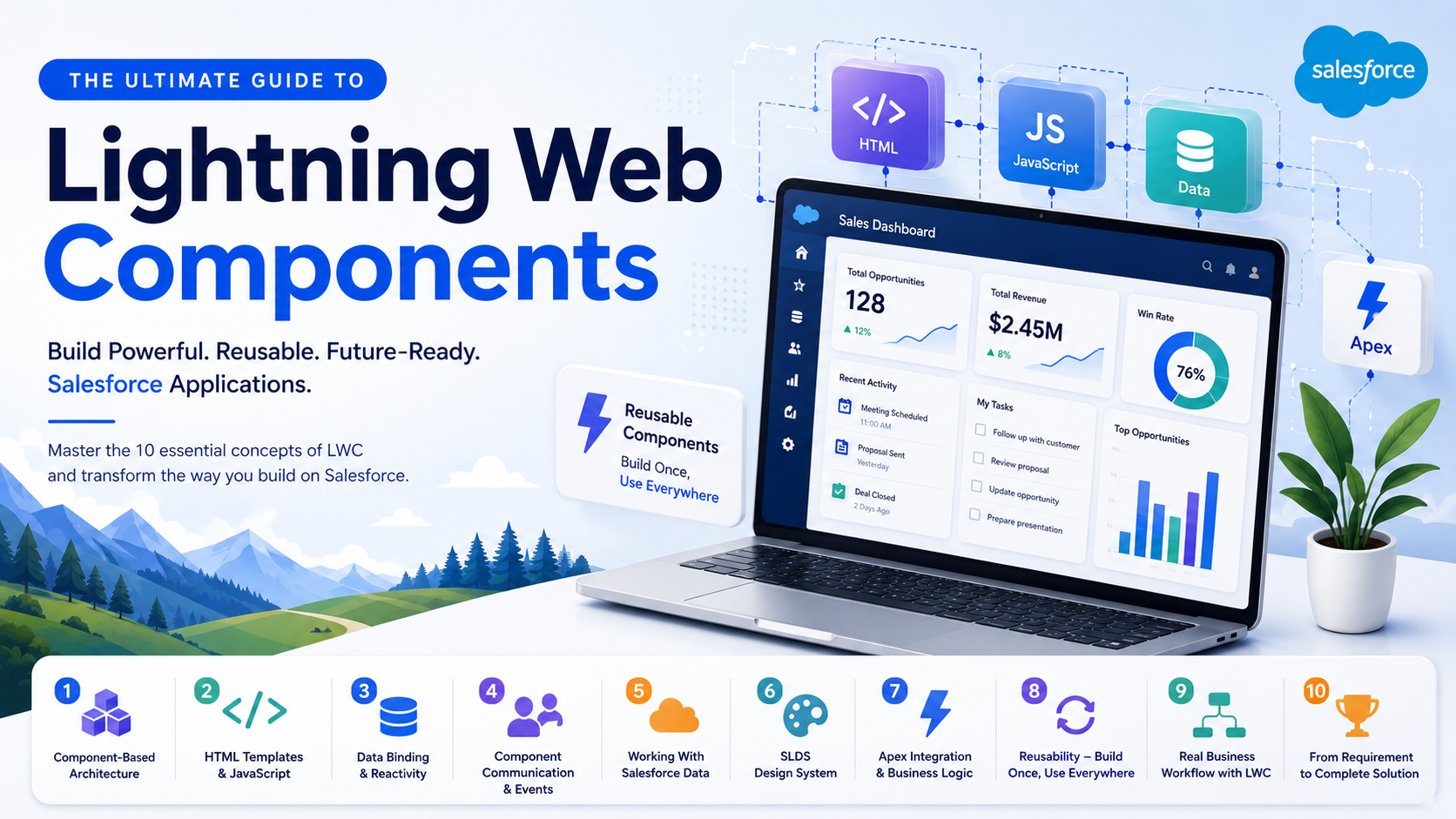
Salesforce development is no longer limited to configuring standard objects, fields, and workflows. As businesses expect more personalized digital experiences, Salesforce developers increasingly need to build interfaces that are interactive, responsive, reusable, and closely connected to business processes.
This is where Lightning Web Components (LWC) become important.
LWC provides Salesforce developers with a modern programming model for creating user interfaces using familiar web technologies such as HTML, JavaScript, and CSS. Instead of treating an application as one large piece of code, developers can break it into smaller components, give each component a specific responsibility, and reuse those components wherever they make sense.
But understanding LWC is more than knowing how to create a component. Developers need to understand how components are structured, how they communicate, how they work with Salesforce data, and how the interface connects with server-side business logic. Here are seven core concepts that provide a strong foundation for understanding modern LWC development.
1. Component-Based Architecture
The most important concept in LWC is component-based architecture. Instead of developing an entire Salesforce page as one large block of functionality, developers divide the interface into smaller components, with each component responsible for a particular task.
Consider a sales dashboard. Rather than building everything together, a developer could create a customer summary component, an opportunity component, a sales-performance component, and a recent-activity component. Each part can be developed and tested independently while still becoming part of the same overall application.
This approach makes large applications easier to understand because developers can focus on one responsibility at a time. It also makes maintenance more manageable. If the opportunity component needs to change, developers can work on that component without unnecessarily modifying unrelated parts of the dashboard.
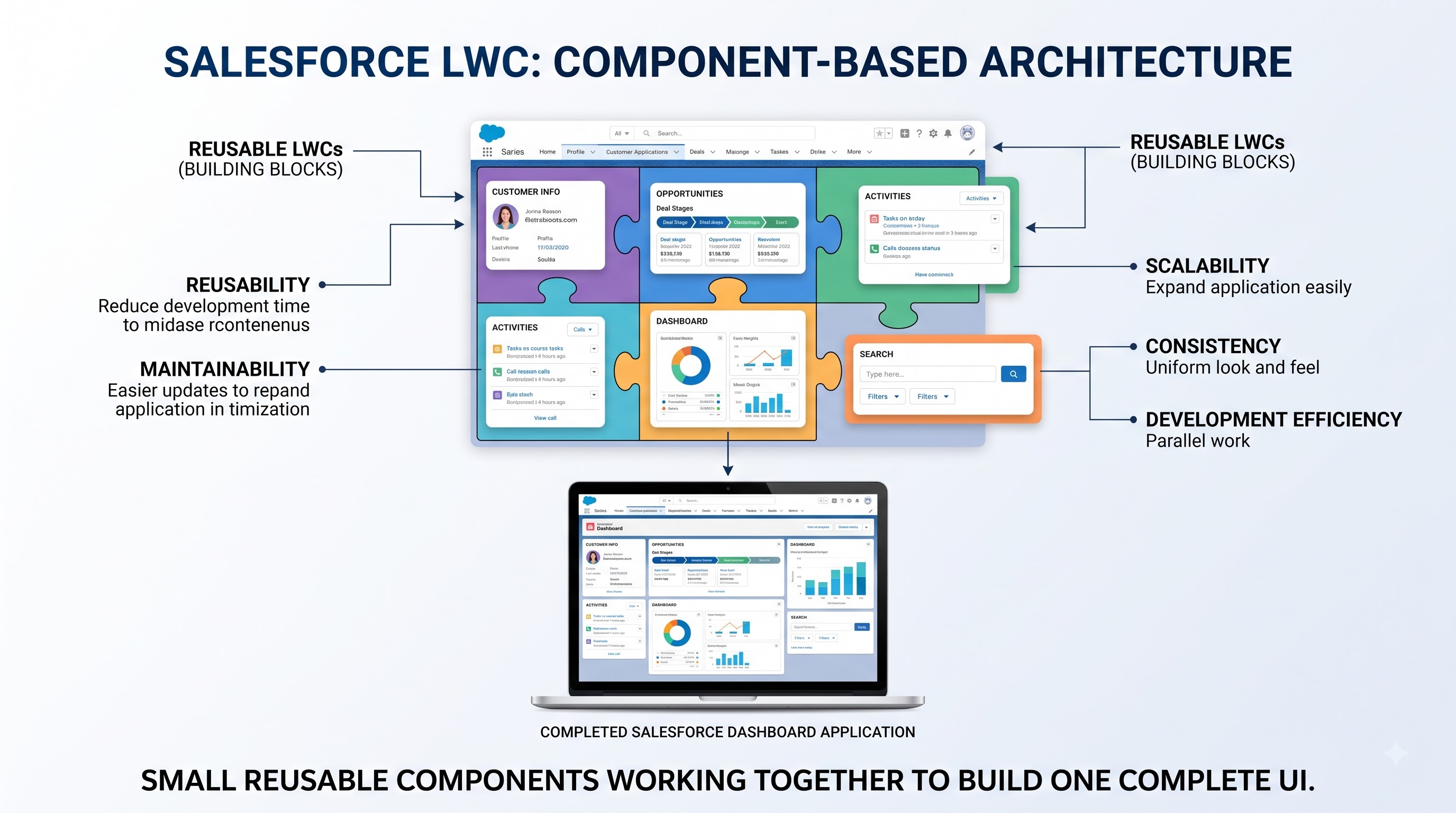
The bigger advantage is reusability. A well-designed component does not necessarily have to belong to one page. If the same customer summary is required on several Salesforce screens, the component can potentially be reused rather than recreated. This is why component-based architecture is more than just a development style. It helps teams reduce duplicated work, maintain consistency, and create applications that can evolve as business requirements change.
For enterprise Salesforce projects, this modular approach becomes particularly useful because applications can contain many different screens, processes, and user roles. Dividing those experiences into meaningful components gives developers a cleaner way to manage that complexity.
2. HTML Templates and JavaScript
Once developers understand components, the next important concept is understanding how an LWC is actually constructed. Two technologies sit at the center of this process: HTML and JavaScript. The HTML template defines the structure of what users see. It can contain text, buttons, forms, tables, input fields, cards, and Salesforce Lightning elements. JavaScript, on the other hand, controls how the component behaves when users interact with it or when data changes.
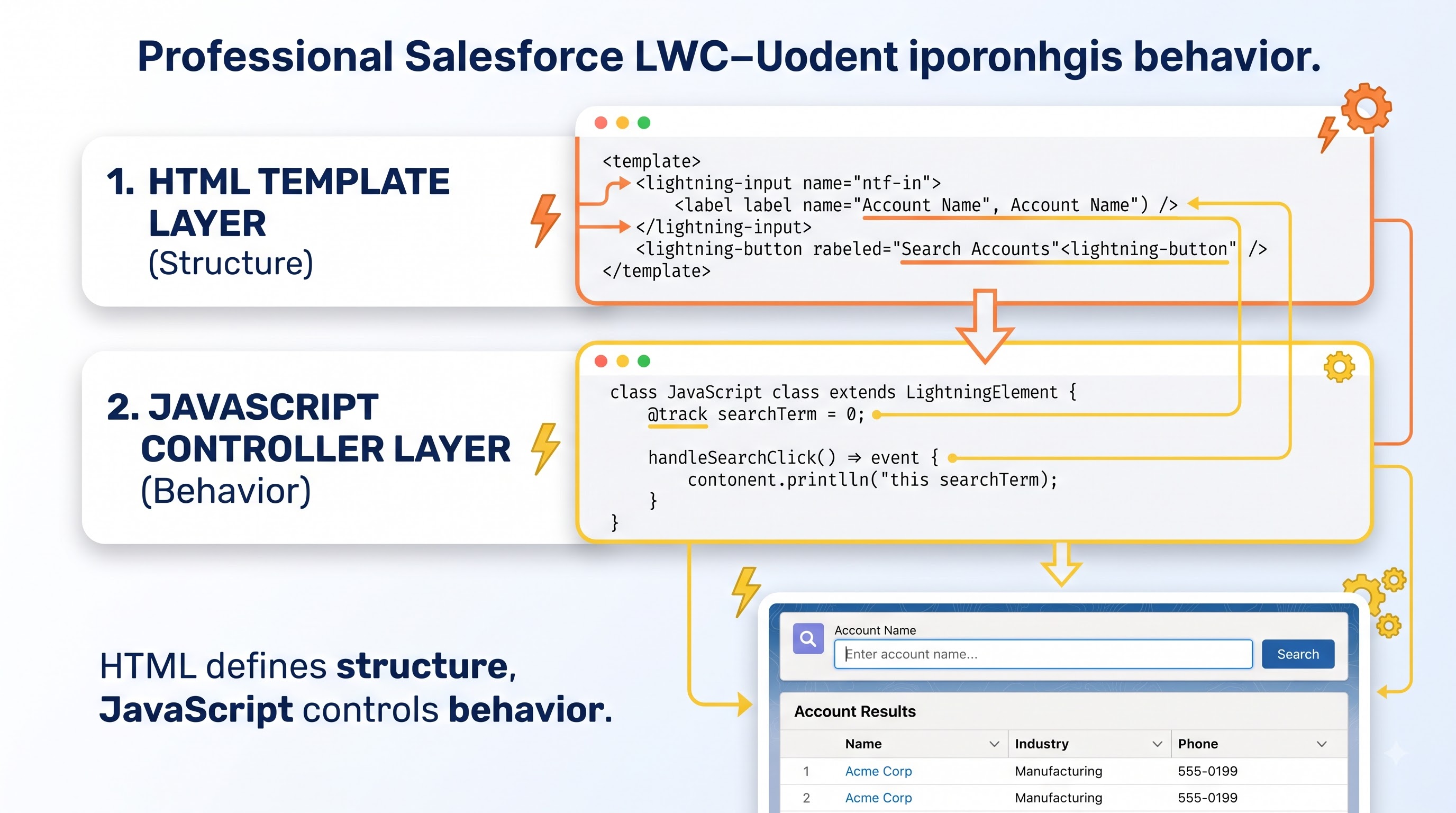
Imagine a customer-search component. The HTML could provide a search input and a button. When the user enters a customer name and selects the search option, JavaScript can capture that interaction, process the input, request the required information, and update the component with the results. This separation makes the code easier to reason about. The HTML answers the question, “What should the user see?” while JavaScript answers, “What should happen when the user interacts with it?”
This is also one of the reasons LWC is approachable for developers who already have web-development experience. The programming model uses familiar web concepts rather than requiring developers to learn an entirely separate approach to front-end development. LWC's use of HTML, JavaScript, and CSS allows developers to apply many existing web-development principles within Salesforce.
However, the real skill comes from knowing how these technologies work together. A developer should not simply create an attractive HTML interface or write JavaScript that technically works. The component should have a clear structure, predictable behavior, and a logical separation between presentation and application logic.
3. Data Binding and Reactivity
Salesforce applications deal with constantly changing information. A user may update a record, select a different customer, enter a value into a form, or perform an action that changes what should appear on the screen.
This is where data binding and reactivity become important. In a reactive component, the interface can respond when the data it depends on changes. Developers do not have to think about the interface as a completely static screen that must be manually rebuilt after every change. For example, imagine a sales dashboard displaying the number and total value of open opportunities. A user changes a relevant value, or new information is retrieved from Salesforce. The component can respond to the updated state and reflect the appropriate information in the interface.
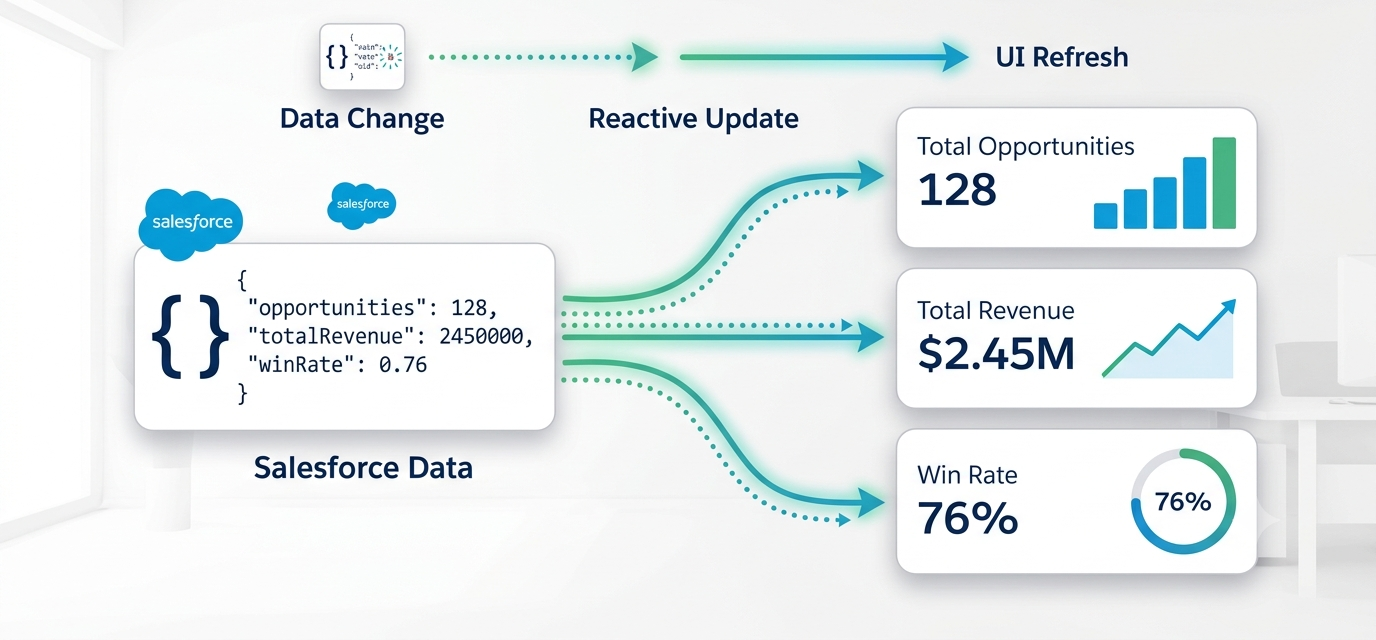
This creates a more natural relationship between the application's data and what users see. The concept becomes particularly important when components contain multiple pieces of information. A search result might change when the search term changes. A form might display different options depending on the selected value. A dashboard might update when new records are retrieved.
Instead of writing separate instructions to manually refresh every part of the interface, developers can structure the component around its data and state. Understanding reactivity therefore helps developers build applications that feel responsive rather than static. It also encourages a better development mindset: think about what data the component depends on, what can change, and how the interface should respond when it does.
For developers moving from traditional programming approaches into component-based development, this is an important shift in thinking. The goal is not simply to manipulate the screen directly; it is to create a relationship between component state and the user interface.
4. Component Communication and Events
A Salesforce application rarely consists of a single component. The real power of component-based development appears when multiple components can work together. Consider a customer-management page. The left side contains a list of customers, while the right side displays detailed information about the selected customer. When a user selects a customer, the details section needs to know which record was chosen.
This requires component communication. LWC provides mechanisms that allow components to exchange information without forcing the entire application into one tightly connected block of code. A parent component can provide information to a child component, while a child component can communicate an action or change back to its parent through events.
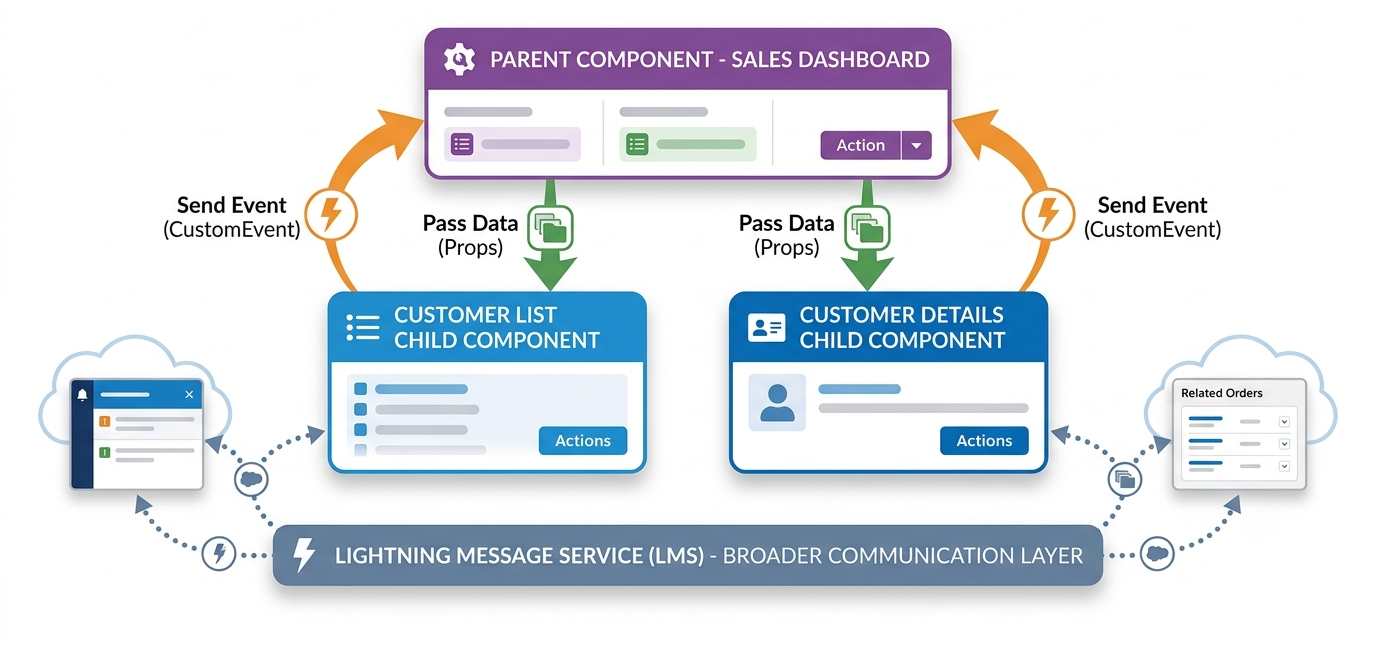
For example, a customer-list component could notify its parent when a user selects a particular customer. The parent can then provide the selected record information to the customer-details component.
This separation is valuable because each component can maintain its own responsibility. Events are particularly important because user interfaces are built around actions. Clicking a button, selecting a record, submitting a form, or changing a value can trigger an event that another part of the application needs to respond to.
For more complex communication scenarios, Salesforce also provides capabilities such as Lightning Message Service, which can help components communicate across different parts of an application. The objective is not simply to make components communicate. It is to make that communication predictable and maintainable. When developers understand how information should move between components, they can build larger applications without creating unnecessary dependencies between every part of the interface.
5. Working With Salesforce Data
An LWC becomes significantly more useful when it can work with the data that drives the business. Salesforce applications are built around records such as Accounts, Contacts, Opportunities, Cases, Leads, and many custom objects. A component may need to display those records, search them, update them, or use them to calculate information for the user.
LWC can interact with Salesforce data through platform capabilities such as Lightning Data Service, wire adapters, and Apex. The right approach depends on the requirement. For common record-based scenarios, Salesforce's data services can simplify the process of retrieving and working with records. Developers do not always need to create custom server-side logic for straightforward operations.
For more complicated requirements, an LWC can work with Apex. For example, a business might need information from several objects combined into one customized dashboard. The server-side logic can perform the required processing and return the result to the component.
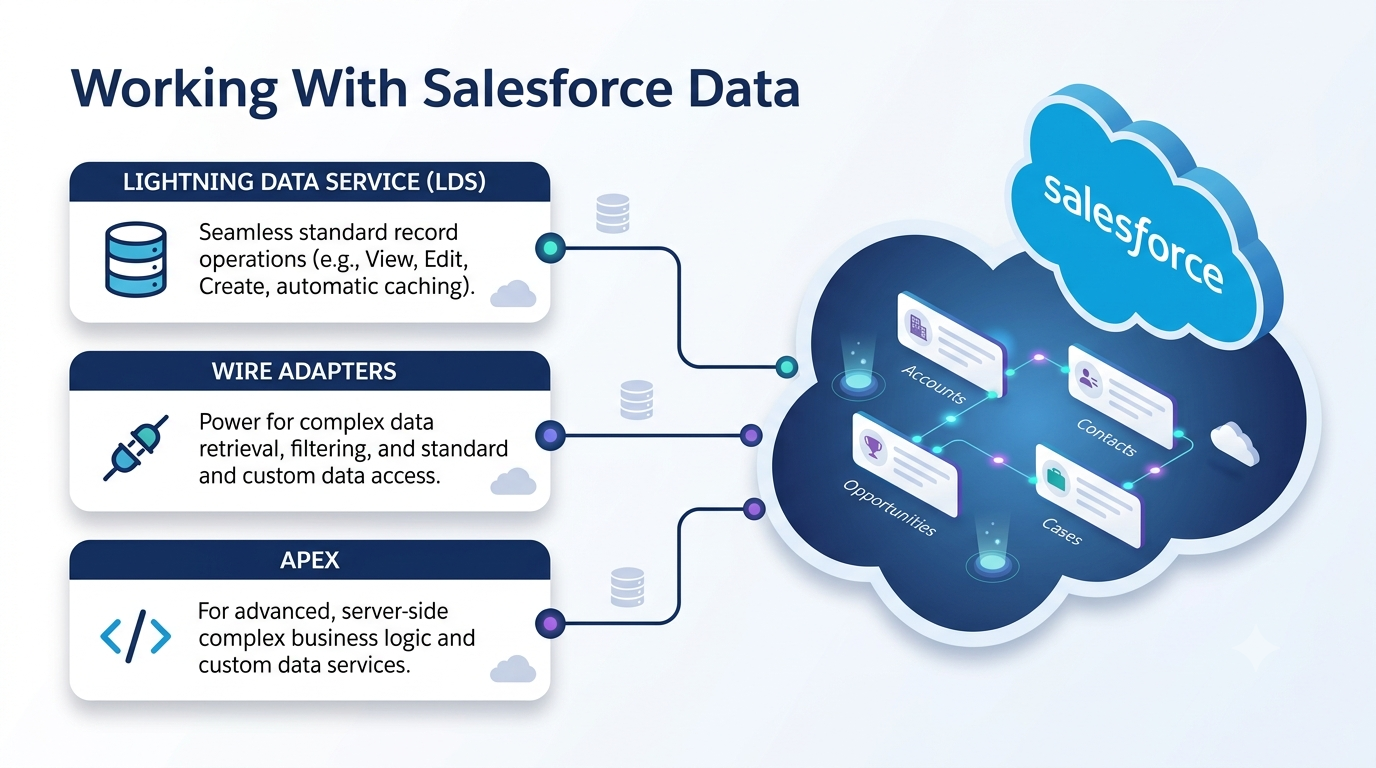
This creates an important connection between the interface and the Salesforce platform. Developers therefore need to think beyond simply displaying a field on a screen. They need to understand where the data comes from, how it is retrieved, how it can be changed, what permissions apply, and how the data should be presented to the user.
This is also where good architecture becomes important. A component should request and process only what it actually needs rather than unnecessarily loading large amounts of information. Thoughtful data handling can improve performance and make the application easier to maintain. Ultimately, the purpose of connecting LWC with Salesforce data is to turn a front-end component into something useful for a real business workflow.
6. Salesforce Lightning Design System
Technical functionality is only one part of a successful Salesforce application. The interface also needs to be intuitive and visually consistent. This is where the Salesforce Lightning Design System (SLDS) becomes important. SLDS provides design patterns, styling guidance, icons, layouts, and other resources that help developers create interfaces aligned with the Salesforce Lightning experience. Imagine a company has built several custom Salesforce components. One uses oversized buttons, another uses completely different spacing, and a third follows an unrelated color and typography scheme. Even if all three components work correctly, the overall application can feel inconsistent.
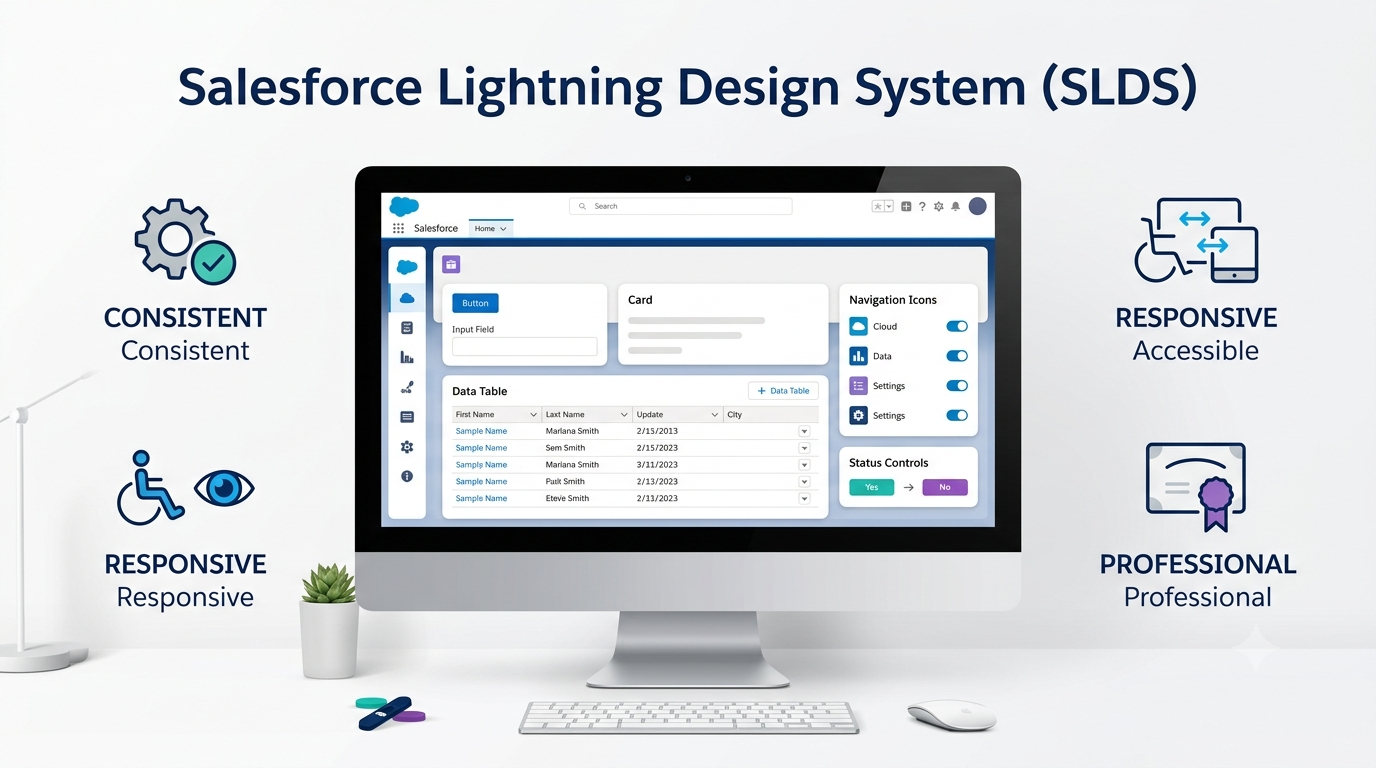
SLDS helps developers avoid this problem by providing an established design language. For example, a custom form can follow familiar Salesforce patterns for labels, inputs, spacing, and actions. A dashboard can use consistent layouts and visual hierarchy. Users can then move between standard Salesforce functionality and customized components without having to relearn how the interface works.
But SLDS is not only about appearance.
Good interface design also considers accessibility, responsiveness, readability, usability, and information hierarchy. Developers need to think about how users will interact with the component, not simply whether the component technically functions.
This is particularly important in enterprise applications because Salesforce users may spend several hours every day working inside these interfaces. A confusing custom screen can slow down an entire business process.
A strong LWC developer therefore combines programming knowledge with an understanding of user experience. The best component is not necessarily the one with the most features; it is the one that helps users complete their work clearly and efficiently.
7. Apex Integration and Business Logic
Some Salesforce requirements are too complex to handle entirely within the user interface. A component may need to retrieve information from multiple objects, perform calculations, apply custom business rules, or process information before returning a result. In these situations, Apex integration becomes an important part of LWC development.
An LWC can call an Apex method when server-side processing is required. For example, imagine a company wants a custom sales dashboard that calculates performance using several Salesforce records and applies organization-specific rules.
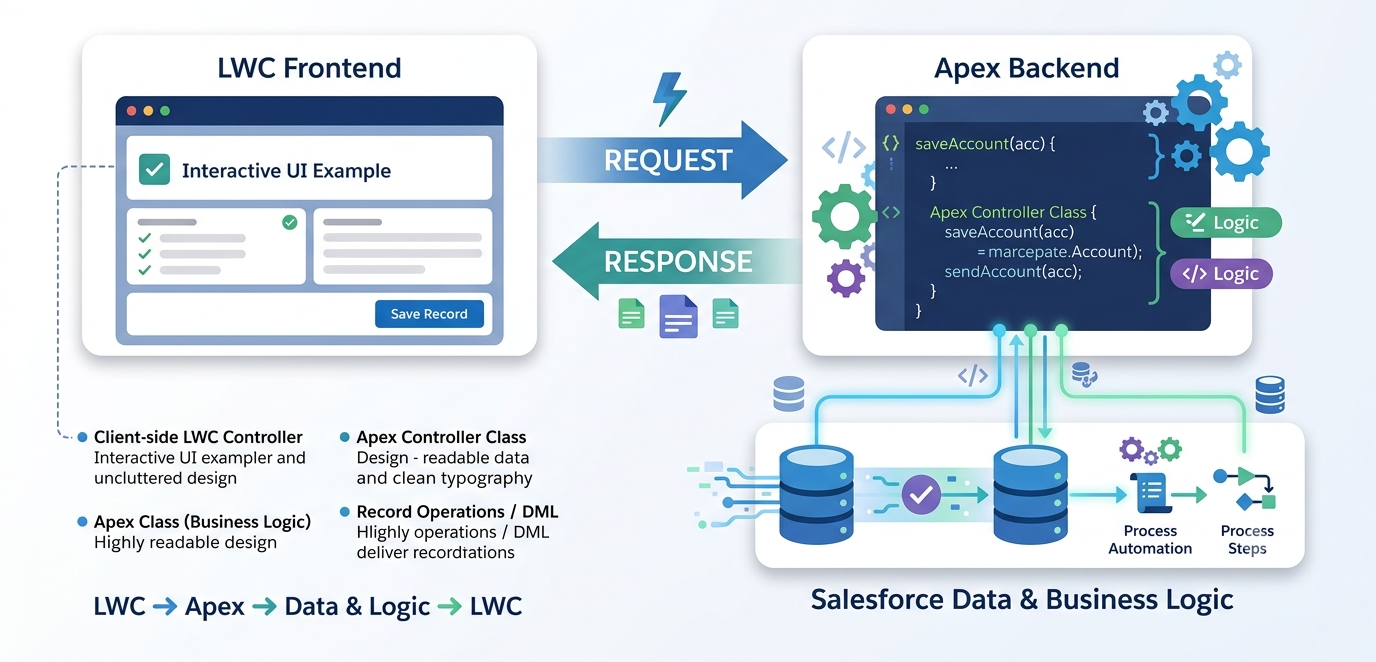
The LWC can provide the user interface, while Apex can perform the more complex server-side processing The basic relationship can be represented as:
LWC → Apex → Salesforce data/business logic → LWC
This separation allows each technology to focus on what it does best. LWC handles the user experience and client-side interaction, while Apex can handle server-side operations and more complex Salesforce business logic. The concept becomes especially important in enterprise applications where requirements often go beyond standard record retrieval.
For example, a business may want to calculate a customized sales score based on opportunity value, probability, stage, account information, and internal rules. Rather than placing all of that logic directly inside the front-end component, developers can use Apex where appropriate to process the information and return the required result. However, integration should be designed carefully. Developers need to consider security, permissions, data volume, error handling, and performance when deciding how an LWC should communicate with Apex.
Understanding this relationship helps developers move beyond creating isolated interface elements and toward building complete Salesforce applications where front-end experience and business logic work together.
Bringing the Seven Concepts Together
These seven concepts are most valuable when they are understood as parts of one development process rather than as separate technical topics. Imagine building a custom Sales Performance Dashboard for a Salesforce organization. Component-based architecture divides the dashboard into manageable sections. HTML defines the structure of each section, while JavaScript controls user interactions and component behavior. Reactive data allows the interface to respond when information changes. Events allow different components to communicate when users select records or perform actions.
Salesforce data services provide access to the records required by the dashboard, while Apex can handle complex server-side calculations or business rules. SLDS then helps bring everything together into a consistent Salesforce experience.
The result is more than a collection of individual components. It becomes a complete business tool.
This is the real value of learning LWC. Developers are not simply learning how to create buttons, forms, tables, or dashboards. They are learning how to break down business requirements into reusable components, connect those components with data, manage communication, and create an interface that users can actually work with.
For learners who want to develop these skills practically, salesforce lwc training can be valuable when it focuses on building and understanding complete solutions rather than only memorizing syntax. Hands-on development helps connect concepts such as component architecture, data handling, events, and Salesforce integration to situations developers are likely to encounter in real projects.
Why These Concepts Matter for Modern Salesforce Development
LWC is important because it brings modern web-development principles into the Salesforce ecosystem. Its emphasis on reusable components, structured interfaces, data-driven experiences, and modular development reflects the direction in which modern application development has been moving. Developers who understand LWC also gain a useful connection between Salesforce platform knowledge and front-end development. Instead of working only with prebuilt screens, they can create experiences tailored to specific business processes.
For example, a sales representative may need a fast opportunity-management interface, while a customer-service team may need a completely different case-management experience. The underlying Salesforce platform can remain the same while the user experience is customized around each workflow. A strong salesforce lwc course should therefore go beyond teaching individual features. It should help learners understand how LWC fits into Salesforce architecture, how components interact with data and business logic, and how reusable development practices can be applied to real applications.
The goal is not simply to know what LWC is. The goal is to understand when to use it, how to design with it, and how to build components that remain useful as an application grows.
From Learning LWC to Building Real Solutions
Learning LWC becomes meaningful when developers can move from a requirement to an actual working solution. A business requirement might sound simple: "We need a better way for sales representatives to view and update customer opportunities." Turning that requirement into a useful application requires several decisions. What should the user see first? Which information should be retrieved? Which parts should become reusable components? How should components communicate? Should the data come from standard Salesforce services or Apex? How should the interface behave when information is loading or unavailable?
These are development decisions, not just syntax questions.
That is why a lightning Web Components course can be particularly useful when it combines concepts with practical application. Learning how to create a component is only the first step; understanding architecture, data integration, communication, styling, and business requirements is what helps turn individual skills into professional development capability.
Final Thoughts
Lightning Web Components has changed the way Salesforce developers can approach customized user experiences. Its strength does not come from one individual feature. It comes from the way several concepts work together: components provide structure, HTML and JavaScript provide the interface and behavior, reactivity keeps the UI connected to changing data, events connect components, Salesforce services provide business information, SLDS creates consistency, and Apex handles complex server-side requirements.
Together, these capabilities provide a foundation for building Salesforce applications that are modular, interactive, reusable, and aligned with real business needs.
For developers, learning LWC is therefore not simply about adding another technology to a résumé. It is about developing the ability to take a Salesforce requirement, break it into meaningful pieces, connect those pieces to the platform, and turn them into an experience that makes work easier for the people using it. That is where LWC becomes truly valuable—not just as a framework for building Salesforce interfaces, but as a practical approach to building better Salesforce experiences.