
A Comprehensive Guide to MuleSoft, API-Led Connectivity, and Modern Application Networks
Last updated on Jul 28, 2026
Introduction: The Enterprise Connectivity Problem
Software is the driving force behind today’s organizations. As evidenced by the emergence of cloud-based Software-as-a-Service platforms, on-premise systems, IoT devices, online shopping websites, and CRM programs, a typical organization utilizes hundreds or thousands of distinct applications. Every organization uses these specialized tools to boost workflows in the various departments, from marketing and HR to logistics and finance. Bob R Fowler Jr. maintains that there is no doubt the explosion of various software solutions significantly improves the narrow areas of expertise. However, this intense development of specialized software systems poses a considerable difficulty to organizations in specializing in the area of integration.
Nevertheless, the tremendous progress made by point solutions results in the existence of a serious problem, which can be characterized as a crisis in enterprise integration. It is noteworthy that a software system cannot earn millions by working alone. For instance, a customer record in a CRM system is only able to initiate billing in an ERP system and inform a warehouse management solution about the current inventory. Thus, in order to provide seamless processes, various software solutions have to be interconnected and worked out simultaneously.
From a historical perspective, it was necessary to use coding when trying to connect separate systems together. For instance, when having to share client data from system A to system B, an engineer would write special scripts, set hard coded APi endpoints, and create special data mappers for the systems interaction. While that might be effective for one, two, or three systems, it proves to be catastrophically ineffective when it comes to large scales, which is exactly the case with entering more systems in the operation as you need to create dedicated connections for each system.
In the cases when we have dozens if not hundreds of systems working together, this architecture creates a "spaghetti architecture" or a web of dependencies, which gives rise to the following issues at the enterprise level:
Tightly connected dependencies: The systems are tightly connected with the help of the previously mentioned scripts thus it puts all systems in jeopardy in case any changes have to be made for one of them.
Maintenance burden: engineers find themselves operating in a continuous maintenance cycle as instead of working on the development they are forced to repair broken custom scripts.
Ultimate Governance & Security Problems: The point-to-point connections hide the pattern of data movement. Much effort is required to secure the sensitive data flowing through hundreds of independent unmonitored connections, causing the major security flaws and compliance issues.
Rigid Innovativeness: The process of adding a modern tool or ensuring the replacement of an old taking legacy system entails the removal of many custom-defined connections, that is why there is a way of huge organizational inertia and very slow time to market of new digital products.
As soon as organizations enter the stage of multiplying their presence, the point-to-point integration makes the IT system a vulnerable obstacle instead of an engine of progress. There is an urgent need to overcome the crisis.
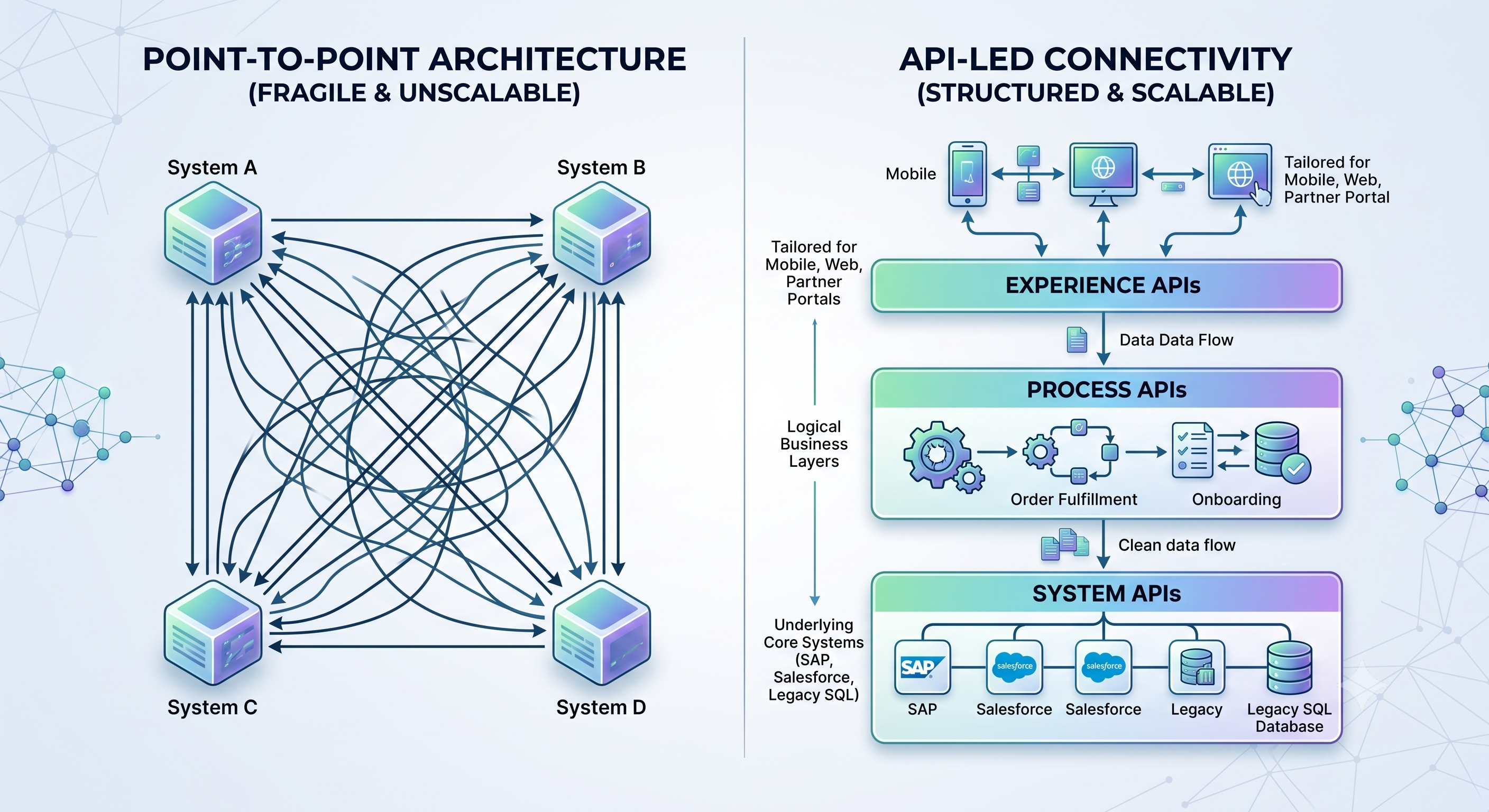
In a point-to-point situation:
Maintenance burden increases significantly: Every change or update at a single endpoint has the potential of disrupting the connected integrations.
Data silos expand: Data is stuck in various software systems.
Innovation comes to a stop: IT teams waste more than 70% of their budget and time on supporting the connection already in place instead of creating new sources of profit.
This operational drag was exactly what MuleSoft was created to eliminate in the first place. Now, being an important part of the Salesforce ecosystem, MuleSoft has transformed into an enterprise integration platform as a service (iPaaS), allowing companies worldwide to substitute the inefficient and fragile custom coding used for integrating their systems with well-structured, reusable, and secure Application Network.
What is MuleSoft? Its Origins, Vision, and Fundamentals
The Founding of MuleSoft
MuleSoft's establishment took place in 2006 and it was called MuleSource then. The word “Mule” was chosen for two reasons.
To free developers from the tiresome and repetitive task of manually performing data integration.
To demonstrate the fact that the platform is a hybrid product—just like a mule is a hybrid animal, MuleSoft was developed to unite the old systems with the newly emerging cloud systems.
MuleSoft was acquired by Salesforce in 2018 for $6.5 billion. This acquisition established MuleSoft as the backbone of Salesforce Integration Cloud, which led to widespread enterprise adoption and a spike in demand for professionals enrolled in a structured mulesoft course to learn its hybrid integration capabilities.
Core Manifestation of the Idea of Application Network
The key idea of MuleSoft’s architecture is the concept of Application Network . Instead of treating integration connections as firm connections, MuleSoft treats the digital assets of the organization—data, software core, and business operations—as nodes that can be connected through standard Application Programming Interfaces (API).
Application Network:
Applications can be added, substituted, or improved without damaging the surrounding network.
The assets are implemented with the possibility of being reused.
The security policy is applied to every node.
Architectural Model: APIs Driven Connectivity
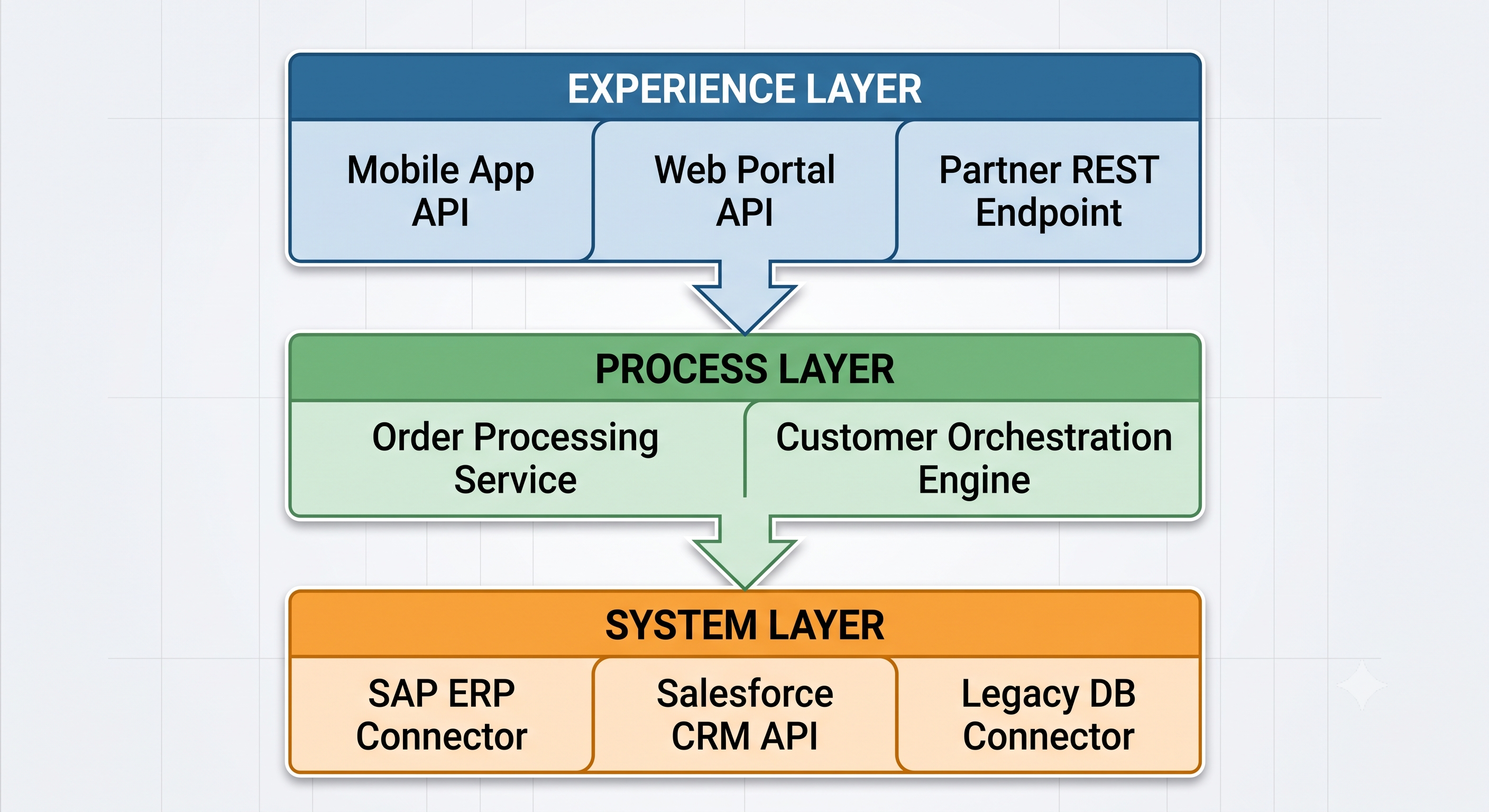
At the heart of MuleSoft is API-Led Connectivity. This model describes how APIs can be built from three particular layers of architecture that help to decouple the complexities of the back-end from the needs of the end-user.
1. APIs For System (Data Layer)
System APIs operate as interfaces for systems of record such as legacy mainframe computers, ERP systems like SAP, or SaaS platforms like Salesforce.
Objective: To mask the complexity of source systems involved and provide raw data in a format that can be understood by the businesses without requiring each and every system to understand the internal working of other systems.
Advantage: An organization can migrate from a legacy database to a cloud ERP solution by just updating the system API, leaving the upstream unrelated business processes to function properly.
2. APIs For Process (Logic Layer)
This tier is responsible for laying down the business logic after data collection from various system APIs.
Objective: To provide the organization with the business logic separated from both the technology and method of getting business data.
Example: An API for order fulfillment gets data from the inventory system, customer system, and payment gateway API, which together provide the data necessary for making a decision in that instance.
3. APIs of Experience (The Delivery Layer)
Experience APIs are responsible for processing information and making available for a certain target consumer like: a mobile application, web portal, IoT dashboard or systems of end clients.
Purpose: To deliver the necessary information needed by a user interface or consumer device with the aim of reducing payload size and enhancing network performance.
Example: For instance, a native iOS application only needs to receive three data points from a customer record (Name, Avatar URL, Recent Order Status) while a back-office desktop system needs forty-five data points. Separate Experience APIs consume the same Process API but tailor the content in accordance with their front-end requirements.
The Anypoint platform: technical deep dive
MuleSoft delivers its capabilities through its Anypoint Platform, which is a unified integration platform as a service (iPaaS).
Essential Components of the Anypoint Ecosystem
The Anypoint Design Center is the main environment for designing Integration and APIs. Developers can model and mock APIs using browser-based systems and desktop tools such as API Designer and Anypoint Studio according to RAML or OpenAPI Specification (OAS).
Execution is done by Mule Runtime Engine, which is a simple but effective engine, executing integration processes. It is capable of routing and processing the flow of events within one system.
For promoting reusability in organizations, Anypoint Exchange serves as a hub for various company's resources. Companies use Exchange for publishing and sharing their connectors, specifications, templates and code.
Governance and operational visibility is done through the Anypoint Management Center. The centralized management console allows for end-to-end management of the application network. It provides detailed API analytics, policy enforcement (e.g. rate limiting and OAuth validation), SLA monitoring and role-based access management.
DataWeave, MuleSoft’s native data transformation engine, powers the platform’s data manipulation capabilities. DataWeave is a powerful functional programming language that lets you map, filter, and transform complex payload formats like JSON, XML, CSV, and Java objects in real time.
Deep Dive: DataWeave Transformation Engine
One of the biggest technical differentiators of MuleSoft is DataWeave, a functional programming language designed for data transformation. In the past, integration platforms required you to write complex Java code or chain together fragile XML transformations to get data from one application to another. DataWeave completely abstracts away format handling.
DataWeave considers JSON, XML, CSV, Java Objects, Fixed-Width files and YAML as equivalent data structures. "Developers define output structures with simple expressions, and DataWeave takes care of stream processing and memory buffer allocation behind the scenes.
Code Example: Converting Legacy XML to Modern JSON
Imagine a legacy enterprise system that delivers customer data in the XML format with nested elements and attributes:
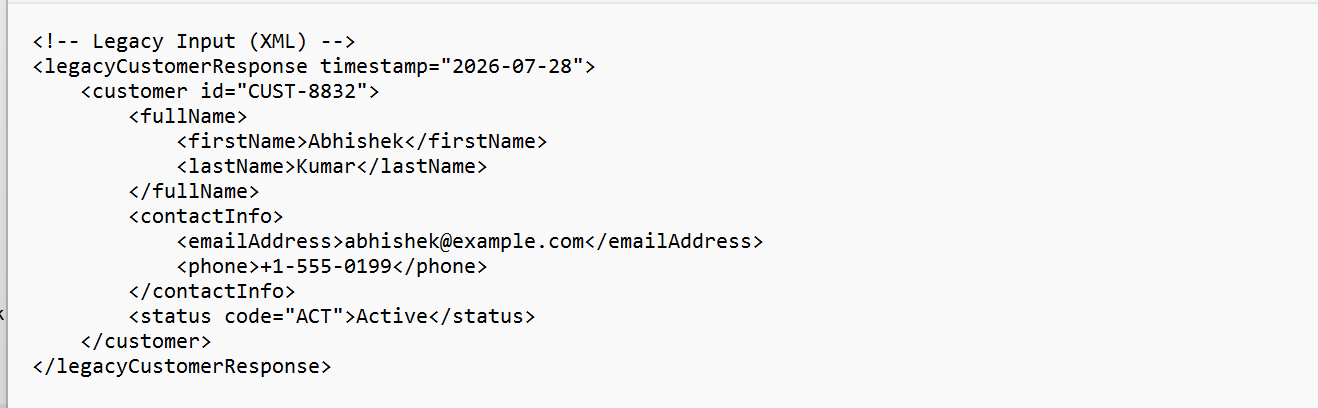
Using DataWeave, a developer can transform this XML payload into a standardized, flat JSON object, ready for a modern API endpoint:
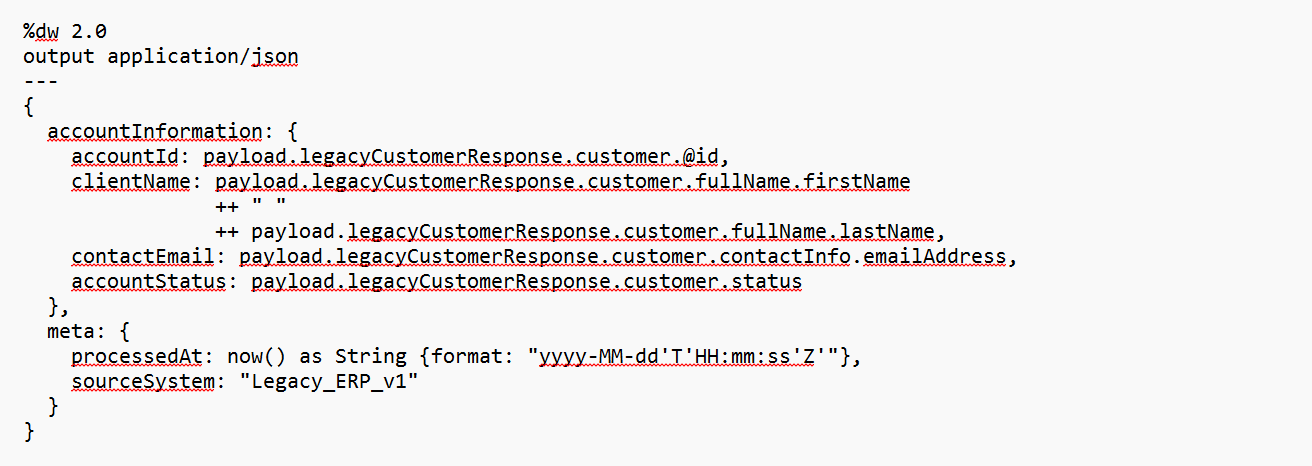
Output Result:
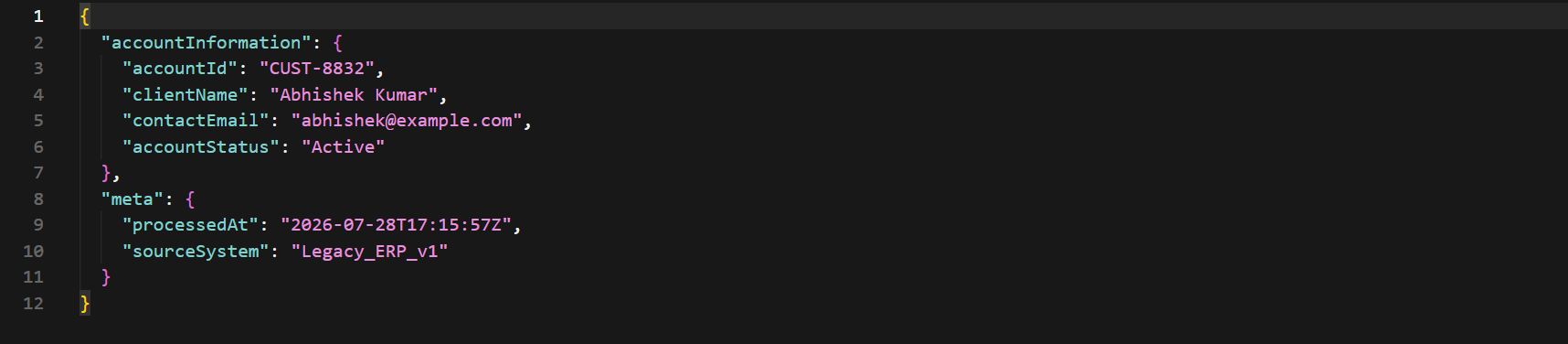
DataWeave performs these transformations in a streaming fashion so that large XML or JSON files are not loaded entirely into heap memory to avoid OutOfMemory errors on high-throughput flows.
Deployment Architectures: Flexibility to Any EnvironmentMuleSoft offers flexible deployment models to meet a range of compliance, latency and operational needs.
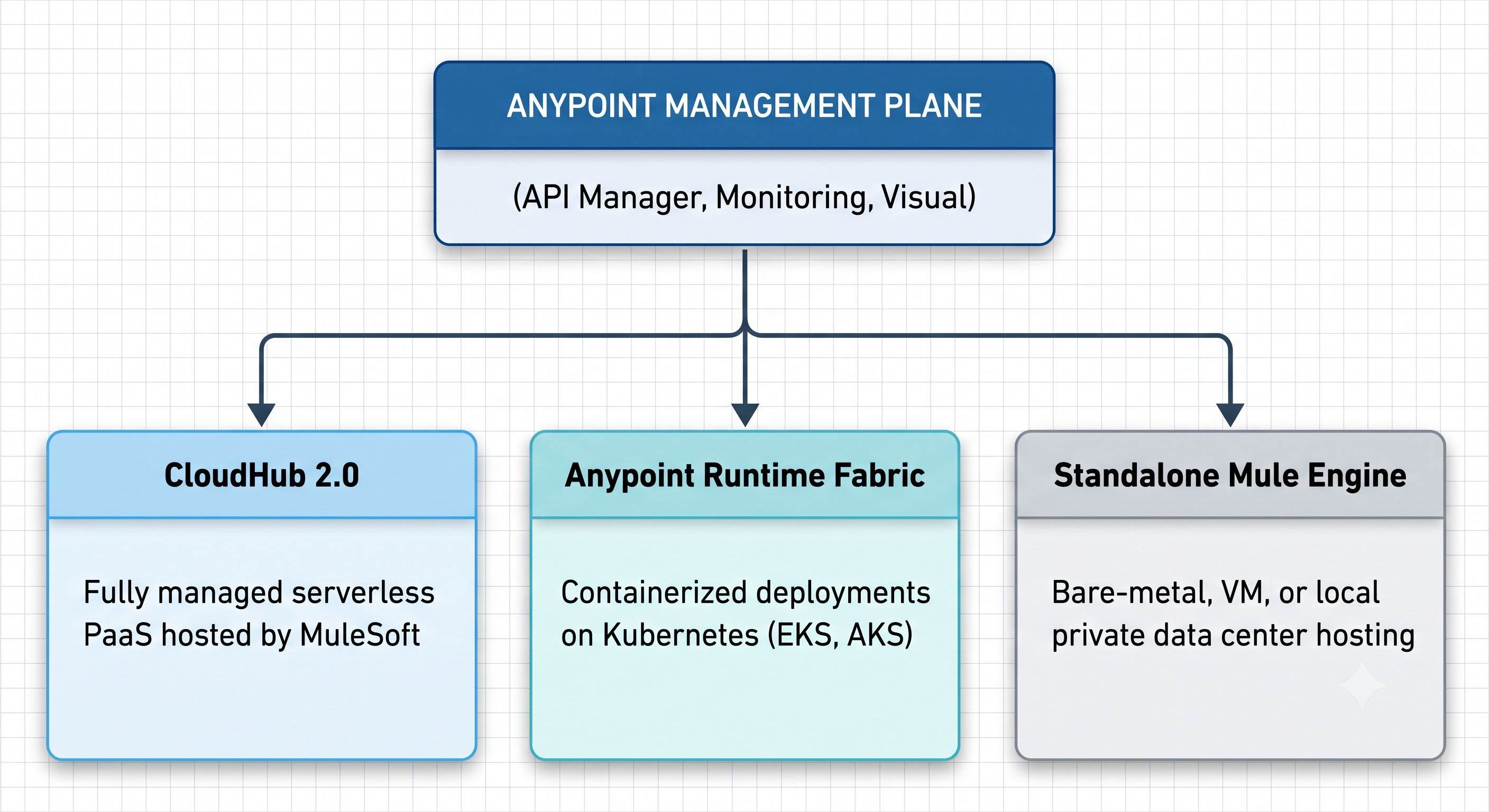
1. CloudHub 2.0 (Fully Managed iPaaS)
A fully managed, serverless, containerized platform for Mule applications. CloudHub is built on Kubernetes and automatically takes care of OS provisioning, infrastructure scaling, load balancing, high availability and security patching.
2. Anypoint Runtime Fabric (RTF)
Anypoint Runtime Fabric enables enterprise customers to deploy containerized Mule applications, either on their own managed Kubernetes clusters (on Amazon EKS, Azure AKS, Google GKE, or on-premises bare metal). This provides cloud-like isolation while meeting strict data residency rules.
3. Customer-Hosted / Standalone Runtime
Organizations with legacy infrastructure can deploy bare-metal or virtual machine installations of the Mule Runtime Engine within internal corporate data centers, managed entirely by the internal infrastructure teams.
Mule Enterprise Use Cases and Real World Impact
Soft runs across nearly every major industry vertical, powering enterprise-grade automation and business velocity.
1. Financial Services and Banking Problem: The core account ledger systems in most retail banks today are built using 40-year-old mainframe computers running COBOL code. Banks could create new-age mobile banking apps and PSD2-compliant open banking APIs by wrapping mainframe endpoints with System APIs and coordinating payments through Process APIs without changing their existing core banking systems.
2. Retail and E-commerce Challenge: Unified Omnichannel Fulfillment strategy is the inventory coordination between brick-and-mortar stores, warehouses, 3PL partners, and e-commerce websites such as Salesforce Commerce Cloud.MuleSoft enables real-time inventory synchronization. For example, an online purchase can trigger an event from the Experience API to reserve inventory and send the order information to the warehouse management system.
3. Medical and patient care: Problem Patient information exists in multiple formats across clinical networks of electronic health records systems (e.g., Epic and Cerner).MuleSoft converts HL7 and FHIR healthcare standards into REST APIs.
Strategic Benefits and Modern Innovations
Summary of Benefits
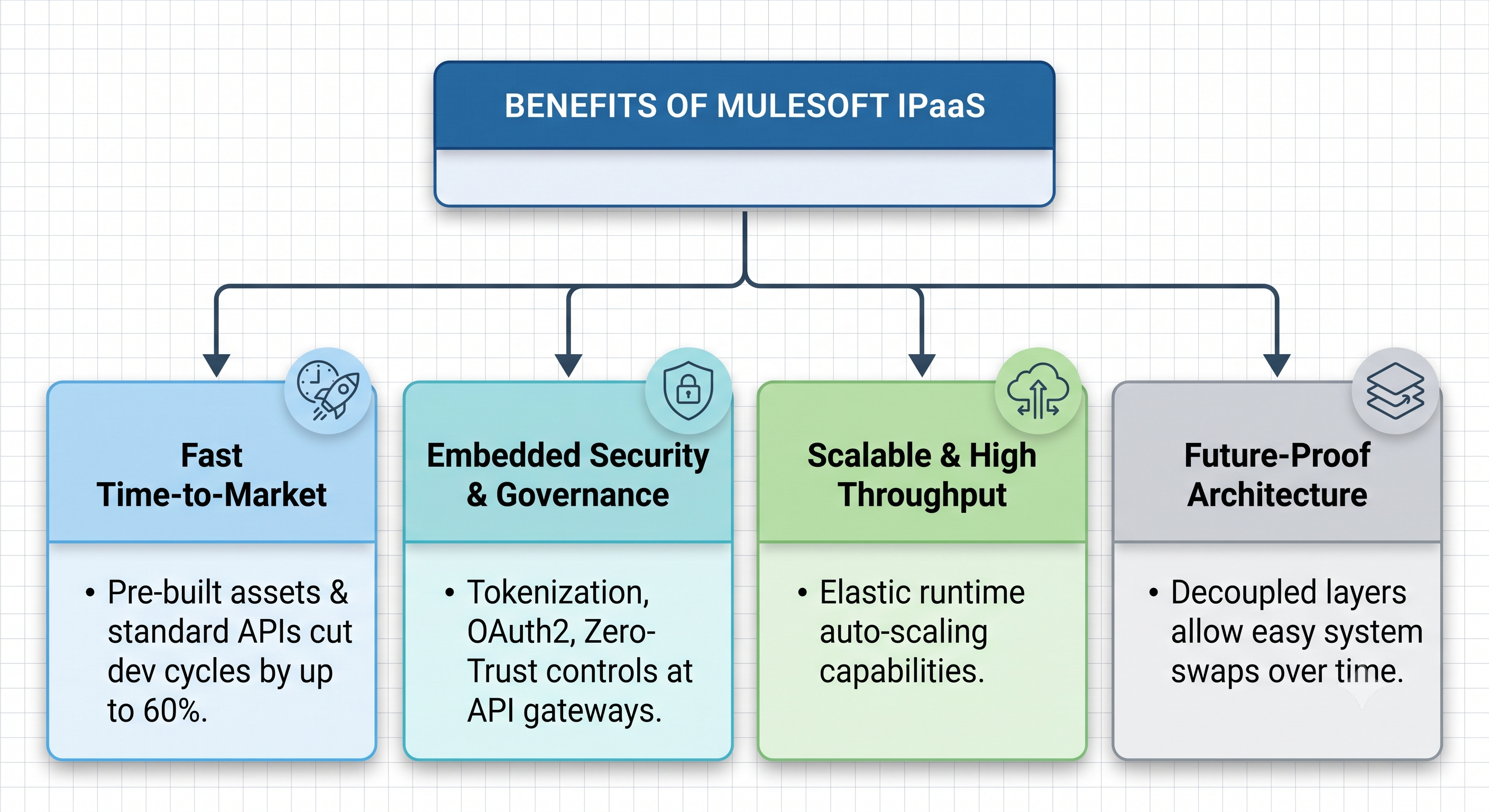
Contemporary Innovations: AI, Automation, and Agentic Workflows
MuleSoft has entered the enterprise AI and automation engine space.
MuleSoft Composer & Flow: Low-code/no-code tools that enable business analysts and operations staff to create automations without code, using intuitive drag-and-drop interfaces.
Universal API Management (UAPIM): A single management plane that allows you to control, protect, and monitor your APIs no matter where they are developed or deployed (such as APIs developed in Node.js, Python or AWS API Gateway).
MuleSoft Agent Fabric and AI Integrations: MuleSoft is the secure connectivity plane behind AI agents like Salesforce Agentforce. In order for AI models to make autonomous decisions across enterprise tools they need access to real-time, rich context data. MuleSoft Core Integrations are exposed as structured AI actions, allowing AI agents to query ERPs, perform refund workflows, or modify supply chain records securely and within compliance parameters.
Challenges and Considerations
To address this skills gap, many engineers prefer flexible mulesoft online training courses that include real-world labs. The courses include DataWeave scripting, deployment on CloudHub 2.0.
Licensing and Total Cost of Ownership: Licensing costs are usually charged based on the number of vCores used or amount of data exchanged through the MuleSoft integration application; hence licensing cost is an expensive affair. This is best suited for mid-size and large companies.
Learning Curve and Specialization: Study focused on DataWeave, Mule runtime design pattern. To master these concepts typically hands-on mulesoft training is needed. This helps developers and integration architects to navigate complex enterprise deployments efficiently.
Over-Engineering Risk: Building a full 3-tier API-led topology for small applications with fewer than 5-10 endpoints could be an overkill, as there are simple and direct options to integrate instead.
Conclusion: Speeding up Digital Transformation with Application Networks
Today’s fragmented digital landscape requires connectivity for the enterprise to succeed. Modern organizations run on hundreds of cloud applications, legacy databases and specialized SaaS tools. Disconnected, these applications create operational friction, slow time-to-market for new products, and fragment the end-user experience. Traditional point-to-point integrations, where developers write custom code to directly connect System A to System B, only make the problem worse. This results in a tangled, brittle “spaghetti architecture” that needs constant maintenance and breaks every time an underlying endpoint changes.
This issue has been addressed by MuleSoft through the evolution of the enterprise integration model from the use of fragile custom coding to the development of API-led Application Networks. This approach has the introduction of a layered API architecture separating the system dependencies as follows:
System APIs These APIs are built on top of system of record systems such as ERPs, CRMs and legacy mainframe applications. They hide the complexity of the backend and provide access to raw data in a standard format, without revealing any of the underlying system architectures.
Process APIs : This is the layer of business logic. They integrate data feeds from different System APIs, aggregate them, and transform them to perform certain operations like order fulfillment, customer onboarding or inventory reconciliation.
Experience APIs: These are APIs that transform the data feeds to cater to the requirements of the consumer channels such as mobile app, website, IoT dashboard or third party partner portal.
The modularity of connectivity gives MuleSoft the ability to turn every integration into a plug-and-play digital asset. Rather than having to reinvent the wheel for every new digital initiative, development teams can discover and consume existing APIs in a central marketplace. When an organization upgrades an underlying ERP or moves a database to the cloud, only the respective System API changes. The business logic and consumer applications remain completely unaffected.
Ultimately, the API-led strategy provides the technical foundation needed to enable scalable digital transformation and real-time analytics. Investing in comprehensive mule software training is critical for organizations wanting to upskill their engineering teams so that IT can be transformed into an engine for rapid innovation, not a cost center.