
A Day in the Life of a ServiceNow Administrator: What Exactly Do They Do?
Last updated on Sep 26, 2026

Whenever someone hears the title ServiceNow Administrator, they might imagine the person spending most of their day doing ticket maintenance or adjusting a few parameters in a ServiceNow instance. The truth is that the position requires much more than simply performing regular adjustments. They ensure that the employees can submit requests, the support team can manage incidents, managers can approve access, and much more is happening seamlessly in the background.
Most of what an administrator does, the end-user will never know about.
Any time someone submits an access request and gets approval without contacting the IT department, there’s most likely some configuration that made it possible. Every time a new employee gets access to the required applications and data faster than one would expect, there’s likely a set of processes that have been tied together. And whenever the support team can view the history of an incident effortlessly, there’s always been some configuration to make it happen.
That’s where the ServiceNow Administrator comes in handy.
They are the professionals who understand how the ServiceNow platform works and can use that knowledge to support real business requirements. A ServiceNow Admin needs to understand what end-users and other stakeholders need, how they use the platform, and what they expect from it in their daily work. Their responsibilities can range from small tasks, such as updating forms or adjusting approval rules, to more complex work involving automation, access controls, data management, troubleshooting, and platform configuration. For anyone preparing through a servicenow administrator course, developing this combination of technical knowledge and practical business understanding is important because the role requires administrators to handle different types of tasks while keeping the platform reliable and easy to use. So, what does a ServiceNow administrator do most of the day? Let’s take a peek behind the curtains.
The Administrator’s Day Usually Begins Before the First Ticket Comes In
The administrator’s work rarely consists of simply waiting for someone to call for assistance. First things first – the administrator spends a portion of their morning being certain that everything works correctly. Sure, there might be some tickets to investigate, alerts to resolve, or approvals to fix, but a bigger priority is ensuring that there are no issues in the first place. Therefore, the morning of an administrator may consist of walking through some of their current requests, investigating any reported incidents related to the ServiceNow platform, reviewing failed processes, or simply checking if the configurations from the previous days are still working correctly.
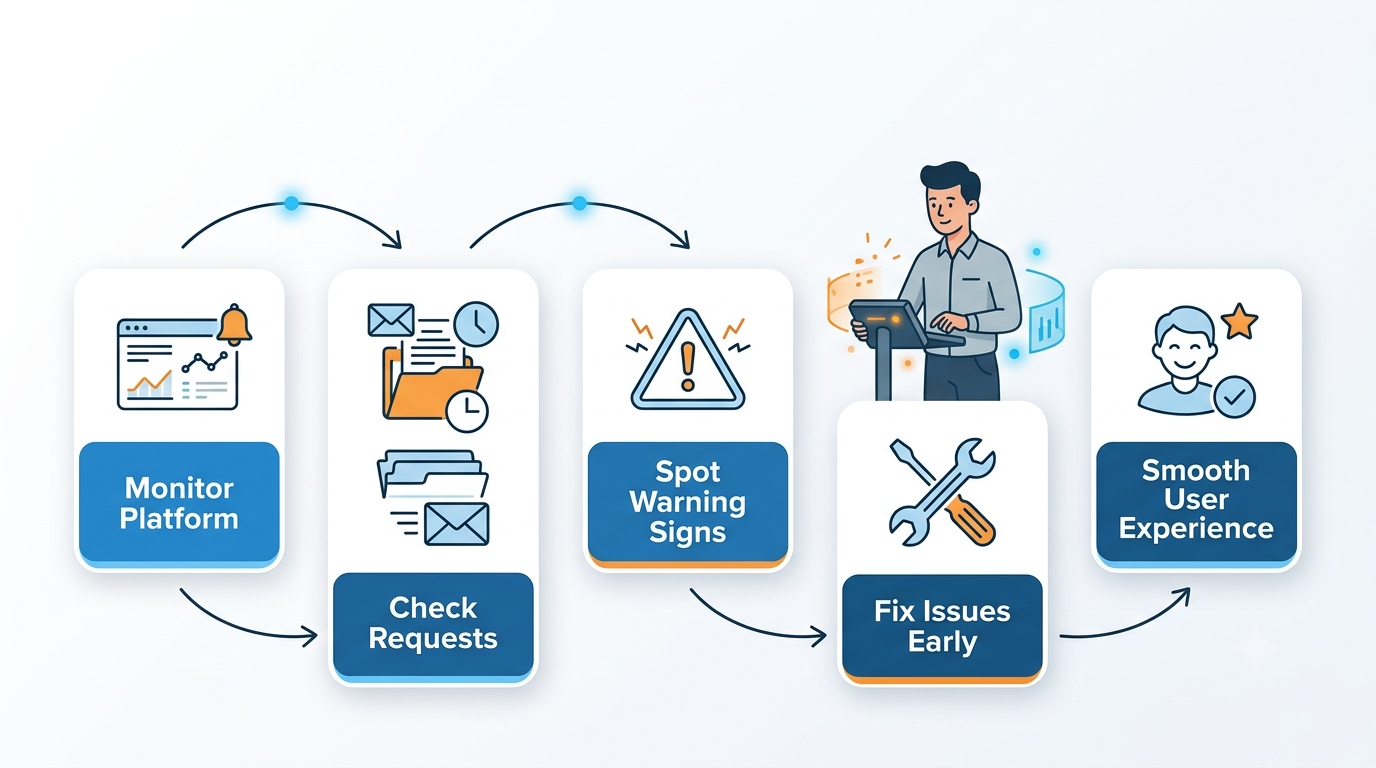
For example, if an email notification has suddenly stopped working for a particular request type, it might confuse the users into thinking that their request hasn’t been received, even though it actually has. The above-mentioned issue could be anywhere in the process, and the administrator’s job is to trace it and fix the problem. That’s why they must have an intimate knowledge of how various elements of the ServiceNow platform interact with each other.
So, a morning of an administrator can be highly variable and include several different tasks. Sometimes they deal with an individual who has a concern and don’t know how to proceed. Other times, they review a process to determine if an automation needs to be added for it to be more efficient. And sometimes, they simply update a form as requested by another department. All of these tasks are essential, but they’re different in terms of urgency and importance, so administrators often need to multi-task.
Keeping Users, Groups, and Roles in Check
User administration is one of the most crucial areas of experience for a ServiceNow administrator, as it often includes some of the most straightforward but vital operations at the same time. There are employees who enter the organization and leave, people that switch teams, have new responsibilities, or become managers. Each of these transitions affects their access to information in ServiceNow, and the administrator needs to keep track of all of these changes.
They spend some time of their day adding or updating users, groups, roles, and other elements of the access control system. While it may seem simple, there are many pitfalls that can lead to much bigger issues if an administrator doesn’t do their job correctly. For example, an employee that was transferred from one team to another needs to be added to a new group and removed from the previous one. Failure to do so can result in an employee obtaining information that they’re not entitled to or, on the contrary, being unable to get the data that they need.
That’s why administrator needs to understand what users, groups, roles, and their interactions stand for. They should be able to see the bigger picture and adjust the configuration accordingly, and not give everyone a full administrative access to the system. The same principles apply when new teams are formed within an organization, and the administrator needs to configure them within ServiceNow. They have to make sure that everyone gets access to the data that they need, that everyone is organized in roles and groups that make the system easier to manage, and that the configuration is consistent with the rest of the ServiceNow instance.
All of these tasks are important in their own way, but they also require a different set of skills. For someone studying for a career as a ServiceNow administrator, learning the basics of administration is as important as developing a proper understanding of how various features and functions will be used.
Every Simple Request Often Has a More Complex Explanation
Requesting access to a certain application or data that requires special privileges can be a routine operation for an employee. One person fills out the request, another reviews it and approves it, IT takes some specific action, and another department gives the necessary access, and the request is complete. What most end-users fail to realize is that there is a lot more to such requests than it seems, and that’s where the ServiceNow Administrator comes in. Administrators configure and maintain request types, approval rules, catalog items, flows, notifications, conditions, and many other features of the system. They should be able to walk through a single request and explain its purposes, process, and the logic behind it. It’s essential for administrators to have a comprehensive understanding of what they want their automated process to accomplish since they will need to determine how it will perform.
For example, a certain department may request a new approval type. An administrator needs to first understand the nature of this request and identify the relevant actors. It’s necessary to determine who submits the request, who approves it, if there are any variations for different departments, who should reject the request type, and what actors should take over if the approval isn’t granted or completed.
Having the abovementioned information is often the first step toward configuring a request or approval type in ServiceNow. If the administrator knows how they want this process to operate, they will be able to select the right conditions, actions, and other attributes. At the end of the day, an administrator should be able to transform the requirements of the business stakeholders into something that makes sense within ServiceNow without complicating the process too much. That’s why administrators often work closely with various teams in the company and communicate with them on a regular basis. The business side of administration often requires more verbal communication, as opposed to the technical side of the work, where written communication is more prevalent.
This is also why technical skills should go hand-in-hand with business skills in ServiceNow administration. It’s not uncommon for administrators to be confused when they hear too-technical explanations from business stakeholders. The best thing to do is ask clarifying questions to determine the requirements of their processes. The answer to these questions will often guide the rest of the technical design.
Fixing Problems Without Shooting Yourself in the Foot
When a problem with ServiceNow occurs, it can take a lot of time and effort to fix it. A single misconfiguration can lead to errors in multiple places. That’s why the administrator must go through a process of elimination in order to identify the root cause of the problem. Once they locate the source, it usually takes a few more steps to resolve it.
First, communication with the affected user or administrator is vital to identify the details of this issue. The first step in troubleshooting is to identify the problem, which will often take the user explaining what they wanted to do and what exactly went wrong. After that, an administrator will review the relevant processes and configuration to see what could’ve gone wrong.
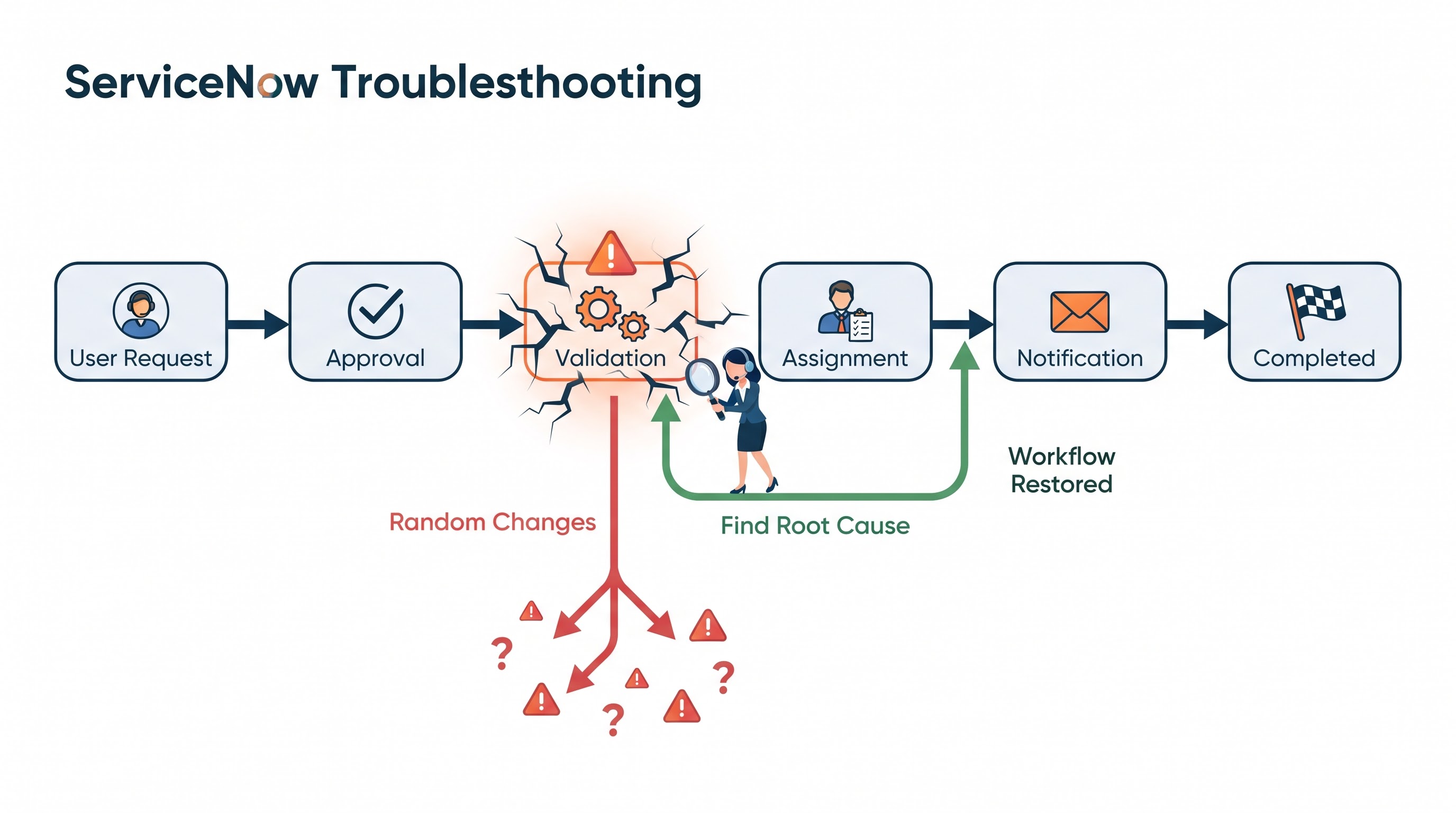
For example, if a field has disappeared for a particular user, it can be a problem with the form this person was using, their user roles, the conditions of the fields, and any other relevant attributes. If an approval wasn’t completed because it went to the wrong manager, the administrator needs to check if there’s anything wrong with the department, manager, group, or any other attributes. They should always follow the process flow in order to troubleshoot an issue, starting from the beginning of an incident and gradually moving to its end.
This is especially true for processes that were established a long ago and most of the current configuration is unclear to the administrator. There isn’t a single configuration item that always indicates the cause of the problem. As the person troubleshooting an error, the administrator must be able to follow an existing process flow or analyze a new one to determine if any misconfigurations are present.
Troubleshooting can be extremely frustrating, especially when a minor issue is causing much more serious problems. That’s why administrators need to be careful with every change they make, as there’s often a chain of events that needs to be reviewed once a configuration error is resolved. As the ServiceNow administrator becomes more productive and efficient, the number of problems they encounter will increase. That’s partially due to the fact that the ServiceNow instance itself grows and requires more and more configuration. Every configuration change that an administrator makes can be connected to some other functions, which is also the reason why they should only make these changes in a controlled environment in the first place.
To summarize, the better an administrator knows ServiceNow at both a technical and business level — the less likely it will be for them to make unnecessary or even more serious changes in an attempt to fix an error.
Where Automation Can Help Administrators Save Time and Effort
One of the biggest advantages of using ServiceNow is an array of automated functions that help eliminate unnecessary manual tasks. When it comes to ServiceNow administration, automation can help eliminate a lot of repetitive and tedious operations that an administrator would otherwise perform manually. At the same time, an administrator needs to have a proper understanding of what they want their automated process to accomplish.
Automated processes are often much better at completing repetitive tasks than humans. That’s why it’s essential for an administrator to invest enough time in determining what processes should be automated and how they should be configured. A single click of a button or a set of automated approvals can save a lot of time and effort.
For example, every new employee needs to have access to the same set of applications. Instead of an administrator or IT support team having to configure an access request for every single user, a process in ServiceNow can be configured to complete this operation automatically.
This does not mean that every process should be automated, because some tasks still require manual approval, review, or human intervention. The real goal is to identify which ServiceNow processes take the most time and effort and determine where automation can make the work easier. For someone taking a servicenow admin course, understanding this balance is important because effective administration is not about automating everything; it is about knowing when automation adds value. An administrator should ask whether a process can be made faster or more efficient without creating confusion or disrupting the way end-users currently work.
It’s always worth asking the questions like “Is there a pattern?”, “Does this operation repeat itself?”, “Can this be standardized?” and “Are there any unnecessary steps?” in order to determine if automation can improve a process in ServiceNow. The more understanding of the business side of ServiceNow administration that an administrator has, the better they will be at determining where automation can be used. As in many other areas of ServiceNow administration, a comprehensive understanding of business logic often plays a bigger role than a technical side of this operation.
Cleaning Up the Data in ServiceNow Can Be More Important Than It Seems
Data is arguably one of the most important aspects of any ServiceNow instance. When a ServiceNow administrator leaves this data untouched, it can affect any process that uses this information and cause serious issues. That’s why it is absolutely essential for an administrator to perform routine data maintenance and ensure that there are no problems that might affect the process flow.
For example, users who submit a catalog request often need to select a manager that will approve this request. If this field is populated incorrectly, such an approval will be sent to the wrong person. At first, it may seem like an easy task to fix a misconfigured manager field, but it’s worth noting that almost any piece of information can affect the operation of the ServiceNow instance.
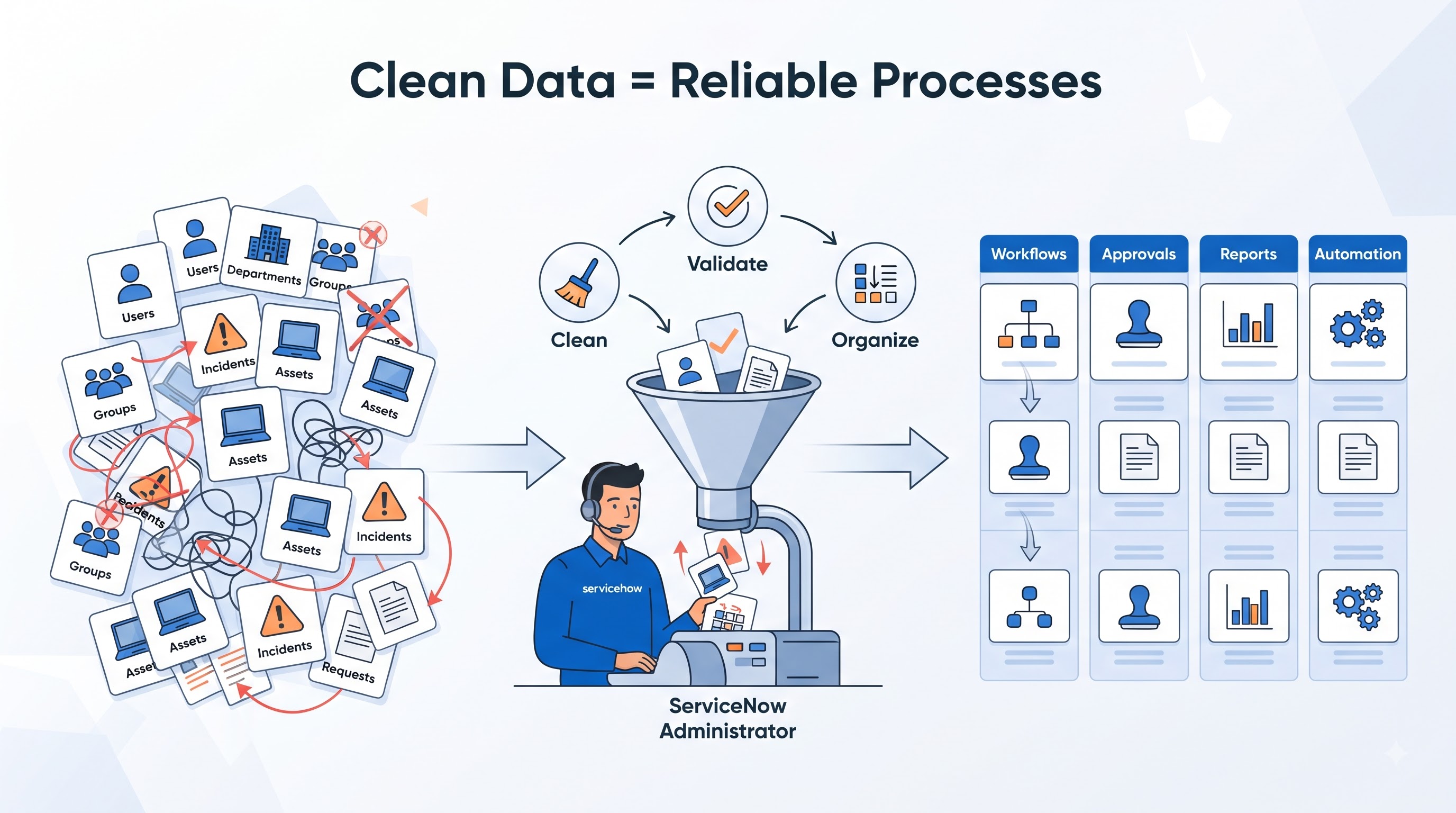
This includes manager field values, departments, groups, locations, and any other data that is used in ServiceNow. This is why it is often a good idea for the administrator to work with other teams to clean up erroneous data, correct incorrect records, and add any missing information. Data maintenance is especially important when importing information into ServiceNow. When incorrect information is imported from another source, this data can overwrite existing information in ServiceNow, affecting any existing processes. That’s why it is essential for an administrator to understand how incoming data can be mapped to existing information.
These are just a few examples of data maintenance tasks that a ServiceNow administrator should be aware of. It is always worth learning a comprehensive set of best practices for data maintenance, as it is one of the most important things that a ServiceNow administrator can do to improve the performance of their ServiceNow instance.
Administrator Often Acts as an Intermediary Between Various Teams
Administration in ServiceNow is rarely done in isolation, which means that an administrator often has to communicate with other teams within an organization. They work closely with IT and support teams on a regular basis, determine the requirements of business teams and managers, and may occasionally communicate with developers, human resources, and even regular end-users.
This is why it is essential for the ServiceNow administrator to understand the requirements of all teams and find the right solution that everyone will be satisfied with. Sometimes, solving one issue requires an administrator to make configuration changes that will affect other teams. That’s why an administrator must understand the requirements of all parties and ensure that everybody can operate the ServiceNow instance without any serious problems.
As mentioned above, communication with various groups within the organization is one of the most important tasks of a ServiceNow administrator. It requires them to have excellent verbal communication skills and the ability to explain complex technical details to people who have little or no understanding of ServiceNow. At the same time, administrators need to keep in mind that any changes that they make should be necessary and sufficient to address an issue without adversely affecting the work of other teams. This is especially true for technical communication, where excessive changes can require additional explanations or training for stakeholders that don’t have a technical background. A ServiceNow administrator must also be careful when discussing technical requirements with business teams. Sometimes, they assume that an application or a feature is needed when, in fact, a minor change to an existing process is a much better solution. Communication with technical teams is also vital, as many administrators don’t have a comprehensive understanding of what technical requirements can be applied to solve a particular issue.
That’s why asking clarifying questions is often one of the most important things that a ServiceNow administrator can do. Instead of asking “What feature do you want me to configure?”, a good administrator will be able to ask “What problem do you want me to solve?”. This approach is often much better, as it gives a clear idea of what needs to be done without getting stuck on irrelevant details.
Documentation Isn’t Something That Can or Should Be Ignored
A ServiceNow administrator will often have to spend a significant amount of time making various changes to the instance. If they don’t maintain proper documentation, it will become very difficult for them (or another administrator) to determine what exactly was done and why. It will also take a significant amount of time to review an undocumented set of changes and find out what they were intended for.
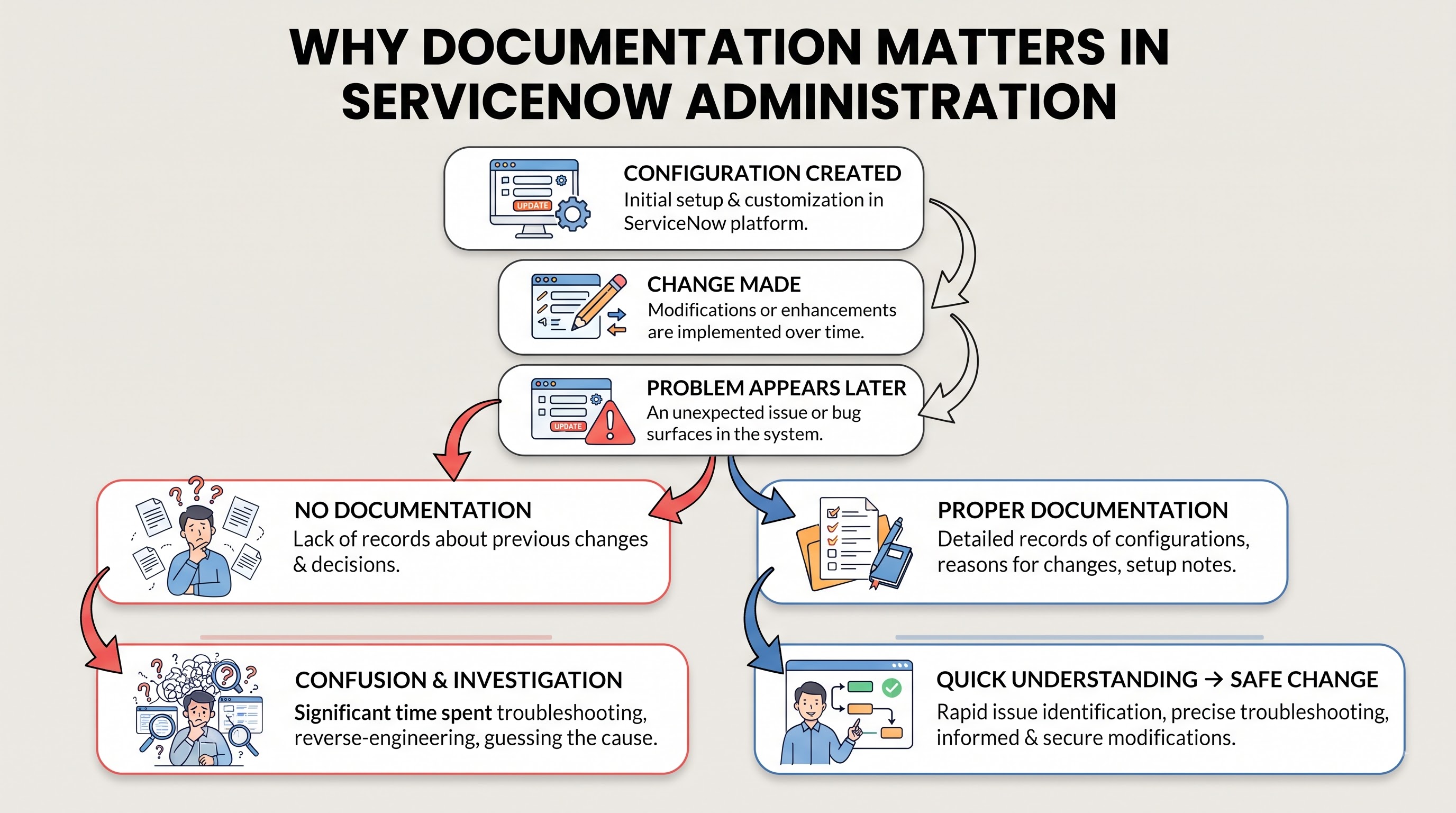
Documentation should be used for all major changes that an administrator makes. It is vital to indicate what these changes were intended for, who requested them, what they might affect, and what other alterations might be connected to them. That way, an administrator can refer back to this document and see if the change was completed successfully. It can also be extremely useful for troubleshooting, especially if an administrator has previously documented the solution for a similar problem. Once they identify the cause of an error, it might be worth looking back at similar issues that were previously reported and see if any of the previously-documented solutions can resolve it in the same way.
Documentation isn’t that hard to maintain, though – it simply requires a few words to be written down for a specific change that allows to understand what this change is intended for. In many ways, documentation serves as a practical guide for an administrator and, eventually, another ServiceNow administrator that will take over their responsibilities. It is essential for people who have limited experience to be able to understand the purpose of specific changes and determine their impact on the ServiceNow instance.
Learning Should be a Continuous Process for Anyone Interested in ServiceNow Administration
As an administrator becomes more and more experienced, they will start to see the bigger picture rather than focus on the specifics. It isn’t enough to simply learn what every feature in ServiceNow can be used for – an administrator needs to understand the purpose of these functions and how they can be applied to solve specific issues.
A thorough understanding of ServiceNow will allow an administrator to determine the most optimal way to address a particular request or process. However, it is also important to acknowledge that their knowledge of ServiceNow will continue to grow and develop, which means that they should always be open to learning new things about the ServiceNow platform. It is rare for administrators to have all the answers, at least at the beginning of their careers.
Learning the technical side of ServiceNow administration goes hand-in-hand with building a comprehensive understanding of its business side. This is especially true for those administrators who want to be able to determine the requirements of an end-user. If a new administrator doesn’t ask enough questions, they will find themselves spending a lot of time trying to figure out what exactly the client needs. This is also true for situations where an end-user isn’t technical enough to explain what they want in a technical support ticket. It can be frustrating for a new administrator to hear vague and general complaints about ServiceNow or see their end-users struggling to complete basic requests.
Reading about ServiceNow administration is a good way to begin the learning process, but it shouldn’t stop there. If an administrator wants to become truly proficient, they should invest time and effort into configuration and troubleshooting tasks. It is much easier to understand how various functions of ServiceNow work when an administrator sees and studies them in practice. A good way to learn ServiceNow administration is to take an online course that provides a comprehensive overview of the ServiceNow platform. This way, administrators won’t spend too much time learning irrelevant topics or miss out on the most important topics that will help them in their careers.
Regardless of this, it is essential for a beginner administrator to practice as much as they can. It will take time and effort to learn the basic functions of ServiceNow, such as creating users, groups, and roles, configuring forms and catalog requests, approvals, reporting, and much more. However, all of these skills will become second nature for an administrator, which will enable them to develop an even deeper understanding of more complex aspects of ServiceNow administration.
Conclusion
The daily tasks of a ServiceNow admin professional do not only revolve around tickets and configurations. Instead, they focus on users, access control, super processes, troubleshooting, optimization, data organization, testing, documentation, and automation opportunities. It can be seen that some daily tasks require a high level of technical expertise, while others involve communication and coordination. In addition, many tasks combine these competencies. The role of a ServiceNow administrator becomes even more critical when the organization grows and processes become more complex and numerous. The software’s complexity necessitates professionals who could organize and manage services efficiently, thus increasing the demand for such specialists.
The main advice for aspiring ServiceNow admins is to learn the platform deeply rather than only understanding its basic features. It helps to study how different functionalities work, learn how to configure them, and most importantly, practice those skills through real examples. A servicenow administrator certification can also provide a structured way to build this knowledge and understand the platform more systematically. However, practical experience remains important because admins need to understand not only how a feature works, but also why a particular process was designed that way and how it fits into the company’s operations. Finally, admins should remember that they often act as the “glue” connecting different parts of the ServiceNow environment. They need to understand how their configurations can affect different processes, teams, and users across the organization.
This way, the daily tasks of a ServiceNow administrator contribute to the efficient functioning of companies in multiple ways. While some seem mundane, they are vital to keep the ServiceNow system operating correctly. For example, someone’s diligent work enables the correct routing of requests, approvals, notifications, and IT-process-related elements.