
Agentforce in Practice: How Autonomous AI Agents Are Replacing Standard Chatbots in Service Cloud
Last updated on Sep 16, 2026

More than ten years have had the field of customer service move forward despite the existing contradiction. It started with the need for companies for maximum operational efficiency and expansion on one side which collided with the needs and requirements of a simple consumer who wants to have his/her issue dealt with in the quickest and easiest way.
For many years, companies have used rule-based chatbots to resolve this conflict. They addressed this issue financially by buying all kinds of instruments including decision trees, scripted dialogues, and keyword-matching engines. The result was that the chatbot icon at the bottom of the support page became a clear sign of avoidance and not a savior.
In this way, the invention of Salesforce Agentforce is the end of this approach. Agentforce has shifted the approach to customer service from the use of a scripted conversation to the idea of the use of goal-oriented autonomous software agents.
This transition is crucial within Salesforce Service Cloud. Unlike traditional chatbots, autonomous agents do not just repeat knowledge articles or engage users in rigid question-and-answer formats. They understand the context of situations, plan steps accordingly, access relevant enterprise data in real time, perform complex transactions across different platforms, and pass cases to human beings whenever sensitivity or judgment needs to come into play.
In order to grasp this transformation, one has to analyze why traditional chatbots often do not work, get the gist of how Agentforce is built, review the available case studies, and understand how this new workforce impacts governance, culture, and economy.
The Structural Impasse of Traditional Chatbots
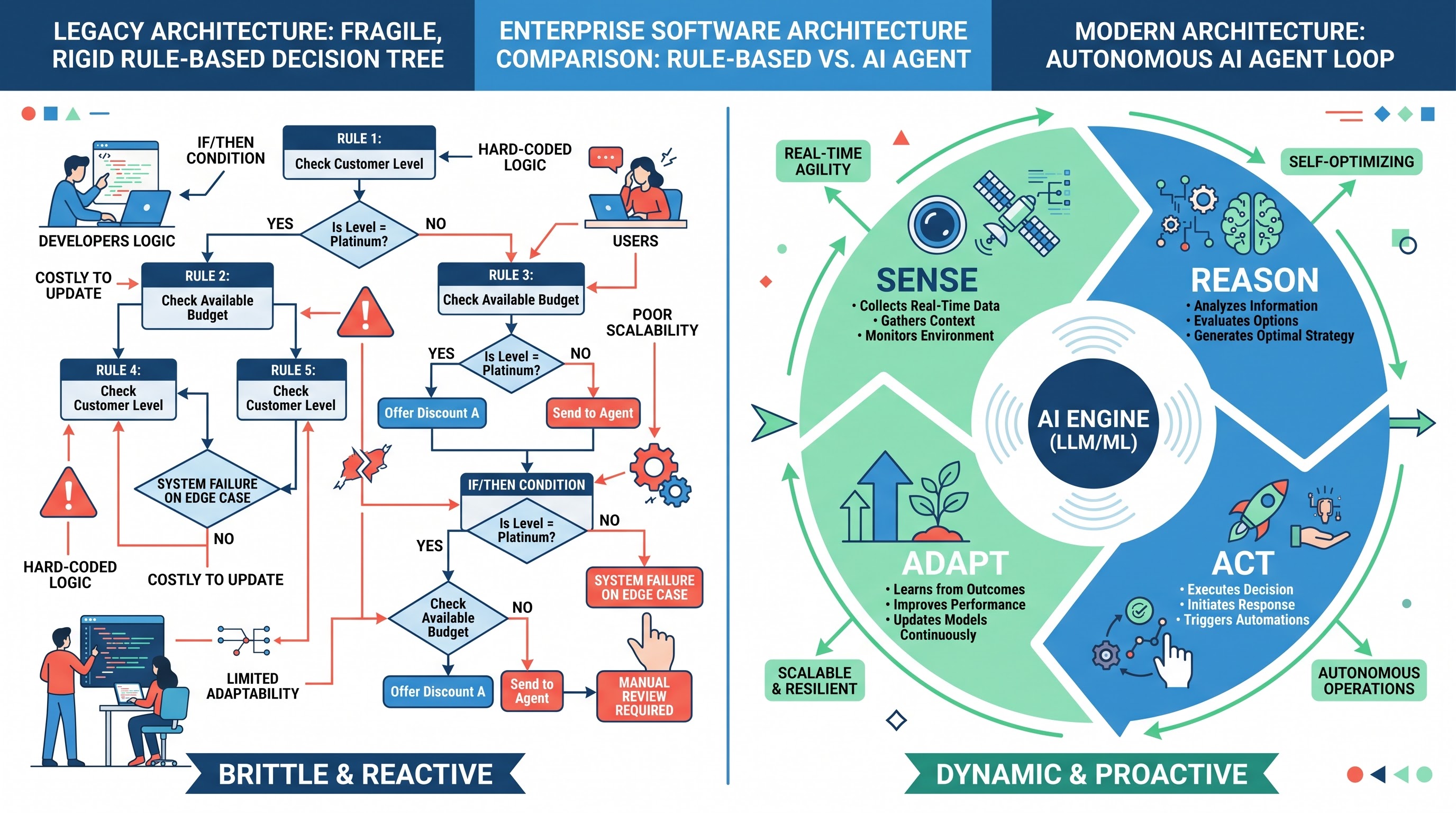
For one to understand the significance of autonomous agents as an advancement in technology, they must first identify the reasons leading to the failure of traditional chatbots to meet business requirements both for company leaders and users.
The Vulnerability of Decision Trees
Traditionally, service chatbots in Service Cloud utilized decision trees with rigid pathways of interaction. Every way a user might interact with the bot would be outlined by the system administrator: if the user clicks on option A, the bot shall answer B; if they write the message containing particular keywords, they will get the answer from record C.
The main disadvantage of this approach is its vulnerability. The way humans communicate is always non-linear and unpredictable. Users do not usually initiate a support dialog with a perfectly formed request. They can miss some important details or change their mind mid-sentence, introduce another issue, or get upset and use informal expressions.
The chatbot fails every time whenever there is even a slight diversion from the predetermined flow of information by the customer. It falls back on default fallback phrases, erroneously conveys the meaning of the intention, and compels the customer to reinitiate the conversation.
Maintenance Nightmare
It is a never-ending torture for the administrative teams to keep the traditional chatbots running. Having the enterprise chatbot requires constant manual efforts:
Going through countless transcripts that were not fruitful
Incorporating numerous synonyms in the library of intentions
Joining the relevant API connections when the backstage system underwent changes
Repairing the dialogue for every new business policy.
Due to the increase in the number, conditions, and requirements for the products and service level agreements of organizations, the chatbot network becomes a huge tangled mess of conditional rules that require constant updates. As organizations stop using these fragile and high-maintenance architectures, it has become critical to involve the technical team in use-case-oriented sfdc online training.
The Isolation of Early Chatbots
Early chatbots were detached entities. Even though they were sometimes connected to applications via basic APIs, they wouldn’t have genuine knowledge of the context. They approach every customer request as a standalone statement and do not even remember what they were told only two requests prior.
Moreover, the early bots were only able to retrieve information. They could respond to straightforward questions like "What is your return policy?" and provide the link to an FAQ page, but were unable to process the return. For instance, if the customer needed to know the shipment tracking number, confirm the warranty, calculate a refund, and print a return label, the bot had to end the conversation.
Understanding the Autonomous Agent: The Revolutionary Shift
Agentforce is not an improvement over Einstein Bots; it represents a groundbreaking concept of replacing pre-defined scripts with a self-driving reasoning cycle that utilizes both organizational data and business rules.
The Key Cycle: Sensing, Reasoning, Acting, Adapting
The self-driving agent operates under the control cycle that replicates the cognitive problem-solving processes:
Sensing and Understanding
Instead of comparing user input with fixed intention categories, the agent takes into account the entire conversation. It utilizes both the natural language input from the customer and information from the organization’s CRM—namely, the customer’s identity, value, health, issues reported, and the state of their assets.
Logic and Breakdown
Thanks to the Atlas Reasoning Engine, the agent is capable of understanding the overarching aim of the client. It splits the overall objectives into simpler logical steps. In case a customer states “I was charged too much on my last bill because my service was out of order for two days. I want it to be solved,” the agent sees three tasks: to prove the dates of the service interruptions, to determine the sum of compensation, and to make changes in the customer’s bill summary.
Independent Execution of Actions
The agent does not only write; it utilizes the capabilities of the entire platform. It causes flows to initiate, it calls Apex classes, it interacts with different systems through the connections of MuleSoft, and it alters records in Salesforce.
Flexible Evaluation
The agent makes an observation of the outcome after executing an action. If an API has not done its work right or the asset cannot be found, the agent won’t collapse but will re-evaluate its operation, choose another option of action or send the case to a human specialist with all the necessary information.
Actions That Are Deterministic are Initiated by the Use of Probabilistic Intelligence
One constant worry for business executives analyzing generative AI in customer service is the problem of unpredictability and hallucinations. No business would accept an AI system that creates fake refund policy or claims that delivery time of a service is impossible.
Agentforce is resolving this conflict through a hybrid solution based on both deterministic and probabilistic models. The language processor is being used for purposes which it was designed to perform the best - understanding the human language, generating semantic meaning and executing processes meaningfully. However, the action is determined.
When the agent issues a refund to the customer, updates some address or books an appointment, it does not create any business logic. It uses the previously approved Salesforce Flows, proper and tested Apex actions, and corresponding endpoints. The agent will understand what needs to be applied in each case, while the tool will perform all operations according to the rules predetermined in Salesforce.
The Vital Components of Agentforce
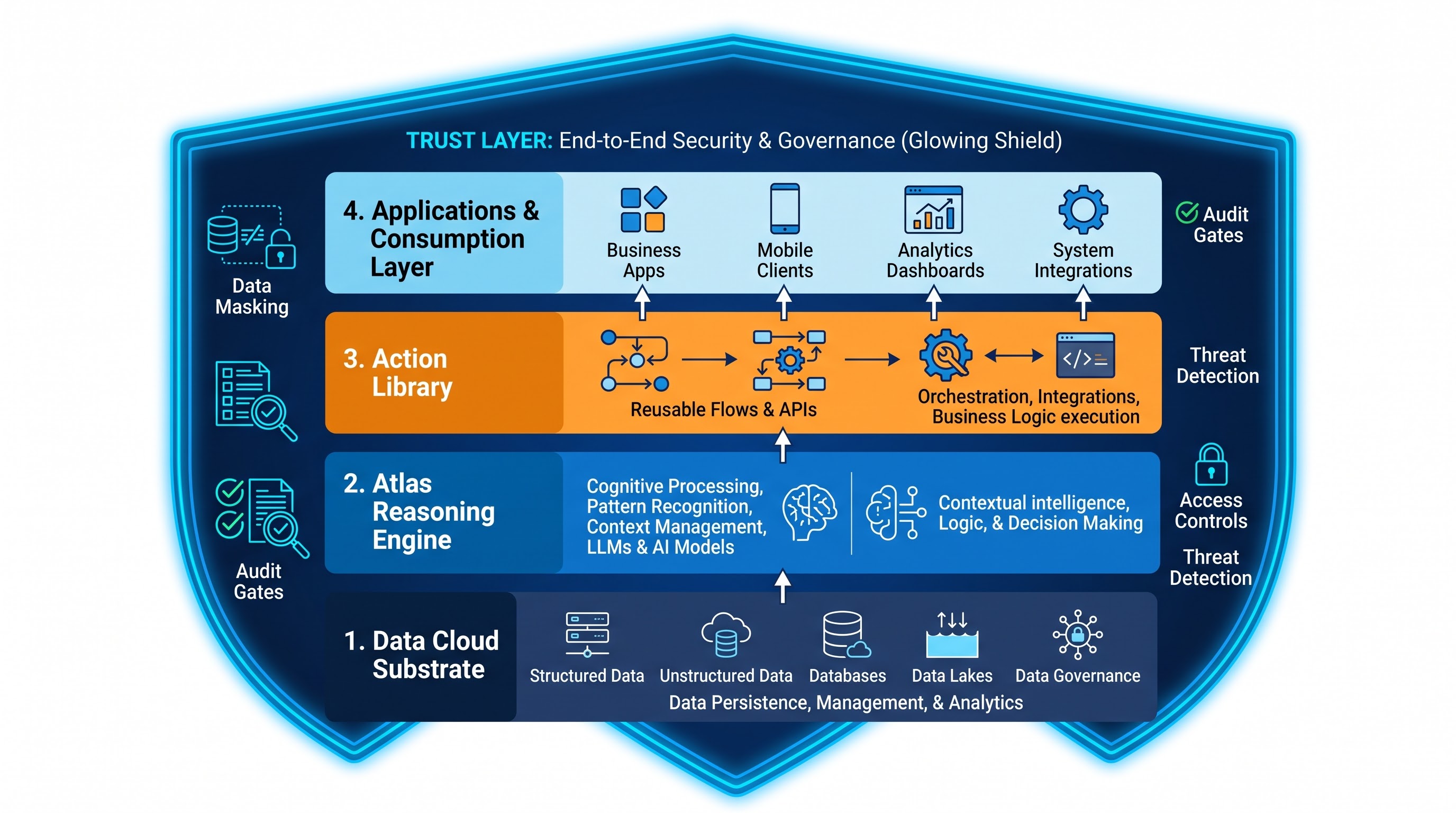
The successful functioning of Agentforce in Service Cloud is based upon four elements that are well connected to each other: Data Cloud, Atlas Reasoning Engine, Action Library, and Trust Layer.
1. Data Cloud: General Substrate
An autonomous agent has intelligence which is based upon data. In the past, the information regarding crm was divided into several parts: information about purchases was loaded into erp system, information about the user was collected from online analytics, information available in telematics was concentrated in proprietary data lakes and information on transactions was stored in Service Cloud.
Agentforce provides it with relevant context via Data Cloud. Data Cloud makes it possible for the autonomous agent to gather the necessary information at one go.
When a customer interacts with an Agentforce agent, the agent immediately knows who the customer is, as well as his recent web activity, previous order shipping delays, any support ticket he may have filed, and even any particular contractual terms. Importantly, Data Cloud performs vector search on unstructured enterprise documents—knowledge bases, troubleshooting guides, warranty agreements, and chats—to help the agent come up with a highly pertinent answer, without having to manually tag knowledge first.
2. The Atlas Reasoning Engine
The Atlas Reasoning Engine acts as the brain of Agentforce. Unlike the traditional generative AI chatbots that predict the most probable next token in a sentence, Atlas thinks ahead.
In reaction to a user's request, Atlas goes through the following reasoning process:
Creates a workspace where the conversation will be evaluated;
Formulates hypotheses about the user's intention and compares them with organizational policies;
Determine what missing data need to be asked for before any further actions;
Queries the Action Library to choose the best sequence of system operations;
Improves its strategy based on the additional inputs or reactions of the system.
Such reasoning capabilities turn the interaction into an iterative process of solving the problem.
3. The Action Library: Providing AI with Physical Capabilities
Intelligence without action is simply a way of speaking. In Service Cloud, Agentforce gets its power from the Action Library.
Salesforce system administrators do not need to be involved in training big models of language technology in Agentforce but can make use of the already available services and have access to them as separate functionalities. A functionality can be an existing Salesforce Flow (for instance) an Apex class, a ready-made template for prompts, or any external API serviced by MuleSoft. To find out how to create and operate such modular backends, specialists can take a complex salesforce course.
By providing the reasoning engine with these building blocks, organizations enable the agent to act. An agent can:
- Check the availability of stock across warehouses
- Verify identities through two-factor authentication
- Calculate warranty adjustments
- Send repair workers to customers along with necessary parts
- Create, edit, or reorganize complex hierarchies of CRM records.
As all functions utilize existing rules and policies of the organization, the risk of malfunctioning is minimized.
4. The Einstein Trust Layer: Guardrails and Governance
The successful implementation of autonomous agents by enterprises requires a focus on safety, compliance, and control. The Einstein Trust Layer is implemented between the reasoning engine, foundational models and enterprise data plane ensuring that sufficient protections are in place, which involve:
Dynamic Data Masking: PII, credit card numbers, social security numbers are stripped and masked before the context is sent to LLMs.
Zero Data Retention: External model vendors sign strict agreements that ensure that enterprise data is neither stored, logged or used in training public foundation models.
Toxicity and Hallucination Detection: Outgoing agent outputs are scanned for inappropriate tone, toxic phrases, and hallucination before they are presented to the user.
Complete Audit Trails: Each reasoning step, decision point, action taken or data obtained will be logged completely ensuring that the support managers can understand the rationale of why a particular action was taken by the agent.
Real-World Use Cases: Agentforce in Different Sectors
The shift from old-fashioned chatbots to autonomous agents dramatically influences the way companies function in the various industries.
Retail: Solving Issues Before They Occur
Traditional chatbots always fail to solve complicated issues regarding inventory, shipping, and modification of orders in the field of retail.
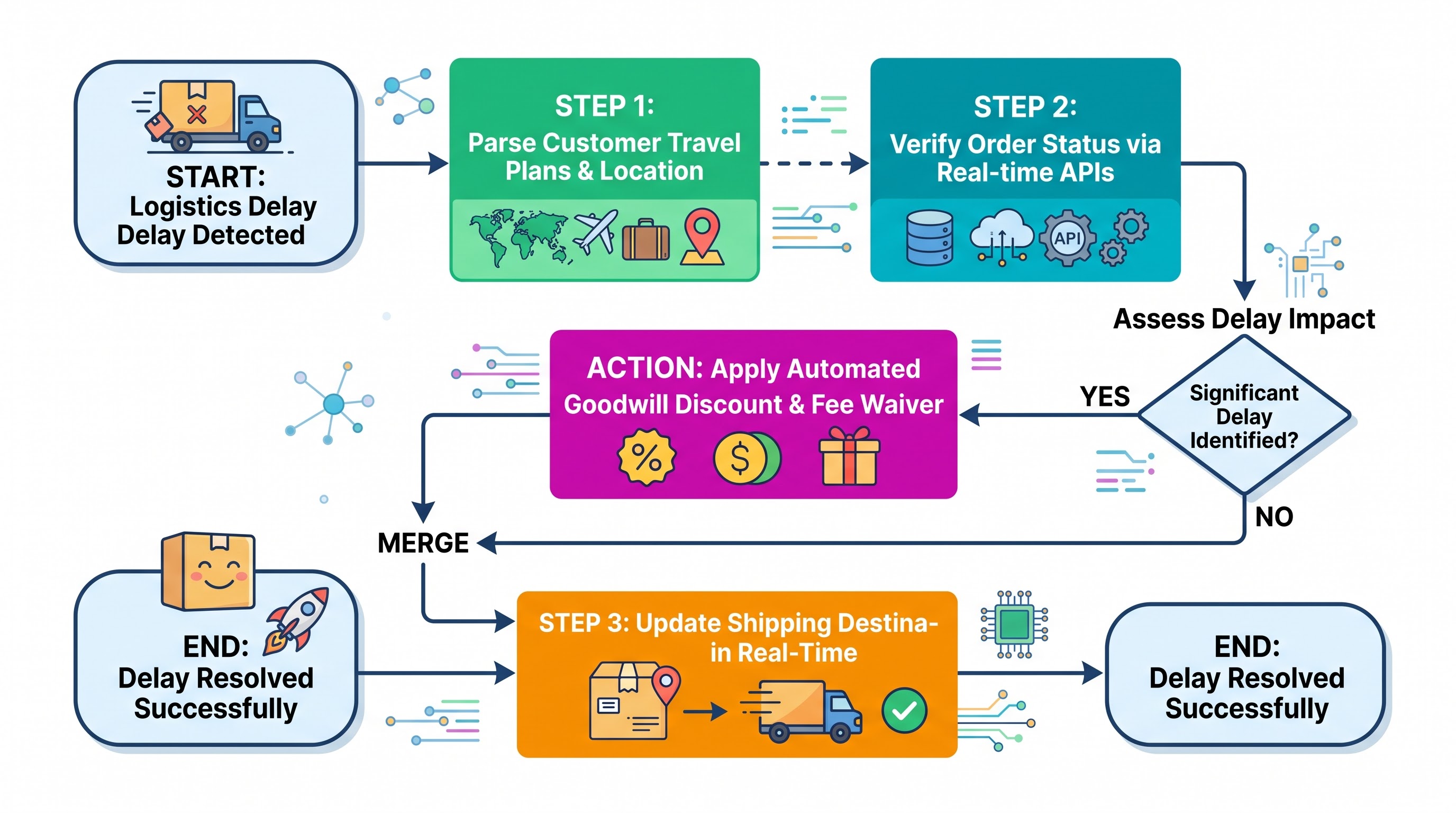
For example, a customer contacts, saying: "I got a message saying that my order has been delayed, but I am leaving for a flight on Thursday and need everything on time. Is there a way to ship it elsewhere?"
When faced with a request where the customer has different intentions (shipping delay, travel schedule, change of address), an ordinary chatbot suggests a link to the general terms of delivery or moves the customer to a human-operated queue.
In contrast, an Agentforce agent will successfully resolve the problem through the multi-stage autonomous processing of the request.
Its function is to authenticate the identity of the customer as well as to find the original order given in the recent logistics note.
It checks real-time transport systems using the MuleSoft connector in order to learn the transportation status of the parcel.
Since the package cannot arrive at the given home address until Thursday, it asks for the target destination.
It reviews the rules of the carriers in order to find a chance for rerouting the package en route.
If it’s possible, then it calculates a rerouting price, defines the loyalty tier of the customer, applies the goodwill fee waiver automatically, executes the rerouting API call, and updates the records in the Service Cloud.
The issue is solved almost instantly and without any human intervention, thus avoiding potential problems with the client.
Telecommunications services often have high ticket counts that require detailed technical resolution steps
Traditionally, chatbots have created long decision trees that ask users questions about whether lights are flashing green, amber, or red, making them stop talking to the bot.
The Agentforce solution allows agents to access the information directly from the device telematics and operating networks using Data Cloud:
When a user complains about bad connectivity, the agent is able to check the real-time status of the device, examining latency and packet loss statistics and firmware version compared to industry standards. It simultaneously crosschecks outage databases to eliminate major infrastructure failures.
When the agent finds out that the customer’s router is working with old firmware and corrupted channel allocation, it explains the problem in a clear way. Instead of providing instructions for doing the repair by themselves, the agent asks for permission to reset the device remotely.
The agent gets the confirmation and runs the process of adding the update, monitoring the restart process along with the disconnection, restoring the connection with the customer, and providing the latest information on the status of the customer’s case in Service Cloud.
Policies-based Juggling of Wealth and Bank Inquiries in Finance
In the world of finance, there are always strict rules, and it's crucial for compliance and accuracy. Regular chatbots are known to break these rules when they either give generic and unhelpful information or give potentially wrong financial forecasts.
An Agentforce agent being used in a wealth management or banking institution operates according to string compliance rules while reaching out for sophisticated support:
A client starts a chat message and asks for transferring money between his accounts and making changes to current planned investment due to a change of job.
The agent starts with the process of confirming the identity by using a secure push authentication in the app.
After verification is done, the agent learns of the client's account hierarchy by checking the limitations on the amount to be transferred from the account and other restrictions.
The agent explains the tax implications of making changes to the recurring investment using compliance-approved knowledge sources.
Finally, it prepares the transaction documentation and plans the transfer in the future, using the core banking capabilities of the bank and recording the incident in the Service Cloud for further reference.
The Transformation of the Human Agent: From Call Operator to Director
The existence of autonomous AI agents brings the fear of a complete human displacement. However, in reality, companies using Agentforce within the Service Cloud find out that human agents are not replaced, but their jobs are adjusted and enhanced.
Getting Rid of Boring Administrative Job
People working in customer support often waste up to half of their working time doing mindless administrative jobs. They look through the order numbers, recover the passwords, correct the delivery address, copy information between different tabs, and write down reports.
Such activities lead to great exhaustion of the workers, declining their cognitive capabilities and resulting in the high turnover level of the personnel in contact centers. Agentforce effectively handles these high volumes of monotonous operations.
Thanks to the ability to cope with ordinary requests by itself, the AI is preventing human teams from being overwhelmed by unimportant operations, thus giving them time to solve more complex and emotional customer’s problems.
The Theory of Smooth Handover and Co-Pilot Model
The nature of the interrelationship between Agentforce technology and human intermediaries is aimed towards achieving seamless interaction. In the past, when a chatbot transferred interaction to a living person, customers had to restate their names, account numbers, and issues they faced. This was frustrating for the customer and wasted time for the operator.
Agentforce partnered up with smooth transfer mechanisms, including:
The Intelligent Triggering Technique. Escalation takes place upon evaluation. For example, in cases of heightened customer negativity, when the problem gets out of financial threshold limits, or when it is mandated by company rules, the transfer happens. An operator takes charge of the transfer.
All Information Transfer Process. The human contact person gets a notification about the multi-channel route combined with a clear, structured summary. The summary consists of:
The essence of the customer’s problem.
The actions done by Agentforce.
The reason behind the transfer request.
The recommendations regarding the actions to take.
Transition to Co-Pilot: After the agent has accepted the interaction, the Agentforce enters its internal co-pilot mode. The agent can be instructed by the human agent to look for concealed documents, to compose new responses, to perform some additional tasks, and to prepare post-interaction reports with one click. Admins taking the official salesforce certification course will focus on understanding how agent workflows operate and how to work with expanding Service Cloud capabilities.
Measuring the Impact: Shifting the Balance of Support Economics
The technical change from classic chatbots to independent agents changes contact center performance indicators and cost structures
Shifting the Containment Rate
Contact center leaders always monitor containment rates: the rate of total interactions that were made and completed by automated services without involving human agents. In case of traditional chatbots, high levels of containment were more of a misleading index. An example of that is if a consumer stops the conversation because they have lost all patience and hung up, it will still count as "contained".
The technology of Agentforce converts the notion of containment into the concept of Autonomous Resolution Rate. The agent's real-time access to facts and transactional instruments causes the definition of success to become based on the achievement of goals. As a result, companies using autonomous agents state that the used technologies allow for significantly improved resolution rates ranging from 15-20% to 60-80%.
Reduction of Average Handling Time (AHT)
When it comes to cases that require assistance from humans, the introduction of autonomous systems allows for the significant cut of Average Handling Time.
Thanks to the fact that Agentforce performs identity verification, collects basic needs, checks related CRM information as well as runs the first system diagnosis, human specialists can get rid of project management.
Scaling Capacity Without Increased Costs
Traditionally, contact centers established a direct correlation between the growth of the business and the number of employees on the ground. An increase in the number of clients therefore meant recruiting and training more agents to keep pace with the greater inflow of inquiries. However, during peak holiday times or in cases of annual insurance applications, the demand went up so dramatically that companies hired costly temporary workers to meet demand, which affected their overall operation.
On the other hand, machines enabled businesses to satisfy demand regarding inquiries without linking their expertise to the workforce. A company can easily manage many inquiries even during busy periods as there is no need for personnel hired for that. To establish and maintain this autonomous agent infrastructure, many organizations now turn to structured sfdc training online so professionals in the company will be trained on end-to-end platform implementation.