
Are Business Analyst Certifications Worth It? (ECBA vs. CBAP vs. PMI-PBA)
Last updated on Jul 29, 2026
In the contemporary competitive labor market, the usefulness of various professional certifications has come under more and more scrutiny. The question for Business Analysts (BAs) is a simple one: Will paying hundreds or thousands of dollars for a BA certification yield tangible ROI? Or are such certifications just money down the drain, merely making the resume look good?
Short answer: It all depends on your experience level, current working environment, and the type of certification.
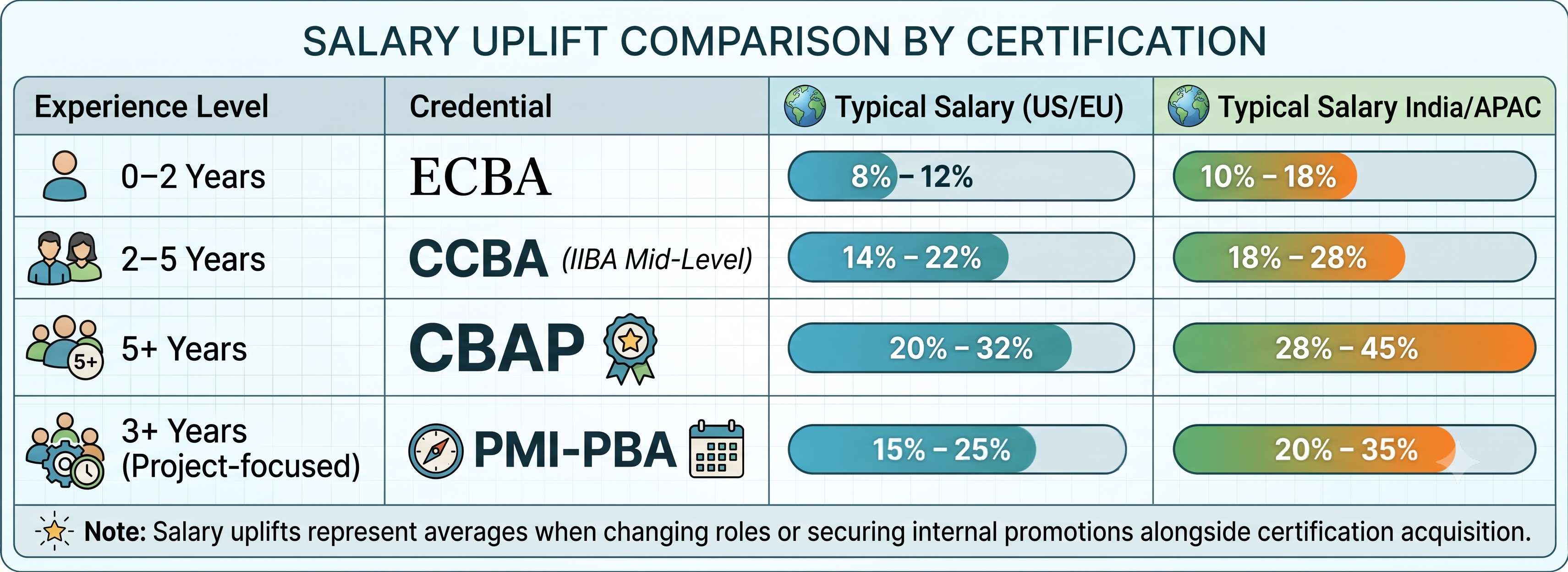
The certification will not miraculously compensate for a lack of critical thinking skills and give you an immediate promotion. But when selected wisely, a certificate will act as an indication of expertise in the area, a way to pass through the Applicant Tracking System (ATS) filters, and a factor for earning a 10%-to-30% salary premium compared to non-certified BAs.
Exploring the available options requires an analysis of the two major associations in the industry:
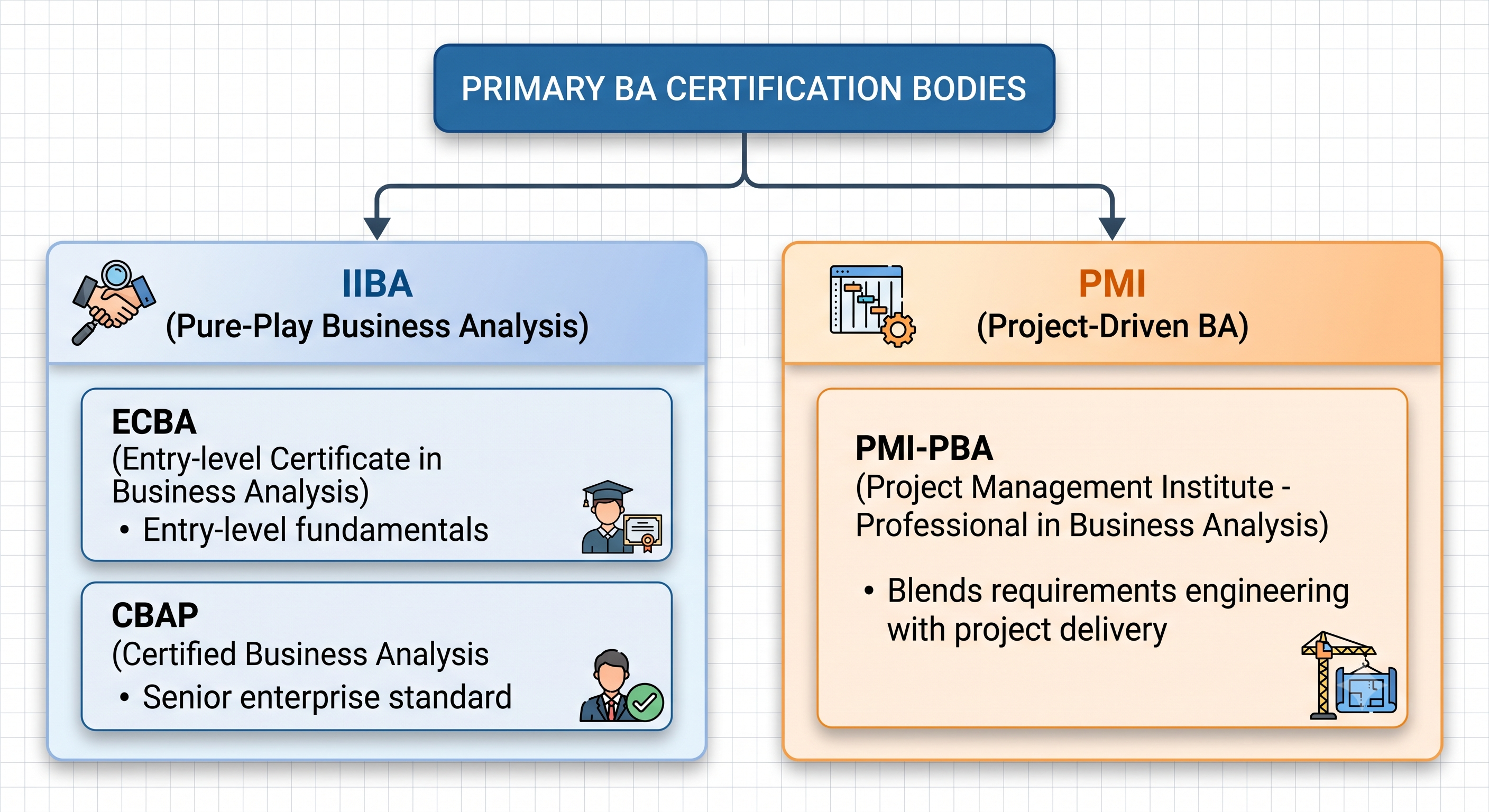
International Institute of Business Analysis (IIBA): Offers a multi-level process based on pure requirements engineering that includes the Entry Certificate in Business Analysis (ECBA) all the way up to Certified Business Analysis Professional (CBAP).
Project Management Institute (PMI): Offers the Professional in Business Analysis (PMI-PBA). This involves a combination of the traditional project management delivery process and requirements analysis.
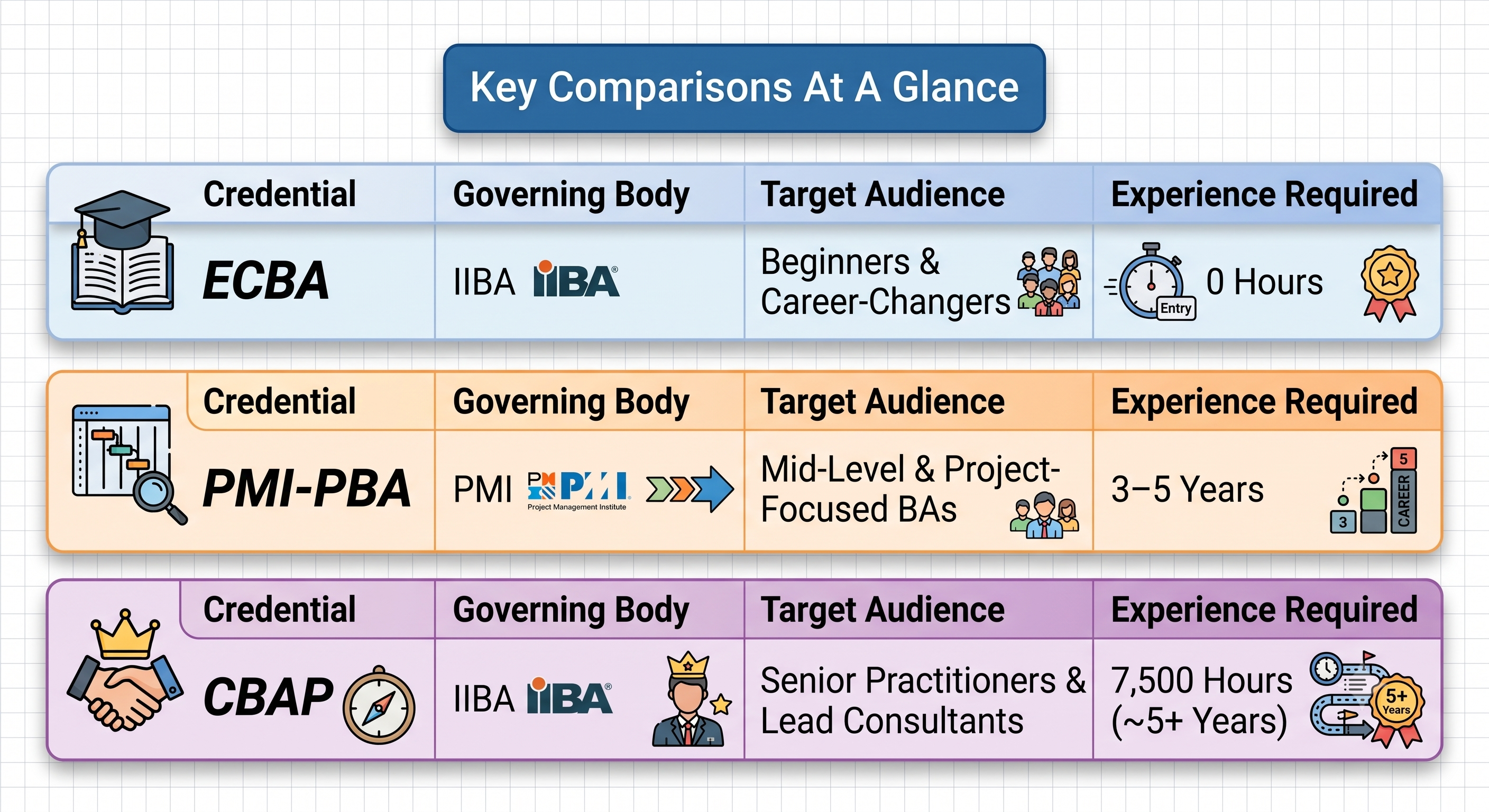
This article analyzes the economics, eligibility requirements, test formats, and real-world utility of the ECBA, CBAP, and PMI-PBA. This guide gives you a roadmap that will enable you to determine whether a particular certification is worth your time and effort—and, more importantly, which one fits your career path.
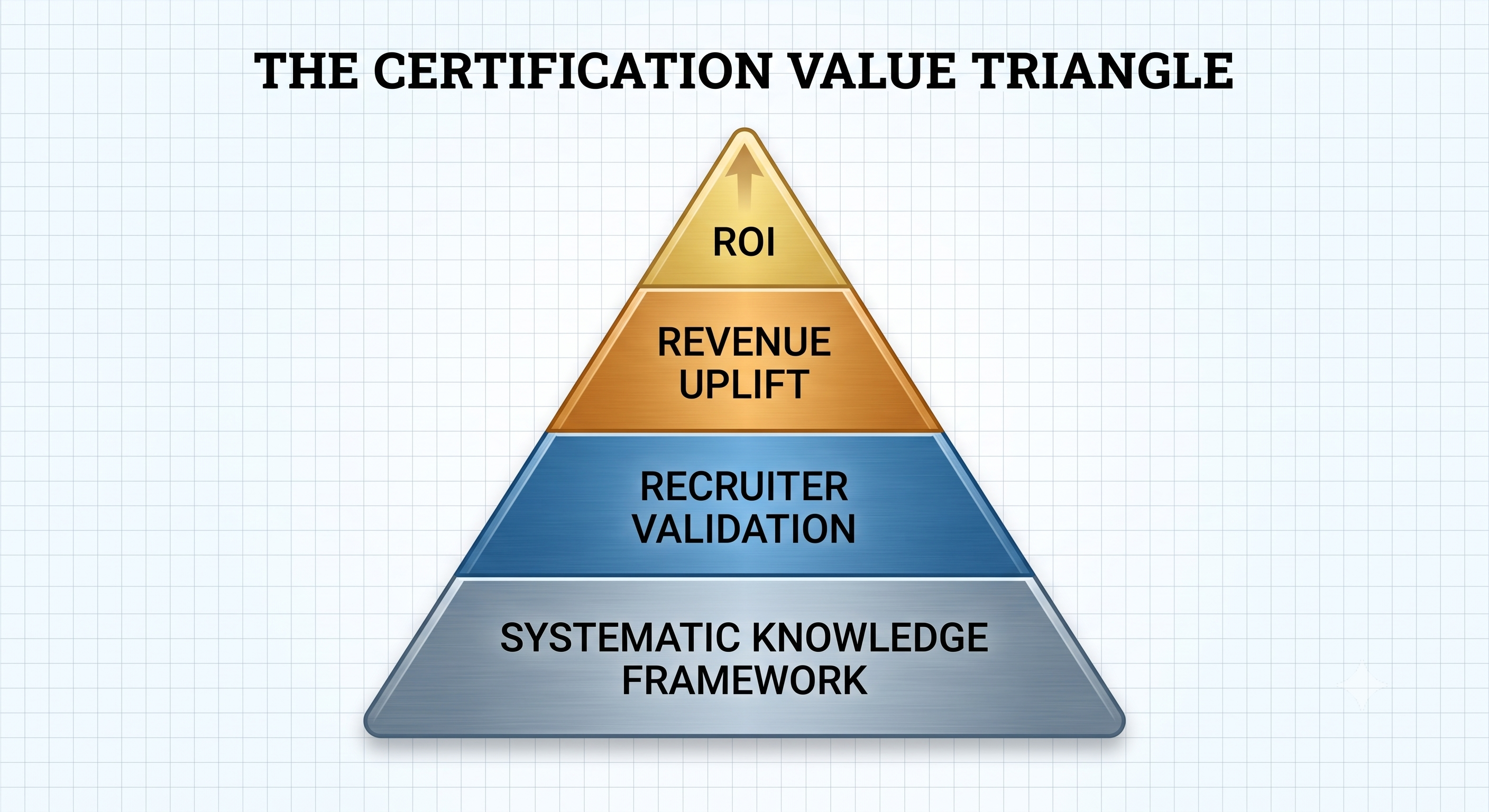
Return on Investment of Business Analysis Certification
Before we get into the individual tests, let's start by looking at the macroeconomics behind the certification: what you get from earning it.
1. Filtering During Resume Screening
Large enterprises, consulting firms, and government contractors all typically have applicant tracking systems (ATS) and third-party recruiters as part of their recruitment process.
In cases where a senior BA position is opened by a hiring manager, “CBAP” or “PMI-PBA” is usually used as a mandatory keyword filter or "desired qualification."
If these acronyms are missing from your resume, you will be automatically filtered out before reaching any human recruiter for your employment experience.
2. Standardized Terminology and Frameworks
"Self-taught professionals who choose to specialize in BA are likely to create their own routines within the framework of one particular organizational culture. Attending a professional BA analyst course and working through IIBA’s BABOK® Guide will force you to become familiar with the terminology and the practices of business analysis that exist within the industry. Consequently, you will be ready to enter a new organization and communicate in the language of architects, product owners, and sponsors."
3. Quantifiable Compensation Advancement
Data from international salary surveys clearly shows that there is a difference in salaries paid to certified and non-certified analysts:
Comparison Analysis: ECBA VS. CBAP VS. PMI-PBA
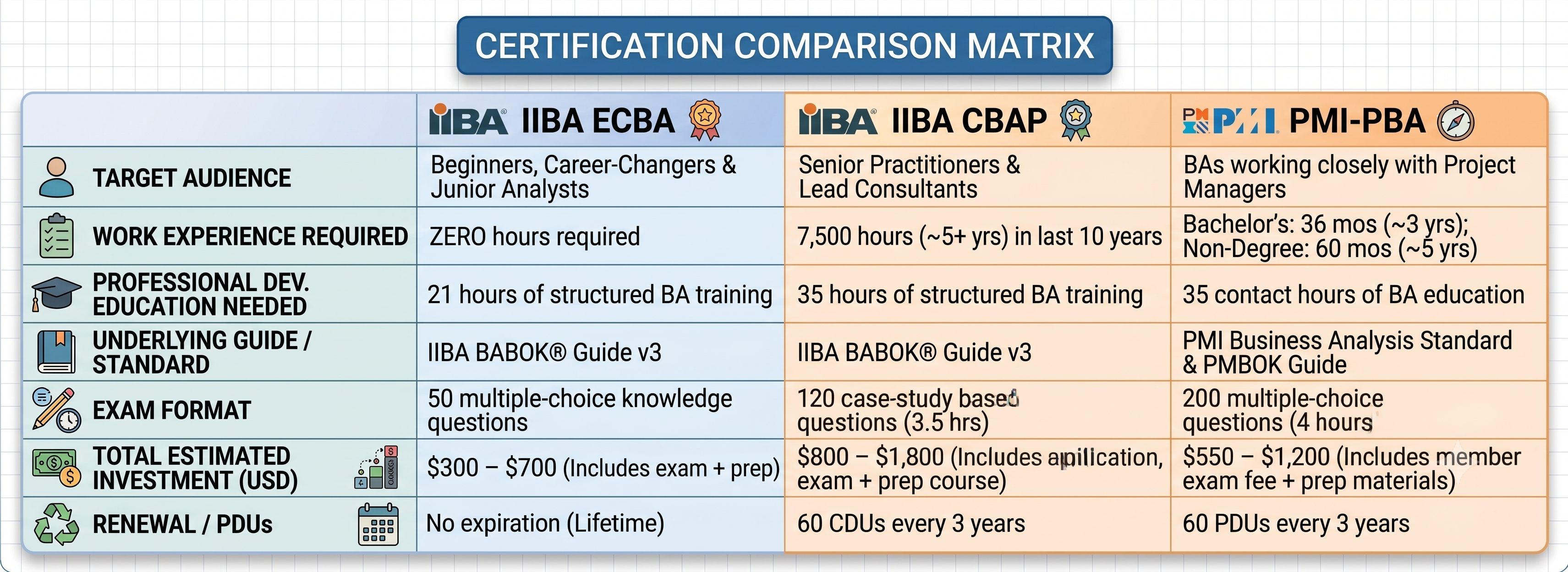
The choice of the right certification test requires an evaluation of three basic pillars, which are Eligibility Requirements, Cost, and Test Format.
In-depth Review of Each Certification
1. IIBA Entry Certificate in Business Analysis (ECBA)
What It Is
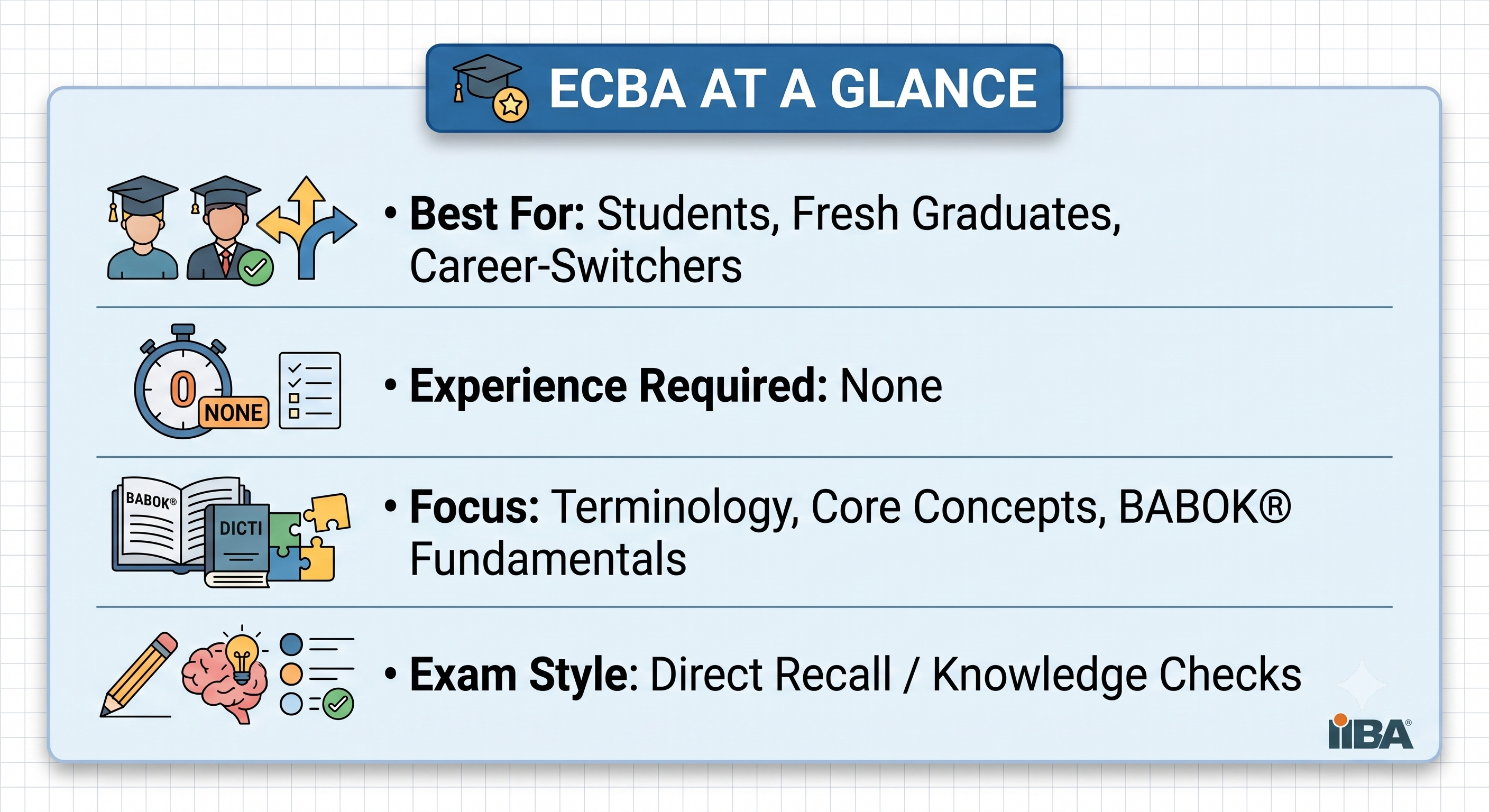
The ECBA is a foundational certification from the IIBA. This certification is for professionals who want to start a career in the field of business analysis with no experience.
Best Fit For
Graduates with university degrees looking for their first junior BA job.
Professionals switching to business analysis from industries that do not involve technical skills (customer services, administration, sales, operations).
QA testers, technical writers, and project coordinators willing to change into requirement engineering.
Requirements
Work Experience: 0 hours.
Professional Development: 21 hours of documented learning in the field of business analyst classes (this can be done fairly quickly by attending classes or boot camp on business analysis).
Exam Format and Content
The ECBA exam includes 50 multiple choice questions to be answered in 75 minutes. In contrast with higher level exams, ECBA is concerned with recalling the information and understanding it.
It assesses your knowledge about basic terms, concepts, and techniques listed in BABOK® guide:
Business Analysis Core Concepts (15%)
Core Competencies (5%)
Business Analysis Techniques (17.5%)
Knowledge Areas of Importance: Elicitation and Collaboration, Requirements Analysis, and Life Cycle Management (62.5%)
Conclusion: Is ECBA Worth It?
Yes, however, with reservations
The ECBA alone will not be able to get you a job. However, what it does is show dedication and eliminate the "zero-experience" issue on your CV. The ECBA shows that you know how to speak the "language" of business analysis. This will reduce your time spent on onboarding.
Skip ECBA if: You already have 2+ years of experience of working on projects involving software delivery and/or business process re-engineering. In such a case, go straight for the CCBA, PMI-PBA, or just wait until CBAP requirements are met.
2. IIBA CBAP (Certified Business Analysis Professional)
CBAP Meaning
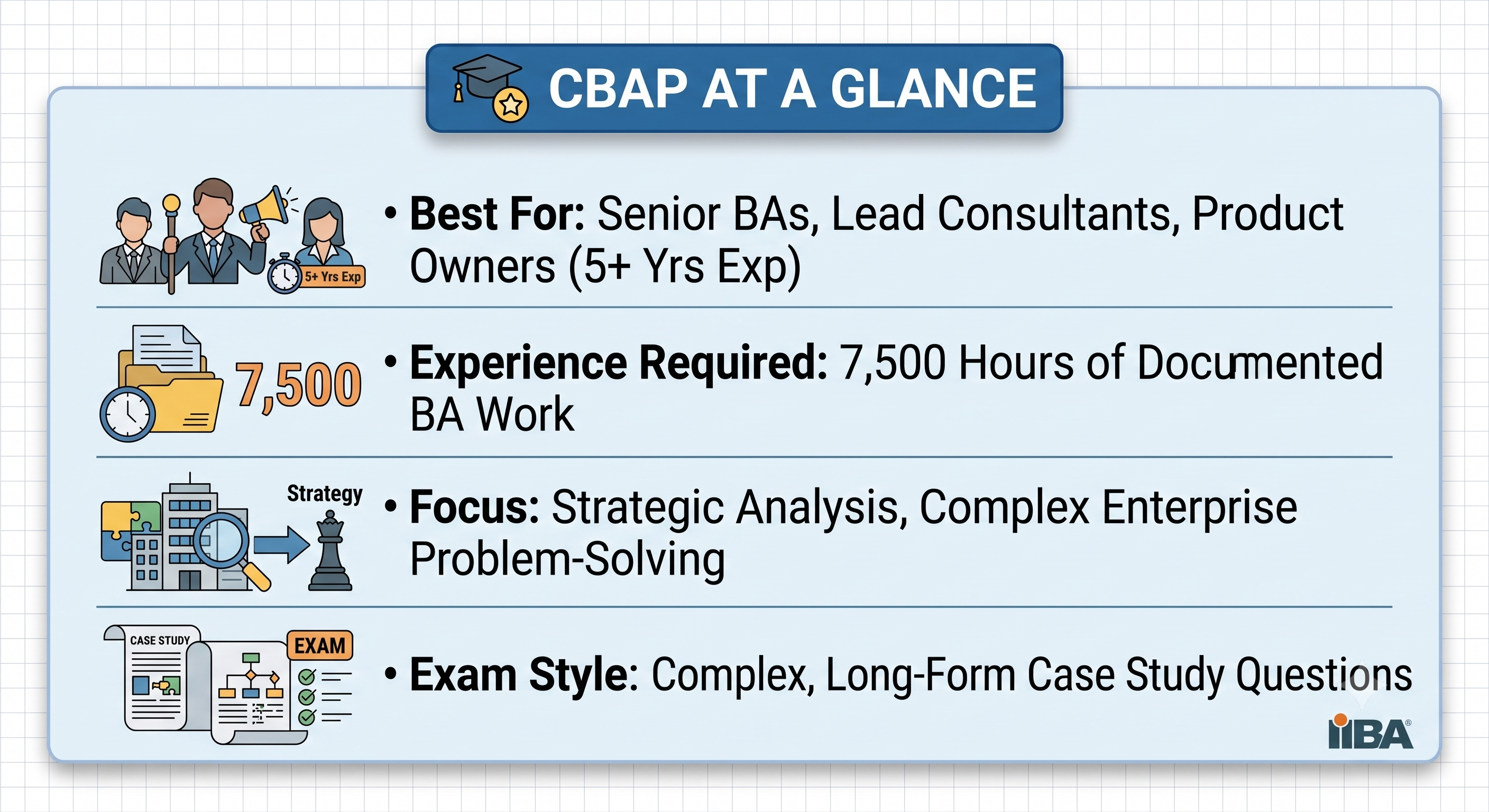
The CBAP is well known to be the international benchmark for experienced business analysis professionals. The CBAP certification demonstrates your ability to initiate and execute complex and enterprise-level projects; create strategic business solutions; and improve the organization’s processes.
Recommended Professionals
Senior Business Analysts; System Analysts and Lead Process Engineers.
Enterprise Architects; Product Managers; and Management Consultants having experience in functional analysis.
Pre-Requisites (Audited Stringently by IIBA)
The CBAP application process set by the IIBA is strictly monitored as follows:
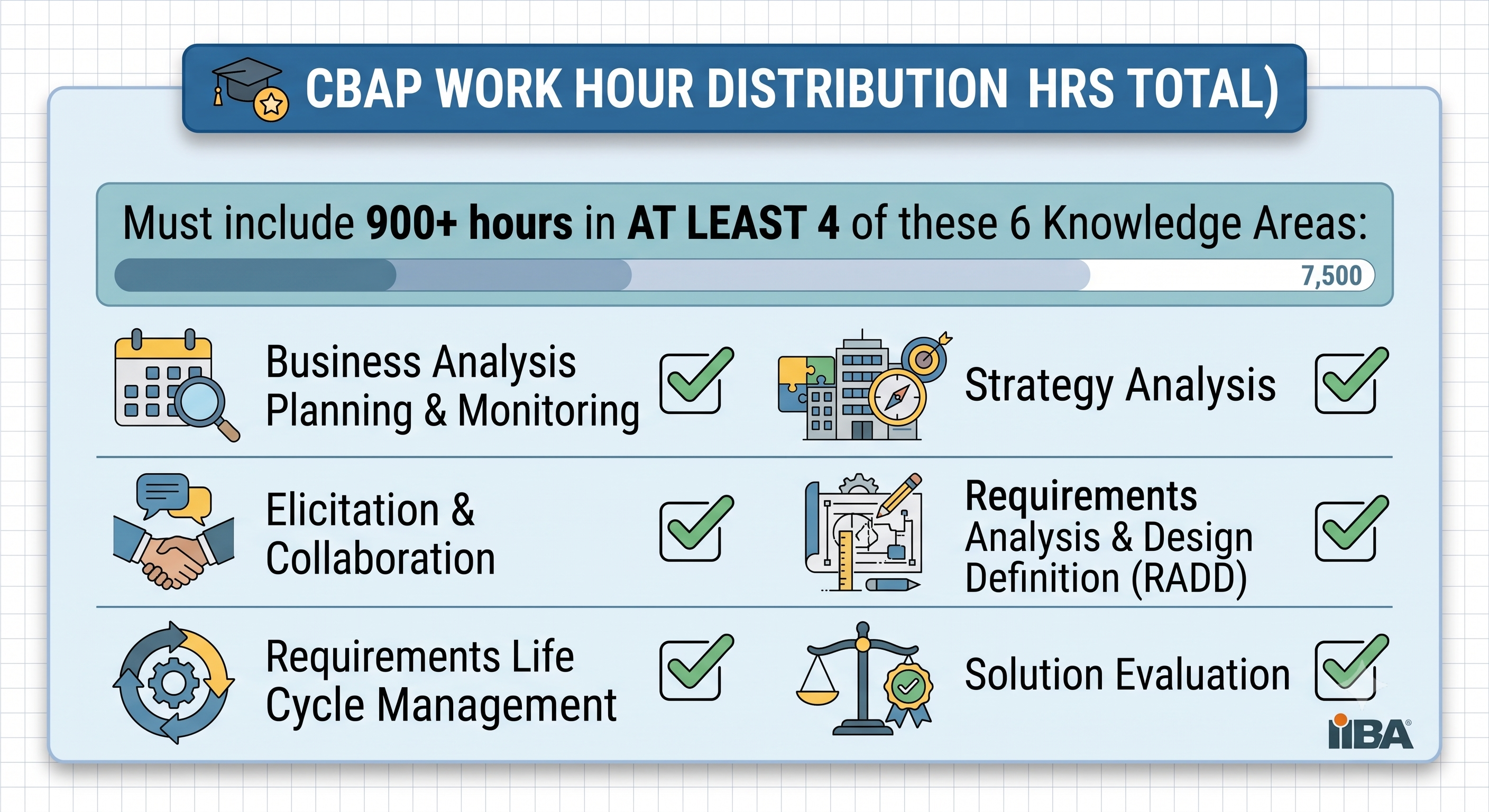
Experience: At least 7,500 hours of BA experience over the last 10 years.
Focus on Knowledge Areas: Of these 7,500 hours of experience, a minimum of 900 hours of experience in 4 out of the 6 BABOK® Guide knowledge areas is required.
Professional Development: 35 hours of verifiable professional development training in the last 4 years.
References: Two professional references from a CBAP holder; career manager; or client.
Exam Format & Topics
This exam is known to be one of the toughest in software certification exams.
It comprises 120 multiple-choice questions in 3.5 hours.
Importantly, it consists of multi-paragraph case studies (1 to 2 pages in size), which you need to go through and then answer a series of questions using BABOK® concepts. Memorization won’t get you anywhere; instead, you need to use your real-life situational judgment.
Cost of Certification (Estimated Prices in 2026)
IIBA Annual Membership: ~$95-$155 USD (price varies by region)
Application Fee for CBAP: $145 USD (non-refundable)
CBAP Exam Fee: $325 USD (members) / $505 USD (non-members)
Formal 35-hour Exam Prep Bootcamp & ba analyst training: $500 – $1,200 USD
Overall Cost: $1,000 – $1,800 USD
Verdict: Is CBAP Worth It?
Definitely, yes - for professionals in senior positions.
The CBAP is required qualification in a principal consultant position, enterprise BA manager, or high-fee independent contractor positions. Return on investment comes either in the form of a salary raise or assignment to high-budget enterprise projects.
3. PMI-PBA (Professional in Business Analysis)
What It Is
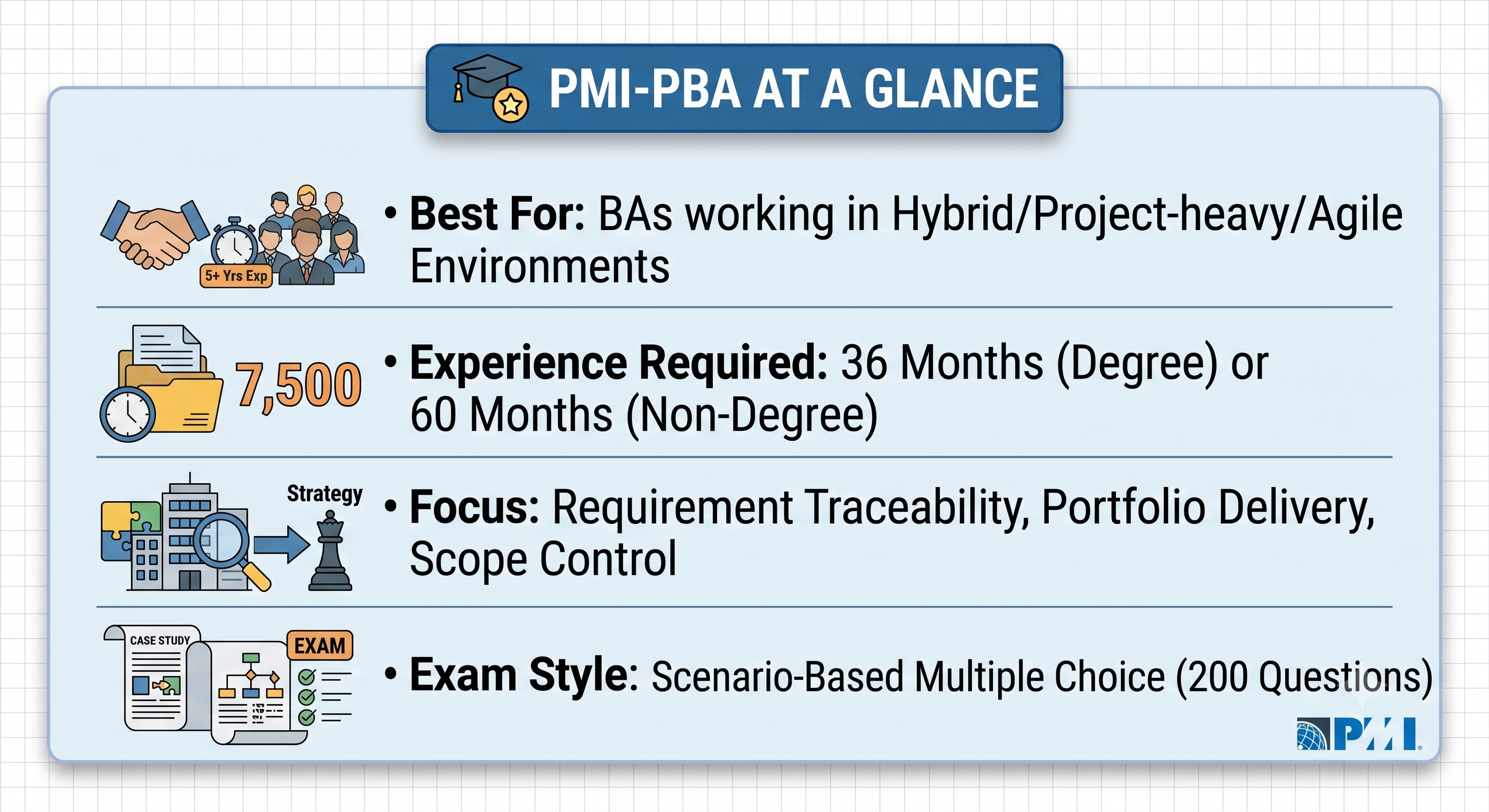
Offered by the Project Management Institute (PMI), the PMI-PBA is highly focused on business analysis as it pertains to project, program, and portfolio management.
Whereas the IIBA's BABOK® looks at business analysis from the perspective of enterprise transformation, PMI-PBA places emphasis on the role of requirements within projects and their scope and schedule and value realization.
Best Candidates
Business Analysts that interact directly with Project Managers (PMs) or often fill dual BA/PM positions.
Project Managers whose job involves extensive requirements gathering and scope management.
Consultants in PMI standards-based organizations or in defense, aerospace, and large construction and engineering IT.
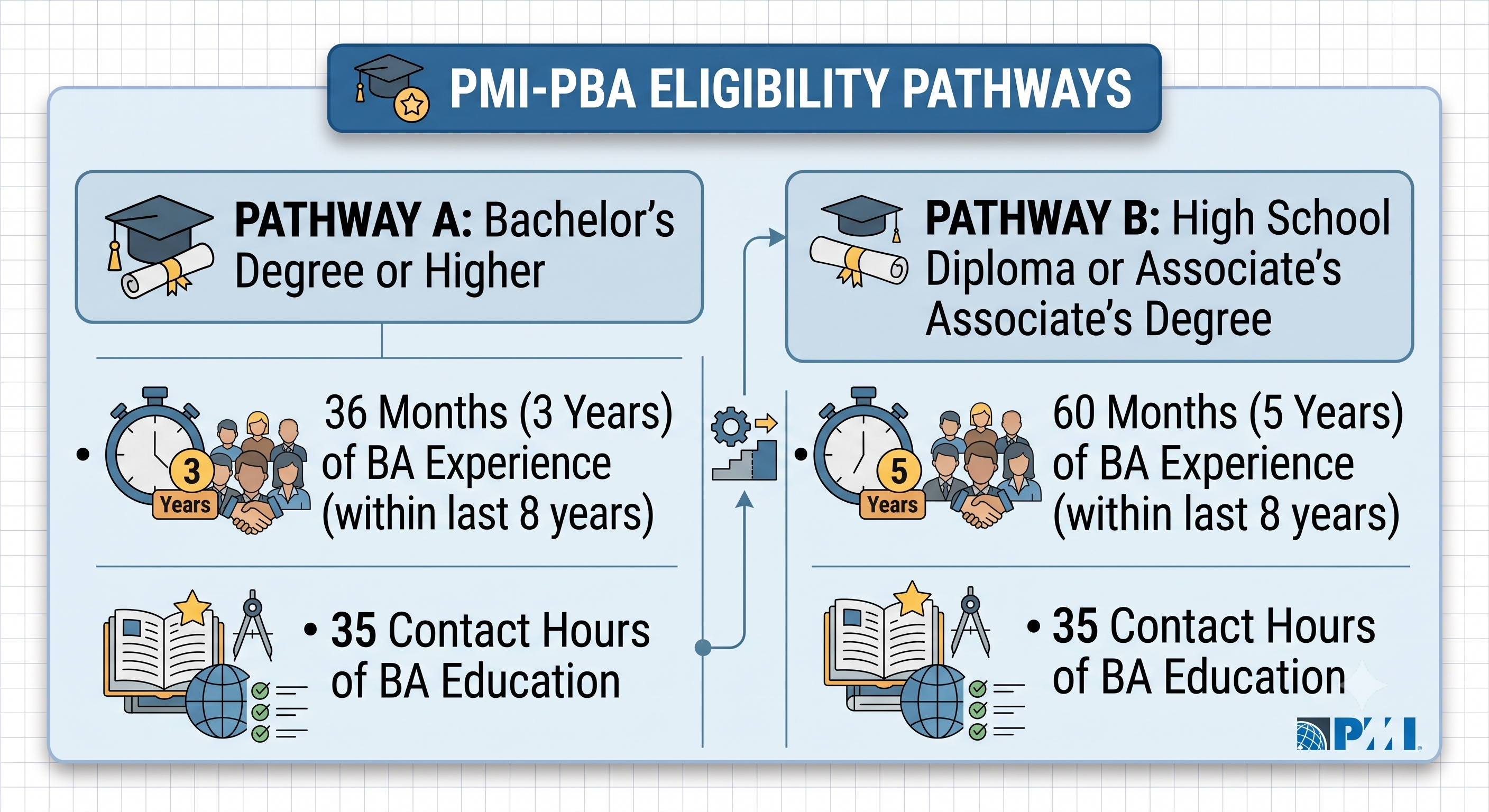
Experience Prerequisites
PMI requires experience in accordance with your education level:
Structure of the Exam and Exam Domains
The PMI-PBA Exam includes 200 questions spread out across 4 hours. The exam topics are divided into the following five domains:
Needs Assessment (18%) – Defining business problems and business opportunities.
Planning (22%) – Building requirements management processes, tools, traceability, and governance plans.
Analysis (35%) – Requirement elicitation, requirement analysis, requirement documentation and validation.
Traceability & Monitoring (15%) – Requirement changes management across the life cycle of the project.
Evaluation (10%) – Confirming that the implemented solution provided the needed business results.
The Verdict: Is the PMI-PBA worth the effort?
Yes, if your employer highly appreciates PMI certification.
In case you work at an organization which greatly appreciates PMP certification, the PMI-PBA will be very important for you. Also, this is the perfect intermediate certification for analysts having 3 to 4 years of experience because it allows getting certified without the need to wait until accumulating the needed 7,500 hours for CBAP.
Strategic Decision Framework: Which Certification to Go For?
In order not to waste your time and money on the unnecessary certification use the decision framework presented below.
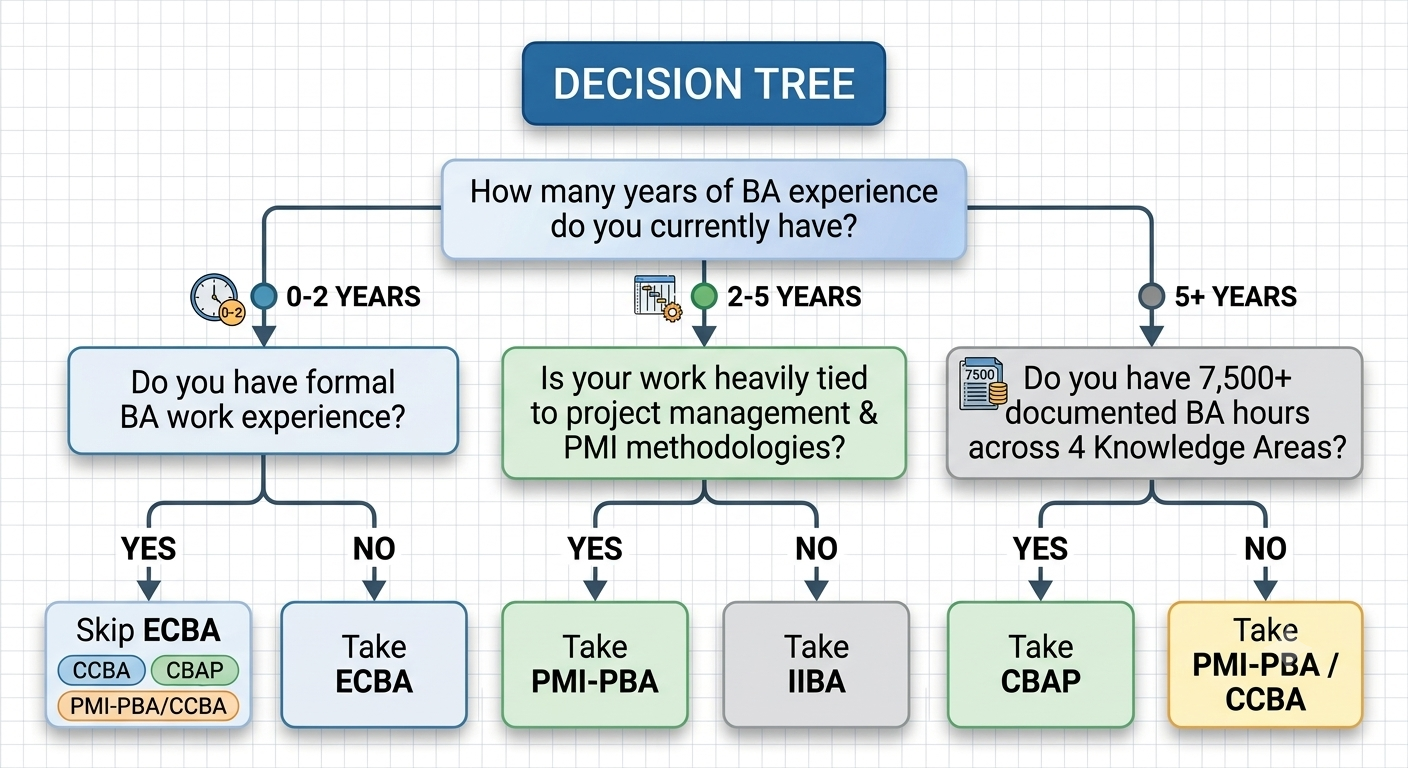
Scenario A: “I am a fresh graduate or changing career from a completely unrelated field.”
Certification to get: IIBA ECBA.
Reason: You need work experience to earn CBAP and PMI-PBA certification. The ECBA provides you structured knowledge of the BABOK® guide, demonstrates your dedication to potential employers and gives you an edge while applying for entry-level BA jobs.
Scenario B: “I have 3 to 4 years of experience creating requirements along with project managers.”
Certification to get: PMI-PBA (or IIBA CCBA).
Reason: At this point in your career, you do not have the 7,500-hour experience to earn the CBAP, but you have sufficient experience in projects to clear the PMI-PBA. It validates your skills in managing requirements through the entire software delivery life cycle.
Scenario C: “I have 6 or more years of experience in business analysis within the enterprise environment.”
Certification to get: IIBA CBAP.
Reason: CBAP is the most sought-after BA certification globally. Once you gain 7,500 hours of experience, earning the CBAP will allow you to take on senior positions, management tracks, and higher billing rates as consultants.
Actionable Blueprint: How to Pass Your Certification Exam
The preparation for high-level certifications such as the CBAP or PMI-PBA involves structured study for at least 3 to 5 months. Below is an actionable blueprint for your study.
1.Check Requirements & Record Hours: Check your history first, before investing money.
Find the application template from the IIBA or PMI. Review your career projects in the past 5 to 10 years on a monthly basis. Calculate your exact hours on business analysis in the necessary Knowledge Areas before investing in the application fees.
2.Pick up 35 Hours of Professional Development: Adhere to the education criterion via an authorized training partner. Enroll yourself in flexible business analyst classes online via an IIBA Endorsed Education Provider (EEP) or a PMI Authorized Training Partner (ATP). Undertaking these courses will ensure that your education criterion of 21 or 35 PD hours is fulfilled..
3.Study the Core Standards (not just Prep Books): Study the body of knowledge behind it.
Study the BABOK® Guide v3 (for IIBA Exams) or the PMI Guide to Business Analysis at least twice and pay more attention to the input, output, and logic behind each method instead of just memorizing things by heart.
4. Master High-Fidelity Mock Exam Simulations: Endurance and Situational Analysis Training.
Devote about 4 to 6 weeks to real exam simulations. In the case of CBAP, train yourself to read long case studies rapidly since you will have only 3.5 hours to solve all tasks. Be sure you get consistent 80%+ marks on mocks before setting your examination date.
The Verdict Is Out: Are Business Analyst Certifications Worth It?
In today’s competitive world of technology and business, obtaining a certification of a Business Analyst (BA) involves a considerable dedication of time, effort, and money. As expected, professionals of all ranks pose the same key question: Is a certification truly worth it?
The answer to this question is yes—if one chooses to obtain the relevant certification that is tailored to his or her current stage in their career, experience, and professional future aspirations.
The certification does not represent a magic trick that will substitute for real-life problem-solving and technical expertise. Nonetheless, together with excellent communication skills and strong analytical thinking, it will help you to become an effective career booster, which will serve as the standardization of knowledge worldwide, pass the ATS filters of recruiters, and earn extra salary compared to un-certified peers.
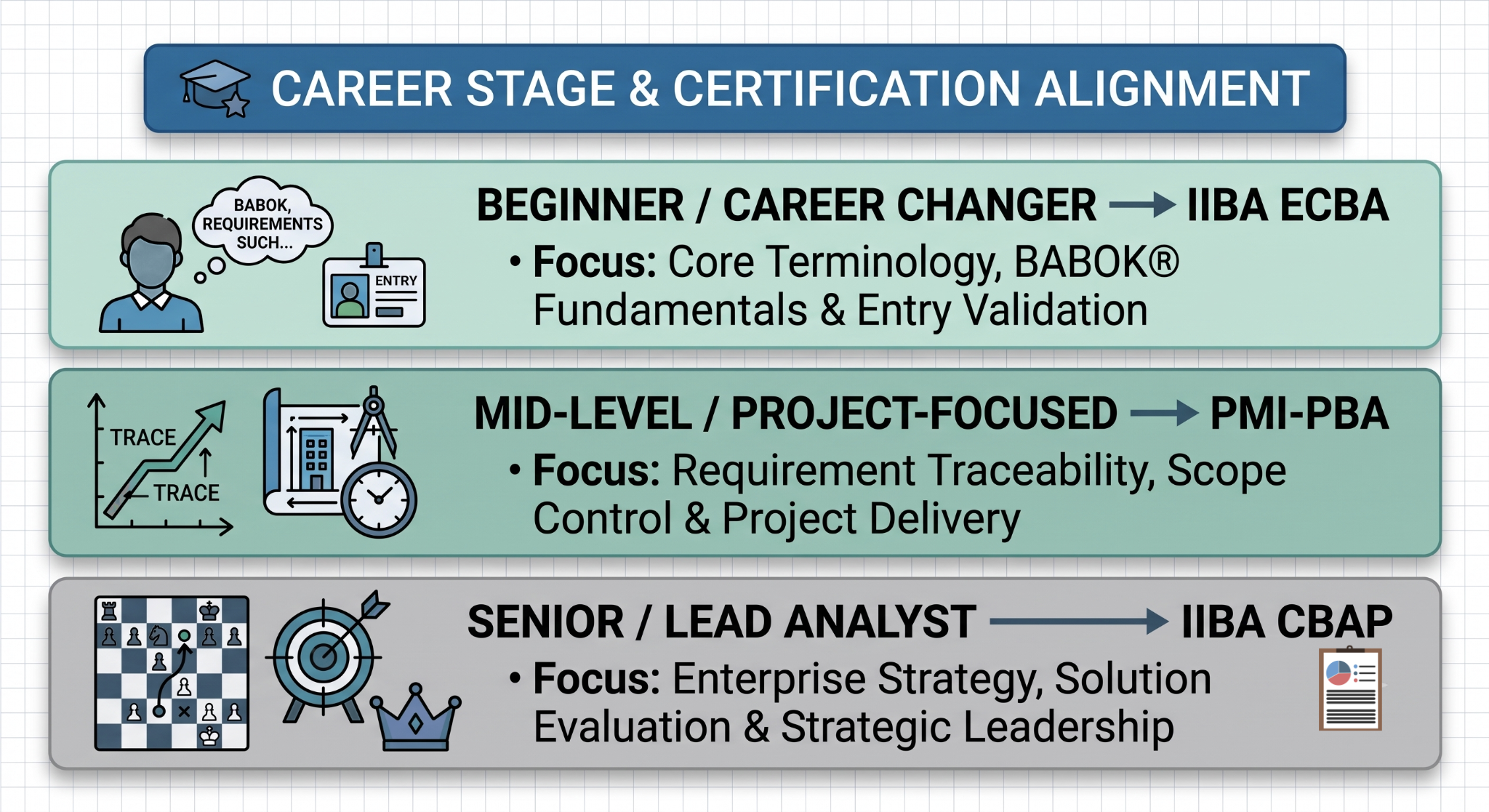
To ensure ROI is maximized, it is important to make strategic selection of your path:
IIBA ECBA (Entry Certificate in Business Analysis): Of high value to newbies, recent graduates, or career switchers moving into the field of technology from other fields. Since it has zero hours of work experience required, ECBA can serve as a sign of dedication. ECBA ensures that you know all the concepts of the BABOK® Guide, getting rid of the “zero experience” label and landing that highly sought-after interview.
PMI-PBA (Professional in Business Analysis): Best suited for mid-career analysts, project coordinators, or people operating in a project environment, as well as those using Agile approach. Conducted by Project Management Institute, it focuses on requirement traceability, scope management, and delivering business value. It enables the analysts having three to five years of experience to get a certification without waiting for their eligibility for advanced level exams.
IIBA CBAP (Certified Business Analysis Professional): The absolute gold standard for experienced analysts, lead consultants, and enterprise architects with at least 7,500 hours of experience in BA. The CBAP test confirms your readiness for managing complex organizational changes, strategic decision-making, and working on projects with substantial budgets. If you already have experience, CBAP will open executive-level opportunities, consulting contracts, and substantial salary raises.
Strategic Conclusion
View your business analysis certification as an intelligent investment in yourself, rather than simply an ornament for your LinkedIn profile or CV.
To ensure that you get your money’s worth, take some time to critically assess your current career status:
Review your experience: Make sure you keep an accurate count of your real experience in terms of business analysis knowledge areas to ensure your eligibility prior to making any non-refundable payments.
Chart your course: Pick the right certification to make sense as your next step to your desired role, be it ECBA, PMI-PBA, or CBAP.
1. Formal Certification
Formal Certification serves as an effective door opener at a very basic level. It assists in clearing the ATS recruitment filters, grounds one’s practice in standardized practices such as the IIBA BABOK Guide or the PMI standards and offers instant validation of competency in the field in the form of a certification.
2. Practical Execution
Knowledge by itself without the application of knowledge through practical execution falls short of its potential. Career advancement comes from formal training being translated through critical thinking, stakeholder negotiation, data manipulation and navigation through various systems and business value creation.
3. Combined Effect
The effect of the two combined creates a synergistic effect. While the certification ensures you have a seat at the table, the skills to effectively solve problems and negotiate will ensure your career takes off and earn you big.
The certificate alone will never become a substitute for practical implementation or good judgement. Nevertheless, in combination with a respected certificate, good critical thinking, effective listening skills, and technical communication, you get a truly formidable competitive advantage.
Implementing your theoretical knowledge through practical implementation, the correct certification will bring you great benefits for your whole career—in terms of interviews in higher levels and earning more money.