
Automating Quote-to-Cash Processes with Salesforce
Last updated on Oct 22, 2026
In today's business environment, being fast, accurate, and efficient is the key factor to success in the market. In the past, businesses used to see the process of transforming client needs into sale transactions as the disconnected series of transitions between departments, each responsible for particular stages of the process: prospects from the sales team, contracts from the legal team, payments and collections from the finance team, and order completion from the operations team, all using different software solutions and spreadsheets.
Quote-to-Cash (Q2C) is the whole cycle of a business process that includes configuration, pricing of the transaction, generation of quotes, contract management, order fulfillment, billing, collections, and revenue recognition processes. It is automated through Salesforce applications, such as Salesforce CPQ, Salesforce Billing, and Salesforce Revenue Cloud. Thus, Q2C became the unbroken revenue chain thanks to the Salesforce solution.
Understanding the Quote-to-Cash Process
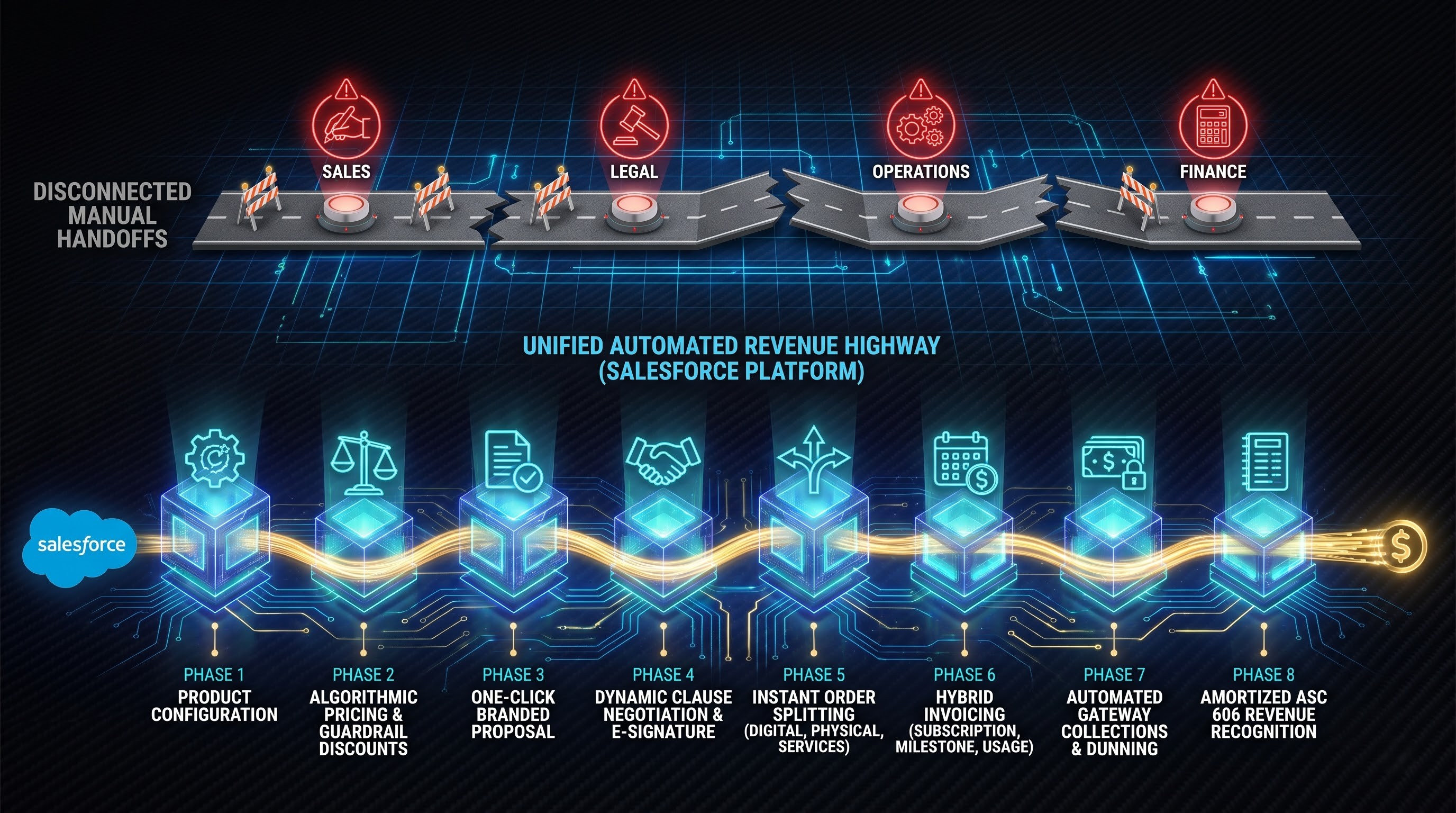
In order to get insight into the influence of automation on this process, we need to split the process into steps first. Quote-to-Cash is more than just a routine back-office process – it is a process that connects client engagement with the financial closing of the transaction.
Configuration
The sales process starts once the opportunity gets to the proposal level after having been at a prospect level. Configuring of products involves configuring of packages, which have software licenses, hardware, maintenance, and professional services to meet the needs of the prospect. If the process of configuring is not automated, then the sales representatives will probably configure the packages which will have incompatible components or the one that promises to deliver more than what the operations can deliver.
Pricing and Discounting
Once the process of configuring is completed, the next step to follow is that of creating pricing rules. Pricing for an enterprise changes and it includes discounts on volumes, discounts on customer tiers, promotion bundles, currency conversions, and distributors’ margins. When the pricing rules are not automated, they can be found in different spreadsheets and even in memory. They end up causing loss of margins and many discounts.
Quoting and Proposal Generation
The products and prices are ready and now it is time to make the document for the proposal. Manual quotation process ends up with the wrong branding, terms, and conditions.
Contract Negotiation and Execution
Legitimate approval, control of the redlines, and executive approval are key steps in the process of an enterprise deal. The current Q2C process enables seamless integration of quotes with the contract management process in such a manner that any deviation from standard in any clause would lead to governance steps prior to signing the document.
Order Management & Orchestration
Once the contract is signed, the quote becomes order, followed by segregation of deliverables into three delivery channels – delivery of digital products, allocation of the physical stock, and professional services deployment scheduling.
Invoicing and Billing
The invoices are generated from customer contracts. Invoicing today requires flexibility in modern approaches, such as usage-based billing, software subscriptions recurring, milestone, and hybrid models that would enable invoice generation based on agreements.
Cash Collection & Collections Management
Once the invoices are generated, the company will have to reconcile payments, handle payment gateway transactions, and perform dunning of past due invoices.
Revenue Recognition and Accounting
Final step would include the matching of cash flow and invoices according to the rules of accounting (ASC 606, IFRS 15). Revenue recognition must be separate from the invoicing and collections process.
Structural Issues with the Traditional Manual Process Flow
Organizations without automation processes face a number of intrinsic constraints that limit them:
Slow Deals Closing
Since sales representatives have to work in inconsistent systems or wait for days for the deal desk approval of their offers, they lose the entire momentum. Automation will enable the competing side to submit a proper offer that will gain customers' trust in crucial situations.
Losses of Margins and Mistakes
While entering information in different CRM and ERP platforms, mistakes happen. Poorly calculated pricing, wrong discounts, and billable events lead to substantial financial losses due to its negative influence on margins.
Customer Experience
A customer has to receive a consistent experience while buying and being onboarded. If the invoice issued in the billing department differs from the estimate provided by account executives, then all the trust goes away.
The Absence of Data and Poor Forecasting
Pipeline velocity, average deal size, net recurring revenue, and cash collections statistics have to be known to the management. With the help of automation, generating those reports takes weeks.
Architecture of SalesForce-Based Automation
In order to understand this architecture, it is important to develop a salesforce course management for consultants and administrators in order to combine the front office, middle office, and back office in one database. The process does not require any integration of different applications with custom integration, which can be very fragile. Instead, Salesforce creates customers, contracts, orders, and billing entities on the basis of customer entity.
Salesforce CPQ as a Front-End Engine
Salesforce CPQ is a pipeline revenue engine that controls product rules through validation, selection, and alerts on product bundling. For example, when the sales rep chooses enterprise software package, the engine takes into account the need for implementation services, but no additional add-ons are considered.
The evaluation of pricing rules is dynamic; in other words, the system calculates prices on contract basis taking into account the specifics of each customer, the volume of purchase, and discounting threshold. If the discount exceeds usual thresholds, then the Salesforce Advanced Approval workflows inform immediately the management, finance, and legal departments about it.
Unified Contract Management
Once the quote is accepted, the contracts are generated using the Salesforce CPQ. The end date, renewal date and asset information of the contract is captured in the customer record. If there are any changes or upgrades during the course of the contract, then the engine will generate pro-rated values and update the master contract without affecting the billing cycle of the existing contract.
Salesforce Billing: Integrating CRM and ERP
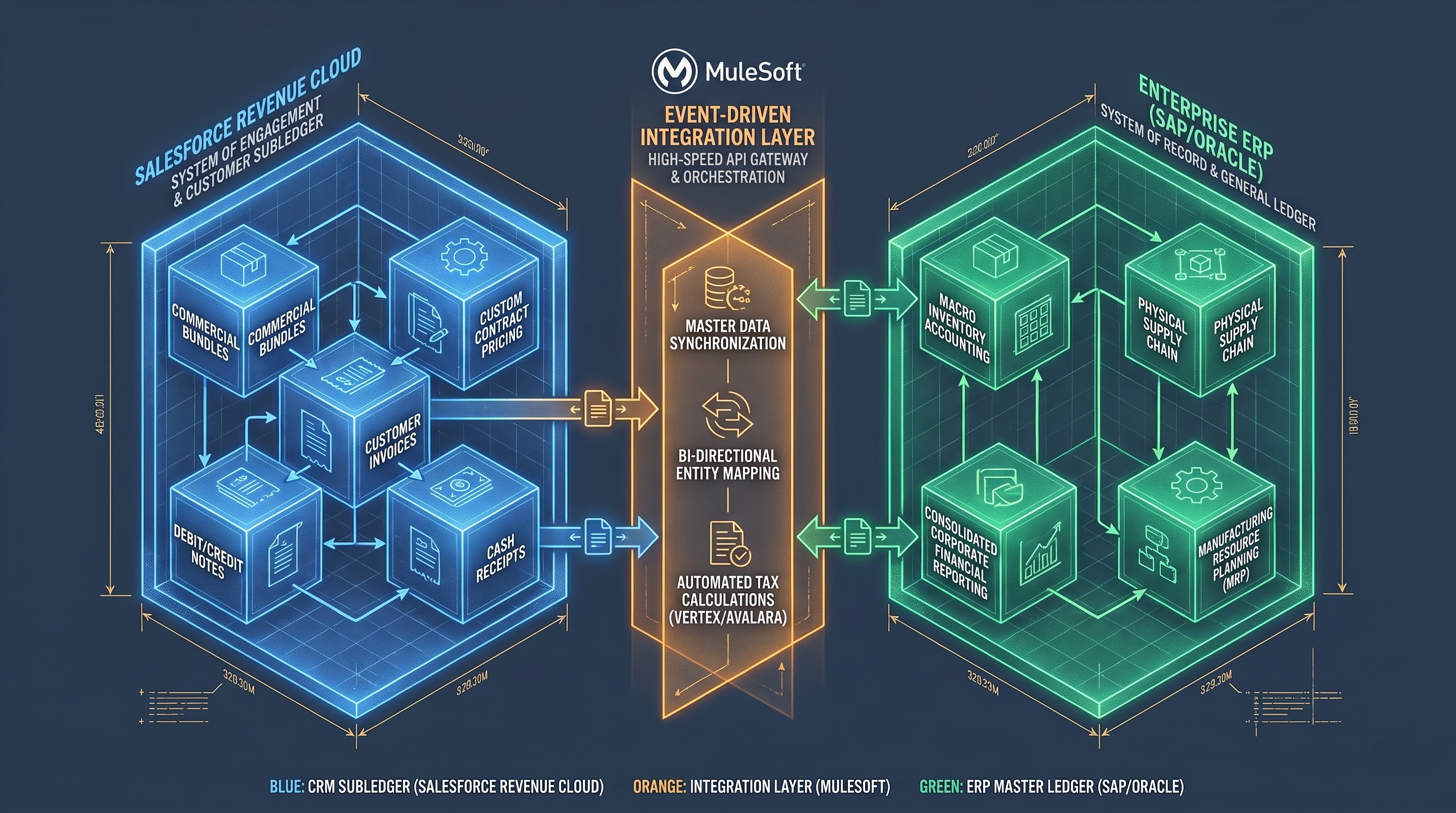
The transactions from CPQ orders are taken by Salesforce Billing and no further translation of the transaction is required. Since the order has all the necessary details of the line items, tax, payment term, shipping schedule; therefore, the billing engine creates all the recurring invoices and generates payments without any problems.
Instead of the ERP for the enterprise, the Salesforce billing works as a sub-ledger where all the financial operations of customers are managed. All the invoices, credit notes, payments, and revenue schedules are managed and then cleansed schedules are sent to the ERP systems such as SAP, Oracle, or NetSuite.
Automation Strategies at Different Process Stages for Q2C
Automation of Quote to Cash process in Salesforce is possible thanks to the following strategies, aimed at automating various stages of the process:
Guided Selling and Dynamic Bundling
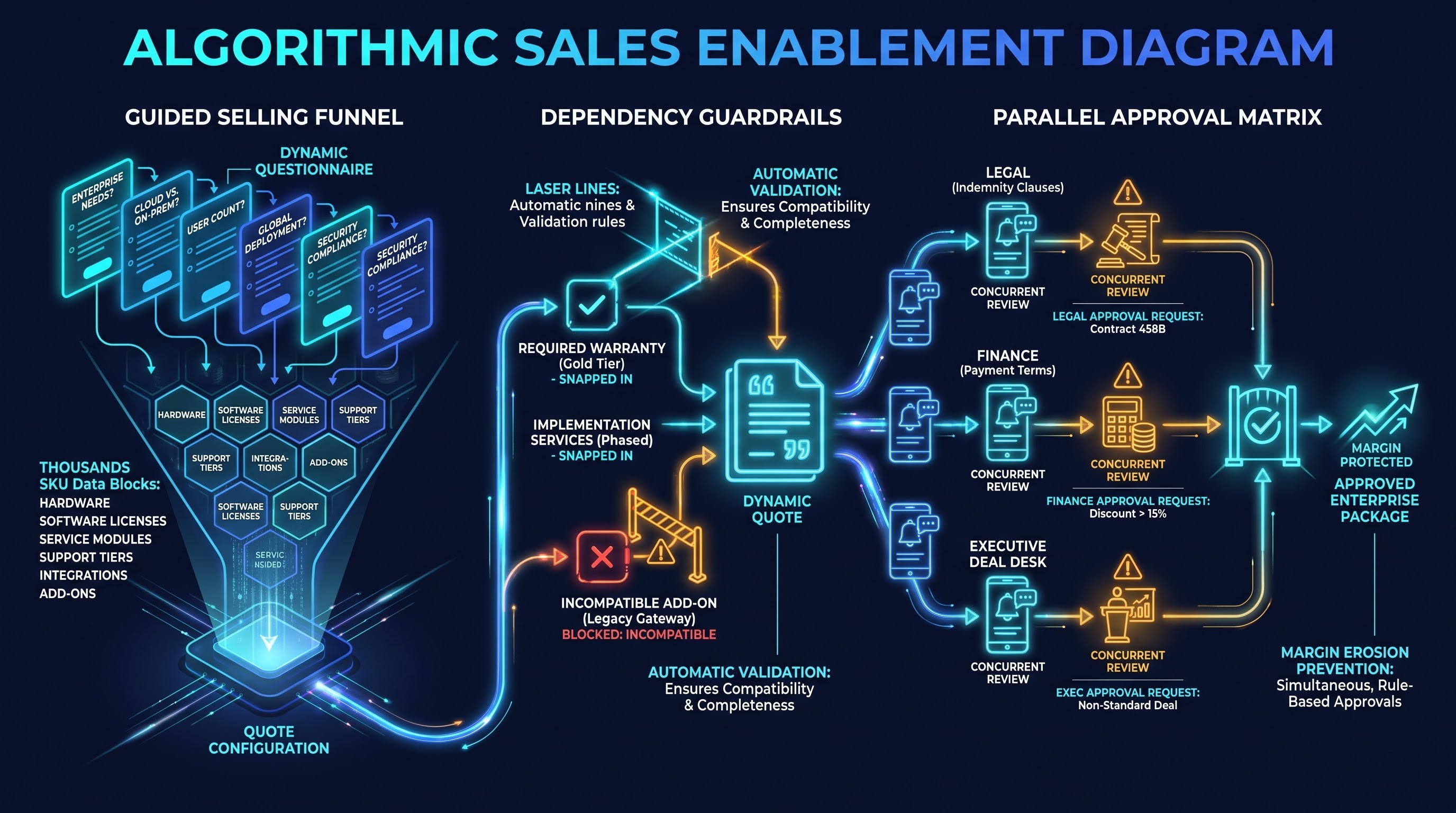
Usually, the case is that sellers face challenges when dealing with large and complicated offer catalogues. Thanks to the tool Guided Selling of Salesforce CPQ, the user is asked questions about the company size and industry, as well as technology requirements. Depending on the answers received, the system chooses the relevant products. The dependent products like maintenance and integration services are selected automatically.
Approvals via Governance
The majority of the times, approvals queues are associated with additional efforts. Via the tool of Advanced Approvals in Salesforce, the user configures workflows with several approval levels taking place simultaneously. For example, if enterprise-level quote requires the review of payment terms from the finance department and indemnity language from the legal one, both departments receive notifications simultaneously. Deals are approved by delegates via mobile notifications and emails.
Automation of Document Generation and e-Signatures
After the opportunity has matured to become a proposal, Salesforce generates the documents based on the pre-defined templates approved by the brand. The templates have conditional language depending on which standard clauses are generated automatically while the customized legal clauses are only generated when certain conditions in the deal have been satisfied. The integration of e-signature capabilities ensures that the system automatically checks the status of the document and closes the opportunity automatically upon receipt of the signature.
Order Creation and Orchestration
After the sales process is completed, order creation must be automated. In the Salesforce automation process, the order is automatically created from the approved quote. An order can be split into various delivery dates, business units, and geographic locations. Workflow automatically pushes information into the provisioning systems by making API calls and creating digital entitlements.
Billing of Hybrid Models and Invoice Schedule
As for the contemporary business environment, diverse billing options must be offered to companies. One and the same client can employ up-front hardware selling, subscription-based and usage-based models at the same time. All of this can be done with help of Salesforce Billing solution. It provides for milestone billing in case of successful project completion, automatic subscription on a monthly basis, as well as processing large amounts of consumption data from other sources and creating charges.
Renewal Management and Change Process
Renewal management is one of the main sources of income in case of recurrent revenue models. The renewal management is performed automatically by Salesforce system; renewal opportunities and quotes are created automatically some months before the expiration of the contract. Products become activated automatically, prices increase automatically, and opportunities for renewals are assigned to accounts automatically.
Benefits of Organization and Finance
The use of automation of the process of quotation and sales will bring the following benefits to the organization:
Speed Up Deal Cycle Time
Time involved in product verification, price calculation, and documentation preparation is reduced from days to minutes, and thus more time becomes available for customer interaction.
Prevention of Revenue Leakage
Revenue leakage may arise owing to discounts without approval, billable milestones ignored, and lack of usage tracking. The anchored digital quote and billing procedures ensure that any quote is billed at the approved rate, and all available services are billed automatically.
Significant Reduction in DSO
Delayed payments arise owing to delayed invoicing and billing errors. Invoicing right after delivery and detailed listing of all the information help avoid disputes. Payments and automatic dunning increase cash flow.
Compliance with Audit Readiness and Revenue Recognition
Strict compliance with accounting regulations implies that everything is properly monitored from the quote to the accounting entry. Salesforce provides a revenue recognition schedule on a line-by-line basis where the revenues are recognized either when the performance obligation is satisfied throughout the period of the contract or point-in-time. Audit trails are maintained for every approval, changes, and transactions made, thus minimizing chances of non-compliance.
Higher Customer Retention Rate
Easy Quote to Cash process will make your organization look professional, responsible, and concerned about their customers. Professional quoting, seamless hand-offs, and accurate billing will make your customers trust you and will bring higher net revenue retention and lifetime value.
Implementation Challenges and Best Practices
Even though there are numerous advantages of Q2C automation, transition to the automated process requires special attention.
Alignment on Cross-Functional Front
The major mistake in implementing Q2C project is perceiving it as the sales or/and IT project. It is important to understand that quote-to-cash affects not only sales, but also deal desk, legal, operations, billing and accounting departments. To implement the system successfully, it is important to have a steering committee consisting of the equal number of members of sales management team and controller's department. It is necessary to harmonize products, discounts and billing periods prior to the configuration process.
Product Portfolio Harmonization
Quite often companies try to automate their processes for several years without even clarifying their own product portfolio. Automation of tens of thousands of SKUs, bundles and pricing rules makes CPQ configuration quite fragile and complex process. Prior to the configuration process, it is necessary to conduct a catalog rationalization project.
Scalability Aspects in Case of Design for Performance and Extensibility
The transaction data, product rules, and approval matrix of the enterprise-scale application involve huge volumes of information. Salesforce architect is expected to consider the possibility of extending the system. Over engineering of the custom scripts as opposed to declarative rules defined by the platform would negatively affect performance and upgradability of the system.
Emphasis on Change Management and Adoption
Any automation engine of such complexity will prove useless if the end users cannot use it properly. The sales representatives used to freedom of ad-hoc transaction processing via spreadsheets will not easily adopt configurative rules. This implies that the management needs to undertake the enablement programs, which include the salesforce certification course, to ensure that those involved in the sales process and the technical team are aware of the automation of the workflow. Highlighting to the users the advantages of the tool as a cost and time saving solution that also increases commissioning speed would be a good approach to adopting the system.
Deep-Dive: Enterprise Architecture, Integration, and Governance
Enterprise Architecture is a key element of developing a robust Q2C solution. Q2C solution involves front office sales processes and corporate accounting processes which requires setting boundaries for transaction data.
Establishing System Boundaries Between CRM and ERP
One of the problems that have been plaguing the design of enterprise systems has been establishing boundaries between Salesforce Revenue Cloud and ERP. According to the best practice standards, Salesforce should act as a system of engagement and transaction processing engine for all processes related to the interaction with customers such as configuration of products, pricing, creation of contracts, orders, invoices and transactions.
In turn, the ERP should work as a system of records for the following processes: inventory accounting, manufacturing resources planning, general ledger accounting, tax processing and consolidated financial accounting. In this case, the Salesforce billing should handle all subledger data, which includes all debits and credits related to the invoices, debit notes, credit notes and allocations.
At the end of the accounting period or daily period of finance, all these data should be summed up and passed to the general ledger of ERP via middleware.
Integration of Data Harmonization & Middleware Integration Architecture
For seamless automation to be attained, it is important for the company to implement extremely strict master data management processes. This is due to the fact that in most cases, products, taxonomy and customers are stored in old systems under various names and codes. For any form of automation process to be attained, the company needs to implement its golden master.
In most cases, ERP system or the master data management system in an organization acts as the golden master of the base product and the financial calendar while Salesforce acts as the golden master of the commercial product bundle, customer pricing strategy and sales contracts.
In order for these two systems to be integrated, there is a need for very robust integration patterns. Point-to-point integration can no longer be sustained with the introduction of any new business logic in the company. There is a need to implement wide spread automation processes using event-driven architecture and middleware like MuleSoft.
Automated Taxation and Global Compliance Management Systems
The transaction process must incorporate all the information about the tax system, including the ever-changing state tax, Canadian Goods and Services Tax, and VAT. The manual tax management is certainly destined to fail due to the constant change in the global business environment. Modern day Salesforce operates effectively with the automated taxation systems, such as Avalara AvaTax, Vertex, and Sovos. During the process of quotation and invoicing, Salesforce is integrated with the tax engine according to the customer address, tax exemptions, and product tax codes. This tax calculation system provides immediate jurisdictional taxations, which are automatically added to the quote document and tax invoices without any need of investigation.
Multi-Currency and Entity Governance
Solutions of multi-currency and entity governance are required for multinational corporations that work with different entities. The currency mechanism in Salesforce depends on the currency standard of the corporation and exchange rates according to the particular date.
In cases where international conglomerates have different legal entities, Salesforce Billing assigns billing rules and legal entities directly at the order line item level. In this way, it is possible for a single enterprise quote to create multiple invoices and send them through the various legal subsidiaries along with VAT registration numbers, different bank remit to instructions, and different financial calendar. With this functionality, international companies will not have to make changes in the Salesforce setup in order to venture into new markets.
Practical Case Studies: Implementation in Industry
Following practical case studies demonstrate the effectiveness of the automated Quote-to-Cash process in resolving the problems in the industry:
High Growth Software as a Service (SaaS)
One of the SaaS firms switched from the traditional perpetual licensing model to subscription and consumption models. Earlier, the sales force would negotiate multi-year deals, which were complex in nature; for instance, fifty licenses for the first year, one hundred for the second year, and so on. It was taking two weeks of the month-end period for the finance team to reconcile the reports against the contracts and pricing.
The use of Salesforce CPQ and Salesforce Billing assisted the company in automating ramp up pricing over many years and dynamic consumption pricing. While Salesforce CPQ automatically applied pre-negotiated discounts in various categories, Salesforce Billing automatically imported daily API events and calculated continuous consumption pricing. Seventy percent decrease was observed in time taken to close at month end; time taken to prepare proposals dropped from three days to fifteen minutes; and unbilled revenue leaks came to an end.
Medical Device and Manufacturing
A multinational medical device manufacturing company struggled to make accurate quotations due to the problem of incompatibility between the devices and regulatory requirements. Sales personnel often missed mentioning required power modules or sterilization modules in the proposals.
CPQ by Salesforce, together with the automation of Guided Selling and product validation rules, was applied in the case. In addition, reps needed to answer the discovery questions related to the specifications of the hospital, and then the system would calculate the configuration of the equipment according to these specifications along with required consumables and warranties. Additionally, the approval routing functionality allowed ensuring that the requests for extending the payment terms would not be sent via emails but would automatically be routed to the regional finance directors for signing on their mobile devices.
Conclusion
For the companies that implement Q2C automation on the basis of Salesforce, the importance of this change is not only the implementation of the new technology but an essential shift in the strategy of managing revenue generation of organizations. As Salesforce integrates sales, contracts, and payments in one source of truth, companies gain an opportunity to manage their business processes efficiently.
The automation of the Q2C process allows organizations to save time, increase margins, close the deals faster and offer better customer experience. In the current business environment, when efficiency and reliability of cash flow are the key factors of the success of businesses, Q2C automation proves to be an essential platform for sustainable development.