
Beyond APIs: How MuleSoft Connects the Systems Behind Modern Business
Last updated on Sep 12, 2026
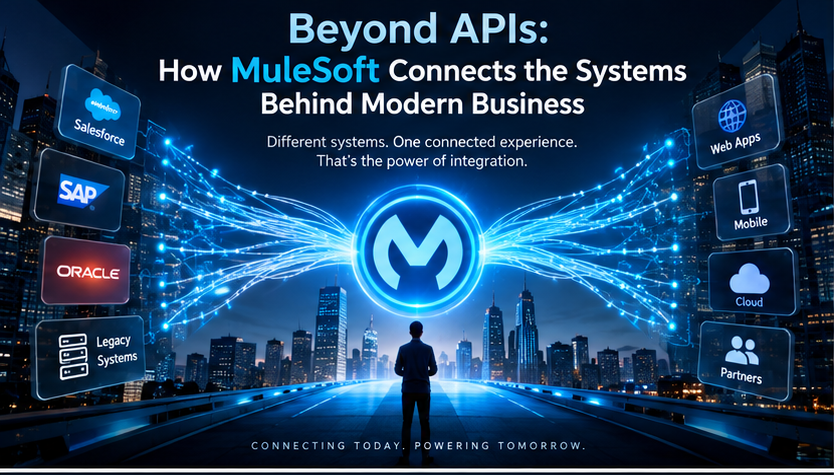
Modern businesses rarely run on one application. Behind every smooth digital experience is a complicated conversation between systems, data, APIs, and people. MuleSoft helps make those conversations possible.
Imagine placing an order on an online store. You click Buy Now, complete the payment, and within seconds the website confirms your purchase. A little later, the warehouse knows what needs to be packed, the inventory system has adjusted the stock count, the shipping provider has received the delivery information, and you get an email or message confirming the order.
From your perspective, it feels like one simple process. Behind the screen, it may involve a website, payment gateway, customer database, CRM, inventory platform, ERP, warehouse system, shipping service, notification platform, and several APIs communicating with one another. That is the part customers rarely see. Modern businesses have become collections of applications that need to behave like one connected environment. The challenge is no longer simply choosing good software. It is making sure all that software can exchange information reliably, securely, and at the right moment.
This is where MuleSoft becomes interesting. Rather than thinking of MuleSoft simply as another API tool, it is more useful to see it as part of the integration layer that helps organizations connect applications, data, processes, and experiences. Its value becomes clearer when we stop looking at individual APIs and start looking at the much bigger problem they are helping solve.
The Integration Problem: Why Modern Businesses Have Too Many Systems
The modern enterprise did not become complicated overnight. Most organizations accumulated technology over years.
A company might start with a CRM. Then it adds an ERP for finance and operations. Later comes a cloud-based HR platform, an e-commerce application, a marketing automation tool, a data warehouse, mobile applications, customer portals, and perhaps a few older systems that nobody wants to replace because they still perform an important job. Each system may work perfectly well on its own.
The problem starts when they need to work together. A sales representative, for example, may need customer information from the CRM, pricing information from an ERP, product availability from an inventory database, and credit information from another system. If those applications cannot communicate efficiently, employees end up switching between screens, copying information manually, or waiting for another team to provide the data.
That creates a strange situation: the company has invested heavily in digital technology, yet people are still doing work that could have been automated. The technical problem is often described as integration, but the business impact is much bigger. Poor integration can slow down customer service, introduce duplicate records, create inconsistent information, and make simple changes surprisingly expensive.
There is another issue that becomes obvious as organizations grow. Connecting two systems once is relatively straightforward. Connecting dozens of systems—and then maintaining those connections as the business changes—is an entirely different challenge. This is where the traditional point-to-point approach starts becoming difficult. Suppose System A needs to communicate with System B, System C, and System D. Then System B needs connections with C and D as well. Before long, the organization has a web of dependencies that can be difficult to understand and even harder to maintain.
One application changes its data format, and several integrations may need to be modified.
One API changes its authentication method, and multiple processes can suddenly be affected.
One business rule changes, and developers have to trace where that rule has been implemented across the organization.
The result is often what integration teams know too well: a technically functional environment that becomes increasingly difficult to change. Good integration is therefore not simply about making systems talk. It is about making them talk in a way that remains manageable as the business grows.
Beyond APIs: Where MuleSoft Fits Into the Conversation
APIs are often presented as the answer to disconnected systems—and they are an important part of the answer. An API provides a defined way for one application to request or exchange information with another application. But an API by itself does not magically solve an organization's integration problem. Think about two people having a conversation. Giving them a common language helps, but the conversation still needs context, rules, coordination, security, and a clear purpose Enterprise integration works in much the same way. MuleSoft's role becomes more meaningful when it is viewed as a platform for managing these interactions rather than simply as a mechanism for creating APIs. The broader goal is to connect applications and data in a structured way while allowing organizations to reuse those connections across different business needs.
This matters because the same information may be needed in many places. A customer record, for instance, might be required by a website, a mobile application, a service representative, a marketing platform, and an internal analytics system. Instead of building a completely separate integration for every consumer, an organization can create reusable services around that data.
That changes the way integration is approached. The focus moves from “How do I connect these two applications?” to “How do I expose this capability so that multiple parts of the business can use it?” That is a much more strategic question.
MuleSoft's Anypoint Platform is designed around this broader integration lifecycle, bringing together capabilities for designing, building, managing, securing, and monitoring APIs and integrations. For someone entering the field, this is also why simply memorizing MuleSoft terminology is not enough. Understanding integration architecture, APIs, data transformation, authentication, error handling, and business processes is equally important. A structured mulesoft course can help build that foundation, but the real understanding comes from seeing how those individual concepts fit together in an actual business workflow. The important shift is from isolated connections to reusable connectivity. And that leads directly to one of MuleSoft's most recognizable ideas: API-led connectivity.
API-Led Connectivity: Turning Integrations Into Reusable Building Blocks
Imagine a company has a customer database containing names, addresses, account information, preferences, and purchase history.
A web application needs some of that information.
A mobile application needs it too.
The customer service team needs it.
A partner portal may need a limited version of it.
One approach would be to create separate connections from each application directly into the database. It might work initially, but now every application knows too much about the underlying system. If the database changes, several integrations could break.API-led connectivity approaches the problem differently by creating layers of reusable APIs. A common MuleSoft architecture describes these as System APIs, Process APIs, and Experience APIs. System APIs sit close to the underlying systems and expose their capabilities in a controlled way. Instead of every application needing to understand how a particular database or legacy system works, the system's capabilities can be made available through a consistent interface.
Process APIs operate at the business-process level. They can combine information from multiple systems and apply business logic. For example, a customer service application might need customer information from a CRM, order history from an ERP, and delivery information from a logistics system. A Process API can bring those pieces together into a meaningful business-level service. Then come Experience APIs. These are designed around the needs of a particular experience or channel. A mobile application may need information in a different structure from a web portal or an employee-facing application.
The important idea is separation. The customer-facing application does not need to know exactly where the data originated. The underlying systems do not need to understand every application consuming their information. Each layer has a responsibility. This architecture also makes reuse possible. Once an integration capability is created, another application can consume it instead of forcing developers to rebuild the same connection from scratch. Over time, an organization can develop a reusable catalog of APIs and integration assets. That is where API-led connectivity becomes more than an architectural diagram. It becomes a way of thinking about enterprise technology. Instead of treating integration as a series of one-time projects, the organization starts treating connectivity as a reusable business asset. And that distinction becomes extremely valuable when the number of applications keeps increasing.
Inside a Real Business Workflow: How MuleSoft Connects the Dots
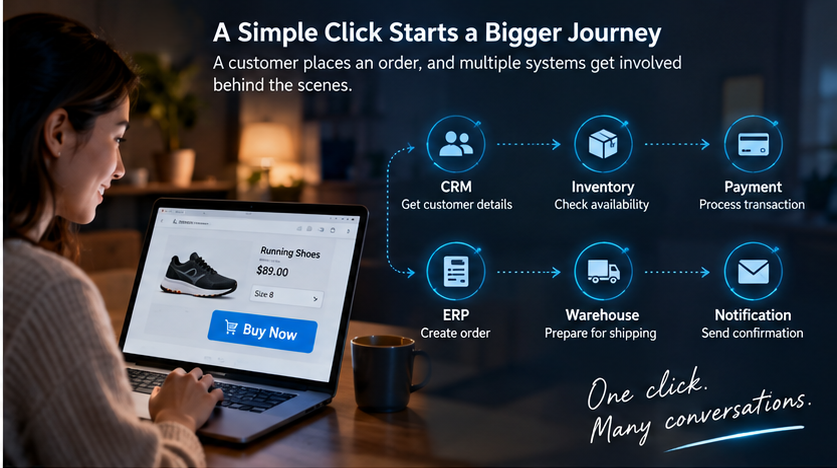
Let's take something familiar: placing an order online. A customer visits an e-commerce website, selects a product, enters their details, and clicks Buy Now. It feels like a single action, but behind that click, several systems may immediately become involved. The website has to communicate with customer records, inventory, payment services, order management, shipping, and notification systems. The customer sees one smooth experience; the technology behind it is anything but simple.
From One Click to Multiple Systems
When the customer places the order, the e-commerce application can send an API request containing information such as the customer ID, product, quantity, price, and order details. An integration layer can then coordinate what happens next instead of forcing the website to understand how every internal system works.
Customer information might be retrieved from a CRM, while the order is sent to an ERP or order-management system. At the same time, inventory may need to be checked and the payment processed through an external payment service. Once the transaction is confirmed, fulfillment information may need to reach the warehouse and shipping systems. What looks like one transaction to the customer can therefore become a chain of conversations between different applications.
When Systems Speak Different Languages
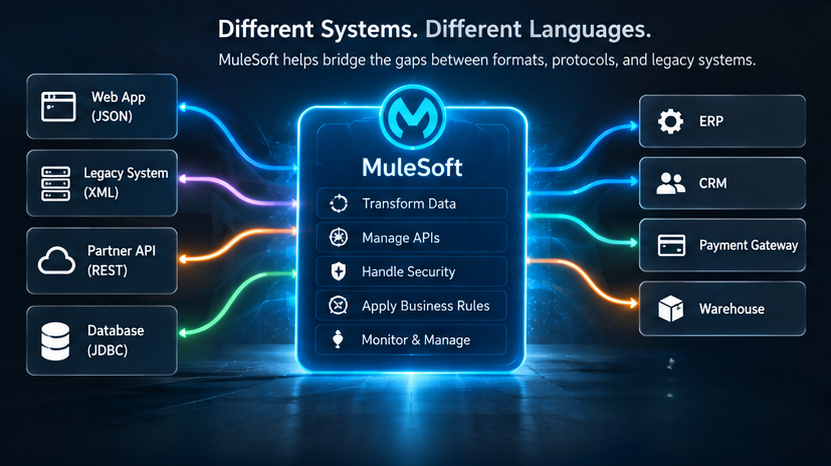
The challenge becomes even more interesting when those systems were built at different times or by different vendors. The modern e-commerce application might exchange information using JSON, while an older enterprise application may still expect XML. One system may identify a customer using a customer ID, while another expects an account number. Even when two systems technically have APIs, their data structures and requirements may be completely different.
This is where integration becomes real engineering rather than simply connecting two applications. Data may need to be transformed from one format to another, authentication needs to be handled securely, and business rules need to determine what information should move where. MuleSoft can provide the integration layer for these interactions, allowing applications and services to exchange information without requiring every system to understand every other system.
What Happens When Something Goes Wrong?
The real test of an integration is not when everything works perfectly. It is what happens when something doesn't.
Imagine the customer has successfully completed payment, but the warehouse system suddenly becomes unavailable. If the integration has not been designed for this situation, the payment system may show a successful transaction while the order-management or warehouse system has no record of the order. From the customer's perspective, money has been taken but the order appears to have disappeared.
A well-designed integration anticipates these failures. Depending on the workflow, the request might be retried, temporarily queued, logged for investigation, or routed for human intervention. Error handling, timeouts, logging, and monitoring are therefore not secondary details. They are part of what makes an integration reliable enough to support a real business.
The Complexity Customers Never See
This is why enterprise integration can be almost invisible when it is working properly. Customers don't think about APIs when their order confirmation arrives within seconds. Employees don't think about integration architecture when customer information automatically appears in the application they are using. The technology disappears behind the experience. And that is often the point. The goal isn't to make the customer aware of how many systems are communicating. The goal is to make those systems work together so reliably that the complexity remains behind the scenes.
Where MuleSoft Fits In
MuleSoft can sit between these different systems and help coordinate the movement and transformation of information. Instead of creating a collection of fragile, one-off connections, teams can build integration flows around APIs and reusable services. This creates a more organized way to handle communication between applications, data sources, and business processes.
For professionals learning the platform, this is also where theory starts becoming practical. Building flows, transforming data, connecting APIs, handling exceptions, and understanding how different systems interact can make integration concepts much easier to grasp. Practical mulesoft training can support that learning, particularly when it includes realistic business scenarios rather than focusing only on individual platform features. MuleSoft doesn't make an enterprise magically simple. It gives teams a structured way to manage the complexity that already exists. And when that complexity is managed well, the customer gets something that feels remarkably simple: click, pay, and wait for the package to arrive.
From Integration Tool to Business Strategy: Why MuleSoft Matters
The most interesting thing about enterprise integration is that its importance often becomes visible only when something goes wrong.
A customer cannot see an updated order status.
An employee cannot access the information they need.
A partner receives outdated data.
A new digital service takes months to launch because developers first have to connect it to five internal systems.
These problems may look like application problems on the surface. Often, the deeper issue is connectivity. That is why integration has gradually moved from being a purely technical concern to becoming part of digital strategy. Companies want to launch products faster. They want to modernize legacy systems without necessarily replacing everything at once. They want cloud applications to coexist with older infrastructure. They want mobile, web, partner, and employee experiences to use consistent business information.
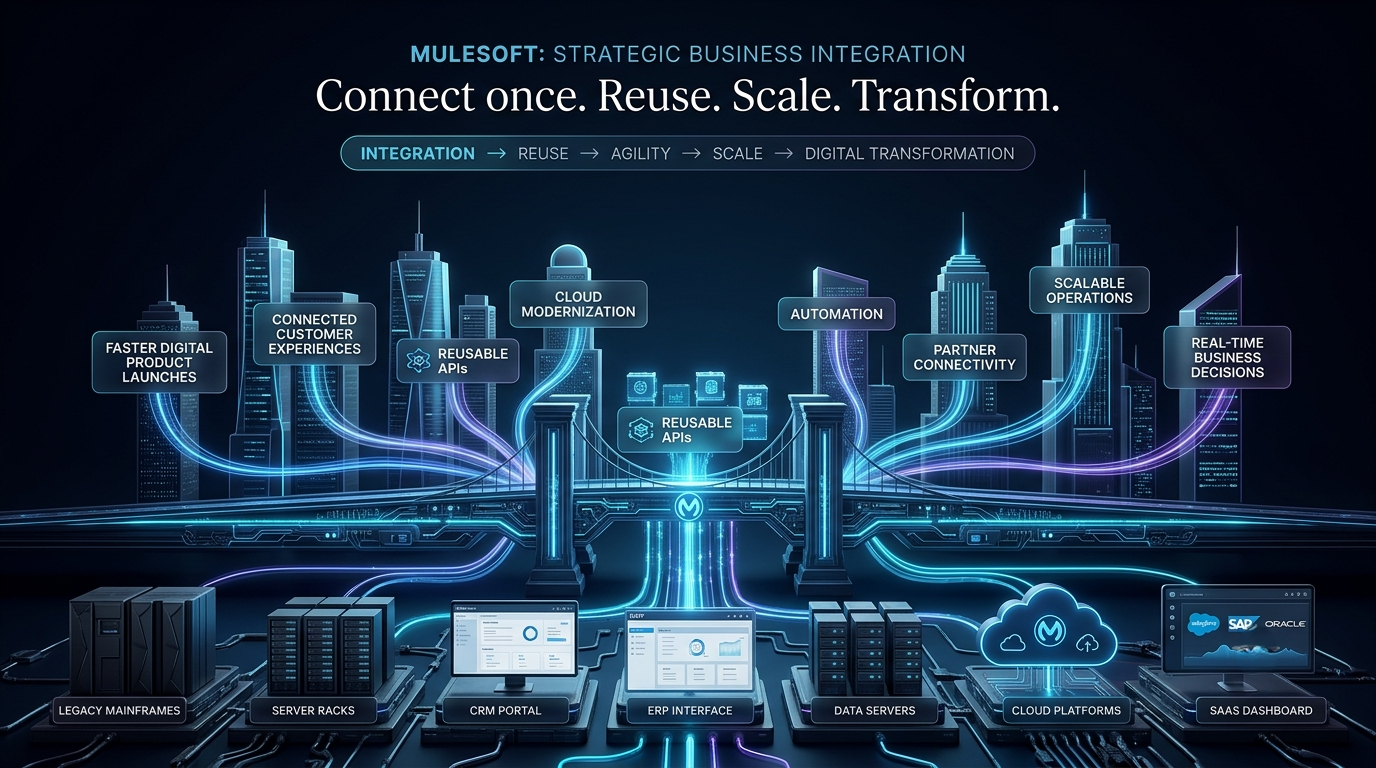
All of those goals depend on systems being able to communicate. MuleSoft's value lies in helping organizations approach that connectivity systematically. Instead of creating hundreds of isolated integrations, teams can establish reusable APIs, apply governance, manage access, monitor traffic, and create integration patterns that can support future applications. There is also an important organizational benefit. When integration assets become reusable, different teams do not have to solve the same connectivity problem repeatedly. A capability created for one project can potentially become useful for another.
That can change the economics of integration. The first project may require significant design and development effort. But if the resulting APIs and services are designed for reuse, later projects can build on that foundation instead of starting from zero. This is one reason learning MuleSoft is not simply about learning another enterprise platform. It can also mean learning how modern organizations think about connectivity, reuse, architecture, and digital change.
For beginners, mulesoft online training can provide a convenient way to learn the platform and its concepts, especially when combined with hands-on projects that simulate real integration scenarios. The goal, however, should not be to memorize components or follow tutorials mechanically. The stronger skill is being able to look at a business problem and recognize what needs to communicate, what data needs to move, where business logic belongs, and how the integration should behave when something goes wrong. That mindset is what separates a collection of integrations from an integration strategy.
Conclusion: The Best Integration Is the One Nobody Notices
Modern businesses are built from systems that were often never designed to become one giant system. A CRM comes from one vendor. An ERP comes from another. A company may have databases that are decades old, cloud applications that were adopted last year, and new digital products being developed today. Yet customers expect all of them to work together. They expect an order to appear in the right place. They expect customer service representatives to see accurate information. They expect inventory to update. They expect notifications to arrive. They expect the experience to feel simple.
That simplicity is deceptive. Behind it is a constant exchange of data and business logic between systems. MuleSoft sits within that complicated conversation, helping organizations build a more structured approach to connectivity through APIs, integrations, reusable services, and management capabilities. The real story, then, is not simply about APIs. It is about what happens after APIs become part of a much larger architecture. Because the future of business technology is unlikely to be defined by one application doing everything. It will be defined by many specialized systems working together so smoothly that, from the outside, they feel like one. And when that happens, the integration layer becomes almost invisible.
That may be its greatest success.
The customer sees the experience.
The business sees the outcome.
The integration team sees everything that had to happen in between.