
Beyond Prompting: Using Generative AI for Accurate Business Analysis
Last updated on Sep 28, 2026
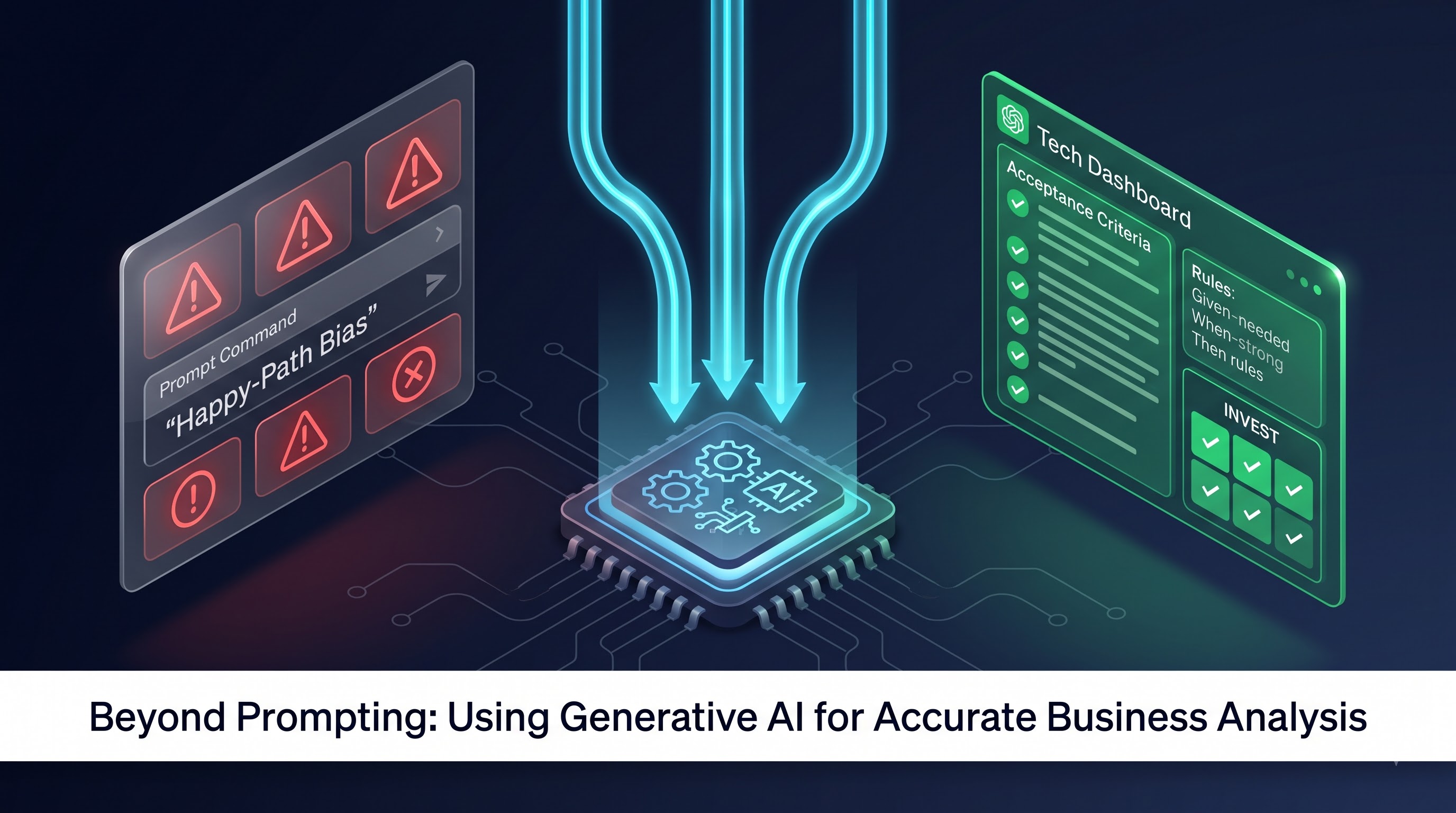
Generative AI has reached the point where it is now commonplace in the field of corporate use of technology. Initially, large language artificial intelligence was employed as a kind of writing machine, used by business analysts and product managers who experimented with easy requests like "Compose a user story for online checkout" or "Prepare acceptance criteria for a password reset."
The results appeared polished from the outside. Sentences were grammatically correct and filled with words used in Agile methodology. However, problems arose for software developers, quality assurance managers, and subject matter experts at the stage of real application of created tickets.
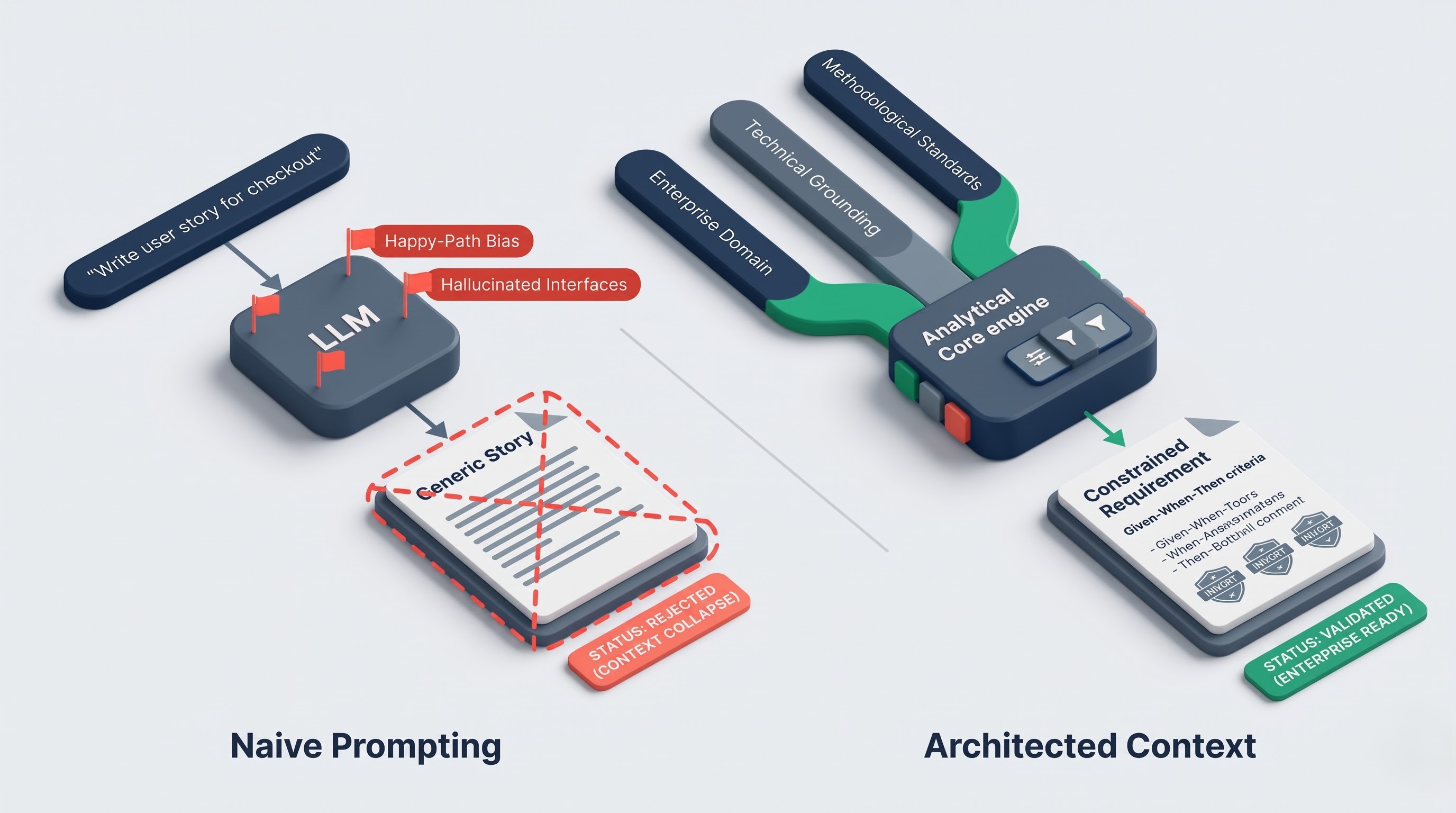
The models fabricated connections to nonexistent systems. They failed to take such limitations as tax compliance, data residency requirements, and limitations in transaction processing into account. They created standard happy-path stories, failing to consider real world exceptions. Most importantly, the tool lacked any details regarding organizational specifics.
Currently, business analysis does not refer to any brilliant instantaneous advice. It refers to consistent discovery, integration, negotiation, and validation of business goals through appropriate technical means. If a senior analyst employs generative artificial intelligence today, it would mean that cognitive exploration is not being delegated but stable structural contexts are being created. Learning how to achieve this working balance requires rigorous hands-on BA training analysts, during which analysts will be taught how to use large language models as active interrogators, semantic processors, and edge cases generators within the organization at hand.
To understand this change, one should not stop at generic prompting instructions focusing on how contextual requirements engineering works. By studying how context collapses, what durable structure can be built, how edge cases can be extracted, and what framework should be used for enterprise protection, modern analysts can turn generative AI from a mere typing assistant into a powerful tool for requirements engineering.
Understanding the Anatomy of Contextual Collapse
Understanding why straightforward prompting is ineffective with enterprise software delivery requires analyzing the chain of events that takes place once the analyst attempts to use either an unrestricted or generic foundational model to create a requirement.
Every software system is surrounded by an invisible but complex mesh of past choices, unarticulated architectural solutions, compliance criteria, organizational solutions, and particular work customs. Therefore, when a business analyst composes a conventional user story, the person is unconsciously filtering the problem through these internal principles. Analysts understand that System A interacts with System B through an asynchronous queue which introduces a delay. They understand that Customer Support processes cancellations by hand when the request is more than sixty days old. They understand that a particular payment gateway won’t work silently under certain session conditions.
Unlike a raw large language model, which has no situational grounding, it uses statistical next-token prediction across all the available space on the internet. Therefore, if we ask it to generate the requirements for a particular feature, it will simply give us a result which represents a general statistical mean found for this feature across billions of webpages.
This discrepancy leads to the so-called contextual collapse: the total disintegration of the region of proprietary enterprise reality and its replacement with generalized industry archetypes.
Contextual collapse is realized in four failure points
The first failure point is functional generalism. The model produces user-story-like phrases that sound good logically but provide no actual functions. For instance, a user story stating "As a user, I want to see my orders in order to control my expenses" does not describe what limits on pagination, what caching policies, what stages of currency conversion, what schema migrations, or what limits concerning read replicas must be set. It depicts an intention but does not clarify the system's behavior.
The happy-path bias has an impact on the system scope. Foundations of models are based on guidance documents, marketing materials, and product descriptions, which place too much importance on the success paths. However, the real enterprise software often spends the majority of its resources on manipulating exceptions, failures, race problems, availability of data, and human failures. Thus, requirements, which analyze only good paths, transfer the burden to development sprints and lead to delays and cascade of errors.
The regulatory and operational invisibility leads to heavy downstream risks. In the industries where many rules exist, such as finance, healthcare, telecommunication, and international trade, the restrictions for requirements are strict. In this case, the request for invoice creation will generate common fields in the invoice neglecting the specifics of the law concerning taxes, audit trails, and documentation signing.
Fourthly, the false validation leads to the teams becoming complacent without having done anything worthy. This is due to the fact that generative models create lucid, well-composed writings leading to the stakeholders confusing fluency with analyticality. Therefore, a badly constructed requirement written in perfect Agile language is more dangerous than a scribbled note, as the first option hides the problem under the polished paper.
Today’s business analyst understands that prompting alone is not enough to deal with the issue of contextual collapse. Precision is possible only when there is a certain operating model that ensures that structured reality gets into the generative system before the document is created.
Architecting the Context: The Triad of the Ingestion
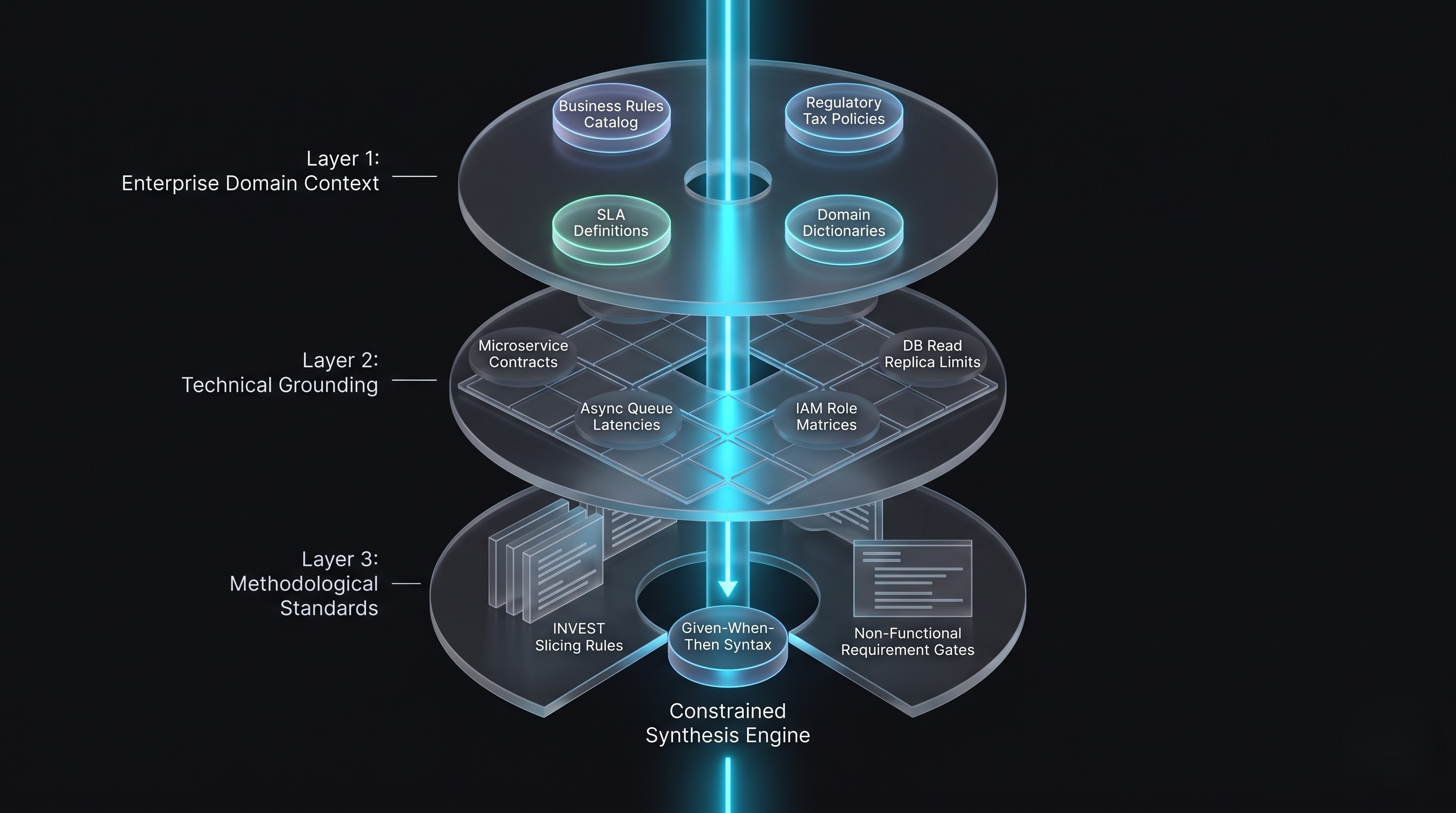
Business analysts do not just create conversations with the help of large language models. They serve as context curators who create context by injecting the original proprietary materials into the system and processing them.
Enterprise Domain Context
Enterprise Domain Context denotes the hard business facts that are important to be addressed when implementing the project. This category includes regulatory legislation, service-level agreements, business terms, customer segment differentiation, and business rules catalogues.
Analysts who don’t use artificial intelligence do not have access to the information in question as it may be dispersed across many folders, outdated wiki-pages, or may exist only in memory of a few experienced professionals. To prepare the information mentioned for an intelligent synthesis loop analysts create modular domain dictionaries, i.e., short texts with the definitions of the points stated above.
The use of domain context in requirement definition allows the analyst to establish a valid foundation. For instance, in case there is an absolute company rule stating that customer data should never be hard deleted, that rule will be part of domain context.
The technical grounding is necessary to properly guide the architectural implementation. In this regard, it must be pointed out that getting rid of technical constraints is one of the most efficient ways of ruining the release process. Nowadays analysts always take technical context into account when developing the generative model.
This layer provides technical grounding to the generative model and may be represented in the following way:
Architectural constraints such as microservices limits, event-driven messaging limits, and asynchronous messaging protocols.
Specification of legacy systems and interface definitions along with database constraints that are already known.
Identity and access management systems including role-based and attribute-based access control systems.
Performance and operational SLAs, which include response time limits, batch processing time periods, and peak concurrent users.
Having equipped the generative workflow with required interface definitions and requirements, the analyst can stop realizing imaginary systems. Moreover, in this case, the model will stop creating systems that are expected to make real-time synchronization between different systems.
Methodological Standards
The third element of context architecture lays down the structural rules for generating the requirements in the organization, outlining how they will be formulated, evaluated, and documented.
Organizations have different understandings of Agile frameworks, with some organizations relying on strict formal behavioral specifications in the Given-When-Then format to enable automated testing runners, while others may insist on the standard user story format to accompany their non-functional requirement checklists or compliance traceability matrices and audit approval blocks.
At this moment, analysts are required to outline the above-mentioned criteria in the context layer by advising on readiness definition, establishing syntax for acceptance criteria, setting functional logic apart from UI designs, and watching for non-functional compliance. Being able to intuitively compose these settings is among the subjects of structured classes for online business analyst classes, who learn how to translate imperfect business models into feasible technical standards. All three streams, namely Domain Context, Technical Grounding, and Methodological Standards make the generative model fulfil the functions of an analytical mechanism rather than those of a fortune teller.
The union of all three streams—Domain Context, Technical Grounding, and Methodological Standards—results in transforming the generative model from being a guessing oracle into being a constrained analysis engine.
High-Fidelity User Story Generation
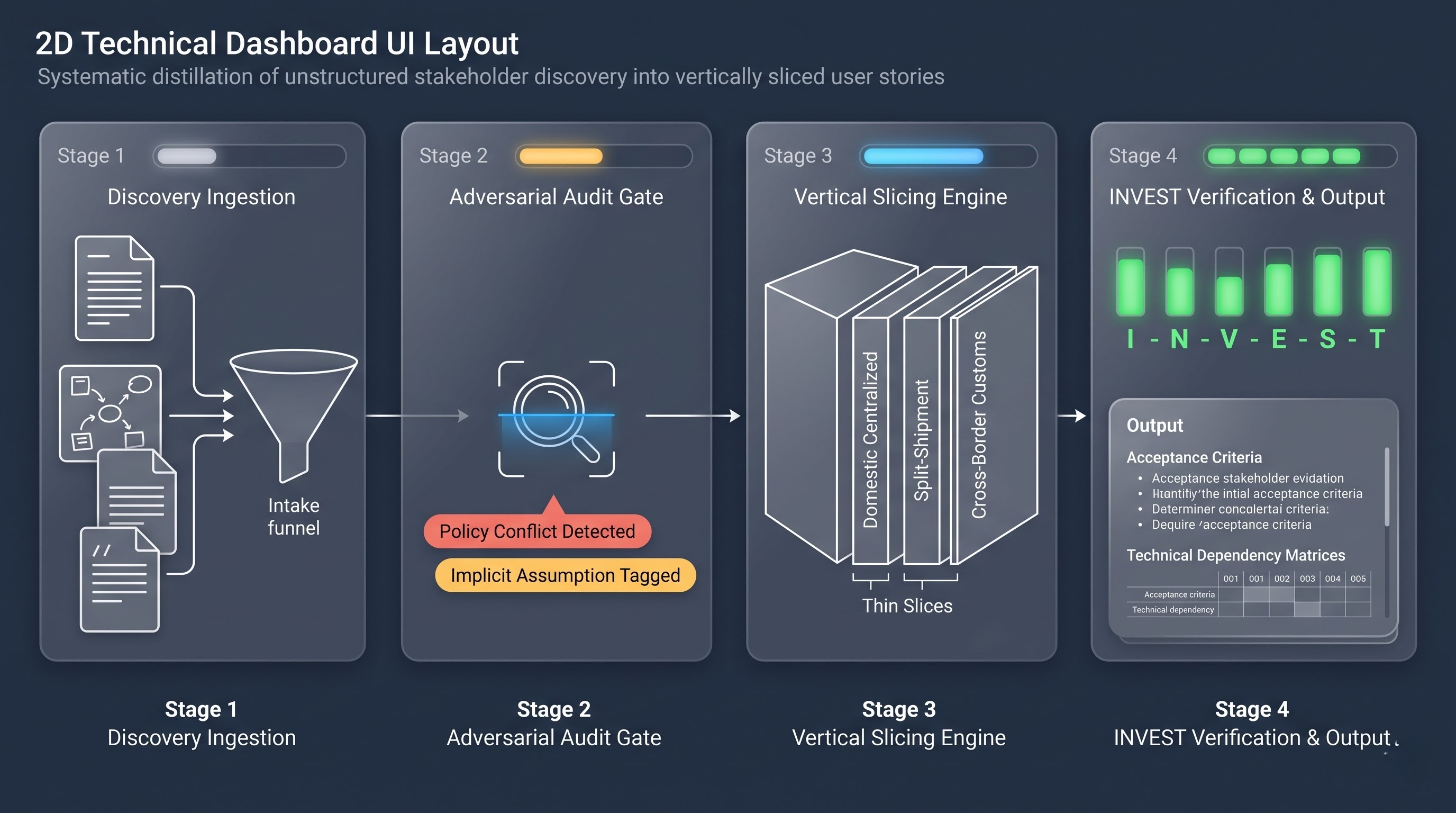
Using strong contextual boundaries, the business analyst goes from the process of manually writing user stories to conducting a determined synthesis process. The synthesis process helps in refining user stories from inconsistent information acquired from the stakeholders.
Traditional discovery sessions produce various different forms of documents: notes written from conversations, bulleted lists from leaders of different departments, chaotic whiteboard drawings, and notes from customers. The main problem for the business analysts was the time-consuming work of transforming unorganized information into coherent user stories.
Nevertheless, today's workflows allow the analyst to oversee a synthesis pipeline with many stages.
The first stage is discovery extraction. Analytics input raw transcripts of an accountability workshop, notes from interviews, and summaries of meetings in a context-based generation environment. The model will not be instructed to tell stories on the go, instead the analyst will instruct the model to conduct an adversarial reconciliation audit. The goal is to identify the themes, find contradictions in stakeholders’ opinions, identify the issues that have not been resolved concerning the policies, and summarize situations when a party assumed a business rule that contradicted the subject matter.
Once the analyst has cataloged the ambiguities, they will move to the next stage - story decomposition. A large-scale concept will be divided into small user stories.
One of the most common mistakes made in Agile delivery is creating a purely horizontal technical stories - stories that update a database without making some high-level business value or stories that develop a meaningless blank user interface that lacks functionality. Value delivery professionals have already instructed the model to work with vertical slicing mechanics.
Following the model's provision with the system architecture and business rules, it can generate slices that ensure seamless operation of the end-to-end system while keeping a narrow scope. For example, a feature related to complex multi-vendor fulfillment may be broken down as follows: first, a story dealing with domestic shipments from a centralized warehouse, then other stories related to partial shipments, customs in other countries, and notifications about back orders.
In this case, the analyst observes traditional INVEST principles and standards, which are Independent, Negotiable, Valuable, Estimable, Small, and Testable. However, unlike passively hoping that the model meets those requirements, the analyst actively uses the generator to check the outcomes against the criteria. The request that would be addressed to the model is to explain how the provided story is independent and provide the dependencies of the story.
In particular, it should be highlighted that a modern business analyst does not treat the created story as a given one. The given analyst becomes an editor who evaluates the story in terms of the political situation in the company.
Edge Case Engine: Systematic Analysis
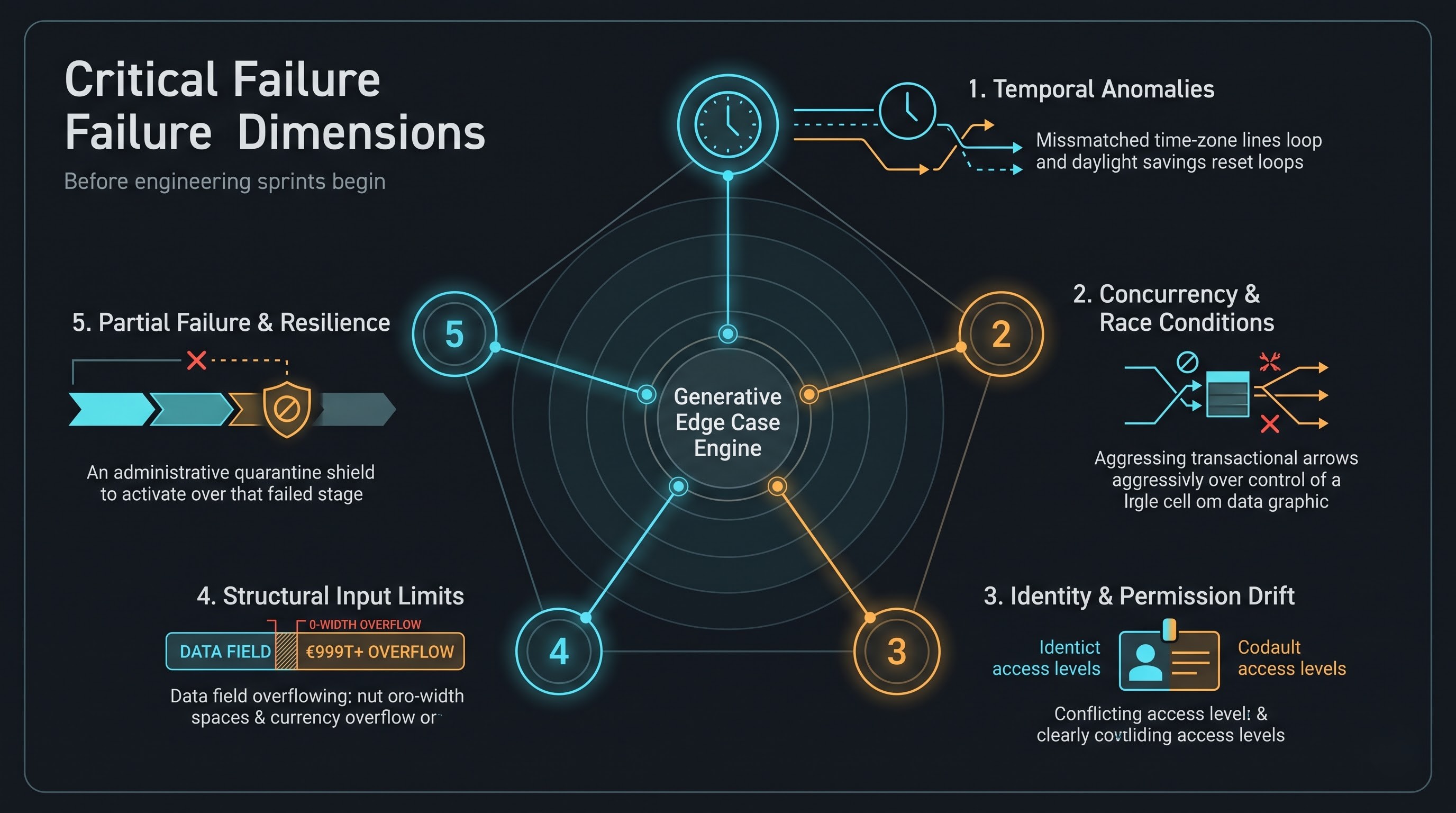
The true difference between the bad business analysis and the great systems engineering is in edge cases detection. It is easy to point out the happy paths as anyone can have an idea about what should happen when everything goes according to the plan, clients do not make any mistake, networks work fine, and other systems react to the request immediately.
System malfunctions, delays and budget overruns, and other serious problems arising during production are not related to the problems with happy paths. They occur due to the unhandled edge cases, contradiction at the boundaries, state changes, and concurrency problems.
Human analysts are prone to the effect of mental exhaustion and optimism and often fail to consider challenging cases when drafting the requirements. A number of cases have to be considered by a person in order to conclude that the case is covered, while a generative algorithm can easily generate new combinations if parameters are set correctly.
At this point, the paper considers five key aspects of the failure.
Temporal and Chronological Anomalies
Modern systems deal with ever-changing timelines, thus the requirement analyst needs to use artificial intelligence for solving the most complicated cases related to timelines, for instance, is it possible to solve a problem if the responding document confirming a transaction has been processed forty-eight hours after the user's session was saved, so the order was already canceled?
How does the system manage time-related issues like the daylight saving time when conducting batch operations planned to be executed during the repeated hour?
What happens if a client performs an action in one time zone but travels to another one to finish it there?
Concurrency, Latency, and Race Condition
The shared enterprise data states are subject to simultaneous actions. Present-day analysts utilize generative tools to create models of difficult conditions of concurrency:
What happens, for instance, when two administrators edit the same permission matrix for the same subordinate group?
In case there is only one unit left in stock and two different customers place their orders on different devices at the same time, what kind of database lock or consistency message is involved in the second transaction?
How does the interface react if an upstream external API takes twenty-eight seconds to answer, thus exceeding the limits established on the client side, although it works at the server side?
Modifications in identity, authorization, and permission
It is rare for the users’ behavior to conform perfectly to their profiles. Analysts rely on generative engines to investigate the cases that involve different roles of users:
What if an employee causes two contradictory internal roles: one allowing access to financial accounting books in read-only mode and another enabling read-write access to the processes of price adjustment?
How would the actions be performed if the permission was removed by the administrator in the middle of an active session?
What would happen if the third-party SSO provider was down in the process of execution of a task and the user remained authenticated locally but unverified externally?
Data Limits and Structural Instability
Input fields are a common cause of breakdowns in systems. Generation engines are told to create comprehensive matrices of edge cases related to inputs.
What happens when a user tries to enter input that contains right-to-left format control characters or zero-width spaces into an old field intended for standard alphanumeric characters?
How does the system compute numbers when limits are exceeded, generating an integer overflow or rounding issues across reports with multiple currencies?
What will happen when it comes to submission on required metadata fields that have format requirements, but conflict with the logic of the business, e.g. a delivery address with a valid postal code that cannot be delivered to by a courier?
Partial Failure, Resilience and Asynchronous Termination
Business processes involve several different systems in which partial completion of operations may happen. As application of the theory is needed, the modern business analyst comes back to the flow of resilience.
What happens to customer onboarding if the process that consists of three stages leads to database profile completion and internal notification set but causes the immediate crash of the regulatory disclosure email microservice? Does it mean that the whole transaction should be rolled back or the user's state might change to quarantine administrative review?
What happens to the draft of an online loan application in case the user closes their browser in the middle of the process? What state machine manages the draft and how long does the session last if the user disappears for unknown reasons?
By applying generative AI methods, business analysts transfer the responsibility of the edge case identification from the quality assurance stage to the requirement engineering stage.
Transcending Naive Prompting
The changing role of generative AI from being just a curiosity into a necessity signifies a major milestone in software engineering. As systems of companies become more and more interconnected, the most prominent danger of success now is not the speed of document preparation, but the systemic cost of context loss. When teams confuse the linguistic fluency with the analytical synergy, they receive vague user stories, unconsidered failures, and unmanaged architectural dependencies that cause problems in the production process of work as well as sprint delays.
A modern business analyst is capable of overcoming those risks due to taking a different stance when operating. Unlike treating large language models as automatized typists, a good analyst acts as a context architect. In other words, a professional analyst formulates structured input points for the architecture of the systems according to the rules of the enterprise, the strict architecture, and policies of the company.
Most clearly, this transformation occurs in edge case identification and requirements decomposition. Where human cognitive constraints and over-optimism often miss out on identifying timing differences, race conditions, permissions issues, and partial outages, the generative engine correctly identifies critical boundary scenarios before coding occurs. It turns the discovery phase of validation into a proactive systems audit that happens before coding.
To summarize, an increase in the level of sophistication refers to the progress the job of the human analyst is making and does not mean that its role has been minimized. On the contrary, the role of the human analyst is now considered to be of utmost importance due to the technical replacement of the mundane tasks of making stories and preparing scenarios. As a result, analysts are able to concentrate on the important aspects of their work such as addressing ambiguity, managing cooperation between stakeholders, and deciding on business trade-offs. If you want to be a leader in this area, make sure to undergo top-notch online BA training with the help of OnlineITGuru that can equip you with the skills required to be successful in your job. Today analysts act as the key ethical and operational medium for business goals and technology.