
Beyond the Buzzword: The Ultimate Engineering Guide to AWS DevOps Mastery
Last updated on Sep 24, 2026
Modern software engineering works at a speed that makes old ways of handling operations no longer work. Teams that perform well no longer see development and operations as parts of a company that only talk through tickets and handoffs and end up blaming each other. Instead moving companies use pipelines that bring code from a local git repository all the way to production without any problems in a safe and automatic way.
At the center of this change is the AWS platform. As the cloud infrastructure provider around the world AWS gives the basic system needed to run big software programs on a large scale.. Getting cloud space is only the first step. Using AWS well means knowing how to do delivery using automation in a clear way having good ways to watch what is happening and making sure there is no downtime when new versions are released.
This guide explains the structure, the methods and the main parts needed to create and keep automated ways to send software to production, on AWS.
Demystifying the Core Engine: The Architecture of Modern Deployment Frameworks
To understand cloud delivery, you must look beyond simple automated scripts. A real continuous delivery framework is more than a series of scripts. It's an engine built to take raw source code and turn it into running, reliable production workloads—without any manual help.
At the heart of this system are three parts that work together:
The Source and Build Pipeline: This part starts automatically when code changes happen. It handles things like isolating dependencies, checking for security issues in the code, running unit tests, and compiling the code into an artifact.
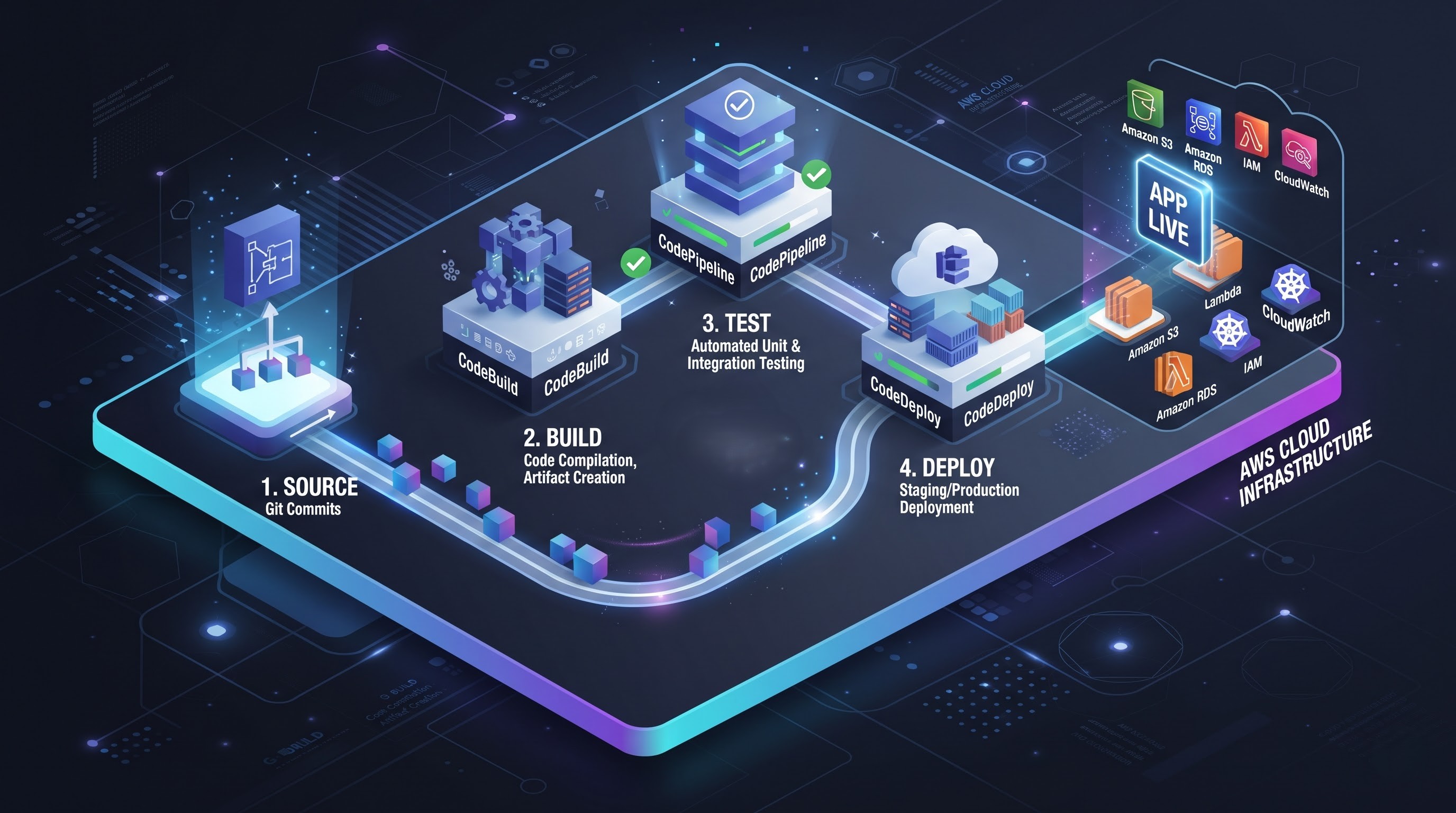
The Infrastructure Provisioning Engine: This layer treats infrastructure like code. Servers, databases, load balancers, and security rules are all defined in configuration files. These are version-controlled like application code, so every change is tracked and repeatable.
The Deployment Strategy Controller: This is the brain during a release. It manages how traffic moves to the version, checks that the system is healthy and can quickly roll back if something goes wrong. Its goal is to keep services running smoothly at all times.
In real-world cloud setups this framework runs across accounts. Development, staging and production environments are kept in AWS accounts. These accounts are connected through a central control point that manages policies and governance. This setup makes sure that problems, during testing or deployment never affect production. It protects the security and availability of systems.
Advanced CI/CD Engineering: Blue/Green and Canary Deployments at Scale
Achieving zero downtime during production releases requires moving away from in‑place server updates, which replace code directly on running instances and create windows where servers are partially configured or temporarily offline. High‑availability systems rely on immutable deployment patterns instead:
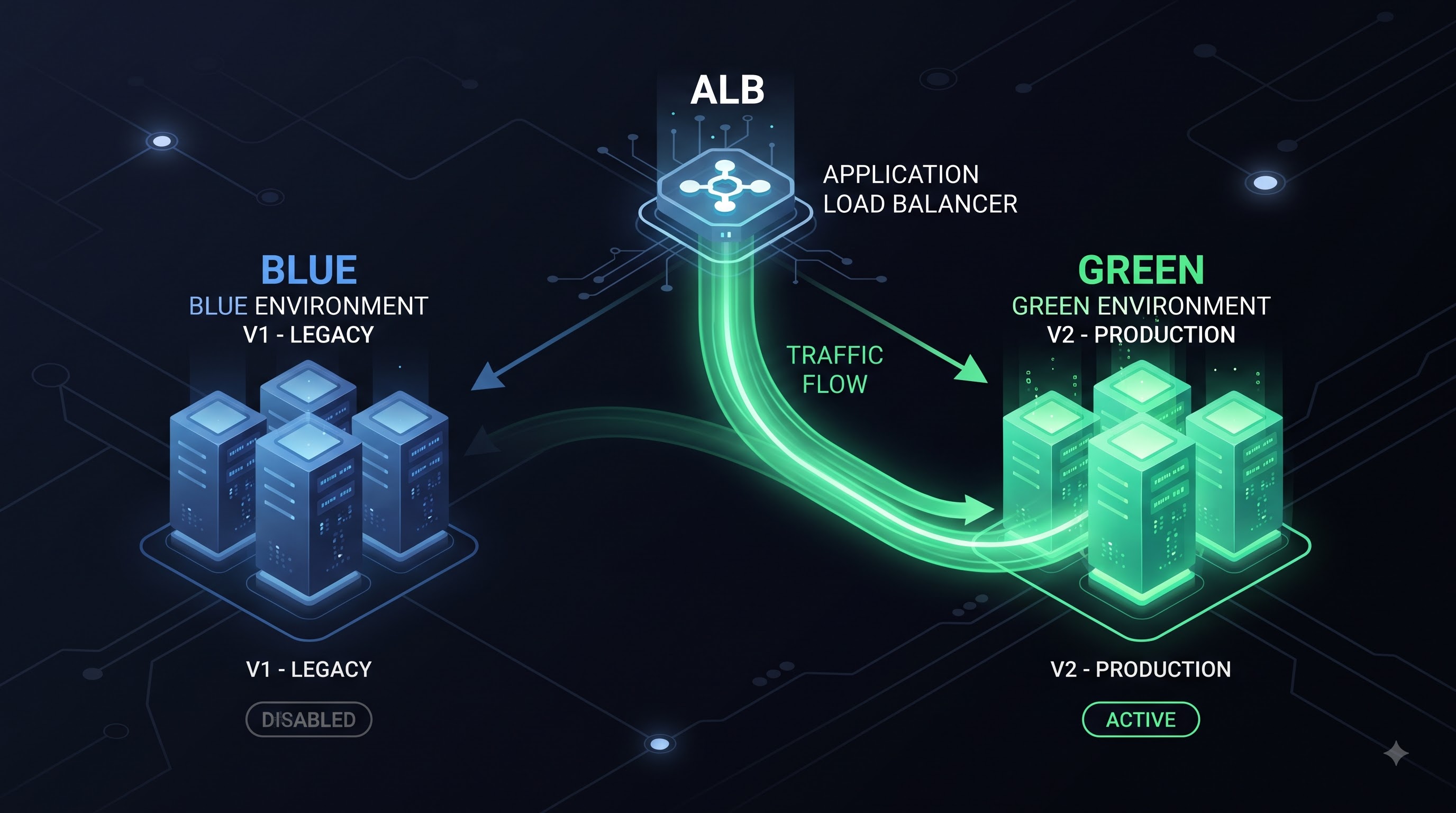
In a Blue/Green Deployment architecture, two identical environments exist simultaneously —the Blue environment serves as the live production cluster handling user traffic, while the Green environment acts as the staging ground for the software release. During a release, the Green environment is fully provisioned, populated with code, and subjected to automated health checks. Once passed, the network layer—typically managed by an AWS Application Load Balancer or Amazon Route 53—switches incoming traffic from Blue to Green instantly, allowing immediate rollback to Blue if an anomaly occurs to maintain zero downtime.
Complementing this, Canary Deployments provide granular risk control by introducing changes incrementally. Rather than switching all traffic at once, the deployment controller routes a small percentage of live traffic to the new version while automated monitoring tools analyze error rates, latency numbers, and server logs. If performance remains within safety baselines, traffic scales up incrementally until the release finishes; if metrics breach thresholds, AWS CodeDeploy triggers an automated rollback to drain connections before end users notice errors. Together, these modern CI/CD strategies ensure continuous service availability at scale.
Declarative Cloud Provisioning: Mastering Infrastructure as Code with AWS CloudFormation
Managing cloud infrastructure through a console introduces drift, human error and inconsistent configurations across environments. Infrastructure as Code solves this by defining state inside structured templates. AWS CloudFormation acts as the provisioning engine for native AWS automation. It translates declarative YAML or JSON templates into managed stacks of infrastructure resources. Drift Detection and Infrastructure Management
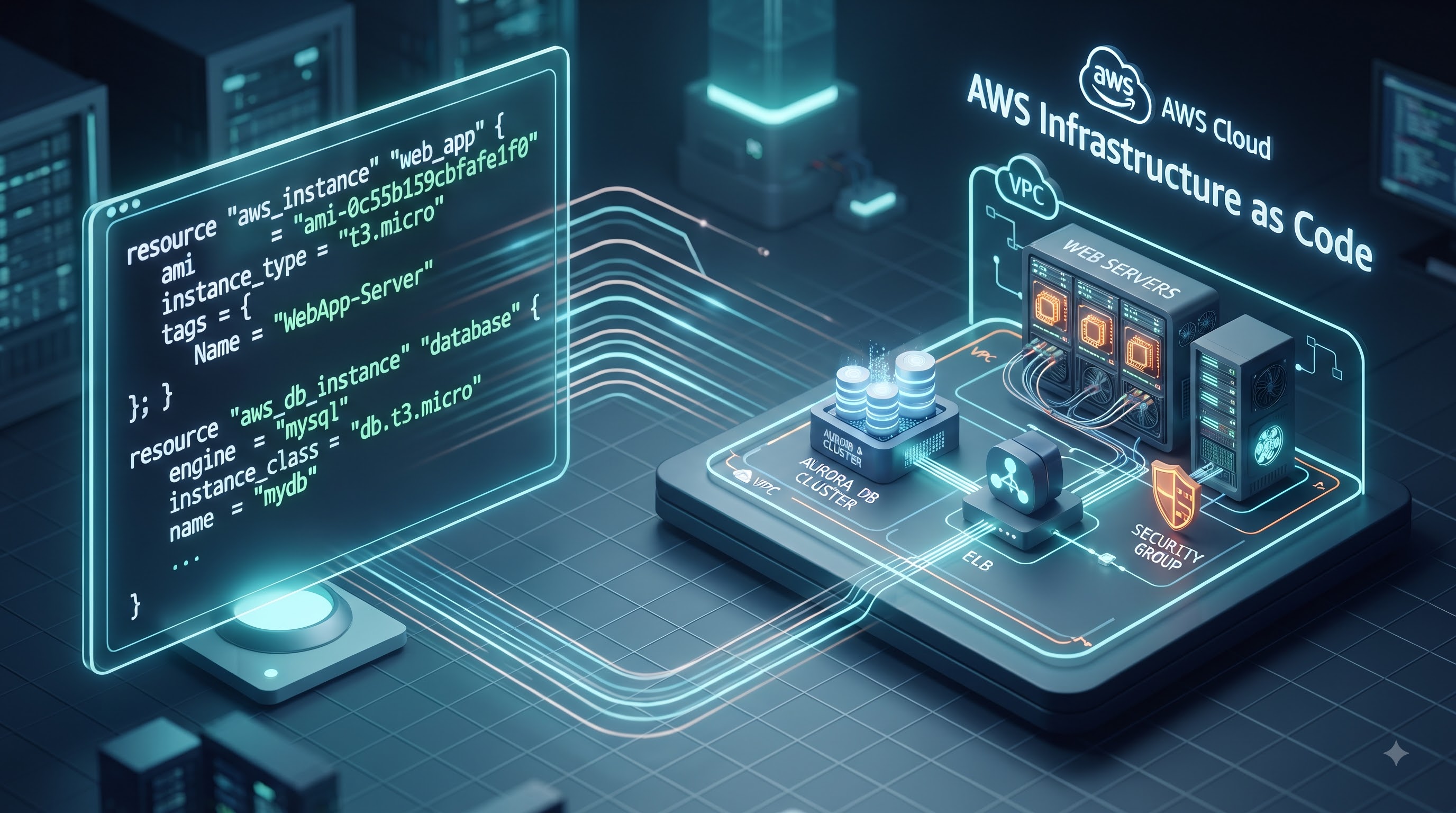
Writing templates is the baseline. Professional cloud automation requires two management workflows:
Drift Detection: CloudFormation tracks differences between your defined code and actual live resources. If an engineer manually alters a security group setting or changes an instance size via the AWS Console, drift detection flags the resource variance. This allows engineers to reconcile differences and prevent configuration drift.
Modular Infrastructure, via Nested Stacks: Large enterprises do not put their database, network, security and compute layers inside a template file. Stacks are broken down into modules. A core networking stack exports foundational variables which compute stacks consume dynamically using -stack references.
Configuration, Observability and Compliance Automation
A pipeline is only as reliable as its monitoring system. Once infrastructure and applications deploy automatically engineers must maintain visibility and automated governance.
Centralized Configuration Management
Hardcoding secrets, API endpoints or database URIs into application code causes security risks and operational friction. Professional AWS deployments configuration state from executable code entirely:
AWS Systems Manager Parameter Store: Holds configuration parameters feature flags and environment variables with IAM access policies.
AWS Secrets Manager: storage for database credentials third-party API keys and OAuth tokens. Secrets Manager supports key rotation natively without causing application downtime.
Real-Time Observability Stack
Observability on AWS relies on three core telemetry metrics:
Amazon CloudWatch Metrics and Dashboards: Collects performance indicators like CPU usage, memory utilization, network I/O and custom application metrics.
Centralized Logging via CloudWatch Logs: System and application logs are collected by log agents on every compute node. Logs are streamed into a central log group for long-term storage real-time pattern parsing and error-rate alerting.
Distributed Tracing with AWS X-Ray: In microservice architectures an API request may pass through API Gateways, Lambda functions and microservices. AWS X-Ray maps request pathways end-to-end helping engineers pinpoint latent microservices or database bottlenecks.
Security Compliance as Code
Manual security audits are too slow for paced deployment workflows. Continuous compliance must be baked into the cloud platform directly. AWS Config: monitors, records, and evaluates resource configurations against organizational baselines. If an S3 bucket is exposed publicly or an unencrypted disk is attached to an EC2 instance AWS Config flags the resource as non-compliant immediately. Automated Remediation, via AWS EventBridge and Lambda: When AWS Config detects non-compliance or CloudWatch triggers an alarm, EventBridge intercepts the event. EventBridge triggers an automated AWS Lambda function or AWS Systems Manager Automation Document to remediate the vulnerability immediately—isolating compromised instances or stripping network rules without human intervention.
Bridging Theory and Practice: Real-World Case Studies
To understand how these concepts work in life lets look at two examples of how they were used in actual situations.
Case Study 1: Financial Platform Zero-Downtime Migration
Challenge: A large fintech company had problems with downtime when they updated their software. These periods of downtime affected the number of transactions they could process and broke their service level agreements.
Implementation: The team in charge of the system rebuilt their way of delivering software using an AWS DevOps course approach. They changed from using servers that were set up manually to an automated system using CloudFormation. They used containers and microservices running on Amazon ECS. They created a pipeline for deployment using AWS CodePipeline and CodeDeploy.
Result: The way they released versions of the software became automated with Blue/Green deployments. They added alarms that used CloudWatch metrics. If there was an increase in HTTP 5xx errors during a release the system automatically sent traffic back to the older version in a few seconds. The platform had no downtime during a twelve-month period. The number of releases went from once every two weeks to times a day.
Case Study 2: Global E-Commerce Compliance Automation
Challenge: A company that operated in four different regions needed to make sure that data was always encrypted and that security rules were followed across hundreds of AWS accounts.
Implementation: The company used automation for security by setting up rules in AWS Config and Service Control Policies in AWS Organizations. All the AWS accounts were set up the way using CloudFormation StackSets. This made sure that the same security rules were applied automatically whenever a new account was created.
Result: Any changes that were not allowed like turning off encryption, for databases or creating IAM roles that were not approved were stopped or fixed automatically within minutes. The time needed for audits dropped a lot. Enforcing security rules became completely automatic. Required no manual work.
Operational Roadmap: Building Your Production Pipeline
Moving to automated cloud operations needs a step‑by‑step plan. I find that a clear plan keeps the team focused.
Phase 1: Version Everything and Establish Baseline Controls
Move every infrastructure definition build setting and script into a central Git repository. Set up trunk‑based branching rules. Require that every infrastructure change is reviewed by a peer. This step builds confidence for the rest of the Pipeline.
Phase 2: Declarative Infrastructure Standardization
Turn cloud resources into CloudFormation templates or modules. Stop changes through the AWS Management Console by taking away direct write rights for regular IAM users in production. I see this cut down on error.
Phase 3: Pipeline Automation and Canary Testing
Create automated deployment pipelines with AWS CodePipeline and CodeDeploy. Run automated Blue/Green or Canary releases that use metrics to trigger rollbacks. The Pipeline then operates with manual oversight.
Phase 4: Observability and Automated Governance
Bring together log collection, tracing, and metric gathering with CloudWatch and X‑Ray. Apply compliance as code through AWS Config rules and EventBridge remediation scripts. This keeps the Pipeline compliant and visible. Career Transformation is happening as technology companies shift to automation. Engineers who can build self‑healing pipelines run infrastructure by writing code. Set up secure multi‑account cloud setups are now the ones leaders want. Traditional sysadmins are less needed.
Career Transformation means engineers must go past cloud console work. A DevOps training program gives real hands‑on work that lets engineers build and run production cloud environments. Working on problems—fixing pipeline failures, setting up complex stacks and adding security rules—sets the best engineers apart. Career Transformation is boosted by taking a DevOps course. That course teaches design patterns, tools, and confidence to build deployment systems. Mastering these Professional Engineering Skills opens paths to big roles, such, as Lead DevOps Engineer, Site Reliability Engineer, and Principal Cloud Architect.