
Bicep vs Terraform: Choosing the Right IaC for Azure DevOps
Last updated on Sep 21, 2026
Choosing between Microsoft Bicep or HashiCorp Terraform involves the most important architectural choices made by companies while upgrading their delivery infrastructure through Azure DevOps. The two platforms meet the basic requirements of Infrastructure as Code, including versioning, repeatability, drift monitoring, and automatic delivery through integration and deployment pipelines. At the same time, Microsoft Bicep and HashiCorp Terraform are based on totally different principles.
Bicep is a specific Azure abstraction layer created exclusively for the Azure Resource Manager control plane and concentrating on minimizing friction, improving usability of the programming language, and providing immediate support for all Azure features from the day of its launch. Terraform is a versatile orchestrator operating on the principles of cloud neutrality, reconciliation of graphs, and integrated cross-platform workflow management.
When introduced into Azure DevOps, the differences between the tools impact the speed of work, security, operational aspects, and complexity of the delivery pipelines. If one intends to use the two Azure DevOps tools efficiently, he/ she should be familiar with the features of their functionalities architecture, nature of their states, execution process of the pipelines, and the costs involved in their functioning. Those platform engineers who want to learn how to use these deployment pipelines in practice and get necessary hands-on lab experience required in the cloud release train can take one of the specialized azure devops training online.
Architectural Concepts and Cloud Philosophy
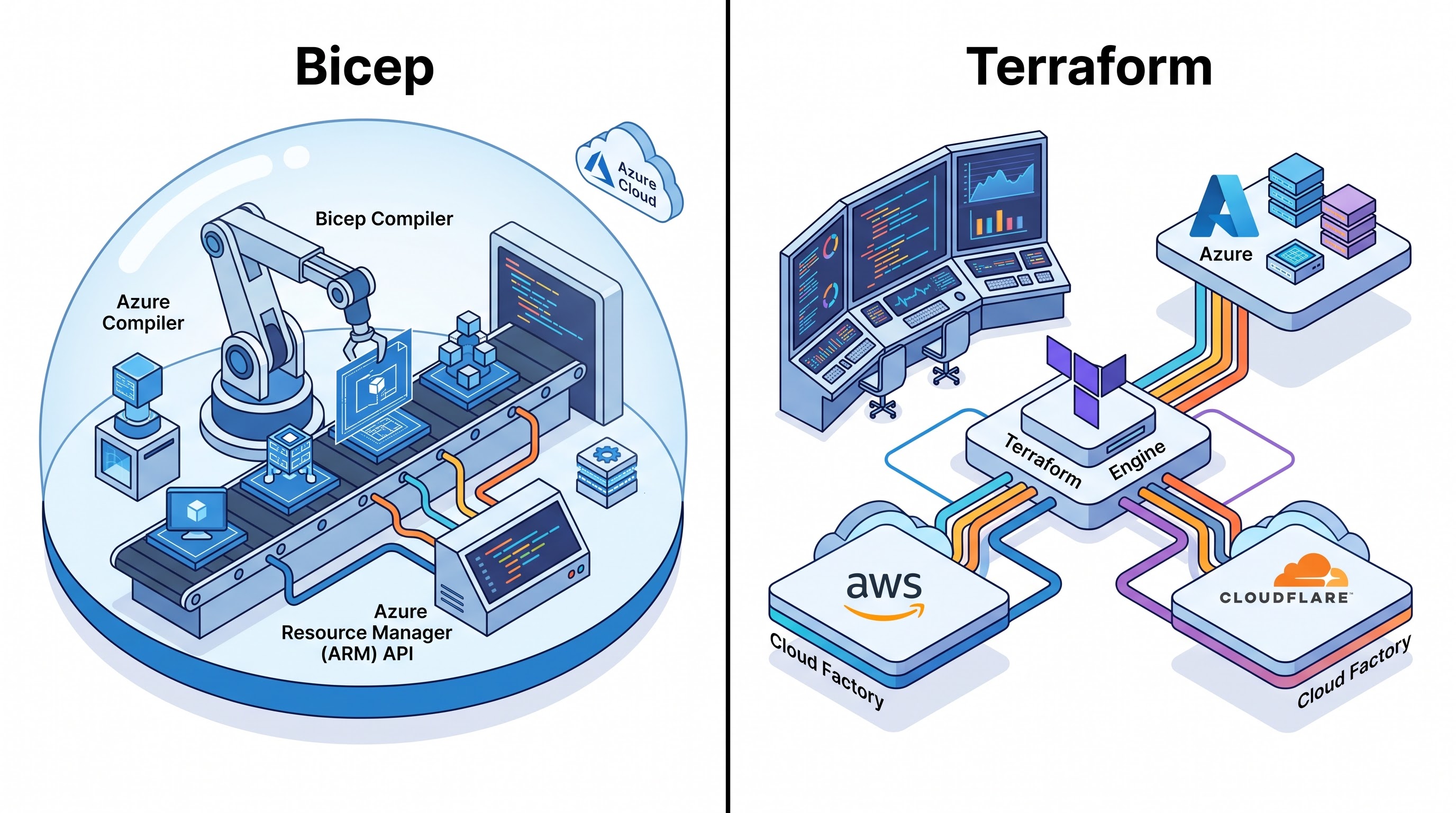
The main difference between Bicep and Terraform is in the scope of operation. Bicep is a language developed by Microsoft that addresses all of the issues such as verbosity, lack of type safety, and difficulties of using JSON-based Azure Resource Manager templates. Instead of working with the infrastructure through runtime drivers, Bicep compiles the code into native ARM templates and sends the API requests in Azure Resource Manager to accomplish the tasks.
Since Bicep is only a compiler in practice, its applicability is limited to Microsoft products and can work with subscriptions, resource groups, management groups, and tenants. Bicep will not create an S3 bucket, configure Google Cloud DNS or set up a monitor in Datadog. Thus, Bicep is the best solution for companies that are committed to a single-cloud strategy and work only in Azure.
In contrast, Terraform makes use of a flexible provider system that is governed by HashiCorp Configuration Language. The Terraform engine works independently from the current cloud provider. Terraform employs upstream provider modules when it works in Azure, while the main provider is AzureRM and the secondary is AzAPI for direct REST communications.
This type of architecture enables an engineering team to architect an intricate network that connects Azure Virtual Network with AWS Transit Gateway; create a Snowflake data warehouse; issue external Cloudflare security certificates and provision Azure Kubernetes Service clusters in one repository and pipeline flow. In addition, Terraform while considering Azure simply as a node in the interconnected corporate structure. The implication is huge: Terraform users acquire a skillset and set of tools which can be used in different settings, while Bicep experts are limited to only Microsoft Azure.
State Management Dilemma: The Truth of Native API versus the Reality of Explicit State Management
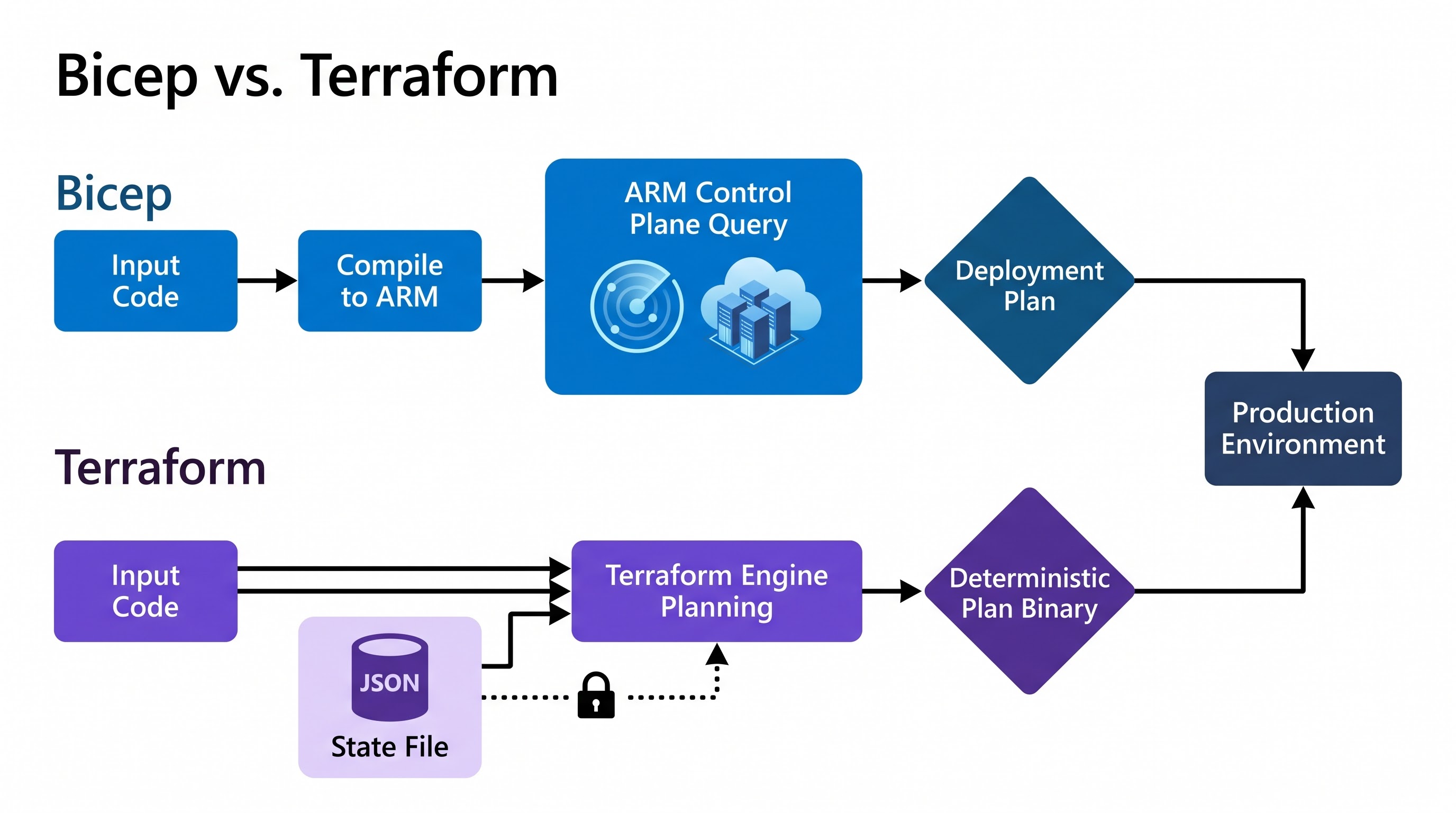
When talking about the primary technical difference between Bicep and Terraform, one cannot escape discussing state management. The key question every Infrastructure as Code solution must answer is how the application recognizes its already deployed infrastructure as well as what needs to be modified or removed.
In response to this question, Terraform suggests using explicit state management. The latter is unchanged and is represented in the external state file. This file is a copy of the state of the resources, with concrete mapping of what was configured under the declarative statement to the real resource identifier, its metadata, and the dependencies. Thus, as soon as the Terraform execution begins, the engine understands the code, reads the state file, interacts with the API to check the current values, builds a different graph, and builds the execution plan.
This design implies significant capabilities:
It allows for instant resolution of dependencies because the entire relationship graph is saved in the local state or is already cached.
It facilitates the renaming, changing, or refactoring of resources in a detailed manner without invoking destructive recreates, thanks to its in-built state handling capabilities.
The engine has complete control over the process of elimination: when a resource block is deleted from the configuration, Terraform checks its state file, finds out about the existence of the resource and executes the necessary commands to destroy it.
Nevertheless, this clear state file is also the Achilles heel of Terraform. The state file may store sensitive information, such as automatically generated admin passwords, connection strings, certificates, or private keys. Thus, it forces the teams to design reliable, highly secure back-end repositories (usually Azure Blob Storage configured with strict customer-controlled encryption, public access disabled, private endpoints and soft delete).
In addition, locking mechanisms must be used to avoid race conditions when several pipeline agents are trying to deploy to the same target environment at once. In a situation where an Azure DevOps pipeline runs into a network interruption and then suddenly shutting down and consequently orphaning acquired locks, the process will be put on hold until the unlock operations are completed either by the code or the administrator.
Bicep totally rejects the idea of stateful client-side operations. Bicep is based on a simple stateless reconciliation approach. Bicep operates with a premise that the source of truth does not reside in a separate counter record inside some remote space but rather in the Azure Resource Manager control plane. Once it gets a Bicep template to deploy, Azure DevOps pipeline does nothing but compile the code and deliver it to the Azure Resource Manager API, which handles the deployment itself through its control routine.
The elimination of external state files means that Bicep also removes an entire class of administrative overhead. Since there is no remote backend to be configured before provisioning takes place, there are no concurrent state locking problems that would lead to pipeline failures. There is no possibility of exposing sensitive information or production secrets through a separate JSON file stored in blobs, and there is also no risk of corruption of the state file requiring a recovery process.
In the past, statelessness used to be a disadvantage of Bicep: the issue of cleanup and deletion. When deploying in an incremental manner, Bicep is capable of adding or updating resources, however, the moment the resource definition is removed from a file, the resource continues to run in Azure. To address this issue, Microsoft has launched Deployment Stacks, which extend the capabilities of ARM with a native lifecycle monitor allowing it to perform real garbage collecting, orphan resource deletion, and other delete operations straight from the Azure level without requiring local state information.
The process of deploying Infrastructure as Code via Azure DevOps
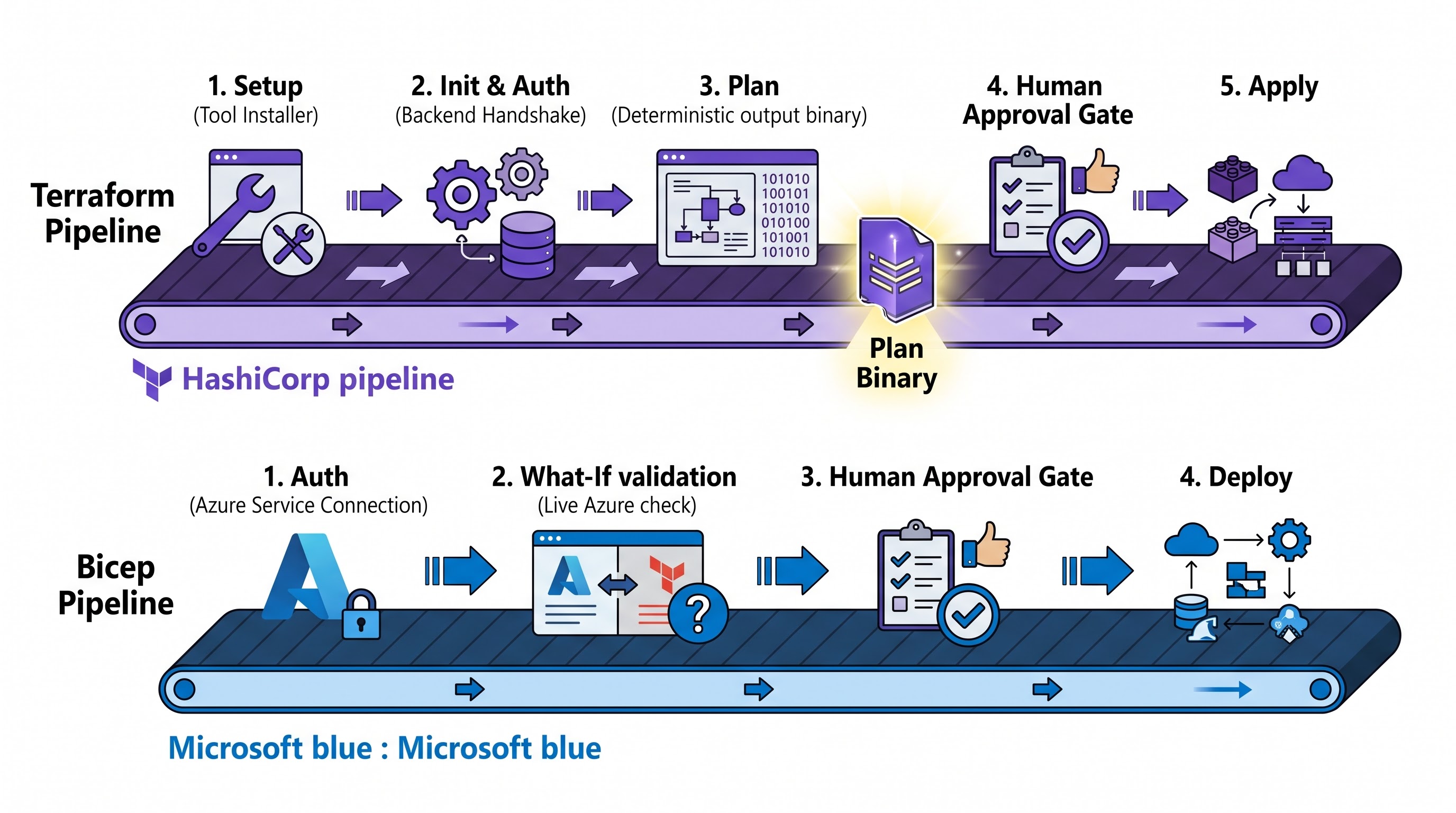
Pipelines reveals clear contrasts in agent requirements, task management, artifact processes, and credential administration.
The lifecycle of a Terraform pipeline proceeds through a defined series of steps beginning with set up, moving through verification, plan submission, review, and ultimately, execution.
Preparation of agents: Since Terraform is a standalone third-party binary, build agents in Azure DevOps must ensure that they have gotten the version of the Terraform CLI correct. While hosted agents may include general versions, enterprise engineering practices often require the use of a tool installer task in order to lock specific minor and patch versions in various environments.
The backend handshake: This process begins with the pipeline executing the initialization step which entails authentication of the agent against Azure DevOps in order to retrieve the code, but also authentication through the remote Azure Storage Account where the backend state is being stored.
Deterministic Planning: In this step, the pipeline performs a planning operation in which it produces a serialized binary artifact which is the planning of the delta which has been calculated against the current state. This plan file is then published as a pipeline artifact in mature Azure DevOps environments connecting the deployment phase to the build phase.
Human-in-the-Loop Governance: Azure DevOps Environments use approval gates, automated controls, as well as manual actions. During the review process, readers analyze the textual output of the plan that is attached to requests and pipeline results.
Deterministic Application: Once endorsed by the reviewers, the deployment process is started on a separate agent that downloads the artifact which has been created before and executes everything according to this artifact.
A Bicep deployment pipeline works with great ease.
Every tool that is necessary is present: It has all the major tools, such that Azure CLI and the Azure PowerShell modules are installed and already highly optimized in every standard Azure DevOps hosted agent image. Bicep CLI is also included together with Azure CLI. There is no need for any other installations and third-party bootstrapping implementations.
Once the tool is authenticated, it does not require anything else for execution: One Azure Service Connection is required for working of the pipeline. Once authentication takes place with the help of the Azure CLI tool, the pipeline gets full access to the required subscription.
Whait-if Evaluation: Instead of creating a binary plan, Bicep employs the “what if” API of Azure Resource Manager. This involves executing a validation and what-if operation, where it directly connects to Azure to estimate the possible changes.
Implementation: Compared to Terraform, the result of what-if is only for reference and cannot be stored as a permanent execution artifact. After the Azure DevOps authorization process has been passed, the Bicep template will again be sent to the ARM system. This occurs in an asynchronous manner. The design of resilient build-and-release gates along multi-stage YAML pipelines requires in-depth knowledge of cloud automation principles, which makes it necessary for teams standardizing their CI/CD techniques to complete a thorough microsoft devops course at OnlineITGuru.
Safety, Identity, and Secret Management Systems
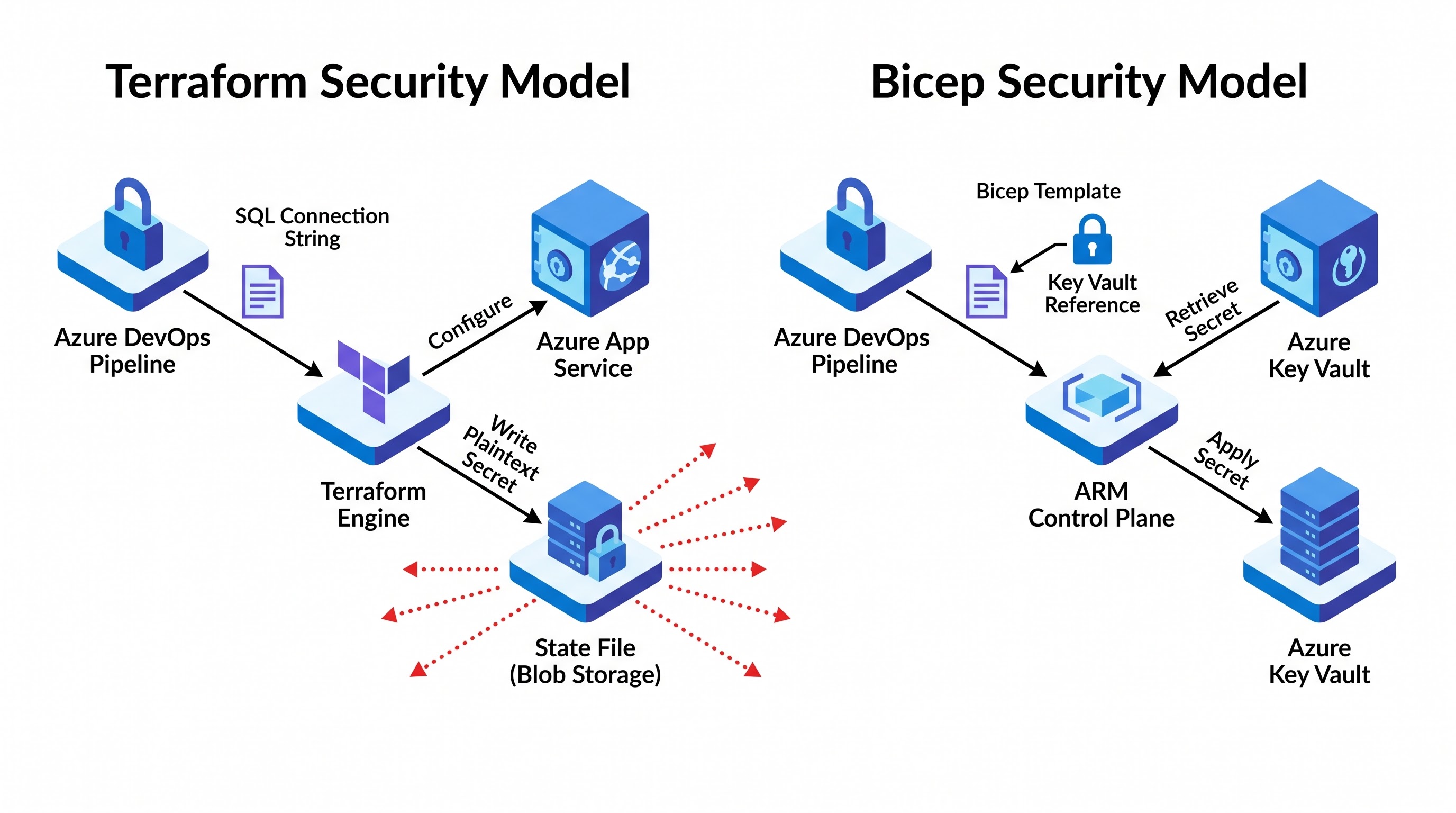
The focus of security in continuous delivery pipelines is a matter of identity separation, credential replacement and inhibiting lateral displacement.
Bicep and Terraform migrated from the phase of long-term administrative secrets used in Azure DevOps. Current technology uses Workload Identity Federation via OpenID Connect that connects Azure DevOps service connections and Microsoft Entra ID. According to this approach, an ephemeral pipeline run applies for OIDC tokens at Azure DevOps and receives a temporary access token from Entra ID, enabling it to conduct its work without storing any client secrets or certificates in the Azure DevOps project called Bicep.
Both approaches differ in case of downstream secrets exposure:
The Terraform Ingestion Issue: Terraform configurations frequently establish composite structures – for instance, deploying an Azure SQL Database, setting up an administrator account, and entering that connection string directly into an Azure App Service application configuration item. This procedure requires Terraform to acquire sensitive information which later is redirected into the remote state file. However, even if the values are defined as sensitive in HCL, they are still stored in plaintext in the baseline JSON state. As a result, the Azure DevOps pipeline identity has to have extensive permissions for the read/write actions on the state account thus making the state backend a prime target for privilege escalation.
Bicep Control Plane Encapsulation: Bicep manages secrets natively through the ARM control plane. The Bicep template can merely refer to the existing Azure Key Vault resource at the time of deployment and collect an existing secret or transfer a secret from one resource to another using built-in reference functions, all while keeping the secret within the Azure Resource Manager boundary. Azure DevOps pipeline agent cannot access, retrieve, or store the secret in any way. The likelihood of any secrets being exposed in the pipeline logs, build outputs, or anything on the customer side is practically zero.
In addition, role-based access control in Bicep is simpler to implement since deployments directly link to ARM deployment actions, and access is enabled only by Azure RBAC assignments associated with the Service Connection.
Language Expressiveness and Developer Efficiency And Ergonomics
Developer velocity and the level of efficiency had highly depended on both the conveniences provided by the involved programming languages and the quality of tools used as well as the speed of updates, the target platform catches.
Bicep, for instance, offers an experience tailored to Azure developers with a neat and simple syntax, which resembles the syntax of modern programming languages such as TypeScript. Bicep employs advanced language features such as strong typing, compile-time validation, user-designated types, decorators, and easy loops.
Thanks to the way Bicep works with ARM templates at compile time, the Bicep extension in the Visual Studio Code compiler directly targets the Azure schema registry. Thus, the developers can use all functions of IntelliSense, autocomplete, parameter validation, and linters without waiting for the provider updates.
In this regard, Bicep’s day-zero support for Azure services is one of its notable features. When Azure engineering teams publish new services, the instant the feature flags or APIs enter public preview, it becomes available in Bicep just by changing the API version in the resource declaration. The transition from developer to newest Azure capabilities is smooth because there is no intermediate maintenance team. There is also no community pull request review process or provider release cycles to impede the task.
The mature and verbose nature of HashiCorp Configuration Language shapes the developer ergonomics of Terraform. Though HCL is quite readable, it is quite tedious for complex conditional statements, nested loops, and dynamic object building.
One of the biggest pain points associated with using Terraform for teams that are focused on Azure has always been the lag related to providers. It is important to note that the AzureRM provider must be explicitly modified to include support for new Azure resource types and schema elements. It happens because the maintainer continues supporting the provider ecosystem but the release of the new capabilities of Azure is separated by time lag.
This issue was tackled by HashiCorp and Microsoft through AzAPI provider – a thin layer enabling Terraform to interface with ARM REST calls and hence, manage any Azure resource like Bicep from day zero of existence. But the combination of AzureRM and AzAPI within one repository brings too many mental challenges, inconsistent naming patterns, and complicated inter-resource dependencies microbiology makes working with the pipelines complex.
Drift Detection and Reconciliation Realities
Infrastructure drift, which is a divergence between the true state of a cloud environment and what is written down in code, is a fact of life in enterprise environments; most often caused by unplanned manual interactions through portals.
Using Terraform gives a competitive edge in drift detection as it keeps a unique state file that shows the last working configuration which allows Terraform to conduct full-graph reconciliation every time the plan is executed.
As part of an Azure DevOps pipeline, Terraform is a tool that enables teams to perform drift audits automatically. Teams often create scheduled, automatic pipelines (such as nightly builds) that perform an operational check without any change. If there are discrepancies in the plan, the pipeline fails on purpose and notifies employees about the possible problem.
Bicep achieves drift detection through ARM's what-if mechanism, which has faced a range of information overload and operations constraints. When utilizing the what-if feature, the Azure API attempts to identify changes by comparing the template with the existing status.
Nevertheless, many Azure resource providers tend to add default runtime values, some internal non-modifiable flags, and random parameters into the system when a resource is created. As a consequence, what-if will report these defaults as planned changes and lead to a number of false alarms that may distract attention from actual issues. Even with all investments made by Microsoft, its what-if tool can hardly compete with Terraform drift audit in terms of accuracy.
Modular Ecosystems, Governance, and Reusability
When scaling up projects in large enterprises, project development teams should not begin creating their whole architecture design completely from scratch. Rather, platform engineers develop and release stable and compliant modules enabling application developers' work with them in their Azure DevOps pipelines.
Terraform is leading in terms of its module ecosystem which is one of the most advanced module systems in contemporary IT. Companies working with Azure DevOps can keep their own private Terraform module repositories using Azure Repos, Git submodules, or artifact feeds equipped with version control features provided by Terraform. Terraform comes with advanced options for module creation such as semantic version lock, advanced validation expressions, and compatibility with unit tests and tools like Terratest and other frameworks.
Governance Let’s code policies in Terraform are mostly processed using Open Policy Agent, Trivy or HashiCorp Sentinel that check the produced plan JSON file within Azure DevOps before starting any cloud operations thus preventing creation of non-compliant systems.
Bicep has achieved this advancement through the usage of Azure Verified Modules and Azure Container Registries’ native integration.
Simple Registry: Bicep takes care of modules as top priority components that eventually turn into Open Container Initiative (OCI) artifacts. Platform teams may create an Azure Container Registry and utilize native Azure CLI commands in the administration pipeline to publish the upgraded version of Bicep modules. The application pipeline can, therefore, identify these modules at OCI URL, enabling them to automatically inherit credentials in addition to receiving high-speed downloads during agent execution.
Automatic Policy Integration: Rather than using client-side analyzers for simultaneous policy execution, it directly uses the Azure Policy. Bicep compiles straight to native application layer (ARM) deploys, meaning integration happens at control plane level. Moreover, tools like PSRule for Azure provide pipelines with Bicep template evaluation against Microsoft Well-Architected Framework within the process of creating the product and identifying security and reliability issues.
Team Topologies, Operating Expenses, and Strategic Decision Models
Deciding on whether to use Bicep or Terraform in Azure DevOps is not just an issue of technical syntax; it is a proxy for the crucial characteristics of the operating models, the scope of the platform, and levels of risk tolerance of the organizations involved.
When It Comes to Choosing Bicep
If your company operates solely in the Microsoft Azure universe, then Bicep is the best option for you. With Bicep, you will not have to pay for the exorbitant architectural costs that come with operating with external storage accounts, executing state locking in a high-availability manner, protecting plaintext state files, and having to provide training in the use of of a generic cloud orchestrator to application developers. It is easier to learn for developers and system engineers who already have experience in Azure management. It works well with Azure DevOps without having to set up an agent, it is free from confidentiality secrets, it supports new Azure developments from day one, and it also shares the execution stability risks with Microsoft's Resource Manager.
Small and medium-sized groups, public sector entities with firm limitations on data pertaining to the cloud, and teams developing internal developer platforms based upon Azure Container Apps or Azure Kubernetes Service will be pleased to learn that Bicep is comparatively economical and quick besides being safer to implement throughout the period of their development.
When Terraform Outperforms Competitors
For progressive companies utilizing hybrid, multi-cloud and SaaS operating structure, this solution becomes the only option available.
If you need your deployment process in Azure DevOps to run the AWS infrastructure model and the corresponding networking environments, GitHub enterprise controls, Datadog monitoring parameters, and multi-tenant databases, the extended functions of Terraform provider model become invaluable.
Big engineering firms that have specialized teams on cloud technology are capable of running secure state backends and establishing good pipeline locking systems while absorbing maintenance costs in exchange for maintaining consistency across clouds, being knowledgeable organizationally, and ensuring complete control over the use of infrastructure.
The Coexistence Model
In many modern enterprises the situation does not have a direct answer. Leading engineering companies adopt a hybrid model: centralized teams of platform engineers to provide the foundations across platforms.
At the same time, both autonomous application and product teams that deploy workloads into pre-provisioned Azure subscriptions are the ones that are making use of Bicep in building their own application-specific infrastructure. This model allows the platform teams to utilize the wide reaching and structured state reconciliation of Terraform while taking away the rapid day-zero speed, simplicity, and state-free operation characteristics associated with Bicep.
In conclusion, both tools pave the way for different forms of automation in business, although the final result depends on how well the tool's philosophy aligns with the cloud deployment path chosen by the organization. Regardless of whether you choose to focus on cloud-native Bicep templates or multi-cloud Terraform architecture, the popular OnlineITGuru azure devops online course will help you gain all the required skills for smooth functioning of your company.