
Building a Successful Career in Automation Through UiPath Skills
Last updated on Jul 12, 2026

The business world today is changing at a dizzying pace. This is driven by rapid technological advances and increasing demands for productivity, speed and customer experience. Digital transformation is now a strategic imperative for organizations of all industries, not a nice to have initiative to sustain growth and stay competitive. Automation is one of the most disruptive technologies shaping the future of work as businesses look for new ways to streamline operations and eliminate manual work.
Automation is transforming the way organizations operate their day-to-day business by removing repetitive, time-consuming activities with structured digital workflows. Because of this, businesses are increasingly adopting automation technologies to increase efficiency, to standardize processes, to reduce errors and to allow employees to work on strategic responsibilities instead of requiring human intervention for every task. This is helping to fuel the creation of new types of jobs and demand for people who know how to build and deploy automation smartly is on the rise.
This change has been made possible by the arrival of technologies like UiPath, one of the most recognized platforms for intelligent automation and robotic process automation. Enterprises use it to automate business processes across departments and functions, while retaining scalability and operational control. As automation proliferates around the globe, automation specialists are discovering more and more opportunities to develop rewarding and long-term careers.
You can’t build a successful automation career on one software platform alone. It is about building technical capabilities, knowledge of business operations, using analytical thinking, implementation experience and keeping up with technology developments. In the longer term many people thinking about automation also see opportunities to move into leadership, consulting, architecture and transformation roles beyond the traditional development roles.
Why Automation Is a Strategic Business Priority ?
Automation is becoming increasingly important and is closely tied to the operation of organizations in today's markets. Businesses are constantly being challenged to improve the customer experience, but also to keep operational costs low and increase output. Customers want faster service, employees want more efficient systems, and leadership teams want to see measurable performance improvements.
Traditional manual workflows often don't meet these expectations. Manual processes can cause delays, inconsistencies, duplicated efforts and higher operating costs. As an organization grows, these inefficiencies become more pronounced and can have a direct impact on profitability and customer satisfaction.
Automation is a pragmatic answer to this that enables organizations to do repetitive and structured processes more efficiently. You can speed up and make more efficient processes such as dealing with invoices, onboarding new staff, talking to customers, generating reports, compliance paperwork and data management.
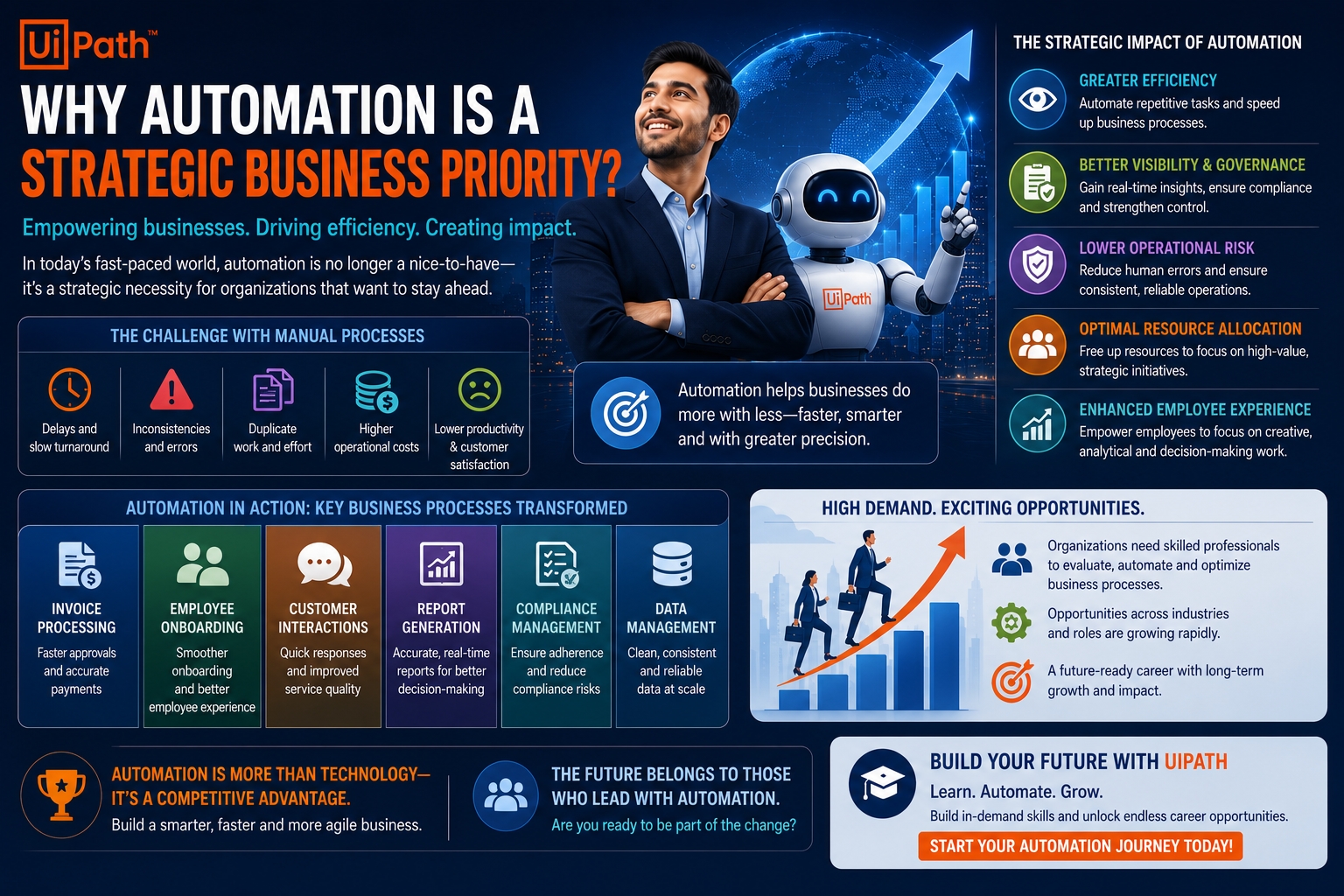
This impacts business more than efficiency alone. Automation also delivers better visibility, better governance, lower operational risk and better resource allocation. Employees benefit by focusing their attention on analytical, creative and decision making work rather than repetitive work.
Demand for skilled professionals continues to be high as more organizations begin their automation journey. Companies need people who can evaluate business processes, identify opportunities for automation, develop workflows, oversee deployments, and enhance results over time.
The growing demand creates a favorable climate for those who want to pursue long-term careers in automation.
Why Industry Still Loves UiPath Skills?
Automation platforms differ greatly in capability, usability and scalability. The industry has recognized UiPath’s enterprise capabilities and support for accessibility.
Companies increasingly want to leverage solutions that can be quickly rolled out and provide value without wholesale change to their existing technology environments. And UiPath makes it easy, with integrations into all applications, systems, databases, web environments and cloud platforms.
And one of the reasons companies prefer working with UiPath is that it supports end-to-end process automation. Rather than automating individual tasks, companies can link together different phases of their operations into smooth workflows that enhance efficiency and consistency.
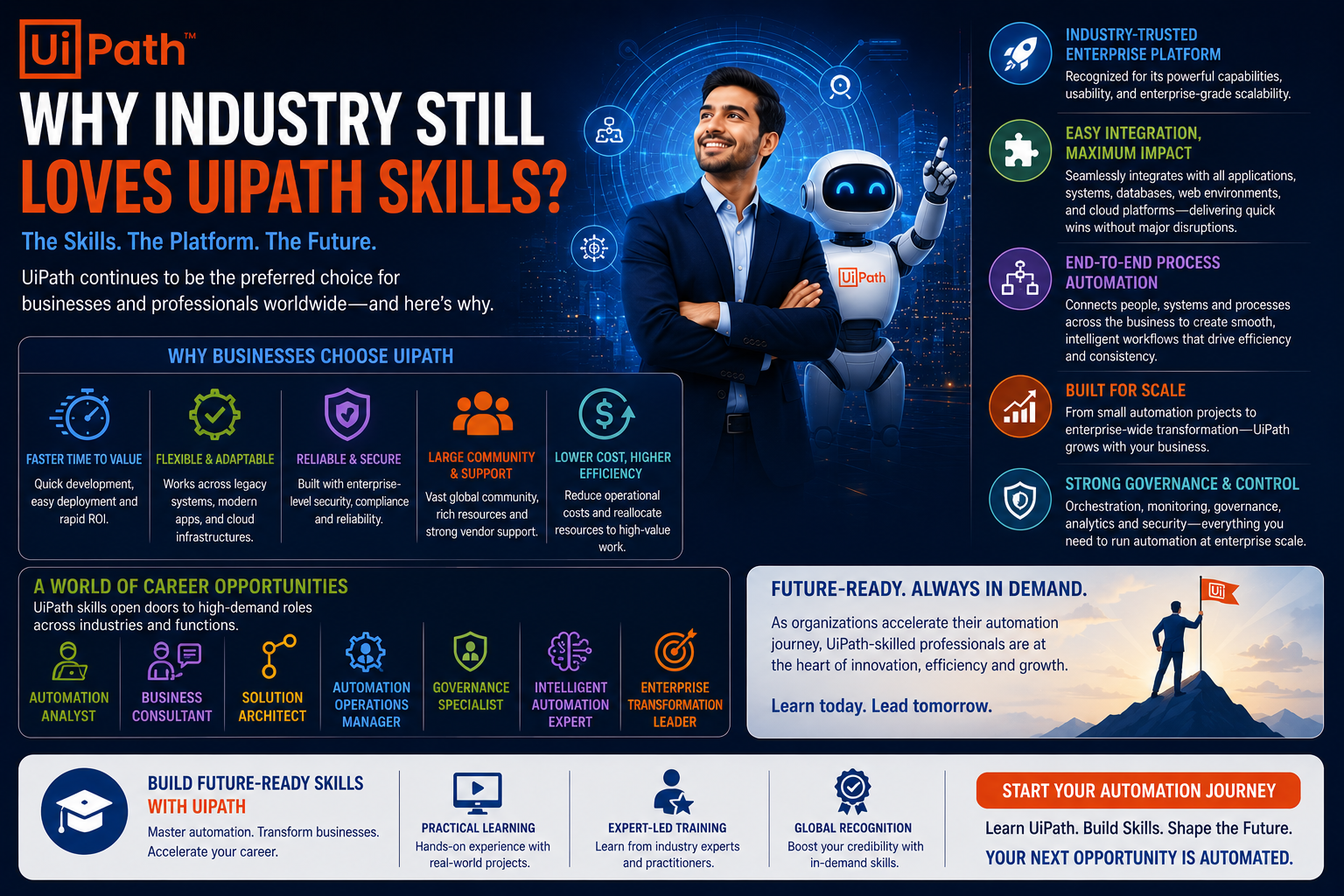
Another important factor is the ability to scale up. Many companies start with small automation projects, then graduate to enterprise-wide transformation programs. UiPath supports this journey with automation management capabilities including orchestration, monitoring, governance, analytics and more.
It opens the doors to outside workflow development for practitioners. Learn UiPath for careers in automation analysis, business consulting, architecture, operations management, governance, intelligent automation and enterprise transformation.
As organizations advance on their automation journey, professionals with a solid grounding in automation technologies are well positioned for increased career opportunities.
Lay the Foundation for Career Advancement
It gives a great foundation for a successful career in automation. Most professionals learn only the features of the software and don’t understand the larger capabilities needed to be successful in enterprise environments.
However, there is still a need for “technical know-how” because automation professionals must know how systems behave, how workflows execute, and how information flows between applications. You’ll also be able to better handle variables, conditions, process flow, and exceptions, and to organize workflows, so you can make your automation more reliable.
But sustainable growth is seldom just a question of technical knowledge. It’s also vital that the professional has a grasp of how business works, and how automation fits into the organization’s bigger picture.
Business awareness helps people find real opportunities, not just technical solutions. When professionals understand how processes are interdependent they can deliver automation outcomes, operational goals and performance expectations that deliver greater value.
Problem-solving ability is important too as automation projects are often full of uncertainty. Processes may not work as designed. Exceptions may occur. Requirements may change over time.
Great communication skills are critical when working with technical teams, business users and leadership stakeholders. Often a key ingredient in career advancement is being able to explain technical concepts clearly.
Those who enter automation often accelerate their learning curve through the use of structured educational strategies. UI path Learninig Professionals often begin to build their implementation confidence through UI path Online Training. It will guide you through workflow creation, process logic, automation concepts, and real-time project execution, helping you develop a more structured understanding.
A strong foundation of technical skills and business skills is essential for long-term career potential.
Developing Technical Skills for Success in the Long Term
The technical growth needs to be strategic, not trying to learn everything at once.Automation professionals need to understand process structure and execution. Structured workflows are easier to maintain and work on collaboratively.Errors are particularly important to handle, because things are rarely smooth in the real business world. Create workflows that respond to changes in inputs and increase reliability
In addition, data handling is becoming more and more important. Organizations generate vast amounts of data and it is critical that automation professionals know how to effectively manage, validate and transform that data.Application integration increases automation capabilities because business processes are often cross systems. Knowledge of application communication provides more flexible solutions.
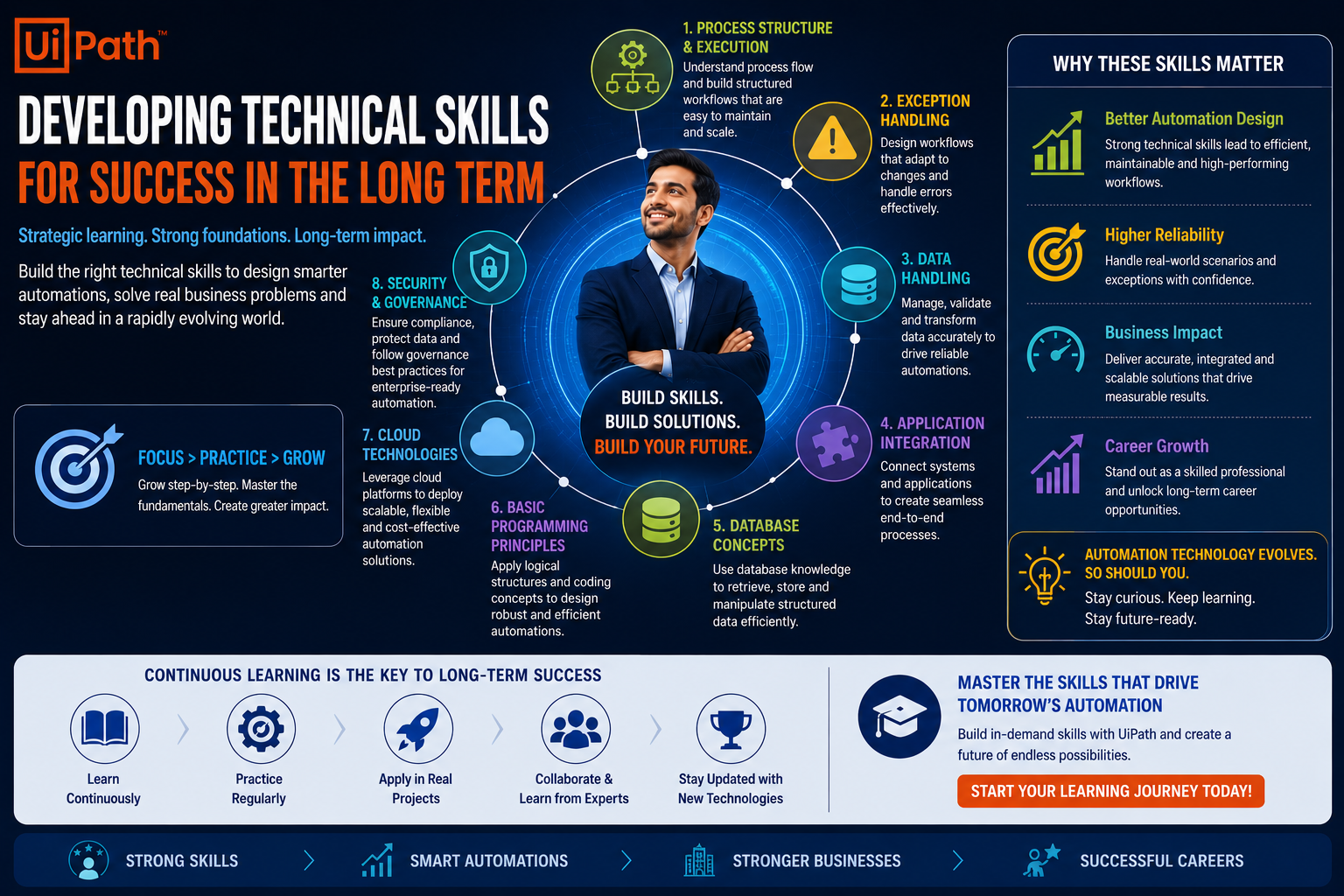
The concepts of database help to obtain the information and to perform the processes. Understanding structured data can make your workflow more effective.The basic programming principles also result in better automation design. This is not always the case, but knowing logical structures will improve the quality of the implementation.With organizations deploying solutions on scalable infrastructure environments, cloud technologies are becoming more important.
Security awareness and governance knowledge makes an enterprise ready and opens a lot more avenues of advancement.Automation technologies change very fast, so technical development has to be a continuous process.
Gaining Confidence and Practical Experience
Only knowledge that is applied in real life is of value.Most professionals do not realize the importance of getting hands-on implementation experience first. Understanding comes from the theory exercises and reading docs, but confidence comes from doing.Projects offer practitioners problems that are hard to appreciate from theory alone. The result of an implementation can be affected by data inconsistencies, unexpected user interactions, system limitations, changing requirements, etc.
Building projects also helps you make better choices. Professionals learn how to choreograph workflows, handle dependencies, increase performance and guarantee scalability.Practical experience allows for experimentation and helps people find more efficient ways to implement things.
Project portfolios build professional credibility, especially as employers want to see more of what you can do .Moreover, the practical experience makes the professionals feel more prepared for the interviews because they can speak about the implementation decisions and problem-solving experiences with more confidence.
Automation and Knowledge Extension Development
If you’re not already working in automation, it’s often a matter of creating workflows and deploying the tech. Those capabilities are important, but long-term career growth is based on the ability to grow the knowledge into surrounding disciplines that add to the overall value to enterprise environments. Automation is not a siloed technical skill, but a cross-functional skill.
Organizations rarely evaluate automation initiatives solely on the basis of whether a workflow executes successfully. They measure outcomes in terms of: operational improvement, scalability, business impact, cost efficiency, user adoption and long term sustainment. So it means that people who have bigger ideas tend to add more value.
The development of business process analysis is becoming a major area, as often the identification of the right opportunities determines the success of the automation and not the technical implementation itself. It’s the understanding of how departments interact, where the bottlenecks are and what actions deliver measurable improvements that lead to better project outcomes.
Another critical factor in successful automation implementation is data analysis. Organizations produce significant operational data and increasing number of automation initiatives are based on data driven decision making. For those who can read trends, measure performance and identify opportunities to improve their professional stature.
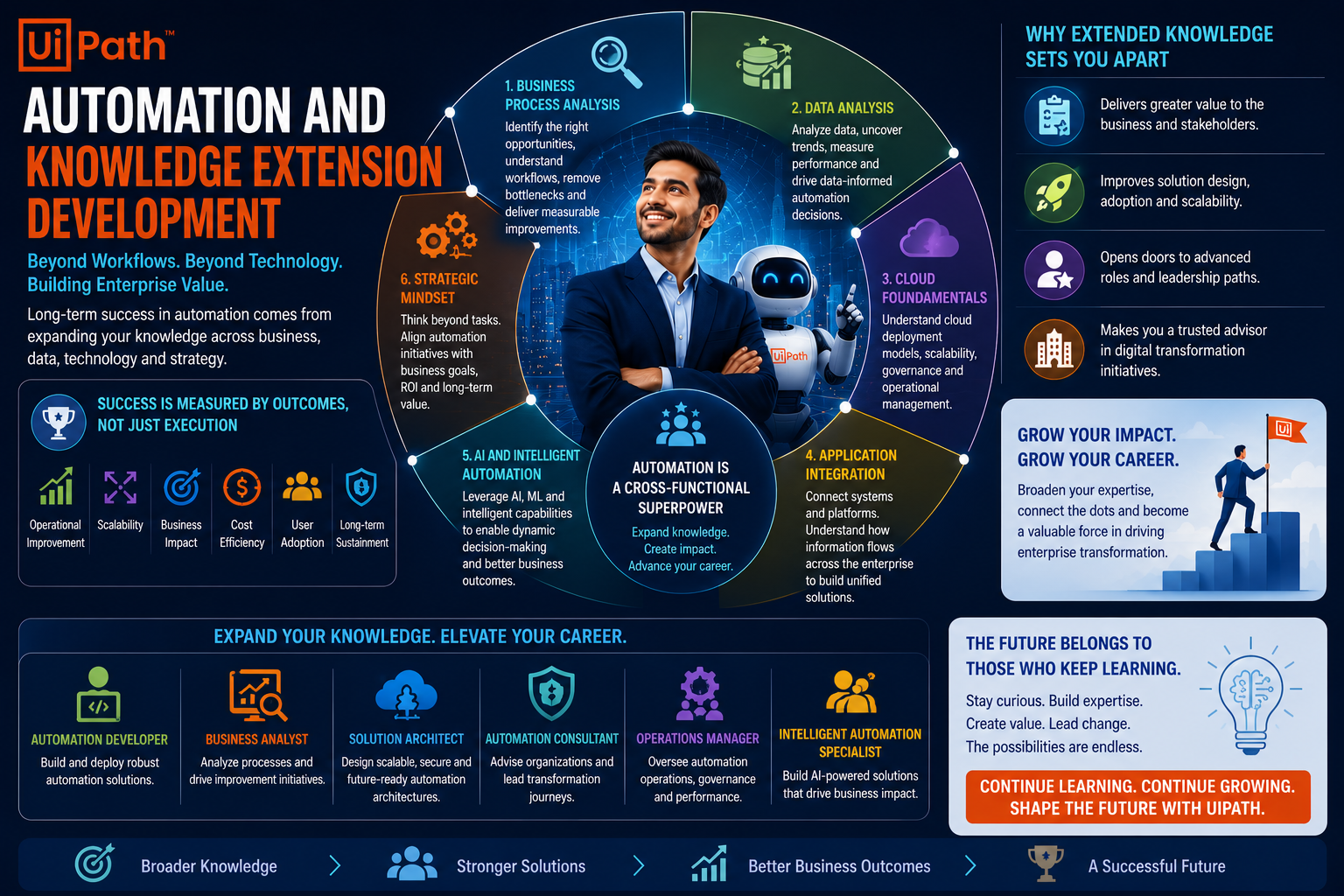
In organizations, centralized infrastructure strategies are becoming more popular and cloud technologies are continuing to shape automation environments. Understanding the basics of the cloud will help you to understand more about deployment models, scalability, governance and operational management.
Application integration also provides more opportunities since business operations usually require coordination across multiple platforms. Professionals know how information flows through systems to build larger, more responsive solutions. AI is increasingly being incorporated into automation ecosystems. Automation has been about repetitive rule-based execution. Intelligent capabilities support more dynamic decision making and improved business results.
Business Process Knowledge as a Career Differentiator
Automation experts who have experience have an advantage over beginners because they really know business processes.“Do not begin with selection of the technology for automation. Good automation starts with a clear understanding of operational goals and an assessment of how processes impact business performance.
Automation is solving problems for organizations. Delays, inconsistent results, manual effort, compliance requirements, scaling issues, etc.People with a business mindset can often see improvements beyond the technical performance. One especially helpful skill is process mapping, which allows us to see how work flows between departments and systems.
It helps professionals build workflows that lead to better results by understanding what comes in and out, who depends on what, what can go wrong, who needs to approve and how well things are running.Better communication with business understanding Stakeholders
Professionals who speak the language of business can be more effective in technical discussions.People with this skill often move into strategic positions because they are part of the decision making not just the implementation.If you can learn to think like a business you're going to create more value in the long run.
Automated jobs
One of the biggest benefits of learning automation skills is the range of career paths you’ll be able to pursue.Most careers in development-related functions begin at the professional level. Responsibilities include: Designing, implementing, testing, and deploying workflows.
But career growth is more than development. Business analysts help organizations identify processes that can be automated, and assist in gathering requirements and assessing processes.Automation consultants work with companies to define strategies and guide implementation programs.
Solution architects plan scalable environments and set technical standards.Operations specialists manage the deployment environment, and the performance of the workflow.Governance professionals set standards and support compliance requirements.Transformation managers are responsible for larger programs that span business functions.
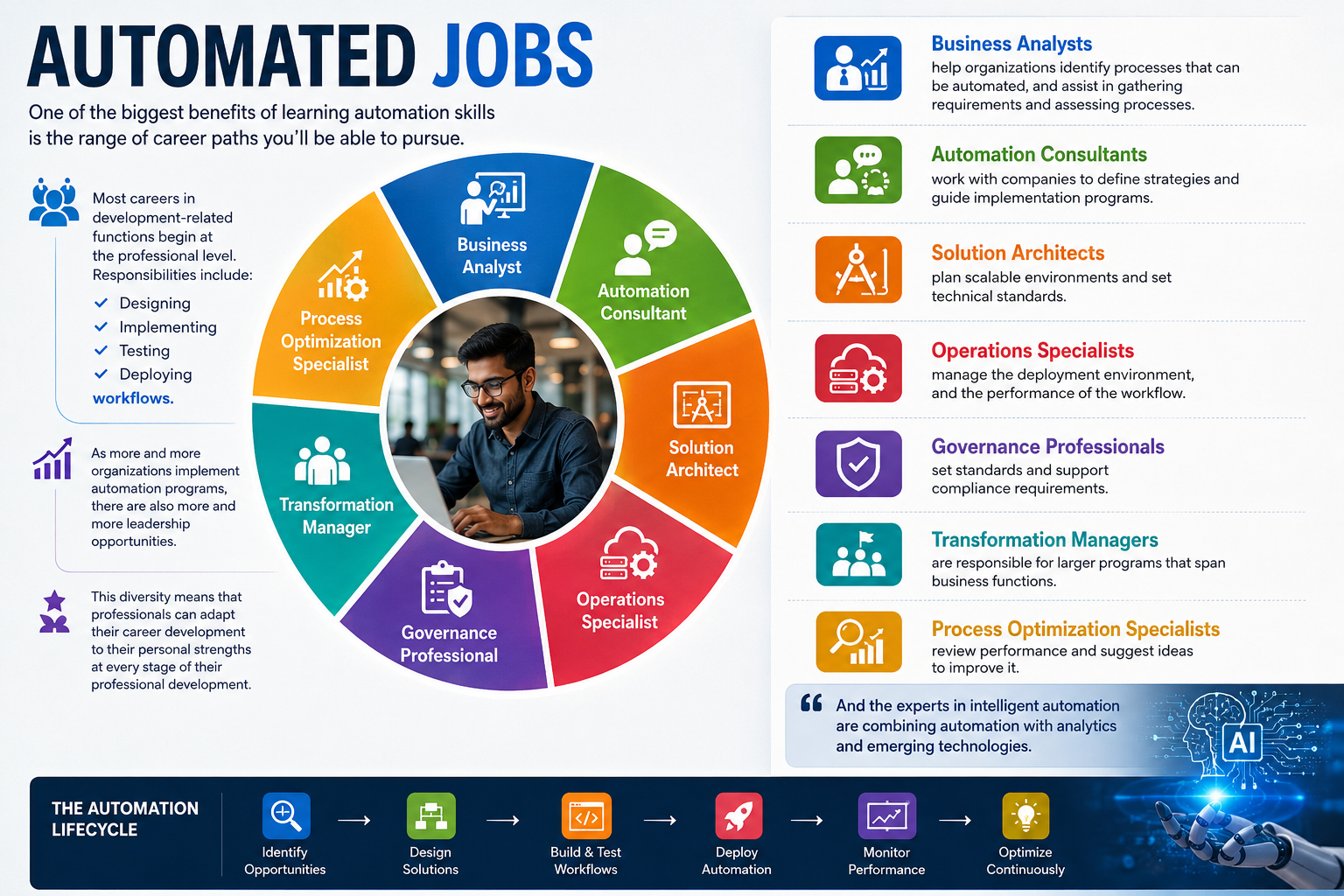
“And the experts in intelligent automation are combining automation with analytics and emerging technologies.”
Its performance is reviewed by process optimization specialists and they suggest ideas to improve it.As more and more organizations implement automation programs, there are also more and more leadership opportunities.This diversity means that professionals can adapt their career development to their personal strengths at every stage of their professional development.
Constructing a portfolio that shows actual ability.
Professional development is no longer about the certificates you have or what you know in theory, but what you can do.
Employers also want to see how candidates go about solving problems and how they utilize technical concepts.A good portfolio can say a lot about your ability.Projects should be focused on real business problems.Automating document processing, streamlining approval workflows, integrating systems, improving reporting processes or optimizing customer communication.
Adding value by documenting project decisions.
You show a greater understanding when you speak about objectives, implementation choices, challenges and outcomes.Also professionals should focus on functionality and show scalability and maintainability .It's less about the number of projects and more about the quality of the portfolio. Credibility is built through a professional presentation, reusable components and organizing documentation.Ongoing project development progresses and supports stronger career conversations. There’s no better way to develop professional confidence than to do it yourself.
The Significance of Constant Learning
Technology Careers Pay Off for Those Who Keep Learning Momentum
Automation is still moving ahead rapidly.
If professionals stop learning, their skills can become obsolete.
It should be part of the professional routine, not a one off activity, to keep on learning.
It’s good to keep you in the loop about industry news so you know what’s going on.
And it provides new angles by talking to professional communities.
Explore documentation for more technical depth.
Experimentation breeds innovation.
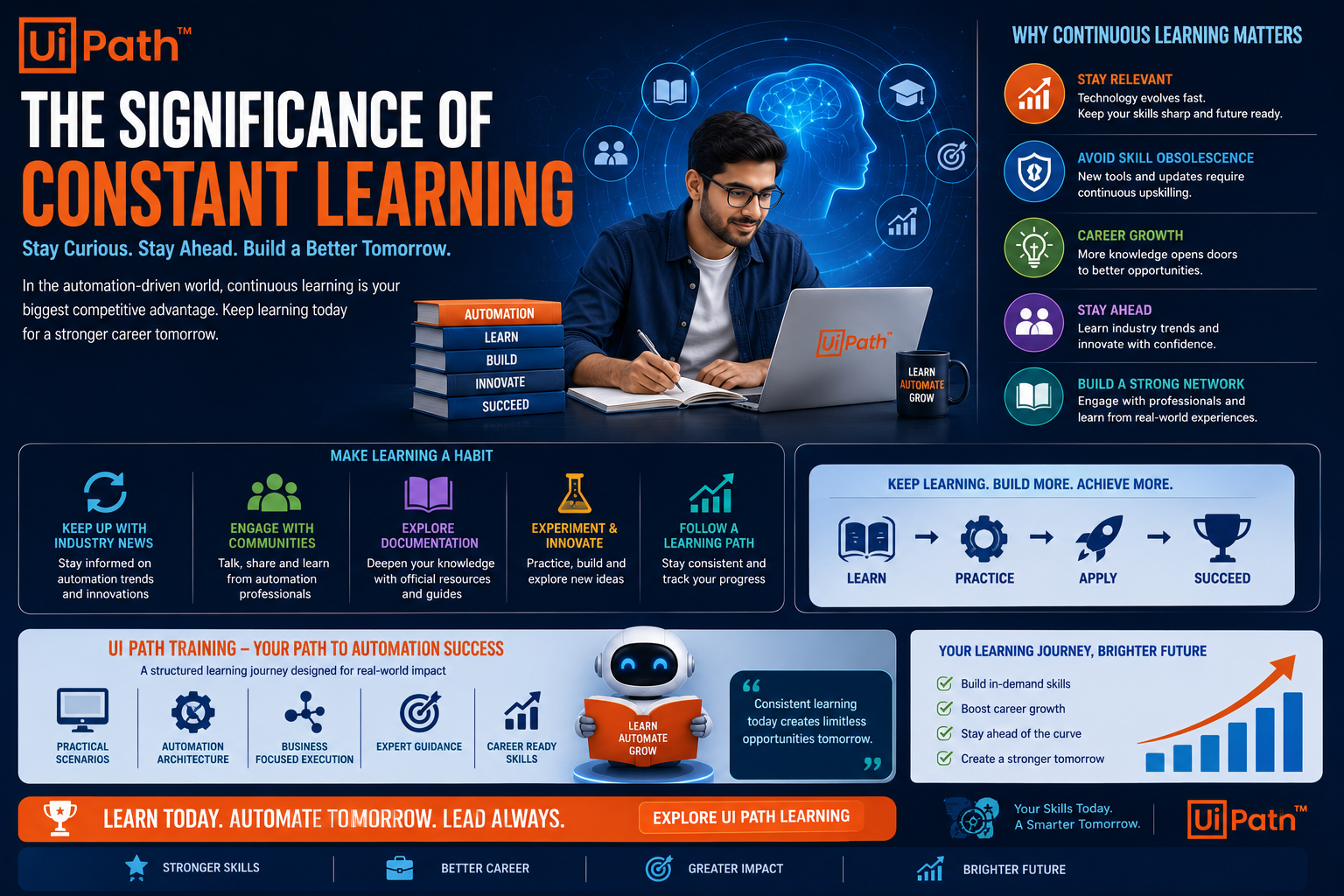
The development paths are usually created to speed up the professional development. A focused Best UI Path Training Online targets a large number of people to enhance their practical skills, guiding them through implementation scenarios and reinforcing their understanding of automation architecture and business oriented execution approaches.
How to Improve Your Leadership Skills and Achieve Long-Term Career Success
As professionals gain in technical confidence, leadership skills in implementation are becoming more important. An automation career is about more than just building workflows. It’s about decision-making, inspiring teams and leading technology initiatives that support organizational objectives.
Leadership is developed long before people get a management title. Ownership is a common entry point. We have observed that when professionals identify opportunities for improvement, document solutions and communicate clearly and proactively to help others, leadership behaviors tend to emerge naturally.
Automation environments are typically cross-functional. Teams may include business analysts, operations specialists, technical architects, developers and executive stakeholders. The trusted contributors are usually the ones that know how to coordinate between these groups.
Another very important ability is the ability to make decisions. Automation projects typically involve a trade-off between speed, complexity, cost and scalability. Leaders are going to look at these factors, and suggest what can be done to create long-term results.
Strategic thinking helps you get promoted, too. Sometimes, the best contributors are not those who are focused on nothing more than completing individual tasks, but rather true professionals who understand the priorities of the organization.
Mentoring provides more opportunities to grow. Peer work develops communication skills and enhances technical understanding Experienced pros sharpen their own skills, while helping others solve problems.
At its heart, it’s about driving clarity, execution and measurable business value through technical solutions.
The Future of Automation Emerging Technologies Powering The Future Of Automation
Automation is not just about the traditional rule-based execution anymore.Increasingly mergers are taking place between complementary technologies that enhance intelligence, flexibility and decision making.
Artificial intelligence : Systems are more flexible in processing information .
Ø Machine learning gives you pattern recognition, prediction.
Ø Natural language technologies enhance users’ interaction with systems.
Ø Document intelligence processes unstructured and semi-structured data.
Ø Analytics platforms tell you how you are doing operationally.
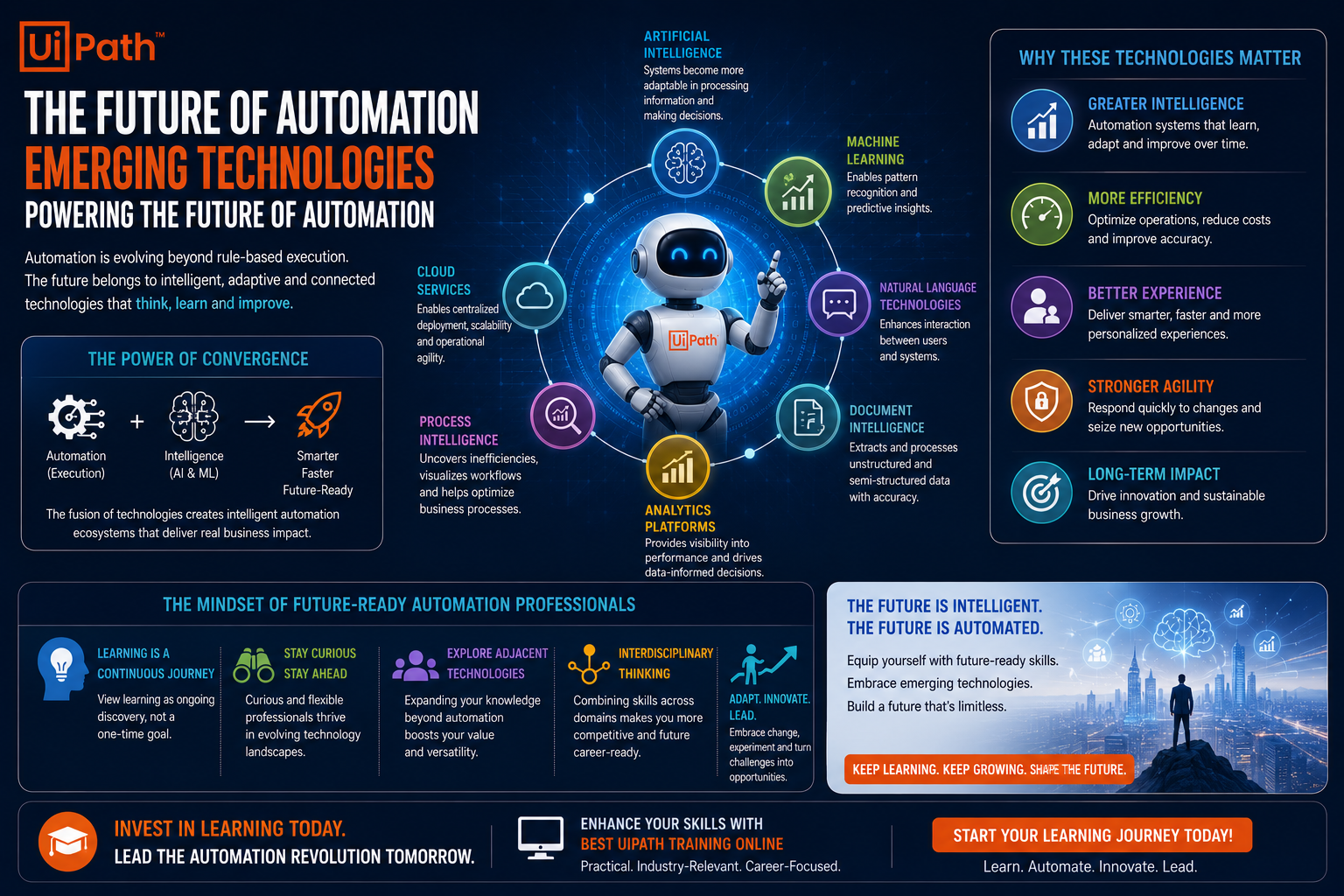
Ø Process intelligence helps organizations uncover inefficiencies and optimize their workflows.
Ø Cloud services allow operations to be centrally deployed and scaled.
Ø As these technologies become mainstream, automation professionals who explore adjacent areas will enhance their long-term career prospects.
Ø So the whole concept of learning should be viewed as a process of ongoing discovery, not as an end in itself.”
Ø The most curious and flexible professionals often thrive on technology changes.
Ø Interdisciplinarity makes you more competitive and helps you to change your career in future.
The Road to Professional Confidence: Why Consistency is Important?
Ø Self-confidence is essential for career advancement.
Ø “Too many professionals think they are confident once they get their training or certifications. “In practice you build confidence by doing something again and again and getting better and better.
Ø Construction projects constantly raise technical understanding.
Ø Reflecting on results makes for better decision making.
Ø Overcoming implementation challenges to build resilience
Ø Professionals begin to recognize patterns, feel comfortable solving problems they don’t know and get confident.
Ø Documentation also boosts confidence by making one’s progress visible.
Ø Professionals should document lessons learned, areas of improvement and projects completed.
Feedback leads to growth.
Confidence is not sureness. The best professionals are willing to learn and believe they can change themselves.
Success, in the long run, is usually a matter of confidence and constant improvement.
How to Create an Effective Career Growth Plan?
Ø If you want to advance in your career, it’s best to be deliberate.
Ø The professional must determine clear goals and plan in an orderly way to achieve the goals.
Ø Short term goals should be aimed at technical capability and practical implementation.
Ø Medium term goals include certifications, specialization and enterprise readiness
Ø Longer term you might target leadership, architecture, consulting or strategic transformation roles.
Ø Breaking your goals down into smaller milestones can make measuring your progress easier.
Ø A regular self-assessment will help you to identify your strengths and areas for development.
Habits of learning - Better project planning.
The more professional profiles you have, the more opportunities you will get.
UI Path Online Training helps many professionals to enhance their practical execution and implementation maturity. This helps to embed enterprise concepts and promote a wider understanding of automation delivery methodologies.
Flexibility is needed in career planning.
Industries change and new opportunities emerge, and professionals should update their goals without losing sight of the long term direction.Often, consistency trumps intensity.From Technical Skill to Professional PossibilityThe more professionals know how to communicate the results, the more valuable technical knowledge becomes.Employers are more interested in the ability to deliver measurable business value rather than technical know-how alone.
Professionals need to learn to speak impact language about projects.Talk about efficiency gains, quality outcomes, scalability benefits and implementation options to build professional credibility.Get ready for interviews by solving problems and implementing. Highlight achievements and duties in professional bios.Continuous learning shows commitment.Visibility creates relationships.The professional’s visibility is added active in the community.
“f you want to speed up your development, get a mentor.Usually, career opportunities don’t come from one accomplishment, but from consistently contributing.Automation pros who can strategize and communicate tend to move up the ladder faster.
How to Develop a Career in Automation for the Long Term
Sustainability enables long term success.Professionals often forget the habits that will help them grow over the long term when taking on new technical skills.The key to careers that are sustainable is balance.Learning should be continuous but achievableTo be complemented with practical work of theoretical knowledge.Reflective practice makes you more effectiveFlexibility is the key to resilience. Support systems are professional relationshipsIndustry trends help you make strategic decisions.
Don't define success by job titles, certifications.True growth is usually a matter of accumulated experience and steady improvement.The more capabilities we have, the more adaptable we are.Curiosity fuels innovation.Sustainable routines will help you in the long term.Those who continue to invest in themselves tend to remain competitive when technology environments shift.
For those who are looking for more practical experience and wider application readiness, a full UI Path Course Online India can often help to improve their ability. This helps them to develop further and prepare for changing automation requirements.
Conclusion
A successful career in Automation with UiPath skills requires more than just technical familiarity. Foundation for sustainable growth is practical implementation, business understanding, continuous learning, adaptability and strategic thinking. With automation on the rise across industries, those committed to sharpening their skills will be in a good position to capitalize on better opportunities and long-term growth. What really gives you a career advantage is project experience, knowledge of the enterprise environment and a growth mindset. OnlineITGuru provides ongoing professional growth and long-term development for individuals seeking structured learning support and career-oriented guidance in the automation field.Write your blog content here...