
Building Asynchronous Integration Workflows Using MuleSoft
Last updated on Nov 24, 2026
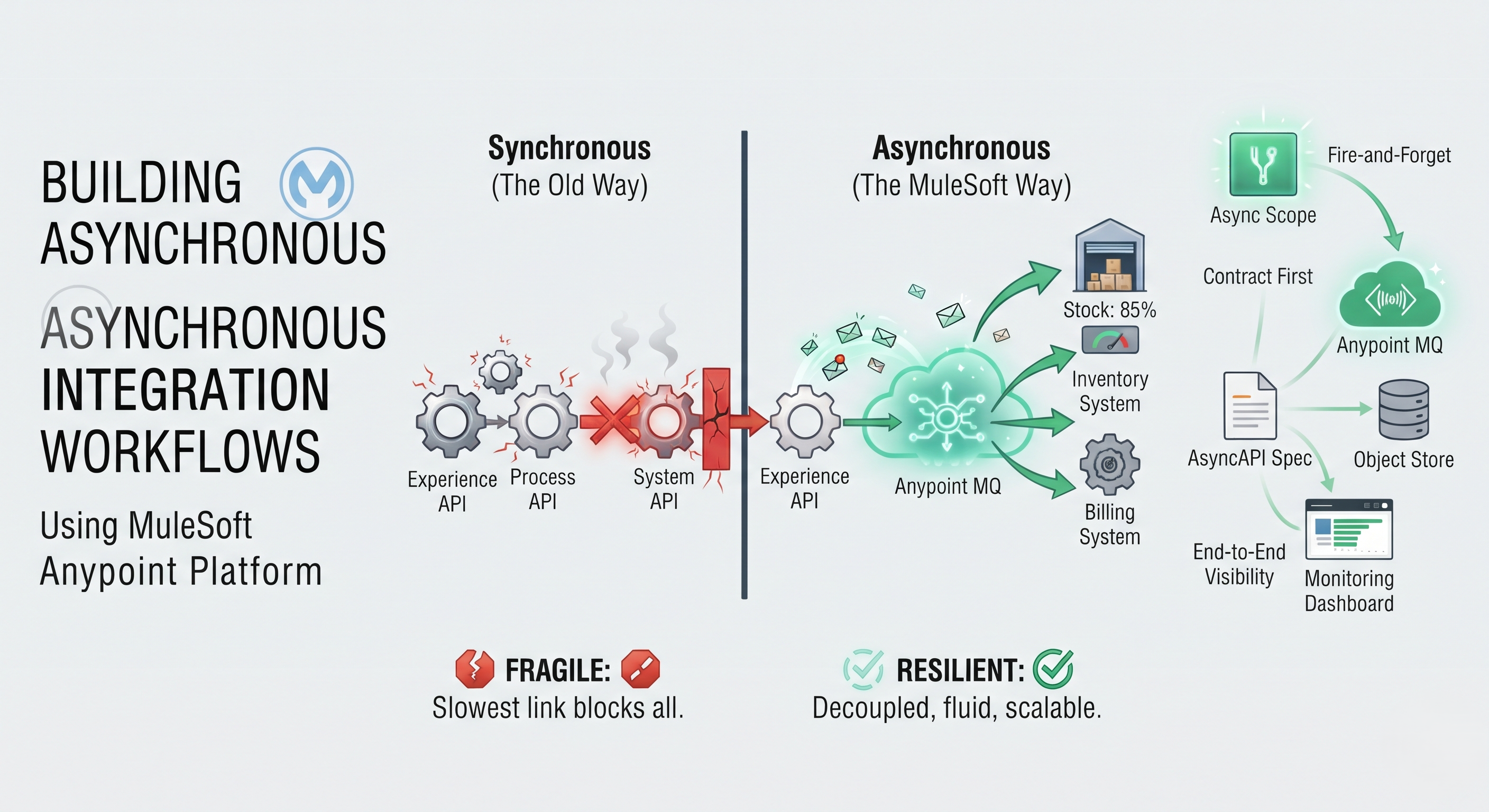
The pace of enterprise digital ecosystems is rarely the same. A modern retail shopfront can handle thousands of customer orders per second during a flash sale, but a legacy enterprise resource planning system updates inventory in measured intervals, and a third-party logistics provider may take several minutes to generate shipping manifests. Trying to link these independent systems together with rigid synchronous request-and-response chains creates a fragile architecture where the speed and reliability of the entire business operation is determined by the slowest component. When a downstream database is slow or in scheduled maintenance, upstream applications get stuck, user interfaces freeze, and important transactions disappear into timeout errors.
The design flaw is solved through asynchronous integration as the creation and consumption of the request are separated. In such a case, the application creates the request by sending out the message or the event and goes on to perform the other operations without having to remain connected to the network awaiting a response from the request. The other system gets the message and processes it according to the speed of the systems. MuleSoft Anypoint Platform provides all the necessary tools, messaging brokers, specifications and runtimes required to design resilient, scalable and observable asynchronous processes. For more information on the patterns, one can go through mulesoft training courses by OnlineITGuru.
From Event-Driven Decoupling to Synchronous Chains
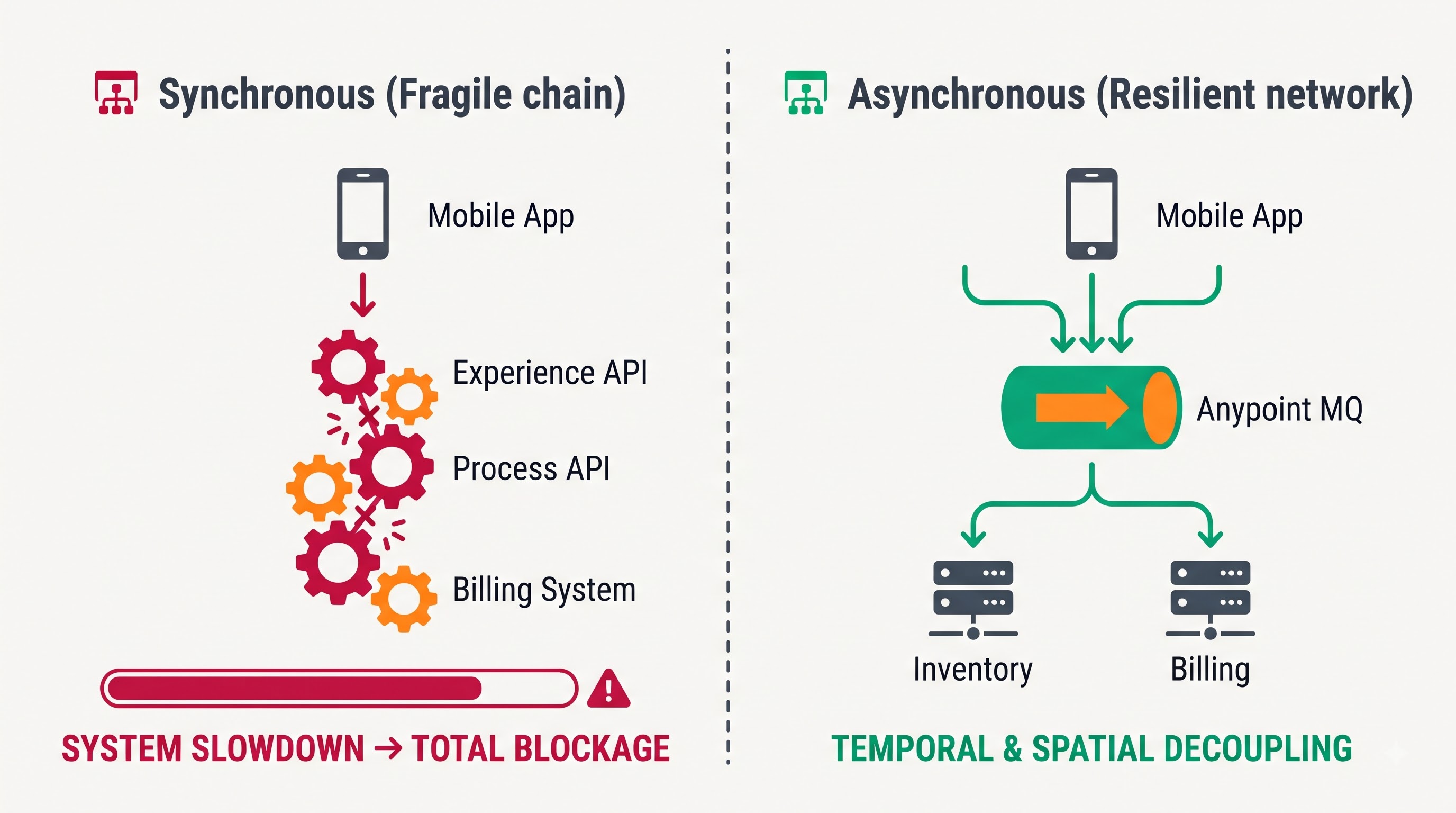
To gain a good understanding of how asynchronous design works in MuleSoft, it is useful to understand the limitations of the standard synchronous API-led connectivity. So a typical synchronous interaction might be: The Experience API gets a call from some mobile application, calls the Process API to orchestrate the business logic, and then calls several System APIs to update customer records, reserve inventory and trigger billing. Every link in that chain remains blocked until the last system API confirms. If the billing platform starts to experience latency spikes, the threads back up on all upstream Mule runtimes until memory and connection pools are exhausted and the entire integration layer degrades.
Asynchronous workflows break this chain of dependencies by decoupling time and space. Temporal decoupling means that the sender and receiver do not have to be online and responsive at the same point of time. Spatial decoupling means that the sender does not need to know the physical location in the network, the scaling topology or even the identity of the downstream consumers. This paradigm shift, says MuleSoft, transforms integrations from brittle point-to-point pipelines into fluid, event-driven networks that can absorb massive bursts of traffic without data loss or degradation of the end user experience.
Core Architectural Pillars of MuleSoft
MuleSoft allows teams to implement asynchronous processing at various levels in the architecture, so that the right level of durability and complexity can be selected for each business case.
Local scopes in memory and asynchronous
The most granular level is the Mule application itself where developers can use the native Async scope and Virtual Machine queues. The Async scope is a fire-and-forget integration flow branch. When a message arrives at the main flow, MuleSoft makes a copy of the message payload and variables and passes them to a separate thread pool within the Async scope, and immediately continues with the execution of the main flow. This pattern is especially useful when the side effects are not critical, such as writing audit logs, updating analytics dashboards, or sending non-urgent notifications, and you don't want to block the main transaction while these auxiliary tasks complete.
Virtual Machine queues offer an internal publish-and-subscribe or point-to-point mechanism when an application requires lightweight decoupling between different flows that are running on the same Mule runtime or cluster. Persistent Virtual Machine queues are persisted to disc, not just volatile memory, to provide rudimentary protection from application restarts . Distributes the workloads on the worker nodes in CloudHub. But Virtual Machine queues are tightly bound to the lifecycle and boundary of a given Mule application deployment, so you need a dedicated external message broker to decouple across the enterprise.
Enterprise Messaging with Anypoint MQ
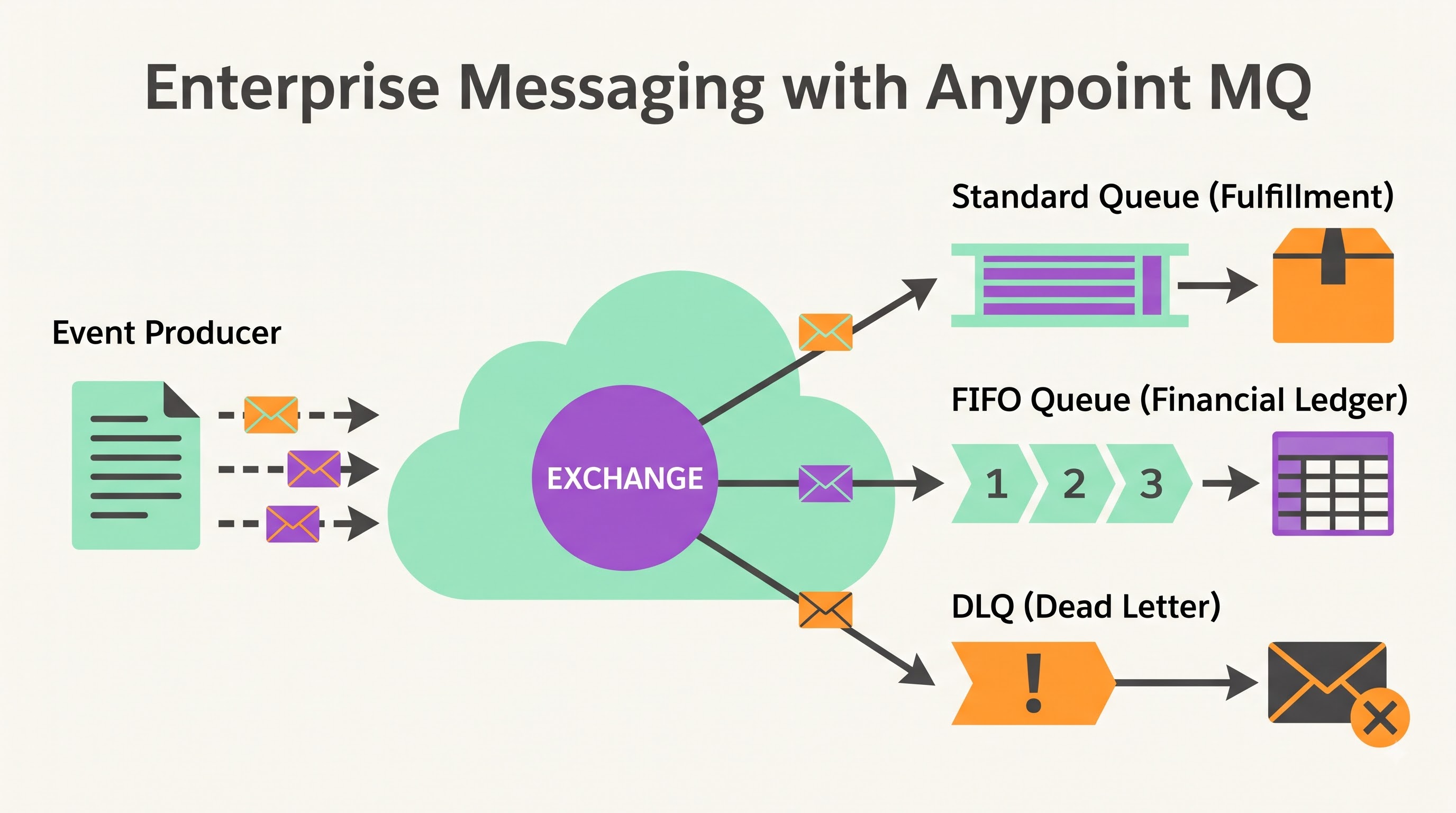
Anypoint MQ is MuleSoft’s native, multi-tenant cloud messaging service you use when you need mission-critical, asynchronous workflows across multiple applications, departments and cloud environments. Fully integrated with the Anypoint Platform, Anypoint MQ removes the operational burden of provisioning, patching and scaling third-party broker infrastructure, while delivering enterprise-grade reliability.
Anypoint MQ uses two key constructs for organising communication: exchanges and queues. Standard queues provide point-to-point messaging, meaning that a single message is delivered and processed by a single consumer. If several worker nodes listen on the same queue, they are competing consumers and implicitly load-balance high-volume traffic over the available processing capacity. In some applications, order is important and First-In, First-Out queues ensure messages are delivered in the exact order they were published. This is important when sequentially processing financial ledger adjustments or state transitions of a single order.
The exchanges support the publish-subscribe pattern A producer publishes an event to one message exchange, and the exchange automatically routes copies of that message to many bound queues based on the routing rules. This allows a single “Order Placed” event to trigger fulfilment within the warehouse system, calculate loyalty points in the customer relationship platform and run fraud analysis in a security service—all without the original order service having to know about those downstream consumers.
External Event Brokers link
Many organisations already have a heavy investment in external event streaming platforms and enterprise message brokers such as Apache Kafka, Solace PubSub+, RabbitMQ or ActiveMQ. MuleSoft enhances this hybrid reality with specific high-throughput connectors, giving external brokers first-class citizenship in Anypoint Studio and Anypoint Code Builder.
For example, in the case of Apache Kafka, MuleSoft applications can be high-speed producers publishing serialised event streams to partitioned topics or consumer groups reading from offsets with fine-grained control over commit intervals. Likewise, Solace PubSub+ or Java Message Service broker integrations rely on native protocol support for durable subscriptions, message selectors and distributed transactions for seamless interoperability across heterogeneous enterprise landscapes.
AsyncAPI for Designing and Governing Events
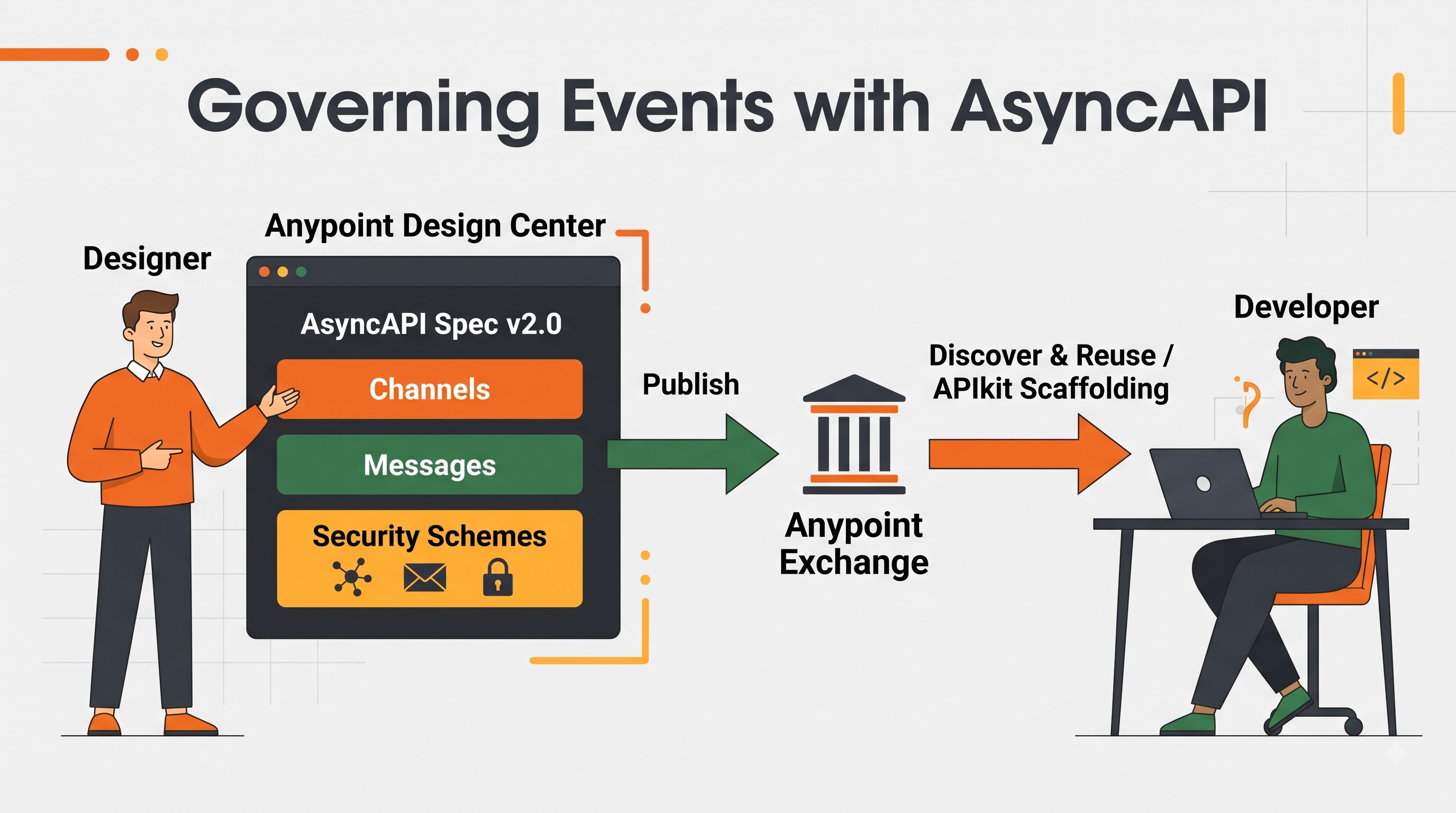
Historically, governance has been one of the challenges with asynchronous architecture. While RESTful APIs can benefit from contracts like RAML and the OpenAPI Specification, event-driven interfaces often end up with undocumented message payloads exchanged via obscure queue names, leading to shadow integrations and breaking schema changes.
MuleSoft closes this governance gap with support for the AsyncAPI specification over its full lifecycle. AsyncAPI provides a standard machine-readable contract for event-driven interfaces in the same way OpenAPI describes the endpoints, methods and request-response schemas of a synchronous web service. In Anypoint Design Center, architects specify the channels (topics or queues), operations (publish or subscribe), message schemas, and broker binding information through a structured specification.
When AsyncAPI specs are written, they are published directly on the Anypoint Exchange. Publishing event contracts to the Exchange makes them discoverable and re-usable assets across the organization. If you’re a developer integrating with Exchange, you can know the exact shape of an event payload, know which message broker hosts the channel and inspect governance rules before writing a single line of integration logic. MuleSoft’s APIkit for AsyncAPI also provides scaffolding for integration flows straight from the specification, auto-generating message listeners, publishers, and payload validation rules. With this specification-first discipline you get the same rigour, discoverability and security compliance for asynchronous architectures as you do for traditional API-led connectivity.
Essential Design Patterns for Robust Asynchronous Workflows
Creating a robust asynchronous integration is far more than just placing a message on a queue. Network partitions, transient service outages, and malformed payloads plague distributed computing environments, so MuleSoft architects must bake proven resilience patterns into every workflow.
Message Acknowledgement and Reliability Patterns
With synchronous communication, the HTTP status code immediately indicates to the sender whether a transaction was successful. Explicit acknowledgements provide reliability for asynchronous messaging. When a consumer on MuleSoft retrieves a message from Anypoint MQ or from an external broker, the broker puts that message in an in-flight state, hiding it from other consumers while safely storing it on disc.
Once the Mule flow processes the payload successfully and updates the target database, it sends a positive acknowledgement to the broker to delete the message permanently. However, if an unhandled exception occurs (e.g. a downstream database times out), the flow sends a negative acknowledgement or the visibility timeout expires. The broker then makes the message visible to another consumer worker to be re-processed. If a Mule runtime crashes in the middle of execution, automatic acknowledgement upon message receipt can result in message loss. Manual acknowledgement modes can be carefully configured by developers to achieve at-least-once delivery and eliminate the possibility of message loss.
Duplicate Prevention and Idempotency
In distributed messaging systems with at-least-once delivery, durability is preferred so that consumers are guarantyd to see duplicate messages during network retries or failover events. If the asynchronous payment processing flow is run twice with the same transaction identifier, the business is charged twice and reconciliation fails.
MuleSoft tackles this with the Idempotent Message Validator and the persistent Object Store v2. Each incoming event needs to have a globally unique correlation or event identifier generated at the source. Mule flow will check this unique identifier against a distributed Object Store before executing any state changing business logic. If the identifier does not exist, it records it in the Object Store with appropriate time-to-live window and continues processing. If a duplicate message arrives minutes or hours later, the validator will find the existing key and safely discard or short-circuit the duplicate execution, but will still acknowledge the message so it can be cleared from the queue.
Dead Letter Queues and Poison Messages Handling
Some mistakes are for ever. If the network glitch is transient, it will disappear on its own after a few retries. But a message with corrupted data, missing mandatory fields or an invalid customer reference – often referred to as a poison message – will fail every time it is processed. A poison message that loops forever wastes compute resources, clogs thread pools and blocks healthy messages behind it.
MuleSoft requires every production queue with explicit redelivery policy to have a Dead-Letter Queue attached to it, to prevent infinite retry loops. The architect will set the maximum number of deliveries, generally 3 to 5 attempts. If a message fails processing and the number of retries exceeds that limit, the broker automatically moves the message out of the main processing queue to the Dead-Letter Queue. Operations teams can configure automated alerts on Dead-Letter Queue depth, examine the quarantined payloads with their failure metadata, repair underlying data defects and replay the fixed messages back into the main workflow without affecting live traffic.
Backpressure, Rate Limiting and Throttling
One of the main advantages of a queue in between systems is to act as a buffer for traffic spikes. But a MuleSoft consumer consuming messages from a queue as fast as it can with its internal thread pool can inadvertently launch a denial-of-service attack on a fragile legacy backend system that can only handle ten requests per second.
MuleSoft has intelligent backpressure controls to protect downstream targets. Developers are able to configure max concurrency limits on the Mule flow — the exact number of messages each runtime worker can process concurrently. You can also control how quickly messages are pulled from the broker by setting the prefetch sizes and polling intervals on message listeners. MuleSoft also integrates with circuit breaker patterns that stop message consumption for a period of time if downstream error rates exceed a threshold, ensuring that downstream systems recover gracefully from heavy load instead of crashing under a sudden surge.
Connecting Sync Clients to Async Servers
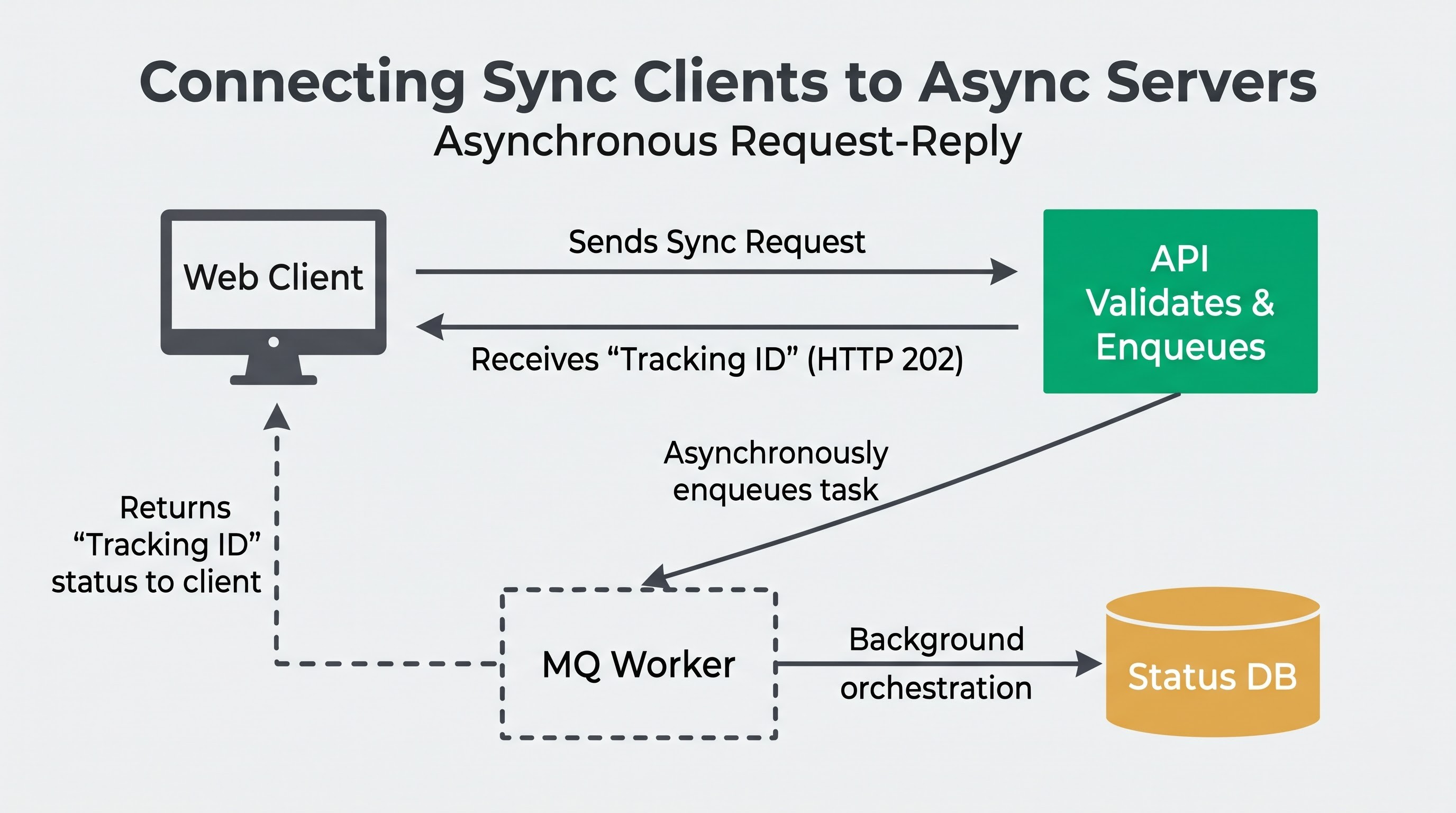
The interaction may be initiated by an external user interface or partner system using a synchronous HTTP protocol, but the underlying fulfilment process can take several minutes to finish. MuleSoft elegantly fills this gap with Asynchronous Request-Reply pattern.
The Experience API then receives a request from the client and validates the incoming payload, creating a unique tracking identifier in the process. The Experience API then places the work item onto an Anypoint MQ queue and returns an HTTP 202 Accepted status code to the client immediately, along with the tracking identifier. The client is released immediately and does not wait for the backend execution. When the background async workers complete the complex orchestration, MuleSoft either pushes the result to a client webhook URL that the client registered earlier, or updates a status record in a database that the client can poll periodically, by its tracking identifier.
Distributed Tracing and Observability Monitoring
If a single business transaction passes through three APIs, two message exchanges and four background queues, it is almost impossible to troubleshoot in the traditional way if observability is not baked into the foundation. And without end-to-end visibility, an error that happens deep inside an async consumer seems completely unrelated to the original customer request that initiated it.
Asynchronous observability in MuleSoft starts with passing a consistent Correlation ID in every single boundary. When a message arrives in the source Experience API, MuleSoft generates or extracts a Correlation ID. The producer explicitly injects this Correlation ID in the custom message headers or properties before publishing a message to Anypoint MQ or Kafka . Then, when the downstream consumer receives that message seconds or hours later, it pulls the Correlation ID out of the message metadata and attaches it to its own execution context.
Structured JSON logging with the Correlation ID, message identifier, queue name, and processing duration for each stage is required. Teams can query Anypoint Monitoring or external observability solutions such as Splunk or Datadog to re-construct the full lifecycle of an async transaction in seconds. In addition, operations teams can proactively gain insight into bottlenecks well before end users experience delays by tracking queue-specific metrics like message age, enqueue vs dequeue rates and Dead-Letter Queue growth.
Best practices for production readiness
To successfully run asynchronous MuleSoft workflows at an enterprise level you need to adhere to a number of operational disciplines:
Keep event payloads small and relevant. Message brokers are not for bulk data warehousing but are optimised for fast routing. You can send short event notifications with key identifiers and state changes, or you can store large binary attachments in cloud object storage using the Claim Check pattern, and pass only the reference link to the storage location in the message payload.
Design for backward compatibility asynchronous ecosystems have independent producers and consumers, so evolve event schemas carefully. Don't remove or rename existing attributes, but instead add new optional fields so that older consumers will continue to work seamlessly in phased rollouts.
Differentiate between transient and permanent failures. Design Mule error handlers carefully using On Error Continue and On Error Propagate scopes. Transient connectivity errors should cause a broker redelivery with exponential backoff. Unrecoverable business validation errors should not consume retry cycles, but should be logged and routed immediately to a Dead-Letter Queue.
Secure Data In Transit And At Rest: Provide transport layer encryption for all broker connections, use client credential authentication to access queues, and encrypt sensitive personally identifiable information at the payload level before publishing events to shared enterprise buses.
Following these rules of reliability shall help those professionals who are preparing for mule soft certification since these terms come across quite frequently in such tests. Onlineitguru provides practical mulesoft classes with lab-based practice to test these characteristics in case of failures.
Conclusion
Asynchronous integration has moved beyond being a mere optional performance optimisation for high-frequency trading platforms or gigantic consumer web applications. This is a fundamental need for any modern enterprise that wants to gain true operational agility and architectural resilience. As organisations grow across hybrid cloud environments, software-as-a-service ecosystems, and legacy on-premises infrastructure, the limitations of purely synchronous communication become inescapable. With tightly coupled systems, immediate request/response dependencies and a single slow database or scheduled maintenance window can lead to widespread outages, poor user experiences and lost revenue. These fragile chains are disrupted by the move to an event-driven, asynchronous model, enabling individual services to work, fail and recover at their own natural speed without destabilising the wider enterprise network.
MuleSoft provides a single unified platform to enable this architectural shift while enabling governance and visibility. MuleSoft bridges the gap between traditional service orchestration and real-time event streaming by combining the structural discipline of API-led connectivity with native messaging capabilities like Anypoint MQ and seamless connectors for external brokers like Apache Kafka and Solace. Architects no longer have to choose between clearly defined APIs and scalable message queues. Instead they can blend both paradigms to precisely match the throughput, latency and durability needs of each business process.
Building enterprise-grade async workflows is serious engineering. It's more than just moving messages from A to B. It's about being reliable and managing contracts and having observability Anypoint Design Center allows organisations to manage AsyncAPI specifications and publish them to Anypoint Exchange, enabling them to leverage the same discoverability, schema validation, and lifecycle governance for asynchronous events that RESTful APIs have long offered. At the same time, Mule flows can embed proven resilience patterns, such as explicit manual acknowledgements, Object Store-backed idempotency checks, dead-letter queues for poison message isolation, and max-concurrency throttling, to ensure that distributed transactions are accurate and recoverable even under extreme load or partial infrastructure failure. Combined with end-to-end Correlation ID propagation and structured logging, operations teams have full visibility into complex multi-hop async pipelines.
In conclusion, the implementation of asynchronous integration design through MuleSoft changes how an organization responds to growth and change. The independent applications will be allowed to evolve on their own and handle the unexpected increases in traffic such as flash sales traffic. Any additional downstream consumers that include real-time analytics, AI workflows, or even fulfillment applications from partners are able to receive business events without having to touch the basic upstream applications. Using tightly coupled and designing for inherent network disruptions, the organization is creating a resilient integration layer that will serve as the nervous system for continuous digital innovation. For those individuals wishing to gain further insight into integration and obtain a mule soft certification, there are various mulesoft classes and mulesoft training programs available through OnlineITGuru.