
Building Enterprise Smart AI with MongoDB Vectors
Last updated on Oct 16, 2026

The Growth of Smart Applications
Modern software engineering has reached a unique point. For many years databases were constructed around fixed matches, relational mathematics, and lexical text lookups. Applications could answer set questions: locating a customer through his account number, checking transactions that took place in some date range, or finding words in a catalog search. Although it was efficient in deterministic operations, this method was unsuccessful in simulating human language, unstructured information, and contexts.
New large language models, various dense vector representations and generation systems have reshaped the way users expect modern software to function. Current software should be able to understand subtleties, guess intentions, recognize voice features and pictures, and find relevant contexts despite the large data amount it possesses.
To leave the operation of generative models behind the world of data, vector searching has turned into essential company technology. With the help of continuous numerical vector usage, or so-called embeddings, data can be represented as continuously measurable space, enabling to compare distances in the models.
Thus, previously to enact vector work companies had to add vector databases to their companies’ technology infrastructure. However, this kind of structure could create additional operational difficulties.
Understanding Embeddings Segmentation: The Basics of Semantics
The vector embedding plays the central role in semantic retrieval. Understanding embeddings helps to create good data processing methods used in retrieval-based generation systems.
Mathematical Definition of Meaning
The vector embedding is a collection of constant real numbers placed in a certain high-dimensional idea converted into a continuous space vector. When the machine learning model receives any text, video, or audio, it processes all the tokens using the transformer processes and analyzes their meaning from the structural, semantic, and context points of view to produce the vector output.
The idea of geometry means that there is a direct correlation between the distance and the degree of semantics. The words which are identical are placed in close proximity in the coordinates:
There are physicians and doctors almost at the same coordinates.
There is a car close to the vehicle and sedan.
As a result, traditional lexical search becomes ineffective.
Thanks to this innovation, the issue of typical lexical searches is solved. Inverted indexes do not work in case words with similar meanings are searched for and differ in their spellings because of different dialects or slang. Vector embeddings enable it to process the query in a way that will not depend on its pure wording.
Dimensions and models of learning in embeddings
Embedding dimensions refer to the uniqueness of the vector and fall into the range of hundreds or thousands. The larger the dimension of the embedding model is, the more parameters can be used and the more detailed the description of a field or language can be. At the same time, this requires more storage facilities.
Choosing an embedding model implies balancing the speed of calculations and accuracy of the results. General models are suitable for common texts while special models are meant for certain fields of knowledge.
The current embedding models are multilingual, which allows the expression of the same idea in various languages.
Exploring the Dimensions: Measuring Similarity and Indexing
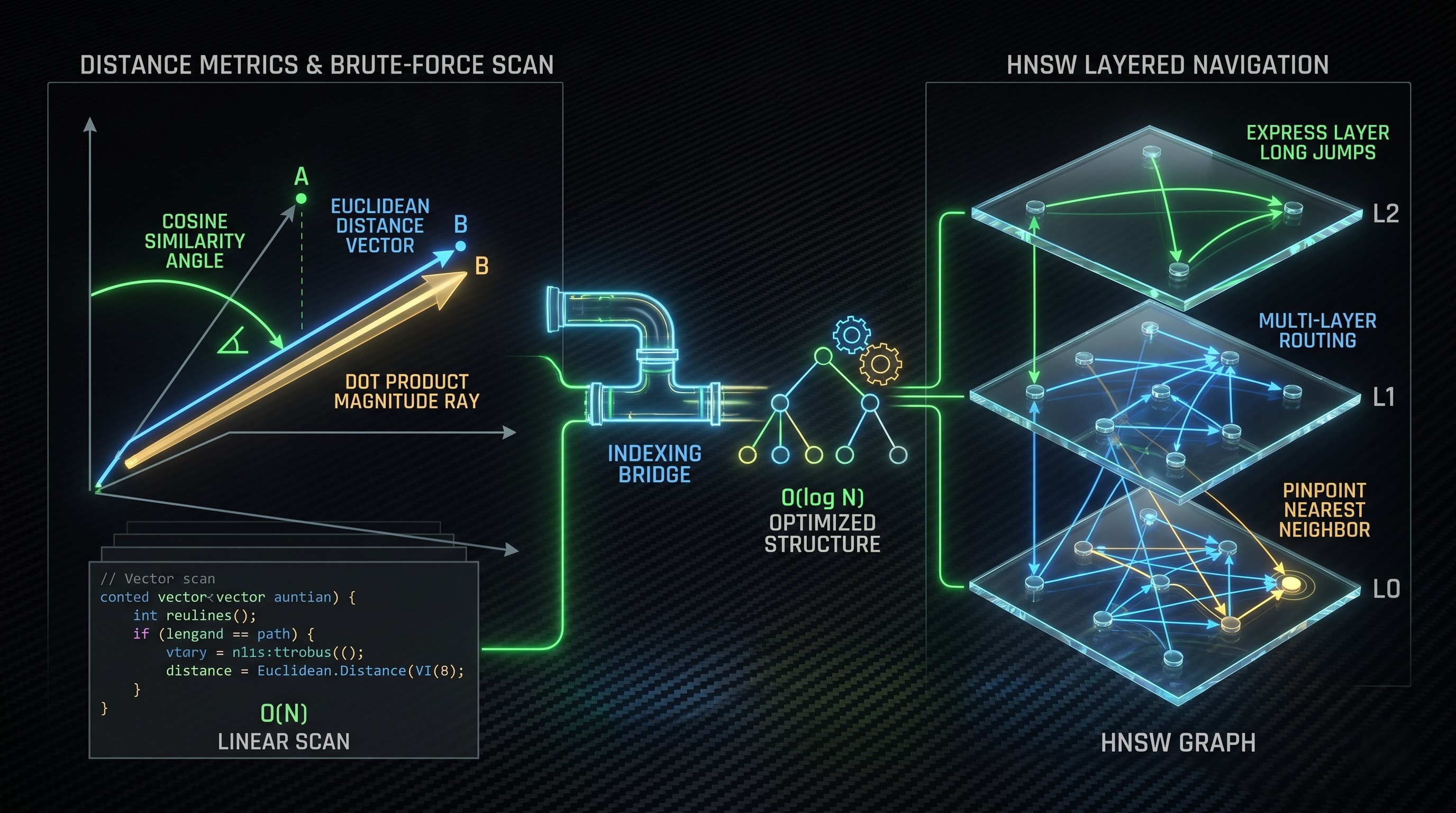
In situations where data has been converted into coordinates, it is crucial that the database understands which data sets match with the incoming query set. The problem of searching through millions of entries in the production database becomes complex since all sets of information must be mathematically checked against the specified instruction data. This problem can be solved with the help of efficient measures for determining the degree of similarity between data sets, and also by various methods of approximate indexing.
Distance Measurement Methods
In the process of retrieving vectors, a set of mathematical formulas for measuring the distance of two vectors from each other is used.
Cosine similarity: Cosine similarity determines the angle between two vectors. The length of a vector is irrelevant here since all that matters is its direction.
Euclidean distance: Euclidean distance defines the length of a straight line between two data points in multidimensional space.
Dot product: The dot product measures the product of the lengths of two vectors in relation to the angle between them. In other words, the dot product equals cosine similarity.
The Approximate Nearest Neighbor algorithms
Scanning an entire data set to get the exact nearest vector is inefficient as it increases linearly with the amount of the data. This process is not practical for applications requiring high throughput and low delay time.
Hence, modern vector searches based on Approximate Nearest Neighbor algorithms can achieve sub-second responses. The Hierarchical Navigable Small World graphs are one of the most important algorithms of this kind.
Hierarchical graphs are used to organize vectors into a network like the express subway network which has several layers. In the upper layers of the graph there are few connections between vectors that allow long connections across big distances and going down the graph the number of links will be increased.
In the process of search the engine uses the previous links in upper layers to find the approximate location of the needed vector and climbs down the graph down to the last layer.
This system allows changing the complexity of the search from linear to logarithmic which means that the engines make queries using a small amount of data from the whole dataset and still managing to provide relevant output.
Unified Architecture: Benefits of Using MongoDB for Vector Searching
In light of the rapid development of AI technology, there arose a demand for the creation of specialized databases equipped with vector search functions. While these specialized applications do solve the problems at hand, they also entail a number of difficulties in production.
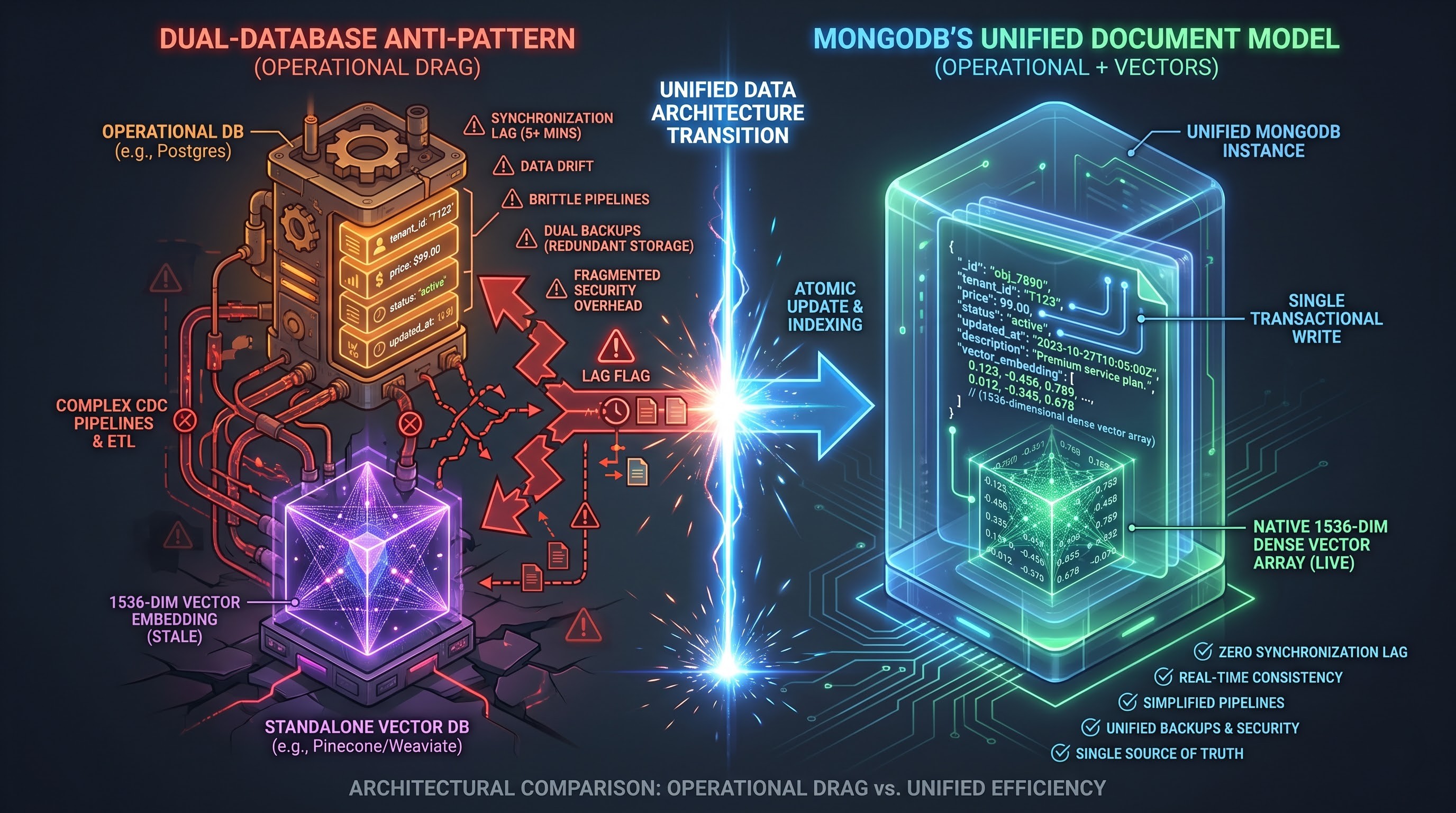
The Way to Solve the Challenge of Working with Two Different Databases
The presence of a vector-oriented database alongside a regular database complicates enterprise architecture design and leads to:
Difficulties in Synchronization: The operations of updating, deleting, and entering new data in the main database must be reflected in the external vector database as soon as possible. The setting-up of specialized connections for achieving that (which usually includes sometimes expensive data transmission systems and change of database events revelation) adds burden to the system.
Uncertainty in Data Status: The data may be accessible on different remote hosts, which leads to the possibility of errors made in the course of the processing of the data.
Additional expenses: Running two independent systems means that all processes connected with monitoring both databases must be carried out twice, and it concerns the requirements for security policy implementation, access rights, backup etc.
The structure of documents in MongoDB makes it possible to keep operative data and very complex vectors in the same document.
The alteration of the document entails making changes in the vector of data, thus enabling the transactional update technique. This implies that developers will have a unique reference point, one common backup, and no excess middleware. For those specialists who would like to understand how to use a unified database and real-time retrieval, the best mongodb online course is the right choice.
Native Hybrid Search
In life, the search is rarely purely semantic. People do not usually say that they need to find "anything similar to leather jackets," but they rather say that they look for "black leather jackets selling for less than $200 available at a store rated at least 4."
In such a way, there is a need for a very complicated choreography because searches need to be performed on many databases. Thus, the system needs to contact a vector database to get the semantically similar results and to an operational database in order to know what is in stock currently and how much it costs.
The act of filtering vector graphs by leveraging different document attributes can take place prior to or during the process of searching and/or traversing the graph. Because of this, the request will produce accurate results without any unnecessary computational costs.
The issue that entails vector search is the inability to deal with certain kinds of formats or acronyms that do not utilize any semantics. Thus, the approach in use by MongoDB consists of using a combination of different techniques: the results of the semantically dense vector searches and the classical keyword-based searching system.
Designing Retrieval-Augmented Generation (RAG) Architectures
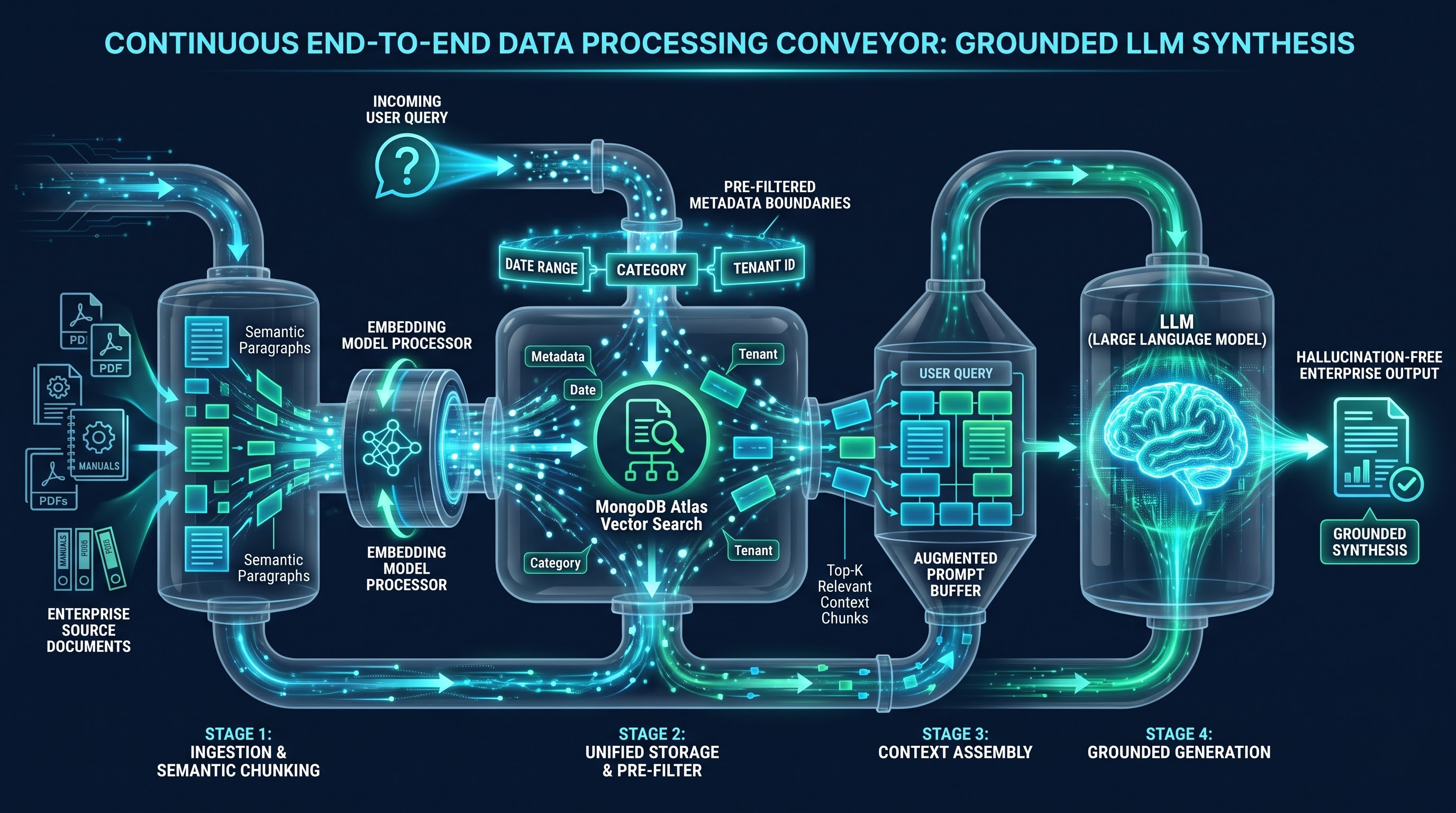
Retrieval-Augmented Generation (RAG) is a widely adopted concept in business AI development. LLMs can produce any text due to their linguistic abilities and general knowledge accumulation but they cannot check databases for relevant information or current updates. This results in LLMs being able to formulate a rather plausible answer without actually verifying it against the available databases.
The ingestion segment
The initial step in the path of the RAG application is data onboarding:
Extraction of documents: Through the ingestion phase, raw data is extracted from various places, such as manuals in PDF form, tickets, internal wiki, or entries in a CRM.
Chunking method: Since the majority of models have limited context windows, large documents lose their meanings. Thus, documents have to be divided into smaller separate logical sections. This process is performed through a method known as paragraph-based chunking (semantic chunking) which keeps the study of the topic intact.
Embedding method: Each chunk is sent to the embedding model API which returns a structure with high-dimensional feature vectors.
Data ingestion phase: A portion of text is stored in MongoDB together with its vector and metadata including the author, time of creation, access, and tags.
The query process lifecycle
When an inquiry is made using the generative interface, the process is triggered automatically.
The process of adjusting the request: The request is recognized when user input is received. If the user makes a reference to the old information, it is necessary to recast that into a separate request prior sending the query to the embedding engine that will create a vector for the query.
Vectorization and searching: The vector representing the query is sent to MongoDB and the database is analyzed through the vector searching process that is responsible for discovering the relevant data after excluding the options that would not reveal what the user would need to know.
Constructing context: The data is processed, the text is organized, and the query is developed through a structured text derived from the processed data.
Grounded generation: The language model is based on the context and generates the correct answer based on the information that can be retrieved from the database.
Advanced Design Principles for Business Systems
With the advancement of artificial intelligence from a demo usage to the real implementation, it is necessary for the developers of the systems to use advanced methods to check the effectiveness of their developments.
Access Management and Multi-Tenancy
In order to guarantee effective data separation, the business setup has to possess a significant amount of confidentiality. When it comes to the Software as a Service model, the situation where confidential customer data gets out of the framework of the organization is prohibited during any similarity searches.
MongoDB solves the task of multi-tenancy very simply through the use of indexing and document-level security. Specifically, the vector search indexes can contain unique tenant ID fields in the pre-filter.
While running the query, the vector engine only looks into those vectors that have the organization ID defined.
As a result, the use of only one collection becomes possible due to the ability to structure the data in such a way that does not allow for the leakage of data from one tenant to another at the same time permitting a considerable decrease in infrastructure expenses.
The implementation of role-based access control helps cope with the problem of multi-tenancy, at the employee level.
Semantic Caching Saves Money and Time
The use of giant models of language gives rise to additional expenses and delays in time. The same questions could lead to extra expenditures and delays if sent to external providers of language models.
Semantic caching serves as a solution and introduces vectors of the efficient cache:
Once a user enters the question, the embedded generation starts and the query is sent to MongoDB for a search in the cache collection.
Instead of searching for the exact match of the string, the system needs to find the answer meaning-wise thus reaching a required degree of similarity.
If a semantic database answer is found, the answer to the earlier question is sent to the user.
If there is no answer in the semantic database, the request is sent to the language model and saved in the cache for the future.
Multi-Modal Data Intelligence
Currently, data does not consist of text alone. Various organizations generate both data that consists of images, audio recordings, diagrams, and video. Multi-modal embedding technologies make it possible to connect different types of the data.
For instance, an engine's damaged gasket can be related to the mechanic's document that says "engine's rubber gasket has some holes".
Some software applications allow users to take pictures of the objects using their mobile phones and then match them against a database of warranty claims.
MongoDB's unique architecture is well-suited for such systems because it allows saving data like the images' URLs in the object storage, text documents, and different vectors attached to the pictures and texts.
How to Best Use the Systems in the Desert
The introduction of such systems needs a lot of thinking and planning beforehand.
Hardware Issues and Memory Requirements
The method of vector search requires a great deal of both memory and computing power. It is important for the Nearest Neighbors’ graph approximation to provide effective random node accesses. For the query processing to take less than a second, it is necessary to store the vector index in the machine’s memory. Otherwise, when the index is larger than the RAM, the engine has to constantly perform I/O operations with components stored on the hard disk that leads to lower efficiency.
It becomes necessary to pay attention to memory consumption when designing:
- The total number of documents expected to be processed.
- The number of dimensions of the embedding model.
- The amount of memory consumed for the graph built from nodes.
- The average memory used to build indexes, aggregations, and caches.
In case there are hundreds of millions of documents to be dealt with, the vector data can be spread over a large number of independent shards utilizing horizontal partitioning methods. To efficiently cope with all these clusters, memory setups and high-availability systems, individuals need to gather a lot of knowledge about these areas. So there is a special mongodb dba course that is designed for professionals working on really critical applications.
Trends in AI Structures with Indexes
AI designs evolve over time and are not static.
However, there is a paradox regarding the usage of different models for vector generation: points obtained from different versions may yield completely different results as even though the varieties are similar in their dimensionality characteristics, the geometries are very different.
The process should start with the transition from embedding models to their lifecycles.
The back-end development will allow the initial model to leverage the vector indexes seamlessly.
A new vector computation will bring about a vector index creation.
The application will stop using the old index altogether after backfilling and other indexing operations are performed.
The future: Intelligence in context
Vector search is already drastically changing the architecture behind document applications.
With the help of MongoDB Vector Search, the developers can now consider the vector embeddings a portion of the application's state. This has allowed them to combine the operating capability and flexibility of JSON documents with high-dimensional semantic search and enterprise efficiency, changing the world of programming and freeing it from working with business software.
The applications of vector search include creating autonomous support systems and enterprise intelligent search engines, multimodal asset catalogs, and modern recommendation systems. With the ability to integrate semantic intelligence into live data systems, developers spend less time on distributed data management and more on developing applications that comprehend user needs. Whether you are migrating from relational systems or venturing into AI engineering, taking the mongodb learn online gives you the complete skills to engage and utilize MongoDB’s operational and vector search systems.