
Building Modern AI Apps: Getting Started with MongoDB Vector Search
Last updated on Aug 5, 2026

The world of software architecture has undergone an enormous change. For many years, software used to depend on matching word strings, filtering keywords, and using sophisticated relational or document-based queries. Today, users have become accustomed to intelligence: search engines that can make sense of users' intentions, retrieval-augmented generation systems that can resolve sophisticated business-related questions, and tailored recommendation software.
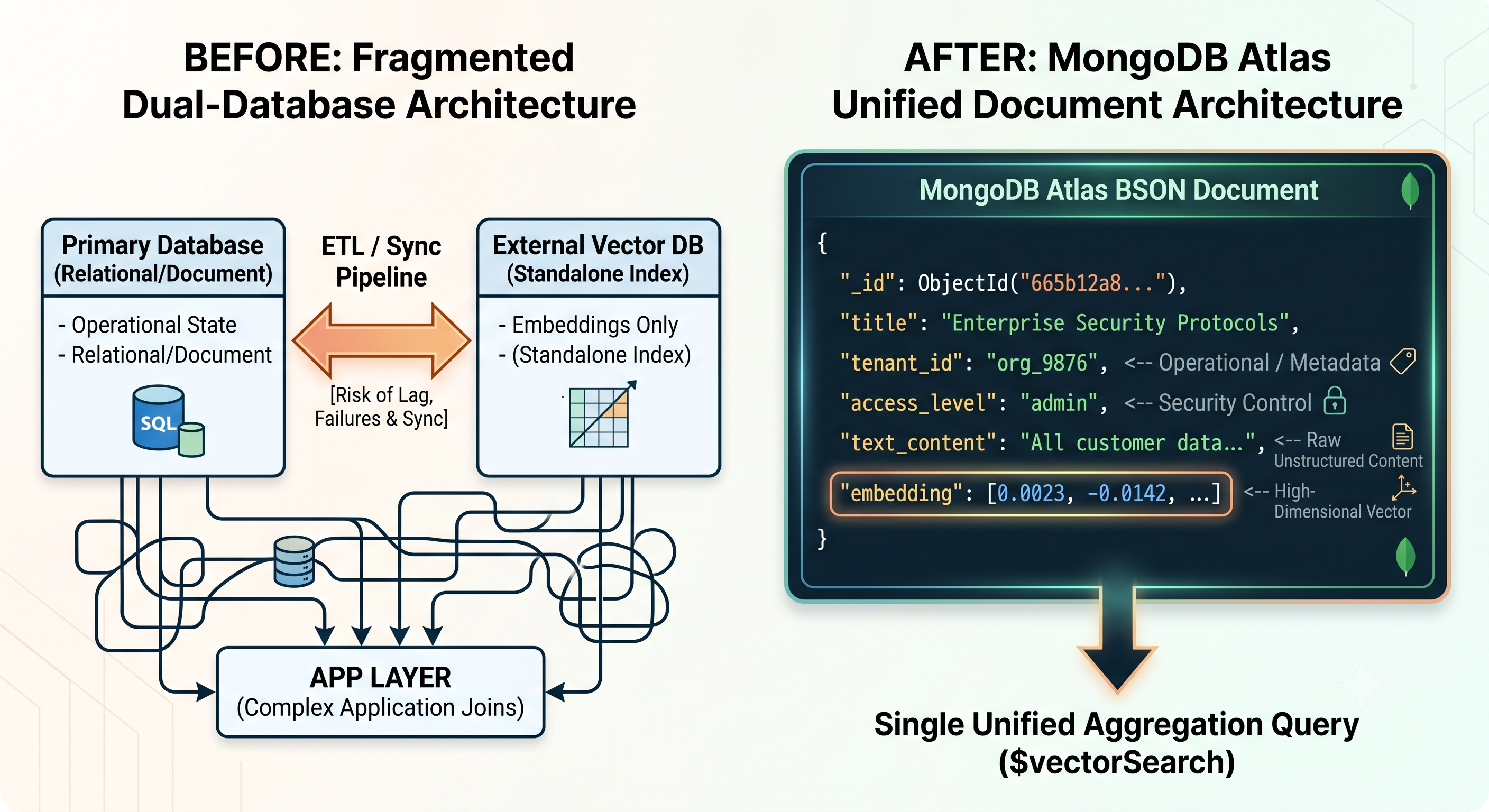
However, the challenge of implementing these intelligent systems was that it required developers to operate two systems in their architecture: one for transactional applications and another standalone vector database for the storage of high-dimensional embeddings. This approach has created problems such as the need to synchronize the databases, which often led to significant processing delays, as well as the risk of failure of the pipelines. On top of that, the fact that there are two different systems has meant twice the expenses for developers because they need to comply with security standards.
The architectural challenge is overcome by MongoDB Atlas Vector Search through the integration of vector indexing and semantic search into the main design of the document database. Operational data, unstructured content, and vector representations are contained in the same documents. Thanks to the mongodb course, developers can learn a unique approach to document modeling and fully understand how their work differs from typical CRUD operations.
The Basic Principles of Working with Vectors and Embeddings
Before you understand how the MongoDB Vector Search works, it is important to understand the ways in which AI works with unstructured content (such as text, images, sound, and code).
Understanding High-dimensional Embeddings
Neural networks and Large Language Models have presented unstructured information in a form of dense arrays of numbers that are called vector embeddings. Each element of the vector is responsible for the particular semantic dimension that was learned by AI during the training process.
In processing a piece of text, an AI embedding model does not only rely on individual words but rather examines what the text means. High-dimensional vectors help to put text parts with similar notions, emotions, or themes, closer together. For example, when forming a query about dog food requirements, its vectors will be located close to the vectors of documents describing the need for protein for dogs, although there will be no common word. Thus, capturing the true meaning has become a basis of modern semantic search.
Vector Distance Calculation
To determine how close the two vectors are to each other it is necessary to measure the distance or the angle between them in a multi-dimensional space. MongoDB Atlas recognizes three primary means of calculation:
Cosine Similarity: Cosine similarity is the process of calculating the cosine of the angle between two vectors in multiple dimensions, but disregarding the absolute magnitude. This technique verifies if the two vectors indicate the same path, thus providing a useful tool for accomplishing tasks related to text processing and natural language comprehension.
Dot Product: A dot product is found by obtaining the total quantity of products of the coordinates of the corresponding dimensions. Both directional and magnitude related information is utilized to obtain the outcome. It should be noted that if an embedding model returns the vectors that have been normalized beforehand, the dot product leads to results identical to those returned by cosine similarity; however, it takes less time to process the data.
Euclidean Distance: Euclidean distance denotes the straight line length between two objects within a multi-dimensional space grid. It is frequently used for matching visual images and recognizing faces, as well as dealing with geospatial coordinates and audio signals.
Design of MongoDB Atlas Vector Search
MongoDB Atlas has local implementations of vector search, which takes place at the cluster layer. Instead of using a different repository, vectors are kept in standard MongoDB collections with non-vector data.
Vectors Stored with Operation Data
Traditional approaches require developer teams to extract document records, convert them into vectors, introduce them into the external system, and store primary keys in both repositories to later connect them during user requests.
The system by MongoDB removes all the trouble. The vector representation occupies a single BSON document together with conventional string fields, operational tenant identifiers, rights of access, time of creation, the text of the document and a dense array of vectors created by AI.
The vector representation is stored together with operational fields and this results in a huge increase of performance. Security rules, limitations of authorization and filters for the organization tenant will be checked at the same time with vector calculations.
Hierarchical Navigable Small World Indexing
The task of finding billions of points located in high-dimensional space by means of brute-force search takes up too much time for any interactive applications. A search that requires comparisons between many stored points and current requests demands too many CPU resources, which leads to a serious increase in latency.
The solution to this problem was found in the application of the Hierarchical Navigable Small World graph indexing technique by MongoDB Atlas, which enables fast query processing in the environment filled with numerous objects. The essence of the method is its layered nature; the upper layer provides location of distant entities in a relatively fast way, while the lower layer connects neighbor entities, allowing searching in a more precise way.
The search process takes place as follows: starting from the first layer, the system moves to the lower layers, skipping the undesired parts of the database all the way down until reaching the desired objects. Thus, the searching is done in logarithmic time instead of scanning the entire collection.
The End-to-End execution of a Retrieval-Augmented Generation system
Retrieval-Augmented Generation, also called RAG, is the best architecture used to get rid of artificial intelligence hallucinations. It uses the capability of retrieving documents while using the Large Language Model structure to make sure that the output of RAG systems is always relevant in terms of business records.
Document ingestion and vectorization
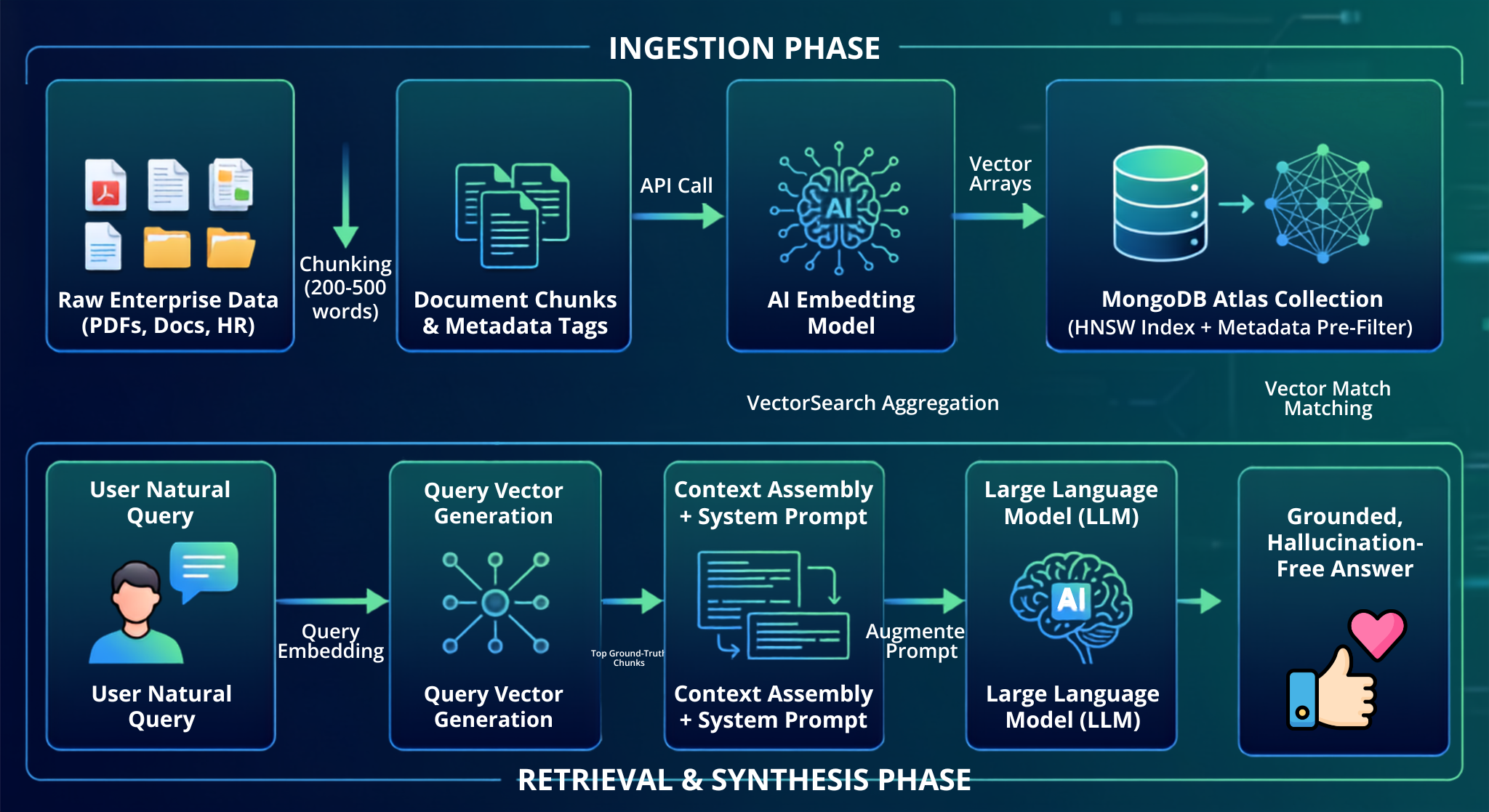
The first step in a modern RAG system is transforming business documents into vectors that can be searched.
Initially, raw documents are cut into small logical text fragments. Using the whole document as one vector decreases the semantics of the incoming information, making the retrieval process impossible. That is why the smaller all parts of a document, the more precise will be the information obtained in the future. These pieces are usually not longer than 200 to 500 words.
Next, the ingested piece of text is sent to be processed by embedding the model API in order to obtain its numerical value.
Finally, the chunk of the text, its vector version, and some other relevant details are saved into the MongoDB collection.
Implementing Vector Search Using the Aggregation Framework
When someone makes a query, the application converts the query written in natural language to a vector by utilizing the embedding model that was used during the process of document ingestion.
After the query vector is created, it is sent to the vector search aggregation operator. The vector search section includes:
The precise index name that is set up within MongoDB Atlas.
The pathway of the document field with the vector array.
The query vector.
The number of graph candidates to be analyzed during the graph exploration stage.
The final limit of the number of matches to be returned to the user.
Any required filters used for restricting search limits to certain organizations or access levels.
MongoDB processes the graph vector indexes, filters through the required metadata, assesses the similarity of the vector results and delivers the matching document segments with the calculated similarity ratings.
Generating Grounded Answers
The concluding process refers to linking the vector search with a Large Language Model.
The application extracts the raw material from the top matching document segments given by MongoDB and builds a structured prompt context block. The context block is accompanied by precise system instructions directing the model to use strictly the retrieved information and user’s initial question.
When receiving a modified prompt, the Large Language Model glances through the acquired documents, extracts the important information, and creates a brief, clear reply. Given that its answer is based directly on the documents retrieved from MongoDB, the chance of generating hallucinations is much lower making the raw data stores effective interactive pools of knowledge.
Utilization of Advanced Vector Search Patterns in Businesses
It is important to deal with various real-life problems in the enterprise context when moving AI solutions from testing to production, such as the need for hybrid query processes, tenant isolation, and memory issues.
Hybrid Search: Combination of Lexical and Semantic Search
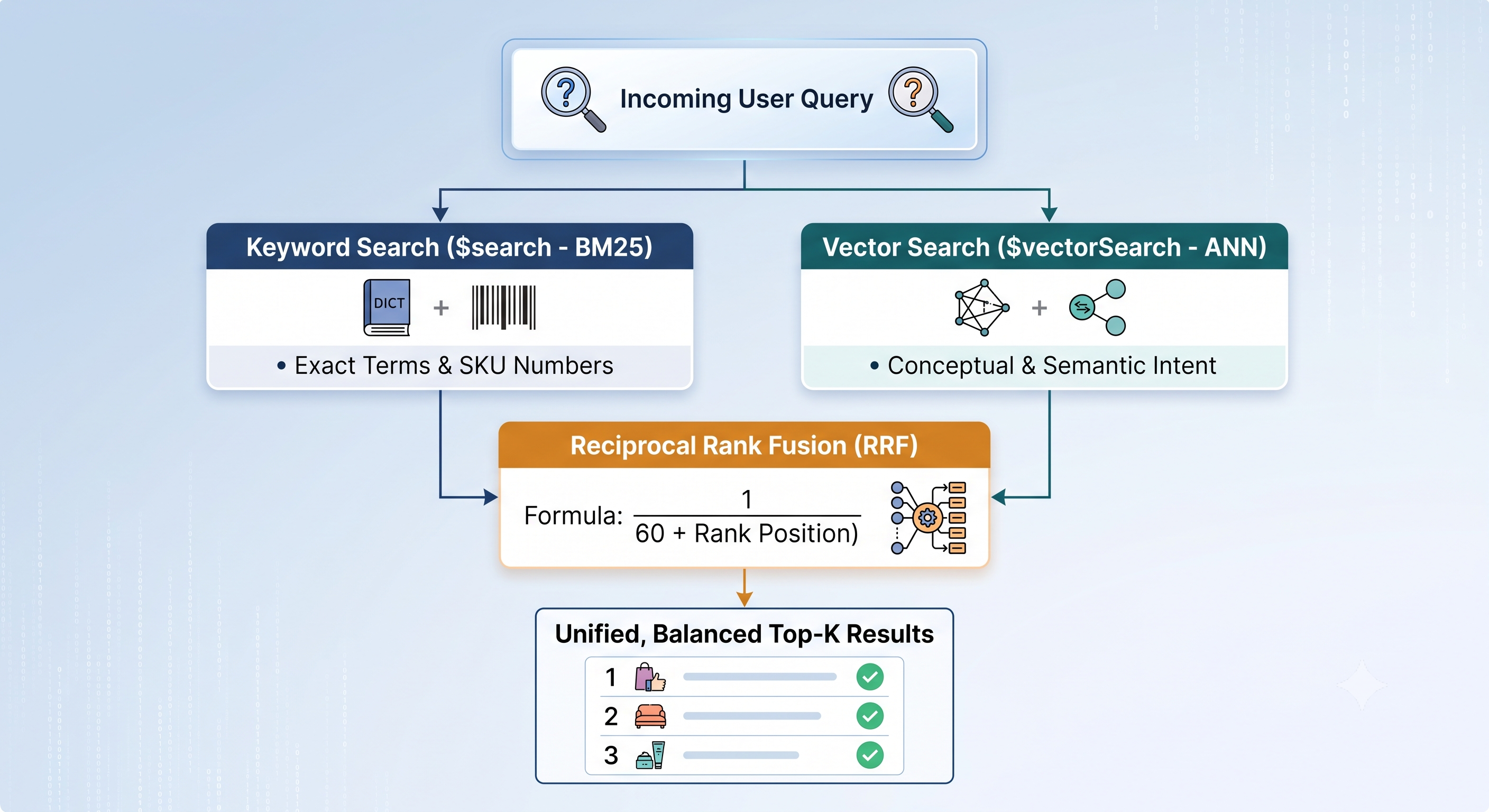
While vector search is good at understanding abstract meanings and concepts in natural language, semantic search may face difficulties in matching keywords. Queries with specific parts numbers, SKUs, people’s names, error codes, or professional terminologies require exact string matching to get correct answers.
Hybrid search addresses this issue by merging traditional keyword search relying on frequency scoring with semantic vector search.
In a combined implementation, both lexical text search and native vector search are being executed within MongoDB. While processing a request, each engine performs the respective operation. The lexical engine finds the specified term, while the vector engine is utilized for finding the meaning of a word.
In order to merge the types of scores, Reciprocal Rank Fusion algorithms are being used. The given method involves looking at the document's location in both lists, assigning a new score depending on how well the document performed in every type of search, and presenting the result. The combination of both methods produces the best possible outcome as the methodology allows for the broadest concept being searched for and the most precise terminology usage.
Multi-tenant isolated vector architecture
Enterprise software systems rely on separating information for various departments and clients in a strict way. An essential requirement for utilizing a corporate vector searching system is to restrict data crossing tenant boundaries. MongoDB manages multi-tenant vector routing with the help of an implemented metadata pre-filtering.
As a result of index evaluation, the vector engine disregards graph nodes that do not meet metadata filter requirements, including tenant identifiers and access levels. Hence, this process guarantees that users search only through records they have permission to see, thus eliminating cross-tenant visibility risks and ensuring the highest possible execution performance.
Memory Optimization and Vector Compression
Vector search performance highly depends on memory. In order to produce results without delay, multi-dimensional indexes should be stored within RAM.
The main problem, however, is that storing uncompressed, raw 32-bit floating-point arrays for hundreds of millions of documents will require huge amounts of RAM, increasing the overall costs of hosting. For instance, the figures show that storing millions of multi-dimensional vectors in an uncompressed form requires dozens of gigabytes of memory just for index management.
To deal with this issue, the production systems make use of the technique called Vector Quantization including Scalar Quantization. In the case when Scalar Quantization is used, large 32-bit floating-point numbers are compressed to up to 8-bit integers.
This process minimizes the amount of memory required by indexers up to seventy-five percent while maintaining all, or practically all, of the accuracy of those original vectors. By constructing a dramatically smaller amount of memory, businesses are enabled to grow their vector search datasets into hundreds of millions of records with a small amount of hardware.
The following are some helpful suggestions for engineering teams when using MongoDB Vector Search
Implementing the MongoDB Vector Search system in actual practice requires teams to plan every operational aspect, including memory management and the chunking strategy, among others. Therefore, conducting mongodb classes led by instructors is necessary to help your engineers acquire the skills they need to implement such complex systems without any expensive trial and error.
Size the RAM for Vector Worksets
It is critical that your MongoDB server instances have enough physical RAM to keep all the vectors indexed entirely in the RAM. If the physical RAM in a cluster is less than the active index size, the database engine will have to fetch index pages from its disk during query execution. Disk reads create a significant input/output bottleneck that can delay the wait time for search query execution from milliseconds to seconds. Regularly monitor index sizes and adjust memory allocation as needed.
Match Candidates with Latency Consistency
Make sure that you carefully adjust your candidate evaluation option while framing your search queries. Having a larger candidate number results in widening the scope of the graph being processed which improves the quality of the results at the cost of increasing the time spent. Using small values of candidates allows responding almost immediately though one risks missing some important similar vectors. System designers need to check various candidate values under load in order to find the value where latency and the precision of the results is balanced.
Use Efficient Chunking Techniques
Do not use a multi-page PDF, guide or long transcript in the form of one entry for the embedding model. The length of the message will cause a loss of important nuances. The best option is to divide the long texts into smaller logical parts with the help of overlapping text windows. Overlapping ensures that important phrases are included into the message completely making sure that the important context is preserved at the final stage of message storage.
Utilize Asynchronous Background Ingestion
Avoid generating vector embeddings synchronously in user-facing request threads. API requests made to external providers of embedding models can be subjected to unpredictable delays from the network. Therefore, ingestion operations should be performed by background worker queues. When the document creation or updates happen, an event for processing must be submitted to the processing queue. It is advisable to allow background workers to asynchronously retrieve embedding vectors and load the output vector record into MongoDB.
Keep Monitoring and Profiling Latency
Implement continuous monitoring on your vector indexes by using performance management software. This way you will be able to monitor average execution times of the search operations, memory usage, and statistics of loaded indexes. By profiling vector queries under heavy traffic, one may identify problems beforehand and act accordingly by adjusting index settings or increasing instance size.
MongoDB Vector Search combines qualities of both the transactional storage of data and AI. The fact that it integrates high dimensional vector searching into a database of documents enables companies to be able to create reliable and intelligent solutions of their own at a low cost.
Conclude
Integrating vector search into MongoDB Atlas enables the solution to witness the way enterprise architecture changes. In the past, the developers had to settle with the odd structure where they had to run one database to store all business processes, meta-data, and access controls while using the second one, small and specialized, to run the high-dimensional search queries. The readings have highlighted the negative implications of having this system of two separate databases in the company in terms of operational processes due to the impact of problems like ETL pipeline and due diligence.
Using MongoDB Atlas Vector Search helps create a new architecture that overcomes this problem by gathering operational status, metadata, unstructured materials, and vector representations in an easy-to-understand document model. The ability to store dense vector embeddings in conjunction with traditional JSON/BSON document fields completely changes how the development team creates intelligent systems. Instead of using costly joins across systems, developers can use transactional updates, filtering of security metadata, and semantic proximity calculation simultaneously in one aggregation query.
The technical platform used in this case is based on HNSW graph indexing technology that operates with Scalar Quantization. This results in less than one second for performing searches, while also significantly lowering RAM consumption. Using the technique of Reciprocal Rank Fusion for hybrid search makes sure that applications can attain a balance between modern semantic vector search and traditional text search in regards to achieving the highest efficiency overall results when it comes to fetching data. In addition to this, it is ensured by the implementation of multi-tenant metadata filtering that the policies regarding data security and access rights in an enterprise environment are implemented while navigating through the space of vector space.
Considering that retrieval augmented generation (RAG) and autonomous AI agents are now part of enterprise software, it becomes imperative for developers to have knowledge about the working of the database. Completion of the comprehensive learning path of MongoDB or signing up for a MongoDB course related to the industry provides the necessary experience to build AI applications. MongoDB Vector Search leverages Large Language Models with real-time domain-specific operational data to remove hallucinations and turn a static database collection into a dynamic knowledge source.
Combining transactional operations and vector intelligence eliminates the complexity of system architecture, reduces total cost of ownership, and speeds up time to market. The engineering team does not need to deal with complicated multi-database synchronization techniques to achieve smart customer experiences any more. With the complete mongodb full course, your team is empowered with the skills to build, secure, and optimize modern database environments, whether it is your first RAG pipeline or enterprise cluster implementation.