
Building Resilient Enterprise Architectures with MuleSoft MQ Event Messaging
Last updated on Sep 28, 2026
A modern digital business is being created in an ecosystem characterized by hybrid cloud, distributed systems, microservices, and SaaS solutions. As a result, point-to-point connections and synchronous remote procedure calls drive a scenario of tight coupling, cascading latency, and vulnerability of operations. In the case of an outage in one service the scenario of synchronous API requests may cause a complete failure of the system. Today businesses are using more often event-driven architecture for building the software solutions that can cope with the volatility of transaction loads.
Inside the MuleSoft ecosystem, Anypoint MQ means the cloud messaging backbone of the enterprise. Anypoint MQ is incorporated into the Anypoint platform and represents managed scalable multi-tenant messaging that disconnects applications from each other and allows delivering messages in real time.
The Paradigm Shift: From Request-Reply to Event-Driven Integration
Traditional integration in enterprises is based on synchronous interaction between resources, often achieved using REST APIs or SOAP. This method entails the client sending the payload and suspending the working thread until the receiver has finished processing and has responded.
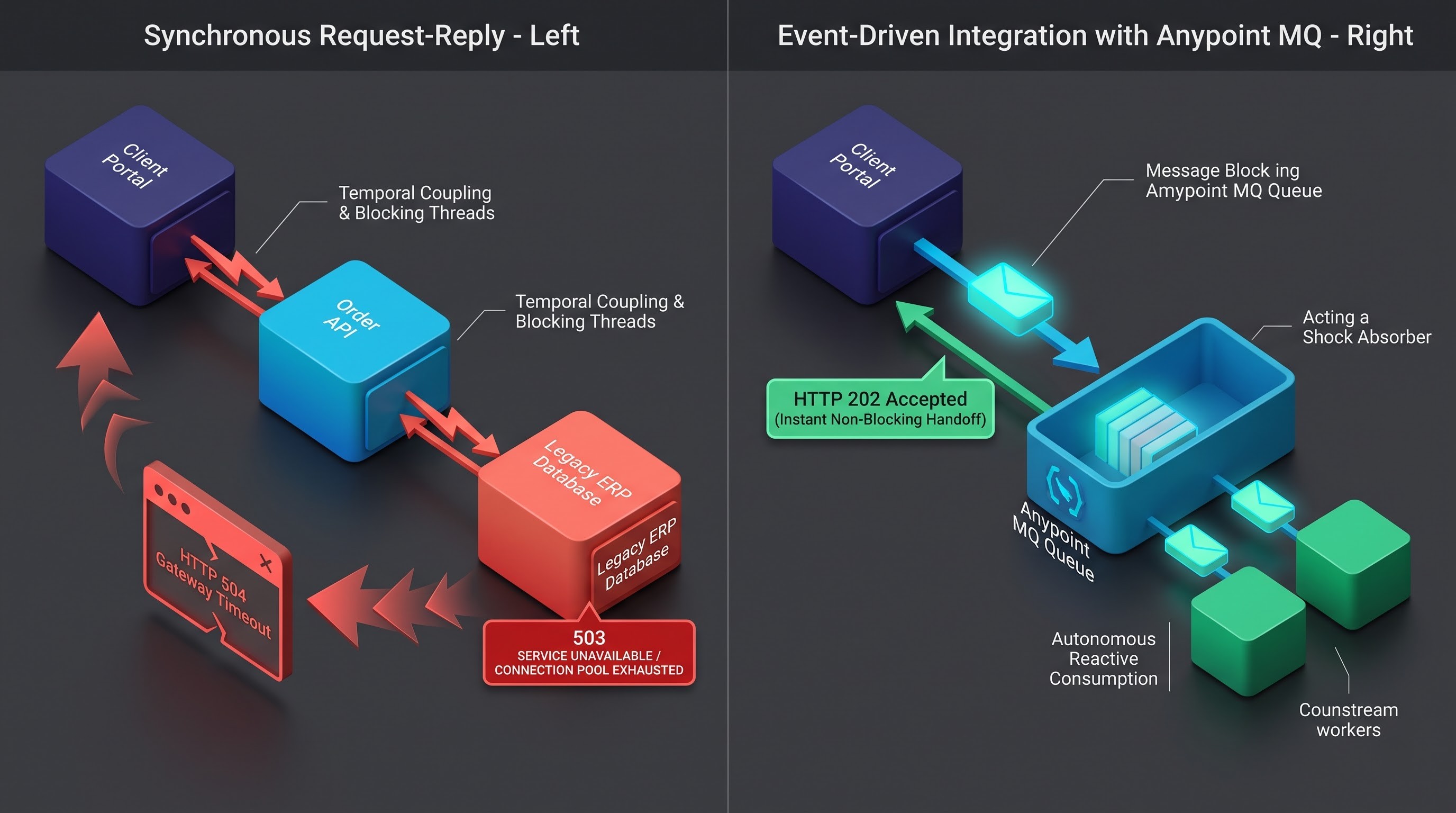
The request-reply interaction offered by the synchronous method produces great results in cases where the caller requires instant confirmation or updating of a transaction state. However, this dependency creates challenges in terms of architecture:
Temporal Coupling: In this case, both producer and consumer must be available at the same moment. If the downstream destination fails due to maintenance, network instability, or lack of memory, then the caller has to either wait, keep retrying, or fail. Cascading Latency: As the business process goes through several microservices, the response time is accumulated, thus being quite significant. Any delay in the last service severely impacts the whole process.
Brittleness Under Load Surge: The request-reply interaction theory fails when dealing with a sudden surge in orders due to a sale or some unexpected event that leads to an overload of a database or existing systems incapable of scaling.
Event-driven integration helps to overcome this synchronization wall. Rather than ordering the other system to perform a task, the application announces the event of a significant state change or event. Potentially interested parties capture the event and respond to it in their own disciplines.
The communication in this system now shifts from proactive initiation to reactive consumption of the information. The sender has no information regarding the number of receivers, where they are located, or how they are going to use the data.
And for the event to reach the receiver, an intermediary messaging system stores it until needed. This technology ensures the current decoupling and flexible workload, while at the same time allowing the developers to add new receivers without changing anything in the process.
Architectural Basis of Anypoint MQ
Anypoint MQ is a cloud-native, completely supervised, distributed message queue and subscribe-publish service located on MuleSoft's multiregional cloud platform. Given that it is part of the Services as a Software solution of the Anypoint platform, it spares one from the hassle of creating virtual machines, optimizing the operating system as well as the disk space and other cluster peculiarities as well as security updating of the message brokers.
Key Components
Anypoint MQ provides three main components for the messaging process: queues, message exchange and dead letter queue.
Consistent Queue
A standard queue is a point-to-point endpoint that aims for efficient asynchronous distribution of work. In case the producer transmits a message to the standard queue, the message stays on the different storage nodes until the consumer receives and confirms it. Several consumers can receive messages from the queue simultaneously, making sure that a message is processed in the shortest time possible.
Regular queues in distributed systems have an "at least once" delivery guarantee. This means that regardless of network retries or node redistribution, the message will always reach the consumer. However, due to the fact that network latency may cause acknowledgment delays, some messages may be received multiple times. Regular queues also offer best-effort ordering; they prioritize throughput over strict assurance of ordered delivery.
FIFO Queues
In enterprise operations such as adjusting ledger balance, allocation of inventory, or entering a state change, ordering is crucial. Anypoint MQ FIFO queues enforce perfect message handling. Messages are sent to their consumers in the same order that the broker received them.
FIFO queues use a deduplication mechanism. In case of a disconnection in the upper segment of the network, and a producer sends a message again during the time when messages are being monitored for duplicates, the broker will block repeated delivery.
FIFO queues use message group identifiers to maintain the strict ordering between parallel consumers. Any messages marked with the same group identifier are locked in a queue, and only one consumer thread processes them, while messages with different group identifiers are processed concurrently.
Message Exchange
A message exchange implements Publish-Subscribe messaging. The publisher does not send messages to a consumer's queue but sends messages directly to the exchange. The message exchange binds one or more destination queues. When a message is sent to the exchange, it will create messages that will be sent to each of the bound queues.
The fan-out topology allows various systems to subscribe to one business event without disturbing other systems. For example, when an order creation message is sent to the exchange, one of the bound queues will transfer the information to a billing processor, while another queue will send the data to a warehouse, and the last one will transmit it to a service that notifies customers.
Dead-Letter Queue (DLQ)
In an effective, resilient architecture of distributed systems, it is necessary to separate the harmful messages technically, i.e. loading those corrupted, out of the established schema, or with parameters impossible to process, which create crashes in the operational process.
Fortunately, Anypoint MQ enables engineers to set up a dead letter queue for any primary information queue. Administrators set the limit of attempts to deliver the message. Following that when the event fails to be processed and sends an acknowledgement that a particular message cannot be processed for a specific number of attempts, Anypoint MQ will directly take the message away from the main pipeline of messages and deliver it to the DLQ.
The Mechanisms of Core Messaging and Its Lifecycle
Messages in Anypoint MQ go through various stages of their lifecycle, which ensures the integrity of the data and avoidance of loss of messages caused by hardware or network issues.
During the flight of the message and timeouts for the acknowledgment
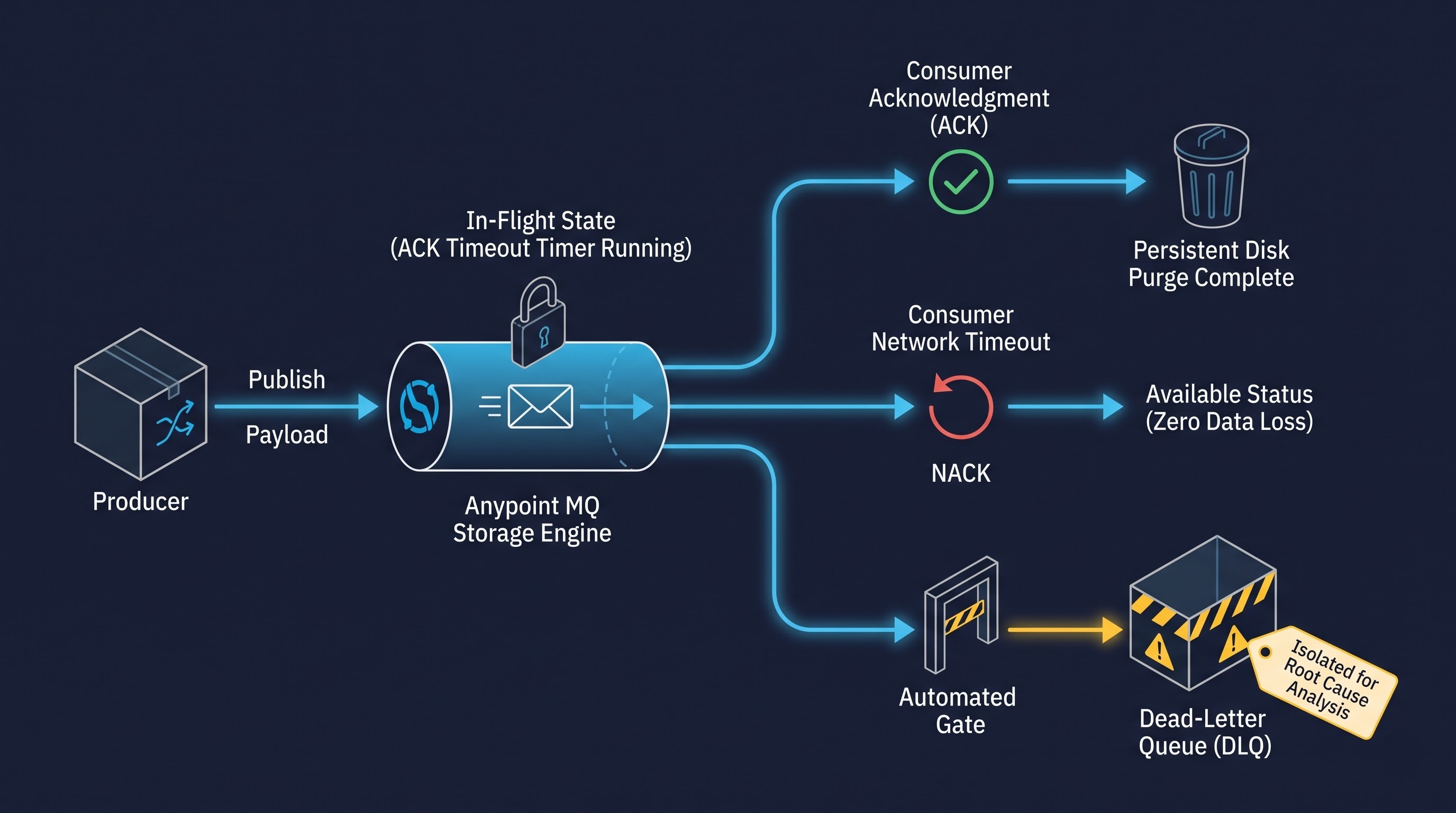
When a message is requested or received from one of Anypoint MQ queues by a consumer, it means that the message is said to be in-flight. The message is not removed right away, but it is hidden from all the other consumers during the time of acknowledgement timeout.
In this regard, the applications are busy doing their business logic while the message is in acknowledgement mode. After the payload has been safely processed (for example committed to the database or sent to the third-party backend), the application sends an acknowledgment back. Upon the receipt of the ACK, the message is deleted from the disk storage forever.
In case the application faces a temporary error (like downstream database unavailable), it can send a negative acknowledgement (NACK) through the message broker. This NACK will notify the broker to unlock the message immediately thereby releasing it and putting it into the active status again; thus, making it available to the next worker.
In case the consuming worker’s hardware crashes completely or if a network connection is lost without sending an ACK or NACK, the timer for acknowledgment timeout will be triggered. Upon the expiration of this timer, the broker assumes that the consumer has failed and unlocks the message.
Time to Live and Retention Policies
Not every event is relevant for business forever. Anypoint MQ provides the ability to configure TTL for queues. TTL is the maximum time a message can remain in the broker without being consumed.
When a consumer platform suffers an outage exceeding the configured TTL, expired messages will be either discarded permanently or transferred to backup storage as per the policy settings. This functionality ensures that the broker remains unreliant on outdated operational states and avoids the message queues being populated with irrelevant requests.
Encryption, Security, and Governance
In regulated industries like finance, insurance, and healthcare, message brokers are responsible for handling sensitive personal identifiable information, account information, etc. Anypoint MQ offers multiple security solutions that operate through multiple layers of security, including:
Transport Layer Security: The encryption of all communications with Anypoint MQ is performed according to the transport layer security protocols. With the help of the security protocols, all communication becomes inaccessible to the third parties.
Payload encryption at rest: Queues can be configured in a way that ensures that the payload encryption at rest is implemented.
Authentication of Clients and Authorization: To access queues and exchanges, client applications must have their own client application credentials in the form of client identifiers or client secrets. Permissions are given to client credentials by the system administrators in a detailed way so that they can be allowed to read, write, or control different queues. The application of this rule helps safeguard the multi-tenant environment from unauthorized access of data.
Implementing Anypoint MQ Using API-led Approach in MuleSoft
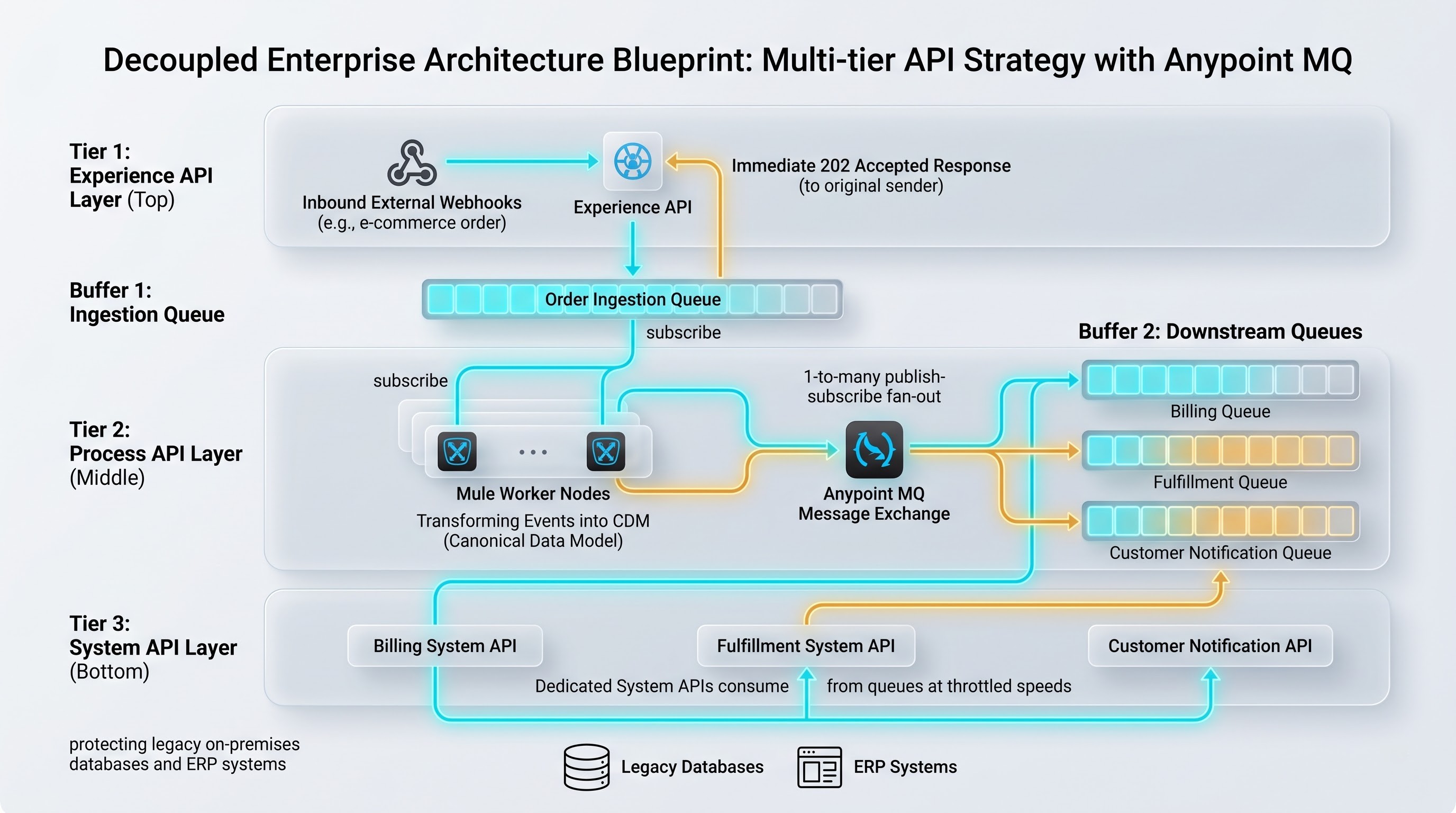
MuleSoft's API-led approach has three building blocks, which are System APIs, Process APIs, and Experience APIs. Although the API-led architecture has come about based on the idea of synchronous REST architecture, the latest ecosystem in enterprises uses event messaging in an asynchronous way in all the three layers. Mulesoft api training for those engineers who need to learn both design patterns will be highly helpful.
Experience Tier: Receiving External Events
The Experience API level gets involved with the user interaction with users, mobile clients, web portals as well as different partner ecosystems.
When an external e-commerce provider sends an asynchronous webhook with a revised order status, for instance, an HTTP-based Experience API retrieves the webhook, authenticates the client quickly, checks the incoming message if it meets the API requirements, sends the event to Anypoint MQ for further processing and transmits HTTP 202 response to the originator.
This strategy allows reducing the time needed for external systems' connections. The inbound webhook message is delivered to persistent cloud storage in milliseconds hence protecting the external caller from any waiting due to internal processing times of the enterprise, database locks, or delays in the network.
Process Tier: Business Orchestration and Event Correlation
Process API layer contains logic of business operations on the domain level, aggregation, clearing of cross-system entities and orchestration rules.
Process API subscribes to an Anypoint MQ queue, pulling messages in as the worker is capable. After receiving the messages, the Process API translates the data from being in a specific format for a system into the enterprise Canonical Data Models for that data. It has the ability to carry out calls to System APIs that it depends on, divide complex bulk requests into atomic events, or collect different asynchronous replies with the help of the correlation IDs.
After the processing is completed, the Process API may send out new domain events such as a new notification of the order being validated or the account balance being changed that will reach Anypoint MQ exchanges.
System Tier: insulating Systems of Record
System APIs give direct, secure and standardized access to the systems of record like ERP systems, core banking systems, CRM systems, etc.
Most legacy systems of record are unable to scale automatically to cater to high-volume concurrent events. The connection of thousands of concurrent mobile requests to on-premises databases may lead to database connection pools being drained and serious outages occurring.
By placing Anypoint MQ in the front of the System APIs, the message queue becomes a kind of buffer. The System API consumes messages in a controlled manner, thus preventing any downtime for the legacy system during the peak periods.
Architecture patterns with MuleSoft MQ
Event-driven architecture solves various repeatable integration issues. The use of proven architectural patterns by means of Anypoint MQ allows software developers to solve issues of performance, reliability and data consistency.
Competing Consumers Architecture
At high message processing volumes a single worker instance does not have enough processing potential in order to keep the lag of the consumer under the allowed limits of operation.
The competing consumers architecture resolves this issue by launching several instances of a MuleSoft app that are configured for listening to the same Anypoint MQ queue.
These active consumer threads will receive messages from Anypoint MQ brokers. Since the broker locks messages in flight on a per-message basis, each worker processes a unique message at the same time as other workers.
As transaction volumes increase, administrators have the option to scale worker instances or enable horizontal scaling on CloudHub and Anypoint Runtime Fabric. Scaling by adding workers into the mix allows for instantaneous queue processing without the need to change the configuration of the broker or bring down services. This allows for true horizontal scalability. As more organizations begin to implement hybrid cloud architectures in their enterprises, it becomes crucial to enroll in muleSoft training India programs to learn all about it.
Scatter Gather and Fan Out Patterns
In distributed business systems, it is often necessary that a single event be processed in parallel by several independent domains.
In a fan-out pattern, a publisher sends an event to a message exchange in Anypoint MQ . This exchange copies the event into different queues . Each queue has its own applications subscribed to it .
For example, when an employee onboarding event happens:
Queue A sends the event to an Identity Access Management API for provisioning of software accounts.
Queue B puts the event through to a Facilities API to provision physical access badges and workstation hardware.
Queue C transmits the event to a Payroll System API to generate salary disbursements.
Each consumer is independent of the other consumer. If the facilities system goes down, the identity and payroll integrations will still process their queues without issue.
Claim Check Pattern
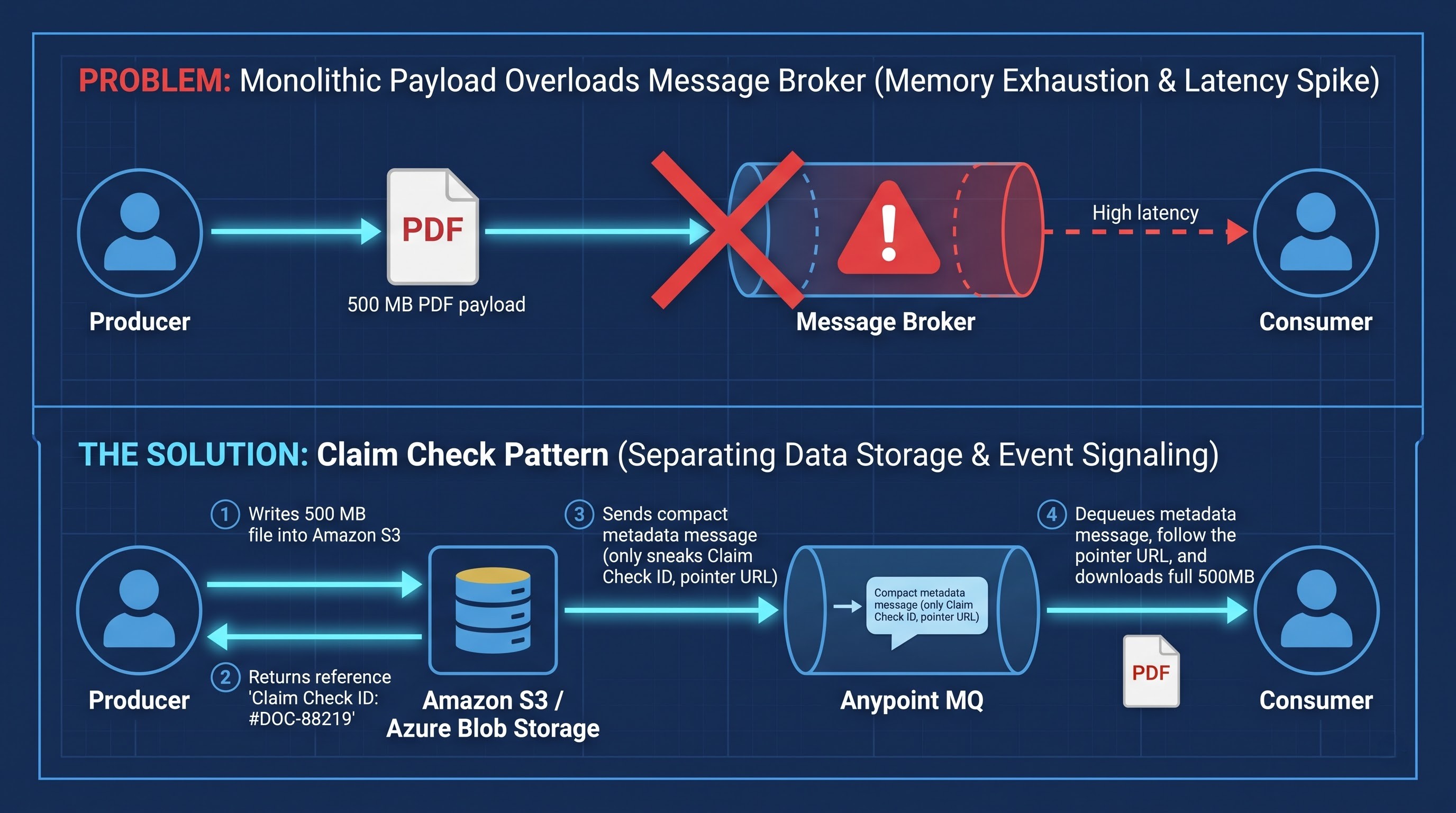
Anypoint MQ is designed for high-velocity transactional events and can handle payloads up to standard cloud messaging limits (typically hundreds of kilobytes or up to several megabytes depending on configuration). Directly pushing raw payloads through message queues will degrade broker memory, saturate networks, and create performance bottlenecks for business transactions that need to move large payloads (e.g. high-res medical imagery, multi-gigabyte document scans, massive data batches).
The claim-check pattern overcomes this limitation. The producer writes the large payload directly to a high-capacity object storage repository, such as Amazon Simple Storage Service, Azure Blob Storage, or an internal enterprise content management system.
The producer then generates and stores a compact metadata event that contains a pointer, URL, or reference key—the claim check—and basic operational attributes. This light-weight reference event is published by Anypoint MQ from the producer.
The consumer reads the message from the queue and uses the claim check to get the full binary payload directly from object storage. This retains the benefits of decoupling and buffering of asynchronous messaging, without burdening the broker with large data payloads.
Event-Carried State Transfer and Event Sourcing
The architects of event-driven systems need to decide how much data an event must carry. Anypoint MQ supports two primary types of messaging:
Event Announcement
The event contains little data indicating that a state change occurred, and an identifier (e.g. customer identifier and timestamp). The consumer then has to make a synchronous API call back to a System API to get the full record.
This keeps message payloads small, but increases network chatter and re-couples consumers to the availability of the system of record.
Event-driven state transfer
The event contains both the notification and the full state of the entity as required by downstream consumers to perform their business logic (e.g. the full snapshot of customer attributes, addresses, and status flags).
The consumer does its work without a callback to the originating system . This pattern enhances resilience, removes synchronous API roundtrips, and improves operational autonomy across domains.
Reliability, Fault Tolerance, and Error Recovery
Part of the job of building distributed systems is designing for operational failure. Network partitions, hardware reboots, service timeouts and malformed inputs are an inevitable part of modern cloud environments. To achieve enterprise-grade reliability with Anypoint MQ, you need to think about deliberate error handling strategies.
Design of Idempotent Consumers
Since standard Anypoint MQ queues use at-least-once delivery semantics, applications must be designed to process duplicate messages safely. In case of a network timeout immediately after a consumer finishes an operation, the ACK from the consumer may never reach the broker.
Eventually the broker will unblock the message and send it to another consumer.
An idempotent consumer is one where receiving a message multiple times has the same business outcome, without any unintended side effects.
MuleSoft Idempotency Implementation
For implementing the concept of idempotency in MuleSoft apps, one can use the Idempotent Message Validator component. It picks out a unique identifier from the body or header of a message (such as an event ID or transaction ID) and validates it using an Object Store or distributed caching system. Being able to identify and manage duplicate transactions as well as possible issues with replaying messages is an essential step of the learning process when it comes to mulesoft online training.
When a new message arrives, the flow looks for it in the store. If the identifier does exist, the flow identifies the message as a duplicate, bypasses the downstream processing steps, and sends an ACK to Anypoint MQ straight away to remove the duplicate from the queue.
Systematic Errors Classification
Robust event-driven flows distinguish transient connectivity failures from permanent data anomalies:
Temporary Connectivity Failures
These could be short-lived network timeouts, third party API rate limits or short-lived backend database locks. In such cases, a second attempt at the operation after a short delay is likely to succeed.
The Mule flow catches the exception, does not send an affirmative ACK, and lets the message come back to the queue or sends a NACK. You are able to set up redelivery policies that use exponential backoff strategies to avoid system overloads as systems come back up.
Permanent Data Loss
These could be malformed JSON payloads, schema validation errors, missing mandatory business attributes or unrecoverable business rule violations (for eg. trying to debit an invalid bank account). A permanently flawed payload cannot be retried successfully; it only wastes computing cycles and pollutes operational logs.
The error handling strategy should catch the business exception, log the diagnostic context, send an affirmative ACK to the primary queue to clear the blockage and explicitly publish the failed payload to a designated Dead-Letter Queue or error topic with structured metadata explaining the failure reason.