
Business Analysis in Cybersecurity: Bridging Strategic Risk and Technical Defense
Last updated on Aug 8, 2026

Executive Summary: A Change in the Structure of Enterprise Defense
Cybersecurity used to be viewed as an isolated field and an entirely technological one, run by technological personnel, network administrators, systems engineers, and security professionals who worked backstage. Their aim was simple: to build the digital fence, set up firewalls, install antivirus, and keep the bad guys off.
However, with enterprises moving their operations to the cloud and accelerating their use of third-party Software-as-a-Service (SaaS) applications, as well as making digital transformation the main driver of global business commerce, the conventional approach to cybersecurity no longer works. Cybersecurity is now a part of everything done for business purposes and should be understood as an enterprise risk, an initiator of business development, and a key aspect of modern governance.
The change has created a tremendous structural problem for modern companies. The specialists in technical security know everything about cryptography and networking, but they normally do not have a good understanding of how business works, and what values prevail in business. In contrast, business experts have no understanding of the technical side of modern cyber threats, even though they are great at understanding business-related terms.
Organizations face two big dangers when there is a disconnect between their business goals and their technical security systems: either they implement extremely heavy and non-flexible security measures that obstruct creative thinking and cause frustration in the personnel, or they create fast-moving and flexible products that are not secure from potentially catastrophic data breaches and huge fines.
It is precisely in this gap that Business Analysts surface.
By putting the fundamental principles of business analysis into practice in the field of digital security, Business Analysts are quickly transforming into indispensable translators, strategists, and orchestrators of the overall defense of the enterprise. Those interested in pursuing this highly sought-after specialization can develop the necessary skills via a thorough ba online training.
Changing Perspective - Why Business Analysis is Essential in Cyber Security
To understand the importance of Business Analysts in the present-day cyber security environment, we need to consider how cyber issues take place. While the films portray cyber crimes as committed by someone sitting at a computer in a dark room, things turn out to be much more simple in reality. Most of the time security failures are due to procedural problems, some business logic not being thoroughly mapped, mediocre identity governance, insufficient training or poorly structured incentives.
Although companies can spend millions trying to obtain the most efficient security systems, they still may encounter serious incidents due to the following reasons:
Third-Party Excessive Privileges: An offshore contractor was given permissions to access the entire system in order to accomplish minor administrative tasks.
Operational Deviations: In order to perform one important business process, employees had to share their access credentials via unauthorized means of communication.
Prioritization of User Experience: There was launched a new casual platform that allowed users to retrieve unauthorized information due to the fact that user experience was prioritized at the expense of identity verification.
These issues represent failures on the systemic level. In other words, they indicate discrepancies between the intended functioning of a certain process, the actual process of its utilization, and its actual technical control.
Main Roles of Cybersecurity Business Analyst
The titles may change from Security Business Analyst through Cyber Risk Analyst to Enterprise Process Analyst, but the functional area remains within the same boundaries that comprise the alignment of the business aspect with the implementation of technical security.
1. Statement and Registration of Security Needs
While traditional functional requirements deal with the definition of what should be done by the system (for example, "System must check credit card payment in no more than 2 seconds"), security requirements, which are often referred to as non-functional or quality-of-service requirements, stipulate the negative side of the operation as well as its actions under adverse conditions.
In this respect, the role of a Business Analyst consists in understanding the hidden needs and translating them into measurable specifications. No matter how vague a request may sound like ("The application should be secure"), Business Analyst collaborates with business representatives, lawyers, and technical designers in order to transform the general rules into detailed specifications.
Classification & Context of Data: What data classifications are engaged in this workflow?
Responsibility: What contractual or regulatory responsibility comes into play in the instance that unauthorized parties access this information?
Tolerance of Latency: What Tolerance of Latency is acceptable concerning the application of MFA or cryptographic verification?
Management of Section: What needs to happen with users' sessions time-out in cases when the application is used under a high load in a business-related circumstance?
By providing this context, an analyst can turn the abstract security details into our user story, acceptance criteria, and business logic in the form of technical specifications.
2. Assessing Corporate Data Processes
One of the main principles of cyber security is that one cannot protect what one does not know about. In large corporations, information travels between many internal solutions, third-party cloud solutions, data analysis warehouses, and employees workstations.
Business analysts are rather good at process mapping and analyzing data flows. In terms of security, it means mapping the data lifecycle.
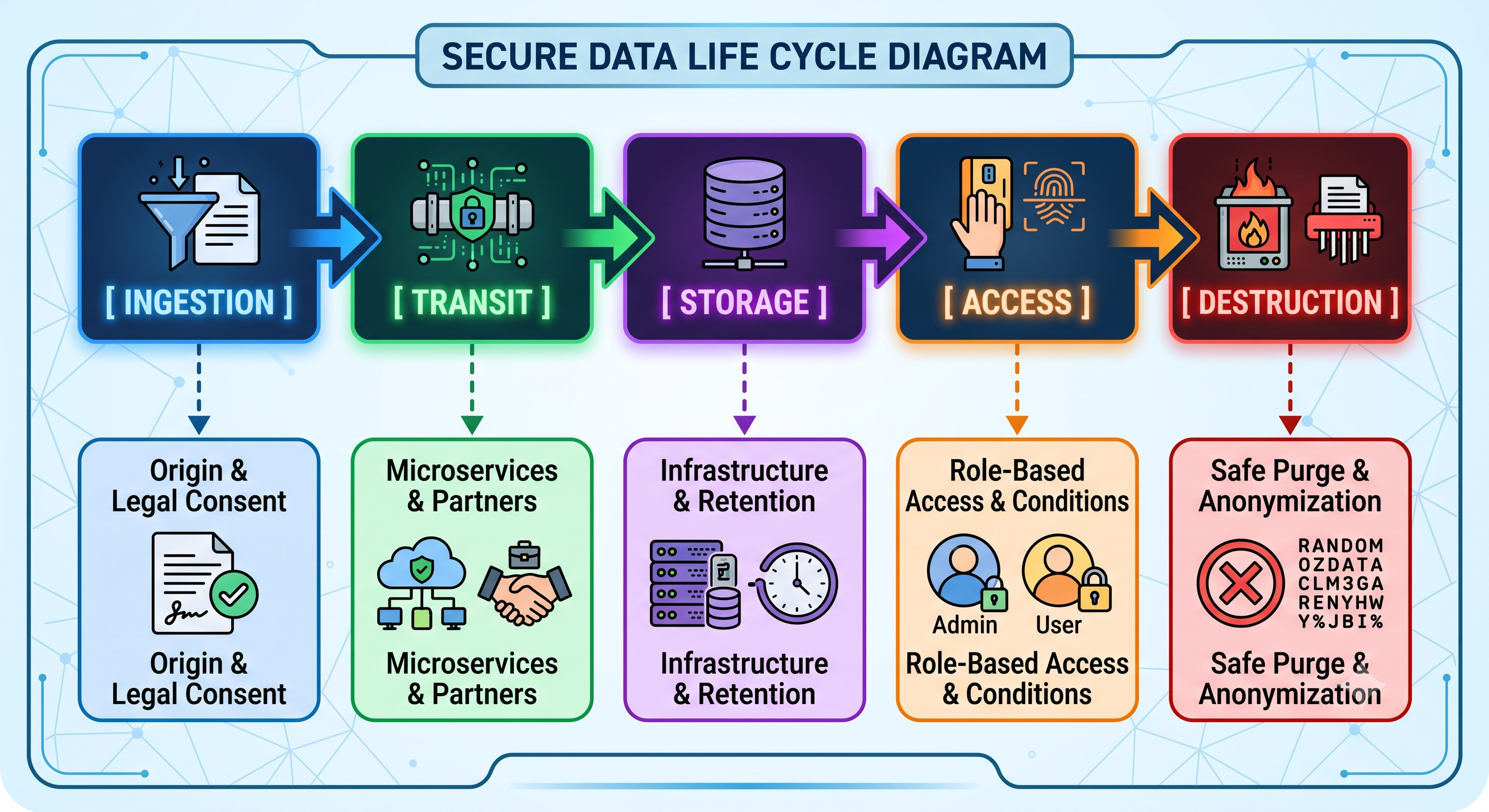
Ingestion: Where is sensitive information gathered from? Who has the authority to approve this?
Movement: In what way does sensitive information move from one point to another in network activities?
Storage: How is sensitive information recorded and stored, what infrastructure does this information take up, and how long the information is retained?
Access: What level of access does each employee have regarding sensitive data? How much access do they require to perform their duties in specific situations?
Destruction: How does one carry out data deletion or anonymization when the information has reached the specified time of keeping?
By carrying out a comprehensive data lifecycle model carried out by the analyst, as well as locating operational weaknesses such as lack of encryption for data that is transferred, redundant database copies, unauthorized connections with third-party services, the security department can use effective data protection methods once the sensitive information enters operational activities.
3. Converting Regulatory Guidelines into Functional Features
Current regulation is a challenging and dynamic sphere. For instance, legal requirements like GDPR, CCPA, HIPAA, and PCI-DSS may lead to significant financial penalties for failures in security. Apart from that, industry regulations like ISO 27001 and NIST Cybersecurity Framework set straightforward frameworks for operations.
Nevertheless, regulations are actually explicitly broad. A specific regulation can dictate that a business must "take any necessary technical and organizational actions to provide the required level of safety for a calculated risk." That means this legal technique does not help a developer or engineer at all.
Business Analysts turn ambiguous recommendations into real-life instructions. They introduce into practice such legal ideas as "Right to be Forgotten" and "Privacy by Design." This permits them to determine such operational aspects as database deletion procedures, logging practices, anonymity protecting procedures, and verification interfaces.
Implementing Business Analysis Throughout the Cyber Security Life Cycle
In order to understand how business analysis contributes to enterprise protection, one should observe the analyst's contribution within traditional security life cycle phases: Strategy, Implementation, Operations, and Incidents.
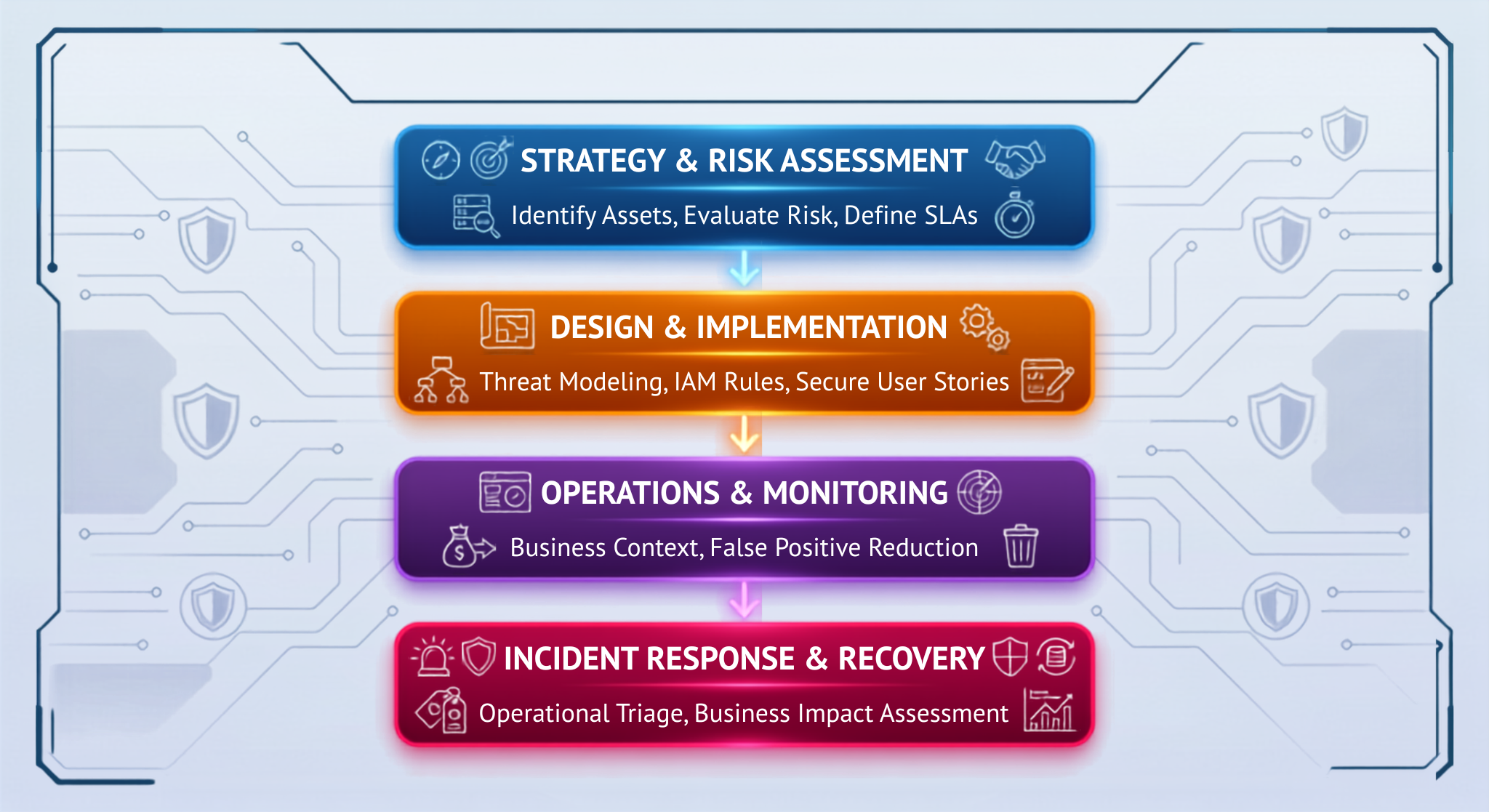
Phase 1: Strategy, Context and Risk Analysis
First things first, to start a successful security strategy, it is essential to identify the risks. However, the technical risk parameters (e.g. vulnerability ratings) can yield little significance without the operations context. A severe flaw in an internal server that is used to store a non-sensitive archive presents much less risk for business than a medium-level flaw in a customer payment database that is unencrypted and online.
Business analysts start their work with a Business Impact Analysis (BIA) and help to measure the real financial cost connected with the security failures that are evaluated through the following aspects:
Direct Loss: This metric gives the revenue loss referring to the time spent inoperable during busy business hours;
Reputational Loss: Business analysts estimate the long-term consequences for the customer acquisition processes caused by the data breach;
Contractual Losses: This metric provides the information about possible fines for breaching SLAs and agreements with third parties;
Operational Loss: It’s a measurement of inconveniences that were brought to the critical operations
By understanding the real influence on the enterprise, the analyst assists the security authorities in prioritizing the spending.
Phase 2: Secure System Design and Implementation
In the system design and development phase, the role of the Business Analyst becomes critical due to the importance of the security assurance during the software development lifecycle (SDLC). In the current DevSecOps environments, it is essential to make security considerations part of every sprint and release.
The Business Analyst ensures incorporation of security into agile backlogs by:
Creating Abuse and Misuse Cases. A standard User Story describes the behavior of the legitimate user when using the feature ("As a user, I wanted to reset my password..."), while the Abuse Case explains how the attacker may exploit the system in his/her (in this case, the) attack ("An attacker tries to brute force the password reset token via the API automation...").
Giving recommendations on the access policy. The analyst collaborates with team leads to apply the Principle of Least Privilege and ensure that users get only as much access as needed for the performance of their duties.
Facilitating threat modeling. The analyst somehow organizes sessions where business partners colve with tech architects on how the new business solutions may create new attack vectors.
Phase 3: Procedures for Security and Supervision
Operational security is largely dependent upon using automated technology such as Security Information and Event Management systems (SIEM) that analyze patterns in network logs and send warnings about security breaches.
Nonetheless, automated security mechanisms send out countless alerts, most of which are false alarms caused by ordinary business processes. To illustrate, a sharp rise in the volume of data transferred by accounting software can either mean a malware attack is currently underway or simply be the result of another quarterly accounting operation.
Analysts serve the purpose of providing contextual information necessary for fine-tuning the monitoring systems. In particular, learning about process schedules, operational profiles of users and business logic allows the analysts to assist in distinguishing between normal operations and true threats, hence mitigating the feeling of alert fatigue.
Phase 4: Responding to a Crisis and Ensuring Business Continuity
When a significant cyber attack or virus infection does happen, the emergency situation/incident does not affect just the technical infrastructure but also has an effect on business continuity, lawfulness, company communications, and financial security.
During a crisis situation, the business analyst acts as an operator in the incident team.
Operational triage: they examine the influence of business operations depending on chosen containment strategies (for example, assessing whether destroying the entire processing unit to isolate malware is less expensive than keeping it running while protecting the network).
Continuity execution: they take care of continuity strategies and relate to the fact that there can be manual workarounds or alternative processes in order to fulfill crucial operations.
Post-incident reengineering: they reflect on the lessons learned after the crisis in order to improve the process in the future.
Learning about bridging cybersecurity and business strategies in an organized way is needed. Training on cybersecurity by taking a business analyst course online will give professionals such capabilities as modeling using BPMN, threat modeling, and RBAC matrix.
Important Sub-Disciplines of Cybersecurity Business Analysts
In order to flourish in this field, Business Analysts have to have a strong knowledge of four key working sub-disciplines:
1. Identity and Access Management (IAM) and Governance
In modern cloud-based cybersecurity, identity has become a new perimeter. When staff work remotely and gain access to cloud services from different locations, there is no need for traditional cybersecurity measures anymore. The security is ensured by the process of authentication.
The process of implementing IAM is an involvement into complex process reengineering. The reason for failure does not necessarily lie in the software itself, but more likely in the governance system.
The Cybersecurity Business Analyst responsible for IAM transformation conducts a thorough examination of RBAC:
Taking stock of other users' access levels around different units, eliminating excessive access grants.
Setting up standardized job roles and giving access rights based on real world activities instead of obsolete practices.
Developing simple JML processes to let access be granted upon employment, modified when employees change departments, and terminated as soon as they leave the company
2. Third-Party Risk Management (TPRM)
The modern company needs a whole network of its contractors, software providers, cloud vendors, etc. and even a single misplaced vendor can add up much to the attack surface of a company. In recent times it turned out that many big breaches happened not because of attacks on the targeted company, but rather due to attacks on equally unprotected third party vendors that got access to the network of victims' companies.
BA’s are the ones who deal with managing third-party risks, because:
They analyze vendors based on various audits and assessments while working on procurement.
They provide clear requirements for data management and security SLAs in vendor contracts.
They provide proper threat exploration, ensuring that third parties' access to the network is limited.
3. Secure Agile Development and DevSecOps
In organizations that develop software quickly, security becomes a potential area for delay. If security teams perform manual assessments towards the end of the software development cycle, this will cause delays in delivery to the market, creating tension between the security units and business decision-makers.
Cybersecurity Business Analysts will help introduce business requirements without delays in the processes by:
Including security-related constraints in the usual acceptance criteria of each single backlog activity.
Taking part in sprint-planning in order to make security-related requirements equivalent to new functions.
Creating self-service security procedures enabling programmers to use automated safety tools and not wait for security checks.
4. Analysis of Business Logic Vulnerabilities
More and more often, attackers do not use information system encryption altogether. Instead, they exploit vulnerabilities of business logic. This means that an application is functioning properly from the technological standpoint, but the business rules which govern it are either wrong or missing.
When an e-commerce enterprise uses promo codes to process discounts, it becomes vulnerable if it has negative order balance or permits incorrect coding due to unresolved logic conditions, making it easy for any hacker to take advantage of the situation without tampering with the software or breaking into accounts. The important aspect is that business analysts can help eliminate such issues, as they excel in cases like identification and elimination of edge cases and creation of business rules and user workflows. They are able to identify contradictory logic even with the early stages of design before any software is developed or tested.
Case Studies. Application of Business Analysis
These theoretical concepts can be viewed practically with two case studies. By working on similar practical case studies within an online ba analyst course India, professionals can prepare portfolios suitable for employment in companies offering hefty salaries.
1. Case Study: Solving the Problems at Healthcare IAM
After an agency checked the healthcare organization located in the region, it discovered that there were many problems with encryption compliance across multiple hospitals. The investigation found out that in various situations, employees shared their physical cards and logging information, which was a way to avoid difficult checks in the form of multi-stage authentication.
Even though the policy that did not make use of business analysts may have had its own advantages, it has led to operational issues. A nurse spent lots of valuable time in re-authentication while admitting patients, thus causing frustration, neglect of patients, and avoiding the use of technology by personnel.
A Cybersecurity Business Analyst analyzed the operational process in order to find the reason for the problem. He observed nurses working in hospital conditions and realized that it was due to the fact that the traditional MFA methods were created for desk workers instead of mobile medical staff wearing gloves and moving from one room to another.
So, he created a completely new project based on the following principles:
Contextual Authentication: He defined new rules for context-based authentication, replaced the static password with fast access through tapping badges, and connected with the SSO system.
Step-Up Verification: He did not establish additional authentication after every successful login but initiated it only before accessing sensitive administrative or financial databases.
Emergency Protocols: He has developed emergency switch protocols (“Break-Glass”), and thus ensured that patient care is not delayed through creating automated audits.
Using business analysis to address the security issue, the hospital has eliminated credential sharing practices, fully complied with regulations and sped up the patient care process workflow.
Case Study 2: Bridging Business Logic Gaps in Financial Services Client Onboarding
A digital financial services organization established a completely automated and speedy digital loan application process, enabling the approval of business loans within minutes.
The product management team aimed to maximize conversion rates by minimizing the number of fields in the application form and eliminating any secondary verification processes while registering the accounts.
Three months after the process went live, the company was hit by a major fraud incident. Fraudsters opened various accounts using stolen identities and took the money out of accounts before any fraud could be detected.
At first, the engineering team thought that the fraudster was able to hack an external system or failed to verify their identity using the identity verification API, but an in-depth investigation performed by a Business Analyst turned out to be revealing the real issue, which was a fault in business logic.
The process of registration gave applicants a chance to modify the details of the payouts bank account after their identity verification was done but before they were issued any funds from the lender.
However, there was a flaw in this system: The process did not verify that the names found on the bank account that is used for the payout were the same as the name of the applicant found in the loan application.
The analyst documented the whole system of onboarding, pinpointed the flaw, and presented the new requirements.
Pre-Disbursement Validation: Checks for matching names between a loan application and the bank accounts were performed automatically before any funds were transferred.
Trigger-Based Risk Queues: Triggers that sent changes to the bank account information to the risk assessment queue for approval after verification was complete were implemented.
Adaptive Verification: Secondary verification was introduced automatically in case of discovering high-risk behavior at the stage of filling the loan application.
Thus, the analyst solved the fraud problem successfully not aggravating the experience of true borrowers.
Conclusion: Ensuring Enterprise Value
Cybersecurity cannot simply remain an isolated technical function that is only concerned about keeping the attackers at bay. In an interconnected digital economy, security should be an indispensable component of the culture, operations, process, and strategic vision of the company.
Creating secure and defensible systems involves more than just the installation of the latest software, configuring complex firewalls, or hiring specialized penetration testers. It requires the understanding of how the organization works, how information flows among the business units, how employees are performing their daily tasks, what the regulations are which govern the company, and how value is created.
This is the competitive edge that Business Analysts offer for cybersecurity.
As the critical link between strategy, operations, and defense, Business Analyst transforms cybersecurity from a painful bottleneck into a productive enabler of business processes. While implementing their role, the Business Analyst makes sure that security does not only protect technology but also supports and secures enterprise value, increases customer confidence, and enhances operational resilience.
Integrating business analysis in security implementation will allow companies to build not only secure solutions but future resilient ones.
Career Tip: Cybersecurity Business Analysis is among the rapidly developing disciplines in IT governance. Discover how to develop business processes in an environment of security by enrolling into a BA Analyst course online.