
Business Analyst: The Role That Turns Business Problems Into Better Decisions
Last updated on Aug 21, 2026

Imagine a company launches a new app after months of development, but customers barely use it. The technology works, the design looks good, and the development team has delivered everything that was asked for. Yet something went wrong. The real problem may not be the technology at all—it may be that nobody clearly understood what customers actually needed in the first place.
This is where a Business Analyst becomes important. A Business Analyst works between business teams, customers, and technical teams to understand what the business is trying to achieve and what needs to change to get there. They ask questions, study processes, identify gaps, analyze information, and help teams turn unclear requirements into practical solutions.
In many organizations, projects do not fail simply because developers cannot build something. They fail because the wrong problem was identified, requirements were misunderstood, priorities changed without proper communication, or the final solution did not solve the actual business need. A Business Analyst helps reduce this gap by making sure everyone is working toward the same outcome.
The role has also changed with the growth of digital businesses, cloud platforms, automation, data-driven decision-making, and Agile development. Business Analysts are no longer limited to writing requirement documents. They may work with data, process mapping, stakeholder management, product teams, software development teams, dashboards, customer journeys, and business strategy.
What Does a Business Analyst Actually Do?
At its simplest, a Business Analyst helps an organization understand a problem and decide what should be done about it. That sounds straightforward, but real business problems are rarely presented in a clear format. A manager may say that sales are falling, customers may complain about the application, or an operations team may report that a process takes too much time. The Business Analyst has to go beyond the first explanation and understand what is actually happening.
This often starts with asking the right questions. What is causing the problem? Who is affected by it? What happens today? What should happen instead? What information is missing? Which part of the process is creating the delay? These questions help the analyst move from assumptions to evidence and create a clearer picture of the situation before a solution is proposed.
A Business Analyst may then document the current process, identify gaps, speak with stakeholders, analyze available data, and define business requirements. The objective is not to make the documentation look impressive. The objective is to create enough clarity that business and technical teams understand what needs to change and why that change matters.
This makes communication one of the most important parts of the role. A Business Analyst may need to speak with a senior manager in the morning, understand customer complaints in the afternoon, and discuss technical requirements with developers later in the day. Each group may use different terminology and have different priorities, so the analyst needs to connect those perspectives without losing the actual business objective.
The Real Problem Is Often Hidden Behind the First Problem
One of the most useful skills of a Business Analyst is learning not to accept the first problem statement as the complete truth. A business team might ask for a new dashboard because they believe the existing reports are insufficient. But after speaking with users, the analyst may discover that the real issue is not the dashboard. The problem may be that employees cannot access the right data quickly enough.
This distinction matters because building exactly what someone requests does not always solve the underlying problem. If a company spends money developing a new feature without understanding why the feature is required, it may end up with another system that employees do not use. A Business Analyst helps prevent this by separating the requested solution from the actual business need.
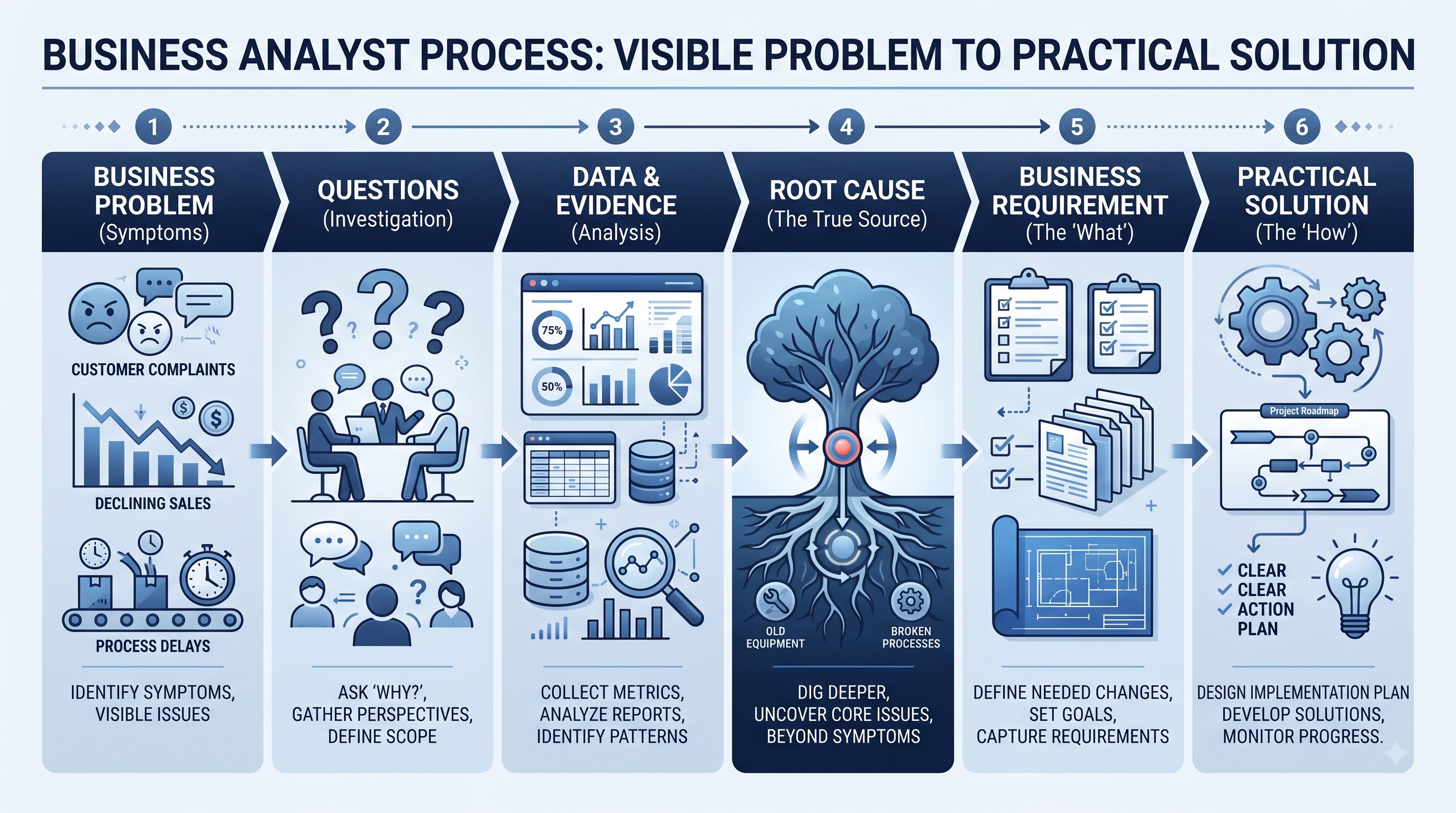
Consider a simple example. An online retailer notices that many customers add products to their shopping carts but do not complete their purchases. The initial request might be to redesign the checkout page. Instead of immediately sending that requirement to the design and development teams, a Business Analyst could examine the customer journey, analyze where users leave, review support complaints, and compare payment failures.
The analysis might reveal that customers are abandoning the process because the payment system fails for certain methods. In that situation, redesigning the page would not solve the main issue. The better solution might involve improving payment reliability. Good analysis prevents teams from solving the wrong problem efficiently.
This is why Business Analysts are valuable even when an organization already has strong developers, designers, project managers, and technical teams. Someone still needs to understand the relationship between the business objective and the proposed solution.
Requirements: Turning Business Needs Into Something Teams Can Build
Requirements are one of the central responsibilities of Business Analysis. A requirement explains what a business, customer, or user needs from a product, process, or system. However, requirements are often unclear at the beginning of a project because stakeholders may describe what they want rather than clearly explain what they need.
For example, a stakeholder might say, "We need a better customer management system." That statement is too broad for a development team to build from. A Business Analyst needs to understand what "better" means. Does the company need faster customer searches, centralized information, automated follow-ups, improved reporting, or better integration with another system?
The analyst works with stakeholders to break broad expectations into specific and understandable requirements. Depending on the project and methodology, these may be documented as business requirements, functional requirements, non-functional requirements, user stories, acceptance criteria, process flows, or other forms of documentation.
Clear requirements also help control project scope. Without them, new requests can continuously enter a project while teams are already working on existing priorities. This can lead to delays, higher costs, and confusion about what the project is actually supposed to deliver.
A good Business Analyst therefore does more than write requirements. They help stakeholders agree on priorities and clarify what is essential, what can wait, and what may not be necessary at all. The purpose of a requirement is not to create more documentation; it is to create shared understanding.
Business Analysts and Data: Looking Beyond Opinions
Modern Business Analysis increasingly involves data. Organizations collect information from websites, applications, customer interactions, sales systems, support platforms, financial systems, and operational processes. The challenge is not simply having data. The challenge is knowing what the data is saying and how it should influence a business decision.
A Business Analyst may examine sales figures, customer behavior, process times, conversion rates, support requests, or operational performance to identify patterns. The level of analysis can vary depending on the role. Some analysts work extensively with SQL, Excel, Power BI, or other analytical tools, while others focus more heavily on requirements and process analysis.
Suppose a company believes that a particular product is becoming unpopular because sales have declined. Looking only at total sales might support that conclusion. However, a deeper analysis could show that the product is selling well in some regions but experiencing stock availability problems in others.
The analyst can use this information to challenge assumptions and provide a more accurate explanation. This is where analytical thinking becomes important. A Business Analyst does not have to turn every problem into a complicated data science project. The goal is to use relevant information to make better decisions.
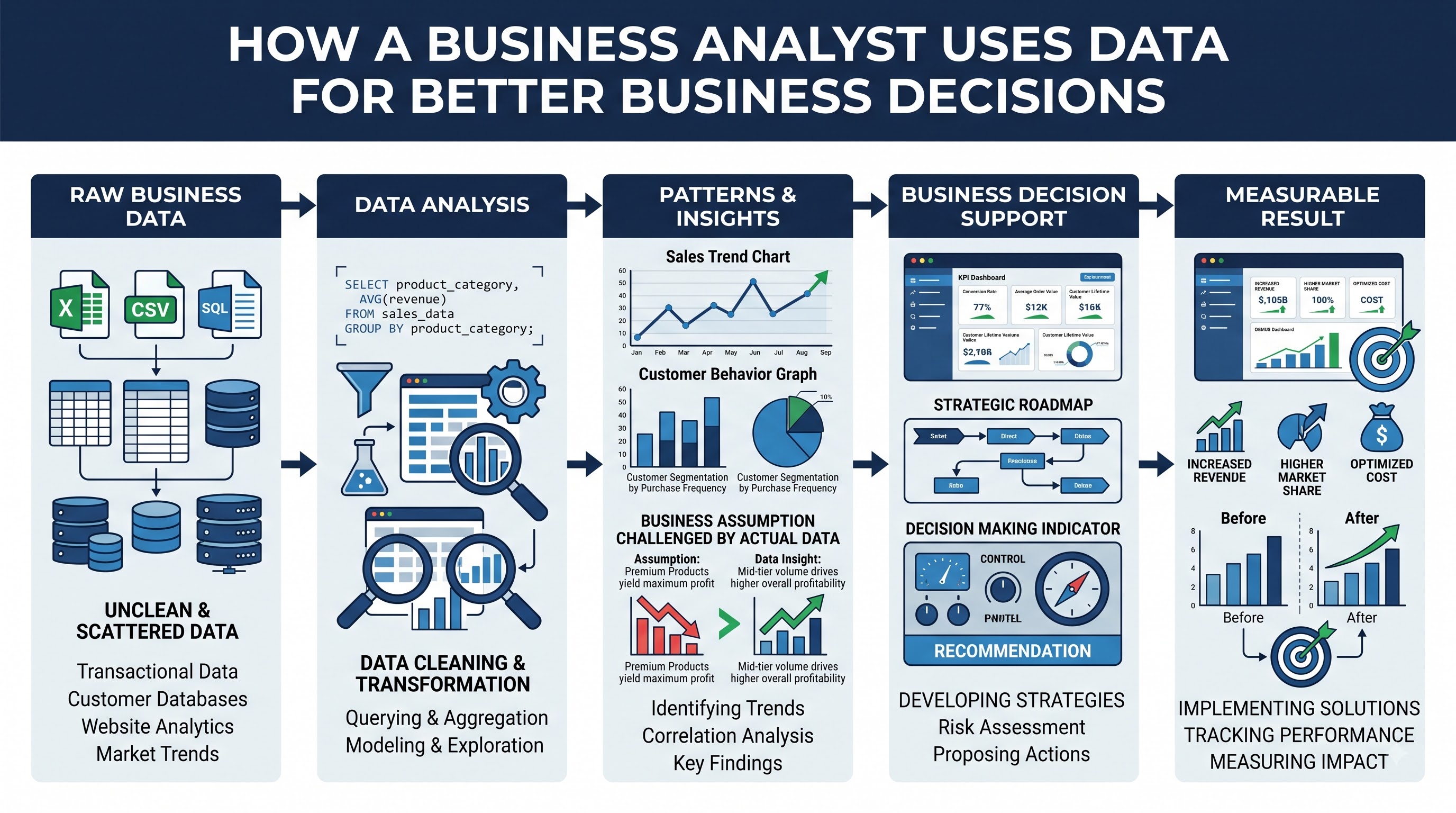
Data also becomes useful when measuring whether a solution actually worked. If a company introduces a new process to reduce customer waiting time, the team should be able to compare performance before and after the change. Analysis should not stop when a solution is delivered; it should help determine whether the solution produced the expected result.
Process Analysis: Finding Where Time and Money Are Being Lost
Many business problems are hidden inside everyday processes. Employees may spend hours entering the same information into different systems. Customers may have to provide the same details multiple times. Approvals may sit in someone's inbox for days, while reports may require several people to manually combine information before they can be used.
A Business Analyst can map the current process and identify where these problems occur. This is often called “as-is” analysis. The analyst then works with stakeholders to understand what the improved process should look like, often referred to as the “to-be” process.
Process mapping makes invisible problems easier to see. A process that looks simple when explained verbally can become surprisingly complicated when every step, approval, handoff, exception, and dependency is documented. This is also why practical exercises in a course business analysis program can be useful for learning how to identify process gaps and design more efficient workflows.
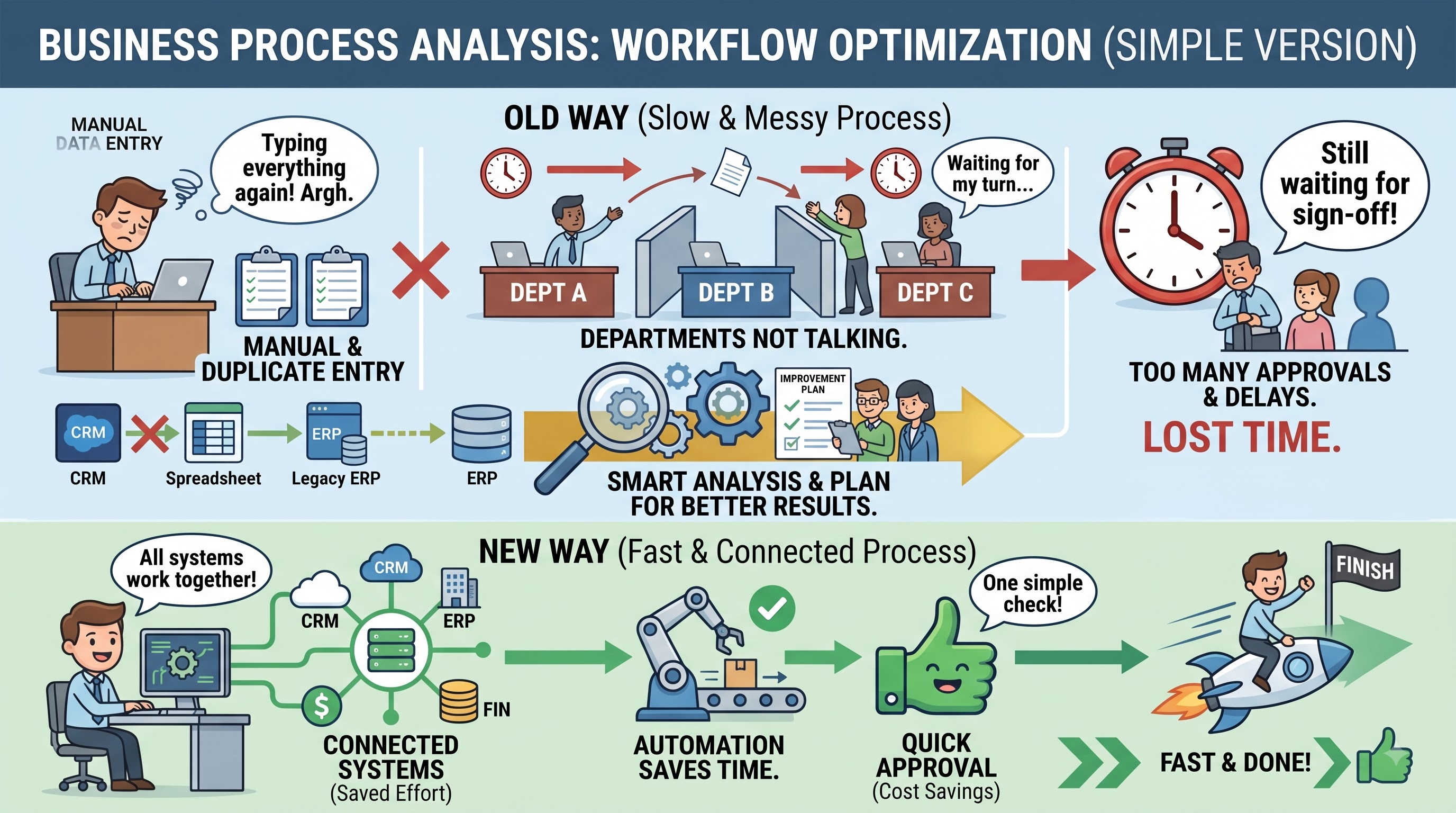
For example, imagine a company where a new employee requires access to five internal systems. If each request is handled separately by different teams, onboarding may take several days. A Business Analyst might identify unnecessary approvals, repeated data entry, and delays between teams before proposing a more streamlined workflow.
The solution could involve automation, better system integration, or simply removing unnecessary steps. Business Analysis does not always result in new software. Sometimes the best solution is a better process.
Business Analysts in Agile and Modern Product Teams
The way software teams work has changed, and Business Analysts have adapted alongside them. Many organizations use Agile approaches where requirements are discussed, developed, tested, and refined continuously instead of being completely finalized months before development begins.
In an Agile environment, a Business Analyst may work closely with Product Owners, developers, designers, testers, and stakeholders. Instead of creating one massive requirements document and disappearing from the project, the analyst may continuously clarify requirements as the product evolves.
User stories are commonly used to describe functionality from the user's perspective. Acceptance criteria can then define what needs to be true for the work to be considered complete. The Business Analyst helps ensure that these items describe meaningful business outcomes rather than simply technical tasks.
Communication becomes particularly important in Agile environments because teams often work in short development cycles. Requirements may change based on customer feedback, market conditions, technical limitations, or new business priorities.
A good analyst does not treat every change as a problem. Instead, they help the team understand the impact of the change. What will it affect? What needs to be removed or delayed? Will it change the original business objective? Does the new requirement create dependencies?
This makes the Business Analyst an active participant in product development rather than someone working only at the beginning of a project.
The Tools Business Analysts Commonly Work With
Business Analysts use different tools depending on their organization, project, and responsibilities. There is no single tool that makes someone a good analyst. The important skill is knowing how to use tools to understand problems, communicate requirements, and support decisions.
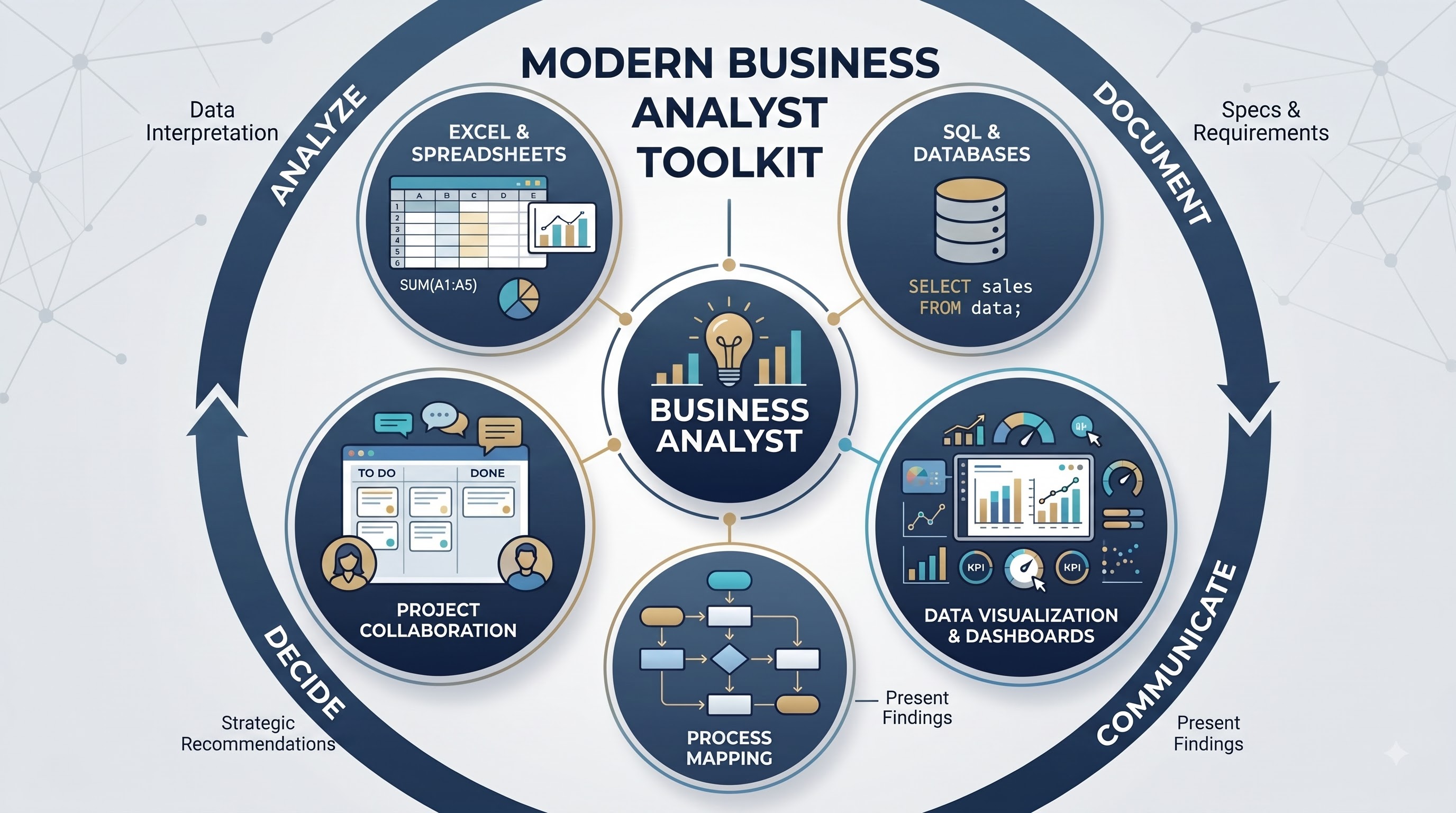
Spreadsheets remain widely used because they are flexible and useful for organizing information, comparing data, creating simple calculations, and performing initial analysis. SQL can become important when analysts need to retrieve information directly from databases. Visualization tools can also turn large amounts of information into dashboards and reports that stakeholders can understand quickly.
Process-mapping and diagramming tools are useful for documenting workflows, system interactions, customer journeys, and business processes. Project and collaboration platforms help teams manage requirements, tasks, discussions, and priorities. For beginners, a ba analyst course that includes practical work with these tools can make it easier to understand how they are used in real business scenarios.
The tools may change from one organization to another. One company might use one project-management platform while another uses a completely different system. What remains consistent is the underlying analytical process: understand the problem, gather evidence, communicate clearly, and help the team reach a practical solution.
Business Analyst Skills That Matter Most
Technical knowledge can certainly help a Business Analyst, but strong analytical and communication skills are equally important. The role sits between different groups, which means the analyst needs to understand enough about each side to communicate effectively.
Critical thinking is one of the most important skills. Analysts regularly deal with incomplete information, conflicting opinions, and assumptions. They need to evaluate what they hear rather than automatically accepting it as fact.
Communication is equally important because even a technically correct analysis has limited value if stakeholders cannot understand it. A Business Analyst needs to explain complicated situations in simple language, ask clear questions, listen carefully, and adapt communication depending on the audience.
Problem-solving is another core skill. The analyst should be comfortable breaking a large problem into smaller parts and examining each part systematically. Attention to detail matters as well because a small misunderstanding in a requirement can create significant problems later in development.
Basic technical knowledge can make an analyst more effective, particularly when working with software teams. Understanding databases, APIs, cloud systems, software development lifecycles, testing, and data structures can help an analyst communicate with technical stakeholders without needing to become a software developer.
At the same time, the analyst should not become so focused on technical details that the business objective is forgotten. The strongest Business Analysts can move between business goals and technical discussions without losing sight of the customer or organizational outcome.
How to Start a Career in Business Analysis
Business Analysis attracts people from different professional backgrounds because it combines business knowledge, communication, analytical thinking, and technology. Professionals from operations, finance, customer service, project coordination, testing, and similar fields may already have skills that transfer well into the role.
The first step is to understand the core concepts of Business Analysis, including requirements gathering, stakeholder management, process mapping, problem identification, documentation, data interpretation, and solution evaluation. These fundamentals help beginners approach business problems in a structured way rather than relying on assumptions.
Practical experience is just as important as learning the concepts. A learner can take a simple business scenario, such as improving an online checkout process or reducing employee onboarding time, and analyze it from a Business Analyst's perspective. Identifying the current process, finding pain points, defining requirements, and suggesting measurable improvements can provide valuable hands-on practice.
Structured learning can provide direction, especially when comparing business analyst classes, but it should be supported by practical work. Learners should focus on understanding how Business Analysts investigate problems, communicate with stakeholders, document requirements, and evaluate solutions. The goal is not simply to learn Business Analysis terminology; it is to develop the ability to use that knowledge to solve realistic business problems.
Why Business Analysis Is Becoming More Important
Businesses today work with more technology, data, automation, and digital systems than ever before. The challenge is no longer simply choosing new technology. Organizations also need to understand whether a solution addresses the right problem, improves the existing process, and creates measurable value.
This is where Business Analysts play an important role. They help teams examine problems before investing significant time and money in a solution. By connecting business goals with user needs and technical possibilities, they can help organizations make more informed decisions.
The growth of automation and AI is also creating new questions for businesses. Which processes should be automated? What data should be used? How should results be measured? Where is human approval still necessary? Business Analysts can help answer these questions by evaluating both the business opportunity and the potential risks.
Technology can execute a solution, but it cannot replace the need to understand whether that solution makes business sense. As organizations adopt more digital systems, Business Analysts can help manage the impact on employees, customers, processes, reporting, and existing technology.
The future of Business Analysis is not about replacing human decision-making with technology. It is about using technology more intelligently while making sure every solution has a clear business purpose.
Business Analysts can also help organizations manage change. A new system may affect employees, customers, processes, reporting, security, and existing technology. Understanding those impacts before implementation can reduce surprises and make adoption easier.
Conclusion
Business Analysis is ultimately about understanding before building. Whether the problem involves declining sales, slow operations, poor customer experience, outdated systems, or a new digital product, the first step is understanding what is actually happening and what outcome the organization wants.
A Business Analyst helps create that understanding. They connect stakeholders, examine processes, analyze information, define requirements, identify gaps, and help technical teams build solutions with a clear business purpose. Their work may involve documents, meetings, data, dashboards, user stories, or process maps, but the objective remains the same: turn a business problem into a clear path toward a practical solution.
For someone considering this career, the role offers a combination of business, technology, communication, and problem-solving rather than requiring expertise in only one area. A structured business analyst course can help beginners build these foundations, but the most important skills develop through practice—asking better questions, challenging assumptions, understanding data, documenting clearly, and thinking about the impact of every proposed solution.
The best Business Analysts are not simply requirement writers. They are problem solvers who understand that a successful project is not measured by how much software was built or how many documents were created. It is measured by whether the solution actually improved something that mattered to the business or its customers.
That mindset is what makes Business Analysis valuable—and it is also what makes it a strong career path for professionals who enjoy understanding problems, working with people, and turning complex situations into clear, actionable solutions.