
Business Analyst vs Product Owner: Skills & Career Path
Last updated on Oct 28, 2026

In the case of contemporary enterprises looking forward to achieving digital transformation and agility, no other two positions are discussed so often and misunderstood so much as Business Analyst and Product Owner. Both Business Analyst and Product Owner positions are found at the intersection of three domains – business, technology and user experience. Both positions are dedicated to providing support in making sure the developed products bring value to the business. Nevertheless, in spite of similarities, there are significant distinctions between those two positions in terms of their history, mindset, duties and career paths.
Those distinctions are critical not only for people seeking professional growth but also for recruiters and executives trying to form highly efficient cross-functional teams.
Origins and Mindset
To be able to understand how these roles function now, it is necessary to understand their origins first.
The Business Analyst position is a step up from the classical ways of doing system analysis and project management. Usually, the procedure is accomplished through linear methods whereby the need inside the organization is determined, and the gap addressed by bridging the gap between the need of the business and the technical developers as the duties of the Business Analyst. The core activities involved are requirement elicitation, documentation, process modeling, and feasibility. The efficiency of the analyst relies on the accuracy of the end product.
The Product Owner position has evolved from the Agile methodology, which in particular employs the use of Scrum methodology. As compared to the Business Analyst position that involves documenting the requirements for sign-off, the Product Owner position is intended to improve the value that the development team will deliver. In contrast to meeting the pre-defined needs of the system, the key concern is the ability of the development team in solving the right customer problems.
Here comes into effect the difference between the project-oriented and the product-oriented approaches. The project-oriented approach focuses on scope, timeline, budget, and functionality, whereas the product-oriented approach focuses on value, retention, fit, and iteration.
Key Responsibilities: The Way to the Job
Despite the fact that regular activities may vary depending on company culture and team size, it is not difficult to figure out what the responsibilities of the person are going to be depending on their approach to requirements, discovery, stakeholders, and sprints.
1. Requirements discovery and analysis
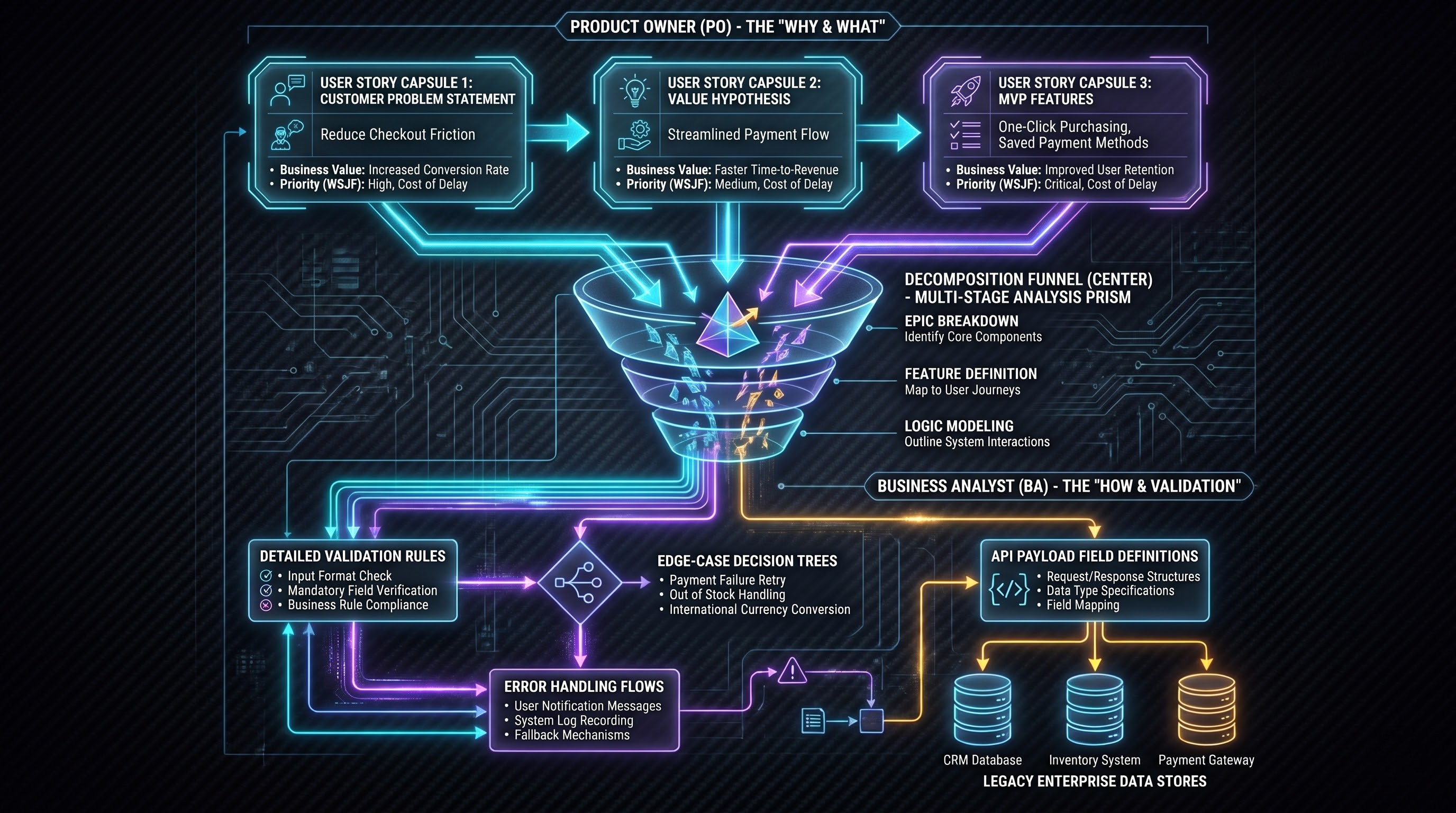
The Business Analyst uses the systematic decomposition approach when analyzing the requirements. They conduct interviews, identify the business problem, analyze the legacy systems architecture, and draw "as-is" and "to-be" maps of the business processes. If there are some issues within the business, they identify the root cause, data lineage, interface mapping, and edge cases.
The approach to defining requirements that is taken by the product owner can be characterized as an approach based on values. At the stage where the process has just started, the product owner does not try to take into account all possible situations. The product owner attempts to evaluate the impact of the problem on the clients and make some assumptions about the business that should then be confirmed. The next step that should be made is prioritization of the problems that should be solved to change KPIs. While the participation of the Product Owner in the formulation of user stories and criteria for the solution is extremely important, the key point is the definition of value and creation of MVP.
2. Interaction with stakeholders and decision-making authority
There is one major distinction between the role of the Business Analyst and the role of Product Owner in terms of decision-making authority.
The Business Analyst is a consultant, mediator, and detective. The person holds the workshops with various stakeholders, including departmental, financial, regulatory, and operational. In case the priorities and design options of various stakeholders conflict, the analyst makes a trade-off and cost-benefit analysis.
It is clear that the Product Owner should be granted the right to make the decisions. These individuals are not mere couriers that relay the information received from stakeholders to the team of developers. These individuals are those that make decisions about which demands contradict the current goals and should be rejected. Product Owners manage the product roadmap and are responsible for the product performance.
3. Rituals in Agile and Cooperation with Developers
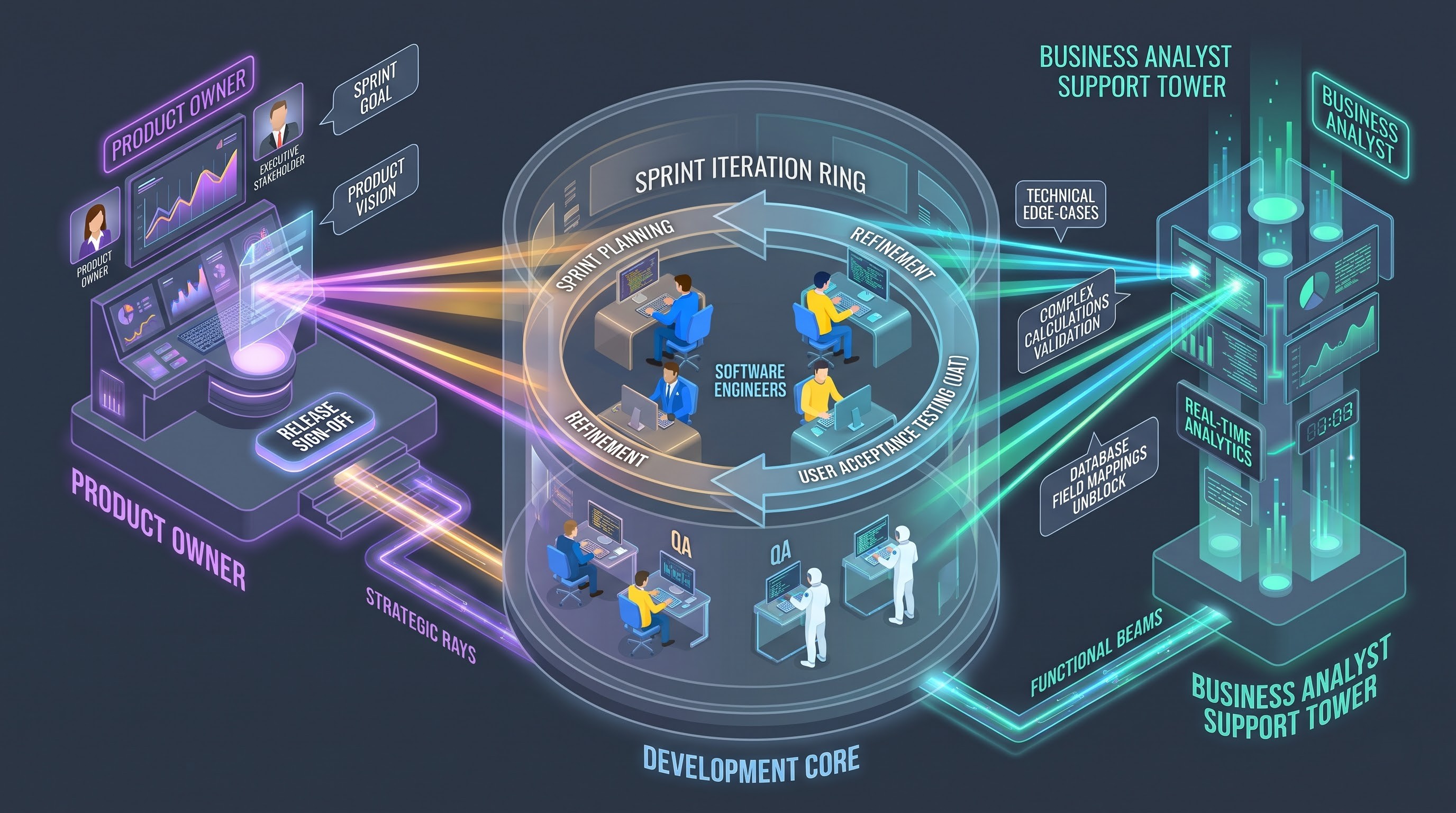
As an ongoing process of Agile development goes, both roles work very close together with the developers, QA professionals and designers, but the place of each one of these roles differs.
The Product Owner opens the sprint planning meeting, where the goals of the sprint are set and the value of user stories for the product vision are discussed. During the refining process, the Product Owner defines the direction and makes sure that the proposed plan suits the product vision. The Product Owner demonstrates the developed software during the sprint review meeting and makes a decision whether the increment satisfies the acceptance criteria.
The Business Analyst acts as the engine of technical and functional support in the sprint. Developers turn to the business analyst in case of edge cases, unmapped database field, integration logic, or external services. The Business Analyst is responsible for making sure that technical designs satisfy business rules and validate complex scenarios prior to user acceptance testing. As far as mature Agile teams, which have created such practices, go, the Business Analyst is the analytical spine of the Product Owner, who performs all necessary technical investigations so that the Product Owner is not engaged in this.
Key Skill Set: A Detailed Comparison
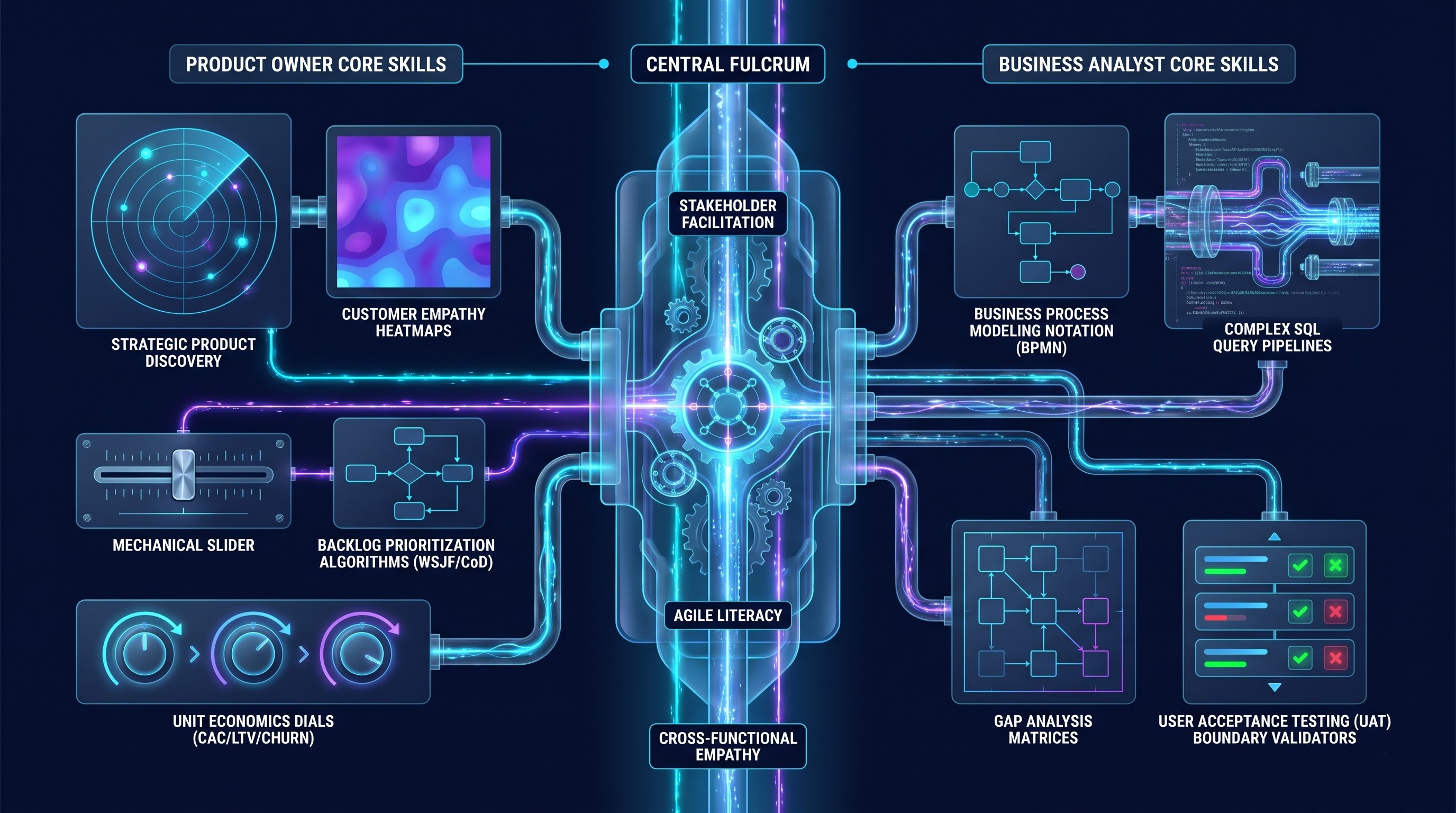
In order to perform any of the roles described above, one should have functional knowledge and emotional intelligence, but the skill set is somewhat different for each of the roles.
Key Skills of the Business Analyst
Requirements Engineering and Elicitation
The most important aspect of the good Business Analyst is the ability to uncover hidden assumptions. Stakeholders tend to talk about the solution rather than the problem. With the use of requirements engineering and elicitation techniques like structured interviews, contextual observation and gap analysis a business analyst is able to uncover the business problem behind the request.
Process engineering and systems modeling
It is essential that the person can understand the intricacies of the process ecosystem in the organization. Flowcharts, swimlane diagrams, state machine diagrams, and conceptual entity relationship diagram development will be required from the analyst. It will also be critical for the analyst to convert the complex business rules to logical formats, which can be further used by software engineers to develop application architecture.
Data Skills and Data Analysis
In today’s world, it is essential that the business analyst has advanced data skills. They should be able to analyze the data in the organization, query the data to understand the systems, perform data reconciliation and legacy system data dictionary analysis to aid in system migration.
Quality Assurance and Acceptance Testing
As the business analysts understand the complexities of the business rules, they are the best suited individuals to conduct acceptance testing and validate edge cases.
Skills Needed by a Product Owner
Product Strategy and Vision Development
A Product Owner should possess skills for developing and communicating the vision of the roadmap. He needs to be innovative and should think out of the box about how his product will look in 12-24 months from now. In other words, he needs to analyze trends and changes on the market and among competitors and customers.
Prioritization of Backlogs and Balancing of Trade-offs
Prioritization of backlog items is a difficult task and it requires taking into account the factors such as quick wins, strategic enablers, repayment of technical debts and dealing with visible customer defects. The Product Owner needs to be an expert in the frameworks of prioritization of backlog such as WSJF, CoD, Value vs Effort Mapping and be able to prioritize without getting influenced by "the loudest voice in the room."
Skills of Customer Discovery and Empathy with the Customers
The Product Owner spends a lot of time discovering. It includes doing customer interviews, behavioral analysis, usability tests, measurement of the customer sentiments. They are aware of customer psychology and can convert the complaints of the customers to improve their product.
Commercial & Business Savvyness
The Product Owner should be aware of the business logic of the product. In other words, he or she needs to understand the cost of acquisition of a client, lifetime value, the churn rate, different types of pricing strategy, revenue attributions, and ROI. All the actions done regarding the product are the investments in engineering which will generate the value.
Some of the crucial skills that a business analyst should know include requirements engineering, SQL query writing, and process modeling. This will only be done through a proper approach, which can only be done through the business analyst course online offered by OnlineITGuru.
Organizational Models - Ways of Establishing the Team
There are several approaches how organizations utilize the roles of the Business Analyst and the Product Owner depending on the organizational nature and technological maturity.
Model 1 - Product Owner
The model is mostly used when working with startups developing SaaS products. The role of the Product Owner is the only one and the person is responsible for both the market strategy and the back-log grooming process, working with full stack developers and UX designers. However, this is very dangerous and risky approach because too much responsibility has been assigned to the Product Owner.
Model 2: Business Analyst Only
Widespread in traditional internal corporate IT departments, governmental organizations, and custom software development companies. In this case, the external business departments play the role of "the business sponsors", and Business Analyst captures their requirements for delivery teams. Although Model 2 can boast such strong features as good documentation, traceability, and control, this model is usually connected with such problems as slow decision-making, complicated change request procedure, and delivery of the required features without adding any value to the business.
Model 3: Collaboration (both roles are present)
Prevalent in large organizations, financial organizations, healthcare organizations, and platform engineering organizations. The model presupposes collaboration between Product Owner and Business Analyst.
Product Owner acts as "the minister of foreign affairs", and he/she focuses on the external world, customers, executives, changes in the market, and value decisions.
Business Analyst acts as "the minister of internal affairs", and he/she focuses on internal processes, system integration, data dependencies, and dependencies between teams.
This model is the most balanced one if executed properly: fast value-driven approach and functional precision and system integrity at the same time.
Dealing With the Shadow Zones and Normal Disputes
If both of the roles are working together in one team, issues may come up regarding questions of authority, ownership and scope of the process. And in order to resolve such disputes, an agreement on how to deal with it should be reached.
Who is the Owner of the User Story?
Disputes concerning the issue of ownership of the user story creation are probably the most common ones. Ideally, the responsibility of the Product Owner includes the definition of "why" and "what" – the user persona and the business need. After this, the Business Analyst should cover "how" – system interaction, validation logic, error cases and non-functional aspects.
Scope Disputes
In most cases, the source of the problem might be the unexpected complexity of the system. The Business Analyst argues that it is necessary to keep the logic of integration in order to be compatible with the legacy systems, while the Product Owner would like to narrow down the scope in order to release the increment. In this situation, the main issue is related to the question of responsibility because it is the Product Owner who is responsible for the decision whether to release an increment or not, and the task of the Business Analyst is to mention all the risks of the reduction of functionality.
Career Paths and Opportunities for Professional Development
For those people who intend to advance in their careers by graduating from being junior analysts to senior analysts will have to posses all these qualities in order to succeed in this mission. It would be worthwhile to take the ba analyst course online offered by OnlineITGuru in preparation for the ECBA and CBAP certifications.
Career Path of the Business Analyst
The classical career path of the Business Analyst includes entry-level jobs which gradually evolve to become experience in analysis:
Junior Business Analyst to Mid-Level Business Analyst: Elicitation at the tactical level, process mapping, creation of user functional specifications, involvement in acceptance testing of certain functionalities/processes.
Senior Business Analyst: Requirements analysis for complex and large projects that include lots of functionalities and systems. Mentoring of junior analysts, management of inter-functional systems dependencies and senior heads of departments.
Lead / Principal Business Analyst: Being the guru of the company in business architecture and analytics. Establishment of company’s best practices in requirements analysis.
Career Paths:
Enterprise Architect / Business Architect: Skills development from analysis of software functionalities up to enterprise capabilities design, organization design and enterprise technology strategy.
Director for Data and Analytics Strategy: Skill development in deeper knowledge of data governance, business intelligence, predictive modeling and enterprise data warehousing.
Consultant: Use of business process reengineering and strategic analysis skills in consulting of external corporate clients on their restructuring and transformation.
Career Path for Product Owner Growth
Career growth path for Product Owner can be easily adapted for the management and leadership roles as well as in the field of Product Management in general:
Associate Product Owner / Junior Product Owner: Manages the part of the feature backlog, works with one development team and learns customer discovery and agile delivery.
Product Owner / Product Manager: Manages the whole product or the substantial part of the customer journey from end-to-end. Influences business metrics, develops feature roadmaps and ensures cross-functional alignment on design, engineering and marketing.
Senior Product Owner / Senior Product Manager: Manages the complex product through multiple teams, launches the important projects and makes autonomous decisions on the transitions of the product life cycle.
Group Product Manager / Product Director: Moving from the individual role to the leadership role. Manages the portfolio of products, develops product owner team, builds product operations and aligns product investments with the goals of the business of the company.
Vice President of Product / Chief Product Officer: Become an executive responsible for the product vision and strategy, market differentiation, customer lifetime value, portfolio management and revenue generation.
Role Transition
As IT jobs nowadays offer employees various chances to improve their professional skills and advance in their career, a person can become a product owner having previously worked as a business analyst and vice versa.
From Business Analyst to Product Owner
It is quite simple to switch from one role to another, especially when one changes his or her job from a business analyst to a product owner. This happens because there are many reasons for such change. For example, there are numerous skills that business analysts have in common with product owners, namely stakeholder management, functional literacy and the agile environment. However, there are certain challenges as well:
Stop Being Addicted to Absolute Accuracy: Former business analysts have to learn to work in an unpredictable environment and give up writing 50-page long specifications, but produce MVPs instead.
Business Intuition: Business analysts have to stop measuring success according to delivery and budgeting and try to create a business instead.
Take the Driver's Seat: Business analysts have to become decision-makers, not proposers.
The transition from being a business analyst to a product owner is based on the knowledge about how to work with digital technologies, backlogs and business logic, which can be achieved with the help of the best online ba analyst course offered by OnlineITGuru. This online course will provide a full overview of both the business analyst and the product owner.
Product Owner to Business Analyst Career Transition
One of the less common transitions is the transition from Product Owner to Business Analyst/Enterprise Architect. The career transition is perfect for individuals who:
Are interested in investigation and structure and not politics and business that comes with being a Product Owner.
Enjoy solving complex enterprise integration issues, creating efficient data flows and dealing with regulatory issues on multiple layers.
Enjoy process optimization in business and organizational architecture without the responsibility of earning profits or making losses related to any specific product.
Which Career Path is Right for You?
Career path totally depends on your motivation.
If you feel motivated to be a Business Analyst then:
Liking disassembling something: figuring out how it works, and coming up with all kinds of edge cases no one else has considered.
Just like conducting comprehensive research: analyzing data models, and building a rational architecture.
Like playing the role of a consultant: investigator and mediator of different business units.
You get satisfaction from making it work, perfecting it and ensuring that your technical solution is embedded in the business process.
You will make a great Product Owner if:
You enjoy creating a strategic vision, defining a mission and decision making in uncertainty.
Liking communicating with users, understanding their psychology and market opportunities.
Bottom-line driven, market success driven, user adoption driven and sales driven.
Not afraid to say No to key stakeholders, to admit mistakes and to change course when reality proves you wrong.
Conclusion
The two major pillars in the current world in terms of digital delivery are the Business Analyst and the Product Owner. The Business Analyst can be referred to as the one who provides analysis and the approach to the problem and functional correctness needed for building a proper solution, whereas the Product Owner is the one who provides the vision and the customer knowledge needed to build a proper solution.
Does it make any difference if these two positions are played by different people or by only one person? Definitely not, because both of them are equally important anyway.