
Business Analysts Turn Complex Compliance Rules Into Secure System Features
Last updated on Aug 24, 2026
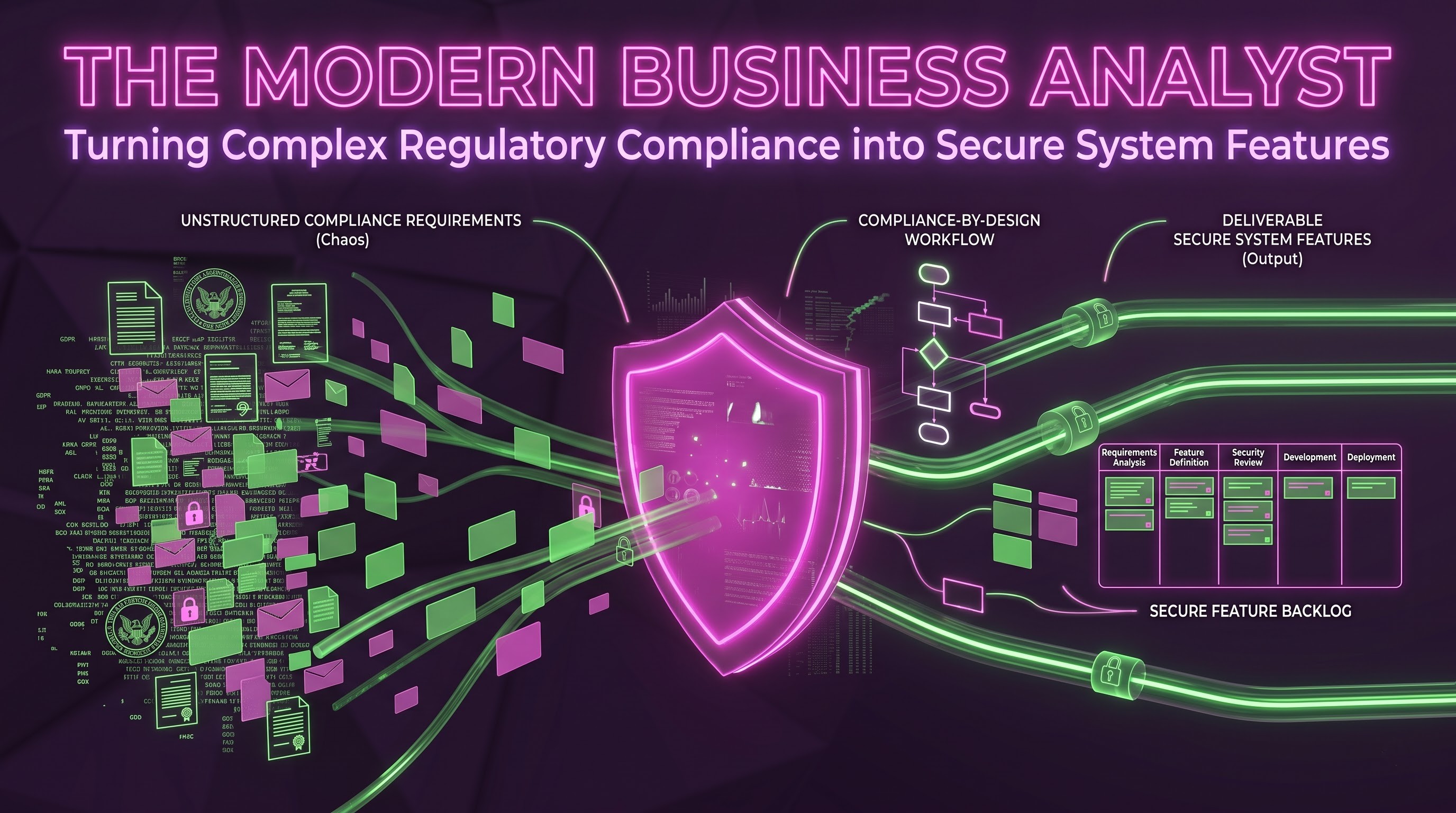
Today’s software systems work in an environment of ongoing digital change. Previous generations of cybersecurity and regulatory compliance were entirely separate from each other and were done only after the fact by infrastructure engineers, security experts, and legal advisors. Security measures became part of the development cycle only when it was time for pre-release testing which led to costly changes in design.
Considering that many new global laws protecting data privacy are in the works, as well as the appearance of more advanced forms of cyber-attacks it is time to change the attitude toward security in web design.
The BA’s position allows him/her to combine business goals and software architecture with security criteria providing input to the design stage of system development.
The Changing Role of a Business Analyst
The primary focus of the business analyst has always been discovering business challenges and suggesting solutions. In the past, this meant understanding user procedures, drafting functional specifications, writing down unusual cases, and ensuring the software meets the requirements of its users.
These days, data protection, digital identity verification, and business continuity are part of the product. Security measures should be treated as baseline; if a platform has lost the information related to its clients, its design and processing speed become irrelevant.
The modern business analyst functions as an active interpreter. Corporate compliance departments refer to regulations, and chief information security officers recognize the necessity to comply with the standards of the industry; the information is given in the form of complicated legal text.
Business analysts turn the regulations into practical criteria for acceptance, rules for data verification, and workflows based on user rights, as well as policies for the retention of data and procedures for dealing with mistakes. By using the Secure by Design approach, business analysts are able to avoid expensive redesigns, keeping the system compliant and user-friendly.
Through professional online business analyst classes and by utilizing a Secure by Design approach, business analysts are able to bypass any costly redesigns by maintaining both security and usability within the system.
Managing and Harmonizing the Landscape of Security and Compliance
In order to implement different forms of models properly, a BA needs to comprehend the law models and technical conventions concerning digital systems.
International Laws on Data Privacy
The privacy laws are a specific term which means how systems gather, manage, keep and delete Personal Identifiable Information (PII).
General Data Protection Regulation (GDPR): This EU directive introduces the legal standards for lawful processing of data, processes of consent gathering, “right of access”, “right of correction”, and “right of deletion” ("right to be forgotten") including being obliged to minimize information gathering and ensure privacy by default.
California Consumer Privacy Act and CPRA: These laws deal with transparency of data monetization, users opt outs, and precise access of users in the USA.
Digital Personal Data Protection Act (DPDPA): This legislation creates the rule for explicit digital consent artifacts, rules for data fiduciaries and withdrawal mechanisms.
Regulations Regarding Specific Industries
Payment Card Industry Data Security Standard (PCI DSS): This standard applies to any software handling credit card transactions. The main requirements are that any sensitive data must be isolated and maybe stored after data processing.
Health Insurance Portability and Accountability Act (HIPAA): This act protects personal health data in health care practices and ensures that any record processing is recorded, secured, and immutable.
Basic Security and Control Frameworks
SOC 2: This framework evaluates the information systems in accordance with five principles of Trust Services Criteria: security, availability, processing integrity, confidentiality, and privacy.
ISO/IEC 27001: This international norm describes the implementation and operation of information security management systems.
NIST Cybersecurity Framework (CSF): This framework summarizes the approach thus it consists of five basic functions such as identify, protect, detect, respond, and recover.
OWASP Top 10: The fundamental framework of creating web applications that defines the existing weaknesses.
The Translation Engine: Changing Frameworks into Software Functions
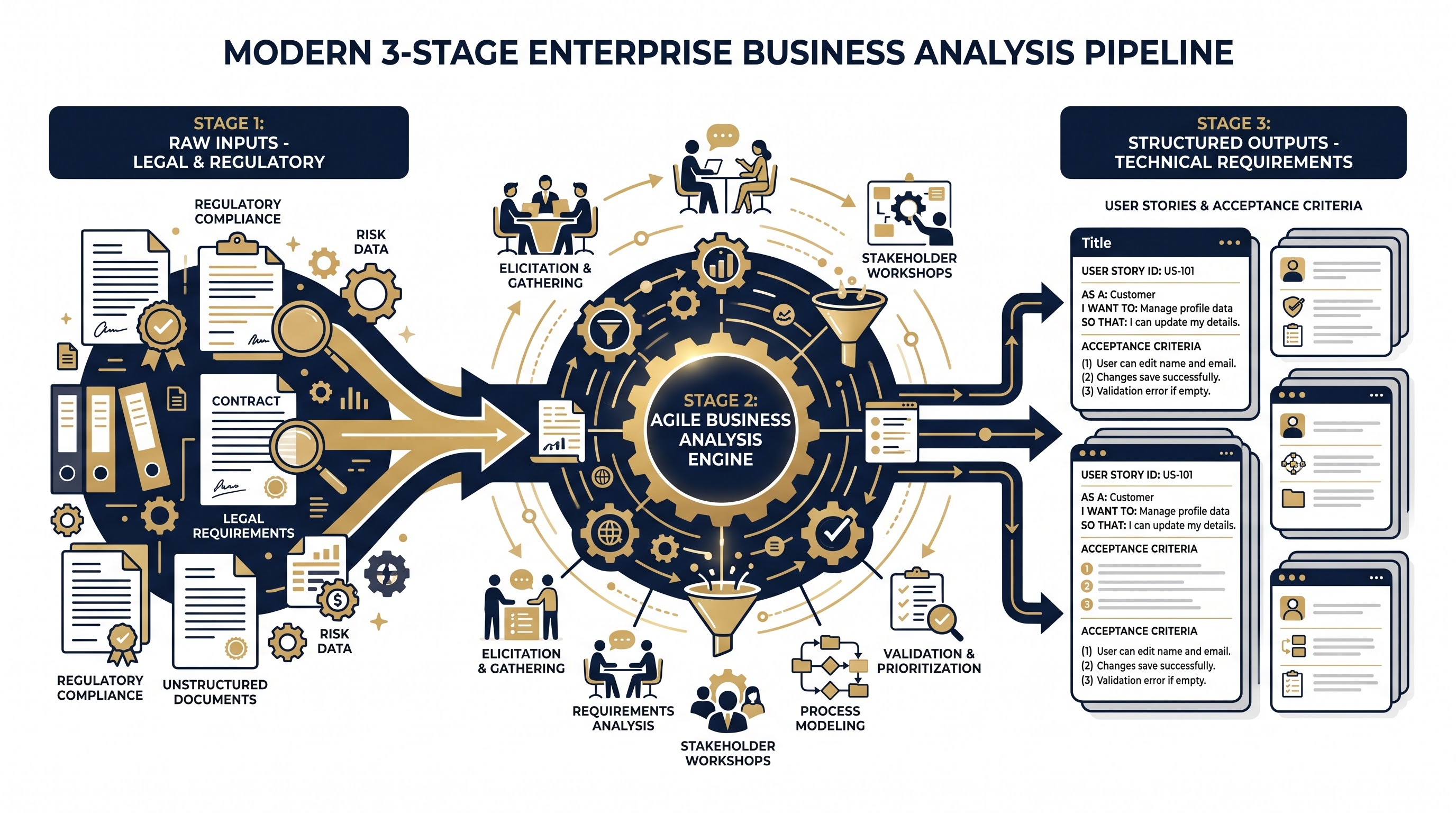
Translation of a standard into a feature implies breaking abstractions into system actions: triggers, inputs, validations, system functions, user messages, and events.
Access Control: Role-based and Attribute-based Access
Most standards prescribe the least privilege principle: users should be able to access only the minimum required data to accomplish legitimate work-related duties.
Where security principles require the least privilege principle to be enforced by the BA, his/her role does not end with a simple login screen. The BA is responsible for designing the hierarchy of roles, the matrices of role assignments, and the constraints of field visibility.
Functional Behavior: The support agent for an e-commerce platform needs to authenticate a query raised by the customer; the Business Analyst states that the customer’s email and phone numbers are visible, whereas the primary credit card number is encrypted except the last four digits.
Negative Path Definition: The Business Analyst explains the system behavior when an uninvited user attempts something; the system must drop the request made, keep away system routes or configuration details from disclosing in the error message, show a different unauthorized prompt message from any other message on denied access, and record the denied access in the security database.
Data Reduction and Process Design
Laws such as GDPR call for data minimization: systems ought to take only those data that are necessary for the completion of the task.
Functional Behavior: In case the online retail system offers a guest checkout feature, the Business Analyst examines every field available for input. Is the business required to ask for the date of birth or the gender of the customer for processing a delivery of an audio accessory or a charger? If no, these fields are removed from the data contract.
Opt-In Mechanics: If there is a legal obligation to obtain consent, the BA creates clear and separate opt-ins. Pre-checked boxes and hidden terms in footer navigation do not pass legal audits. Consent has to be provided as a clear interaction with the customer where it can be verified later using the user ID.
The Right to Erasure and Data Subject Requests
According to the privacy regulations, the users are entitled to ask for the complete deletion of their personal data.
Implementation of Features: A simple instruction to the database to remove the user will not work sometimes because the system is complex and processes data in different ways.
Creating the Workflow: The BA creates a computerized workflow for data scrubbing. Customer information is pseudonymized in that the name of the person, their physical address, the telephone number and the IP logs are changed into random numbers or tokens. But the customer’s fiscal record, order ID and tax papers are not changed at all and stay the same in the accounts because there is a mandatory law to retain them in their original form.
Complete Audit Log Tracking and Traceability
Auditing standards such as HIPAA, SOC 2, and PCI-DSS require complete traceability for all interactions with the data.
Translating into Features: Often developers implement technical logs for system troubleshooting only, not meeting security auditing requirements. Acceptance criteria for functional logging defined by BA.
Exactness in Specification: BA requires capturing information on the system side of when a sensitive record is accessed, created, updated or exported: authenticated user ID, timestamp, source IP, activity performed and record ID. BA points out specifically that audit logs must never contain unencrypted data of any sensitive nature (e.g., passwords, session tokens, or credit card numbers).
Threat Modeling in Requirements Gathering: Abuse Cases and Misuse Cases
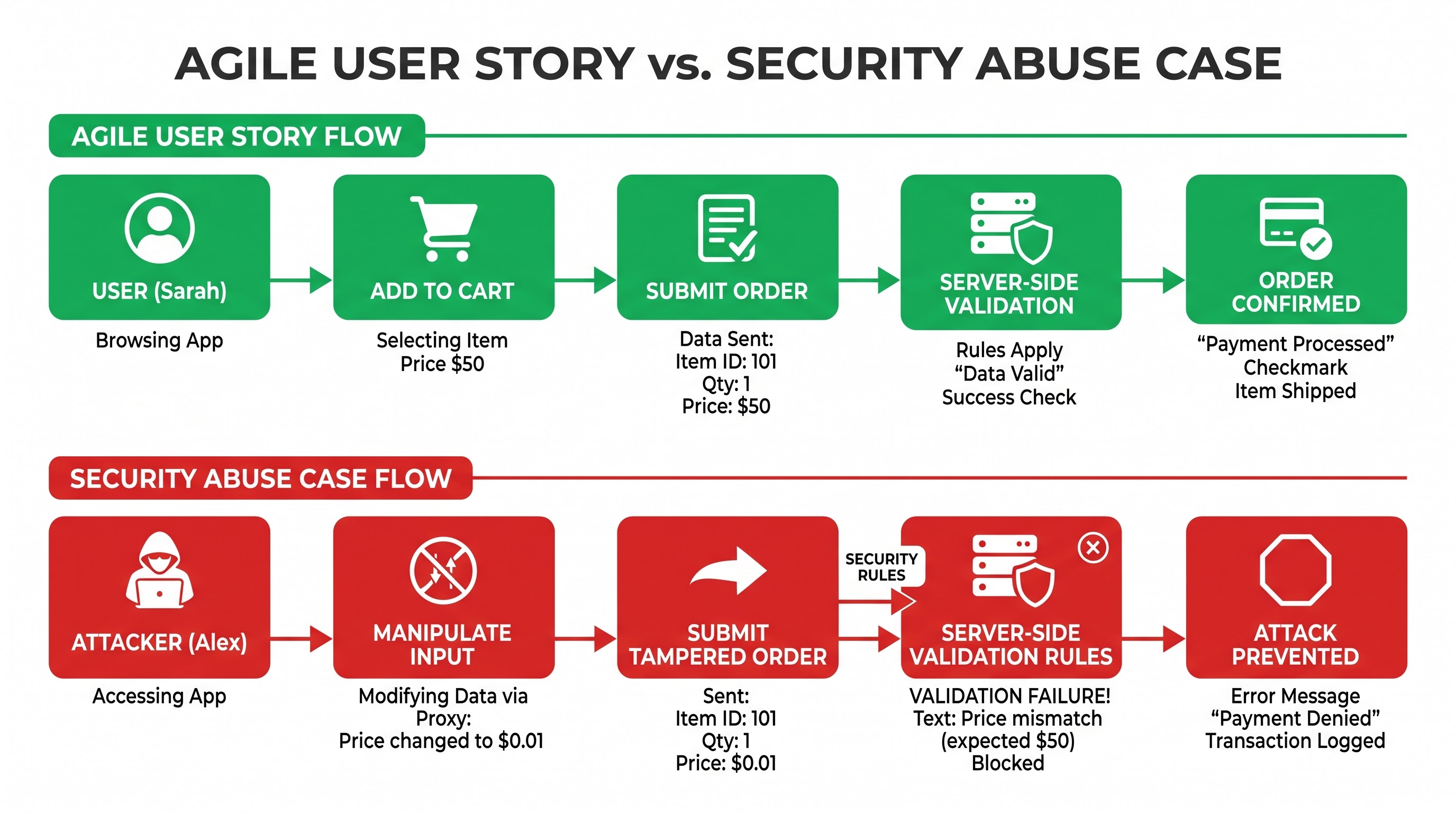
Regular business analysis focuses on user stories telling what a legitimate user tries to achieve:
"As an authorized buyer I want to update my profile details in order to have correct addresses to ship my orders"
Abuse case or misuse case is introduced in the security-aware business analysis process that is taught in the online ba training programs aligned with industry needs.
Abuse Case Design Template
Identify the Asset: What valuable asset is involved here? (e.g. customer address book, password reset token, balance, checkout calculation).
Identify the Abuser: script kiddie, competitor, disgruntled staff, scammers.
Attack Vectors: What is the interface/abuse vector? (e.g. url parameter manipulation, rate API manipulation, session hijack).
Design the Acceptance Criteria that will stop the abuse: what validation will the system do that will prevent the problem?
Misuse Scenario Examples
Scenario: Order totals manipulation (parameter manipulation)
Use Case: As a customer, I want to enter the discount coupon code so that I can have the amount of discount off my order total.
Abuse Case: Tech-savvy user looks at the payload sent by browser and manipulates unit price parameter from one hundred dollars to one dollar before sending the request.
Business Analysis Specification: The client application must send only the SKU and the quantity of the product to the backend. All the prices must be recalculated from the server side. No payments can be done with hard coded prices coming from the client browser.
Use Scenario: Automated Bot Script for Account Takeover Attack
User Stories: As an account owner, I would like to be able to log in to use the customized dashboard.
Abuse Case: The threat actor deploys a script using automated bots to try logging into accounts using breached credentials.
BA Specification: The BA specifies rules for adaptive rate limits – five failed login attempts in a span of three minutes from one unique user/IP will cause escalation of lockout, present an issue related to bot mitigation, and send an e-mail alert to the account owner about any suspicious log in attempts.
Security by Design Throughout the SDLC
Building security is a persistent process that applies through every stage of the systems development life cycle.
Discovery and Scoping
In the discovery phase, the BA finds out the footprint of the data. Each piece of the data collected in the system that is being proposed is put in the right classification which includes Public, Internal Business Use, Confidential, or Restricted /Sensitive (PII, PHI, Card Data).
Through the early creation of classifications for the data collected, the BA makes sure that the correct encryption protocol is budgeted for the data collected (example, TLS, and AES-256).
Requirements Identification and Backlog Refinement
A BA always ensures that security requirements cannot be left alone in a general user story like "Keep the system secure."
Security is embedded in everyday user stories via specific Acceptance Criteria (ACs). A BA crafting an authentication user story creates AC for strong passwords, timeouts, prompt for MFA, and session logout when the password is changed in multiple tabs of the browser.
Testing and Acceptance
In UAT, a BA does not only test the "happy path," but also the perimeter of security in User Acceptance Testing (UAT):
Do the session cookies become obsolete as soon as one clicks "Log Out"?
Does the backward navigation in the browser reveal personal health care or finance data in publicly accessible computers?
Are the SQL and script tags filtered successfully, without stopping the application?
Maintenance, Change Management, and Audits
The software is constantly evolving, and when business stakeholders demand additional functionality in the form of integrating with a third-party marketing or analytics solution, then the BA needs to do an impact assessment.
In doing so, the BA analyzes the data that the new third party will be consuming, confirms that the third party holds the same certification as the core product and creates the necessary data processing specs.
Managing the Risk Associated with Vendors and External APIs Integration
Modern enterprise-grade solutions are no longer just closed ecosystems; on the contrary, they are ecosystems integrated with payment processors, delivery partners, analytics services, customer service ticketing systems and various identity management services. These interactions represent one of the largest attack surfaces in modern computing.
When working with an external integration, the BA becomes the main functional component in maintaining the security of the software supply chain.
API Data Contract Audits: The BA documents all API contracts for any data sent between systems. For example, if a 3PL service needs only the destination postal code, recipient name, and tracking number for processing the order, the BA will create API contracts which exclude passwords, full transaction history, and other sensitive data from being sent through this connection.
Failover and Circuit Breaker Criteria: External vendors go down for maintenance and due to breaches and attacks. The BA will include failover logic: What happens if a fraud screening process does not respond anymore? The system will have to fail securely with queuing the transactions to be reviewed manually or switching to another solution.
Vendor Functional Specs Attestation: The BA will work with legal and procurement to make sure that the specs provided by the vendors are in line with all organization certification such as SOC 2 Type II or ISO 27001. Requirements must require a notification in case of data leakage in a specified amount of time (e.g., 24 hours).
7. Data Lifecycle Governance: From Ingestion to Archival
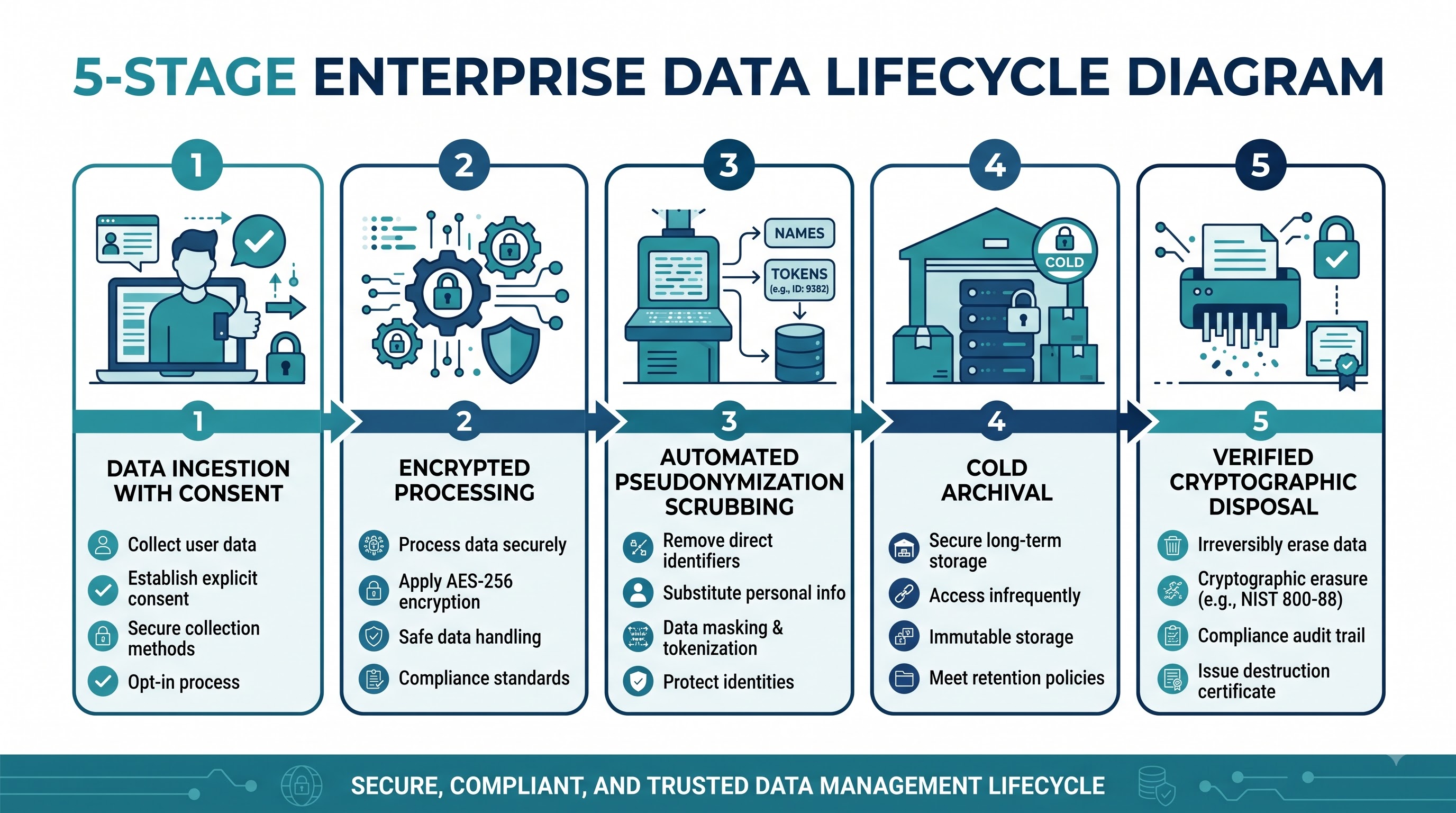
Every requirement must describe the entire lifespan of data. Data flows from one stage to another, and undergoes transformation, replication on backup, aging, and final disposal.
Retrieval Periods & Purges: An endless amount of data storage poses significant liability concerns. Together, the BA and the compliance group create a life cycle plan that pertains to all entities of the DB. While chats may be programmed for automated purge in 90 days, the data related to successful transactions has to be retained in seven years to satisfy the tax authorities.
Archival pipelines: It is the role of the BA to capture the business logic when shifting old data from the active database to cold encrypted storage. It should contain the business logic for archiving data that no one in the operations department is allowed to access unless there is an audit trail that contains manager authorization.
Defensible disposal: When its life cycle expires, the data becomes subject to definitive disposal. The BA will document the process of verifying the removal/deletion/anonymization of any records, metadata, cached media or secondary backup images.
UX & Defensibility Balance
Another common struggle while building applications lies in balancing smooth UX with tight security control measures that are too aggressive. This approach will irritate users and cause them to abandon the service completely or resort to workarounds such as putting complicated passwords on sticky notes.
Here is where BA acts as a mediator between user-friendliness and system safety.
Adaptive Authentication: Unlike requiring Multi-Factor Authentication (MFA) through a cumbersome process at every step on a low-level threat, BA establishes trigger conditions for this measure. It will occur only in the account creation process and at every login from unknown device or location, as well as during any important profile changes like updating your bank account or shipping address.
User-friendly Explanation of Failed Input: If a given user input failed the validation step, the error message will have clear guidance on how to fix this problem without providing access to database structure or server architecture.
Graceful Timeout: For security purposes and to avoid using open stations in public environments, user sessions should be timed out in case of inactivity. But BA has planned it properly. There will be a modal window that will inform about 60 seconds left before timeout in order to extend the session.
Collaborative Bridges: BA’s Cross-Functional Intersection
To develop compliance-oriented architecture from complicated legal systems, the persons who are trained through an business analyst course online India create communication networks through four key parties, which include:
1. Legal and Compliance Group
Legal experts pinpoint the regulatory limits and liabilities of the corporation. The BA coordinates with the legal experts for interpreting ambiguities in statutes and converting them to technical terms.
2. Information Security and DevSecOps Team
Information security experts articulate the technical ground level with the help of firewalls, encryption, identity provider, and vulnerability scanning. The BA collaborates with them to gain knowledge of architectural principles to incorporate in the software specifications.
3. Software Development Teams
The developers write the code that implements these requirements. The BA supplies developers with usable user stories, error-handling requirements, boundary values, and full data life-cycle models.
4. End Users/Business Product Owners
Business executives generate income, acquire customers, and maintain velocity. The BA communicates how securing against security risks ensures brand loyalty, consumer confidence, enterprise selling capabilities, and no disastrous legal fees.
Conclusion: Security as Competitive Advantage
Security and compliance are not two disparate entities anymore which have been left to the server room and legal department. In today’s world of digital technologies that handle lots of financial, organizational and individual data, trust becomes the very basis of the digital economy.
However, it is the responsibility of the Business Analyst to ensure that trust functions. With these skills obtained from an online business analyst course India, the BA ensures that all difficult regulatory legislations become practical and workable functionalities and logic of businesses.
When the security is embedded into functional requirements, systems get released sooner, they are capable to scale without danger, resist any malicious attacks, and provide secure services to the customers.