
Client-Side Field-Level Encryption in MongoDB for Secure Compliance
Last updated on Sep 12, 2026
Client-Side Field-Level Encryption is a vital change in the way in which sensitive data is protected in modern distributed systems. Historically, security models were based on perimeter defense methods and access lists in addition to encryption methods such as Transparent Data Encryption. Even if these measures are still applicable for general defense-in-depth systems, the reality is that they create major structural blind-spots. For instance, databases that encrypt information only at the storage level are still very suitable for so-called “memory scraping” attacks, attacks executed by unauthorized administrations of databases, “SQL injections” threats, and hypervisor attacks in multi-client cloud environments. It should be noted that when database engines are equipped with plaintext keys allowing them to read and write records, their host poses a serious risk of a single point of failure.
The Client-Side Field-Level Encryption mechanism that runs over the application layer radically changes the traditional security perimeter. In the process of changing up sensitive attributes including personally identifiable information, social security numbers or health data into cryptographically secure strings, it enables systems to introduce unprecedented confidentiality guarantees. Now, the database layer functions merely as an untrusted storage medium and thus does not grant database administrators or hackers any chance to inspect sensitive information. This architecture makes it possible to introduce watertight data pipelines that may follow global regulatory requirements of the General Data Protection Regulation or the Health Insurance Portability and Accountability Act.
The Shift in Data Protection and Zero-Trust Strategy
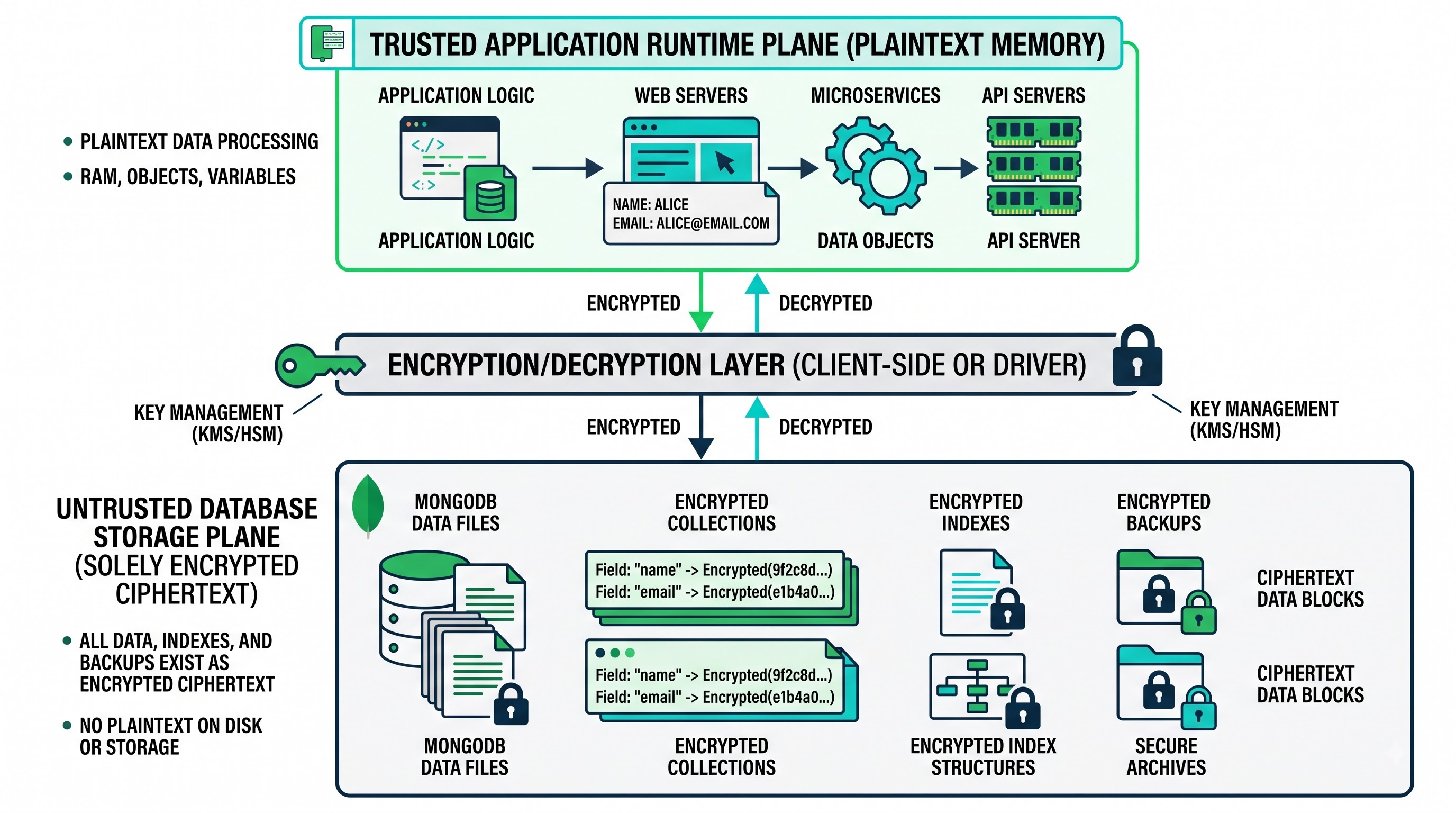
For decades, the traditional data protection method used in organizations was based on two main states, meaning data that was either in motion via Transport Layer Security protocols, or data in storage protected by Advanced Encryption Standard or other volume-level means. This method relied on having middle tier systems operate as controllers of the process. By decryption of a block of information stored on disk and going through the specified operations, data would be processed and the results returned to the consuming service.
The method has been unable to keep up with the new threats that emerged. Modern challenges from internal attacks, third-party subpoenas, misconfigured permissions of the database, compromised backup files and application vulnerabilities prove that information stored in the company’s databases is never actually in a safe state and can be compromised at any time. It occurs right after the start of the database when the keys are mounted and the data is available in the current operational mode of the operating system.
The introduction of zero-trust network access models has made it clear that this storage-focused approach is inadequate. The zero-trust theory is simple and entails three main principles – assuming a breach, checking and verifying everything explicitly, and not trusting any layer of the system just because it is inside the private subnet. Following the principles of zero trust in relation to data storage entails that the storage layer must be treated as an untrusted component of the system.
Client-Side Field-Level Encryption brings this premise into practice. It allows performing cryptographic operations in the client driver or at the level of the application. During this process, sensitive data is encrypted on the machine that hosts business logic and runs the application. The network transfers ciphertext; the database parses, indexes, and commits ciphertext; replication pipelines stream ciphertext; and remote disaster-recovery snapshots persist ciphertext. The plaintext exists only in the ephemeral memory of authorized runtime instances of the application.
The implementation of client-side encryption requires a comprehensive familiarity with driver drivers, schema definitions, and document modeling. Such knowledge is generally gained by developers and database administrators through specialized mongodb online course designed for modern distributed systems.
Core Crypto Mechanisms and Envelope Encryption
The basic but significant idea of envelope encryption rests in its mathematical principles, adapted to provide adequate speed, scalability, and security. Encrypting millions of records by using the same master key will lead to massive key exposure risks and make the rotation of keys in the entire enterprise time-consuming. The use of a unique asymmetric key pair will create unacceptably high processing latency. Envelope encryption addresses the problem through a dual-level key hierarchy.
The solution separates data encryption keys from the main key management solutions, which are usually called customer master keys or key encryption keys. When the application is ready to encrypt some sensitive data, it does not need the Hardware Security Module or cloud Key Management Service for processing data. Transferring raw application data to the external key manager can create enormous transaction latency.
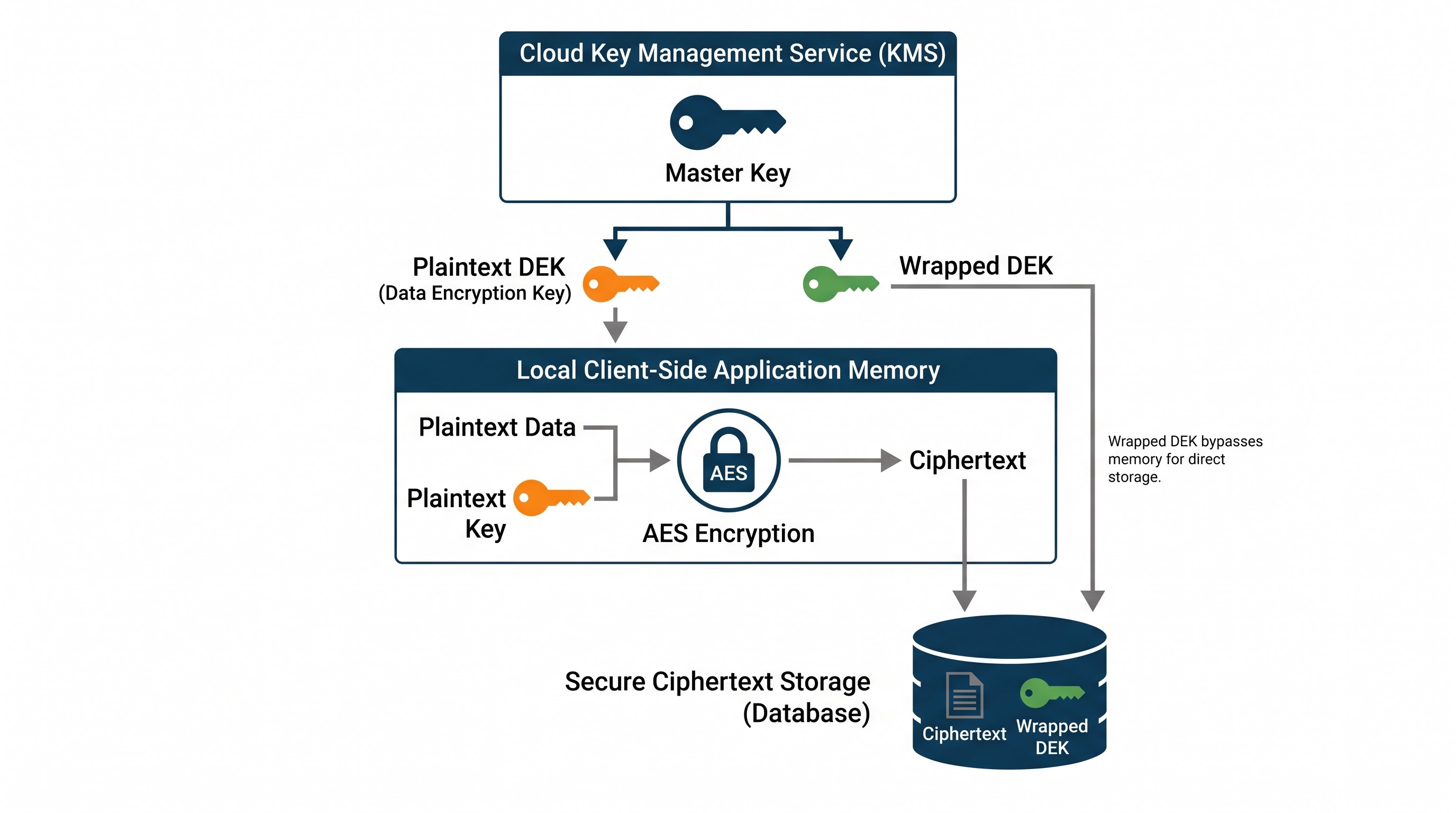
On the contrary, the application takes advantage of the Key Management Service to control the root Customer Master Key. The client application asks for the creation of a unique Data Encryption Key that is symmetric and related to the AES algorithm having a key size of 256 bits. The Key Management Service will produce the Data Encryption Key and send back two forms of this key to the client's runtime: a plain Text Data Encryption Key, and an encrypted Data Encryption Key that had been encrypted through the Customer Master Key.
The client application merely holds the plaintext Data Encryption Key in its safe non-swappable heap space. It makes use of this symmetric key to conduct a local cryptographic operation on the required fields using authenticated encryption methods including AES, which uses either Galois/Counter Mode or Cipher Block Chaining mode plus a Hash-based Message Authentication Code.
Once the data field is transformed into encrypted data, the application associates the encrypted area with some data that refers to the identifier of the Customer Master Key and the encrypted version of the Data Encryption Key. Then the plaintext version of the Data Encryption Key is removed from the memory immediately through secure overwriting processes or cache eviction techniques. After the record is saved in the database, the database engine gets ciphertext and the information about the encrypted Data Encryption Key.
In the process of reading data, everything goes the other way around. The application obtains a record containing ciphertext and the encrypted version of the Data Encryption Key and sends the encrypted key to the Key Management Service. If the application is eligible to use Identity and Access Management, then the Key Management Service unlocks the data key through the Customer Master Key and sends the plaintext version of the Data Encryption Key back to the client. Thus, the client reads and decrypts the field in its memory and provides the plaintext data to the business domain.
With this system of classification, the root keys stay in the secure hardware area of the Key Management Service, as all the data processing via cryptography takes place on-site, allowing for extremely fast processing speeds.
Due to the possibility of local cache misconfiguration or wrong KMS orchestration, which can cause reduced transaction throughput, architects prefer the best mongodb online course to master tested caching solutions and learn multi-cloud key management practices.
Cryptography Types: Random and Deterministic Systems
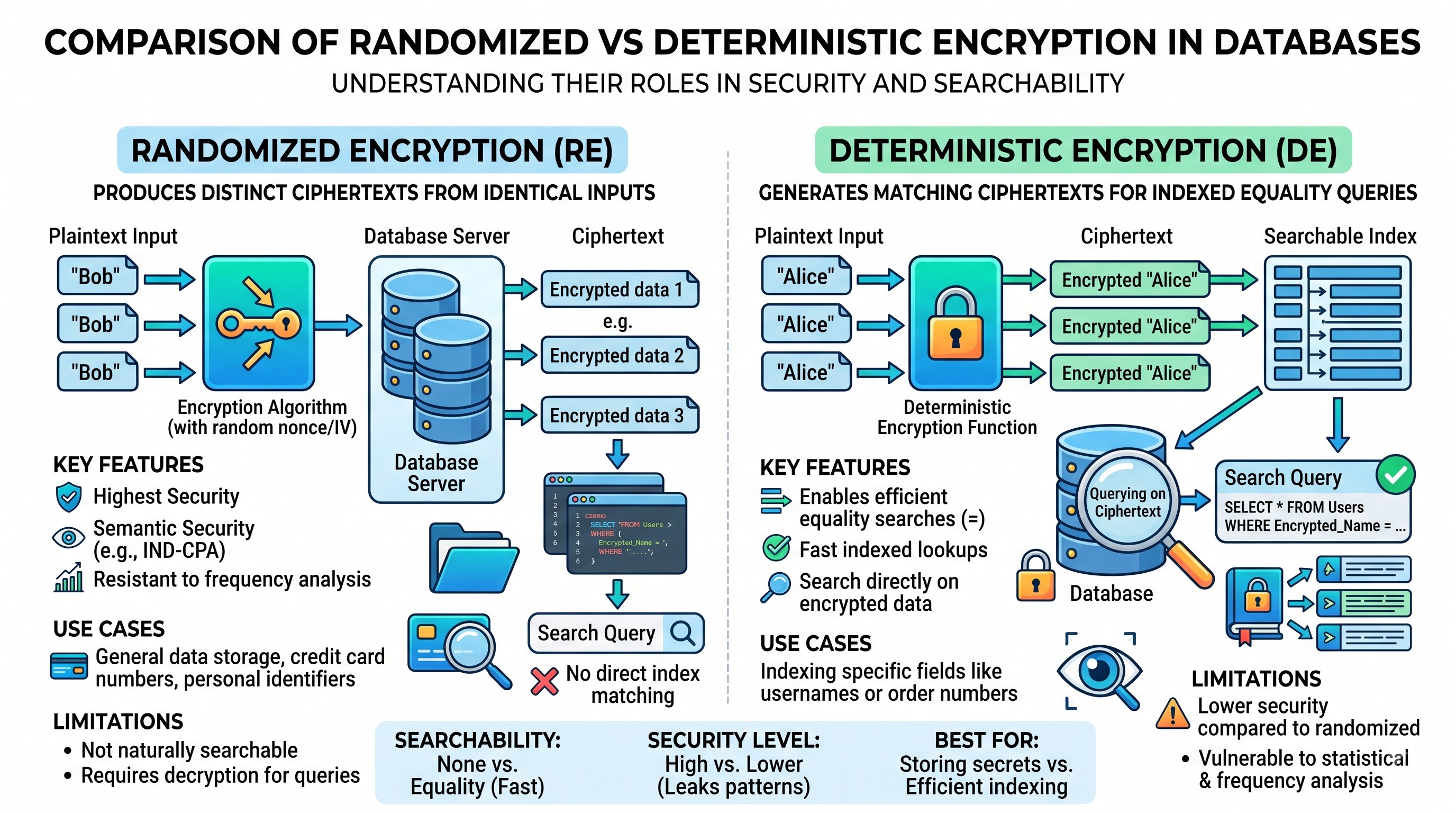
One of the significant tech difficulties faced when trying to implement field encryption in the data persistence layer is maintaining query capabilities. In standard randomized encryption, encryption systems transform similar plaintext data into significantly different ciphertext information or codes each time the encryption process is completed. Such transformations come as a result of using a different cryptographic initialization vector or nonce for each encryption operation.
Randomized encryption achieves the highest level of semantic security. The adversary who intercepts the contents of the database will not be able to identify whether identical values are present on two records, rendering frequency analysis, dictionary attack, and pattern matching useless. Randomized encryption does not create any predictable link to the original data. This makes it a must for the most confidential, fragmented, or low-cardinality data.
Nonetheless, randomized encryption completely destroys the indexing and search functionalities of regular storage technologies. The search for equality in the database is impossible because the random ciphertext derived from the search criterion will not match any ciphertext in the index. Therefore, the whole database must be transferred to the use of applications to perform the decryption in memory and conduct search filtering, which nullifies the efficiency of the entire system.
To enable database functionality to be merged with respect for privacy of sensitive information. In deterministic mode, the cryptographic initialization vector is derived from the plaintext, usually involving the use of synthetic initialization vector counterparts like AES-SIV. Here, the same plaintext messages encrypted using the same Data Encryption Key always produce the same ciphertext.
This method of encryption simply means that matching databases can function correctly. The relevant applications can use standard equality criteria with identifiers of customers, national identity numbers, and passport and email data. Finally, the database system can create usual B-tree or hash indexes of the ciphertexts, thereby ensuring effective search within the message range.
Since identical plaintexts lead to identical ciphertexts, an encrypted column will still be susceptible to attacks based on frequency analysis. Thus, if a database stores values like gender or blood type using deterministic encryption, then an attacker gaining access to the database will be able to correlate the frequency of ciphertexts with the known demographics to decipher the values at a rate close to 100 percent.
Creating indexes working on deterministic ciphertext while protecting against frequency analysis is a highly technical skill that is often covered in advanced courses from comprehensive mongodb training programs aimed at improving the performance and security of databases.
This is why even though deterministic encryption has its advantages, industry standards recommend that this encryption method be used for attributes with very high cardinality, i.e., attributes whose values consist of mostly unique data, such as tax ID numbers, account numbers, or UUIDs. In addition, some of the latest developments in database systems have led to the introduction of new encryption methods that combine the strengths of deterministic encryption with the zero-trust approach using queryable encryption methods.
Compliance at its Geospace: HIPAA Security Rule and GDPR Implementation
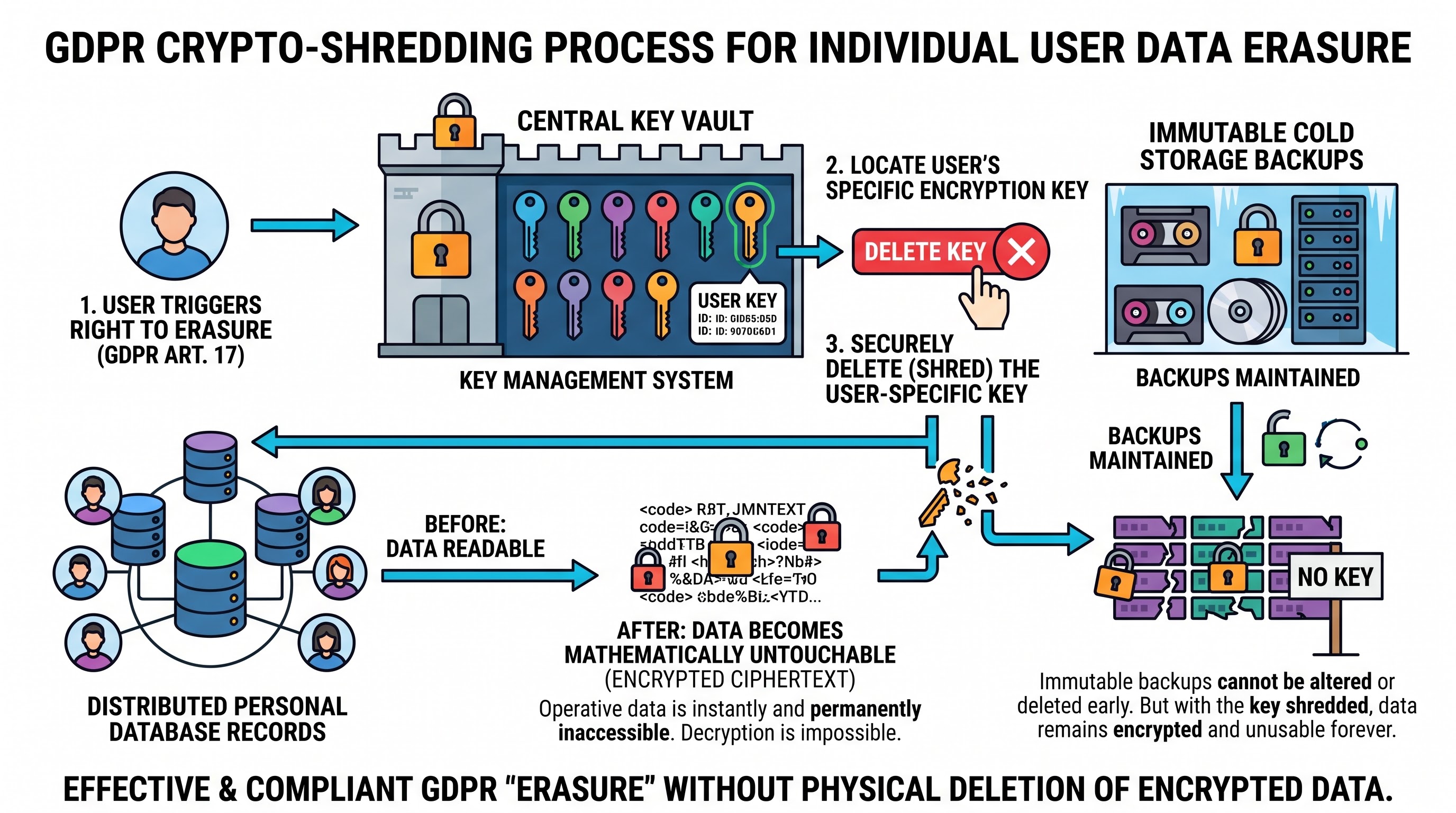
The implementation of Client-Side Field-Level Encryption establishes a definite basis for satisfying key global requirements of confidentiality, leading organizations from vague policies to verifiable access protections in practice.
According to the Health Insurance Portability and Accountability Act, the HIPAA Security Rule applies to covered entities and business associates. The Security Rule holds requirements for protecting the confidentiality, integrity, and availability of electronic Protected Health Information.
A chief weakness of classic HIPAA implementations is the wide scope of the business associate landscape. Companies in the cloud hosting business, providers of database-as-a-service, storage services, and monitoring services can easily fall under the definition of a business associate, as their personnel or facility has access to systems with protected health information records. This creates complicated Business Associate Agreements and several legal problems that arise with every architectural integration.
The use of Client-Side Field-Level Encryption has transformed HIPAA compliance. Given that the cryptographic keys are always stored in the same location as the application, neither the cloud infrastructure vendor nor the managed database provider, alongside with other third-party carriers in between are able to get any access to electronic Protected Health Information. As per the law, any data encrypted on the client side with industry-standard cryptographic technique is viewed as sanitized data by unauthorized third-party users.
In addition, under the HIPAA Breach Notification Rule lays an essential safe harbor provision: suppose an incident takes place, which includes the exfiltration of data that is encrypted, and the situation does not constitute a reportable breach if the encryption keys were never compromised and satisfied the NIST requirements. If the organization ensures that field-level keys stay solely within the boundaries of decoupled application memory, then a total compromise of the database or exposure of the backup snapshots will not result in financial penalties, loss of public trust, and damage to the operation of the business.
As per GDPR Client-Side Field-Level Encryption meets a number of core articles. The focus is primarily on Article 32 regarding security of processing of data, Article 25 concerning data protection by design and by default, and Article 17 about the right to erasure.
Article 32 clearly indicates the importance of pseudonymization and encryption of data as the first technical measure that allows ensuring sufficient data security. Field-level encryption achieves the maximum pseudonymization success as, as soon as the characteristic such as a customer's name, IP address, or financial status is converted into ciphertext, the record cannot be connected to a specific person without other cryptographic details kept only in the separate key management system.
However, the most revolutionary application of Client-Side Field-Level Encryption according to GDPR is related to the right to erasure, or the right to be forgotten. In modern distributed cloud environments, the realization of full data erasure from active databases, distributed replicas, daily differential back-ups, cold archiving tapes, and analytical data lakes is almost impossible without violating immutability principles or suffering astronomical computation costs.
It is the implementation of client architecture that makes the process of crypto erasure possible. While working on an application schema, architects link a unique Data Encryption Key with every single subject of data and do not rely on a single giant entity key that would conceal thousands of users. With the help of this unique key, all personal data elements belonging to a particular customer are encrypted.
Whenever a customer makes a formal complaint of erasure per Article 17, the application skips the time-consuming error-prone process of clearing databases from distributed transaction logs and physical backups. Instead, the application engages the Key Management Service and deletes the key of Data Encryption related to the respective users identidad irreversibly.
Immediately, the user’s private information is made mathematically untouchable within any database. Given that a 256-bit symmetric encryption key is necessary for AES decryption, users can rest easy knowing that their information has been permanently deleted according to the standards of law.
Moreover, Client-Side Field-Level Encryption offers excellent protection for your cross-border data under chapter V of the GDPR regulation. Thanks to the recent landmark court rulings concerning the international movement of data, the organizations that send data from Europe to countries with strong surveillance laws face many restrictions in that regard. By keeping the encryption keys inside the European economic zone, companies can store their operational databases in international data centers while being sure that customers of the cloud provider don’t have access to decrypt client information.
The Design of Threat Models: What Is Prevented and What Is Still Vulnerable
In order to design secure systems, it is crucial to know exactly how specific architectural patterns work and where their limitations exist. Client-side encryption reduces the attack surface significantly but does not nullify all types of cyber threats.
In terms of defensive capabilities, client-side encryption protects against a number of types of attacks on a level of infrastructure. For example, in spite of their presence in the target database, malicious DB administrators or external attackers who acquired credentials by means of phishing or credential stuffing will not be able to gather the information from the fields that are encrypted by database encryption. Memory dumping attacks on the database servers, unauthorized snapshots taken with the help of compromised clouds, and sniffers will only produce random ciphertext for the compromised fields.
Like physical hardware theft, illicit extraction of disposed solid-state drives, and bent database backup storage buckets do not provide any actionable intelligence. Therefore, the storage tier is deemed irrelevant from the confidentiality perspective - the hacker gets hold of the digital vault that contains some heavily encoded mathematical blocks.
On the other hand, threat modeling identifies the attack surface and reveals responsibilities of the application engineer. The most evident vulnerability is transferred to the application host environment. As decryption keys, cryptographic operations, and plaintext strings must be stored in the memory space of the client application process, any breach in the application layer will result in breach in underlying data.
The application run-time being exposed to Remote Code Execution, insecure deserialization, local memory scraping, or debug interface exploitations will give adversaries access to the plaintext Data Encryption Keys either from the application's heap or during a fleeting moment of exposure just before the data is encrypted or right after it has been decrypted.
Another operational vulnerability is represented by the DDoS attacks on the external Key Management Service. In case an adversary reached either the maximum allowed volume of requests or damaged the communication channel between the application cluster and key management infrastructure, the application would not be able to decrypt records for legitimate traffic and consequently fail to operate, even though no confidentiality is lost.
To conclude, metadata leaks represent a constantly existing downside of field-level encryption. The fields are legitimately secured with cryptography, nevertheless, anybody who accesses the database engine is granted an insight into the database schema, the number of rows, transactional time patterns, relationships between tables, foreign key links, and the time of record creation. Attackers can conduct advanced statistical side-channel analysis, allowing themselves to understand business activity in the company, user behavior, and organization of various entities merely by the fact that they analyze the metadata of transactions.
Architectural Implementation: the Lifecycle of an Encrypted Request
The process starts when the patient changes his/her personal information using TLS. After the request reaches the microservice, the payload gets deserialized into domain models. Because of the rules established in the cryptographic schema, the medical notes are getting marked for randomization, the patient’s ID will be determined in advance, while the account preferences remain in plain text.
Prior to sending requests to the storage, the application driver captures the write operation. It checks for a valid Data Encryption Key in its own cache, and acquires one from the Key Management Service through valid identification in case it is not available. The service gives both the plaintext key and the wrapped version of it.
With the plaintext key, the application performs AES-256-GCM in a local environment for the medical history and AES-SIV for the patient ID. The plaintext values are replaced with ciphertexts, the identifiers and metadata of the encryption being included, while the preferred options remain unchanged.
After that, the hybrid payload is written into the database. The persistence engine only stores the string and binary blocks, making changes to the B-tree indexes of the key in a way of deterministic encryption without actually analyzing the original values. In that way, plaintext data is kept only in the memory of the microservice and is never disclosed to the database, log files, or anyone else.
Becoming an Expert in Enterprise MongoDB Security
The application of Client-Side Field-Level Encryption is just one aspect of the creation of a robust, regulation-compliant NoSQL system. For technical professionals who are interested in learning more about advanced aggregation, sharding of clusters, zero-trust data protection, and administration in practice, learning at OnlineITGuru through its mongodb training online can provide them with all practical know-how in architecture about how to successfully set up a database backend that is critical for the mission and is compliant with HIPAA and GDPR regulations.