
Comprehensive Types of Business Analysts & Key Roles
Last updated on Nov 13, 2026
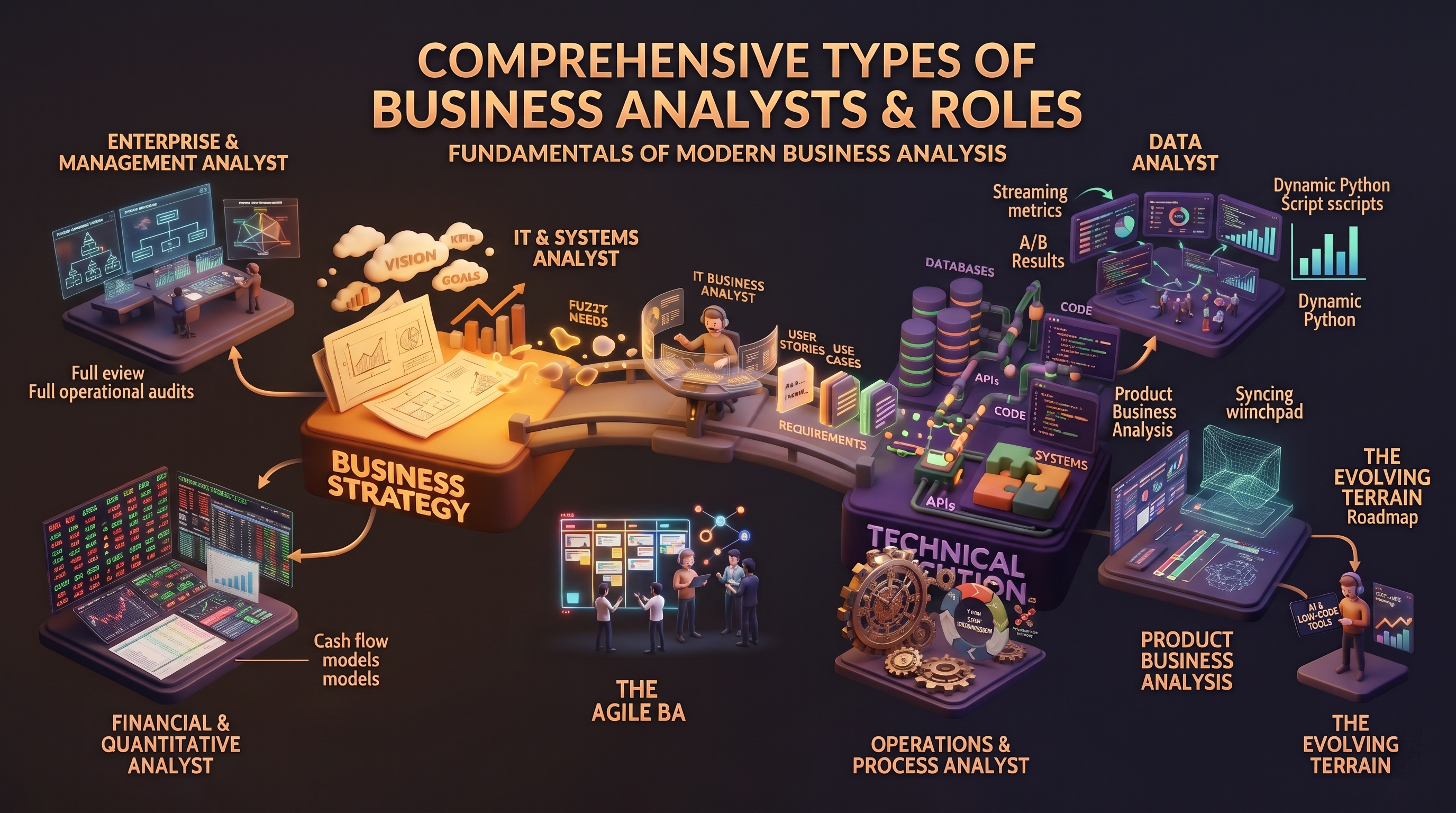
Fundamentals of Modern Business Analysis
In the last 2 decades the role of a business analyst has changed dramatically. Business analysts are not just note-takers or administrative middlemen between software developers and C-suite executives. They must now become strategic architects. Today's global marketplace is hyper-competitive and data-rich, with organisations facing constant pressure to innovate, optimise operational workflows and decode complex consumer behaviour. In this fast moving world the business analyst is the vital connective tissue that turns raw corporate vision into tangible operating reality. They are the translators who can take fuzzy business problems and turn them into sharp, actionable technical and functional requirements to make sure every dollar spent delivers tangible value.
However, the traditional monolithic definition of a “business analyst” is no longer true as enterprise ecosystems are exponentially more complex. The organisations of today range from agile software start-ups and massive supply chain networks to large multinational financial institutions and healthcare systems that operate under strict regulatory guidelines. Thus no one profession can have detailed, specialist knowledge of all aspects of operation. This need for specialisation has resulted in a diverse array of business analyst archetypes. Each type brings to the enterprise table its own world view, its own specialised methodological toolbox and its own industry nous. Career seekers should be aware of the different roles in order to be able to chalk out their career path. Individuals who want to make their career fast by means of professional education like online ba training courses require hands-on experience. The managers within an organization should be aware of the roles.
Business Analysis Core Concept
But before you explore the different types of business analysts, it’s important to define the core competencies that hold the profession together. All good business analysts, regardless of title or department, have a common professional core. The nucleus is defined by rigorous disciplines and shared goals. At its heart, business analysis is about enabling and managing change in organisations. This may be a structural change, a process optimisation, a policy development or a software implementation.
All analyst positions have one main responsibility: to elicit requirements. An analyst’s job is not to parrot what people are saying on the surface, but to talk to a variety of stakeholders, from customer service reps on the front lines to C-suite executives, to uncover their underlying needs. This requires a lot of listening, facilitation and emotional intelligence. Once the requirements are collected, analysts use rigorous analytical frameworks such as gap analysis, root cause analysis, and SWOT analysis to evaluate the current state of operations in relation to the desired strategic objectives. They translate this information into complete functional specifications, process maps, and user stories to guide the implementation teams. Business Analysts also act as a constant QA gatekeeper throughout the project life cycle to ensure the final deliverable is in line with the original business case and stakeholder expectations.
Business Analyst - IT & System
Technical Execution & Business Strategy: Closing the Gap
One of the more traditional and common specialisations in the corporate world is Information Technology (IT) or Systems Business Analyst. IT Analyst The IT analyst works in software engineering and business operations. He/ she is focused on technology solution development, design and deployment. Whether a company is developing a custom application, migrating old databases or implementing a massive enterprise resource planning platform, the IT business analyst is the master planner who ensures the technology will directly support the goals of the organization.
Daily Workflows & Responsibilities
The day-to-day of an IT business analyst is quite busy with lots of technical collaboration and documentation. They usually start by translating high level business goals into detailed functional and non-functional requirements documents. They develop complex system data flows, develop detailed use case scenarios, and define user acceptance testing criteria. In an agile development environment, IT analysts often play the role of product owners or work with product managers to write crisp user stories, groom the product backlogs and clarify technical ambiguities for software devs and quality assurance engineers. They also do a lot of system integration testing to make sure that the new software components released by the company integrate well with existing enterprise infrastructure without any security issues or performance bottlenecks.
Core Skills and Competencies
The successful IT Systems Analyst will have a good balance of technical literacy and sharp analytical skills. They should have a solid grasp on software development life cycles, database architecture, Application Programming Interfaces and cloud computing paradigms but seldom write production ready code. Must have experience with requirements management tools, enterprise modelling software and SQL for database querying. In any case, there will always arise the problem of adopting technology. It means that IT Analysts should have some skills in troubleshooting technical problems, systems thinking, and communication to fill the communication gap between non-technical business stakeholders and technical software engineers. People who want to develop such skills can do it via online business analyst classes.
Enterprise & Management Business Analyst

Transformation and Organisational Alignment
IT analysts are looking at software and systems. Management Business Analysts (usually within internal corporate strategy teams or working for top management consulting firms) tend to focus on the overall business . Their main role is to evaluate the overall performance of the organization, pinpoint structural inefficiencies and develop integrated strategies to boost profitability, market share and operational agility. They think not just about a single software tool or department workflow, but about entire business unit interactions, capital allocation across portfolios and how corporate culture impacts bottom line performance.
Principales actividades y funciones diarias
Management analysts spend a considerable amount of time doing full operational audits and financial modelling. They review the executive leadership work flow and assess the organisational structure. They compare the company’s results with aggressive industry competitors and analyse cost structures. Every day they interview department heads, synthesise reams of qualitative and quantitative data and turn it into compelling executive presentations. They identify inefficiencies and growth opportunities, develop detailed business transformation road maps, implement change management programs and establish key performance indicators to measure the success of organisational restructuring initiatives over multi-year periods.
Skills & Core Competencies
A management business analyst requires a very well rounded toolkit, with strong financial acumen, advanced data visualisation skills and elite stakeholder management skills. They need to master corporate finance and build complex discounted cash flow models, ROI projections and zero-based budgeting frameworks. We are able to use strategic frameworks such as Porter Five Forces, McKinsey Seven S and Balanced Score Cards. It is important. Above all, management analysts need to have strong executive presence and be persuasive communicators because their recommendations directly influence the major capital allocation decisions and corporate governance policies that boards of directors enact.
Business Analyst, Data

Convert Numbers to Words
In the modern digital economy, one might say that data is the new currency of business. But raw data is nothing more than noise. But before it can be turned into actionable intelligence it has to be rigorously structured, statistically analysed and put into context. This is the role of the Data Business Analyst. Data analysts bridge data science and business strategy to uncover hidden patterns, assess past performance trends, and construct predictive models that enable executives to make fact-based decisions rather than guesses.
Daily Work Flow & Main Responsibilities
The data business analyst conducts all the data cleaning, exploratory and visualization activities on a daily basis. They prepare complicated database queries for obtaining data from various sources. Data cleaning and ensuring that the data is valid is yet another function. The data analyst will conduct exploratory data analysis as well. Preparing and managing executive dashboards that help monitor operational metrics in real time is another function. For instance, whenever an organization develops a marketing campaign or modifies its pricing strategy, the data analyst will conduct A/B and multivariate tests.
Basic Skills Proficiency
A data business analyst needs good technical skills. They should know query languages like SQL, data processing and analysis libraries in Python or R, and enterprise visualisation platforms like Tableau, Power BI, or Looker. Strong background in experimental design, applied statistics, and probability theory. A good data analyst also needs to be able to tell a good story . Elite data analysts add real value by taking complex statistical concepts that could easily overwhelm non-technical stakeholders and translating them into visual narratives that are clear, compelling, actionable and drive strategic execution.
The Agile BA
Fast iteration environments for success
The tech and product companies are increasingly using agile development methodologies, which had a tremendous impact on business analysis. The traditional waterfall approach to analysis, where requirements are gathered months in advance and a fixed development process is followed, does not fit the fast moving digital markets. Introducing the Agile Business Analyst. He is a go-getter professional who thrives in fast-paced, iterative environments. In these cases, the client feedback and market situation are dynamic. So requirements are constantly changing.
Duties & Responsibilities (What a day looks like)
Agile business analysts work with product teams, software engineers and scrum masters across disciplines. “It’s a daily exercise in heavy collaboration and iterative iteration.” They participate in daily standups, sprint planning, backlog refinement meetings and retrospective reviews. Agile analysts do not produce large static specification documents. They write small, testable user stories with clear acceptance criteria. They are the voice of the customer on the development team, constantly testing assumptions with rapid prototyping, user testing and immediate integration of stakeholder feedback into the active sprint cycle.
Core Competencies & Skills
The agile business analyst will always be adaptable and resilient. The agile business analyst will always be adaptable and resilient. It is critical that the effective agile business analyst be conversant with various agile methodologies like Scrum and Kanban and have advanced knowledge of various agile project management tools like Jira and Confluence. The effective agile business analyst will be able to generate solutions and decisions even in the absence of documentation because the agile business analyst must be able to work with different stakeholders.
Financial & Quantitative Business Analyst

Risk and Complexity Management in the Financial Sector
The Financial Business Analyst is a specialist role of importance in banking, insurance, fintech and corporate finance divisions. They sit at the intersection of business operations and hard-nosed mathematical finance and are masters of the arts of budget forecasting, capital allocation efficiency, portfolio optimisation, investment appraisal and regulatory compliance modelling. Their primary role is to ensure the financial health of the business and to identify cost effective investment and cost cutting opportunities.
Main tasks and everyday working procedures
Financial business analysts are surrounded by financial statements, market research reports and ledger databases all day long. They build complex financial models to forecast quarterly earnings, evaluate capital expenditure proposals and determine the financial feasibility of proposed mergers, acquisitions or new product launches. They do a lot of variance analysis, they look at actual financial performance against budgets they thought they would have. They try to take out cost overruns and operating inefficiencies.” Financial analysts also play a vital role in regulatory compliance, making sure that corporate reporting adheres to intricate financial governance standards at both local and global levels.
Basic Skills and Capabilities
A senior financial business analyst should possess a solid grasp on corporate finance principles, accounting standards, and quantitative analysis techniques. Good spreadsheet modelling skills (including financial automation with Visual Basic for Applications or specialist financial software suites) are important. Good understanding of risk management frameworks, valuation techniques and economic indicators is important. Attention to detail and accuracy is essential. Small errors in financial modelling can lead to multi-million dollar misallocation of capital and heavy penalties from regulators.
Business Analyst - Operations & Process
Boost Performance
All business is one great web of linked-up processes. Inefficient, duplicated or operationally congested processes decrease organisational productivity, build up employee frustration and break down customer satisfaction. The Process and Operational Business Analyst is the corporate engineer who will diagnose, re-engineer, and streamline these internal processes. Operational analysts are obsessed with eliminating waste and maximising operational throughput, from optimising a manufacturing assembly line to automating customer onboarding protocols to streamlining healthcare patient intake workflows.
Basic Skills & Procedures
“Operational analysts do a lot of workflow observation and process mapping. They do time and motion studies in depth. They interview operational staff and record the existing procedures using standard notation systems. They do deep root cause analysis to find friction points, redundancies and delays against current state. They develop optimised future state processes, often leveraging automation technologies or Lean Six Sigma methodologies. Operational Analysts are responsible for the implementation of new workflows, training of all personnel and the construction of systems for ongoing evaluation to assure continued operational improvement after the redesign.
Skills & Core Competencies
The successful operational analyst will be well versed in advanced process improvement methodologies such as Lean, Six Sigma (green or black belt certification), Business Process Management, and Value Stream Mapping. Experience with process modelling tools like Visio, Lucidchart or dedicated BPM software suites. Typically, improving processes implies changing the way people work and is about the art of dealing with resistance to change in the organization. It is important to have Empathetic Communication skills. Project management skills Change management skills
Product Business Analysis
Developing Winning Solutions in the Market Place
Today, product-led companies have overlapping borders between product management and business analysis. The result is the figure of the Product Business Analyst. This role spans the life cycle of commercial products, whether a physical consumer product or a digital software application. Traditional product managers are often focused on high-level strategy, product vision and roadmap prioritisation, while product business analysts go into the weeds — conducting granular market research, creating feature specifications, performing competitive intelligence, and analysing usage to move product ideas from concept to market reality.
Daily Workflows and Primary Responsibilities
Product business analysts are obsessed with balancing customer need versus commercial viability. “They’re in market research all day, every day, looking at competitor feature sets, distilling what consumers say in support tickets and surveys, tracking product engagement metrics. They collaborate with UX/UI designers to translate user insights into wireframes and working prototypes. They develop detailed product requirement documents, product success metrics, and collaborate with marketing and sales enablement teams to ensure successful go-to-market execution of new feature launches.
Core Competencies & Skill Sets
Product analysts require an odd mix of customer empathy, commercial nous and technical literacy. They should know qualitative and quantitative user research, customer interviewing and usability testing practices. Experience with product analytics platforms, customer relationship management software, and collaborative design tools is required. Product analysts need to be able to work cross-functionally to get engineering, design, marketing, sales and executive leadership aligned to a common product vision.
“The Evolving Terrain: Cross-Disciplinary Trends and Prospects”
Looking ahead, the future of enterprise operations is one where the lines between these different categories of business analyst are beginning to blur. Modern organisations, driven by rapid advances in artificial intelligence, machine learning, robotic process automation and big data architectures, need versatile analysts who can move easily across traditional disciplinary boundaries.
In today’s world, you won’t get far in the IT business analyst profession without a good grounding in data analytics and agile methodologies. A management analyst also needs to be aware of how emerging artificial intelligence automation is impacting the strategy of traditional workforce structures. “Furthermore, the democratisation of no-code and low-code development platforms means business analysts can prototype solutions themselves and build automated workflows without having to rely solely on traditional software engineering teams, significantly increasing time to market for business initiatives.
Closing Thoughts

“Business analysis has evolved from a narrow technical support function to a broad and highly specialised field of strategic disciplines. They are the architects of corporate success. Operational analysts optimising global supply chain workflows or data analysts building predictive pricing models. Agile analysts designing software feature sets; financial analysts directing multi-million-dollar capital investments.
If you are interested in joining this field, learning about the different specializations can definitely assist in your career planning process. You can enroll in an all-round online business analyst course India to set the right foundation. Business Analysts who grow themselves technologically, methodically, and individually as per their specialization do not only become participants in the change within the business world but also the agents of change.