
Demystifying MongoDB Indexing: Compound Indexes and the ESR Rule
Last updated on Sep 23, 2026

The Concept of Flexible Schema
What makes document databases attractive is flexibility for developers. When starting out with a project, there is nothing like being able to hold polymorphic data, creating objects within arrays, and being able to change the fields of documents without the need for any formal migration. However, this apparent flexibility hides the underlying fact that scaling data means that hardware does not care how flexible the documents are. The query engine has to search for the data on disk, bring it into the memory, perform checks on it, sort it, and return it.
In the absence of proper indexing the entire process collapses into a scan of the entire collection in a non-indexed fashion. Each of the documents is fetched from the disk into the cache, de-serialized, and inspected in order. Initially, when dealing with a small-scale project, there are no significant differences between a collection scan and an index-based search. However, once the number of documents increases to millions, a collection scan turns from the minor inconvenience into the bottleneck of operation, causing spikes of CPU saturation, issues with disk I/O and high memory thrashing.
Indexes allow for proper structuring without sacrificing adaptability. Essentially, a MongoDB index is a specific kind of data structure that relies on the B-tree data structure as part of the WiredTiger storage engine to store part of the data contained in the collection in an ordered manner. Although the operations carried out by indexing are simple, clustering and working with query plans in production requires management experience. Those developers who are interested in learning about clustering systems can complete hands-on labs, while future operational specialists can take a mongodb dba online training.
The problem comes when the queries become more complicated than simple look-ups based on one field. The majority of work done in production involves filtering out several status flags, sorting the output chronologically, taking slices of the date, and making pagination. The indexes based on one field are going to be of little use for multidimensional queries. To ensure stability and good performance of an application, it is necessary to get familiar with and understand the idea of compound indexes along with the principles guiding them: Equality and Sort and Range principle, index prefix mechanics, the principles of covered queries, and in-memory sorting.
The Structure of the Index Tree
In order to understand how index sequence affects efficiency, we need to see how data is organized at the storage layer.
Imagine having an index made up of three separate columns. But this is not three separate lists in the database engine; it is a single B-tree structured hierarchy. Data can thus be sorted according to the absolute values of the first column. Data entries that have the same first column value will then go through sorting based on the second column. Finally, the third column sorting comes into play for the records having the same first and second column values.

That is why local sorting based on the second column will never lead to any global sorting. Records based on the third column will go through the same sort of local sorting process.
Upon receiving search requests, the application will go through the B-tree searching for the third field value by following the path from the beginning to the end of the B-tree and eliminating the unnecessary branches.
When a user types a request that matches exactly on the first column of the index, the algorithm moves directly to the place where the pertinent data starts and reads until it reaches the last record in that series. If the request also specifies an exact match for the second column of the index, the algorithm continues down the very column in the same manner.
When a request does not specify any matching in the first column of the index, the whole index is no longer valid for the search. Since the second and third columns have no ordered structure outside of the primary keys, the system does not work through the index. It would have to conduct a search of all existing indexes without any structure in hand. The mentioned approach leads to the conclusion that only the indexes which start from the first record mentioned in their definition can be used for a query.
In addition, just reading an index is not enough to finish the task. If an index does not include every field mentioned in the query, the only thing the user will get from scanning the index is a list of record identifiers. After that, the storage system must go through a fetch process where it looks up the documents associated with those identifiers from the disk or memory. If the index run returns five records using thousands of records, then a lot of work needs to be done because the fetch operations performed were unnecessary. The key goal of compound indexes is to reduce both the number of keys and the number of document records required to produce the output.
The Architecture of ESR: Equality, Sort, and Range
The term ESR that stands for equality, sort, and range is the cornerstone of high-performance compound indexes in the MongoDB database system. This factor reveals the necessary order of fields that is helpful for the efficient functioning of queries that require equality filters, ordering solutions, and range limits.
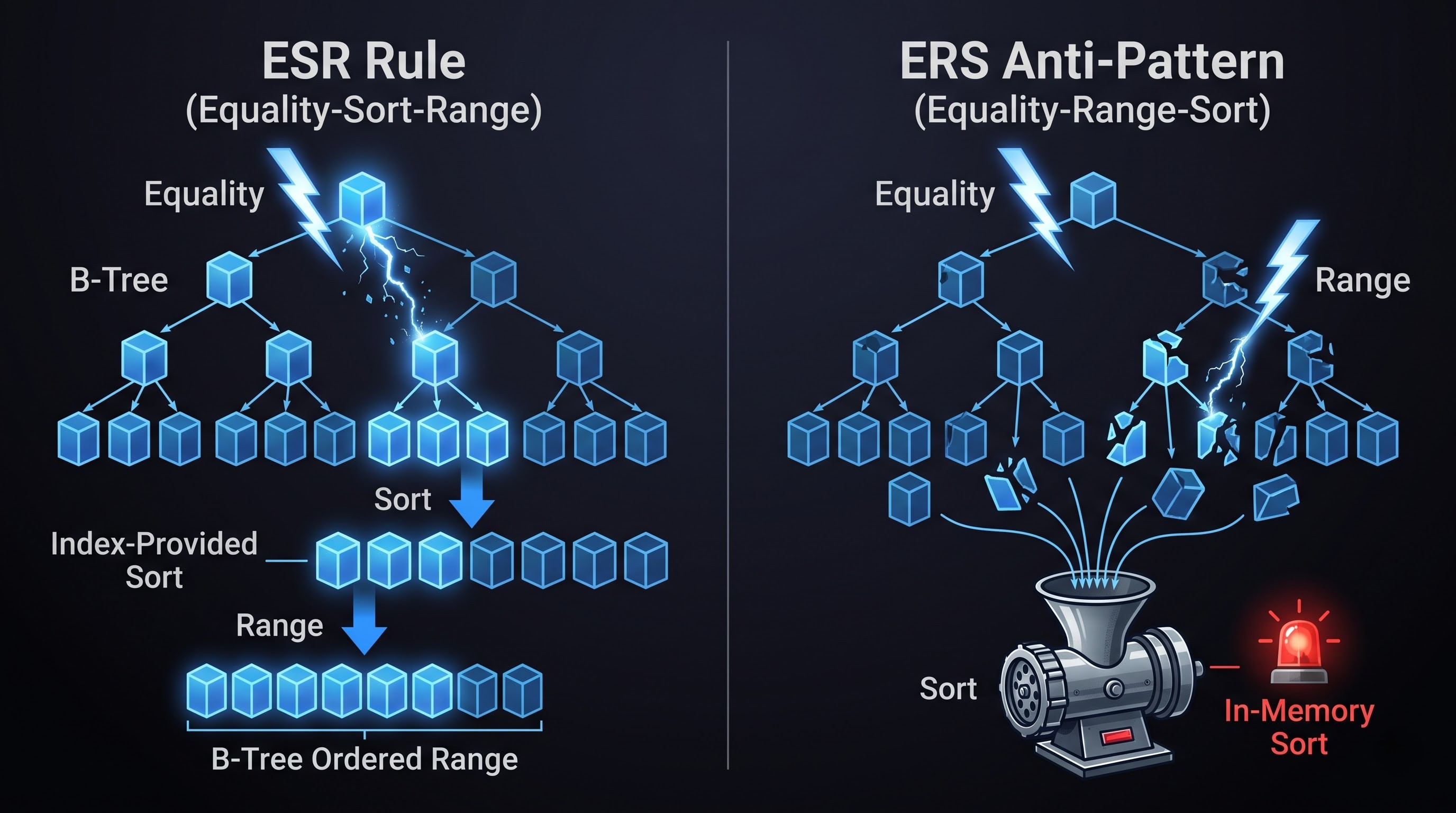
According to the regulations, when making a compound index for a complicated query, the index keys must be arranged in this order:
1. The fields involved in equal comparison should come first.
2. The fields that need to be sorted will go right after the equal ones.
3. The fields filtered with the help of ranges or inequalities will be the last in line.
Although this order is commonly known as a general principle, it is based on an understanding of the working of B-trees. If this order is disrespected, the query engine will have to choose between either scanning unnecessary index records or allocating memory for real-time sorting of the results.
What is the equality component? It is used to refer to the fields checked against the explicit values. For example, it might be tenant IDs, status of users, categories, and so on.
When equality values are present in the beginning section of the index, it allows the query engine to disregard the majority of the index tree. For instance, if a collection comprises tens of millions of records across five hundred enterprise tenants, it would be easier to skip through ninety-nine percent of the tree by putting the tenant id in the first position of the index.
By putting equality values at the beginning of the index, there would be a compact and contiguous block of index entries containing records that meet this requirement. In this case, all remaining processes like ordering, range processing, projections could take place inside the proper bounded area of the index without any external disturbances.
If equality values exist in a certain query, then the order of these values in the equality section of the index does not usually matter as all equality values are fixed constants during execution.
Sort: Using the Pre-Established Order
The second stage of the ESR framework involves sorting fields. After the engine has reduced the index area to a single integrated sub-tree using the primary equalization points, it is time for the engine to perform the requested order.
Since a B-tree is “naturally” ordered, the index will automatically have values in a predefined arrangement. When sorting values are used after the equalization values, the items collected within the range of the equalization values are organized correctly as necessary.
Thus, there is no need for the query engine to develop the order. The operations can read data from the leaves and send the retrieved values to the requester directly. The process is known as the index-provided sort and it leads to the elimination of unnecessary processing time and memory usage.
The mechanical continuity collapses when the sort field is separated by range conditions from the equality fields. The engine realizes that it has a non-ordered set of entries in range and loses its ability to perform sequential scans. Therefore, it needs to send the data to the sorting buffer in memory and subsequently offer the first document.
Range: Sweeping the Remainder
The last element of the ESR series indicates the presence of range operators in the form of greater than/less than operators or inequalities.
Range conditions enlarge the scope of the query. When used in contrast to equality conditions, which find one single and precise route in the tree, range conditions call the engine for scanning a larger range of leaf nodes.
Since range scans cover many values, fields succeeding the range condition in the index become unordered.
For example, let's take an index that is sorted first by creation timestamp and then account status. If a range scan is performed on the timestamp, it can cover a range of time from days to even months. During that particular time frame, the account status could be changing from active to suspended to pending in mere milliseconds. This means that the arrangement of the account status transcends everyone's expectations because it is limited by the time range of the timestamp.
Thus, it is advisable for all the range fields to be located at the end of the compound index. When placed last, the range fields allow for the equality fields to limit the search space before the sorting of temporally based fields is done through the actual index. Hence, it becomes easy for the system to implement the range scan.
Understanding collision: Sort vs. Range
It is in the relationship between the Sort and Range components that the most indexing systems fail. When a query requires a range filter and a specific sort order for two different fields, programmers have to face a limitation of standard B-tree indexes: the index can do one or the other in general but rarely both at the same time if the fields are different.
Let us consider a real example involving financial operations: we need to query an audit log for a specific user ID, put in a filter for transactions worth over one thousand dollars, sum up the transactions by date in descending order.
In this case, user ID is an equality filter, transaction value is a range filter, and date of transaction is the sorting field.
If we follow the strict ESR approach, the index will be constructed with the user ID as the first element, date of transaction as the second and value of the transaction as the third element.
Let us see how our database executes a query using this ESR formation:
The engine retrieves the user ID then navigates to the appropriate user’s section within the B tree. Next, it examines the index's second field, that of transaction date. As the order in the query is specified to be descending in date, the engine begins at the last entry in the user’s section and processes backward throughout the leaves.
During its traversal, it reviews the third index field: transaction amount. If the transaction amount exceeds $1000, the document pointer is forwarded. If the transaction amount is $1000 or lower, the index entry is discarded, and the engine proceeds to the next following entry in time order.
Since the stream is already in reverse time order, it is sent directly to the client. In case the query has a limit of twenty rows, the engine stops as soon as it finds 20 valid entries irrespective of whether it checked fifty index keys.
Let’s now look at the sequence where the range condition is before the sort field which follows the order of equality (E), range (R) and sorting (S) i.e. ERS sequence. In this instance, the user Id comes first, subsequent to this is the transaction amount and lastly the transaction date.
When tracing the execution following the ERS approach, the following can be observed:
The engine pinpoints the user ID block in the tree.
It then analyzes the transaction amount, reaches the threshold and scans through all those amounts that are greater than a thousand dollars thus accessing only the relevant records. It is definite and guaranteed that every index that is accessed meets the amount requirement.
On the other hand, the various acceptable amounts are distributed over different transaction dates and therefore there is no chronological order for them. Hence it is impossible for the engine to figure out the order of occurrence of transactions without accessing all the relevant records.
Which one is superior? It depends on the context of the operation, distribution of data, and pagination approaches.
The design of the ESR places emphasis on streaming, utilization of minimum memory, and predictable pagination. It permits the database to suspend its operation as soon as the limit clause has been reached; hence, it's the better type for applications requiring interaction at a high rate.
The design of ERS aims at achieving index scan selectivity. In case the range condition is narrow (for instance, just two records from a total amount of a million match), the ERS pattern will read a relatively small number of keys, with very little processing required for sorting those two records. The only disadvantage of the ERS design occurs in case the range condition is broad since it would raise serious memory utilization issues for the database engine as it will be triggered to read millions of keys into memory.
Therefore, it is obvious that for the great multitude of application patterns, the ESR approach is the more reliable and scalable one.
The Mechanics and Expenses of In-Memory Sorting
In situations where an index cannot create the order needed for a query, it is necessary for the database to perform an in-memory sort. By understanding how this works from the inside out, it becomes easy to see why this operation presents one of the biggest risks in MongoDB applications.

A query that requires an index sort cannot return results in a streaming manner. Therefore, when an application issues a request for ordered documents, the query engine cannot begin sending results until it has processed all the matching documents. Therefore, if a query matches fifty thousand documents, the database must scan fifty thousand references, collect the necessary document attributes, load them into a separate memory space, and run a sorting algorithm. Most often it will be either a version of quicksort or some kind of heap sort based on insertion for creating the order of results.
This procedure requires three crucial operational risks:
Latency Spikes and Pipeline Stalls
In-memory sorting is responsible for pipeline stalls. The storage engine takes time to sort the records which blocks the downstream operations and clients awaiting. Rather than receiving the first results in milliseconds, now the whole sorting should be completed which may take several hundreds of milliseconds or even seconds. As a result, user interfaces become slow and connection pools at application servers get congested.
Working Set Eviction and Memory Churn
Wired Tiger uses a shared cache for storing index pages and document data frequently used. In case of queries leading to large in-memory sorts, the engine assigns dedicated RAM for intermediate records outside the read path.
If numerous clients’ requests trigger simultaneous in-memory sorts, the sudden requirement for dynamic memory creates additional load on the operating system. To cope with the increased demand, the operating system may raise clean pages from memory to disk thus having a robust negative effect on subsequent read operations as instead of requesting memory reading will go to physical storage thus increasing latencies in clusters way beyond the query.
Severe Execution Failures
MongoDB utilizes a threshold for the avoidance of excessive memory consumption due to bad queries that are not indexed. If the amount of RAM utilized for sorting in memory reaches one hundred megabytes and no temporary files have been written, the system immediately aborts the query.
While it is true that certain flags can allow the use of the disk for temporary storage of queries, relying exclusively on disk sorts is an unwelcome and dangerous practice. Because writing an intermediate sort run to disk incurs intensive input/output work, it can result in query processing times extending in a geometrical way.
Attempting to solve the problem of memory limitation by allowing disk spills is akin to treating a symptom, not a disease. The core issue remains the fact that the query is not indexed appropriately to take advantage of the B-tree ordering principles.
For database reliability engineers, it is essential to develop skills such as identifying performance bottlenecks, analyzing execution statistics, and fixing high-concurrency memory leaks. Those involved in these aspects of the job are able to enhance their skillset significantly through taking mongodb dba course. Such comprehensive programs incorporate the knowledge of application-level querying and WiredTiger engine administration, which will include replication, scaling cluster, and complex indexing among others.
Mastering Enterprise MongoDB Administration
Hands-on experience with troubleshooting is essential for diagnosing issues with indexes, preventing memory overflows, and ensuring sharding for production purposes. If you are preparing for operations or cloud administrative jobs, check out OnlineITGuru’s interactive online MongoDB courses and extensive mongodb online classes to acquire skills required for practical database administration with the help of instructors.
Recognition of Mechanical Sympathy
Present-day software architecture is increasingly urging creators to consider databases to be abstract utility services, presuming that the utilized clusters and the scalable hardware will cover the lack of efficiency. Nevertheless, the efficiency of a database is determined by unchangeable rules of physics and mathematics: the B-tree structure, the performance of data storage, the cache memory limit, and sorting algorithms.
To put it another way, the process of engineering must become a successful operation that guarantees the functioning of databases under difficult conditions. The use of the latest highly developed distributed databases combined with the basic principles of indexing holds the key to great success.
As the performance of databases depends on various complex design patterns like ESR and choosing prefixes, learning NoSQL architecture is not about learning alone without guided help. If you want to learn systematically, choose to mongodb learn online with the help of online platforms such as OnlineITGuru.