
Enterprise Data Governance and Quality Engineering Using Ab Initio EME
Last updated on Sep 19, 2026
Organizations now have to deal with an enormous number of data that comes from hybrid multi-cloud systems, existing mainframes, data warehouses, and streaming services. In this complex situation, performance in processing data cannot achieve its objectives. Companies should be confident that their data is safe and sound, meets the requirements, and stays compliant in all stages of data processing. Data quality and data governance should no longer be the elements of an audit at the end of the year, they should become active components of the process.
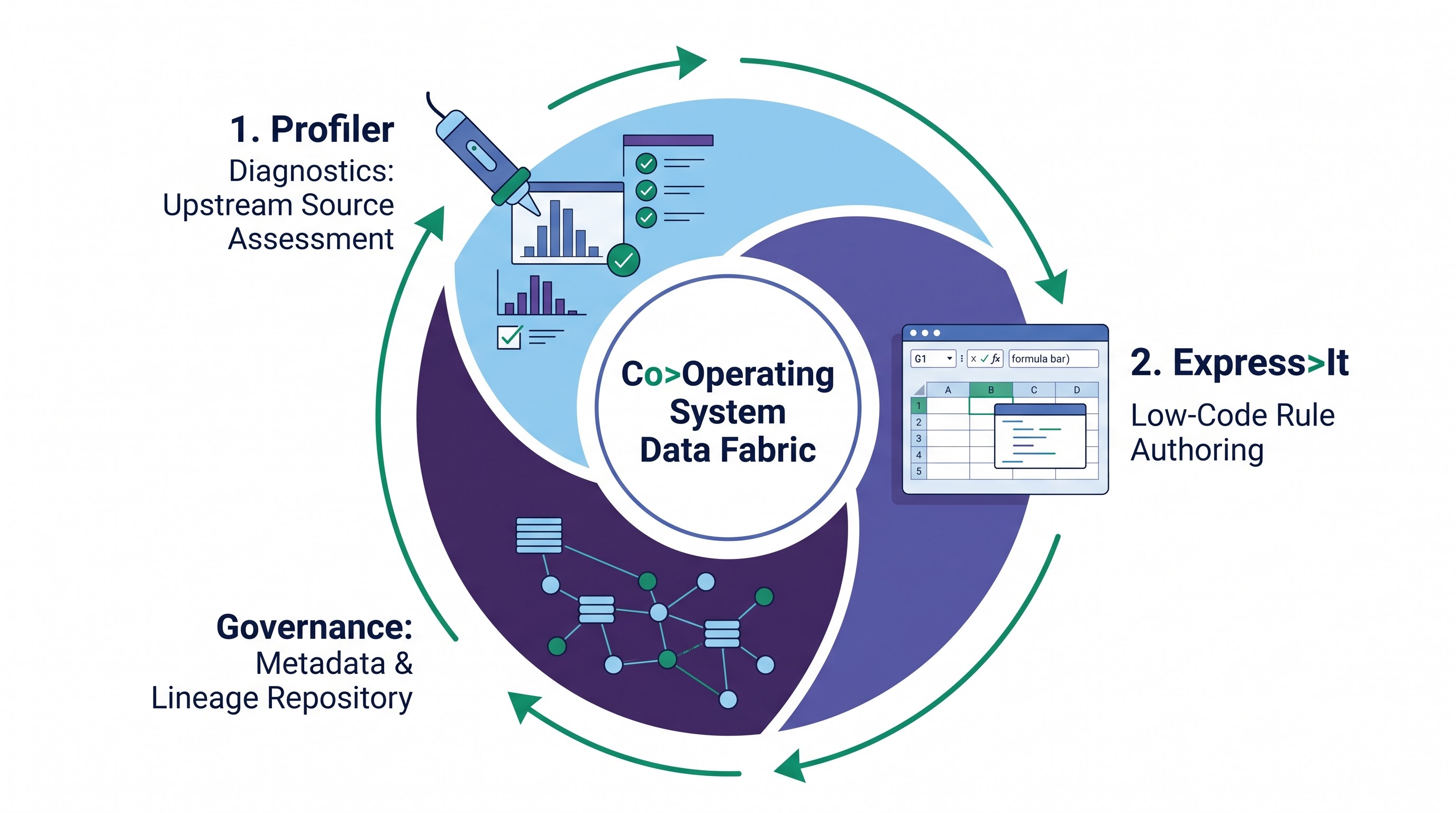
In this framework, Ab Initio creates a unified, large-scale data system that connects technical computing capability with business management. Rather than just having a series of separate specialty products, Ab Initio integrates quality evaluation, business-rule control, and end-to-end data genealogy into one comprehensive system. This system is based on three key technologies: the Ab Initio Profiler, which checks the structural and semantic health of source data; Express>It, which makes it easy for non-technical users to define rules and set up configurations; and the Enterprise Meta>Environment (EME), which provides overall data management.
Through these technologies, the gap between technical teams and corporate data managers is closed, thus creating a constant process of information acquisition, policies setting, automatic checks, and influence evaluation.
The Strategic Triad of Data Governance
Frameworks for data governance fail primarily because of the gap between those who know how data is important for the business and those who create ways of moving it. The role of the business analyst or the risk officer, or compliance executive has always been documenting definitions of data in isolated spreadsheets and separate documentation platforms. Following this, they send lists of their requirements to data engineers. These data engineers translate this data into relevant coding actions, libraries of scripts, and pipelines.
This misconnection creates certain systemic failure points:
The first point is that the semantic meaning of the information is lost. For example, when a financial analyst says that an actual account balance has to follow certain cross-currency validation, a developer may take null and date differently. As a result, the logical structure that is being utilized can differ greatly from the business request.
Next, validation cycles continue to be passive and reactionary. Whenever faulty data shows up downstream in important business intelligence reports or regulatory submissions, fixing it takes time—often days of forensic work to track down the problem. The technical teams must work backward to go through complicated ETL scripts, figure out what transformations have not been recorded, and try to see where the corruption happened.
Moreover, the change management brings in additional risks. Even a simple change, for instance, the update of the data type of a transactional system upstream, addition/expansion of values to an enumeration field, or renaming some identifier may go unnoticed by engineering leads who have extremely little insight into how many applications, reporting formats, or machine learning models downstream rely on this attribute.
Ab Initio solves the aforementioned systemic failures through the closed-loop triad.
The Profiler functions as the analytical base. It reviews the raw physical datasets present across vast quantities of information, indicating the factual condition and variability in addition to its distribution and anomalies before beginning to make any assumptions in the data.
Its role is analogous to that of the configuration and management level. It consists of an intuitive interface that resembles a spreadsheet and is available online. Thus, the professionals in charge of meeting the clients’ requirements and overseeing that the quality of data meets the standards can build and implement sophisticated rules at any level without the necessity of programming.
The Enterprise Meta Environment (EME) represents the systemic nervous system. It collects and combines all the versions of the technical metadata and business vocabulary.
The triad is able to conduct the governance policies and lineage tracking instantaneously since it functions on a level higher than the very effective Ab Initio Co Operating System.
Professional hands-on experience with this holistic approach can be acquired by taking ab initio training from OnlineITGuru.
Thorough Architectural Diagnostics: The Ab Initio Profiler
Good governance cannot be based on general theoretical assumptions. It has to be based on practical situations. Upstream source documentation often does not match actual transactional records. Old systems have undocumented fields, old default dates, whitespace padding, hidden character encodings, and referential orphans.
The Ab Initio Profiler acts as a full-scale diagnostic tool to investigate, inspect, and describe massive datasets across different environments, being operated through flat files, several file systems, cloud data storage systems, or corporate relational databases.
Basic Metrics and Detailed Semantic Profiling
Unlike simple profiling applications that only figure out record numbers, min/max figures, and the number of nulls, the Ab Initio Profiler performs complex methods of statistical and semantic analysis for each column of the data and numerous interconnected entities.
At the level of a data field, Profiler performs three main metrics:
Nullability methods and occurrences of blank strings
Distributions of the length of fields and where certain data fits—strictly uniform or unexpectedly varied
Statistical dispersion, covering the parameters of the quartile, values of the standard deviation, variance, mode, and value convergences
Pattern analysis of characters that allows mapping of input data to its image to find formatting variants, for example, the phones where various characters including hyphens, spaces, and country codes are used
In addition to simple metrics, the Profiler helps to identify complex types of business information and classifies it according to well-defined domains.
Analysis of Relationships Across Different Tables and Datasets
Problems in data hardly occur in complete isolation. Major issues in processing sometimes arise due to inconsistencies in relationships between competing data sources. The Profiler has some advanced features of discovering relationships.
Detection of primary keys and composite keys: It assesses several different variables and their combinations and determines whether they can be relied upon for the purposes of primary keys. Thus, the system reveals redundant variables instantly.
Verification of foreign key and referential integrity: It checks each pair of data containers for inclusion dependency. It verifies whether foreign keys represent primary entities properly. It also identifies orphaned data entries.
Functional dependencies detection: The system checks the relationships between attributes within data entries. This signifies whether the value contained in one field determines the value of another.
High-Performance Parallel Execution
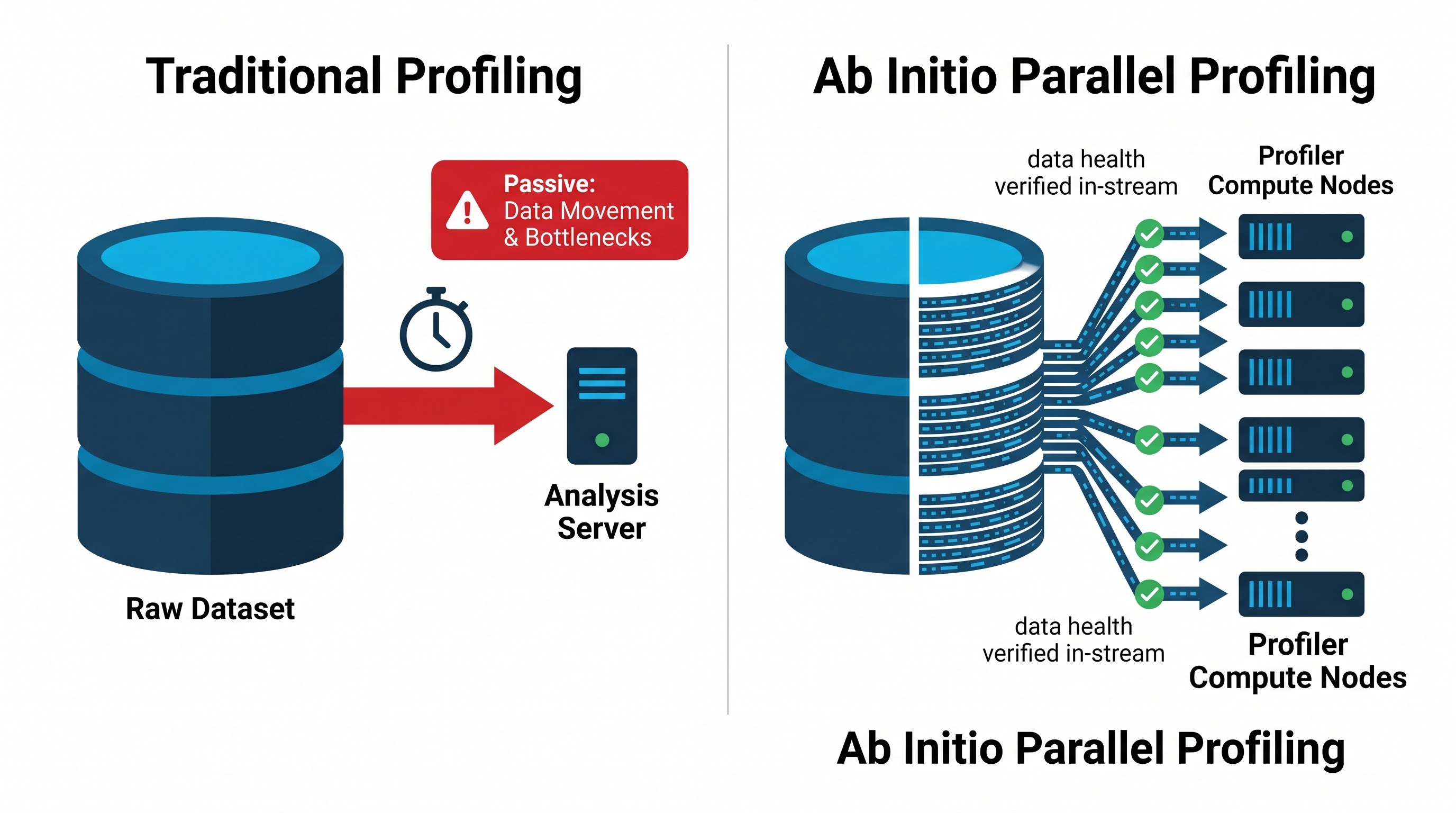
Profiling datasets with millions or even billions of records in an enterprise context may lead to operational bottlenecks. Traditional profiling tools require moving data to a third-party analysis server, costing more bandwidth and memory.
The Ab Initio Profiler uses built-in data parallelism of the Co>Operating System. Data gets divided into several parts for parallel processing using multi-core processors, distributed storage nodes, or cloud resources. This allows the profiling engine to perform in-depth analysis of distinct cardinalities, distribute histograms, and determine data connection in parallel mode. As a result, advanced architecture of Ab Initio makes it possible to run automatic profiling jobs systematically as parts of regular batch procedures and make data profiling regular operational monitoring activity instead of rare project initialization tasks.
Democratization of Governance: Ab Initio Express>It

While technical profiling specifies the content of data, corporate policy describes the needed data content. The definition and enforcement of rules of governance requires the participation of experts in the area of the subject matter, such as risk and fraud analysts, auditors and owners of products.
Previously, professionals who were not technically oriented could not directly set rules for the production data pipelines. All the requirements they had to present were communicated via external specifications and developers had to write difficult transformations. However, Ab Initio Express>It allows avoiding these constraints.
The Express>It Architecture and Paradigm
Express>It is a web-based application that is targeted for businesses and enables non-technical users to create, test, and execute rules for improving data quality and complex transformation processes. It helps businesses effectively communicate their needs for technical functionality through the use of a very simple interface.
Express>It does not require the users to have any knowledge of parameters that apply at runtime, connections among components, and scripting language but it simplifies this complexity by means of dynamic, Excel-like rule sheets, templates, and business forms.
This simple interface is based on the metaprogramming framework of Ab Initio. When any of the business users creates a decision-making matrix or prepares a validation rule in Express>It, the application will not generate a simple configuration file but it generates a transformed logic that is ready to be executed.
Navigating through these metaprogramming features powered by metadata is one of the core topics covered in an ab initio course offered by OnlineITGuru.
Rule Authoring Tools
Express>It guides requiring the setup of logical operations via easily-used methods:
Validation and Cleansing Rules: It is possible to devise thresholds, permissible values and patterns as well as specify constraints here. For example, a user can enter a rule saying that if the loan status is approved, the timestamp of the loan approval must be later than the application date, and credit score must exceed specified values.
Decision Tables: As for composing quite complex logical operations, it is done by means of simple grid tables: the previous conditions will be specified in rows where the needed information and results are provided in the columns. This table represents how risk managers and compliance officers view the processes.
Mapping and Transformation Rules: It means the user may either provide some mapping attributes in rote and fix how categorical codes correspond with main ones or synchronize dates and global time principles.
Interactive Simulation and Sandbox Validation
One of the serious risks involved with allowing non-technical users to create rules is the risk of unintended effects. A rule defined too restrictively can cause valid data to be rejected, while a rule defined too loosely can let fraudulent records through.
To address this risk, the solution uses interactive simulation features embedded in the authoring environment. Data stewards can use sample sets of real production data to test the new rules in the sandbox environment and to evaluate the results.
The interface gives instant visual feedback on how many records went through and how many did not, what exact conditions triggered the failures, and how the derived values were calculated. If the data steward spots an anomaly, they can change the parameters of the rule and re-run the simulation within seconds.
Management of Automated Production and Distribution
After carefully being practiced and verified, the process of governance of the rules begins. The platform has its own structured method of obtaining confirmations.
The following rules apply:
It must be affirmed by professionals in several areas such as compliance and IT governance before being put into practice.
The confirmed rules are transferred automatically to the database of the enterprise where all the changes made in them are recorded.
In case the business policy changes, the technical infrastructure will work according to the new principles without changes made by engineers.
Putting Quality into Practice: The Closed-Loop Feedback Architecture
In enterprise data quality management, the mere detection of errors is insufficient; there needs to be an active approach that ensures exception handling, accountability, and continuous feedback into governance systems.
The coupling of the Profiler, Express>It, and the Ab Initio runtime leads to a closed-loop architecture for quality.
Exception Handling and Data Routing
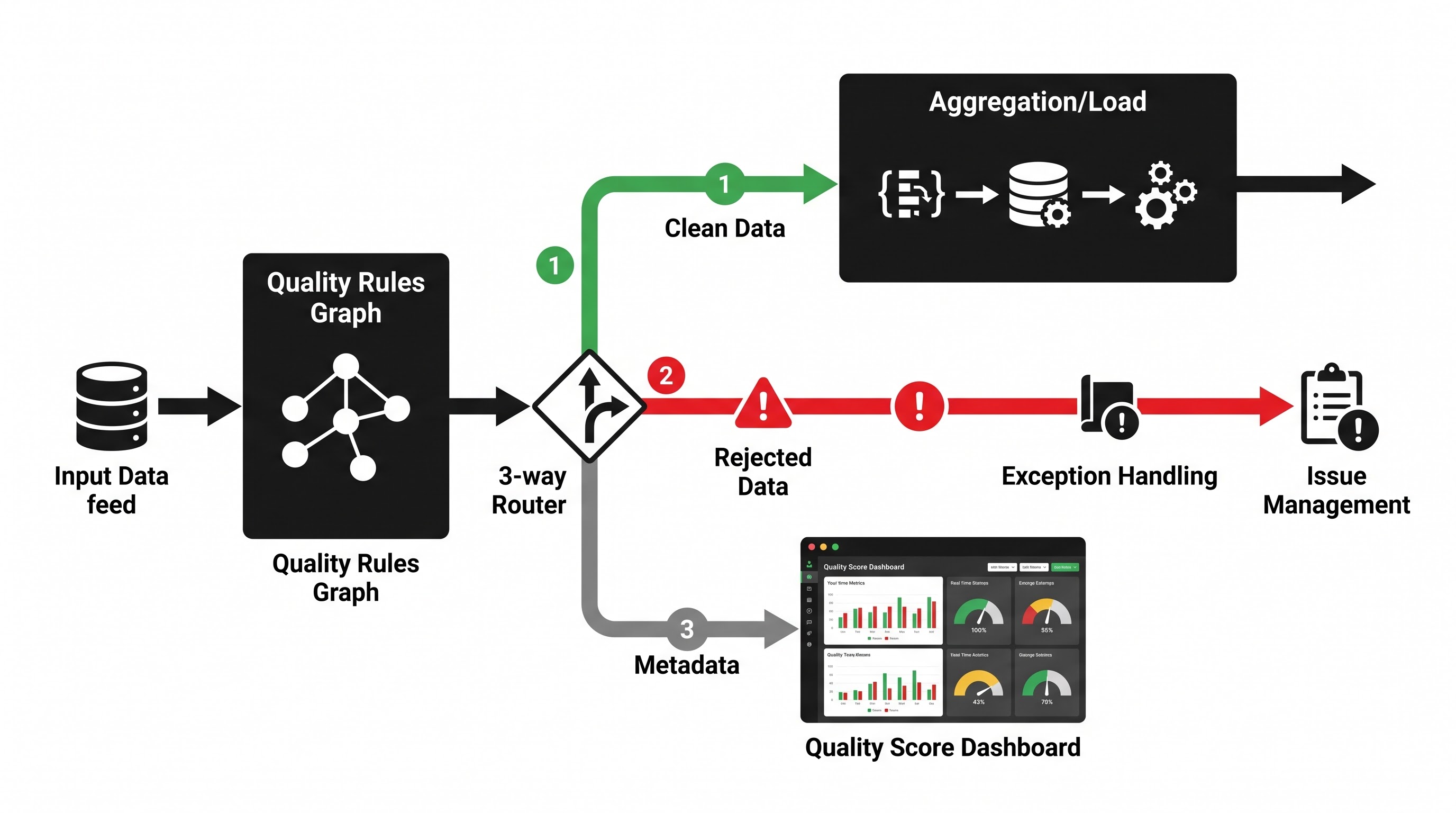
In the case of high-speed Ab Initio graphs, the system takes the input feeds and processes them using the business rules established by Express>It. This process is done via an exceptional multi-stream routing of data quality controls:
Clean Data Streams: Data sets that pass all quality tests progress smoothly from the transformation, aggregation to finally the loading phase without any delay.
Rejected and Error Data Streams: Data sets that do not pass the validation process are channeled into exception handling data streams thus maintaining continuity within the main data stream.
Metadata Logging Data Streams: Information about the point of failure, the rule number that failed, the error severity level, and the data set itself is dynamically collected.
Automated Process of Managing and Resolving Issues
In many existing data warehouse systems, one of the issues that have continued to be a problem is that of rejected records stored in drop directories that are left unmonitored. Ab Initio resolves this issue by automatically linking exception streams to issue management systems.
Records that fail in validation can be sorted by their error signature. For instance, when a partner bank uploads hundreds of records with an unrecognized regional currency code, they will be grouped as one business issue as opposed to thousands of individual error messages.
The events are automatically sent to the designated data stewards or source providers according to the records of metadata ownership kept in the repository. The steward would examine the issue via an administrative console and find out if the error is due to source corruption or an obsolete business rule and implement any corrections or modifications of the rule via Express>It.
Continuous Quality Scoring and Operational Dashboards
As pipelines process, quality scores continue to flow into central repositories. They consist of completeness scores, conformity scores, validity scores, and error trends.
Executives, data governance boards, and operation managers can see the quality scores in real-time dashboards. Instead of asking themselves how good the enterprise data warehouse is, the organization now has quantitative proof that data is in good condition all the time in accordance with Service Level Agreements.
Metadata Foundation and Data Lineage: The Enterprise Meta>Environment (EME)
For absolute trust in enterprise information, enterprises need to be able to answer some essential questions right away: From where did this metric come from? Which systems, databases, and transformations has it gone through? What was used for its calculation? What reports, financial statements, or customer interfaces will be affected by a change in the source attribute?
Such questions in today’s complex enterprises can only be answered via good metadata management. In the Ab Initio architecture, it is done by the Enterprise Meta>Environment (EME), which is a repository and governance environment designed explicitly for capturing and visualizing all aspects of metadata across the whole enterprise.
Enterprise Metadata Dimensions
The Enterprise Meta>Environment is not just a collection of documents describing metadata; it is a knowledge graph where three main classes of metadata are ingested and unified:
Technical metadata: This consists of the concrete manifestation of the technical estate. Examples include database schemas, tables, flat-file record structures, DML constructs, network pathways, storage configuration, scripting construct definitions, and executable graph configuration.
Business Metadata: This consists of the semantic interpretation and governance policy of the organization. Business metadata consists of the corporate business glossary, conceptual data model, regulatory taxonomy definitions, data domain classification, data ownership definitions, and data retention policy.
Operational and Execution Metadata: This consists of the historical record of process executions. Examples include start time of execution, execution duration, number of records processed, system resources consumed, number of errors, data quality score of records processed, and status of job execution.
The strength of the EME is that it enables the synthesis of semantic relationships among the three metadata layers. The business user queries for a regulatory term and is able to determine exactly which physical database columns correspond to that regulatory term in thirty different global systems, what the data quality score of those columns are, and what applications process those columns.
Multi-Level Data Lineage Architecture
The lineage generation capability of the EME supports multi-level visibility for different enterprise constituencies.
Business Lineage
The business users, enterprise risk managers, and auditors need conceptual knowledge about the flow of data without getting entangled in the technicalities. The EME generates easy-to-understand business lineage diagrams that capture the movement of information at an organizational, business domain level, and high-level business application and master data level.
Stewards can see how the customer data collected via mobile banking portals gets transferred into operational ledger domains, settled using the settlement services, and finally loaded into the core executive reporting dashboard. The business lineage captures the data quality of the health directly on top of these flows, showing whether the data flowing through a particular business boundary meets the corporate quality standards.
Lineage at Technical and Field Levels
Whereas a summary will serve a high-level audit, data engineers, developers, and system architects need absolute precision. In case a deviation occurs in a downstream financial statement, technical teams need to be sure of what mathematical operations, conditional joins, lookups and reformatting were done to that specific data element.
The EME is capable of generating an end-to-end technical lineage down to the field and sub-field level through parsing the execution graph, DML constructs, transformation packages and relational query.
In case an attribute in a target table is the result of concatenation of three source fields and lookup of currency exchange and an account status flag, then the EME's field-level lineage will provide all the logical steps involved in the process. The technical team can then click on any node on the path of lineage to view the transformation logic in production.
Forward Impact and Backward Root-Cause Analysis
The bidirectional graph model available in the EME provides two critical operational governance functionalities:
Backward Lineage (Root-Cause Analysis): Beginning with the wrong figure found on a dashboard or within an operational data store, the engineer can trace the lineage backward. The EME helps trace back to all systems, staging files, and transformation processes, locating where the value has been changed because of some incorrect data or logic. This functionality saves a lot of time during the diagnosis of operational issues from several days to minutes.
Forward Lineage (Impact Analysis): Before changing the column of the database, shutting down a legacy server, or changing the common business rule definition, technical architects can perform forward impact analysis. The EME provides the comprehensive list of all dependent graphs, plans, reporting models, APIs, and downstream flat files that would be impacted by the change.
End-to-End Lineage Through Heterogeneous Ecosystems
Data environments in today’s enterprises are hardly ever homogeneous. Even though Ab Initio tends to be at the core of critical data processing operations, data flows out from third-party databases, cloud warehouses, distributed processing frameworks, commercial ETL pipelines, and specialized reporting systems.
The EME has been built with such a heterogeneous ecosystem in mind. It features powerful metadata bridges and scanners able to collect metadata from external databases, mainframes, legacy COBOL copybooks, third-party BI solutions, cloud analytics systems, and code written in external programming languages.
All this metadata collected by the EME gets assembled into a semantic graph providing the end-to-end lineage that goes all the way from the first transaction entered into a mainframe system, through various intermediate message queues, to Ab Initio parallel transformation graphs, and further on to cloud analytical lakes ending in business intelligence visualizations.
Since the process of end-to-end lineage configuration on diverse systems requires intricate repository management and scanner configuration, going through the comprehensive ab initio course content on OnlineITGuru provides a complete understanding of all the EME concepts in industrial training programs.
With increased enterprise needs for governed and audited pipelines in finance, healthcare, and multi-cloud spaces, the need for expertise in Profiler diagnostics, Express>It, and EME lineage is becoming crucial for data engineers. Taking up full-fledged ab initio online training at OnlineITGuru will help engineers design these complete data governance architectures.