
Enterprise .NET Full-Stack & Microservices Engineering Curriculum
Last updated on Jul 22, 2026
Enterprise .NET Full-Stack & Microservices Engineering Curriculum
Modern technology requires developers to be experts at the seamless integration of dependable backend systems, user-friendly front-end applications, and reliable cloud-based architectures. One of the most robust and highest-performing tech stacks available in the modern .NET environment includes .NET 8, .NET 9, C# 12/13, ASP.NET Core, Entity Framework Core, and Azure.
This course aims to be a rigorous course that takes the learner from the fundamentals of object oriented programming through the design of industrial strength cloud based microservices architectures using continuous integration and delivery pipelines. This OnlineITGuru asp net core training online provides the shortest route to mastering the industry.
Educational Core Principles
Production-First Philosophy: This course is not about making "toy apps". Logging, error handling, security, and performance monitoring are built into every lesson.
Clean Architecture & DDD: Learn how to design the architecture of your application to properly separate domain logic from infrastructure and UI logic.
Asynchronous & Concurrent Programming: Write scalable programs using non-blocking and asynchronous primitives throughout all tiers of development.
Cloud & Containers: Design systems for containers with Docker, Kubernetes, and Microsoft Azure.
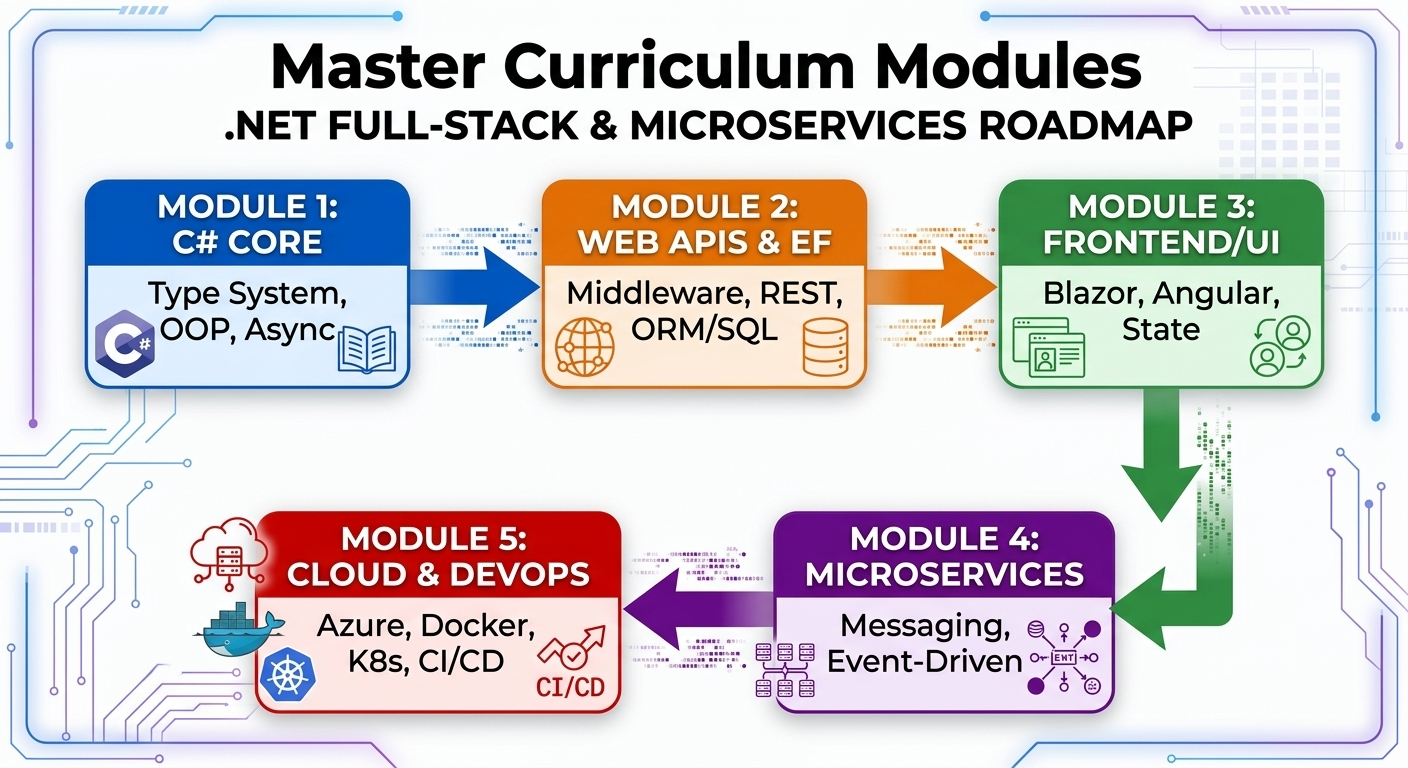
Module 1: C# & Modern .NET Runtime
Modern C# Fundamentals & Language Constructs
Value Types VS. Reference Types: Memory allocation techniques, Stack VS. Heap allocation, stack frame execution, and boxing/ unboxing performance cost.
Modern Language Constructs: Main constructors, records (positional records, immutable, non-destructive mutation through with), init-only properties, switch expressions, collection initializers, and file-scope namespaces.
Memory Management & Nullability: Comprehensive exploration of Nullable Reference Types (NRT), null suppression safely, System.Memory<T>, Span<T>, and zero-memory allocation slice.
Object-Oriented Programming & SOLID Principles
The Four Pillars: Applying encapsulation, abstraction, inheritance, polymorphism for enterprise application development.
SOLID Principles:
Single Responsibility Principle (SRP): A class should have only one reason to work.
Open/Close Principle (OCP): Generalize through interfaces and abstractions.
Liskov Substitution Principle (LSP) Contacts are generated by subtypes.
Interface Segregation Principle (ISP) Separation of interface by role not by monolith.
Dependency Inversion Principle (DIP): Partition of business rules from exercise details using Abstractions.
Advanced C# Collections And LINQ
Generics Generics, generic constraints (where T : class, new(), unmanaged), covariance and contravariance.
Collections: List<T> and Dictionary<TKey,TValue> and HashSet<T> and Immutable collections (ImmutableList<T>) review.
Language Integrated Query (LINQ)
Execution modes: Deferred execution and immediate execution.
Expressions vs Delegates (Func<T>, Action<T>, Predicate<T>).
Optimization of LINQ queries, multiple inventory mistakes preventing (IEnumerable<T> vs IQueryable<T>).
Asynchronous & Concurrency Programming
Async/Await Mechanics: Mechanisms of SimultaneousoccurrenceContext and state machines.
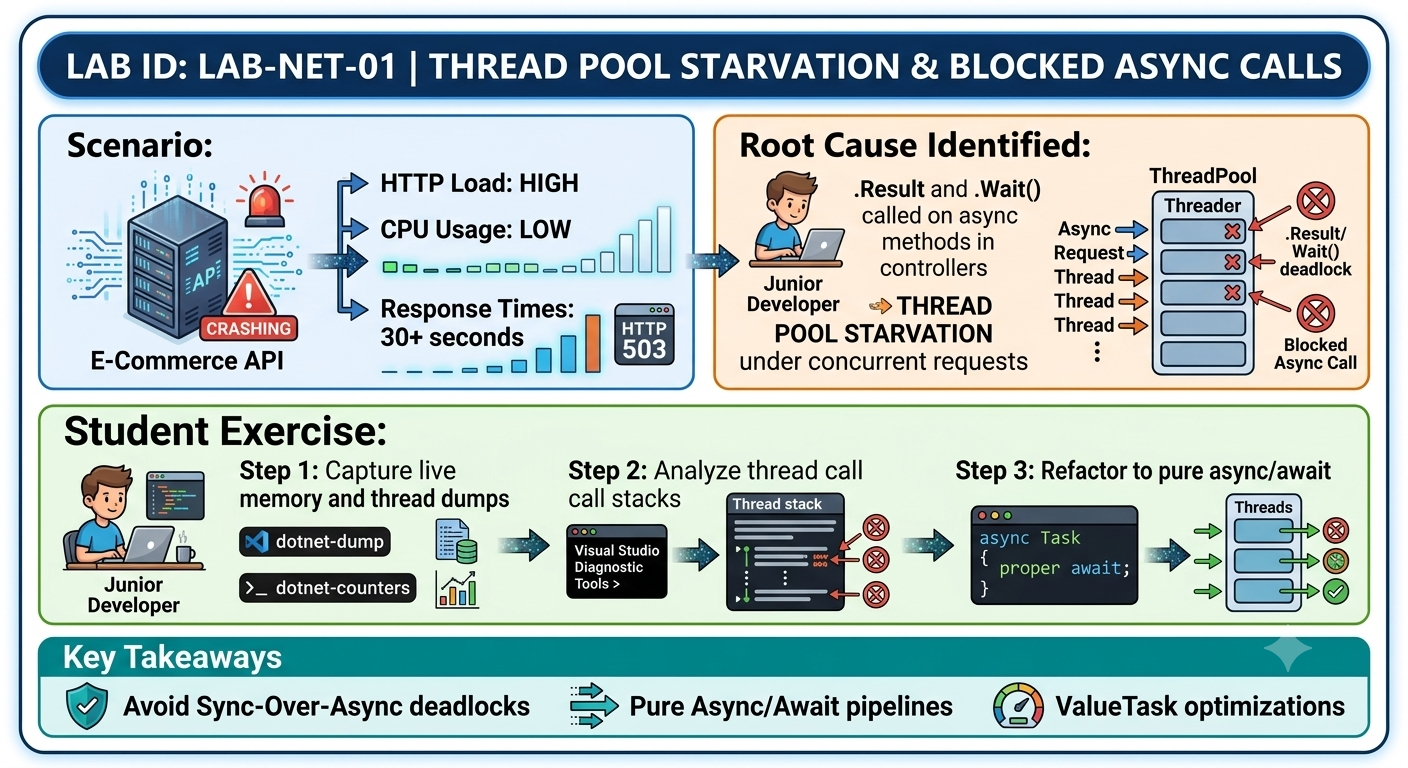
Task-based Asynchronous Pattern (TAP): Work with Task, ValueTask, Task.WhenAll, Task.WhenAny and protection from thread pool starvation.
Cancellation Tokens: Non-blocking operation cancellations with CancellationTokenSource.
Module 2: RESTful Web APIs & Entity Framework Core
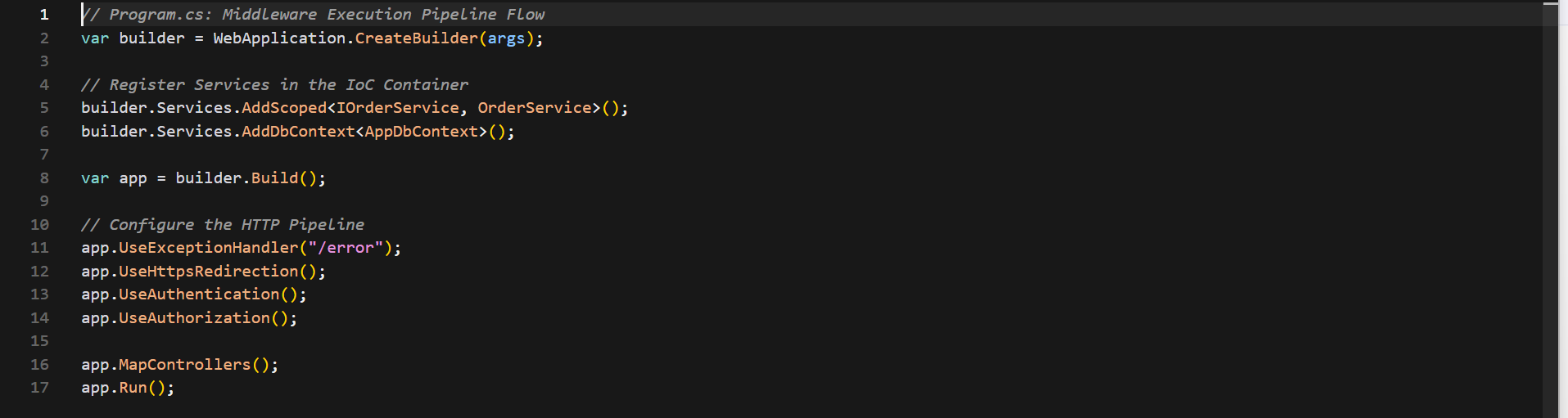
It is one of the key pillars in our asp.net training online course. You will study everything that concerns creating scalable backend services including HTTP request pipeline, Program.cs configuration, Kestrel web server and middleware.
Asp.net Core Architecture & Web APIs
HTTP Request Pipeline: Overview of Program.cs, Kestrel web server and middleware pipeline design.
Comparison of controller to minimal API: routing, endpoint filters application, model binding and attributes validation.
Dependency injection: Service lifetimes (transient, scoped, singleton), dependency injection, memory leak when scoped service used in singleton.
Entity Framework Core - Data Access layer
ORM Basics: DbContext & DbSets operation, Code First vs DB First, migration pipeline.
Entity Relationships: 1 to 1, 1 to Many, Many to Many relationships with Fluent API & Data annotation.
Performance tuning:
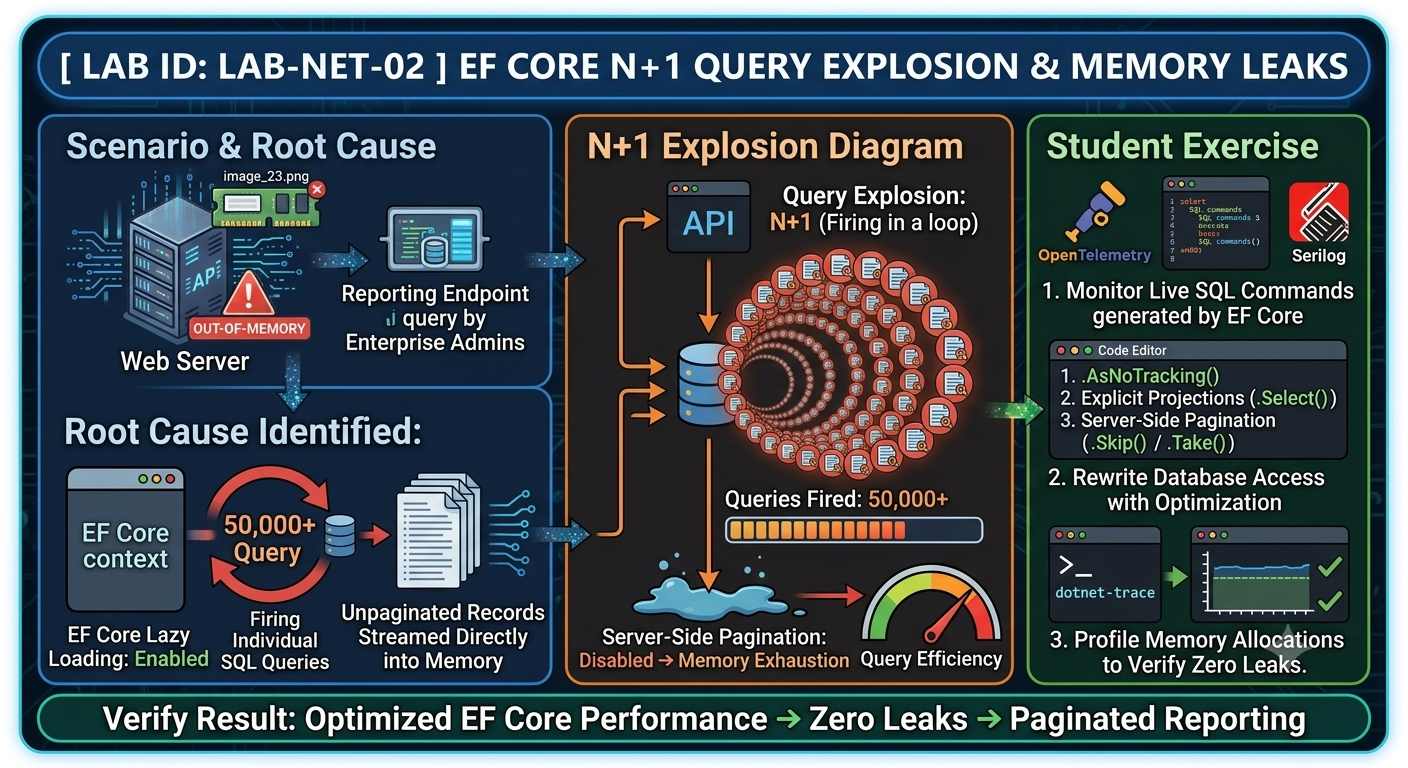
Tracking vs Non Tracking Queries: Use . to enhance performanceAsNoTracking() for queries that don’t require data to be tracked.
Loading patterns: eager loading (.Include(),.ThenInclude(x => x.ThenInclude()) explicit loading and lazy loading (issues).
API protection and authentication.
Authentication and authorization: checking JWT, and OAuth2, role-based access control and policy-based authorization.
Request validation: designing validation in a proper way through FluentValidation.
Error handling: middleware for error handling and implementation of IExceptionHandler for Problem Details response (RFC 7807).
Module 3: Integration of Applications and Web Development with the Frontend
SPA Frameworks (Single Page Application)
Blazor Web App (.NET 8/9) : Blazor Serveur (la pipeline de connexion SignalR) vs Blazor WebAssembly (WASM), cycle de vie des composants (OnInitializedAsync, OnParametersSetAsync), data binding, paramètres en cascade et gestion d'état.
ASP.NET Core SPA hosting, CORS handling, JWT token handling on client side, interceptors, state management. Hosting of Angular / React.
Real Time Communication
SignalR Core : WebSocket fallback option, Hubs, group channels, broadcasting events and creating real time dashboard apps.
Module 4: Cloud Native Microservices Architecture
Patterns for Microservices Architecture
Monolithic Architecture vs Microservices Architecture Basic concepts of Domain-Driven Design (DDD) Definition of Bounded Contexts Ubiquitous language
Database per Service Architecture Pattern : Data isolation, data consistency issues when crossing boundaries.
Inter-Service Communication
RESTful HTTP clients with IHttpClientFactory Resilience (Retry, Circuit Breaker, Fallback) with Polly Synchronous Communication Efficient cross-platform calls via gRPC
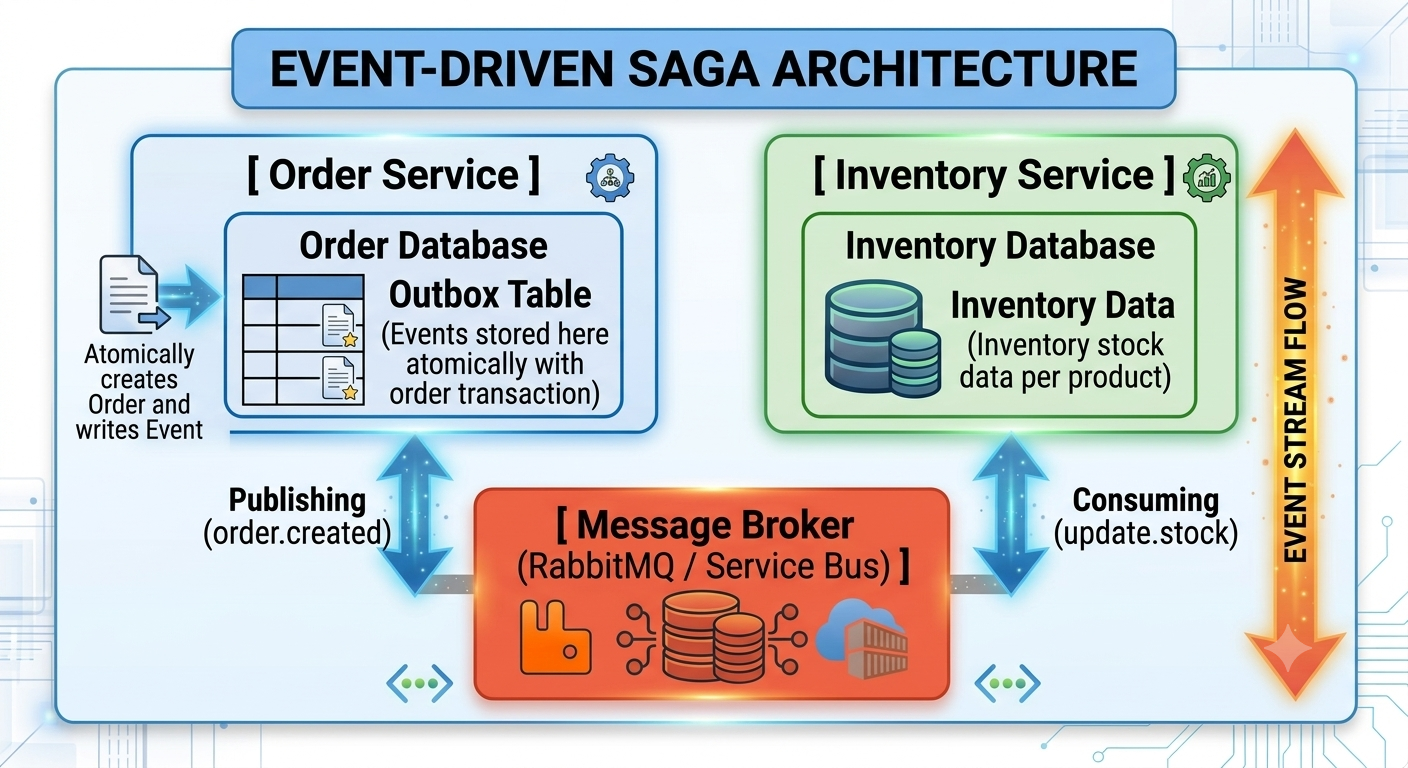
Asynchronous event-driven messaging: Message brokers (RabbitMQ, Azure Service Bus) with abstraction libraries such as MassTransit.
Distributed Transactions Saga pattern (orchestration vs choreography) and transactional outbox pattern to ensure message delivery without distributed locks.
API Gateways and Cross Cutting Concerns
Reverse Proxies & API Gateways: Route, rate-limit, authenticate and transform requests with YARP (Yet Another Reverse Proxy) or Ocelot.
Distributed Caching: Redis (IDistributedCache) multi-level caching patterns and cache stampede avoidance.
Module 5: Cloud Deployment, DevOps & Observability
Containers & Orchestration
Docker Essentials: small and safe base images with multi-stage Dockerfiles, .dockerignore, container network and multicontainer applications with docker-compose.
Kubernetes (K8s) Orchestration - Pods, Deployments, Services, ConfigMaps, Secrets, Ingress Controllers and persistent volume management
Infrastructure as Code (IaC) & CI/CD
CI/CD Pipeline: Build GitHub Actions or Azure DevOps Pipelines for automation of building, integration testing runs, container image builds and deployment to cloud target.
Azure Cloud Platforms Hosting: Deploy to Azure App Services, Azure Container Apps (ACA), Azure Kubernetes Service (AKS), Azure SQL Database, Azure Key Vault.
Distributed Monitoring & Observability
Logging: Structured logging using Serilog with log aggregation (ELK Stack / Azure Application Insights)
Metrics & Tracing: OpenTelemetry instrumentation, metrics visualization with Grafana, end-to-end request tracing with Jaeger, and health check endpoints (Microsoft.Extensions.Diagnostics.HealthChecks).
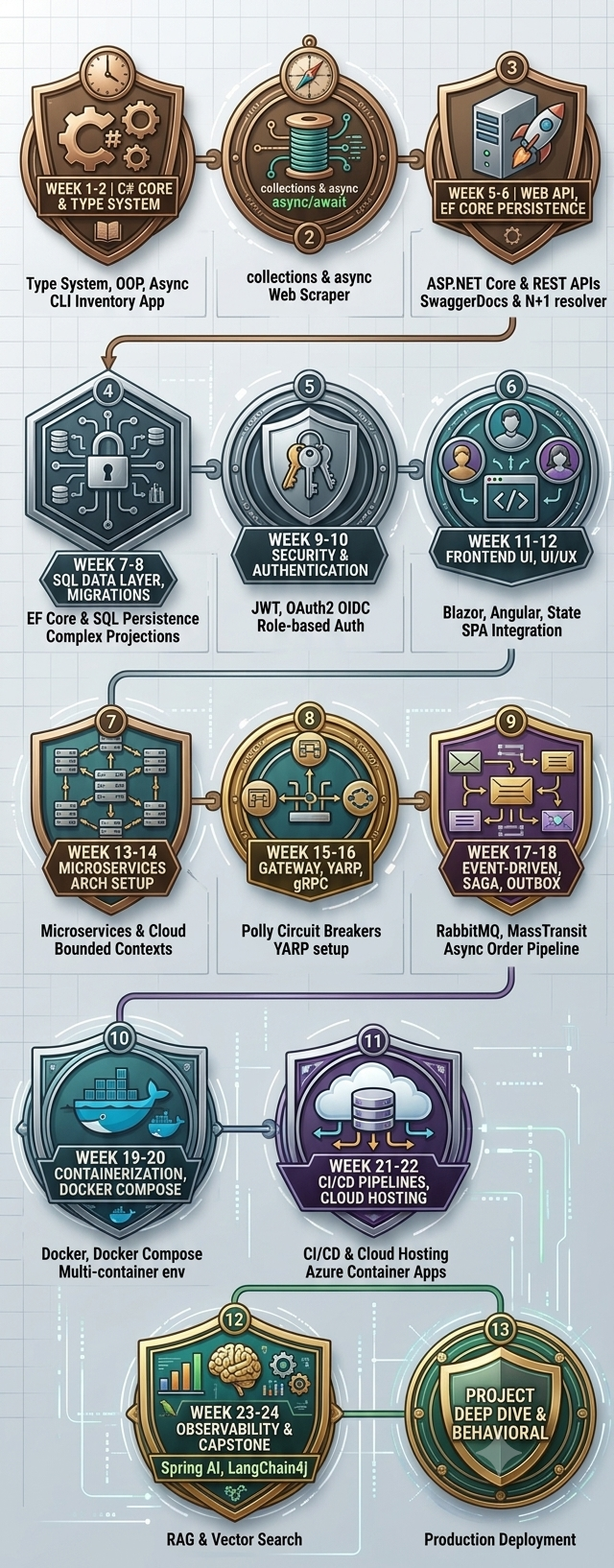
Enterprise Capstone Architecture Project
For the understanding of the above concepts, the students create an enterprise-level system called: An E-Commerce & Logistics Platform.
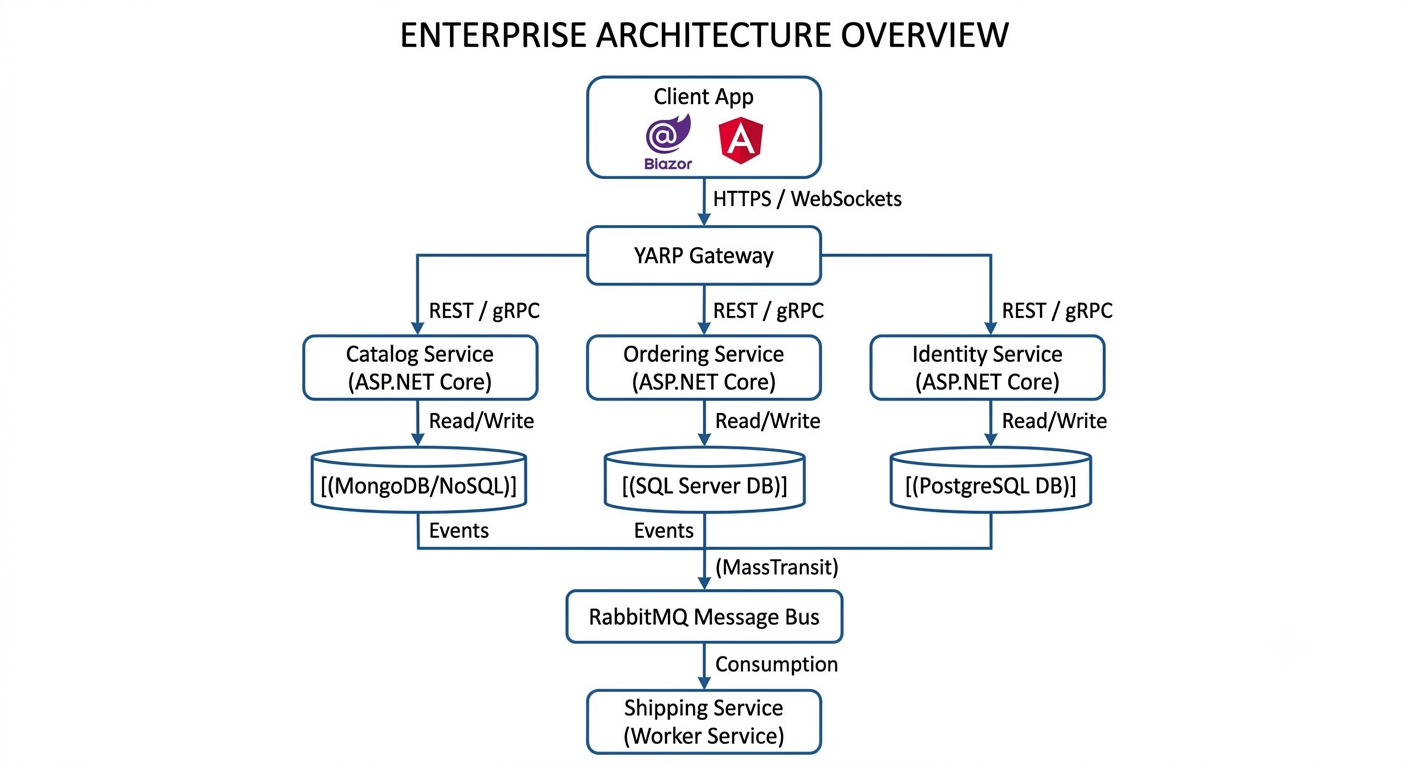
Capstone Functional Requirements
Security & Authentication: OAuth2/OpenID Connect authentication providing JWT for client-side security.
Catalog Service: Read-heavy operations with MongoDB backed by distributed Redis caches.
Order Service: Saga Pattern (Choreography) Payment Processing, Inventory Allocation, Transaction Rollback
Notification & Shipping Service: Background tasks processing domain events from RabbitMQ queue.
Monitoring Suite: Logging, distributed tracing between services with OpenTelemetry and real-time metrics monitoring with Prometheus/Grafana.
Performance Measurement Matrix & Certification Criteria
For the assessment of the above mastery level, the students' performance is assessed on the following four different performance vectors:
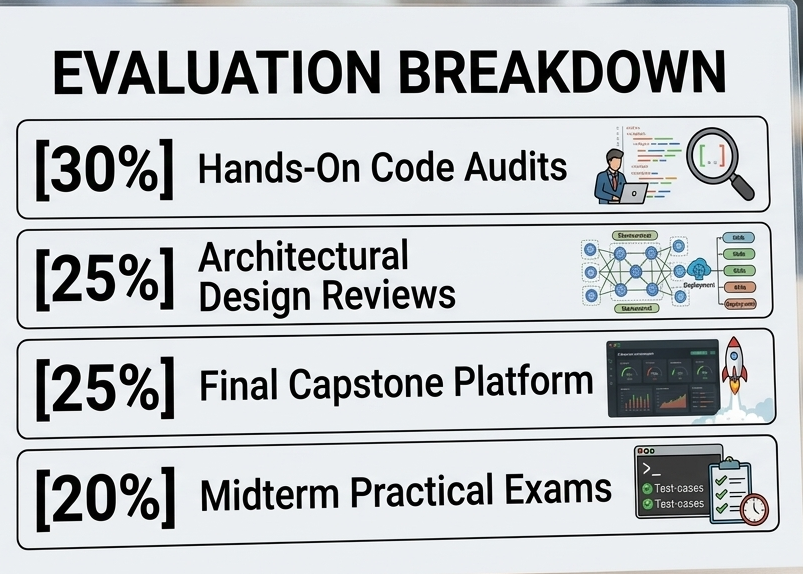
Benchmark Passing
Code Audit: Against the criteria of clean code, no memory leaks, code coverage > 80%, async usage.
System Design Review: Justification for software architecture, system boundaries, choice of data persistence mechanism and fault tolerance approach.
Capstone Deployed: Capstone must be completely containerized, deployed to cloud environments, and available through CI/CD pipelines.
Prerequisite Knowledge & Setting Up the Environment
Tools & Frameworks to be used
SDK:.NET 8 SDK or.NET 9 SDK
IDE: Visual Studio 2022 (Community or Professional) or JetBrains Rider / VS Code with C# Dev Kit
Docker Desktop / Podman containers
Databases: SQL Server Express / Developer edition, PostgreSQL, Redis
API Testing: Postman , Bruno or HTTP Client extension
Module 6: C# Advanced Internals and Enterprise Design Patterns
To be successful in enterprise engineering, knowledge of software design patterns and optimization techniques for runtime performance is essential, but not sufficient; you also need to know the syntax design and Behavioral Patterns in NET Framework
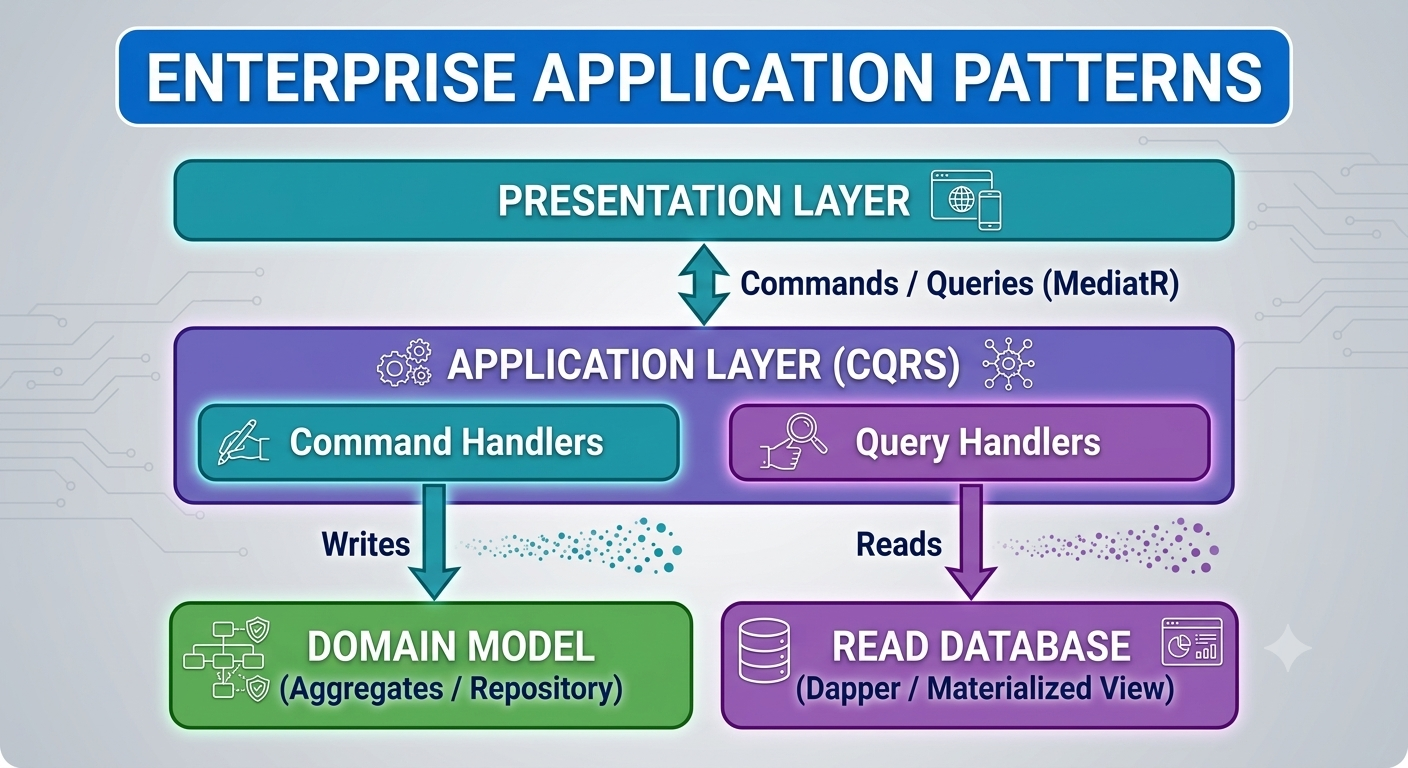
.NET Framework Architectural & Behavioral Patterns
Repository & Unit of Work Pattern: Separating business logic from database contexts. Transactional standardization for multiple write actions, without exposing EF Core architecture to domain services.
CQRS (Command Query Responsibility Segregation) and MediatR:
Separating read pipelines from write pipelines to achieve maximum scalability.
Writing clean command/query handlers and MediatR pipeline behaviors for cross-cutting concerns (logging, validation, performance profiling, transactions management)
Tactical Patterns of DDD:
Value objects vs entities: structural equality and immutability implementation.
Aggregates and aggregate roots: the definition of consistency boundaries in enterprise domain models.
Domain events: emit changes to the internal domain state, before publishing them out across microservice boundaries as integration events.
Creational and structural patterns: Factory, Strategy, Decorator (to create cross-cutting caching wrappers) and Singleton patterns specific to ASP.NET Core IoC container.
Low-level Memory Management and High-Performance C#
Garbage Collection (GC) Internals:
Deep dive into Gen 0, Gen 1, Gen 2 and Large Object Heap (LOH)/Pinned Object Heap (POH).
Workstation GC vs Server GC running modes.
GC pause analysis, memory leak detection, managed resource handling.
Zero Waste Programming:
Memory efficient partitioning with Span<T>, ReadOnlySpan<T> and Memory<T>
optimize string concatenation operations using ArrayPool<T> and ArrayBufferWriter<T>.
Use ref struct types to avoid heap allocation in performance critical code paths.
Benchmarking & Profiling: Benchmark memory allocation, execution time and CPU usage using the BenchmarkDotNet library.
Module 7: AI-Assisted .NET Development (AI Integrations)
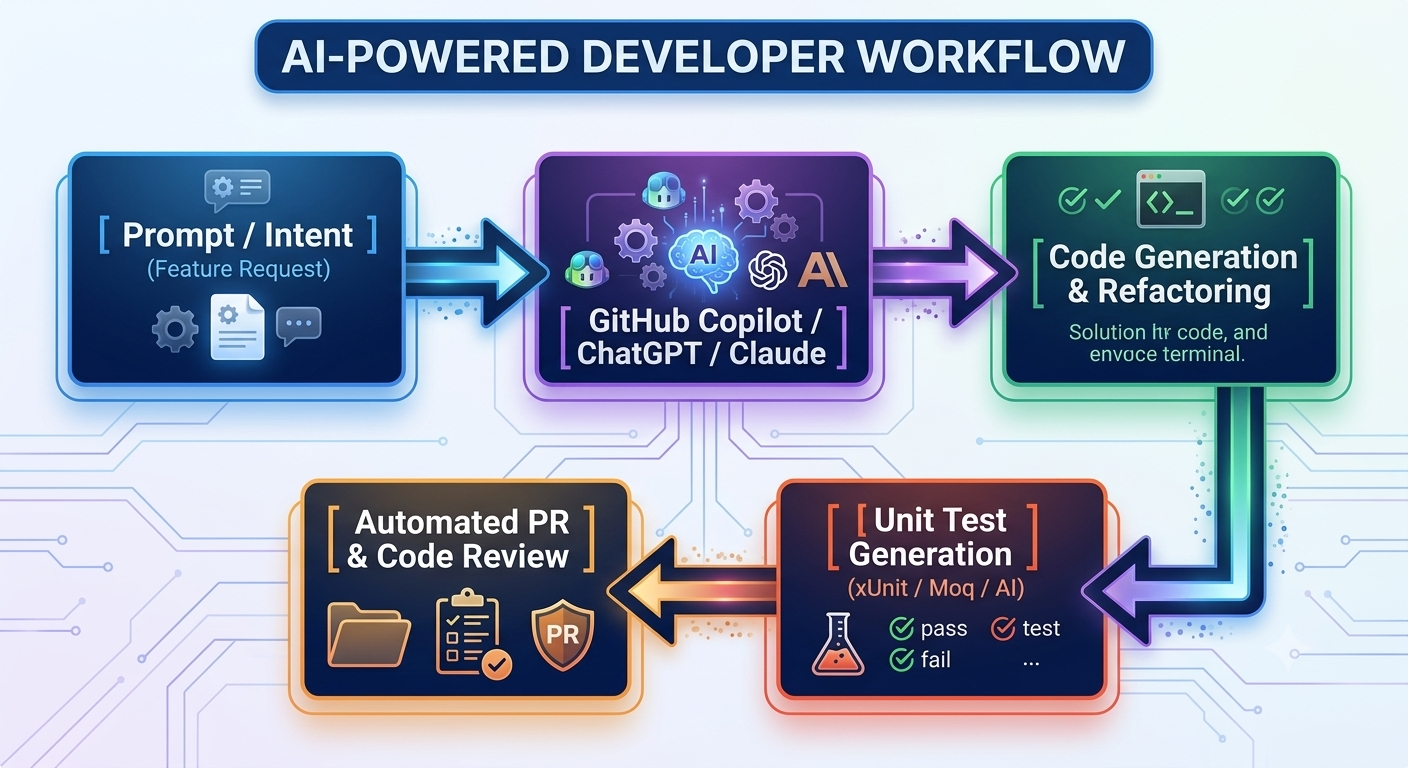
Today’s Enterprise Software Engineers make use of AI to streamline their development efforts, eliminate repetitive code writing tasks, and generate quality unit tests. The asp net core training online Program offers direct AI tool integration in the .NET development process.
AI Coding Assistants for .NET Developers
GitHub Copilot & Visual Studio 2022 Features:
Code completion with contextual prompt engineering for C#.
Automatic generation of EF Core configurations, FluentValidation rules, and Swagger documentation.
Migrating legacy C# code to modern C# 12/13 constructs (e.g., primary constructors, collection expressions).
AI based Test Suite Generation:
xUnit, NUnit and Moq for automatic generation of unit tests for boundary values.
Training AI tools to do boundary value analysis, interface mocking of complex dependencies and realistic integration test datasets.
AI-Based.NET Applications Development (Semantic Kernel & Open API)
Microsoft Semantic Kernel SDK: Native ASP.NET Core Microservices with Embedding Large Language Models (LLMs).
Smart RAG (Retrieval-Augmented Generation) App Development:
Using vector databases (Qdrant / Azure AI Search) with EF Core.
OpenAI / Azure AI Textual Data Embeddings and Querying Vector Indexes with C#
Function Calling & AI Agents: Ability for AI models to call ASP.NET Core REST APIs for automated business processes.
Industry Examples & Hands-On Production System Debugging Lab Workshops
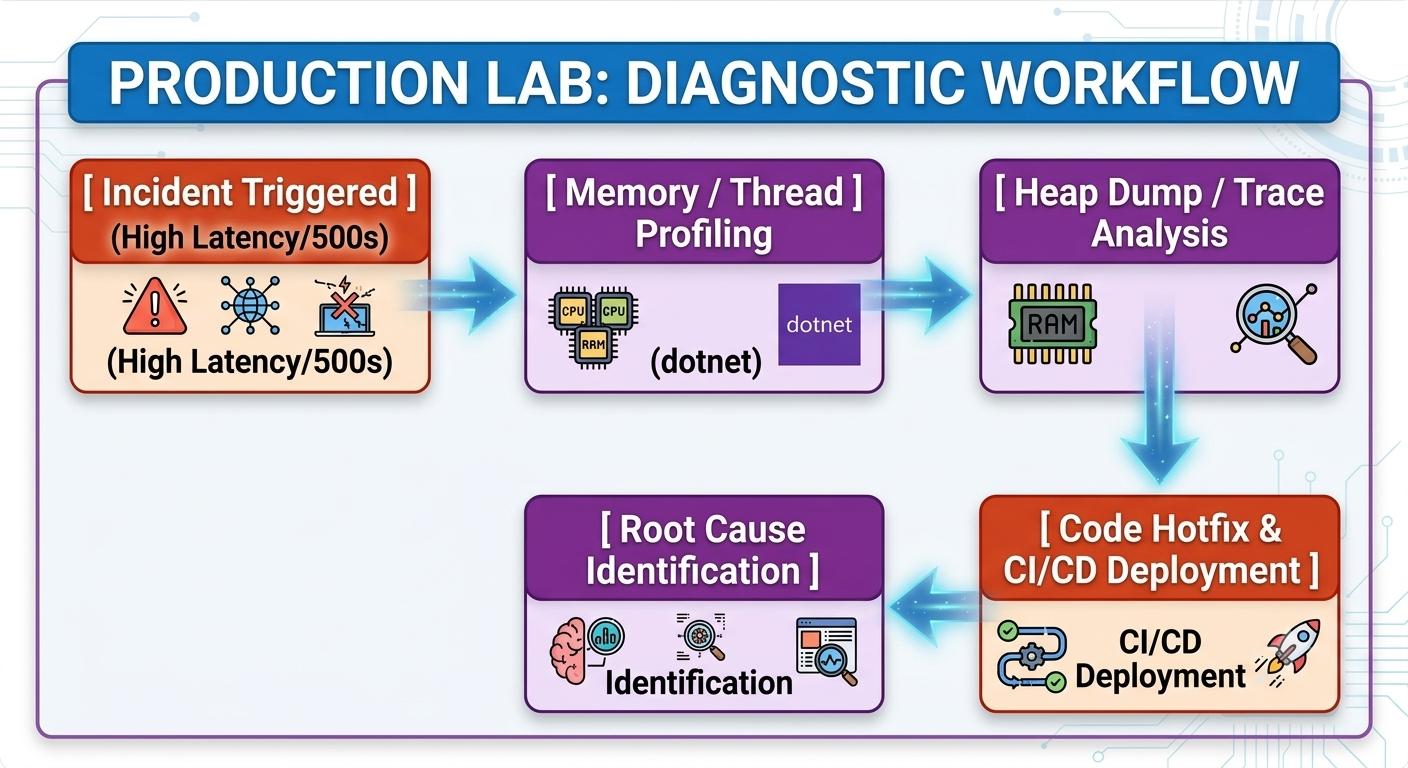
Knowing the theory is only enough until the production goes down. Our OnlineITGuru course contains practical business examples and failure injection labs, in which students will fix enterprise system bugs.
Enterprise Case Studies
Case Study 1: FinTech High-Frequency Transaction Engine
The Business Problem: The digital payment platform experienced database deadlocks and delays in API responses during flash sales because of poorly optimized database transactions and blocking I/O calls.
Architecture Solution.Net Architecture:
The transaction engine architecture has been reimplemented with Clean Architecture principles and CQRS design approach.
Transactional Outbox pattern has been applied for asynchronous database writes leveraging RabbitMQ and Redis caching for fast processing.
EF Core uses Optimistic Concurrency Control to reduce the amount of database locking.
Business Issue: The legacy ASP.NET WebForms solution was running on expensive hosting, was prone to downtime during deployments and had a tightly coupled code base across business units.
Case Study 2. SaaS Platform for E-Commerce Migration Multi-tenant
Business Issue: Legacy ASP.NET WebForms solution faced problems of expensive hosting, downtime during deployment, and tightly coupled code base across different business units.
Architecture Solution Architecture.NET:
asp net core WebAPIs modularized the monolithic application and hosted via Azure Container Apps services.
YARP API Gateway was used for tenants dynamic routing and rate limiting.
EF Core Global Query Filter for multi-tenant isolation
Business Impact: Implemented Blue/Green Deployment strategy to reduce cloud over-head costs by 42% and achieved 99.99% up-time and zero deployment downtime.
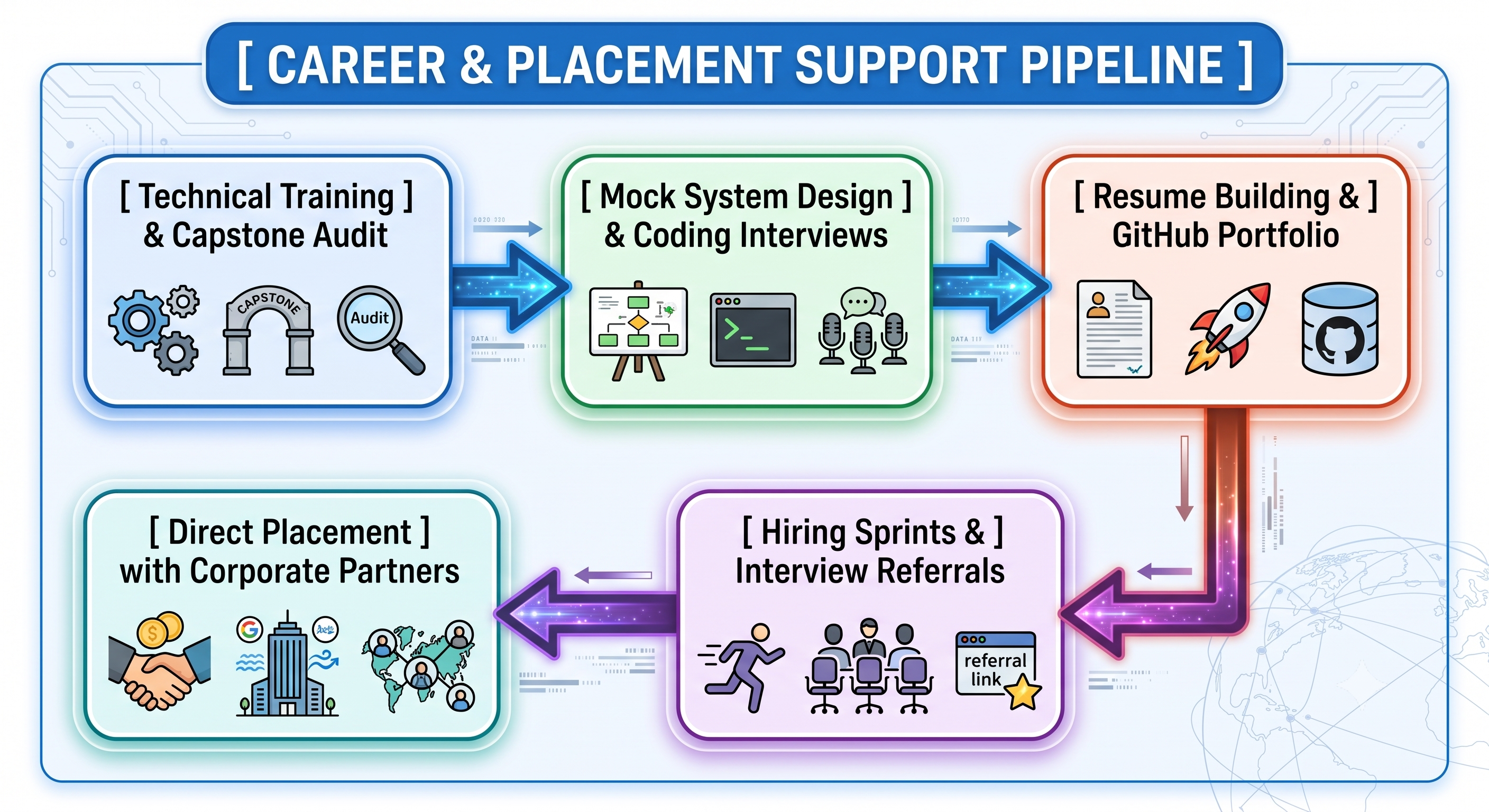
Career Assistance & Interview Preparation
At OnlineITGuru we don’t just teach technology, we help our students through their transition into a career.
Conclusion: Turning Learners into .NET Architects of the Enterprise
There has been a paradigm shift in the software engineering environment. In today’s world, software development process is not only about making sure the code is working, but also about developing solutions that are highly resilient, fast, safe and ready for the cloud environment. Modern enterprise technology is built on modern technologies like.NET 8/9, C# 12/13, ASP.NET Core, and Azure.
A full curriculum that is offered by OnlineITGuru is the perfect guideline that will help you become a productive .NET Engineer and Solution Architect. Do you want to take your software development career to the next level? Register for the asp.net core training online program of OnlineITGuru now.
Why This Program Is Different
An End-to-End Skills Bridge from Low Level to Distributed Systems
In this course, you receive an end-to-end training covering every aspect of software development. From the low-level aspects of C# development (working with Span<T>, Garbage Collection tuning, Asynchronous programming) up to EF Core optimization techniques for high-speed databases, this will help you lay a solid foundation before you tackle distributed systems.
A Cloud-Native and Microservices-Focused Curriculum
Unlike other courses that focus on single isolated programs, this program focuses more on enterprise-scale architecture. Not only do you get to learn about concepts such as CQRS, Clean Architecture, Domain-Driven Design (DDD), and Saga Patterns, but you actually put those patterns into action using event-driven messaging with RabbitMQ, gRPC, YARP API Gateway, and MassTransit.
Production-Level Debugging Techniques and AI Integration
Theory gets proven through practice. You will receive practical experience in dealing with production failures like thread pool starvation, memory leaks, and $N+1$ queries. Also, using AI tools like GitHub Copilot and Microsoft Semantic Kernel, you learn how to integrate AI into writing tests, refactoring legacy code, and building RAG applications.
Career-Ready Capstone & Pipeline for Hiring
This course ends with the development of an enterprise-level E-Commerce and Logistics Platform created using Docker and Kubernetes containers and deployed on Microsoft Azure through automatic GitHub Actions CI/CD pipelines. Together with OnlineITGuru’s CV optimization, system design mock interviews, and direct recommendations from more than 200 corporate recruitment partners, you enter the job market with demonstrable skills rather than just a certification.
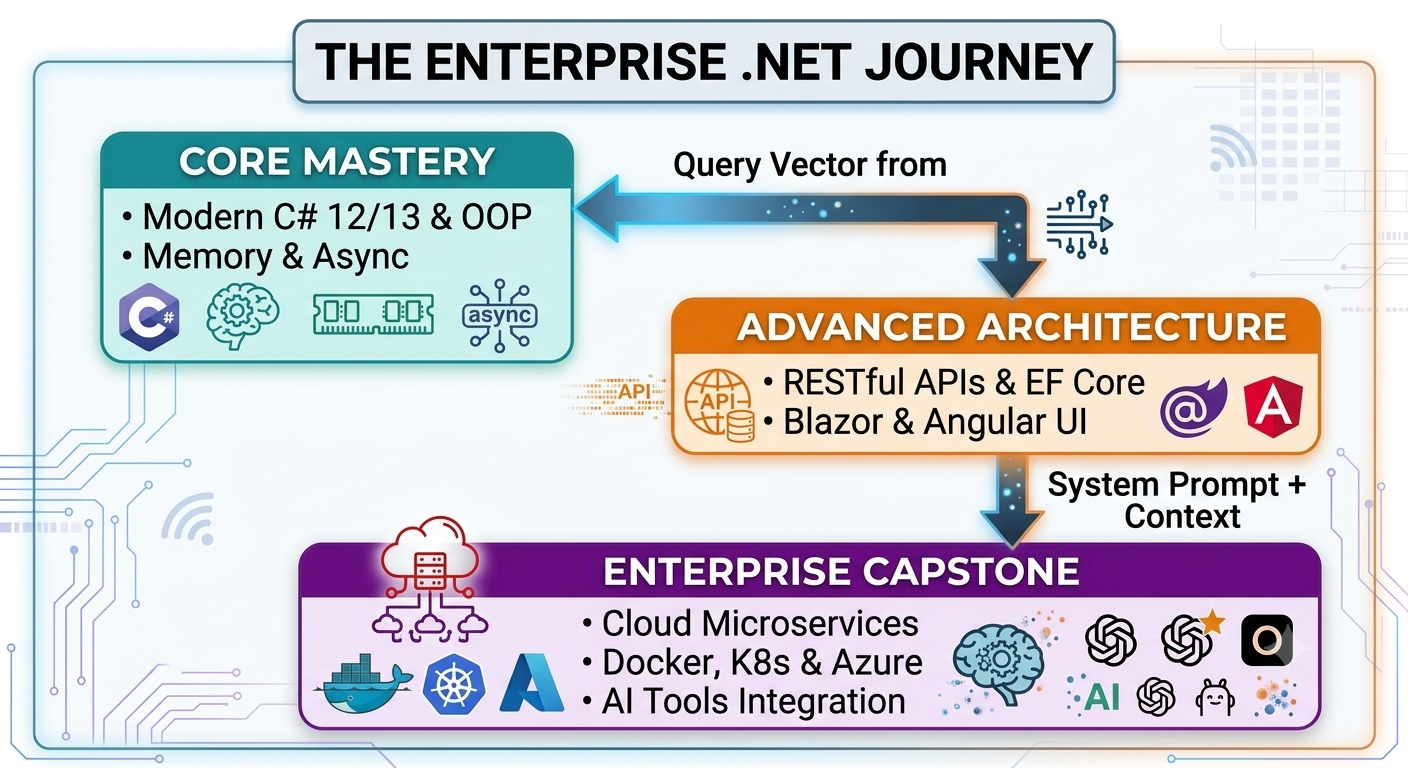
The program follows a design based on four pillars that help one develop complete skills for working in the enterprise. The Core C# and Runtime pillar teaches one about the concepts of memory management, OOP/SOLID practices, async/await capabilities, and zero-allocation programming. Data and API Layer helps one create production-ready RESTful APIs that use such technologies as FluentValidation, JWT authentication, and high-performing queries with Entity Framework Core and Dapper. The Microservices and Messaging pillar includes the topics of defining bounded contexts, asynchronous messaging with RabbitMQ, and service orchestration using saga pattern. In the DevOps and Observability pillar we learn about containerization with Docker and Kubernetes, automation of Azure CI/CD pipelines, and open source telemetry tools and visualizations such as OpenTelemetry and Grafana.
Final Thoughts
If your objective is to acquire new skill sets, become a full-stack cloud developer, or even get into one of those high-paying enterprise engineering roles, then you can be sure that you will get all the right technical expertise that you need to succeed through this program. With its blend of interactive classes guided by mentors, 24/7 lab support, and real-world project portfolio, OnlineITGuru ensures that you learn .NET.