
ETL Is Easy Until You Have 50 Million Records
Last updated on Sep 14, 2026
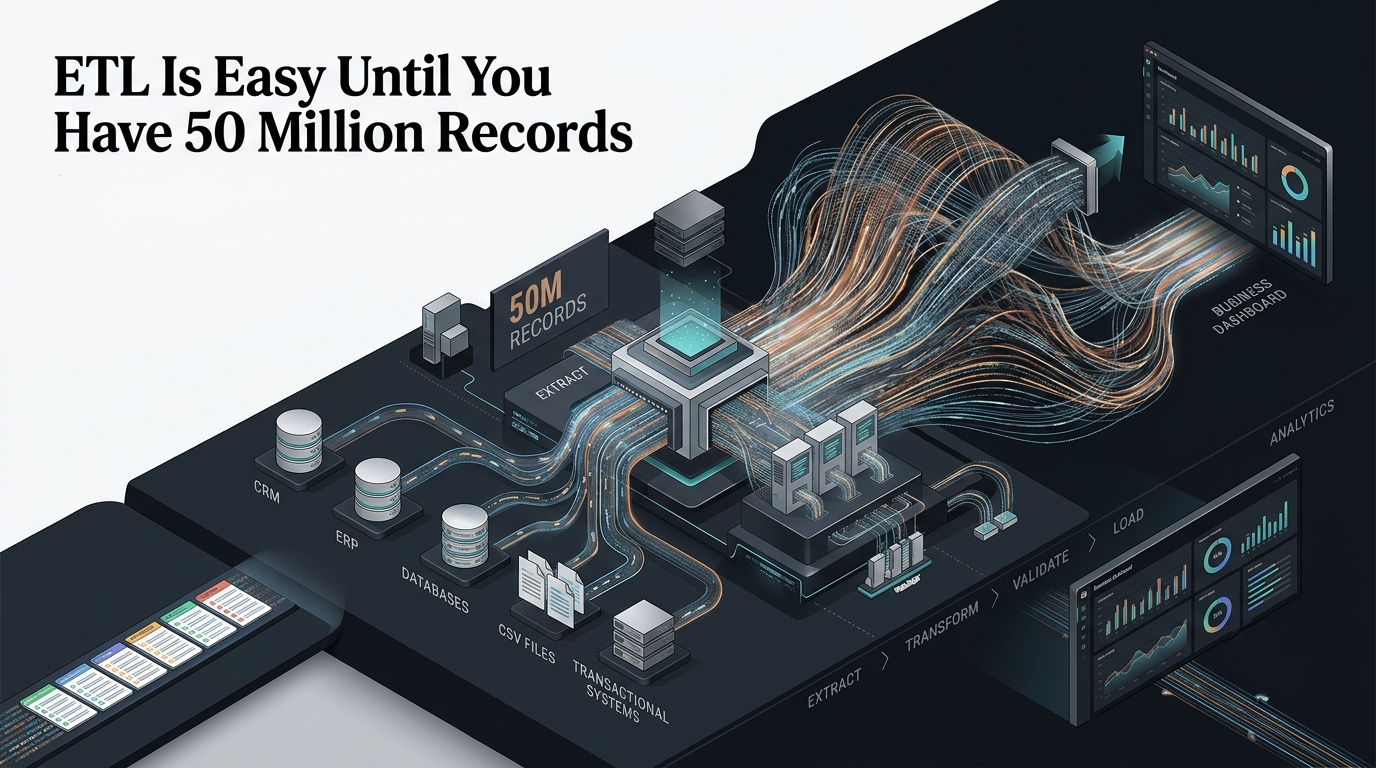
Moving data from one system to another sounds simple. Take the data out, make a few changes, and put it somewhere else. On a small dataset, that description is almost convincing. A developer can take a CSV file containing a few thousand customer records, clean some columns, remove obvious duplicates, and load the result into a database without encountering too many surprises. The process works, the numbers look right, and the job finishes quickly.
Now change the situation. Instead of a few thousand records, imagine an organization processing 50 million transactions. The information is coming from several databases, applications, files, and business systems. Some records are complete, some are missing values, and some follow different formats because the systems were built at different times. The business expects the data to be available every morning, and a delay of several hours can affect reporting, operations, and decision-making.
Suddenly, ETL is no longer just about moving data. It becomes a question of architecture, performance, data quality, reliability, monitoring, and recovery. A transformation that takes seconds on a small dataset may become a major bottleneck when applied to millions of rows. A poorly designed lookup can consume enormous memory. A database query that seems harmless can slow down an entire production system. Even a small mistake in data handling can become a serious problem when it is multiplied 50 million times.
This is where enterprise ETL platforms such as IBM DataStage become important. DataStage is designed for building data integration and transformation workflows that can process large volumes of information. But understanding the tool itself is only half the story. The more interesting question is what happens when an apparently simple ETL requirement meets the realities of enterprise-scale data.
The Moment ETL Stops Being Simple
Consider a retail company that wants to create a daily sales warehouse. Every night, it needs to collect transaction information from stores, online purchases from its e-commerce platform, customer information from a CRM system, product information from another database, and payment information from a separate application. At first glance, the requirement sounds straightforward: extract the information, transform it into a common structure, and load it into the warehouse.
The difficulty begins when the systems are examined individually. The online platform may store a customer's country as “India,” while an older application may use “IN.” One database might store dates as 2026-09-14, another might use a timestamp, and an old file might contain dates in a completely different format. Product identifiers may not follow the same naming convention. One system may represent a missing value as NULL, while another may use an empty string or a special code. With a small number of records, someone could potentially identify and fix these inconsistencies manually. With 50 million records, manual correction is not a strategy. The ETL pipeline needs clearly defined rules that can apply the same logic consistently across the entire dataset.
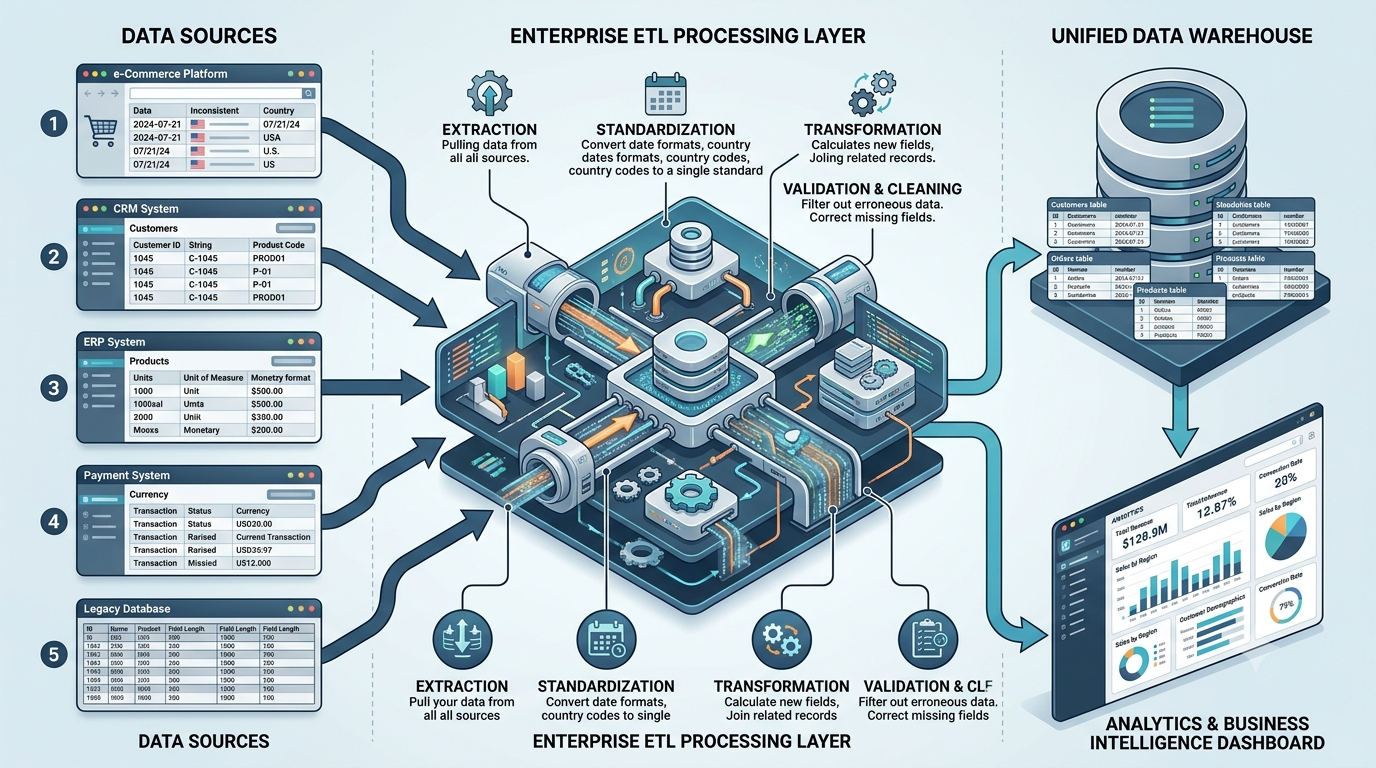
This is the first important shift in thinking: enterprise ETL is not simply a transportation problem. It is a controlled data-processing problem. The extraction stage itself can also become complicated. Pulling millions of rows from a production database requires consideration of how the extraction query is written, when it runs, how much load it places on the source system, and whether the entire dataset actually needs to be extracted every time. If only yesterday's transactions have changed, extracting the entire historical database every night would waste resources. Instead, an organization may use incremental extraction, where only new or changed records are processed.
That decision can have a significant impact on performance. Processing 50 million historical records every night is very different from processing the few hundred thousand records that changed during the previous business day. The underlying business requirement may be described simply as “refresh the warehouse daily,” but the technical implementation determines whether that refresh takes minutes, hours, or becomes impossible to complete within the available window.
The transformation stage introduces another layer of complexity. Suppose the company needs to calculate total order value, standardize customer information, convert currencies, validate product codes, and apply business rules before loading the warehouse. Each transformation has to be performed across potentially millions of rows. A transformation that is logically correct can still be technically inefficient. This is why experienced ETL developers do not only ask, “Does this transformation produce the right result?” They also ask, “How will this behave when the input grows from 10,000 records to 50 million?” That question separates a working ETL job from a production-ready data pipeline.
Fifty Million Rows Change the Performance Equation
Performance problems in ETL are often deceptive because they may not appear during development. A developer might test a job using 10,000 records and see that it finishes in a few seconds. Everything looks fine. But if the same design is deployed against tens of millions of records, the execution time can increase dramatically.
The reason is that data volume changes the cost of almost every operation. Reading data requires I/O. Writing data requires I/O. Transformations require CPU. Sorting requires processing and often temporary storage. Lookups may require memory or additional processing. Database operations may involve network communication and source-system resources. Imagine an ETL job that needs to match every incoming sales transaction against a product reference table. With a small dataset, the lookup appears insignificant. But when millions of transactions must be matched, the implementation of that lookup matters enormously. If the reference data is handled inefficiently, the lookup can become one of the slowest stages in the entire pipeline.
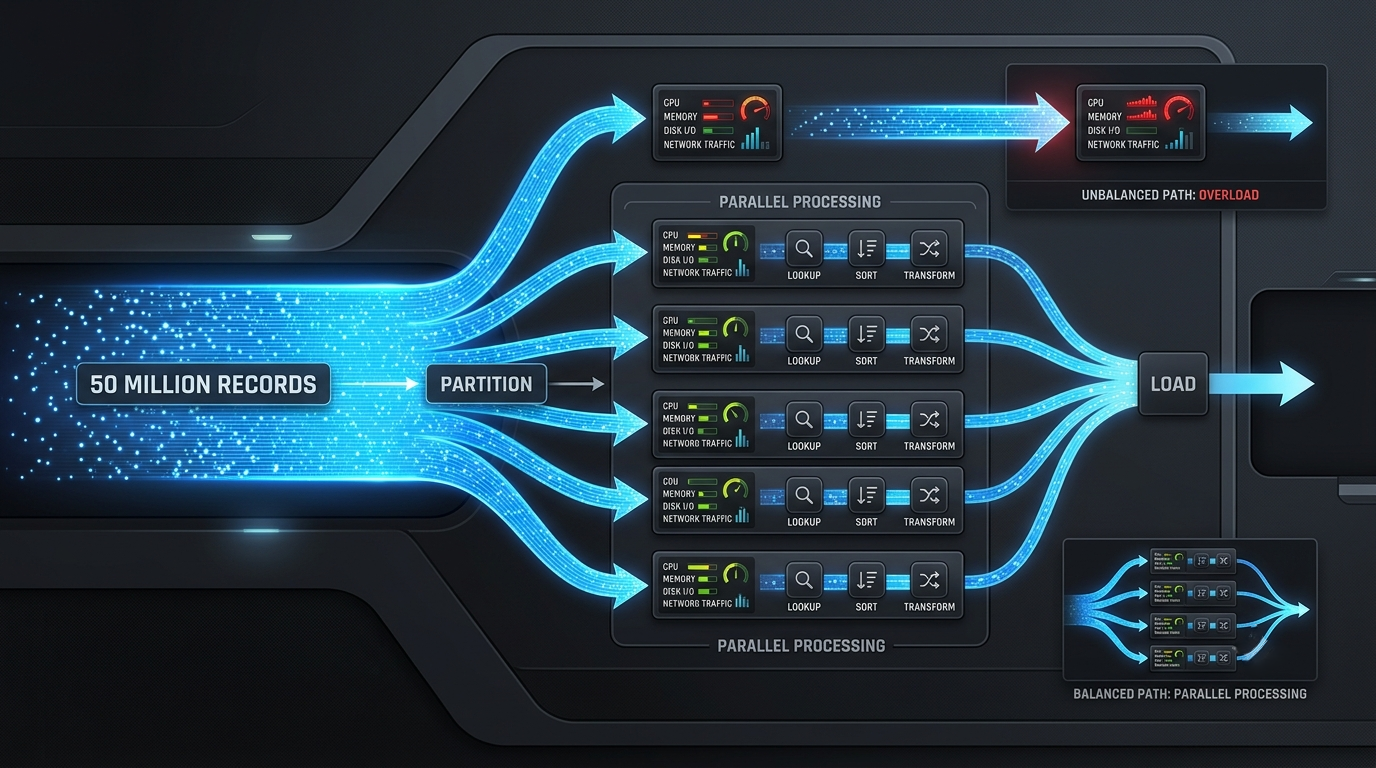
Sorting provides another useful example. Sorting a few thousand records is easy. Sorting tens of millions is a much more significant operation because the system has to process a huge volume of data and may need temporary disk space when the working data exceeds available memory. This is one reason parallel processing is so important in enterprise data integration. Instead of treating the entire dataset as one indivisible workload, large ETL systems can divide processing across multiple execution paths. If the workload can be processed independently, several portions of the data can move through transformations at the same time.
DataStage's parallel-processing capabilities are particularly relevant in this context. The objective is not simply to make an individual transformation faster. The larger goal is to design a pipeline that can take advantage of available computing resources while maintaining correct data behavior. Partitioning becomes an important concept here. Data can be distributed according to specific rules so that processing can occur across parallel paths. For example, records may be distributed based on a customer identifier or another key. But partitioning must be designed carefully. Poor distribution can create an imbalance where one processing node receives much more data than the others. The pipeline may technically be running in parallel, but the slowest partition can determine the overall completion time.
This is a common reality of large-scale data processing: adding more processing power does not automatically solve a performance problem. The workload itself has to be designed so that the available resources can actually be used effectively. Another important consideration is where transformations should happen. Sometimes it is more efficient to filter or aggregate data close to the source rather than transferring unnecessary records into the ETL environment. For example, if the business only needs transactions from the previous day, filtering them at the source can reduce the amount of data transferred and processed downstream.
This kind of optimization may sound technical, but the principle is simple: do not make the system process data that it does not need. For someone learning enterprise ETL, this is one of the most valuable lessons. Tools provide transformation components and configuration options, but good performance comes from understanding what the pipeline is actually doing with the data.
An IBM DataStage environment therefore should not be approached merely as a collection of stages to connect together. It should be understood as a data-processing system where choices about extraction, transformation, partitioning, sorting, lookups, and loading can directly affect execution time and resource consumption. For learners considering an ibm datastage course, this distinction is important because enterprise DataStage work involves much more than knowing where to find individual components.
The Real Problem Is Often the Data, Not the Volume
Fifty million records are impressive, but volume alone is not necessarily the hardest problem. The real challenge often appears when those records contain inconsistencies. Imagine that an organization's customer data comes from five different systems. In one system, the customer is identified by an eight-digit customer number. Another system uses an email address. A third uses a legacy account identifier. Some customers appear in more than one system, and some records contain outdated information.
Now imagine trying to combine all of that information into a single warehouse. The ETL pipeline needs to determine how records should be matched, which values should be considered authoritative, and what should happen when two systems disagree. These are not purely technical questions. They are business rules expressed through technical processes.
Data cleansing therefore becomes a major part of enterprise ETL. Names may need to be standardized. Codes may need to be converted. Invalid records may need to be rejected. Missing values may need to be handled according to defined rules. Dates and numerical fields may need to be converted into common formats. The important point is that the pipeline should not simply hide bad data. It should make the treatment of bad data visible and controllable. Suppose 50 million records enter a pipeline and 100,000 fail validation. If those records are silently discarded, the warehouse may appear healthy while important information has disappeared. A better design separates rejected or problematic records so that they can be investigated. This is where error handling becomes part of data engineering rather than an afterthought. A production ETL job needs to answer questions such as: How many records were processed? How many were successfully loaded? How many failed? Why did they fail? Where are those records? Can they be corrected and reprocessed?
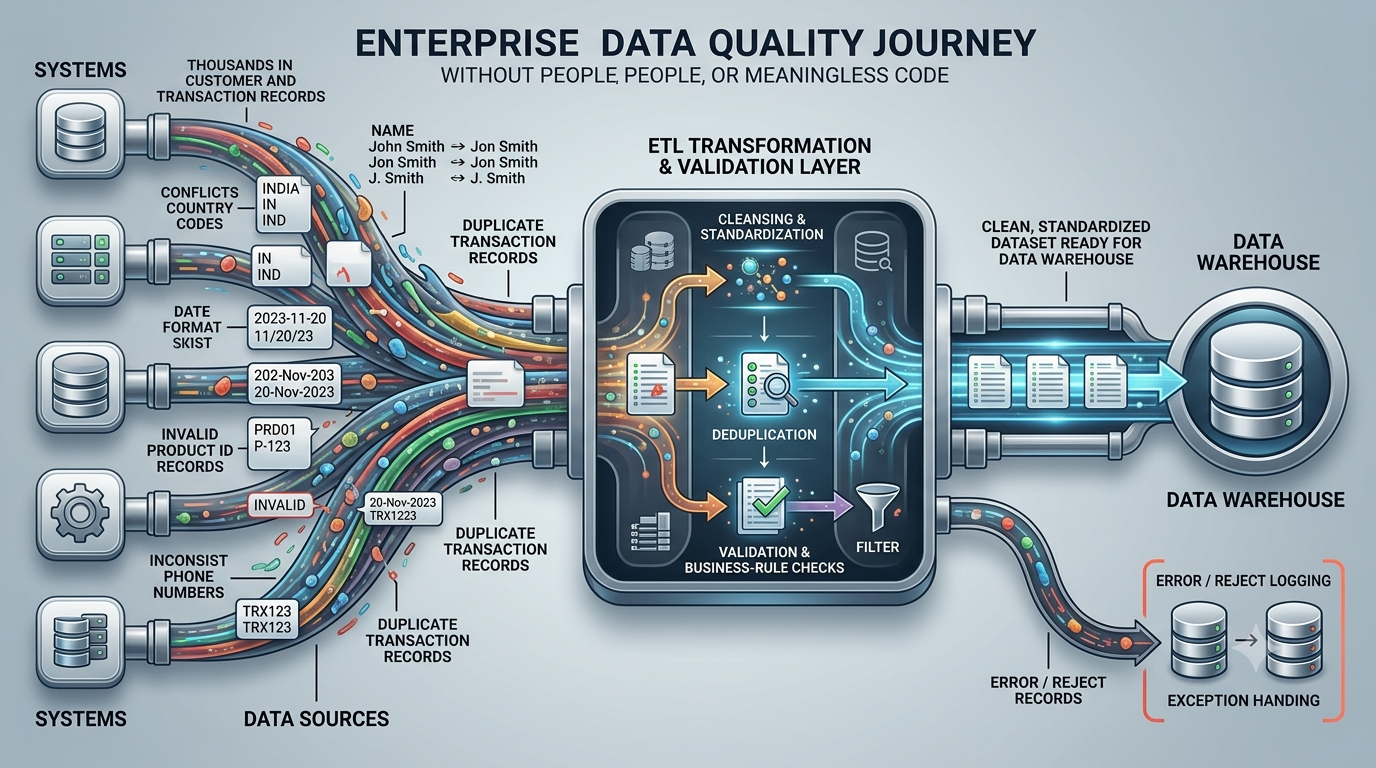
Logging and operational metadata become especially valuable here. A successful job is not simply one that ends without an error message. It is one where the organization can understand what happened during execution.
The same principle applies to duplicate data. Suppose a customer places an order through a website, but the transaction is also recorded through another application. If both systems send the transaction into the warehouse, the ETL pipeline may need to identify whether the records represent the same business event or two separate events. At small scale, these situations can be manually inspected. At enterprise scale, they require repeatable logic. This is why data quality and ETL are closely connected. An ETL platform can move millions of records extremely efficiently, but efficiency does not make incorrect data correct. In fact, processing bad data faster can make a problem larger because incorrect information reaches downstream systems more quickly.
The best pipelines therefore combine transformation with validation. Before data reaches its destination, the pipeline can check whether required fields are present, whether values fall within expected ranges, whether identifiers are valid, and whether records satisfy business rules. There is also an important distinction between technical errors and data errors. A technical error might occur because a database connection failed. A data error might occur because a transaction contains an invalid product code. Both need to be handled, but they require different responses. A database connection problem may require retrying the job or contacting infrastructure teams. An invalid product code may require correcting the source data or reviewing the business rule. Treating every failure in the same way can make production support unnecessarily difficult.
This is also why DataStage professionals need to understand the business meaning of the data they process. An ETL developer who understands only the technical structure may successfully move a column from one system to another while completely missing the fact that the business definition of that column changed. Large-scale ETL is ultimately about creating trustworthy movement of information. The pipeline has to preserve meaning while changing structure.
What Happens When the Nightly Job Fails?
Now consider the most uncomfortable question: what happens when the pipeline does not finish?
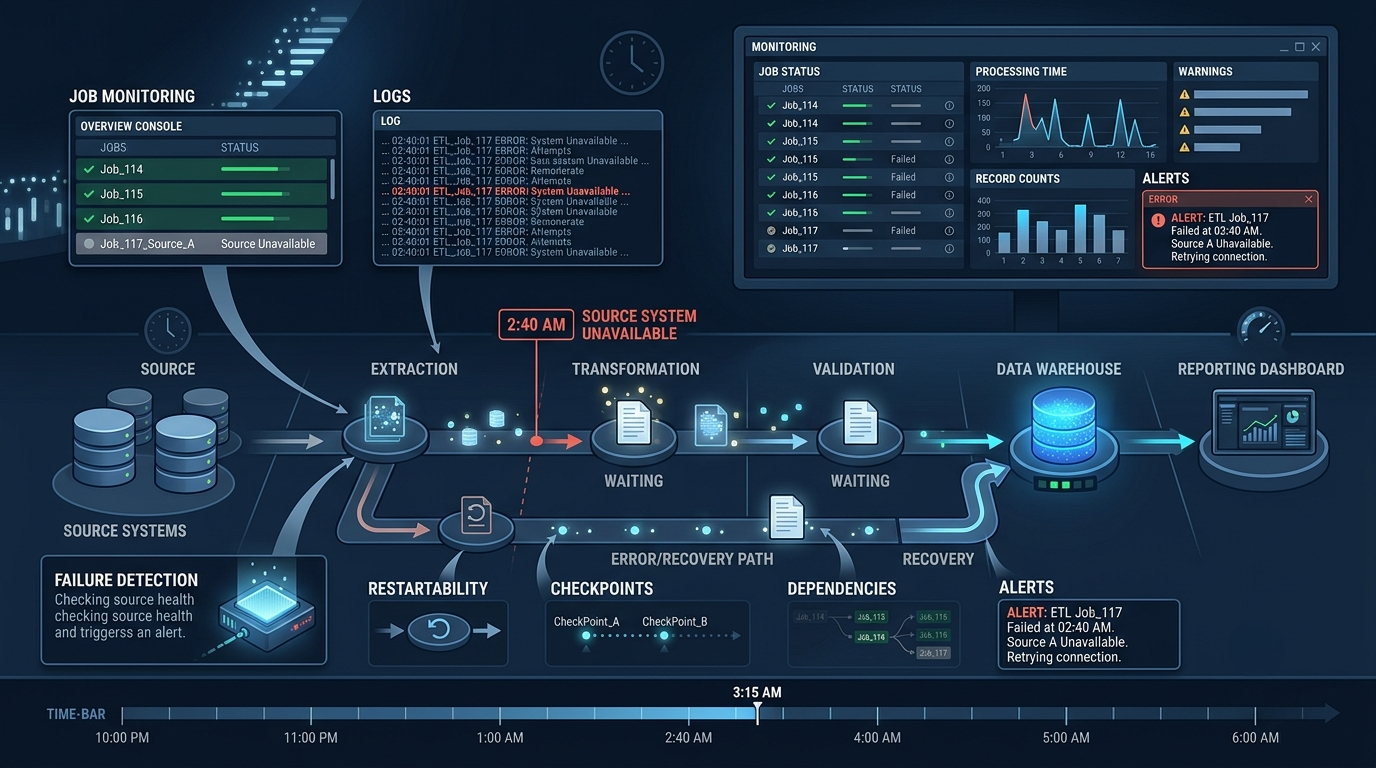
A company may have a nightly processing window from midnight to 5 a.m. The data warehouse needs to be ready before employees arrive in the morning. At 2:40 a.m., one of the source systems becomes unavailable. The ETL job fails halfway through processing.
At this point, simply restarting the entire process may not be the best option. Some records may already have been successfully loaded. Some may have failed. Some may still be waiting to be processed. If the job is restarted without understanding the current state, duplicate data could potentially be created or previously completed work could be unnecessarily repeated. This is why production ETL requires thinking about restartability and recovery.
A well-designed pipeline should make it possible to understand where processing stopped and what needs to happen next. Depending on the architecture, organizations may use control tables, job logs, checkpoints, batch identifiers, timestamps, or other mechanisms to track processing status. Scheduling is another part of the equation. A data pipeline rarely operates in isolation. One job may need to finish before another starts. A warehouse load may depend on successful extraction from several source systems. A reporting process may begin only after the warehouse has been refreshed.
This creates dependencies.
Imagine a pipeline with five major stages. Customer data arrives successfully, product data arrives successfully, but transaction extraction fails. If the reporting job starts anyway, users could see a dashboard containing updated customer information but incomplete sales information. The problem is no longer just that one ETL job failed. The failure has affected the reliability of downstream business information. Monitoring helps organizations identify these situations. Operational teams need visibility into job status, execution time, record counts, warnings, errors, and dependencies. A pipeline that runs successfully most days but provides no useful information when something goes wrong can become difficult to support.
This is where the role of an ETL administrator becomes different from that of an ETL developer. Developers typically focus heavily on designing and implementing data-processing jobs, while administrators may be concerned with environments, scheduling, operational monitoring, configuration, deployment, security, and production support. The responsibilities can overlap, but the perspectives are different.
For someone exploring datastage administrator training, understanding this operational side is essential. Enterprise data integration is not finished when a job is developed. Someone has to make sure the environment remains stable, jobs execute as expected, failures are investigated, and production workflows remain manageable.
The developer's job also extends beyond simply making the happy path work. A good developer thinks about what happens when a file is missing, when a database is unavailable, when a record fails validation, when data volume suddenly increases, or when a downstream system rejects data. That mindset is what turns an ETL job into a production-grade pipeline. Documentation also becomes more important as systems grow. When a pipeline contains dozens of stages and processes millions of records, another developer should be able to understand why a particular transformation exists and what business rule it implements. Otherwise, a company can end up with a strange situation: the pipeline works, but nobody fully understands it. That creates operational risk. If the original developer leaves the organization, making a small change can become surprisingly difficult. Enterprise ETL therefore requires not just technical implementation but maintainability. The goal is not to build the most complicated pipeline possible. It is to build a pipeline that can be understood, monitored, tested, maintained, and recovered.
Building ETL That Can Survive Growth
The biggest lesson from processing 50 million records is that scalability should not be treated as something to think about after a system becomes slow. It should influence the design from the beginning. A pipeline that works perfectly with 100,000 records may already contain architectural weaknesses that become visible only when the volume grows. If a transformation repeatedly scans large datasets, if unnecessary data is extracted, if joins are poorly designed, or if processing cannot be parallelized effectively, increasing data volume will eventually expose those weaknesses.
Good ETL design therefore begins with understanding the data and the business requirement. What data actually needs to be processed? How frequently does it change? How much historical data is required? Which transformations are necessary? Which rules belong at the source, in the ETL layer, or in the target system? How should errors be handled? What is the expected processing window?
These questions sound basic, but they determine the architecture. Incremental processing is often one of the most important strategies for controlling volume. If only a small percentage of records changes each day, there is little reason to repeatedly process the entire historical dataset. Identifying new and changed data can dramatically reduce processing requirements. Parallelism can then be used where the workload allows it. Instead of forcing every record through one processing path, the pipeline can distribute work across available resources. But parallel processing must be balanced with careful partitioning and transformation design.
Data quality should also be built into the pipeline rather than added after the system is already producing unreliable results. Validation rules, reject handling, audit information, and record-count checks can provide early warnings when something changes unexpectedly. Testing at scale is equally important. A pipeline should not be tested only with a handful of sample records. Performance testing with realistic volumes can reveal bottlenecks that functional testing will never expose. For example, a lookup might produce the correct result on 10,000 records but become a performance problem at 50 million. A sort might complete quickly during development but consume excessive temporary storage in production. A transformation may behave correctly with normal values but fail when unexpected data appears.
This is why enterprise ETL development involves a combination of functional correctness and operational thinking. For someone considering datastage developer training, it is useful to think beyond memorizing stages or learning how to connect components. The deeper skill is learning how data flows through a system and how design decisions affect performance, quality, reliability, and maintainability.
There is also a career lesson hidden in this discussion. Data integration may not always be visible to the people consuming the final reports, but it is one of the foundations of enterprise analytics. A dashboard can have an impressive interface, but its value ultimately depends on whether the underlying data is complete, accurate, timely, and properly transformed.
The 50-million-record example makes that clear. At a small scale, ETL can feel like moving information from point A to point B. At enterprise scale, it becomes an engineered system that must continuously manage volume, complexity, failure, and change.
That is why the most important DataStage skill is not simply knowing how to build a job. It is understanding why the job should be designed in a particular way. The difference becomes obvious when the data grows. With 10,000 records, almost any reasonable ETL design can look successful. With 50 million, inefficient transformations become expensive, poorly designed lookups become bottlenecks, unnecessary extraction becomes wasteful, data-quality problems multiply, and weak error handling becomes a production incident. Enterprise ETL forces developers and administrators to think differently. They have to ask not only whether the pipeline works today, but whether it will continue to work tomorrow when the data doubles, when a source system changes, when a job fails at 2 a.m., or when the business suddenly needs the processing window reduced by an hour.
That is the real challenge behind large-scale data integration.
ETL is easy when the data is small, clean, predictable, and forgiving.
The real engineering begins when it isn't.