
From Salesforce Admin to BA: Aligning Technology with Business Strategy
Last updated on Aug 5, 2026
In today’s Salesforce environment, the divide between Salesforce instance management and deciding why and how the instance must change is increasingly blurry. Day after day, thousands of Salesforce Admins find themselves at the intersection of two worlds: a technical one of custom objects, record trigger flows, and permission sets, and a business world of financial goals, process pain points, and executive KPIs.
As a Salesforce Admin, you may recognize this common situation: A vice president of sales comes to you and requests “a simple checkbox” on the Opportunity object. You create it, release it—and three weeks later, you realize it isn’t being used because it did not address the true need of rep accountability or opportunity forecasting.
The distance between what users want and what businesses really need is precisely the sweet spot for the Business Analyst (BA).
Moving from completing your basic salesforce admin training online to being a full-time Salesforce Business Analyst, or perhaps creating a combination of both called "Admin-BA," is one of the best career changes you can make. It turns you from an operative into a thinker.
This full guide will cover all key mindset changes, necessary skills, framework and step-by-step strategy to help you close the gap between business and technology.
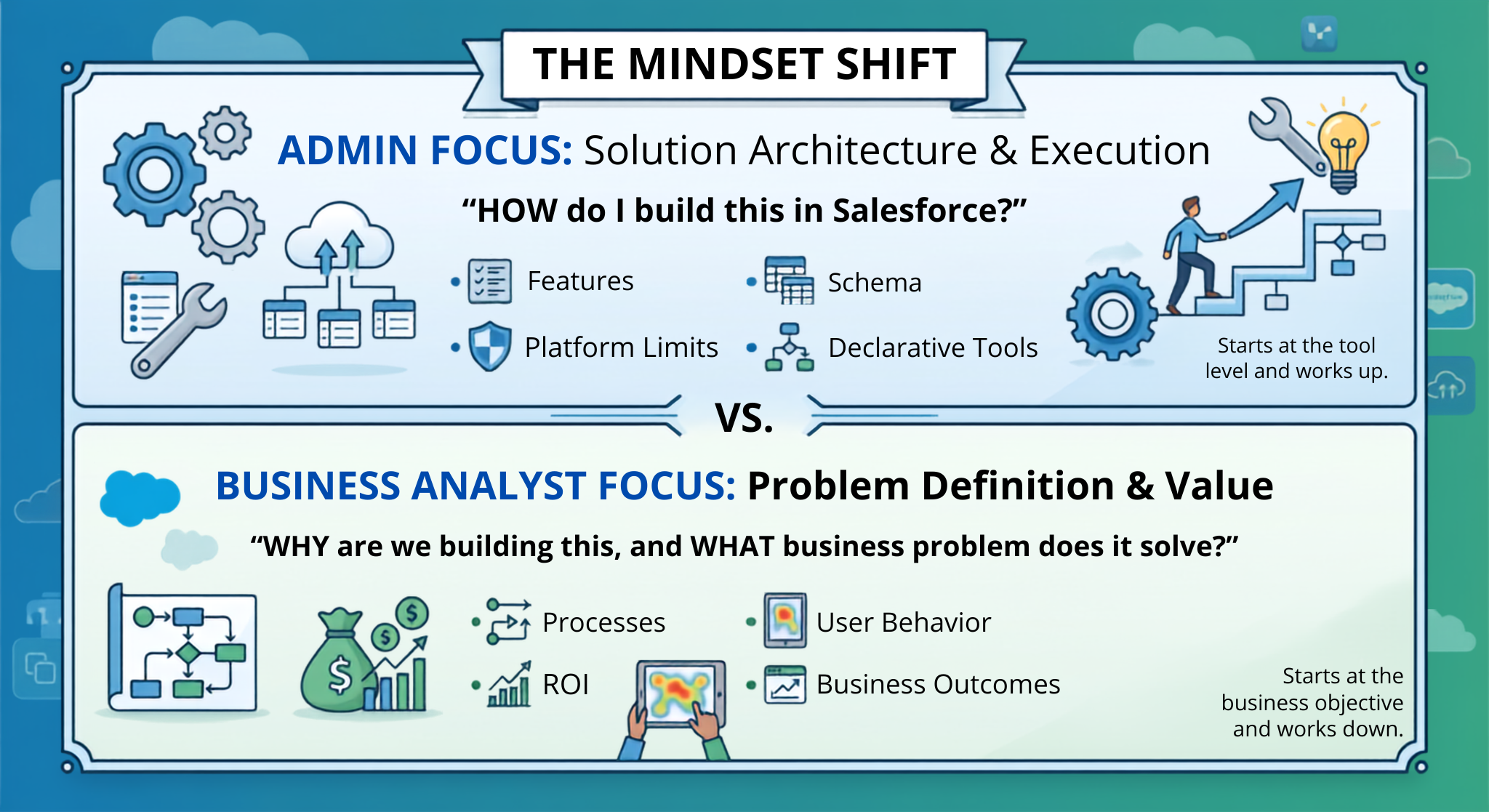
The Core Mindset Change – From "How" To "Why"
In order to make a successful career move from Salesforce Administrator to Salesforce Business Analyst, it is important to realize the difference between the two approaches to the problem.
The “Order Taker Trap”
Most Salesforce Admins begin their career playing catch-up. There’s a new ticket in the queue:
"Can we please add a required picklist field named 'Lost Reason Details' for the Account object?"
And a traditional Admin does what he does. He goes to Setup, adds the field, allocates it on the page layout, and closes the ticket.
But the Business Analyst doesn’t stop there. He probes further with several questions:
Why would this go onto the Account when it could be on the Opportunity?
What would be the decision of the management based on the input?
What effects will there be on rep efficiency if this becomes a requirement during a busy period?
Is there already some kind of process or validation in place that covers this loss analysis?
When all you do is administration, you can end up creating perfectly fine technical functionality, which goes unused or even causes disjointed processes in the business. And that is where the Business Analyst steps in to question until the business motivation becomes clear.
Important Competences of Salesforce BA
To fill in the gap between business entities and tech execution, a unique toolset is needed. The Salesforce domain knowledge gives you an awesome advantage. However, to succeed in your activity, there are five basic competences of business analysis that must be developed.
1. Competence in Requirements Elicitation and Stakeholder Management
Elicitation is more than just asking the people what they want; it implies the process of searching for hidden needs and formulating the outline of the required functionality.
Identify Major Stakeholders: Understand who is holding the purse, who is managing the process, and who is doing the work.
Carry Out Direct Discovery: Arrange structured interviews, focus groups, and job shadowing.
Practice Active Listening and “5 Whys” technique: When a stakeholder asks for a specific technical solution, apply Toyota’s “5 Whys” principle to identify the reason.
Stakeholder: "We need to create a dashboard for regional directors."
BA: "What is the purpose behind it?"
Stakeholder: "The reps are unable to see the reasons behind fall in regional sales."
BA: "What is preventing them from checking in the reports?"
Stakeholder: "It is due to the inaccuracies in close dates of the reps."
BA: "What causes those inaccuracies?"
Stakeholder: "The reps usually update close dates only at the end of the month upon request."
Conclusion: The issue at hand is not the dashboard deficiency but rather the thoroughness of the field in question and an automated reminders system.
2. Business Process Mapping (Current State vs. Future State)
To set up an effective system, it’s important to understand your organization’s workflow. Process mapping is an essential tool that acts as a bridge between business specialists and technical specialists.
"As-Is" mapping refers to the documentation of the existing processes performed in your organization at the moment without omitting any detail, including workarounds and the use of spreadsheets.
On the other hand, the "To-Be" mapping implies designing the new process and removing unnecessary steps or automation.
Among the various tools available for process mapping, the following are the most utilized:
UML process diagrams/ BPMN 2.0: This type of diagram simplifies process mapping by means of description, activity, and state of process completion.
Swimlane diagrams: This tool visualizes processes as a set of modules through tables (for example, Sales, Legal, Finance).
3. Requirement Analysis & Scope Control
Not every possible request can or ought to be implemented. The BA needs to develop raw discovery data into systematized and prioritized requirements.
MoSCoW method of prioritization:
Must Have: Features that cannot be negotiated, since they are necessary for the launch of the project (like legal compliance and core pipeline monitoring).
Should Have: Features that give significant value but have to be initially fulfilled manually.
Could Have: Features that are not essential but should be implemented in case of having time and funds.
Won't Have: Features that are out of the project’s scope, agreed upon by stakeholders.
4. Writing Acceptance Criteria and User Stories
In modern agile methodology requirements are defined via User Stories. As a Salesforce Business Analyst your main job is to write simple but useful user stories to be communicated to the development team (or future Admins).
Standard User Story Format:
As a <type> I want to <do some actions/do in some capacity> So that <achieve some specific business goal/result>.
Acceptance Tests:
User stories need to fulfil certain conditions that can be verified according to the Given-When-Then model to be valid.
Scenario: Approval of Discounts
With an Opportunity discount exceeding 20%,
When Sales Rep confirms the opportunity for further validation,
Then the status will change to "Awaiting Approval",
And an approval path will go towards the regional sales VP,
In addition, the Opportunity will be locked by Rep.
5. Change Management and User Adoption
It is important to note that the most well-planned system can fail if the users do not accept it. While Admins are concerned about system implementation, BA's aim is to deal with the human side of the issue.
Impact Analysis: No matter for whom changes are put to action, the very fact will change their routine.
Training and Enablement: Instead of 50-page generalized PDFs let’s come up with specific training, including micro-learning, in-app guidance, interactive workshops, etc.
Feedback Loops: Open formal channels such as feedback flows, user surveys, and super users.
The BA Lifecycle in a Salesforce Project
To illustrate how these skills fit together we should explore the full lifecycle of the project through the perception of a Salesforce Business Analyst.
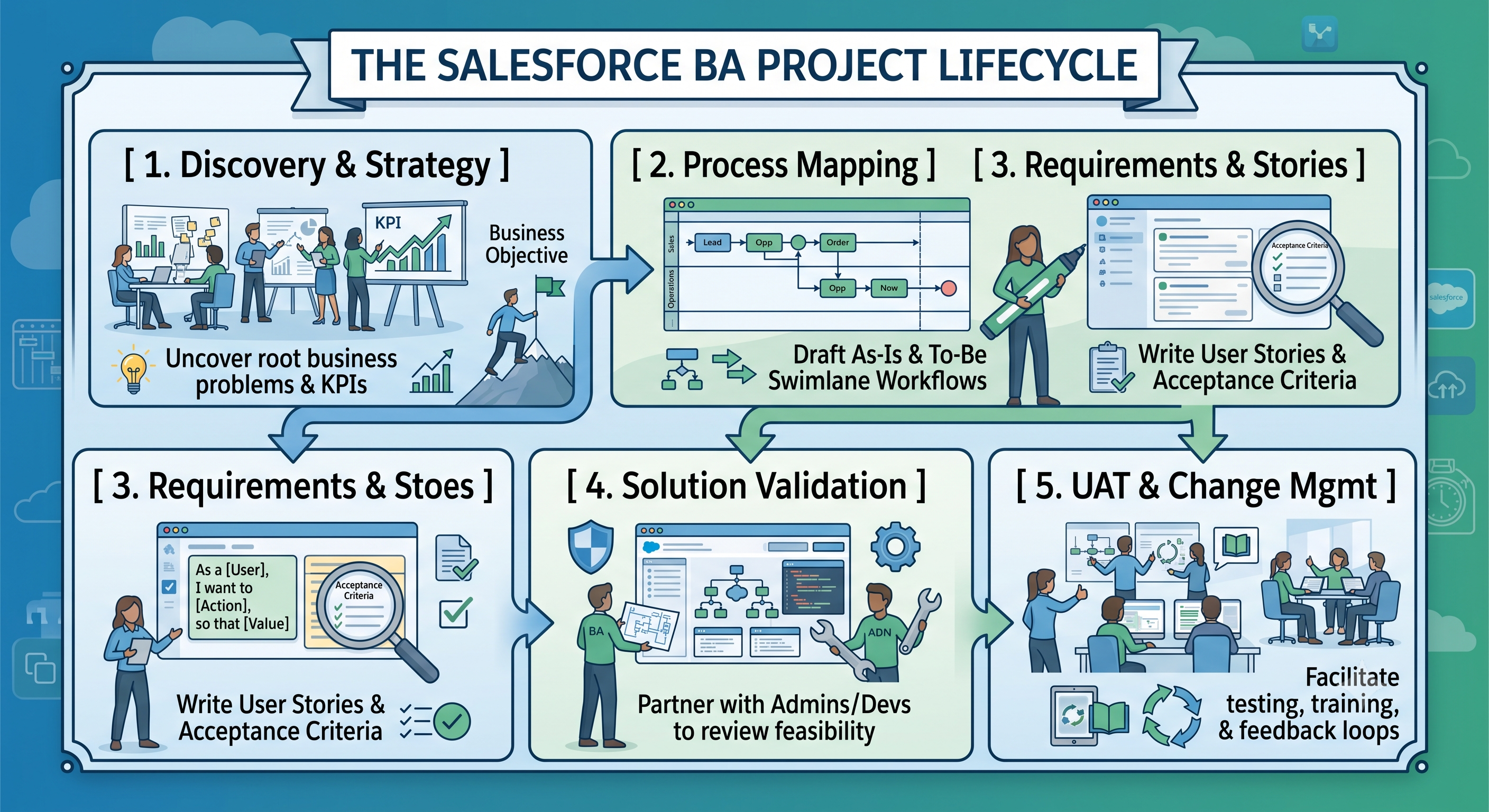
Step 1: Discovery & Strategy
Goal: Set success metrics from the outset.
Hypothetical Scenario: A SaaS company is having some issues related to high resolution time of customers queries.
BA Activities: BA instead of creating a new Case form will arrange a meeting with the Customer Support department to understand the Key Performance Indicators which could be AHT of 15% less and FCR of 10%.
Step 2: Create Process Maps
Objective: Full mapping of customer support process flow.
BA Activities The BA creates a swimlane diagram to show the journey of a customer query from the moment an email is sent to the time it is resolved. It is determined that the agents spend up to four minutes on average entering the customer data from external systems again.
Step 3: Documentation of Requirements & Refinement of Backlog
Goal: Convert operational complications into practical user stories.
BA's responsibility: The role of a Business Analyst is to create user stories which revolve around CTI integration, automated rule of case assignments and quick-text emails. The tasks are forwarded to the project backlog as well as undergo MoSCoW prioritization.
Step 4: Validation of Solution
Goal: Ensure that the proposed business solution is suitable for platform capabilities.
BA's responsibility: In this process, the business analyst’s experience as an administrator comes handy. The BA meets the developers and technical architects. As BA has a good understanding of Salesforce objects, governor limits and their declarative tools, he/she can see the solutions even before its implementation.
Step 5: User Acceptance Testing (UAT) and Launch
Goal: Make sure that the created solution meets the business need.
BA's responsibility: The BA prepares the UAT script which reflects real user scenarios. He/she educates the business users on how to use the prepared solution in a Sandbox environment, keeps track of bugs, receives the user’s approval and manages change management actions before going live.
Effective Frameworks and Techniques for the Salesforce BA
To achieve excellence as a Business Analyst, structured frameworks are essential to help gather complex information and share it among stakeholders.
Matrix 1: Stakeholders Analysis Framework (Power vs. Interest Grid)
Managing stakeholders requires devising communication methods depending on their authority and participation in the project.
High Power, High Interest
“Stakeholder Quadrant: High Power, High Interest”
Key Players: VP Sales, CRO, Executive Sponsors
Strategy: Inform these stakeholders of strategic decisions and maintain one-on-one communication with them.
High Power and Low Interest
Characteristics of stakeholders Legal Department Department of Security Compliance Officers
Approach to engaging: Keep Them Satisfied Provide them high-level overviews that emphasize the ancillary controls associated with risk management, information security, and governance, but not the tedious processes of everyday operations.
Low Power, High Interest
Attributes of Stakeholders Support Managers, Key Stakeholders, Sales Operations Manager
Approach to engaging: Keep Them Informed: Engage them in process mapping, reviews and UAT. Your best friends when implementing.
Low Power/Low Concern
Stakeholders Characteristics: Casual Users, External Contractors.
Engagement Approach: Keep Them Updated : Send them regular updates but no personal contact.
Matrix 2: Traceability Matrix of Requirement (RTM)
Requirements Traceability Matrix ensures that all the technical development aspects on Salesforce are aligned with the approved business requirements avoiding project misalignment and unnecessary changes.
REQ-101
Business goal: 25% reduction in SLA violations for VIP cases
User Story/Description: Support Reps want to be notified when high-value customer cases are unassigned for 15 minutes.
Omni Channel Routing & Record Triggered Flow scheduled path with notifications to Slack/In App Salesforce Solution Architecture
Test Case ID: TC-401
Status: In Production
REQ-102
Business Objective: Prevent unauthorised approval of discount.
User Story/Description: For managing finance I want to get the discounts above 30% approved by the Vice President, so that I do not lose on gross margins.
Salesforce Solution Architecture Custom Approval Process on Opportunities & Validation Rule to prevent changes in Opportunity Stage.
Test Case ID : TC-402
Status : Passed UAT.
REQ-103
Aim of the Business: Boost efficiency of lead conversion
User Story / Description: In the role of Sales Rep, I wish to be presented with pre-completed data about companies while adding leads so that I can spend less time on extra research.
Salesforce Technology / Technique Used: Salesforce Data Cloud / Integration with third-party enrichment solutions (for instance, ZoomInfo) in lead creation process
Testing Case ID: TC-403
Status: In the pending stage
Avoiding Typical Mistakes
You, as a Salesforce administrator moving into the role of business analyst, have a unique advantage: you are well aware of the potential of the software. However, this knowledge may turn out to be your biggest trap if you do not consider other viewpoints.
Solutioning Very Early
The Danger: While in discovery meetings, your Admin thoughts will already start creating solutions: “I can create a Dynamic Form here, an Apex Trigger on the other side, and finally, a Custom Metadata type."
The Solution: The next step is to deactivate your technical thinking during discovery meetings. Concentrate all of your attention on understanding the problem, the process, and the business value. Make a decision about what solution architecture to use only after going through the technical validation stage.
The Danger of Customization and Standard OOTB
The Danger: Stakeholders usually want custom features in Salesforce similar to their old, inefficient technologies.
The Solution: Apply your base of knowledge from your salesforce admin training course to illustrate to stakeholders how valuable using standard Salesforce functions could prove to be. Show them how the use of standard objects (Leads, Contacts, Accounts, Opportunities) and out-of-the-box functionalities can help minimize the technical debt and maintenance expenses in the long-run.
Pitfall 3: Taking for Granted that Users Know their Needs
The Hazard: Users express their pain as symptoms instead of reasons. When you implement users’ requests exactly how they ask, you end up with unorganized, bulky CRM.
The Solution: Treat users’ requests as hypotheses to validate. Confirm statements with real data (e.g., before taking users’ statements for granted, use reports regarding logs usage pattern, field completion rate, or login history).
Roadmap for Career Transition — Step by Step Guide
If you are a Salesforce administrator and you would like to move to a Business Analyst position (or formalize BA tasks in your existing job), you should follow this roadmap.
Stage 1: Reinvent Your Current Admin Position
You do not have to change your job title to commence to be a business analyst now.
Examine Your Daily Tasks: Stop accounting your work as “I have built five fields and two validation rules.” Start to present your accomplishments based on business consequences: “Streamlined the lead intake process by decreasing manual data input for the representatives by 20%.”
Offer Your Services for Discovery: Before taking on your next project or backlog task, spend thirty minutes with the person who is requesting for business to conduct a proper discovery session.
Start Recording: Develop As-Is/To-Be process maps and formal user stories for your company, even if no one has asked you to.
Stage 2: Achieve Professional Certifications
Certifications represent an individual's commitment to the profession and show potential employers that the individual knows their stuff when it comes to working with various established methodologies.
Before pursuing any advanced certifications like Salesforce Certified Business Analyst, ensure that you are well-prepared with all the necessary system knowledge. Joining a salesforce admin course online will help you learn about some basic aspects like data security, record triggers, and object relationships, which will help in creating effective business requirements.
Salesforce Certified Strategy Designer: This certification is ideal for the job of customer journey mapping and business alignment.
IIBA Entry Certificate in Business Analysis (ECBA) or CCBA: These are international credentials awarded by the IIBA and evidence of BA methodology that is widely accepted in the profession other than Salesforce.
Stage 3: Create a BA Portfolio
During job interviews for jobs in the Salesforce BA section, candidates who are able to share specific examples of their work impress the recruiters the most. Candidates should create a portfolio where they can gather:
A sample of a Business Requirements Document (BRD) or a Functional Spec.
A Swimlane Process Map that can be made in Lucidchart, Miro or Visio.
A collection of structured User Stories with Acceptance Criteria presented in the documents.
A sample of a UAT Test Plan.
Conclusion: The Strategic Future of Salesforce Professionals
Salesforce is undergoing significant changes. With the rise of low-code solutions that apparently ease the tasks of routine management through artificial intelligence enabled capabilities of Agentforce and Data Cloud, Salesforce professionals are in the process of moving from simple configuration to strategic oriented business goals.
Whether you are new to salesforce admin online training or an experienced administrator who wants to move into business analysis, closing the gap between technology and strategy is the best career multiplier. When you combine years of experience with a strong knowledge of the platform, you can move from a software administrator to a key strategic partner for a business.