
Future Workday Integration: AI and Connectivity
Last updated on Oct 19, 2026
The Architectural Evolution of Enterprise Platforms
For about 20 years, businesses have relied on enterprise planning and human capital management mainly as systems of record. They were able to concentrate all their employee records, payroll calculations, ledger documents, and procurement processes in a single database, such as Workday. However, most of the time, integration had a rather operational character: structured data was transferred from one siloed system to another through batch processing, flat files, or tightly-integrated channels. Technical specialists faced the challenge of building point-to-point connections, solving payroll problems after night-time data processing, and fixing discrepancies in schemas.
These days, the requirements of business have changed dramatically. An enterprise cannot afford to wait for the results of the night data processing to find out that something is wrong with its personnel. It would not even accept having totally separated systems where people have to connect them through human resources, finance, operations, and IT processes.
Workday has evolved from a traditional storehouse of information into an active, smart coordination center. Integration with Workday is now not only about moving data between different places but about creating a flexible intelligent enterprise matrix. In the intersection of applied artificial intelligence, autonomous automation, event-driven architectures, and integrated connectivity, the contemporary integration environment is redefining how business processes happen over various software environments.
AI-Driven Integrated Matrix
Artificial intelligence has evolved from just a stand-alone analytical engine sitting outside business activities. In current integration development, machine intelligence is integrated into the connection structure, which connects Workday with the corporate stack.
Embedded Foundation Models and Contextual Meaning
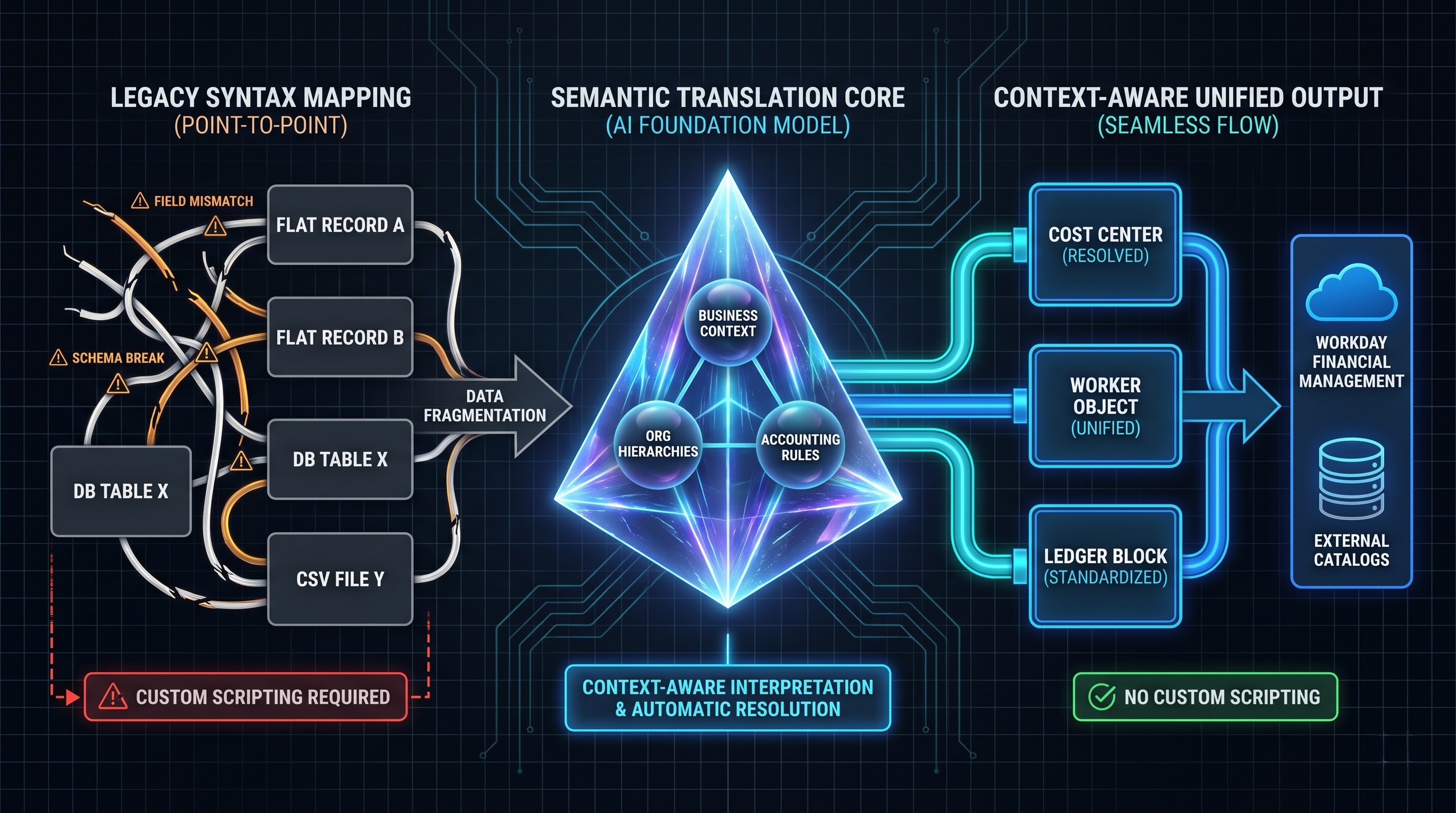
Legacy integration has suffered from the issue of semantic dissonance. The meaning of a term saying "Cost Center" in one financial application can be entirely different from the same term in Workday Financial Management. In the past, engineers were spending dozens of hours developing responsibilities for different operations.
Future integration architecture indicates the use of specialized models of business language along with various semantic intelligence tools which enable businesses to better understand the context of their operations. Intelligent layers’ purpose is to perform the function of semantic architecture, i.e. to interpret the objectives of various data types and relatedness of the types of information. Such capacity enables them to carry out integration activities while traditional integration takes place owing to fixed interpretations. For example, when integrating with third-party catalogs (be that a vendor catalog or a taxation catalog), the software monitoring the semantic architecture makes a discovery of a malfunction in the system and implements necessary amendments and validity checks. The shift from syntax-based integration to semantic structure integration makes it possible to bring substantial cuts in cash expenditures on the integrations and reduce the time for processing integration to days from months.
Predictive Integration and Anomaly Remediation
Opposed to conventional integrations that are always reactive, predictive integrations are proactive and if a mistake or an error occurs somewhere in a process, an engineer may not be involved at all.
Thanks to using machine learning techniques in the process of tracking integration zones, the businesses efficiently establish forecast layers of self-healing integrations. The technology continuously observes the transaction volume, delivers information concerning the load size, looks through the pattern of schemas, and measures the latency rates of APIs, which means that when the signals indicate that something is wrong (for instance, when there is a discrepancy between the bonuses calculated in the Workday payroll and the external systems for commission control), instead of the whole business system collapsing and being still, the technology will act upon it and improve the situation.
In fact, predictive integration pipelines can explore the records causing the problems, execute fallback solutions, alert needed users, and change current payload chunking and limit.
Agentic AI and automated cross-system orchestration
Today, the integration landscape is being developed in a way that only programming automation must be integrated into the orchestration agentic systems. For decades, robotic process automation and business process management created conditions for efficient automation of simple predictable repetitive functions but did not bring any adaptive features for changing events going on simultaneously.
Agentic systems are the key characteristic of this milestone. The difference between the former and a basic script that follows the flows of decision-making is that agentic systems act like an advanced artificial intelligence that has the ability to think critically, remember things, and take actions according to its set goals. The fact that agents are connected to Workday through secure channels enables agents to carry out complicated processes among different systems with no human involvement.
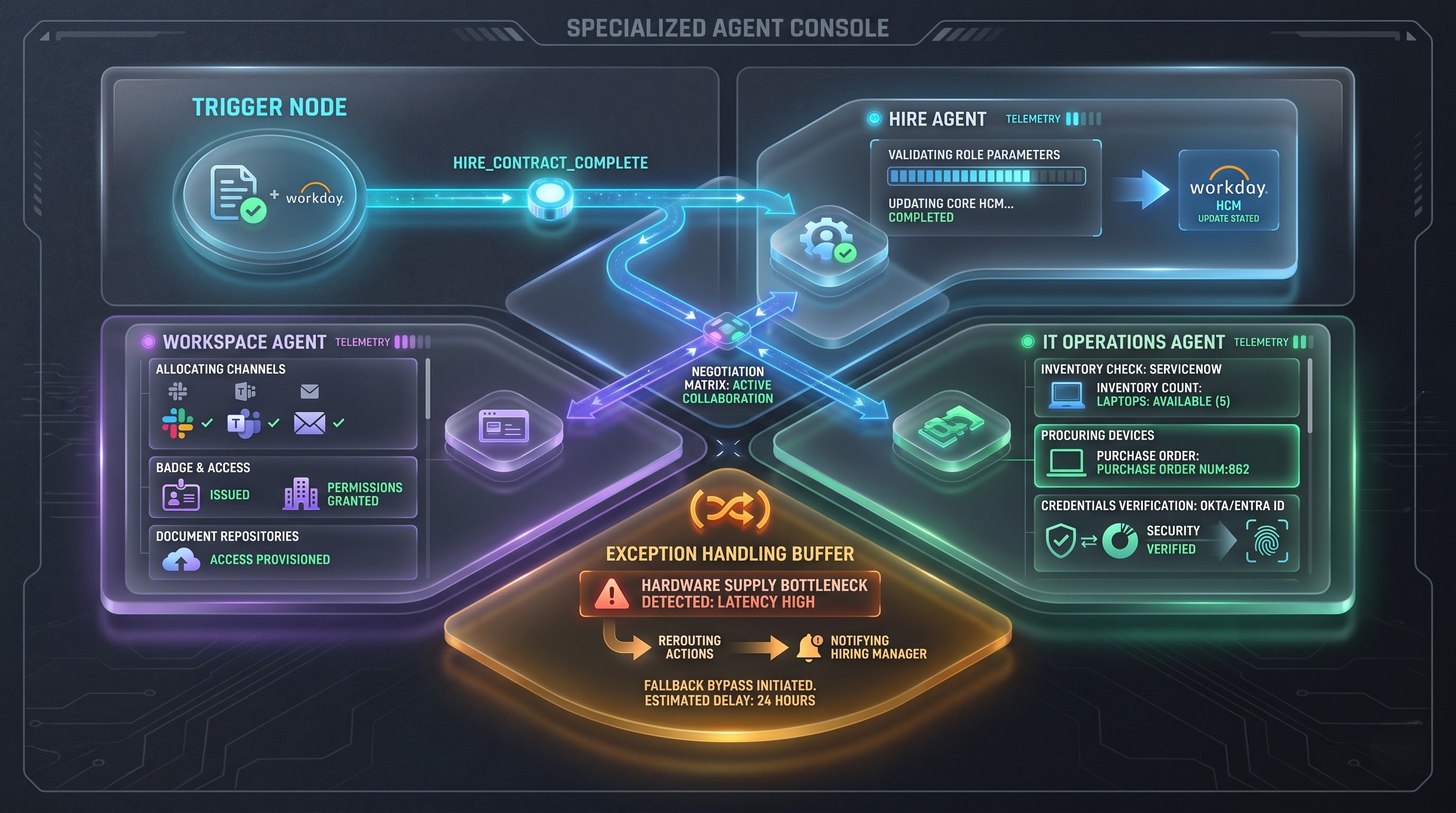
For instance, it can be applied to enterprise onboarding. The moment that Workday Talent Acquisition gives its consent to the candidate’s acceptance of the offer, automated processes start. For example, agentic systems can connect to directory services to create an account for a new employee, send notifications to IT service management, send welcome emails using messaging systems, and connect to building access management systems. In this case, the process will be paused until the manual input takes place in case of a missing asset or a failure of identity authentication in directory services. It is also worth mentioning that agentic systems can work together and perform beyond the limits.
The hire agent locked the completed hire contract into Workday.
The agent coordinates with the IT operations agent in his platform, for instance, ServiceNow, to ask about real-time hardware inventories, procure hardware that might not be available, and securely request for identity provisioning in Okta or Azure Active Directory.
At the same time, the agent assesses the new employee's specific department, role, and historical project alignments, pre-configuring appropriate communication channels, document repositories, and security entitlements.
Should any exceptions occur-such as delays in hardware delivery-the agent will go through alternatives, dynamic buffer changes, and real-time communications to the hiring manager, autonomously resolving the operational impasse, really.
It is not necessarily a straight-through workflow-a transaction-in-trade intelligence and multi-dimensional negotiation through the enterprise ecosystem anchored to Workday as the transactional anchor of identity and organizational layout.
Hyperautomation: Moving Past Rigid Enterprise Workflows
Hyperautomation refers to the advancement of business operations to a new extent. By integrating artificial intelligence, process analytics, workflow optimization, and effective orchestration, hyperautomation makes it possible to completely automate any tasks that can be automated. In terms of Workday, hyperautomation means getting rid of inefficiencies in HR and financial operations.
Current User Experience Trends in Business Applications
The user experience concept is undergoing noteworthy changes. Until now, the main parameter that defined the effective use of software was whether workers managed to log in to the software to complete certain tasks. Presently, the tendency is in tracking employees wherever they operate (in message applications such as Slack and Microsoft Teams or apps designed for mobile use). Modern integration pattern implies the use of conversational generative AI to make the complicated equipment hidden from users who do not have to log in to read process regulations (for example, how to apply for a leave).
In the chat program, the employee writes, "I'd like to take leave next Thursday and the following Friday due to family reasons." The back office has an ‘invisible’ AI assistant that interprets the employee’s message, checks the approval request through Workday APIs, and verifies the available days off in the company. In addition, the AI checks the members of the team using project management tools and makes a decision about the request according to company regulations.
Intelligent Continuous Finance and Automated Closes
Happy New Year, Managers! The integration of Workday and other third-party products has been known to depend on the month-end closing activities of finance departments. Financial departments have had to perform different accounting cycles of ledgers’ reconsiliations, banks transaction importation, foreign exchange conversions, reconciliation and matching of invoices, and much more for months. With the implementation of hyperautomated systems integration technologies, the companies get closer to the aim of the continuous accounting cycle. Continuous financial systems can access clients’ banking transactions data.
The advances in computer vision and natural language processing technologies play a critical role in automating the process of extracting structured data from vendor agreements, contracts, and bills and ensuring that the collected data is three-way matched against purchase orders and necessary invoices, without any human input. In case of any discrepancies, exceptions, or violations, alerts will be sent to human users while all routine transactions are automatically completed in real time. The usual thought of preparing end-of-month reports has been replaced with the idea of constantly running reconciliation.
Enterprise connectivity and next-gen integration architecture
The definition of enterprise connectivity has changed dramatically because of the demand for speedy data transfer between entities and complex interaction methods.
Event-driven architecture and real-time streaming
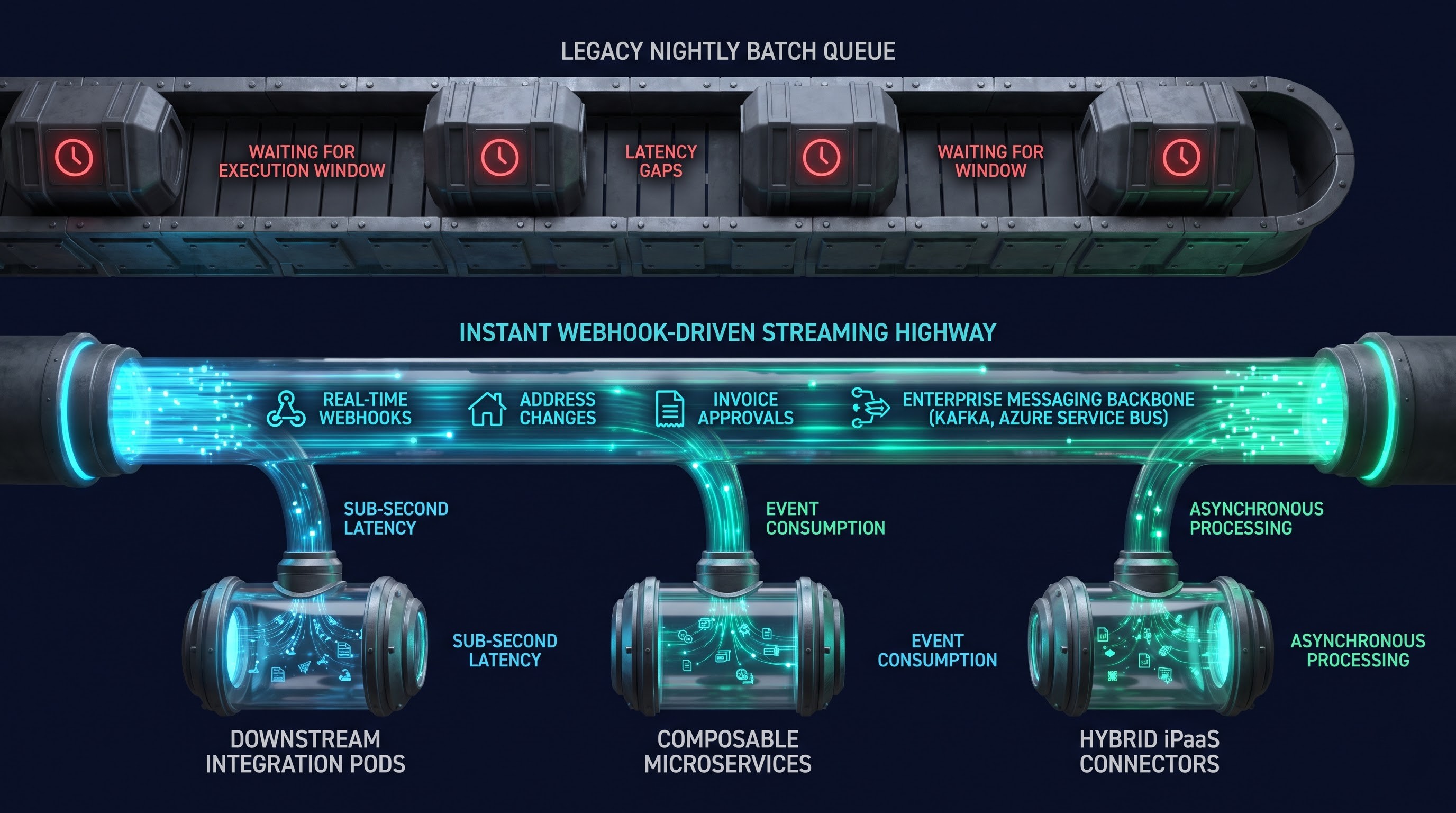
Historically, the Workday integration framework worked on the pull principle where external schedulers used to query Workday to get the latest updates. However, despite its efficiency, this approach was associated with many delays.
Hence, a new paradigm of event-driven architecture has emerged. Workday employs the use of webhooks, unified streaming protocols, and outbound messaging to transmit changes in state immediately when they happen—for example, the changing of an address by an employee, the approval of an invoice, or the stock level of an item being low.
When the event takes place, it is passed to a reliable and resilient enterprise messaging backbone of a type, e.g., Azure Service Bus, Apache Kafka, or Amazon EventBridge.
The Role of Hybrid iPaaS and Composable Architectures
Applications that are incapable of processing the events in real time, whether they are internal or those belonging to SaaS packages, are capable of working with the event streams only asynchronously. The event-driven means of connecting the systems creates conditions for synchronizing the data in real time throughout the software ecosystem, while at the same time enabling the creation of lightweight and responsive microservices around the most important business processes.
There has been a phenomenal evolution of iPaaS as it advanced from the status of general cloud integration methods to a full-fledged vendor orchestration tool. The cutting-edge iPaaS systems have connectors meant particularly for Workday and intended to simplify authentication and pagination issues.
Additionally, the companies are turning to composable architecture. Rather than relying on the complex business rules for integrations, the engineering teams prefer the reusable components for making integrations.
Thus, the integration service capable of getting the information about the hierarchical structures or updating cost blocks can be developed once and reused later in a number of business cases. All in all, composability takes a crucial role in building blocks of launch timing reduction.
API Standardization, GraphQL, and Extensibility of Piecemeal Services
While developing and the integration services, there were many different Web Services provided by Workday; older standards like SOAP are still of use but they are difficult to realize.
All businesses today require agile and user-friendly implementations. Because modern RESTful APIs are emerging quickly alongside GraphQL layers gaining popularity among enterprise-level applications, integration architects have the power to efficiently retrieve specific data they are looking for.
Workday Extend and the use of advanced API Gateways enable organizations to develop customized applications and workflows according to their needs while effectively functioning within the Workday environment. Yet, the management of such a hybrid system necessitates the formation of an initial understanding of the workday integration system fundamentals, from Enterprise Interface Builder (EIB), Report-as-a-Service (RaaS) to Document Transformation and custom Web Services. The potential of the platform itself together with its extendability through external services allows for organizations to adjust their processes accordingly.
Security, Compliance, and Governance of AI Systems
As integration architecture is becoming more automated and linked, the security perimeter becomes wider and wider. Any HR or finance solution contains very sensitive information from the company, such as personal data, information on top managers’ salaries, bank accounts data as well as intellective data and cost forecasts. In order to enable those applications to work with contemporary AI-based technologies and external integrations, high-level endpoint security is necessary.
Zero Trust and Identity Context
Traditional perimeter protection systems are inadequate in a world of ever-expanding cloud integrations. In practice, the application of Zero Trust implies that:
Every application or service connecting to Workday must undergo constant verification of its authentication and authorization procedures.
Fixed interface and constant access should make way to dynamic tokens generated per OAuth protocols with help from hardware identity verification services.
All new integrations must also maintain high-quality identity context representation. This means that there is no need to resort to a universal service account even when using a machine learning agent or another management entity to operate Workday on behalf of another user.
The user’s identity and security profile are communicated from the user to the application.
As a result, there are no chances that an employee would have a way to bypass the security mechanisms and acquire access to financial data solely by reaching out to an intelligent assistant or a third-party chat system.
Importance of Data Privacy, Sovereignty of Clouds, and Legislation
While engaging in global business operations, companies are always faced with one obstacle or the other arising from compliance with legal provisions in different jurisdictions in such regulations as the General Data Protection Regulation (GDPR) of the European Union, the California Consumer Privacy Act (CCPA), or restrictions imposed by different nations on international data transmission.
The technology of the next generation of middleware has to take into account the national legislation. The new connectivity technology will make it possible to implement automated sovereign data-management techniques enabling the blocking of data transfer across borders through middleware.
In addition, while AI solutions use data from Workday for operational insights or to make decisions, the companies are obliged to make use of the strict isolation of tenant data. The special requirements prevent the leaks of any data from companies, requiring the Loop to be completely closed and complying with data-providing regulations and obligations of confidentiality.
Accountable AI and Algorithmic Auditability
The emergence of self-operating agents involved in various automated operations such as promotion tactics, selection of applicants, and cost accounting reflects a huge move towards the implementation of responsible practices in the corporate world. One of the latest trends is the necessity for businesses to implement auditable and transferable logs of actions performed by self-operating systems.
The main goal of the integration framework is to deliver a comprehensive report on the functioning of the AI system. The report should include the names of the algorithms that were employed, the information that was used and enabled calculation of the respective results, the assessment of the results reached, and API systems used for processing.
Strategic Implications for Enterprise Leadership
Business leaders are witnessing a shift in their role as a result of a combination of technologies like AI, hyperautomation, and connectivity. Now it has become necessary for the business leaders who are in charge of acquiring the technology such as CIOs, CTOs, and CHROs to think about systems integration as not only a task for the system integrator but rather an integral part of their business strategy since the companies are becoming the masters of their innovative connectivity architecture.
As a result, companies with their state-of-the-art connectivity architecture possess all the advantages of a fully agile organization. They can now carry out their acquisition strategy and provide software solutions faster than before, while saving money and enabling their employees to use modern technologies. On the contrary, companies employing the traditional point-to-point integration technologies are actually bound by the legacy systems and, therefore, cannot implement their strategy.
Intelligent, Connected Enterprise
The development of Workday Integration is a perfect illustration of the overall evolution of enterprise computing. Formerly, transferring structured data between different databases was purely seen as a business necessity; now this practice has developed into a smart and reactive system to meet the needs of the present-day cognitive enterprise. As AI technologies gain more contextual understanding and autonomous agents are involved in carrying out more and more tasks, while event-driven architecture connects different systems into a unified environment, traditional boundaries of such fields as finance, HR, operations, and IT will vanish. This development will take place with Workday leading the process because it will no longer serve as a mere online storage, but will become an active participant in the business process. Those companies that are willing to switch over to this new technology will be able to form a resilient ecosystem able to change rapidly.
In order to implement this modern connectivity strategy, organizations need people with high competency levels, who are not only proficient in the classical architectural principles but also in the contemporary event-based flows. Architects, developers, and consultants who want to spearhead these kinds of changes may first start by getting their workday integration core certification. People who want to get practical training in the real world and be guided by experts can consider joining a workday Integration course in India offered at OnlineITGuru.