
Google Cloud and Ab Initio Collaboration to Aid Businesses in Data Preparation
Last updated on Sep 17, 2026
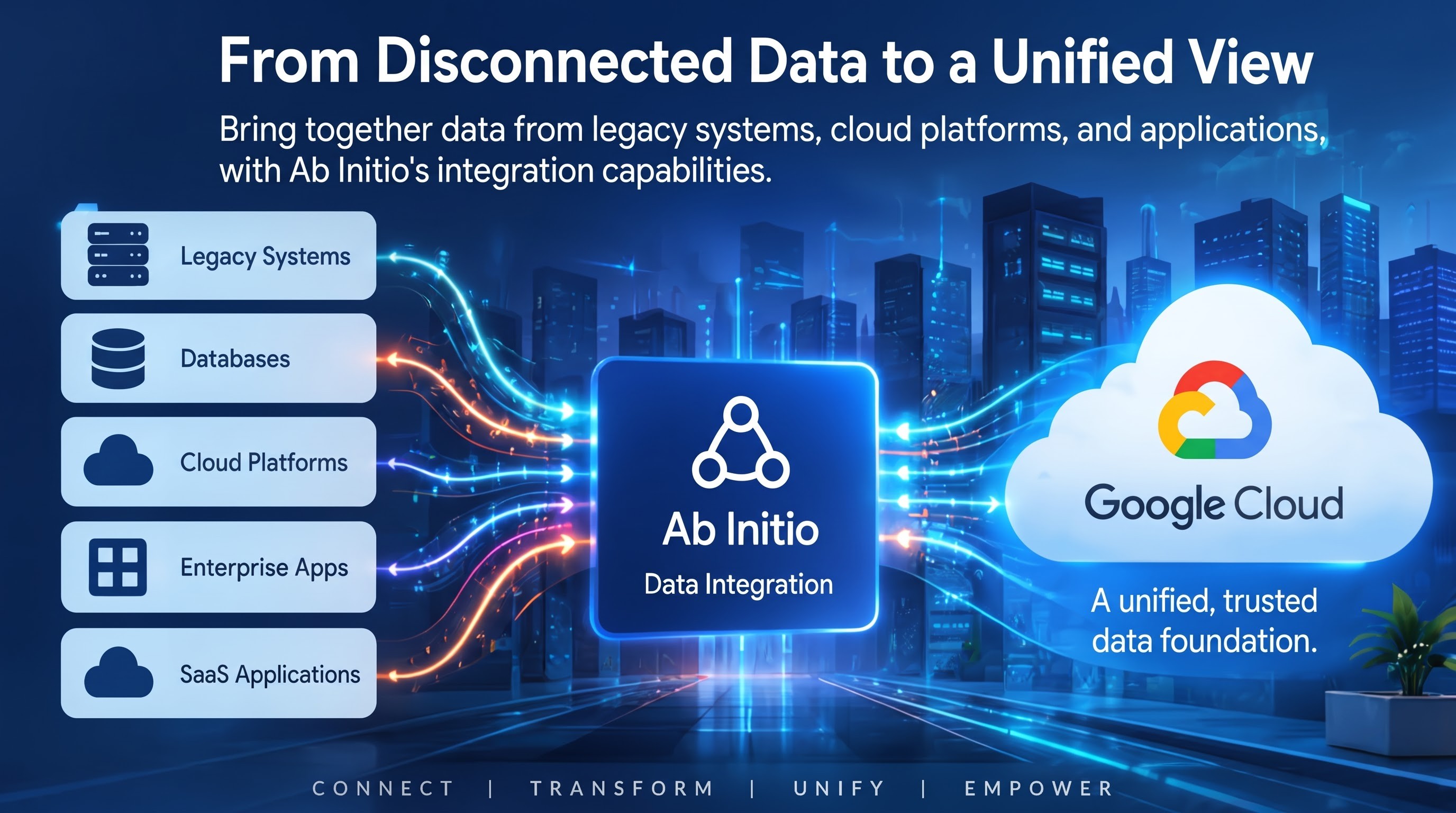
Artificial intelligence and machine learning are transforming the way businesses perceive data. In recent years, businesses were more concerned with gathering and storing data in warehouses and utilizing it mainly for analysis and reporting. However, the introduction of generative AI and AI agents is shifting organizations' focus to data that is trustworthy, well-documented, and organized so it can be used by intelligent applications. Google Cloud and Ab Initio recently announced a collaboration to make information and analytics more prepared and integrated, as both companies aim to meet the growing demand for data preparation solutions.
Why Enterprise Data Needs a New Approach
Large enterprises rarely work with data stored in a single repository. There may be databases with customer data, a separate database with financial data, operational data stored in legacy applications, and data residing in various cloud services and Software-as-a-Service (SaaS) platforms. Moreover, the more such systems, the harder it is for enterprises to operate and ensure data integrity. Data migration between different systems is only part of the challenge: organizations also need to track data provenance, changes, quality, and access rights. Not least, businesses need to ensure that the same data can be used for analytics, and for training AI models, and applied in different machine learning techniques. Enterprises are now prioritizing data quality, metadata, data lineage, data governance, and data integration and migration. They are looking to make this data accessible, understandable, and usable for analytics and AI at higher levels of complexity.
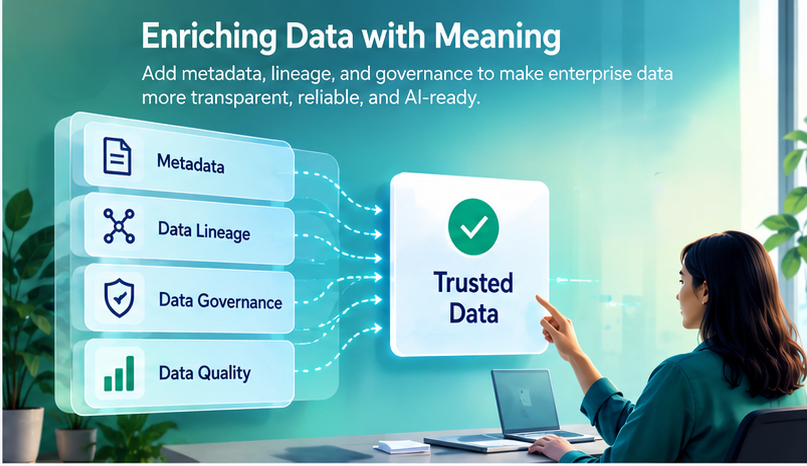
With the advent of AI, the challenges of enterprise data management have taken on new importance. AI applications can analyze large amounts of data, but this does not always reflect reality. If there are problems with the source data, derived information and recommendations may be distorted. Inaccurate information in customer databases, redundant data fields, or the use of different classifications for the same information will cause AI to produce unreliable results. Enterprises are now focusing more on ensuring data quality and increasing the level of data trust. The critical success factor for implementing AI is a confident assessment of data value and trust. Meanwhile, critical data infrastructure is increasingly being viewed in a broader context: data analytics, data science, and AI.
Ab Initio is facing this challenge due to the fact that its platform has been utilizing enterprise data integration, transformation, quality, and other related data management needs. At the same time, the Google Cloud Company is providing infrastructure and services for organizations that can be applied for large-scale data analytics and AI. The partnership is meant to move these fields closer to each other and solve the problem of connecting challenging existing data environments to modern cloud and AI technologies with no loss of relation to the context of the information.
What is being achieved by Google Cloud and Ab Initio?
The partnership that has been revealed between Google Cloud and Ab Initio in the year 2026 has made it possible for the capabilities of Ab Initio to be linked with parts of Google Cloud data and AI ecosystem. Google Cloud has noted its integration with the following technologies: BigQuery, Dataplex, and Gemini as the basis. In addition, Ab Initio brings the capabilities of data integration, metadata, governance, and data management to the collaboration. The value of the collaboration is bigger than just linking two tech products. It enables enterprises to put information from different worlds into a cloud-based data and AI architecture and preserve some critical information about this data.
The development is beneficial for companies that worked for years implementing various big and complicated technologies. An example of such companies may be banks, insurance enterprises, or retailers that have heavily-used applications that cannot be replaced by any other cloud solution. Some data can stay in legacy solutions whereas the new technology operates in the cloud. These two parts should not be treated separately, and companies need to find out the way they can connect them and ensure smooth information flow.
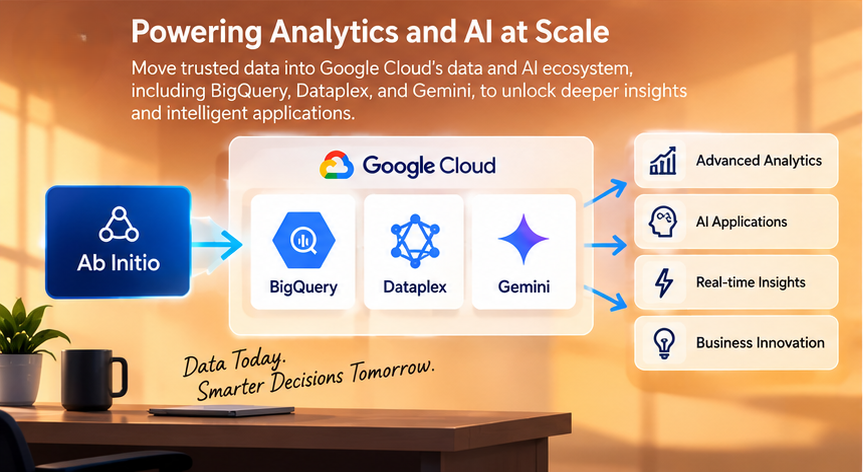
Another crucial aspect of development is metadata. According to Google Cloud, the relationship facilitates metadata-sharing from over 500 data sources and provides information about transformation and lineage. This can be critical for a business as it provides insights into data as it flows through different systems. Simply knowing that some number is stored in a cloud warehouse is helpful, but knowing where this figure originated, what changes were made to it, and how it connects to the original source can be much more important in terms of making usage of that information in business-related decisions and AI applications.
The Move from Traditional ETL to AI-Based Data
Traditional ETL has been important in the enterprise data architecture for decades. Extracting data from source systems, transforming whatever is collected per business specifications, and loading it into the destination like a warehouse or analysis platform is what traditional ETL stands for. While the ETL process is still vital to this day, the modern data landscape is much wider than the traditional warehouse model. Information can be consumed by dashboards, cloud applications, machine-learning systems, APIs, automation, and AI, which means that data pipelines have to meet more requirements than ever.
This is where the idea of AI-ready data takes on significance. AI-ready data refers to not just the sheer volume of data in the cloud, but actually data that has the proper framework, attributes, context, and governance so that the apps can make effective use of it. If we for example think about AI being used to work with customer records. If those records are inconsistent or incorrectly labeled, AI may not be able to tell which pieces of information are correct. So the problem could be seen as AI problem, but the root of it may stem from data integration or data quality problems.
This broader need results in organizations changing their perception of data engineering. They no longer see pipeline merely as a way to transport the records, but realize how important it is to understand the whole data flow: from the original source through transformation, quality assurance, metadata, governance, storage in cloud, analytics, and finally consumption by AI. Being able to work in this complex system makes Ab Initio a suitable technology since it can be used for various data management activities. Therefore, for people studying ab initio training these connections are becoming more and
The Importance of Metadata and Data Lineage for AI
Metadata is perhaps one of the most overlooked aspects of a data space, but it has a significant role to play in how well organizations process their information. While data tells a system the value of something, metadata provides the surrounding circumstances to make sense of that value. For instance, the name of the field “customer status” can convey a multitude of meanings, depending on whether it stands for an active account, a bought product, a subscription to a service, or something else. Thus, merely providing an AI with access to that information does not guarantee that it will comprehend its meaning.
Data lineage represents another important part of visibility in this process. As the organization grows, a number on the dashboard can come from various systems that have gone through different transformations before reaching its final point. After something has changed, engineers and analysts must know where it happened. Data lineage helps them locate the origin of the change and thus adds visibility to this aspect of processing data.
The connection between Google Cloud and Ab Initio means taking into account how the context will play a role in today’s cloud data space. This is important, because AI systems increasingly need to work with corporate information that has context, history, and rules governing it. A data platform will provide the necessary computing/storage power, and a data platform will not provide the necessary understanding of what each piece of corporate information actually means. Therefore, the usage of cloud solutions escalated and helps to create a better context for analytics and AI.
The Importance of Changes for Data Engineers
The transformations in the connection between data integration and AI influence the practices of data professionals as well. In former times, a data integration engineer was mostly pre-occupied with developing graphs, creating transformations, connecting data sources, working on the flows in the process, and delivering data to the final destination. It is true that these steps remain significant for the work of data engineers, but modern data engineers need to have a deeper understanding of the architecture of the data flow.
The significance of cloud knowledge is actually increasing. The role of an enterprise data engineer includes understanding the interaction between an integration workflow and a cloud data warehouse, the management of metadata, processes that ensure data quality, and the role of the information in relation to downstream analytics or AI systems. Hence, learning the tool itself is only a part of his/her development into a well-rounded data engineer. Someone who takes an ab initio course online will learn about the platform but learning about cloud platforms and their governance, metadata, APIs, and modern AI workloads will allow him/her to apply that knowledge in real projects.
However, it is important to highlight that traditional Ab Initio skills have not lost their relevance. Big enterprises continue having huge volumes of data, complex transformation needs, and critical workloads relying on proper integration. Therefore, the role of these skills is evolving. A data engineer who understands the mechanics of integration from the technological perspective and the reasons for data usage in the business context becomes a more valuable asset for various projects.
Implications of the Google Cloud and Ab Initio Development for the Market
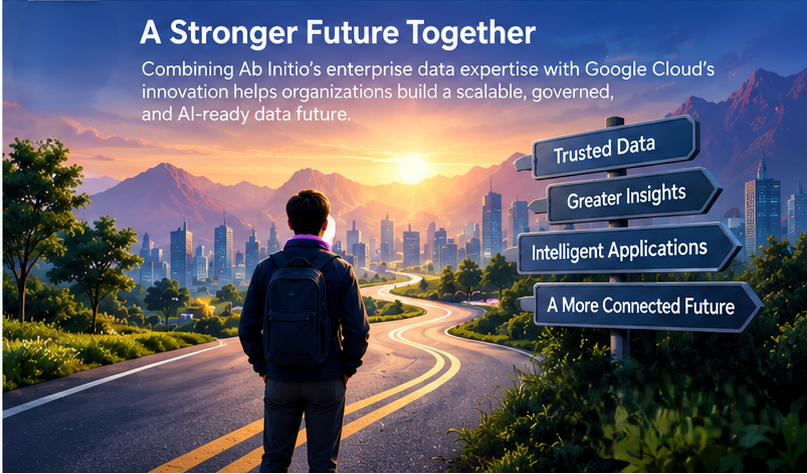
Google Cloud and Ab Initio collaboration emphasizes the evolution of enterprise data architecture. The change in paradigm regarding cloud migration is that it is not simply transferring data from one place to another anymore since the importance of cloud platforms as the backbone of analytics technologies, automation, machine learning, and artificial intelligence becomes more evident. In order to take advantage of the latest technologies, organizations have to create an efficient data pipeline and be aware of the data that passes through it. This adds data integration, quality, metadata, and governance closer to the center of AI discussion.
At the same time, Ab Initio belongs to a competitive market of data integration solutions which includes established enterprise platforms as well as modern cloud-oriented technologies. Organizations have a wide range of instruments for building modern data architecture. Different companies will choose different combinations of platforms based on their systems, strategy in the cloud, budget, and technical requirements, which means that the cooperation with Google Cloud does not necessarily imply using the same architecture for everyone.
The changing technology and market have made it pertinent for professionals to look beyond certain aspects of software functionality and features. While ab initio training offering an ab initio foundation give an insight into software, the more important part of learning lies in understanding the role that technology plays in the overall data ecosystem. It is more important to understand how information gets integrated, transformed, and managed, understood, moved to the cloud, and then used by analytics programs and AIs.
Indeed, the development of Google Cloud and Ab Initio illustrates one very specific change in the technology used by businesses. Companies now focus not only on getting the data from one system to another but also on ensuring that the data is accessible, trustworthy and easy to work with sharing different types of business applications. The importance of data will increase in relation to AI as AI will be getting more integrated into business operations.
This allows Ab Initio to gain an edge by making its data management capabilities relevant in an industry that is becoming increasingly defined by cloud computing and AI. This helps Google Cloud to expand its offerings to meet the sophisticated data environment requirements of several enterprises. It also illustrates that the future of data engineering is bound to be more complex than just ETL methods in relation to data. The new definition of data will encompass aspects such as data integration, metadata, data governance, cloud facilities, and AI.