
How Fast Can You Become a Job-Ready Business Analyst?
Last updated on Nov 27, 2026
One of the most popular career moves for students, working professionals and career switchers across industries is breaking into business analysis. The role bridges the gap between business operations, stakeholder communication and data-driven decision-making, so it doesn’t pigeonhole candidates into a specific academic degree or technical background. But would-be professionals often face a frustrating wall of conflicting claims on the web. Some bootcamps say they can get you job-ready in thirty days, while university programs suggest two full years to earn a specialised master’s degree.
For the majority of focused learners, it takes three to nine months to become a job-ready business analyst. That window will contract or expand based on where you start, how many hours you can dedicate per week, and if you’re building artefacts or simply passively watching tutorials. Knowing the difference between learning theory and being employable is the main way to set a realistic timeline and get your first offer.
What does “job-ready” really mean?
“Having a finish line helps before you start plotting out the months on a calendar. To be job-ready as an entry-level or junior business analyst is not about knowing every enterprise software suite in the market or having five years of domain authority. Instead, job readiness is about having the practical competence to get through structured interviews and be a productive member of the team in your first ninety days.
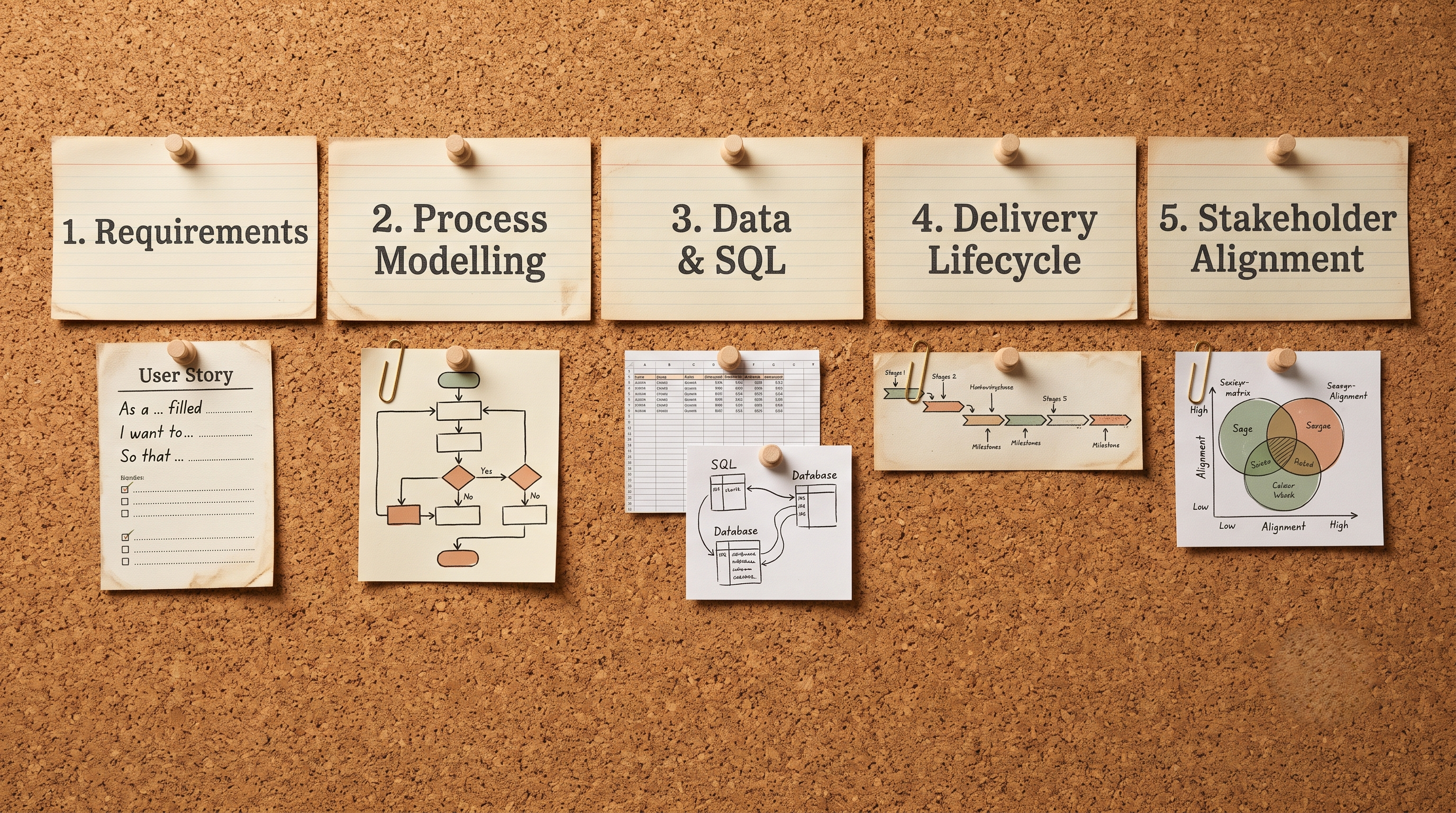
Hiring managers measure entry-level business analysts against a well-defined set of baseline capabilities:
Requirements Elicitation and Documentation: You should know how to interview stakeholders, identify underlying business problems and convert vague requests into structured documents such as a Business Requirements Document, a Functional Requirements Document or even clear Agile user stories with testable acceptance criteria.
Process Modelling and Gap Analysis: You should be able to diagram out how a business workflow operates today—often called the current state—recognize bottlenecks, and design an improved future-state workflow.
Data Querying and Analysis: Business analysts today don’t have to rely on intuition alone. They want you to pull data from relational databases, clean up messy spreadsheets, detect patterns, and present insights visually.
Delivery Lifecycle Fluency: Whether a company builds software using traditional sequential phases or iterative Agile sprints, you need to understand how your requirements move from initial discovery through development, quality assurance testing and user acceptance.
Stakeholder Alignment: You are comfortable playing translator between non-technical business leaders and technical engineering teams, navigating shifting priorities without breaking delivery.
Notice what is not on this list: you do not need to be a software engineer. Many candidates spend 6 months trying to learn advanced machine learning or full stack programming. Technical literacy is a plus, but a business analyst’s main currency is clarity, structured thinking and communication.
Realistic Timelines Depending on Your Starting Background
No two candidates have the same exact baseline. Some skills you can skip or fast-track based on your education and work history. Others will require a deep foundational work.
Information Technology Professionals (Developers, Testers and Support Engineers)
If you are already working in software development, quality assurance, technical support or systems administration, you have the shortest runway, typically two to four months. You know how software is built, tested and deployed and you probably speak engineering teams language fluently. Perhaps you know how to write database queries or sift through issue tracking platforms.
For the most part, your transition is a shift in perspective. Instead of learning to code or test a feature, you have to learn how to ask why the feature is needed in the first place, how to quantify its return on investment, and how to negotiate scope with business stakeholders. Two to three months of focused practice in requirements elicitation, process modelling and business case writing should be sufficient to make you a very attractive hybrid candidate.
Non-IT Domain Experts (Finance, Operations, Healthcare, Sales)
For most banking, supply chain, retail management, healthcare administration, or customer success professionals, it takes three to six months to be job-ready. Many career switchers don’t realise how valuable their domain experience really is. Companies that build financial software or hospital management systems are looking for analysts who already know about regulatory compliance, billing workflows, and customer pain points. That's knowledge a pure computer science graduate would take years to learn.
Your gap is mainly in formal business analysis frameworks, technical documentation standards and modern data tools. Spend 4-6 months learning how to structure Agile user stories, write database queries, and build interactive dashboards, while framing your past domain accomplishments through an analytical lens, and you can often skip entry-level associate roles, and go straight to mid-level domain analyst roles.
Recent Graduates in Business, Commerce or Economics
Those with degrees in business administration, commerce, finance or economics usually require four to six months of focused preparation. As a student you already have a background of introductory statistics, organisational behaviour, market forces and accounting basics. You understand how companies make money and how they measure efficiency.
Too often, university coursework doesn't cover the hands-on toolset you'd actually use on modern delivery teams. Spend most of your time learning how to use spreadsheet modelling, relational database querying, business intelligence visualisation tools, and software lifecycle documentation. Your business fluency, combined with visible portfolio projects, closes the gap between academic theory and corporate execution.
New graduates from non-business backgrounds & absolute beginners
Coming from humanities, arts, pure sciences or unrelated field with no corporate experience, plan for 6 to 9 months. Starting from scratch means building three different layers of competence in parallel: general business acumen, technical data tools and formal requirements engineering.
Packing all three layers into eight weeks often leads to shallow memorisation that collapses in scenario-based interviews. Six to nine months gives you time to absorb the business basics at a pace that’s comfortable, to practise the technical tools until they feel second nature and to build a credible portfolio of case studies that proves to recruiters that you can do the work, even without a traditional background.
Decomposing the Learning Curve by Core Skill

To understand why the timeline is several months long, it helps to look at how long it actually takes to get to working proficiency in each pillar of the business analyst toolkit. Working proficiency is about being able to solve real business problems on your own, Not just about learning all those esoteric items on the software menu. By enrolling yourself in a structured ba analyst training program, you will be able to gain competence in these basics without spending months trying to figure out what to study next.
Fundamentals of Business Analysis and Lifecycle Approaches
It takes about 3-4 weeks of consistent study to get a handle on the fundamentals of business analysis including stakeholder analysis, requirements lifecycles, Agile Scrum ceremonies and traditional sequential project management. At this stage, you learn the vocabulary of the profession. You learn how a business need is translated from high level strategic goal to granular sprint tasks. How analysts verify that the end product actually solves the original problem.
Requirements Documentation & Process Modelling
After you get the theory, it takes another three or four weeks to learn how to make real artefacts. Writing clear unambiguous requirements is much harder than it seems. One common problem for beginners is writing vague statements that leave developers guessing about edge cases. You will learn how to write well-structured requirements documents, crisp user stories with clear acceptance criteria, and draw visual process diagrams using standard notations to show the current state of a workflow compared to the proposed improvements.
Advanced Data Analysis & Spreadsheets
Microsoft Excel or Google Sheets is still the workhorse of the day for almost every business analyst. If all you know is how to enter data and do simple sums, then expect to spend two to three weeks getting up to speed. You have to be comfortable cleaning raw data sets, using lookup functions to merge information across sheets, building pivot tables for summarising large volumes of transactions and applying conditional logic to flag anomalies.
Querying Databases Using SQL
Business analysts today need to have a handle on Structured Query Language. Even if you aren't building complex data pipelines, you need to be able to pull your own data to validate hypotheses, investigate customer complaints, or verify that a new software feature is capturing transactions correctly. It usually takes 4–6 weeks of daily hands-on practice to learn how to write clean queries (filtering records, aggregating metrics, joining multiple tables, writing subqueries).
Visualisation of Data and Business Intelligence
Executives don’t look at raw spreadsheets, they make decisions with visual dashboards. It takes about 3 to 4 weeks to learn a leading visualisation platform like Power BI or Tableau. You aim to do more than build colourful charts; you want to understand data modelling principles, calculate key performance indicators accurately, and design intuitive layouts that answer specific questions from leadership at a glance.
Issue Tracking & Collaboration Tools
Modern delivery teams manage their day-to-day work in platforms like Jira, Confluence or Trello. It takes 1-2 weeks to get a handle on how to build out a product backlog, link user stories to documentation pages, track sprint progress, and maintain user acceptance testing boards. These tools are a reflection of the Agile concepts you learn early on so they are usually easy to pick up once you understand the underlying workflow.
A month-by-month guide to becoming job-ready
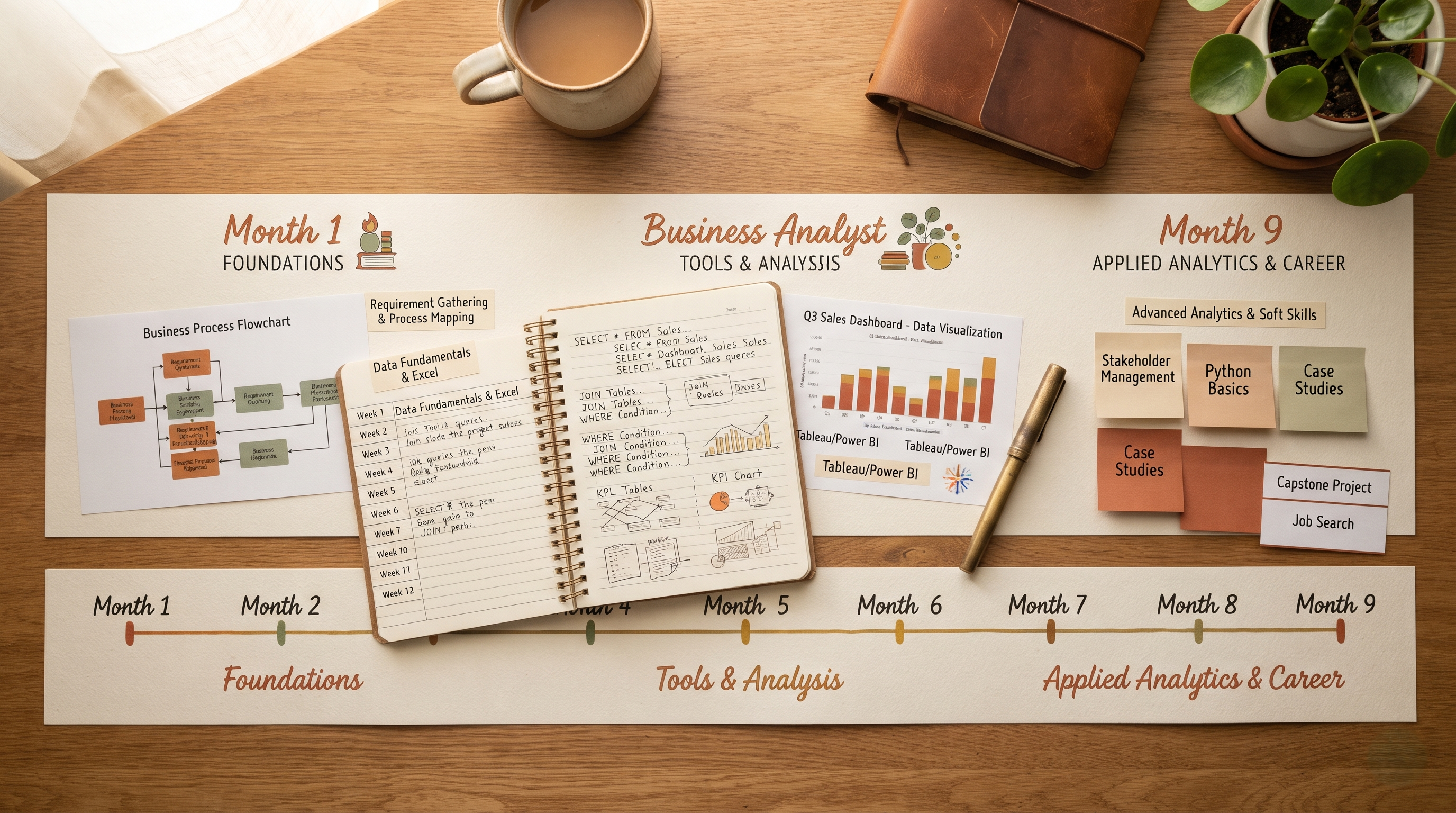
When these skill blocks are embedded into a structured schedule, a six-month roadmap is the most reliable blueprint for career transitioners, investing approximately ten to fifteen hours per week on top of a full-time job or studies.
Month One: Spreadsheets, Business Smarts and Foundations
The first month is about constructing mental models and learning how to manipulate data in everyday life. In the first two weeks, learn about what business analysts do in different industries, how companies measure profitability and efficiency, and how Waterfall and Agile project frameworks work. Get to grips with advanced spreadsheets in the second half of the month. Get messy public data sets like retail sales logs or customer churn records and practise cleaning it, building summary pivot reports and writing executive takeaways that explain what the numbers mean.
Month 2: Requirements Engineering and Process Mapping
In month two, move your attention from numbers to words and workflows. Reverse-engineer features of digital products you use daily – a food delivery app, an online banking portal, etc. – and hone the craft of requirements elicitation. Create a formal Business Requirements Document for a hypothetical new feature, break that feature down into Agile epics and user stories, and create visual flowcharts showing every step a user takes and every system decision happening behind the scenes. At the end of month 2, you should have at least two full documentation packages in your personal workspace.”
Month 3: Mastering Relational Databases and SQL
This is month three – time to start talking data. Start with relational database concepts: primary keys, foreign keys and how business entities relate to one another. Jump right into writing queries from scratch. Solve real-world business problems, not just standalone syntax puzzles: calculate month-over-month revenue growth, find top customer segments, or identify orders that did not pass fulfilment checks. Practicing consistently for forty-five minutes each day will create much better muscle memory than cramming for six hours on a Sunday afternoon.
Month 4: Visualisation of Data and Storytelling
Month 4: Connect your database querying skills to visual storytelling. Select either Power BI or Tableau and master the skills of importing data, joining tables, creating calculated metrics and designing interactive, multi-page dashboards. Concentrate on business context. All the charts in your dashboard should help a specific stakeholder make a specific decision. Practice turning your dashboards into a narrative. Describe the business problem, the trends you found and the specific operational changes you recommend based on the evidence.
Month Five: Capstone Portfolio Projects and Domain Specialisation
It’s month five that separates passive learners from hireable candidates. Skip the guided tutorial exercises; build two or three end-to-end capstone projects from the ground up. For example, you can simulate an e-commerce checkout optimisation project: analyse historical cart abandonment data in SQL, build an interactive executive dashboard in Power BI, map the current and future checkout workflows, and draft a complete set of Agile user stories for the engineering team to build the solution. Customise at least one case study to an industry you would like to target such as fintech, healthcare, e-commerce or logistics.
Month Six: Resumé Positioning, Networking and Interview Prep
Your sixth month should be spent packaging your work and strategically entering the job market. Your resume should demonstrate analytical results, process improvements, and cross-functional collaboration, not just general job functions. Put your portfolio case studies on a clean personal website or document repository so recruiters can check out your documentation and dashboards before they even schedule a phone screen. Continue to practise behavioural and scenario based interview questions, mock stakeholder interviews, and apply to roles for the rest of the month.
Things that Speed Up/Slow Down Your Timeline

Two learners can be on the same curriculum, finishing months apart. There are several practical variables that have a very powerful effect on how quickly you become job-ready.
Weekly Time Commitment and Regularity
The real determinant of how fast you learn is rhythm, not intensity. Studying one to two hours every weekday keeps technical syntax and analytical frameworks fresh in your working memory. For example, learners who don't study at all during the week and then try to pull marathon sessions on weekends are spending half of their time re-learning concepts they forgot since the previous Sunday. Students who study full-time, for thirty to thirty-five hours a week, can legitimately compress a six-month roadmap into ten to twelve weeks, while busy professionals, who study for eight to ten hours a week, should comfortably pace themselves over six to eight months.
Active Artefact Production and Passive Consumption
The biggest trap aspiring analysts fall into is tutorial paralysis. Forty hours of video lectures feels productive, but when an interviewer asks you to walk through a requirements document you wrote or explain how you handled conflicting stakeholder requests, passive learners freeze. Every week of your preparation should result in something concrete: a SQL query script, a process flowchart, a user story backlog, or a dashboard. Building artefacts forces you to deal with ambiguity, which is exactly the skill companies pay business analysts to exercise.
Quality of feedback and mentoring
When you self-teach in a vacuum you don’t know what you don’t know. You might write user stories that make sense to you but omit significant edge cases of the system, or create dashboards full of vanity metrics. Working business analysts can provide valuable insights that can save you weeks on your learning curve by helping you avoid blind spots in the early stages of your learning process. This is done using professional organizations, networking meetings, or ba online training that are offered by experts from the industry who examine your reports and dashboards initially..
Do Certifications Accelerate The Hiring Process?

Ambitious analysts often wonder if a formal credential will guarantee interviews or shave months off their timeline. The truth is certifications show your base level commitment but they are never a substitute for actual proof of work.
The most recognisable entry-level business analysis credential is the International Institute of Business Analysis’s Entry Certificate in Business Analysis (ECBA) for beginners with no formal business analysis experience. No previous work experience is needed and you can prepare for and pass the exam in about six to ten weeks alongside your core studies. Getting it shows the human resources screens that you are comfortable with the usual industry language and models.
Higher level credentials such as the Certification of Capability in Business Analysis (CCBA), Certified Business Analysis Professional (CBAP), or PMI Professional in Business Analysis (PMI-PBA) require thousands of hours of documented on-the-job business analysis experience. Sorry, you can’t take those exams being a beginner. Those are career milestone exams you take two to five years after you get your first job.
If you are on a tight budget, build a stellar portfolio of real-world case studies and get proficient in SQL and visualising data before shelling out for exam fees. A recruiter will always prefer someone who can walk them through a sharp requirements document and a live dashboard versus someone with a certificate who has never applied the concepts.
Accounting for Job Search Window
As you plan your career transition, be sure to separate skill readiness from offer acceptance. It takes three to nine months to become technically and functionally ready to do the job, but the hiring pipeline has its own timeline.
In hot hiring markets, the active job search phase could add another one to three months. Entry level business analyst roles can often have hundreds of applicants . The corporate interview loop usually consists of a recruiter screen , a technical or case study assessment , a hiring manager interview and a final panel involving stakeholders.
You can begin your job search while you are still in your learning phase. Once you've mastered the core documentation, SQL, and visualisation and have completed at least two solid portfolio projects, begin applying while you continue working on your third capstone project and practicing interview scenarios. Also, look for adjacent entry points if direct business analyst titles are competitive. Many common skills are shared by roles like Operations Analyst, Product Support Analyst, Junior Data Analyst, Quality Assurance Analyst, or Implementation Specialist, which often serve as stepping stones to full business analysis positions within six to twelve months.
Popular Myths That Skew Expectations
Dispel the common myths. This will save you wasted effort and needless discouragement in your preparation.
Myth One. You can be job-ready in 30 days.
You can memorise business analysis definitions and basic software menus in four weeks, but real analytical judgement takes time to grow. Employers hire business analysts to help reduce project risk and to add clarity to messy business problems . You need months of deliberate practice to build the confidence to lead stakeholder conversations, spot missing requirements, and back up recommendations with data.
Myth 2: You need an MBA or a computer science degree.
Most business analyst entry-level jobs only require a bachelor’s degree, regardless of the major. Companies care a lot less about what the exact title on your diploma is, and much more about your ability to solve structured problems, communicate clearly, have familiarity with the domain, and be proficient with hands-on tools.
Myth 3: You need to be an expert in Python and machine learning before you apply.
Although a few specialised data science or quantitative analytics roles do require programming, business analysts typically spend their days working alongside stakeholders, mapping out processes, writing requirements, querying databases using SQL and building dashboards. First, learn the basics; you can always pick up advanced statistical programming on the job if your particular team needs it.
From Preparation to Your First Role
Becoming a job-ready business analyst is a journey. It’s a structured journey that is achievable, not a never-ending academic marathon. Whether your personal runway is three months because you’re already in tech or domain ops or eight months because you’re building every business and technical skill from the ground up, the formula is identical. Solve real business problems. Build real documentation and data artefacts week after week. Turn your past experiences into solid evidence of analytical thinking. When you walk into an interview with real work samples and a calm, structured approach to ambiguity, you show you are ready well before your first day on the job.
If what you seek is a pocket-friendly, guided training program that meets the demands of jobs worldwide and nationally, then opting for an effective online ba analyst course India will give you actual project work as well as preparation for ECBA and CBAP.