
How I Became $120k Salesforce Developer in Six Months Working in Hospitality Sector
Last updated on Oct 9, 2026
Six Months Ago, I Was Working Behind a Hotel Counter Earning About Forty-Two Thousand Dollars per Year
My work days were consumed with late-night shifts, unpredictable schedules, and the crushing sense of having hit a career ceiling I couldn’t climb. I didn’t have a computer science degree hanging on my wall, couldn’t write a single line of working code, and every time someone mentioned algorithm it sounded like advanced calculus I could never understand. The tech industry felt like a gated community designed to keep people like me, non-elite coders, out — unless they were willing to invest four years and tens of thousands of dollars back into college.
Today, my life looks drastically different. I work remotely as a certified Salesforce developer, my baseline salary is one hundred and twenty thousand dollars a year, and every time I explain this turn of events to friends, family members, or former hotel coworkers — the immediate reaction is always surprise. People always seem to assume I must have had some secret affinity for math or logic or landed in an incredibly lucky job market window when the economy needed coders more than ever. I didn’t — the real reason why this happened is because enterprise software has a backdoor that traditional software engineering bootcamps rarely speak about: the vast and thriving Salesforce ecosystem.
If you feel trapped right now in a low paying or stagnant career, you don’t need a technical background to break into this industry. Here is exactly what you need to know about transitioning into enterprise software development
Why You Should Learn Salesforce Instead of Traditional Tech Stacks
When people decide they want to pivot into a tech career, their default option is usually to learn traditional software development. This means signing up for python classes, attending web development boot camps that teach HTML/CSS/React, and studying JavaScript full-stack development — I almost fell victim to this exact same thought pattern when first considering my career change, but quickly realized how unfeasible it would be for someone without a technical background to compete in this space.
The first reason why this approach is so intimidating for non-coder is what many self taught developers call the LeetCode trap. In order to land an entry level Frontend or Backend developer position at a traditional tech company, you have to be able to pass a technical interview. These interviews are notoriously difficult and involve solving computer science logic puzzles in real time — nothing short of a brutal combination of whiteboard coding, data structure manipulation and algorithm re-writing under extreme time constraints. For someone like me with a background in hospitality and no computer science training, competing in this type of technical interview against thousands of computer science graduates would be exceedingly difficult.
The second reason why I pivoted towards learning Salesforce is due to what enterprise software development calls a declarative model. Salesforce uses a hybrid architectural framework which means sixty to seventy percent of logic/data rules/workflow automations inside an enterprise organization can be built using a point and click interface before ever having to write a single line of programmatic code. Instead of struggling through months of basic syntax before seeing any results, you can actually write cloud applications using a low-code no-code development environment.
By focusing my attention on this particular branch of enterprise software I essentially removed myself from competing against a glutth of traditional web developers and positioned myself as a desirable candidate within the corporate sphere. The companies who use this particular suite of enterprise software always need people who know how to configure this platform in order to meet their individual business needs — and they are willing to pay six-figure salaries to people who can fulfill this niche technical requirement.
How to Transition into Salesforce Development in Six Months
If you want to follow in my footsteps and transition from being a complete technical novice into a professional software developer you have to be prepared to put in fifteen to twenty hours of work per week. You can’t just casually study Salesforce development as a means of passing time, you have to treat this like a second full-time job. Here is how I broke down my six month learning journey in order to accomplish this goal:
Months 1-2: Learn how to configure the Salesforce data model, security model, and user interface without any programmatic code at all
Before I ever worried about writing actual programmatic code, I had to develop a deep understanding for how this platform handles its data, security, and user interface requirements. This is the part where many self-taught developers make the biggest mistake — jumping right into writing code on this platform before ever understanding how this platform’s database actually works. If you try to write code on a platform without first learning how its database functions you will always end up writing faulty applications with faulty architecture.
In order to prepare myself for writing actual lines of code I spent the first two months of my journey focused on data modeling and platform security. I learned how standard and custom objects work like tables do in a relational database, how relationship types dictate how data is shared between different database tables, and how field-level security and role hierarchies control what individual users can see inside an organization. In addition to learning about the underlying database I spent several weeks studying Salesforce Flow — the visual programming language that allows you to build entire applications using a point and click interface.
In order to assess my readiness to move onto the next phase of my learning I set a deadline for myself and took the Salesforce Certified Administrator exam at the end of my second month. This was an important step because it served as a morale booster and proof that I could actually succeed when I put my mind to it. It also helped establish my technical credibility with potential employers since this exam tested my understanding of the technical infrastructure that allowed me to build applications on this platform.
If you are looking for an organized way to get started with this type of foundational learning, enrolling in a dedicated salesforce development course can give you the practical assignments needed to master this material.
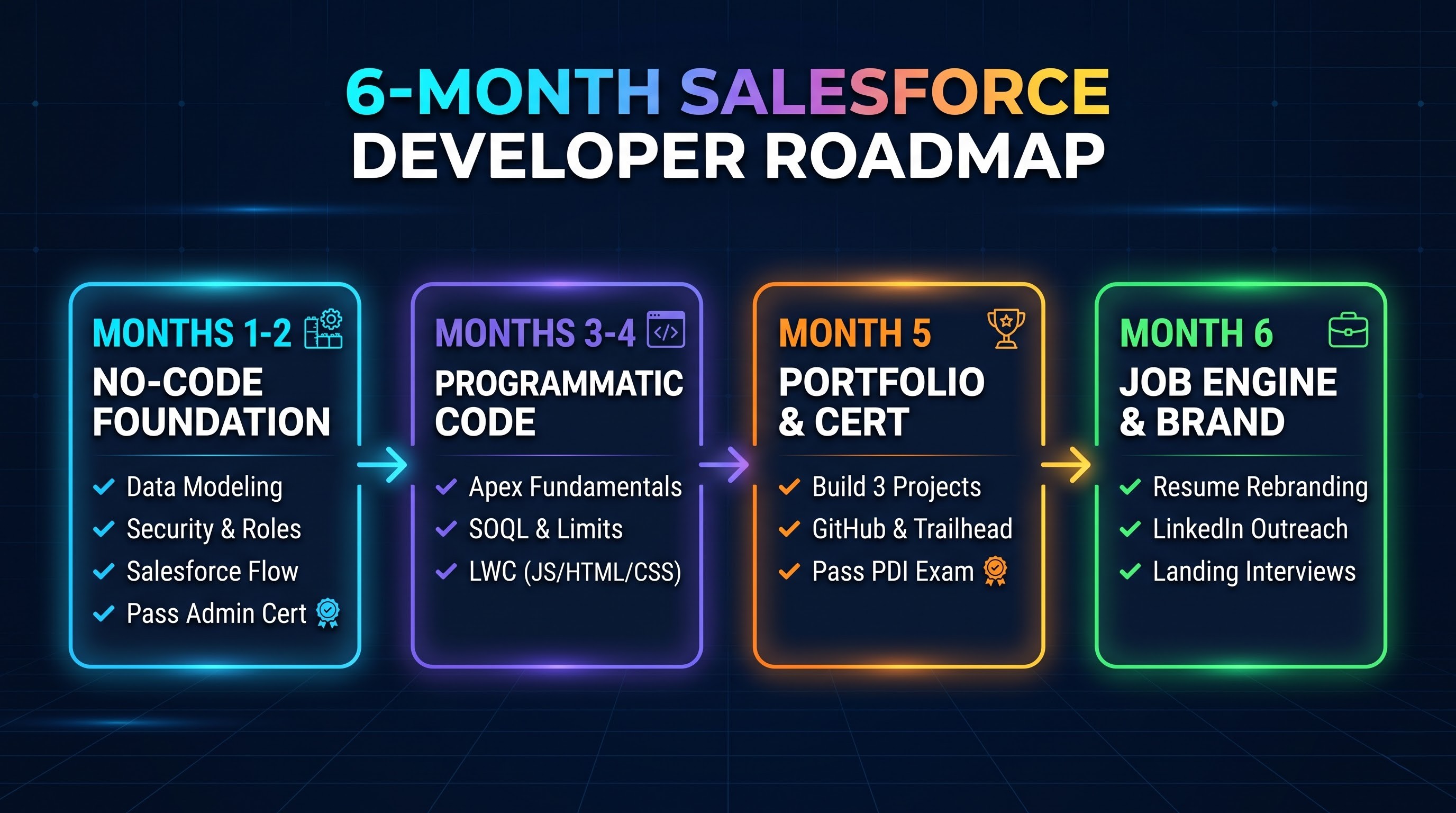
Months 3–4: Transitioning to Programming Code (Apex & LWC)
The shift from visual tools to coding proved to be the most challenging part of my experience. But since I spent the last couple of months studying data structures and system engineering, learning code logic was much easier than if I were to do it on day one. My coding journey began with Apex, which is a strongly typed programming language by Salesforce designed as an object-oriented one. If you have worked with either Java or C#, you know what I mean – Apex looks and works very similarly like one of these languages. Initially, I focused on core programming principles: using variables, applying conditional control flow using if-else statements, working with data collections such as lists or sets, and making sure that my Apex triggers were working properly.
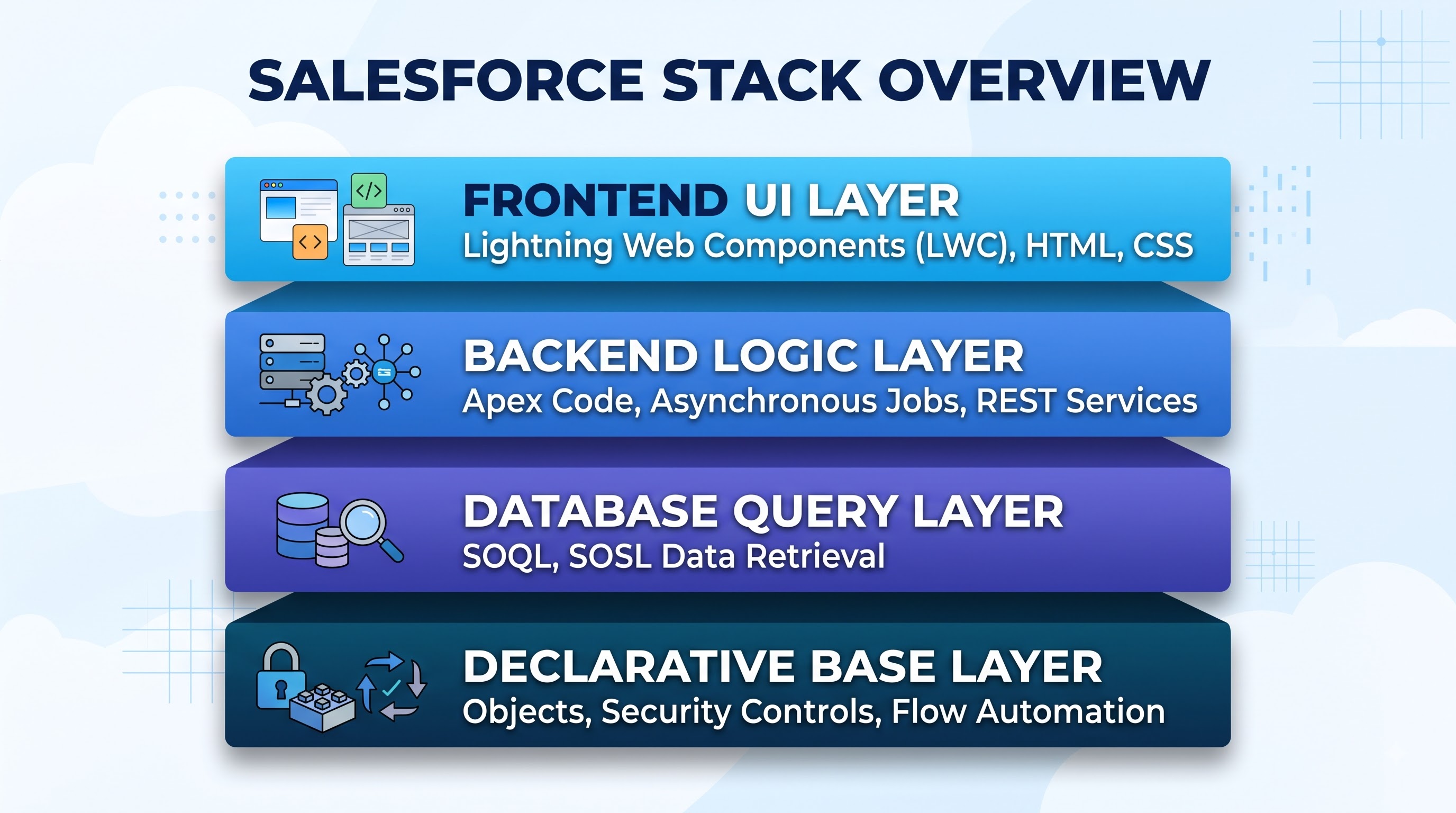
Besides becoming proficient with syntax, I was also required to learn about SOQL, which refers to Salesforce Object Query Language, as well as the governor limits concept. This is because Salesforce is a cloud platform where many companies are hosted in the same infrastructure; hence, the organization has to adhere to the strict governor limits that establish what number of queries and processing cycles the code may execute simultaneously. The skills required to create bulk-sized Apex applications capable of handling many records at the same time are what distinguish professional programmers from amateurs.
Once I became confident about backend development and moved to frontend development, where I learnt about Lightning Web Components, or LWC for short. Based on the modern web standards, this technology utilizes JavaScript, HTML, and CSS to create responsive user web interfaces that can effectively be displayed in the application’s dashboards. Understanding how user web components interact with Apex controllers allows for full-stack development.
Anyone attempting this stage of the journey will find that investing in comprehensive salesforce dev training can drastically shorten the learning curve by walking you through real-world coding patterns and debugging techniques.
The fifth month of the course saw students working towards the Platform Developer I certification as they focused on crucial aspects such as project development and bringing their ideas to life. Tutorial hell is one of the greatest problems faced by aspiring tech professionals; you might spend hours watching tutorials but are, in fact, just copying the work of others without increasing the level of your own knowledge. To avoid this trap and become a true problem-solver, during the fifth month, the writer created three great working projects while working within the Salesforce Developer Edition environment:
Lead Routing Engine: This intelligent background application was built using Apex Triggers together with REST API endpoints. This application scores incoming sales leads and assigns them to an account executive according to their score.
Management Dashboard: This app is developed using Lightning Web Components and is an excellent frontend that helps sales directors filter live performance metrics without having to refresh the page.
API Integration System: This integration service connects an external web service with Salesforce custom objects and enables data sync whenever an event happens externally.
Working on these projects has provided me with real-life examples to utilize during interviews as well as evidence that I can turn the business needs into code. With the completion of these projects, I used my last week of the fifth month to prepare for the Platform Developer I (PDI) certification exam. Passing the exam has been the final seal of approval in my skills to begin applying for programming jobs.
Month 6: Job Application Process & Non-Tech Positioning Having technical skills is just half of the success. The other half is representing the background that is convincing for recruiters to consider you for a new job.
Rather than trying to conceal or downplay my background in hospitality, I actually leveraged it in my favor. I made it very clear to recruiters that I had years of experience working with people and providing services. I pointed out that these skills would give me a significant edge over other job candidates and although most of the hiring candidates had the technical skills, like coding, they usually lack the soft skills necessary for proper communication or understanding business processes. By presenting my experience correctly, I was able to prove my competency as a developer who listens to the problems of businesses and develops and implements solutions. Along with that, I made sure to enhance my online profile to show that I possess all the skills I was talking about. I uploaded my project on GitHub, shared all the details of my work on LinkedIn, and showed my Ranger status on Trailhead. Instead of flooding the job market with my resume, I began to network actively and make direct contacts with recruiters and people dealing with hiring in Salesforce partner companies. Three weeks later, I received several job offers with a salary of $120,000.
For non-tech career changers looking to replicate this step-by-step job search strategy, signing up for structured sales force developer training can give you direct access to mentors who help refine your resume, review your code, and prepare you for technical interviews.
The Modern Edge: AI & Agentforce
If you are starting your transition into this ecosystem today, you actually have an exciting advantage that was not available when I first began: the rapid evolution of Enterprise AI. The advancement of the platform has been increasingly centered on self-governing artificial intelligence technologies such as Agentforce and Data Cloud. Developers of modern times would not need to spend numerous hours on the creation of basic elements of form and database triggers anymore. Their responsibilities are changing towards the integration and management of self-sufficient software agents that are able to process support requests and conduct enterprise analysis on their own.
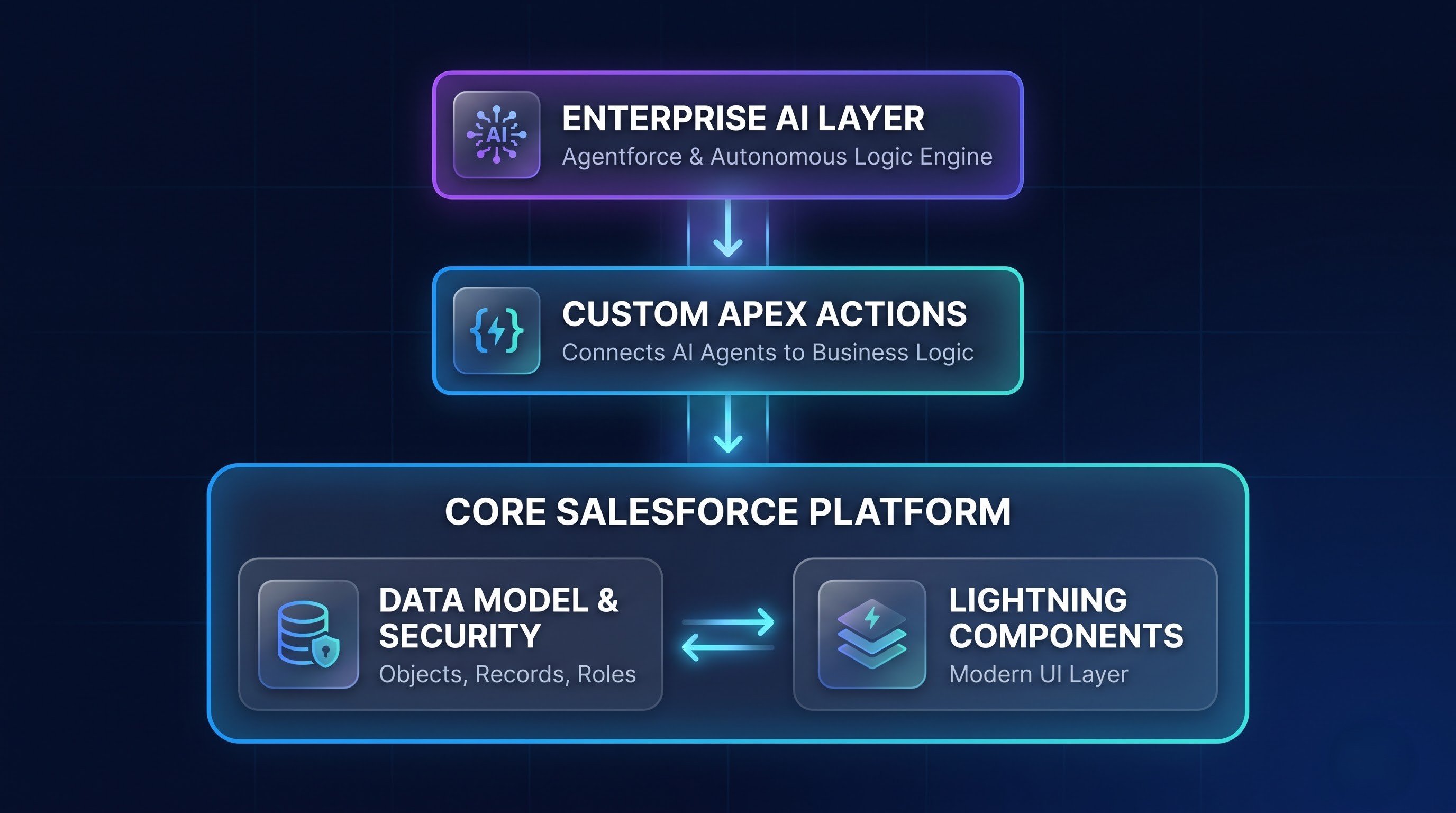
If you master the creation of custom Apex actions, which act as bridges for artificial intelligence agents, you will instantly stand out among traditional developers who have not come to grips with AI management.
Unpleasant Truths: What Others Don’t Share
To maintain honesty in this guide, I must note that transitioning to this career in six months is a hard task. It requires a lot of sacrifices and there will be difficulties along the way.
You Will Fail Practice Tests: You Will Be Frustrated: Certification tests are based on real-life situations, tricky, and intend to test whether you can use the platform rules under difficulties. When I started studying for the tests, I failed all of the tests badly because I had to think differently, and slow down, and read the documentation more carefully.
Imposter Syndrome Comes Due: After you open the first big real-life project on Visual Studio Code, it will seem impossible. You will see complex design patterns, integrations that you have not heard of, and code made by advanced engineers that seems completely strange. Remember: all the developers started from here and feeling lost is a normal thing in the process of acquiring any skill.
Consistency Outweighs Last-minute Cramming: Studying for ten hours continuously on a Sunday will not yield effective results. You require some time in order to consolidate the abstract technicalities of logic, syntax and rules governing the platform. Studying for two hours every evening provides a far more efficient result than studies carried out occasionally, as it helps develop the habits you need to hone your coding skills.
The Start of Your Journey
You are not obliged to borrow money or pay for expensive courses to start learning the basics of coding. There is a lot of information publicly available that will help you learn the fundamentals if you know where to look. Create a Trailhead Account Online: Trailhead is Salesforce's gamified learning site, where anyone can enter into an intern course on the platform and gain the benefit from a structured learning path known as a trail mix.
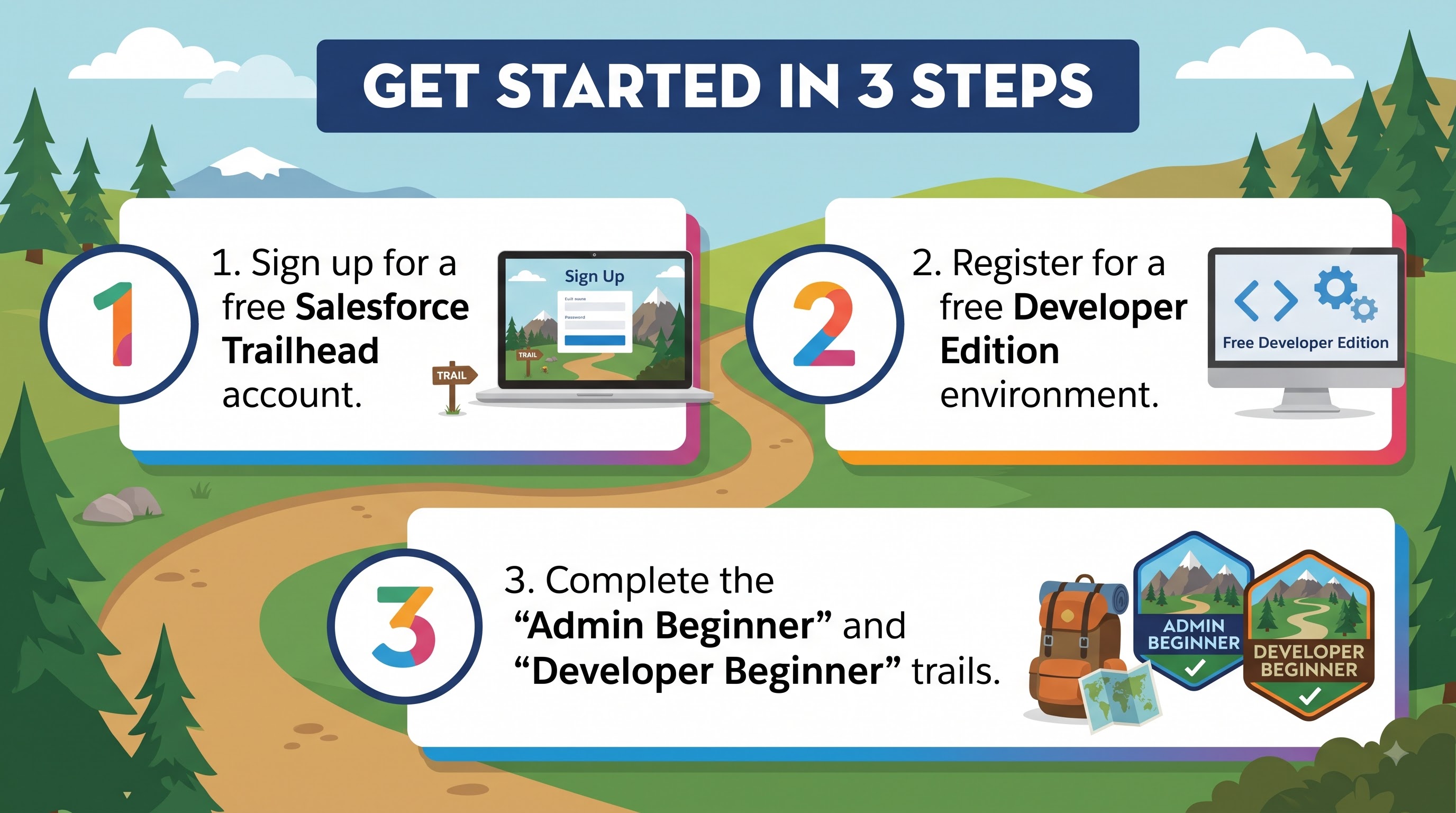
Begin Your Trail with the Basics: As the next step, learn of the 'Admin Beginner' trail mix to obtain no-code skills to the fullest, and it is optional to follow up by doing the 'Developer Beginner' trail mix to learn the basics of Apex programming and SOQL. Moving from non-technical, low-paid work into a high-paying career in software development is not only for mathematical geniuses and computer science experts. Every average person can either pick the right technology, follow a strict educational path, and work hard for the next 180 days.
Conclusion: Your 180-Day Transformation Journey
The journey from a non-technical background to obtaining a lucrative software engineering position might sound unrealistic. Yet, that’s possible within the Salesforce ecosystem. The platform boasts a one-of-a-kind hybrid structure where low-code development is used extensively before any programming language such as JavaScript or Apex comes into play, creating a unique opportunity that conventional software development cannot provide. If you manage to put in 15-20 hours of systematic study each week, you will avoid common challenges in the world of conventional technology and engage in solving actual business queries.
Achieving success throughout this six-month journey does not require you to have some innate ability, computer science degree, or lucky streak. Over the course of this journey, you will need a consistent approach, strategic planning, and willingness to stop being afraid of trying new things. If you study Salesforce Flow, move on to Apex and Lightning Web Components, create a strong portfolio showcasing your skills, and pay attention to innovations, you can effectively turn your non-technical background into an advantage. The plan is evident; all you need to do is take the first step while studying Salesforce Trailhead.