
How MongoDB Powers Real-Time Application Development
Last updated on Nov 19, 2026
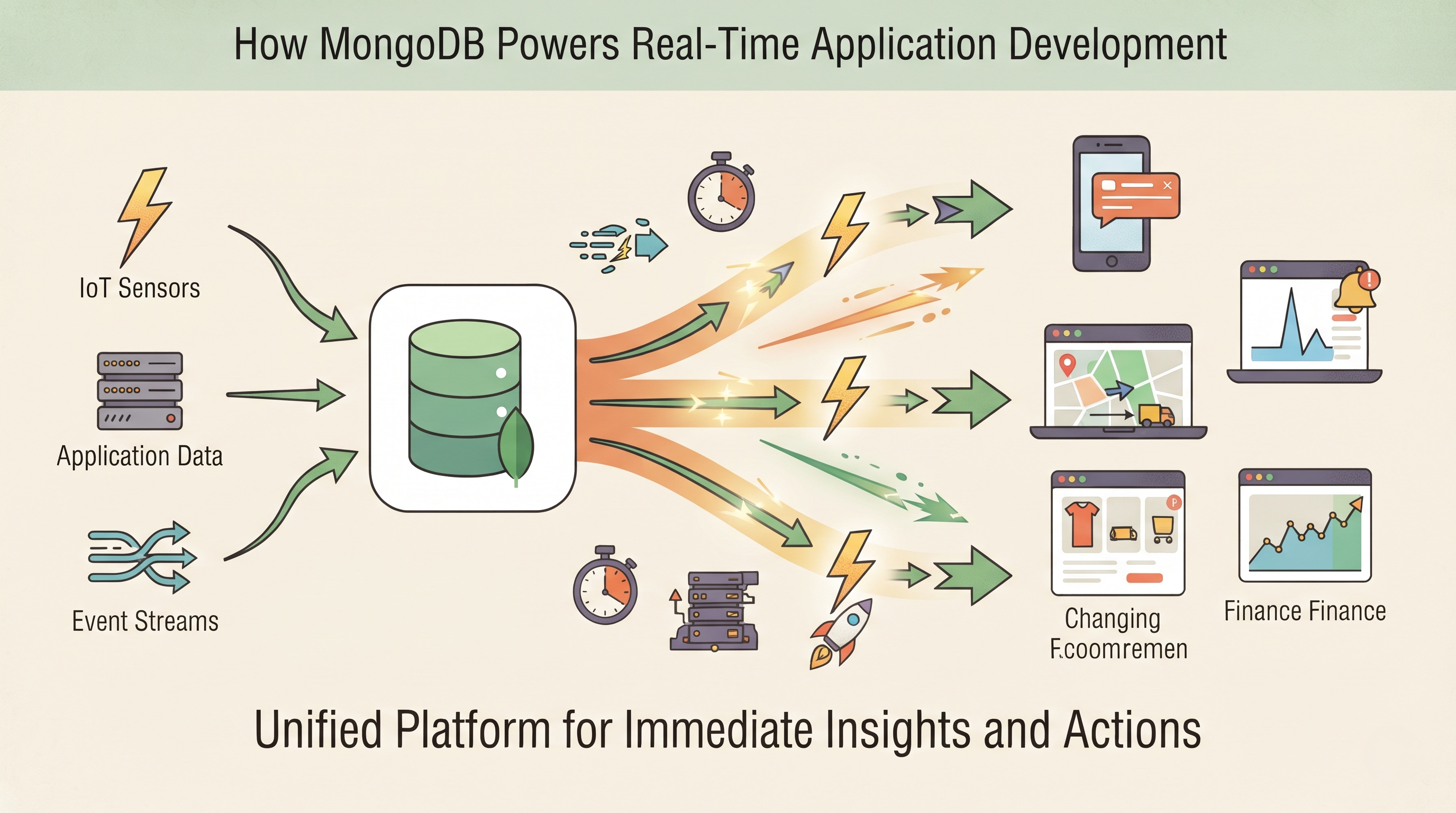
Immediacy is what runs today’s digital world. Whether a user is following a food delivery courier down a city street, executing a high frequency financial trade, collaborating on a shared digital whiteboard or receiving personalised product recommendations while browsing an online shopfront, latency is the ultimate enemy of user engagement. Users no longer tolerate page refreshes, or updates that are processed in batches and arrive hours later. They expect applications to respond to events as they occur, within a millisecond.
Under the hood the data layer is being pushed to the edge to provide this seamless, instantaneous experience. Traditional relational databases were built decades ago for structured, predictable and largely static business records, and often buckle under the weight of modern real time demands. But rigid schemas, expensive table joins and vertical scaling bottlenecks create latency at the very moment speed is needed most.
Because MongoDB’s architecture was built from the ground up to remove these friction points, it has become a fundamental data platform for real-time applications. MongoDB combines a flexible document model with native event-driven streaming mechanisms, in-memory storage optimisations and globally distributed horizontal scaling to allow engineering teams to ingest, process, analyse and serve live data at massive scale without sacrificing reliability or consistency.
The Document Model: Why the Foundation for Real-Time Performance
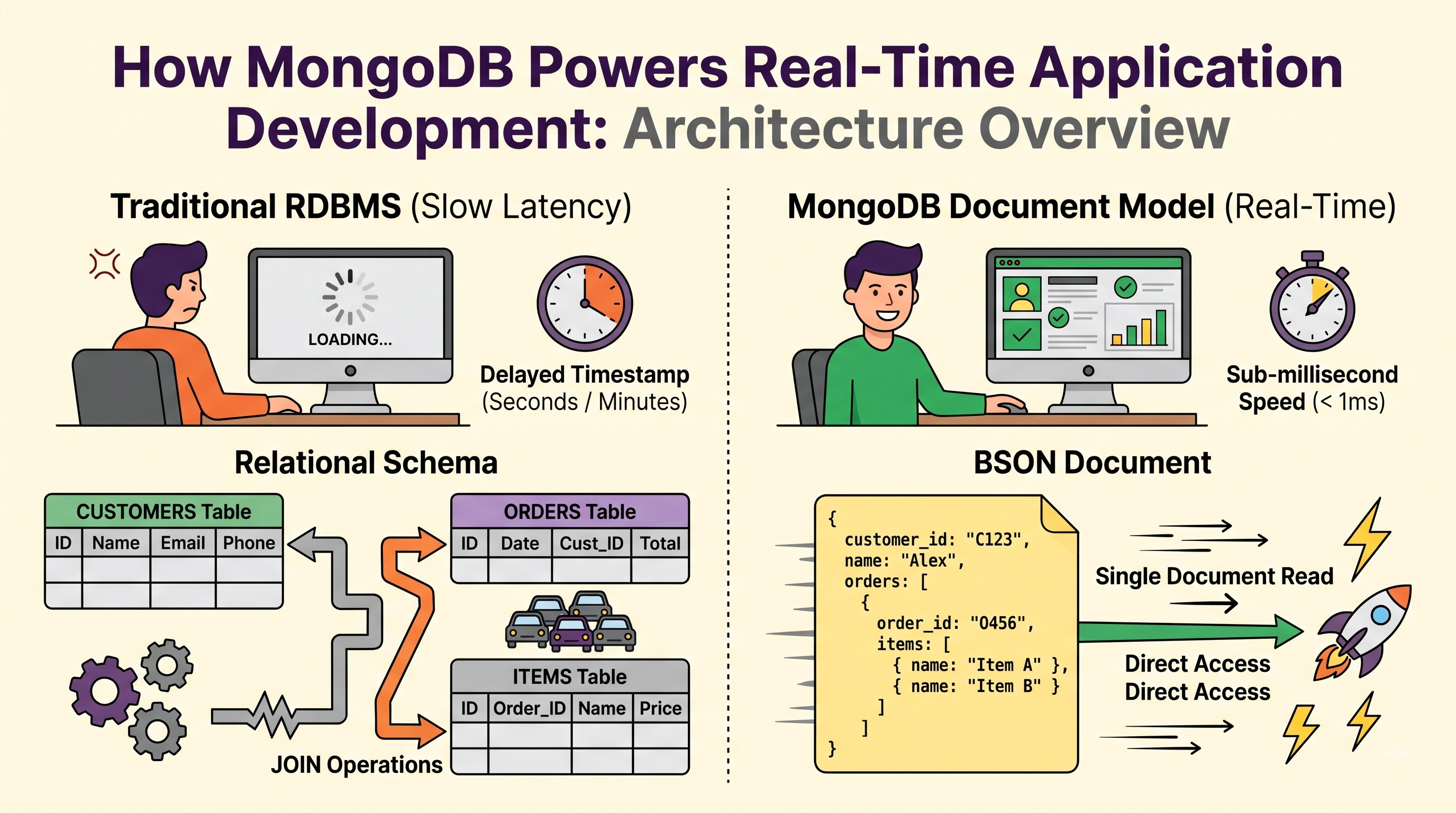
To really understand MongoDB’s real-time responsiveness, you first need to understand how MongoDB stores data. Traditional relational databases normalise information across dozens of separate tables to prevent duplicate data. This approach is mathematically elegant , but has a heavy performance penalty for read and write operations . The database engine has to do multiple expensive join operations across disc bound tables to reconstruct a complex object such as a customer profile, an active shopping cart, or the state of a live IoT device. These joins create lock contention and query delays when traffic is heavy and concurrent, destroying the illusion of real-time interaction.
MongoDB solves this bottleneck with its document-oriented approach. Data is stored in BSON (Binary JSON) documents, which are similar to native objects in modern programming languages. Rather, the associated data is kept in a single hierarchical document rather than in multiple tables. If an application needs to access or modify a user's session state, game inventory or transaction history, MongoDB gets or modifies the entire record in one atomic disc or memory operation. No joins to calculate, no multi-table locks to traverse.
Secondly BSON is binary, and is designed to be fast . BSON is more efficient than plain-text JSON because you don’t have to parse entire strings to find specific fields. BSON encodes type and length information into the data structure itself. This enables the MongoDB storage engine to efficiently traverse documents, jumping straight to the precise field required by a query or in-place update. This efficiency means sub-millisecond response times when millions of writes per second are hammering a database – telemetry pings from connected vehicles, clickstream events from a viral mobile app.
Event-Driven Architecture and Change Streams
Real-time applications are not standalone. They are ecosystems of interconnected microservices, analytics engines, notification gateways and user interfaces that need to react instantly to data changes. Previously, developers achieved this reactivity by polling, writing background scripts to query the database every few seconds asking if anything new had happened. Polling is notoriously inefficient. If the polling interval is too long, the application feels sluggish; if it is too short, the database is overwhelmed with redundant read queries that return nothing new, wasting CPU cycles and network bandwidth.
MongoDB natively solves this architectural dilemma with Change Streams. Change Streams are built directly on top of MongoDB’s replication log and allow applications to subscribe to all data changes in the database including inserts, updates and deletes either on a collection, database or entire cluster. Instead of polling the database for changes, the application opens a lightweight, persistent stream, and MongoDB pushes notifications as soon as a change happens and commits.
That ability turns the database into an active nervous system for event-driven architectures, not just a passive storage repository. Picture an online logistics platform. When a driver updates their delivery status in the mobile app, MongoDB writes the record and immediately emits a change event. That single event might push a notification to the customer, update the live map on a dispatcher’s dashboard, change inventory counts in a warehouse microservice and feed a machine learning model that’s recalculating estimated arrival times. Change Streams are also resumable, respect access restrictions, and provide durability guarantees, so developers are able to build reactive pipelines without having to stand up complex, fragile third-party message brokers just to detect database mutations.
Stream Processing for Real-time Data Processing
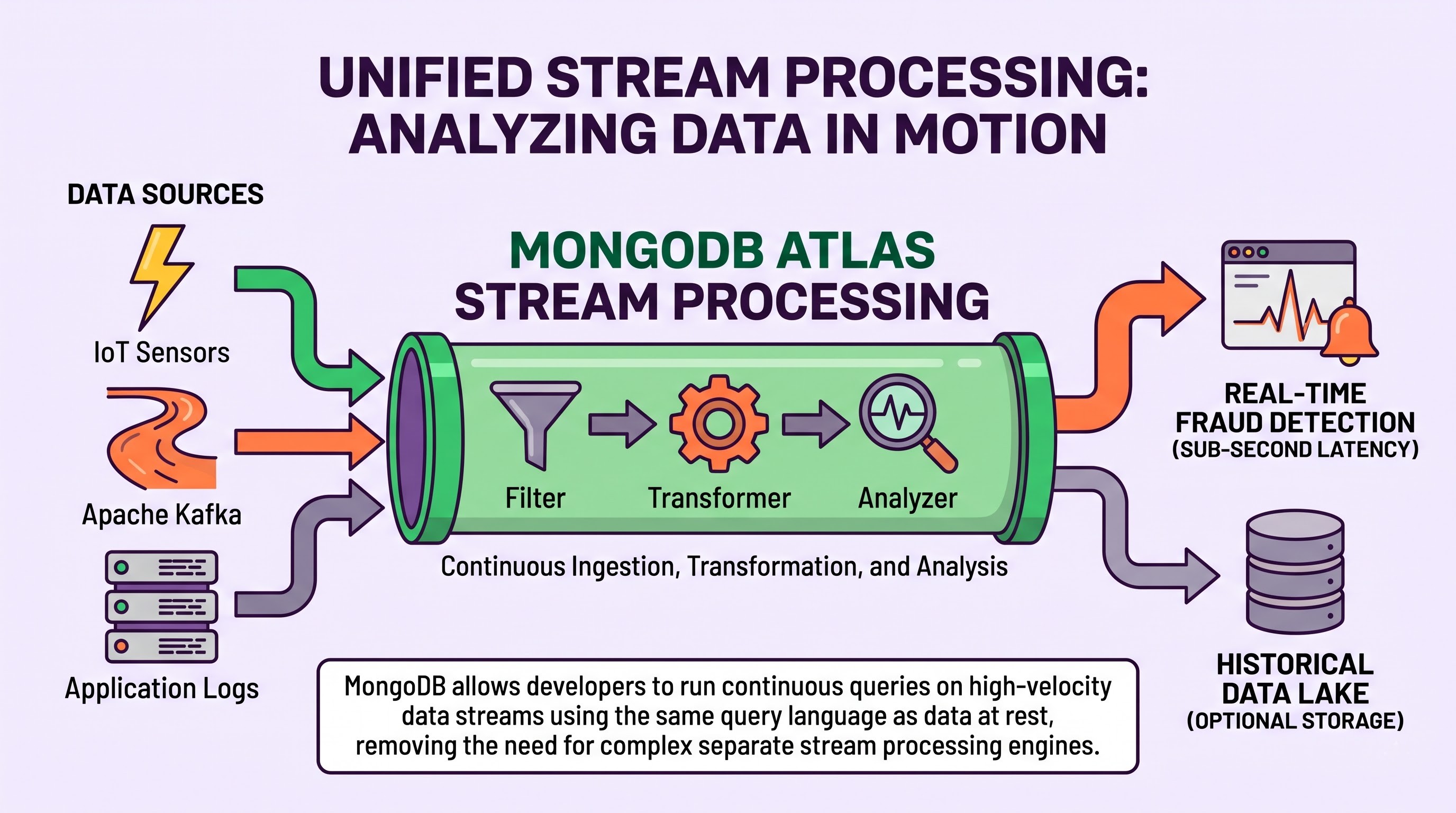
Capturing events as they happen is half the battle, real-time applications must also make sense of continuous data flows before that information loses its value. Traditionally, operational databases are used to process live transactions and data warehouses or special purpose stream processing engines are used for real time analytics. When data moves between these isolated systems, it introduces latency, operational fragility and governance headaches.
MongoDB is closing this gap by building stream processing as part of its developer data platform. Atlas Stream Processing allows organisations to ingest, transform, filter and enrich high-velocity data streams from sources such as Apache Kafka, IoT sensors and application logs in a continuous manner, using the very same query language and aggregation framework they already do for data at rest.
Instead of waiting for nightly batch jobs to review user behaviour or detect anomalies, developers are able to specify continuous queries over moving time windows. For example, a financial institution can cross-check against a rolling five-minute window of geographic location and spending velocity of a cardholder every credit card swipe. If an anomalous pattern is detected, the system flags and blocks the fraudulent transaction even before the authorisation is completed. Likewise, an industrial plant that uses industrial machines can monitor hundreds of temperature and vibration sensors per second and analyze telemetry data streams in real-time to predict the deterioration of any machinery before it fails catastrophically.
In-Memory Speed and the WiredTiger Storage Engine
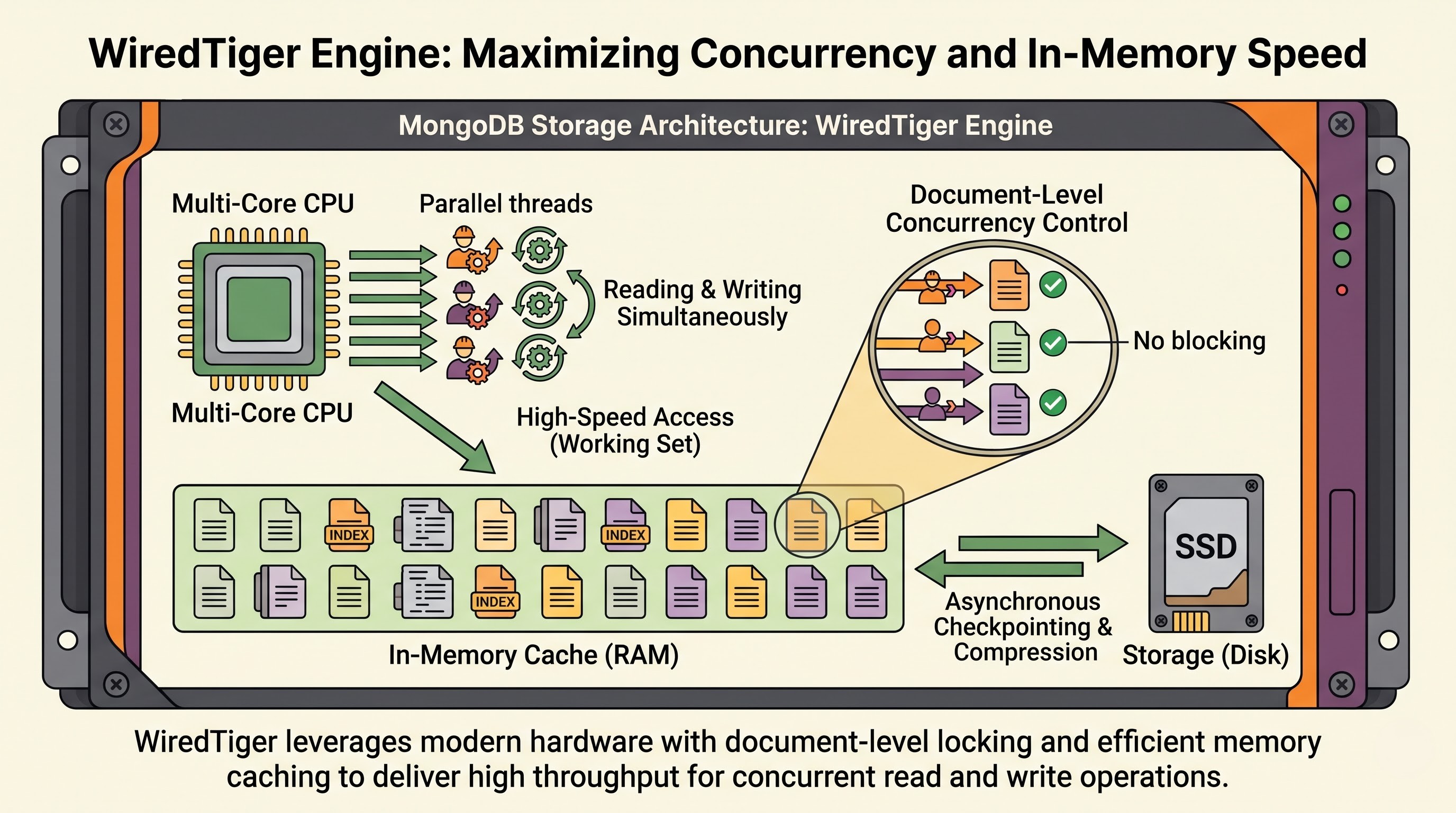
The engine under MongoDB’s user-friendly interface is a high-performance storage engine named WiredTiger, built to take full advantage of modern multi-core hardware and memory architectures. Real-time workloads have high concurrency, where thousands of threads attempt to read and write data simultaneously. Older database engines used coarse-grained locking mechanisms in which a write operation would lock the entire database or an entire table, forcing other users to wait in queue.
WiredTiger uses document level concurrency control. If two users update different documents in the same collection simultaneously, one user does not block the other. During heavy write bursts, threads run in parallel and do not interfere with each other. WiredTiger also uses advanced memory caching, keeping the active working set, the most frequently accessed documents and indexes, in RAM. Reads and writes are performed at memory speed. Checkpoint and compression algorithms asynchronously persist the data to disc, but do so cleanly and compactly.
MongoDB also includes an In-Memory Storage Engine for the most latency sensitive use cases like real-time ad bidding, session caching or high-frequency trading. Applications get predictable, microsecond-level latency while still having the full querying power, indexing capabilities and replication durability of a standard MongoDB cluster by keeping the entire dataset in RAM, removing disc I/O from the critical path.
Native geospatial and time-series capabilities
There are many real time applications that are interested in two dimensions: when and where. In the past, developers had to bolt on specialised databases for their tech stack — one for time-series metrics, another for spatial mapping — creating data silos that slowed down development and complicated real-time sync.
MongoDB offers native geospatial indexing and time-series collections within a single core engine. When you store time-series data such as financial tick data, server health metrics or smart meter readings, MongoDB automatically organises the incoming measurements into an optimised internal storage format. It organises readings by source and time window, significantly reducing storage footprints and speeding up range queries and rolling aggregations. Applications can ingest millions of time-series data points per second, and query recent trends to drive live monitoring dashboards.
MongoDB’s internal geospatial engine is just as important. Real-time location intelligence is the foundation for today’s mobility, delivery and social apps. MongoDB has native support for indexing coordinates and complex polygons, allowing for super-fast spatial queries. When a commuter requests a ride through a ride-hailing app, MongoDB can instantly calculate distances, verify geofenced boundaries, and match the rider with the nearest available driver going in the right direction, all while tracking the locations of thousands of vehicles on the move.
Real-Time Search and AI-Driven Personalisation
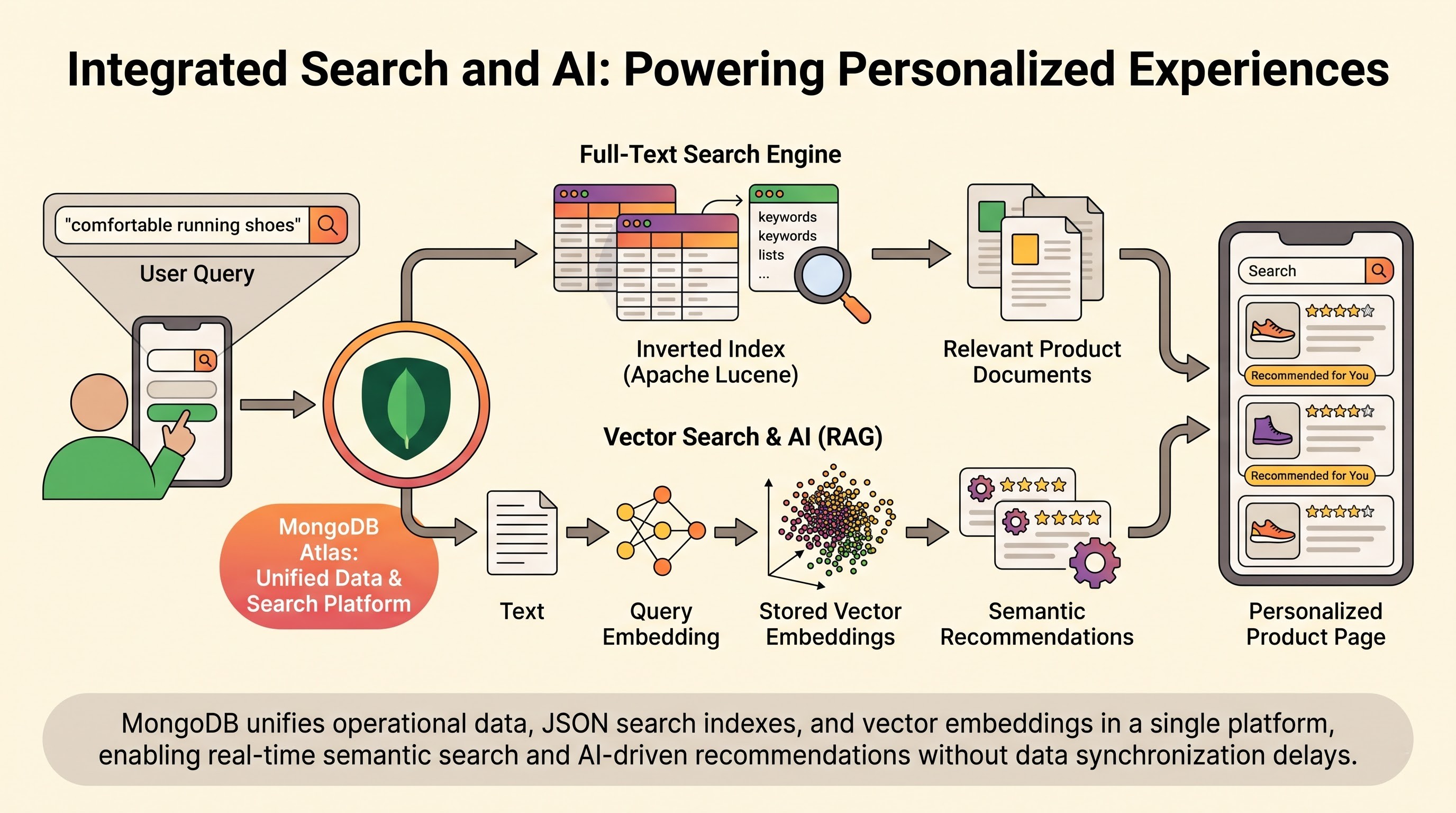
Today’s users expect applications to do more than capture transactions; they expect intelligent, personalised interactions in the moment. When a shopper types a query into an e-commerce search bar, they expect instant autocomplete, typo tolerance, faceted filtering and results relevant to their live browsing session. The use of external search engines often results in synchronisation delays – the product is out of stock in the main database, but it will still be displayed in the search results as available for several minutes.
MongoDB fills this synchronisation gap by embedding full-text search and vector search alongside operational data. The search indexes are automatically kept in sync with the underlying transactional collections, so when an item is purchased or updated, so are the search results.
Native vector search capability in MongoDB aids in real-time AI and RAG functionality. As a user is interacting with the app by consuming content like articles or products or talking to the AI-powered agent, the user’s present context can be converted into vector embeddings and searched within millions of entries in just a few milliseconds. This makes the generation of personalized recommendations and semantic search, along with the contextual response of AI agents, possible.
Global Distribution, Horizontal Scale, and Robustness
A real time application is only as fast as it is available and physically close to the end user. If a database is down, the latency is infinite. A user in Tokyo has to wait for their request to travel across undersea cables to a single server in Virginia and back. The speed of light itself guarantees a sluggish experience.
Two core architectural pillars, replica sets and sharding, allow MongoDB to achieve global scale and continuous uptime. Replica Set is a highly available cluster consisting of servers, with copies of data existing in different availability zones or data centers. In case the primary server fails for some reasons such as hardware failures or network problems, other servers automatically promote another primary server, thus ensuring seamless operations without downtime.
Sharding is used in MongoDB in order to achieve unlimited scalability with regards to the size of data and traffic load. Rather than forcing an organization to buy ever-larger and prohibitively expensive monolithic servers, sharding automatically distributes data across multiple distributed machines. Each shard handles a portion of the total workload so that the read and write capacity can scale linearly with user demand.
MongoDB takes this a step further with zoned sharding for globally distributed architectures. Organisations can pin subsets of data to geographic locations. The profile and active session data of that European user might physically reside in a Frankfurt data center, while the data of that American user lives in Ohio. Both users get single-digit millisecond latency for local reads and writes and the organization easily complies with stringent regional data sovereignty and privacy laws, all administered as one logical database.
Real-World Impact in Diverse Industries
MongoDB’s architectural advantages translate into real competitive differentiation across virtually every sector of the global economy:
Financial Services & Payments: Global payment processors and digital banks use MongoDB to authorise transactions in a matter of milliseconds, perform real-time fraud detection scoring at checkout and provide customers with instant balance updates and spending insights. With multi-document ACID transactions, you get strong financial accuracy without sacrificing the throughput you need to handle peak shopping holidays.
Connected Vehicles and IoT Automotive manufacturers are streaming millions of telemetry events per minute from connected vehicles into MongoDB. That allows for real-time vehicle diagnostics, over-the-air software updates, live traffic routing and instant mobile app controls, enabling drivers to unlock doors or check battery levels from anywhere in the world.
Gaming and Interactive Media Massively multiplayer games online require a shared, consistent world state updated tens of times per second for millions of concurrent players. MongoDB drives high-speed player matchmaking, live leaderboards, in-game economies and persistent player inventories without creating lag spikes that kill gameplay.
E-Commerce and Retail: MongoDB is the choice for leading retailers who want to build dynamic product catalogues, get real-time visibility into inventory across thousands of physical stores and warehouses, and deploy instant personalisation engines that change shopfront layouts based on a shopper’s live behaviour.
Combining Speed of Operation with Modern Agility
Ultimately, making real-time applications work is less about raw database speed and more about architectural simplicity. When an engineering team needs to stitch together disparate databases, caching layers, search engines, and stream processors to deliver a single feature, they add network hops, synchronisation delays, and operational complexity that slow down both the application and the developers building it.
MongoDB is thriving in the real-time era by unifying these capabilities into a single, developer-centric platform. Its flexible document model conforms naturally to application logic, without the friction of rigid schemas and complex joins. Native capabilities such as Change Streams, Atlas Stream Processing, WiredTiger concurrency and integrated search allow data to move seamlessly from ingestion to insight to action in milliseconds. MongoDB’s automated resilience and global horizontal scaling gives organisations the foundation to build applications that not only store history, but also participate in the moment.
The best way for the developers/engineers who wish to apply such design patterns in practical application is by joining a structured mongodb course program offered by OnlineITGuru.
Conclusion
In an era of instant digital gratification, the difference between market leadership and irrelevance is often measured in milliseconds. Today’s applications are not passive ledgers, just recording what happened yesterday. They are dynamic, living systems expected to sense, analyse and respond to the world as it happens. This article has demonstrated that meeting this relentless demand requires a fundamental rethinking of the underlying data architecture. Traditional relational systems were never designed for a world of continuous, high-velocity event streams and instantaneous user interactions – they are constrained by rigid schemas, expensive multi-table joins and vertical scaling.
MongoDB fills the gap, solving real-time performance issues across all architecture fronts. At the heart of MongoDB is a flexible document model and binary BSON encoding that eliminates the structural friction between the application code and data storage. MongoDB lets you make atomic, sub-millisecond reads and writes without the overhead of join operations. This is the foundation within an ecosystem of native tightly integrated capabilities that transforms static storage into an active data platform. Change Streams turn database mutations into immediate, event-driven triggers, while Atlas Stream Processing gives engineering teams the ability to analyse and act on data in motion without building fragile pipelines across disconnected tools.
The WiredTiger storage engine and in-memory optimisations under the hood allow thousands of concurrent threads to run in parallel at RAM speeds, and built-in time-series, geospatial, full-text search and vector search engines remove the latency penalties of maintaining separate specialised databases. In addition to self-healing replica sets and globally distributed zoned sharding, MongoDB ensures data is always available and physically close to end users on every continent, meeting both single-digit millisecond latency targets and stringent regional compliance requirements.
But perhaps MongoDB’s biggest win in the real-time landscape is architectural unification. Previously, millisecond responsiveness forced organisations to create large, brittle patchworks of operational databases, caching layers, message brokers, search clusters and analytics engines. Additional systems added network hops, lag due to synchronisation, and operational overhead that slowed software performance and engineering velocity as well. By consolidating these critical workloads into a single integrated developer data platform, MongoDB reduces complexity at the critical point where speed matters.
As we look to the future, the bar for real-time responsiveness will only get higher as artificial intelligence, autonomous systems, connected devices, and hyper-personalized digital experiences become further woven into daily life. Companies cannot afford architectures where operational transactions and real-time intelligence exist in different worlds anymore. With operational speed, native analytical agility and effortless global scale, builders have the underlying foundation they need to build intelligent applications that actually live, think and react in the moment, instead of just storing historical records, with MongoDB.
In order to develop real-time data pipelines, replication, and performance tuning, you need to hone your skills. That is why many individuals have realized the importance of attending the interactive mongodb classes on OnlineITGuru.