
How MuleSoft Accelerates Cloud and Hybrid Integration
Last updated on Jul 24, 2026

Modern organizations are increasingly dependent on digital technologies, cloud applications and real-time data exchange. Industries are deploying SaaS platforms, cloud-native apps, AI solutions and analytics systems to drive efficiencies and customer experiences. But the big challenge for companies with new technology is making it work. "Applications are siloed and communication between systems is not seamless.Today’s enterprises are running a whole bunch of applications – from CRM and ERP and HR, and e-commerce and marketing automation, to legacy databases. The more applications you have the more difficult it is to connect these systems with traditional point to point and keep them up and running. This sort of complexity increases the cost of operations and reduces the agility of the organization.
These challenges have made MuleSoft one of the most productive integration platforms out there. MuleSoft’s Anypoint Platform and API-led connectivity methodology allow organizations to quickly and securely connect applications, data and devices. It also provides reusable APIs, prebuilt connectors and flexible deployment options that significantly reduce the integration complexity.Cloud computing has changed the way enterprises do business like never before. Building their own infrastructure is no longer necessary for companies. They are working in a hybrid world of legacy systems and cloud services. These environments need to support sophisticated integration capabilities that work seamlessly regardless of where the applications reside. That's the power of MuleSoft's unified integration platform made simple. It unifies legacy systems, new technologies and cloud applications, making integration easier. Organizations can take steps to mitigate risk and protect past technology investments without the cost and disruption of replacing all of their infrastructure.The new focus is digital transformation and integration is one of the most strategic initiatives for enterprises across the globe. When systems are successfully integrated, companies can get a clearer picture of what is going on in their operations, provide better service to their customers and respond more quickly to business needs. MuleSoft is the catalyst to accelerate cloud and hybrid integration projects to achieve these results.
Cloud Integration is the process of bringing together multiple cloud applications, services and data repositories into a single ecosystem. Today’s organizations operate on a mix of cloud platforms such as Salesforce, Workday, ServiceNow, SAP, Microsoft Azure and Amazon Web Services. All applications are performing some business functions. However these systems are distinct and not integrated.
Disconnected applications cause a whole load of operational issues. Workers have to re-type data into multiple systems, which causes delays and errors. Discrepancies in customer data across the platform affect the quality of service and decision making. Distributed data can also be a problem for organisations to get the big picture of business operations.
Cloud integration solves this problem . Applications are talking to each other without problems . The integrated system allows the automatic flow of information resulting in consistency and greater efficiency. Real-time synchronization means decision makers always have the right information and the information is right.But of course there are issues with cloud integration. Many organizations have applications from many different vendors, all with their own API, security requirements and data structures. It takes time to build and maintain custom integrations between these systems.MuleSoft boasts a huge ecosystem of connectors and API management to ease the pain of cloud integration. The platform comes with a set of out-of-the-box connectors to make integration with popular enterprise applications easy. This helps organizations avoid re-inventing the wheel on integrations and allows them to build on top of reusable components that can help speed up implementation projects.
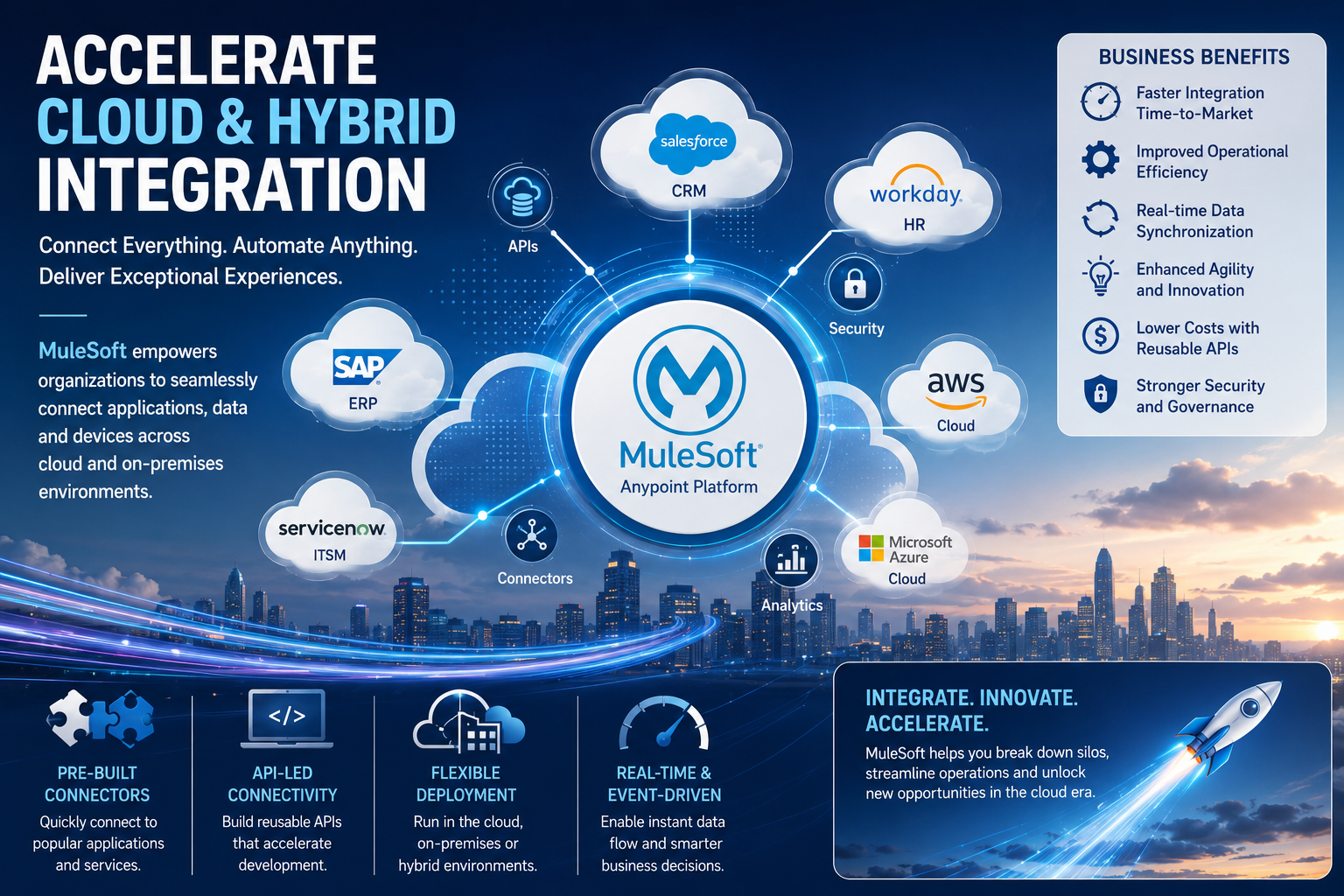
MuleSoft also provides a wide variety of integrations like real time, batch and event driven. This flexibility allows companies to select techniques that are more appropriate to their operational needs. It reduces development effort and maintenance cost and makes organizations agile.Cloud convergence also accelerates innovation efforts. Companies can get services to market faster, engage customers more deeply and take advantage of emerging technologies without the drag of disparate systems. As organizations progress along their digital transformation journeys, cloud integration will remain a core competency and priority.
What is hybrid integration and why it is important?
Cloud adoption is speeding up, but lots of companies are still connected to legacy and on-premise applications. “These are often used by healthcare providers, financial institutions, manufacturers and government agencies that cannot quickly replace mission-critical systems
More and more organizations are ending up with hybrid environments, where cloud apps and traditional infrastructure coexist. Hybrid integration is all about connecting those disparate environments so they can communicate with each other.
The concept of hybrid integration is built on the understanding that most organizations do not go “all-in” with cloud. Migrations are costly, risky and hard to scale. That’s why more and more organizations are adopting incremental modernization strategies that allow them to keep their legacy systems in production while migrating to cloud technologies at an incremental pace.
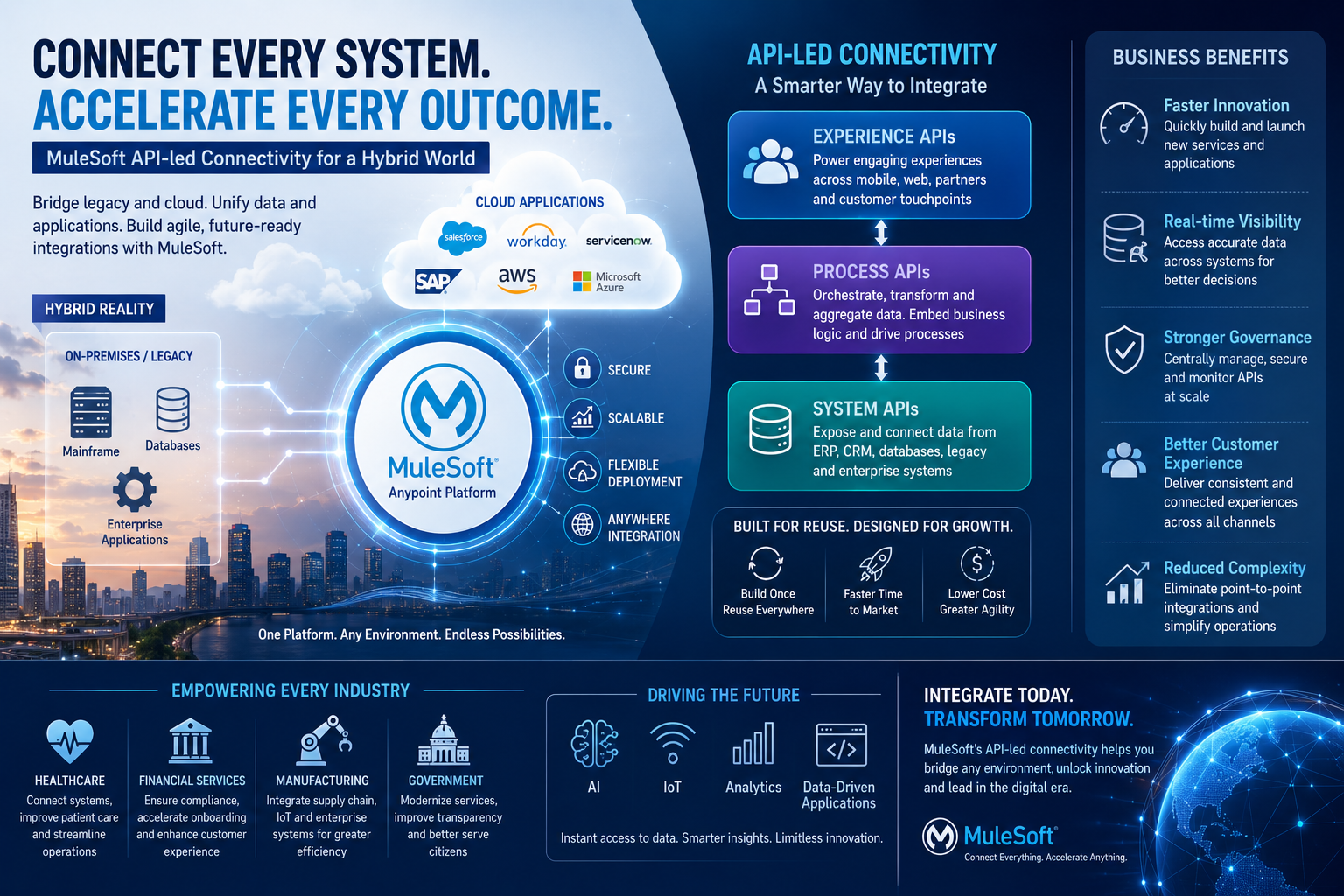
An organization will have a host of challenges without the right hybrid integration capabilities. Poor visibility, inefficient processes and inconsistent data can hamstring performance. And that kills productivity.” Employees will be forced to do manual work across several systems.MuleSoft provides secure, scalable hybrid integration to solve these problems. MuleSoft’s Anypoint Platform enables you to connect on-premise databases, enterprise applications and cloud services with a single architecture.It offers various deployment models that allow organizations to deploy integrations to cloud environments, on-premises data centers, or hybrid deployments. This flexibility enables companies to adapt operations to their needs.Hybrid integration also helps reduce the business risks of digital transformation. New technologies can be incrementally brought into the organizations without disrupting the ongoing operations.Hybrid integration also offers better data access. It provides a real-time view of enterprise operations, regardless of where the data resides. This ability facilitates data-driven decision making and supports analytics initiatives.
Hybrid integration improves the customer experience by providing the same information on all channels. Consumers expect a frictionless experience, whether they are accessing services through mobile apps, websites or in-person locations. Integrated systems are an efficient way to meet these expectations.As enterprises migrate from legacy infrastructure to cloud technologies, hybrid integration becomes more important and more necessary. MuleSoft is able to integrate these environments and strategically positions And that’s what makes MuleSoft so “hot.” “This is a big part of API-led connectivity.” Traditional integration solutions are based on point-to-point connections between applications. This can work for a time, but as organizations keep adding new systems and applications, it gets harder and harder to manage. Every link is a cost. A complexity. A maintenance and operating cost.MuleSoft offers a solution to this problem in the form of a simple API architecture of System, Process and Experience APIs. System APIs expose data from underlying systems such as ERP apps, databases, CRM platforms, and legacy apps. These APIs provide a standard way to access enterprise data without having to interact with the back-end systems.Process APIs are a middleware layer that transforms, orchestrates and aggregates data across multiple systems. They contain business logic. They ensure that information is correctly passed between applications. APIs APIs provide custom data to mobile apps, websites, customer portals and partner systems.
This layered architecture is very good for re-use. Then the multiple applications that use the same APIs can benefit from these integrations instead of re-writing them for each new project. Lower cost, less development effort and faster project deliveryAPI-driven connectivity translates into agility, allowing them to create new applications, services and channels for customers without having to re-engineer the whole integration infrastructure. Flexibility is a huge competitive advantage in a fast-changing market.Another benefit is governance. APIs can be centrally governed, secured, and monitored to ensure they meet your organization’s and regulatory standards. Companies can easily visualize their integration ecosystem and identify potential issues before they become operational problems.The increased adoption of artificial intelligence, IOT devices and data-driven applications has further accelerated the need for API-centric architectures. Applications of today require instant access to data from multiple sources. With MuleSoft’s API-led approach, organizations can build connected ecosystems to accelerate innovation and digital transformation.API-led connectivity makes integration simpler and more reusable, allowing organizations to go to market faster and optimize resources.
All in One Place MuleSoft Integration The Business Value
We’ve deployed MuleSoft and it’s been a lot of business benefit. It’s been good for the operational side of organisations. Disconnected systems and manual processes cause inefficiency and delays. MuleSoft automates the movement of data from application to application, so you can do more without getting your hands dirty. Employees spend less time on repetitive administrative tasks and more time on strategic tasks. APIs are reusable and speed up new project launches Reusing existing integration assets can help to accelerate new applications and initiatives, greatly reducing development cycles.
Better customer experience
Today’s customers expect a seamless experience across channels. Integrated systems enable organisations to create a single source of customer data, delivering a personalised experience and improving customer satisfaction.
Make better decisions
Real-time integration gives departments timely and accurate information and gives executives and managers a better sense of what is happening in the business and the ability to make faster and better decisions.
Size
Organizations are growing and so is the need for integration platforms to grow with them for more transaction volumes and newer technologies. MuleSoft provides you with the infrastructure to grow with your business to suit your needs.
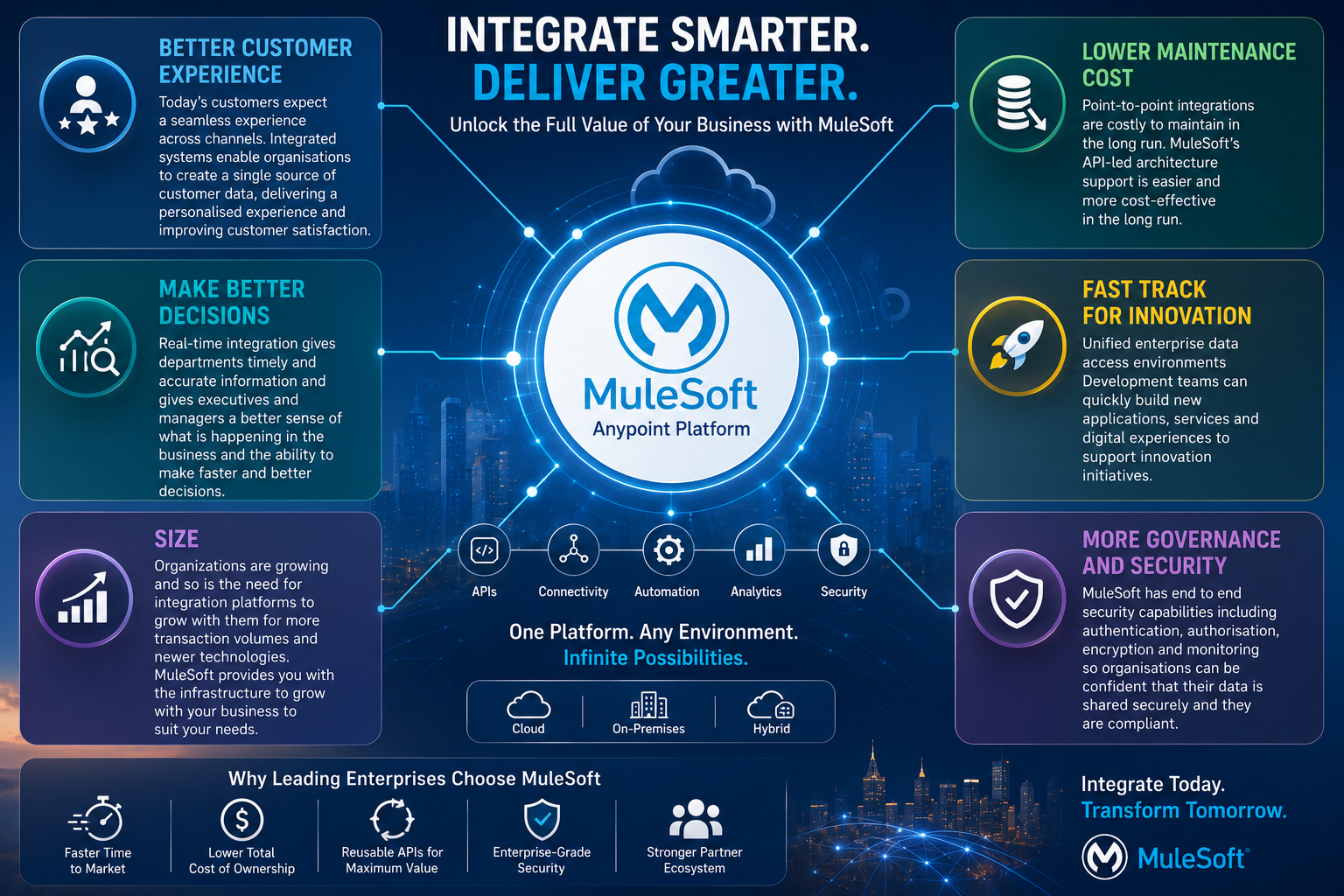
Lower maintenance cost
Point-to-point integrations are costly to maintain in the long run. MuleSoft’s API-led architecture support is easier and more cost-effective in the long run.
Fast Track for Innovation
Unified enterprise data access environments Development teams can quickly build new applications, services and digital experiences to support innovation initiatives. More governance and security.MuleSoft has end to end security capabilities including authentication, authorisation, encryption and monitoring so organisations can be confident that their data is shared securely and they are compliant.
Opportunities for Integration of Skills Development
As cloud computing, digital transformation initiatives and API led architectures become more popular, the demand for MuleSoft professionals is skyrocketing across the globe. Organizations are roping in talented developers, architects and integration specialists to design and build complex enterprise integrations.There is a huge demand for Mulesoft Course Online because of the growing requirement for enterprise integration skills.They cover important topics like API led connectivity, Anypoint Platform architecture, DataWeave transformations, API management and integration design patterns with flexible learning styles.Most of the programs begin with the basics and then proceed to advanced topics such as deployment techniques, security measures, monitoring features, hybrid integration scenarios, and so forth. Considering that many professionals work on a full-time basis, online learning platforms provide the flexibility to learn at one’s own pace and access practical training environments remotely.
One of the big advantages of MuleSoft Training Online is the increasing demand for certified integration experts in the market. Companies in all types of industries – banking, healthcare, retail, manufacturing, telecommunications, government – are looking for integration programs. So MuleSoft skills provide great career opportunities and lucrative salaries for the professionals. APIs are becoming increasingly important in enabling companies to deliver digital experiences, automate business processes and drive cloud migration initiatives. “Learning Mulesoft is not only a technical challenge but a chance for professionals to contribute to strategic digital transformation agendas.
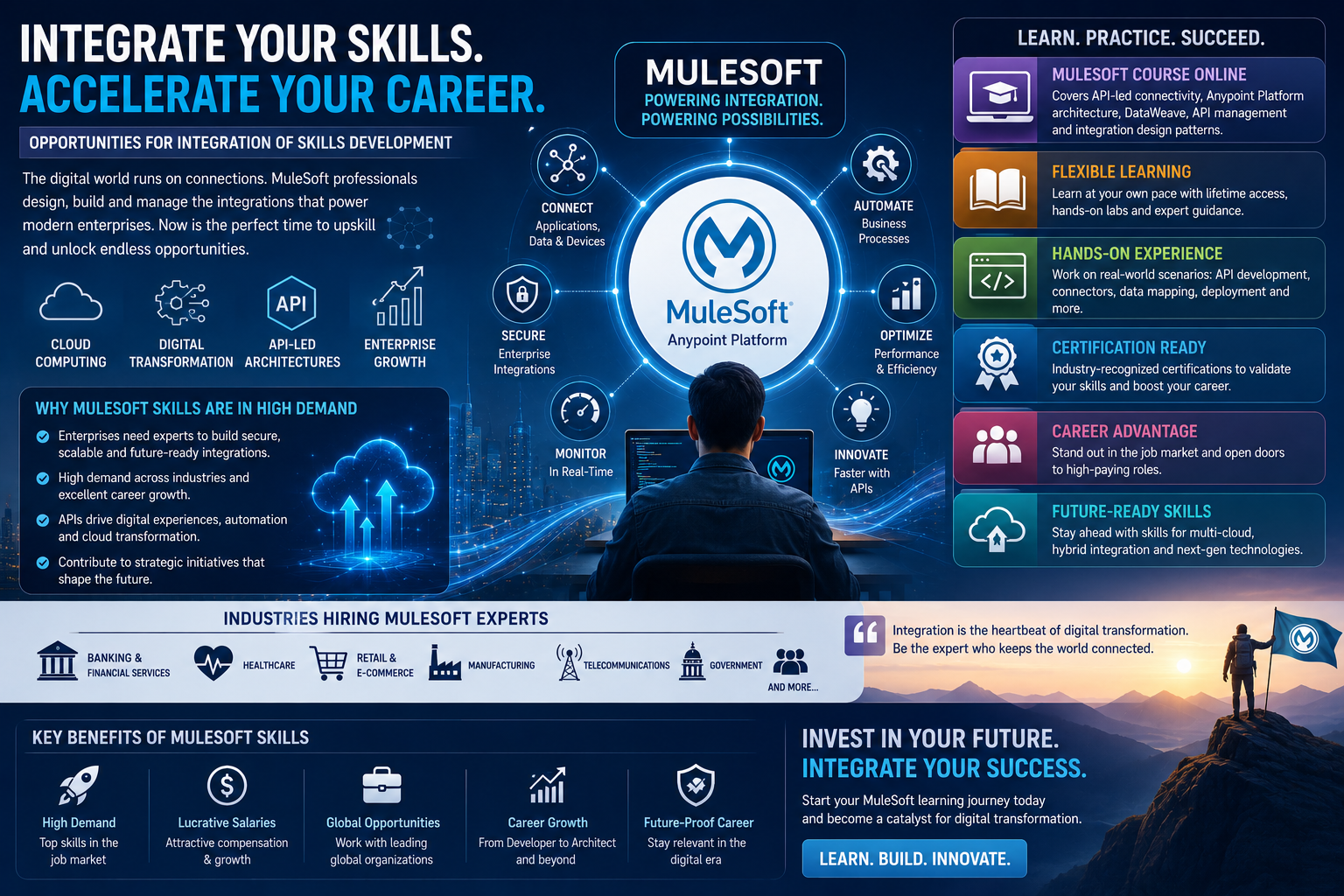
A practical education is a good education. With hands-on exercises on API development, connector development, data mapping and application deployment, learners gain confidence to solve real-world integration scenarios. The project-based learning techniques help professionals to learn how to solve integration problems in the context of an enterprise.MuleSoft Developer Course also helps you to prepare certifications. Industry certifications are great way to demonstrate your technical knowledge and improve your career opportunities. Companies prefer candidate with good background and hands on experience of integration technologies.The shift to multi-cloud and hybrid strategies will create a demand for trained integration pros. Investing in MuleSoft learning is a strategic move for your career, for developers, architects and IT professionals who want to continue their careers in the fast moving digital landscape.
Cloud & Hybrid Integration The Future of Integration
The future of enterprise tech is more connected. Organizations are quickly adopting artificial intelligence, machine learning, Internet of Things (IoT), blockchain platforms and advanced analytics solutions. These technologies generate a lot of data to be exchanged in an efficient and secure way between different systems. Companies are moving toward digital ecosystems and the role of integration platforms will only increase in importance.Multi-cloud environments are also becoming the new normal. Companies are not choosing one cloud vendor, but using AWS, Microsoft Azure, Google Cloud, Salesforce and dozens of niche SaaS vendors all at once. This different environment requires sophisticated integration capabilities to manage communication between them.The ability to build reusable integration assets that can be leveraged going forward to satisfy business needs with little to no redevelopment is enabled by the platform and is being driven by the unique API-first approach and flexible deployment architecture of MuleSoft.
Another trend is event-driven architecture where applications communicate with each other in real-time when a business event occurs. Customers today want instant answers, personalized recommendations and seamless digital experiences. With MuleSoft, organizations can build event-driven integrations to provide real-time synchronization and immediate business insights. AI is also transforming business. AI applications need access to huge amounts of data from many enterprise systems. MuleSoft enables you to securely connect APIs and integration capabilities, feeding AI-powered applications with accurate, real-time data.
As regulations become more complex, companies need better governance and security. With Mulesoft’s centralized API management and monitoring, organizations are able to stay compliant and keep the lights on.The future business success of organizations will depend on connecting applications, data, devices and people. “The integration will be less of a technical requirement and more of a strategic business capability. Companies that build scalable integration platforms today will be better positioned to respond to shifts in technology and market demand in the future.
Career development through professional training
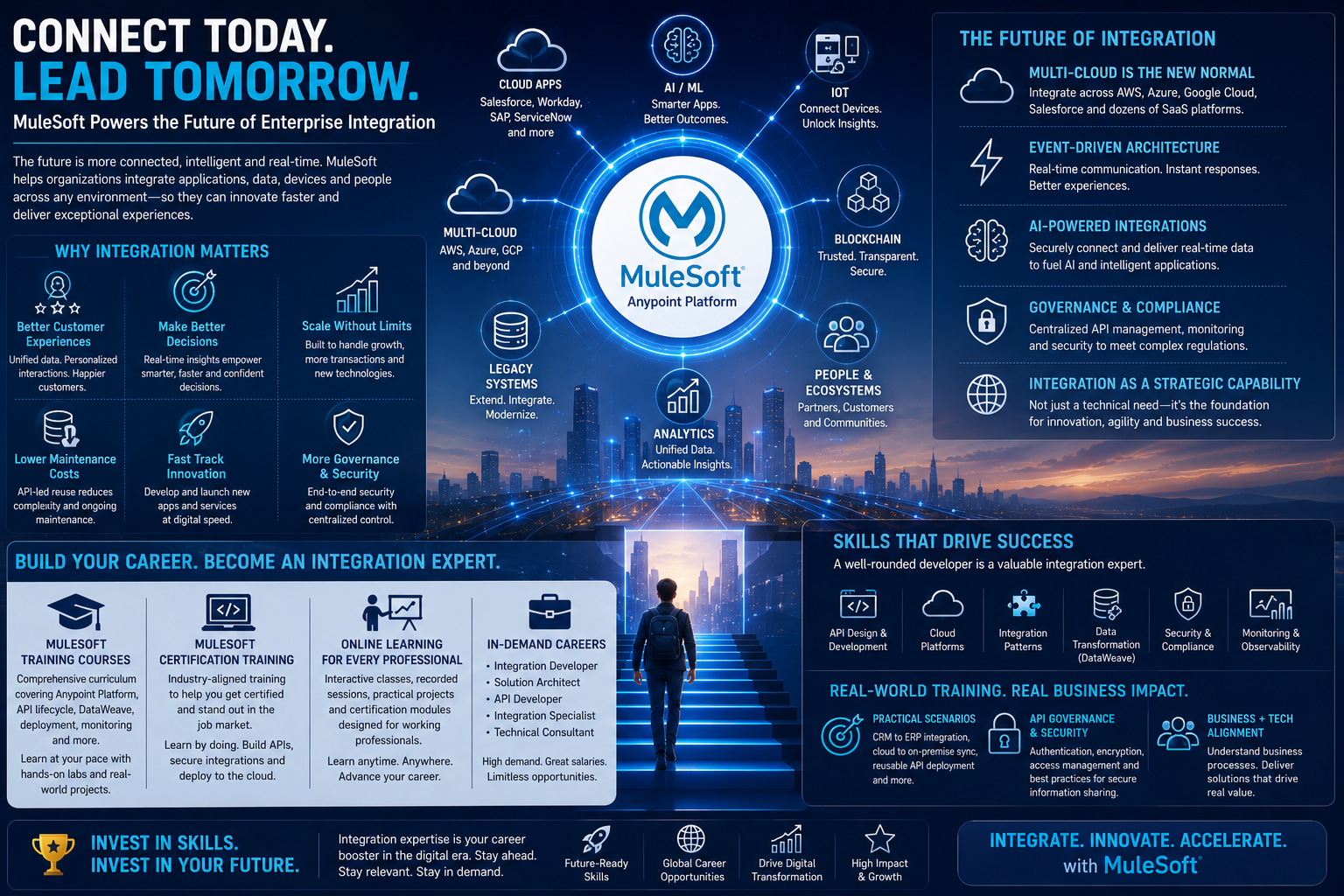
Enterprise ecosystems are becoming more and more complex and this is creating a huge demand for skilled integration professionals,” the organisation said. It’s looking for people who know how to design APIs, cloud architectures, how applications connect and the enterprise security practices.Hence the most of the professionals prefer Mulesoft Training Courses, to get the hands-on exposure of designing and implementing the enterprise integrations. The standard curriculum covers the basics of the Anypoint Platform, API lifecycle management, DataWeave transformations, deploy strategies and monitoring techniques. Online learning for working professionals with hands-on labs and real-world scenarios.
Knowing the integration patterns well can be a game changer for you on the digital transformation projects. Companies are looking for specialists who can drive the integration process, enhance the system interoperability and speed up the project delivery.Most of the aspirants for the post of Integration Developer prefer the Mulesoft Certification Training as these courses are designed as per the current industry needs. Learners learn by doing, they build APIs, integrate applications, implement security and manage cloud integrations.
Online learning platforms have made it easier than ever to learn technical skills. Through interactive classes, recorded lectures, practical projects and certification modules, learners will be able to develop theoretical and practical knowledge. These modes of learning are designed to improve employability and prepare professionals to face challenges in the enterprise implementation.Digital transformation projects are booming across all types of organizations, and so integration skills will be in high demand. As companies continue to invest in cloud migration, automation and API-driven architectures, the demand for MuleSoft professionals is only going to increase.
Developers need a broad set of skills to build modern enterprise systems. These are :
Developers and architects must work together on integration projects, along with business analysts and IT leaders. Developers today must understand programming concepts, enterprise connectivity, cloud platforms, and API governance.Most of the organizations motivate their technical teams to take Online Mule Software Training. These training programs help the teams to get complete knowledge of integration approaches and also helps in building scalable and secure architectures.These training programs are often based on real-world scenarios such as CRM system integration with ERP systems, Cloud application sync with on-premise databases and re-usable API deployment across different business functions. Participants will leave with key takeaways that will enable them to solve real-world integration challenges.
API Governance & Security Another key learning : As companies are paying more attention to cybersecurity and compliance requirements, sharing information securely is more and more important. The training covers authentication methods, encryption techniques, access management, and monitoring practices.Integration experts need business process and technical expertise. Successful integration efforts rely on the ability of technology to fulfill the goals of the organization. This greater perspective is developed through training and allows professionals to create more business value.
The complexity of enterprise connectivity is growing and the need for integration specialists will only grow in the years ahead. The career booster is that professionals spend money on integration technologies for long-term growth and more opportunities.
Learning Developer – Career Oriented
“Now you have developers doing the integration projects. They’re writing connectors, they’re transforming data, they’re building APIs, they’re making sure systems can talk to each other. It’s forcing organizations to go out and find more developers that have a specialty around integration.”Hence many professionals are willing to pursue Mulesoft Developer Course Online training to have practical knowledge of Anypoint Platform and API implementation techniques. This course is designed for developers and includes hands-on exercises in API design, DataWeave scripting, connector configuration, deployment and troubleshooting.
Enterprise integration environments can be quite complex. But the most important thing is the practical experience. Developers need to know a lot about communication protocols, security standards and data formats. Structured learning programs give you practical experience on live projects that are close to the business needs.
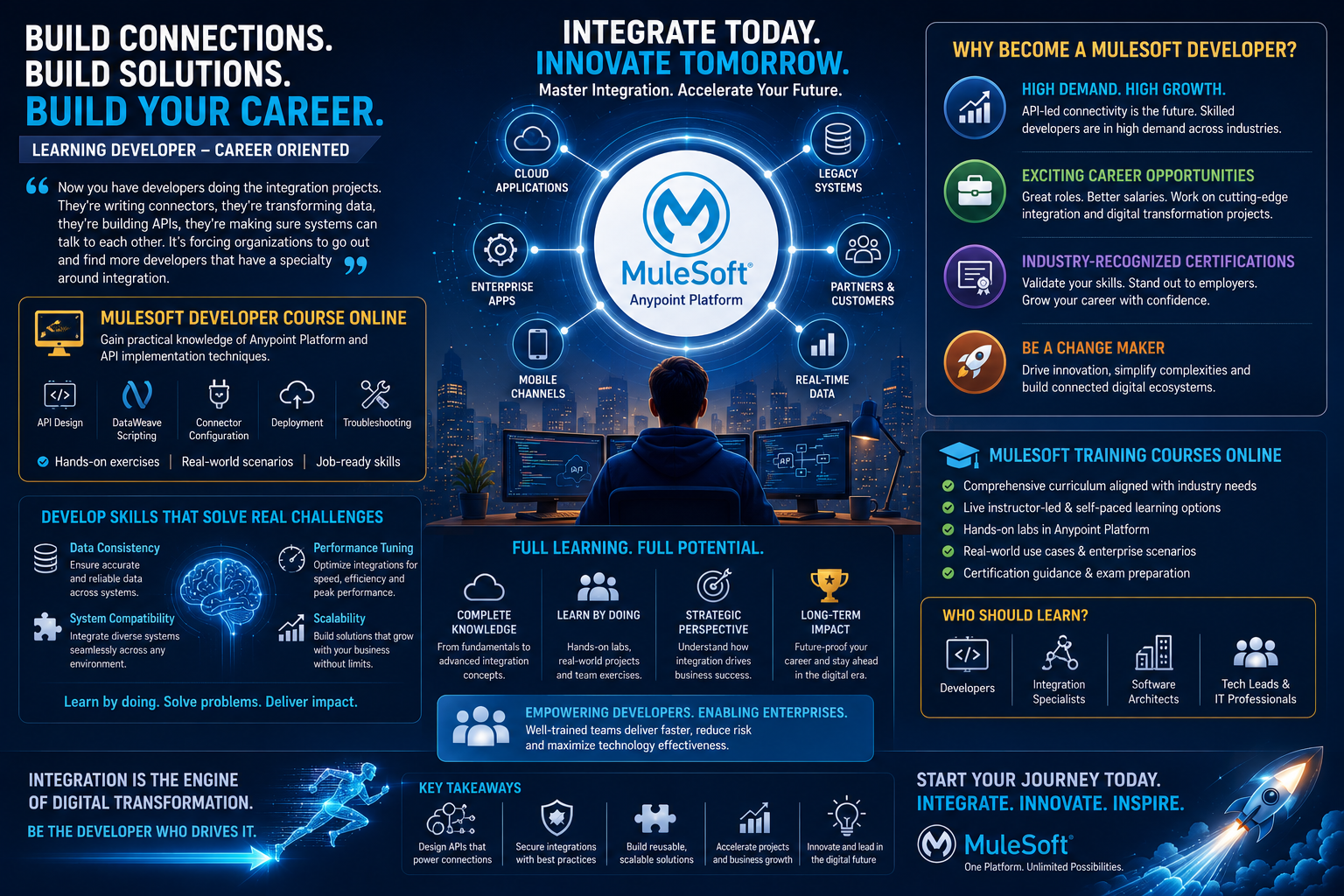
Developers also learn how to develop problem solving skills. Integration projects can face issues such as data consistency, system compatibility, performance tuning, and scalability. Through practical assignments and guided exercises, learners build confidence in addressing these challenges.Specialized developer training is good because it can result in certifications. Certifications recognized by the industry are a sign of technical expertise and can lead to better career opportunities. Employers are looking for people who understand the integration technologies and have experience deploying them.More companies are adopting an API-first approach, and the need for integration developers will continue to rise. The skills of developers are needed for digital transformation efforts and business innovation.
Full learning programs to open your mind
The rise of cloud computing and digital ecosystems has exponentially magnified the need for a holistic understanding of the concepts of enterprise integration. Enterprises need people to orchestrate hybrid environments, deploy APIs and lead big modernization efforts. That’s why many professionals prefer Mulesoft Training Courses Online as they can get a complete knowledge of the Enterprise Integration Technologies.Broad-based learning programs enable people to learn the technical implementation and the strategic elements of the integration initiatives. Students will learn that integration is a key enabler of digital transformation driving better customer experience and operational effectiveness.
The most popular training methods are based on the idea of learning by doing. Practical projects, real world case studies and team exercises in which participants apply theoretical concepts to practical situations. This helps the professionals to hold the knowledge better and also the professionals are prepared for the enterprise functions.And of course it is good for companies if employees are always learning. Well integrated teams can deliver projects faster, reduce operational risk and improve overall technology effectiveness. As more organizations move to digital transformation, the need for integration expertise will only increase. In today’s enterprise technology landscape, the successful professional will have to embrace continuous learning and skills development
Conclusion
MuleSoft has revolutionized the enterprise integration world with its API-led architectures that seamlessly connect cloud applications, legacy systems, and new technologies. “It offers reusable APIs, rich connectors, hybrid deployment capabilities and strong governance features that help organizations accelerate their digital transformation initiatives while reducing complexity and operational costs.” As businesses adopt multi-cloud strategies and data-driven models, MuleSoft remains the leading platform for building connected ecosystems. A MuleSoft expertise training can be a career booster for a professional and can be instrumental for future integration initiatives. OnlineITGuru has customized programs for organizations and individuals to learn in-depth knowledge and practical training on MuleSoft.