
How Salesforce Is Transforming Banking and Financial Services
Last updated on Nov 9, 2026
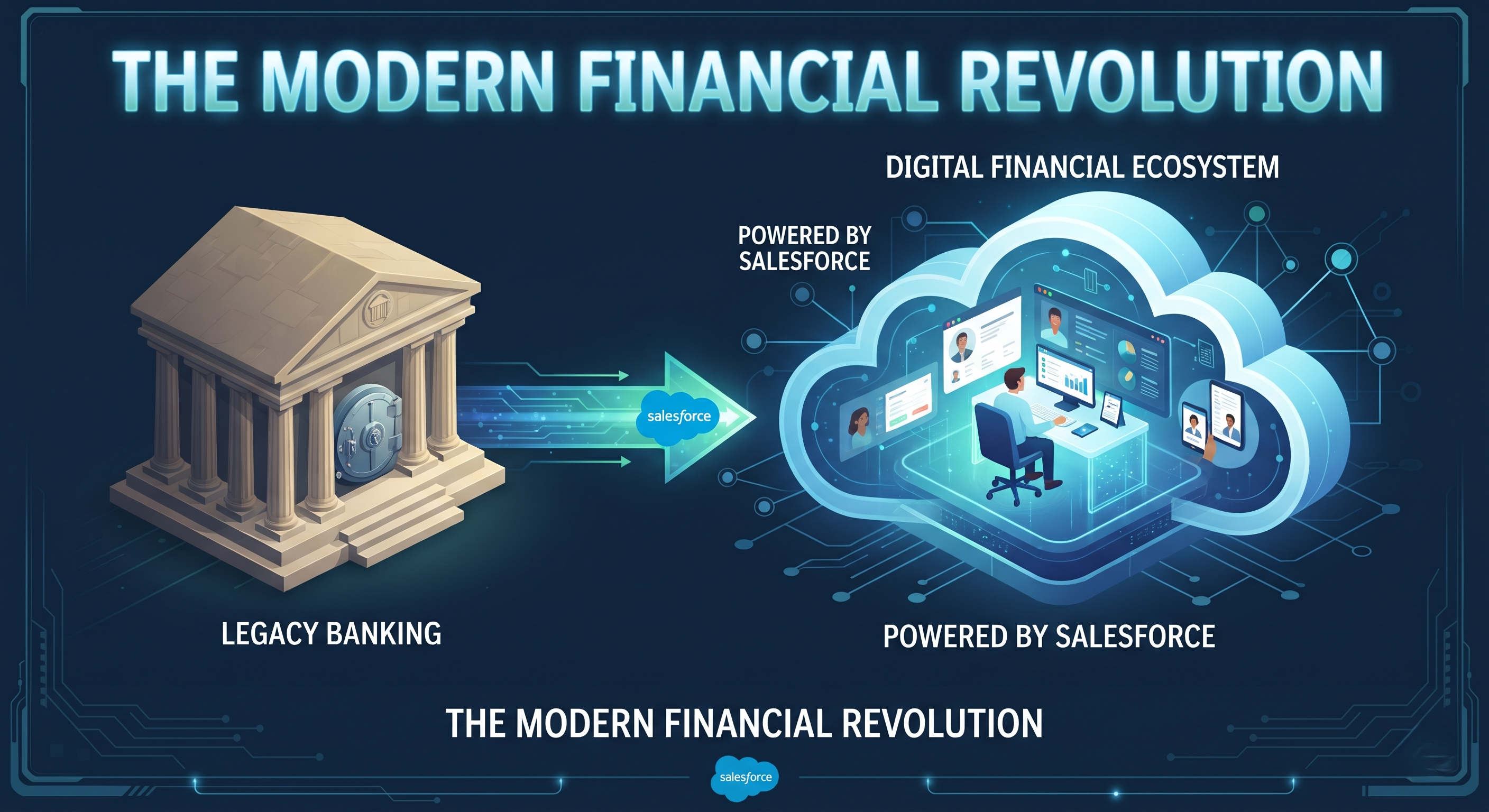
The Modern Financial Revolution – Preface
The banking and financial services industry is at a never before seen inflection point. For decades, conventional financial institutions have operated within rigid, siloed architectures built on legacy mainframes, physical branches, and siloed departmental workflows. They’d have to visit a physical branch to open a checking account, wait weeks to get approved for a mortgage, and be stuck with a disjointed experience where their local branch manager didn’t know what they were doing with their credit card or investment portfolio.
That world is in tatters today. Today’s average banking consumer expects hyper-personalised digital-first experiences that match the frictionless convenience of the e-commerce and streaming giants. Whether it’s checking a balance on a mobile app at midnight, applying for a commercial loan on an iPad or seeking automated financial planning advice, customers want speed, transparency and contextually relevant information. In finance, brand heritage and physical proximity are no longer enough to hold onto customers. It’s all about competitive survival – to leverage modern technology, consolidate disparate data sources and provide proactive, intelligent engagement.
Enter, Salesforce. Salesforce began as a revolutionary customer relationship management tool and has grown from its roots as enterprise software to become the digital backbone of the global financial services industry. Salesforce is transforming the way retail banks, commercial banks, wealth management firms and insurance companies conduct their business with industry-specific frameworks and advanced cloud infrastructure, data unification layers and cutting-edge artificial intelligence.
It allows banks to break down data silos within an organization, streamline complex processes required for regulatory compliance, and even deploy AI bots to convert existing cost centers into dynamic customer-driven profit centers. As an IT professional or developer seeking to learn such skills, taking up a sales force online course will give you real experience in working on cloud infrastructure and data layers. Let us get deeper into the subject of how Salesforce transforms banking and finance industry.
Getting a single view of the customer and breaking down data silos
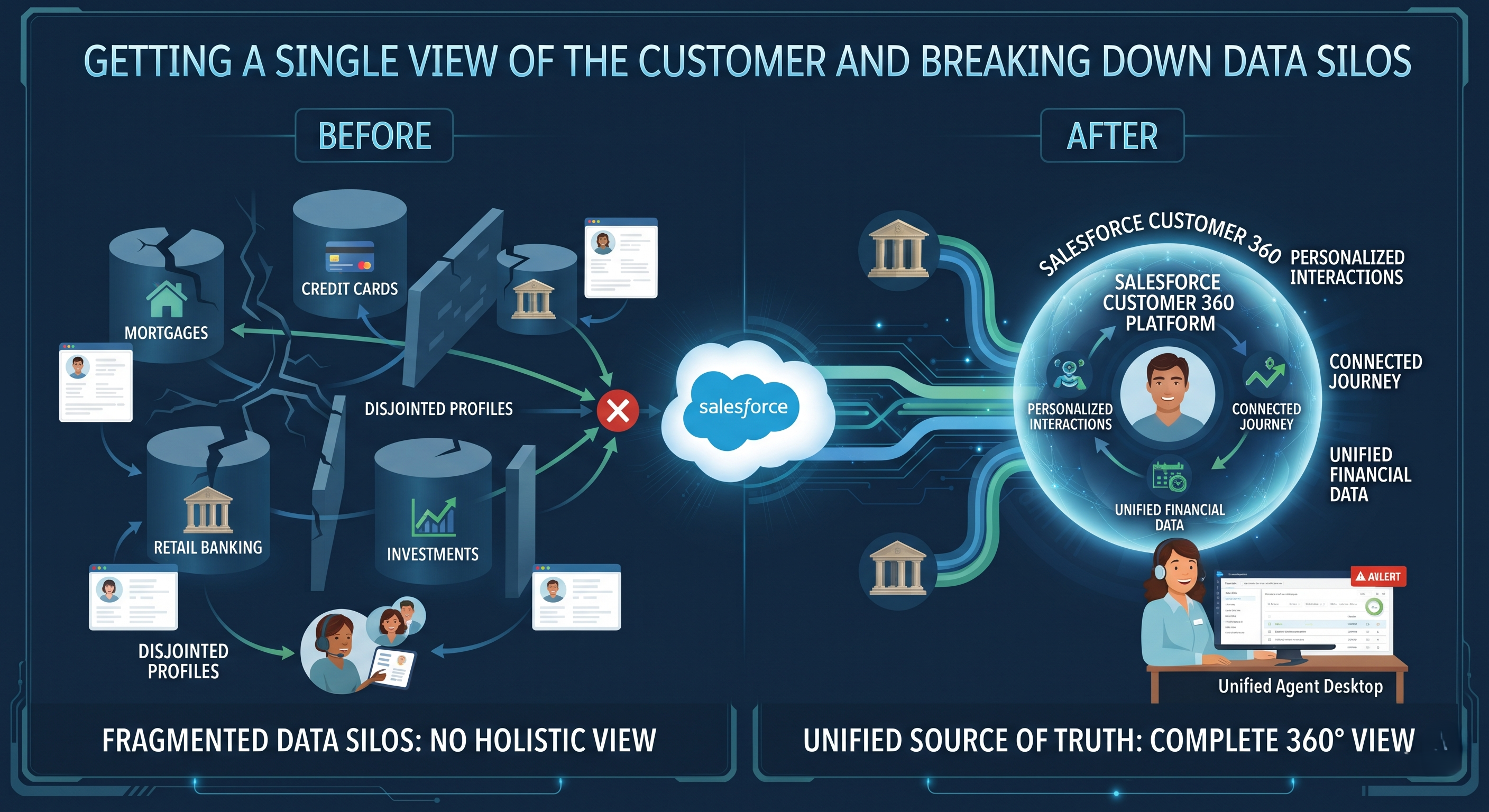
One of the most stubborn structural challenges for conventional financial institutions is fragmented data silos. A traditional legacy bank would have retail banking data in one core system, credit card histories in another, mortgage applications in a third and wealth management portfolios in a fourth completely separate database. When a customer calls a contact center or walks into a branch, the service rep usually doesn’t have a full, holistic view of the customer’s financial relationship with the institution.
Salesforce solves this basic problem by giving you one source of truth for the entire enterprise. Salesforce integrates legacy core banking systems, payment gateways and third-party applications in a single platform, giving relationship managers, customer service agents and financial advisors a complete 360-degree view of every client.
This unified view alters the character of the client engagement. Instead of a client explaining his account history or his financial situation to each department, all employees in the institution can see live updates on the customer’s holdings, active loans, recent service requests and product preferences.
Also, advanced data architecture layers enable financial institutions to consume and harmonise large volumes of structured and unstructured data from internal and external sources. This means customer service teams are no longer reactive fire fighting teams. They have live contextual intelligence that powers every conversation.” A 360-degree view of the customer can enable financial institutions to move from mass-market communication to highly targeted, empathetic engagement that creates long-term brand loyalty and share of wallet.
The Financial Services Cloud Edge: Built for the Purpose
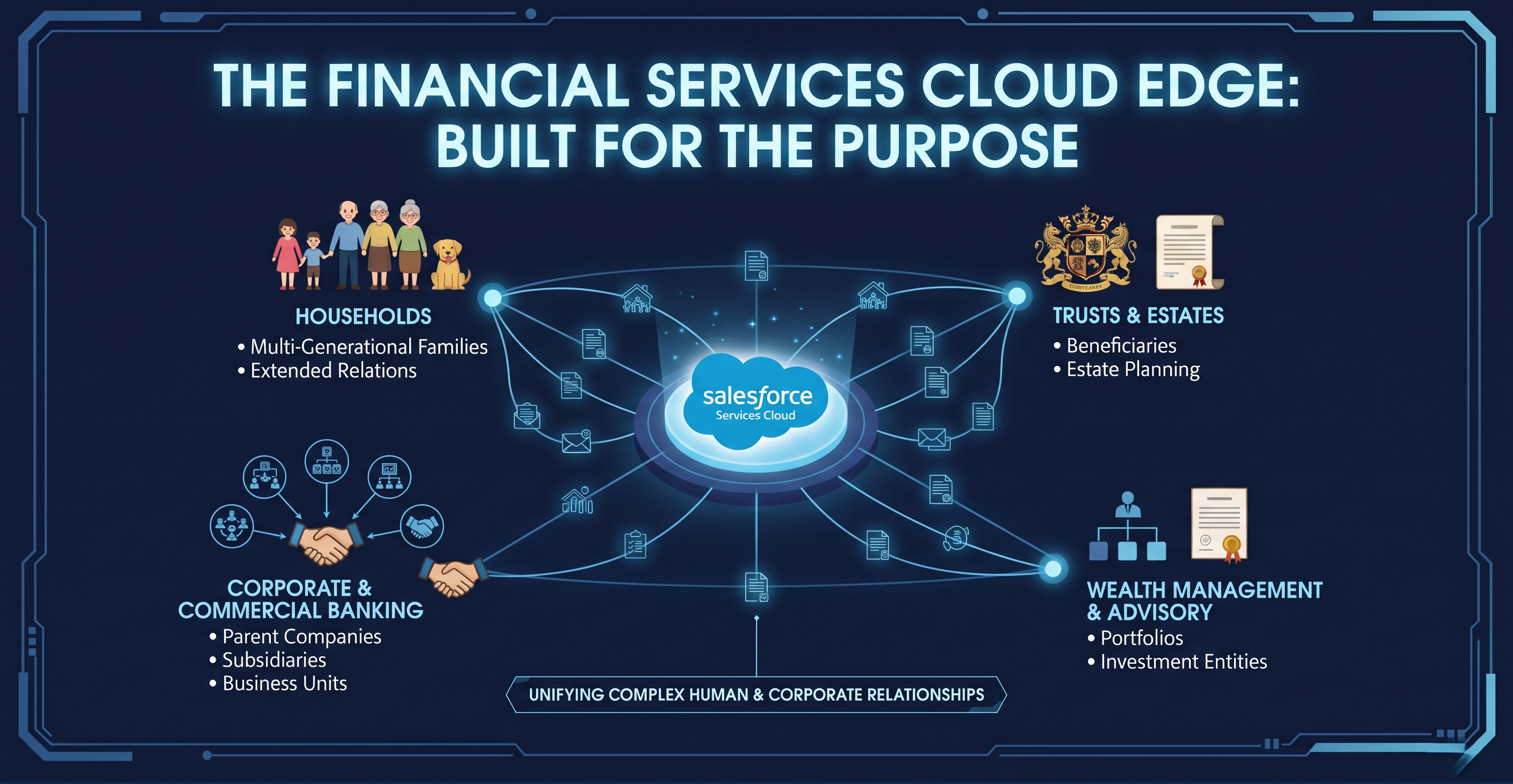
Standard customer relationship management tools can take care of the basics, but the financial services industry has unique constraints, complex regulations and complicated relationship hierarchies that require a specialised architecture. Salesforce responded with Financial Services Cloud, a vertical solution designed to meet the unique requirements of banking, wealth management and lending.
In Financial Services Cloud, the generic data models are replaced by financial objects, which are built to replicate complex human and corporate relationships. Mention wealth management or private banking and seldom does a client appear as a human being. Often found in complex household structures, multi-generational families, trusts and business partnerships and holding companies.
The platform is also built with specialised relationship mapping tools that enable advisors to map multi-party relationships and track how financial accounts, trusts and legal entities are connected through generations. Private bankers and wealth advisers can use it to identify opportunities for cross-generational wealth transfer, sniff out potential estate planning needs and get the full picture of a family’s wealth footprint.
No less important are similar structural hierarchies in commercial and corporate banking. With a big corporate client you have parent companies, subsidiaries, separate business units, multiple signatories and complex credit facilities to track. Salesforce provides commercial bankers with a single, cohesive workspace to manage deal pipelines, active lending portfolios, syndication details and risk exposures.
“The Financial Services Cloud gets rid of manual spreadsheet tracking and fragmented legacy notes that have been hindering commercial banking teams for years, and boosts deal velocity, pipeline visibility, as well as world-class service to institutional clients. Such special data models and multi-party relationship mapping capabilities demand specific learning paths, which is why one may benefit from industry-recognized sfdc online training.”
Streamlining Onboarding and Speeding Up Lending Processes
Among the operational bottlenecks that today’s banking consumers hate the most are bureaucratic onboarding processes and slow loan processes. When a customer is opening a new checking account or applying for a commercial real estate loan, they want a turn around. However, historically these processes have been hindered by duplicative paperwork, manual data entry into disparate systems and opaque approval processes that have resulted in high drop-off rates and lost revenue.
Salesforce transforms the onboarding and lending lifecycle with intelligent workflow automation and task management. When a borrower applies online, Salesforce automatically collects and validates the necessary documentation, performs Know Your Customer (KYC) checks and channels approvals to the right underwriting teams.
It pulls credit scores and verifies identity markers, and runs anti-money laundering database checks in real time with integrations to platforms, without the need for bank staff to enter data manually.
Digital onboarding guides retail banking applicants through account opening, automatic funding and debit card issuance. Mortgage and lending department loan officers can view the borrower journey from start to finish. They get a clear view of where a loan application is in the pipeline, can immediately spot any missing documents, and send automated status updates to keep the borrower informed every step of the way.
The transparency and speed will not only dramatically reduce the financial institution’s operational costs and administrative overheads but also significantly increase conversion rates and customer satisfaction scores. Banks replaced administrative friction with digital flow. They turned a mundane task into a friendly digital handshake.
Elevating the standards of customer service and engagement in retail banking
The customer-bank interaction has moved beyond the physical teller window as the digital bank today. No, it's the contact center and the digital interface. Retail banking customers want instant answers, around-the-clock availability and seamless self-service for everyday tasks such as password reset, transaction dispute or fee waiver request. They want human agents who can empathise, work quickly and have the whole context to solve complicated problems.
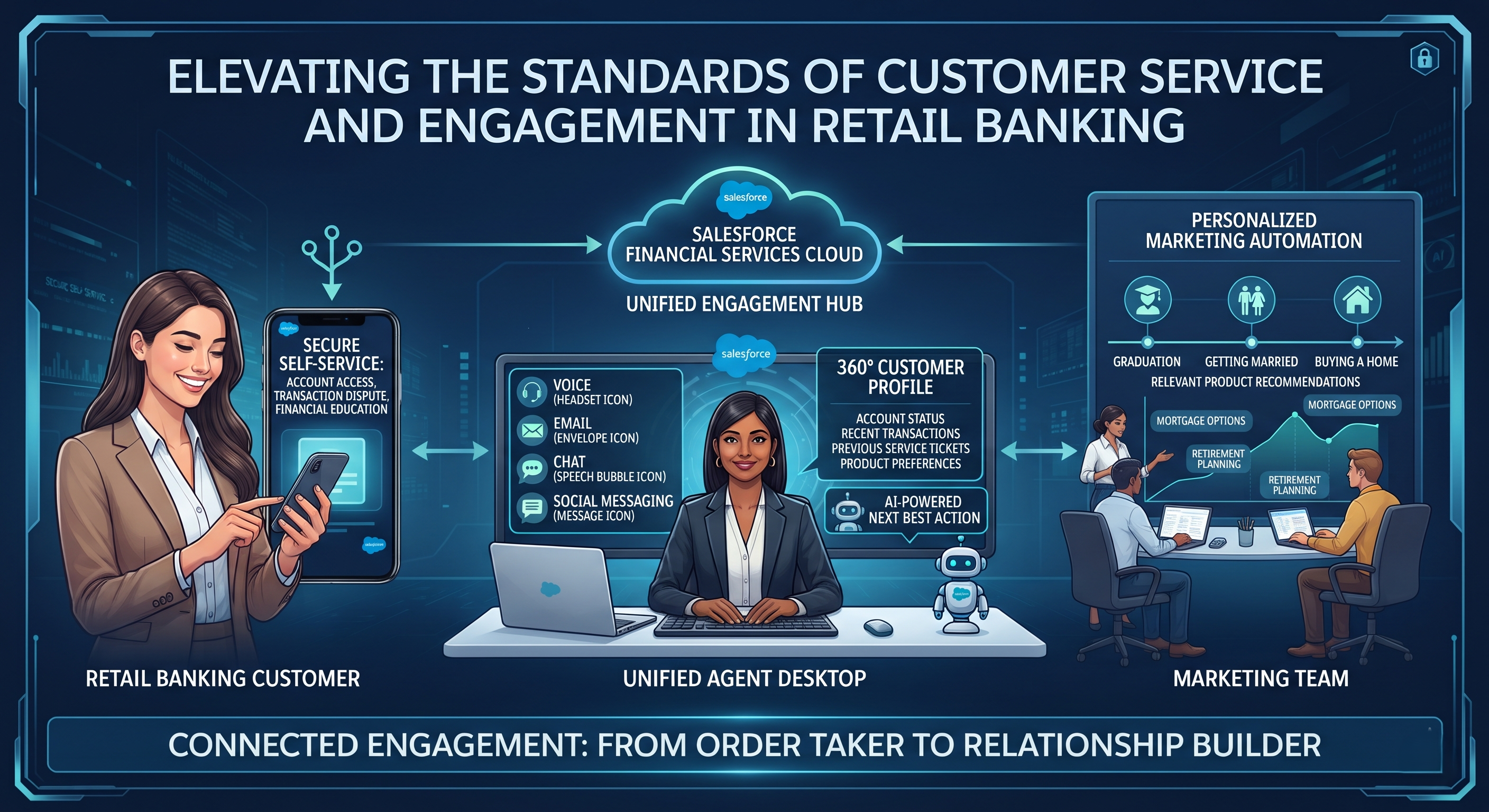
Salesforce is reimagining retail banking service operations with people expertise and connected engagement tools. Unified agent desktops consolidate all communication channels (voice, email, chat, SMS and social messaging) into a single interface for service agents on Salesforce. With mobile chat, when a customer first contacts the business, the agent can view their account status, recent transactions and previous service tickets, and doesn’t have to toggle between legacy systems.
Retail banks can also leverage Salesforce to build strong self-service portals and digital community centers where customers can securely log into their accounts, troubleshoot common issues and access financial education tools. In the background, complex routing rules automatically route complex or high value service requests to the most qualified specialists based on skill set, language and customer tier.
Salesforce is also helping retail banks’ marketing teams to get away from mass, untargeted promotional blasts. Marketing automation tools monitor financial behaviours, transaction milestones and life events such as graduating, getting married or buying a home in real time to make relevant, personalised product recommendations when the need arises. This moves the institution from being an order taker to being a relationship builder that is driven with advice.
Embedded compliance and risk
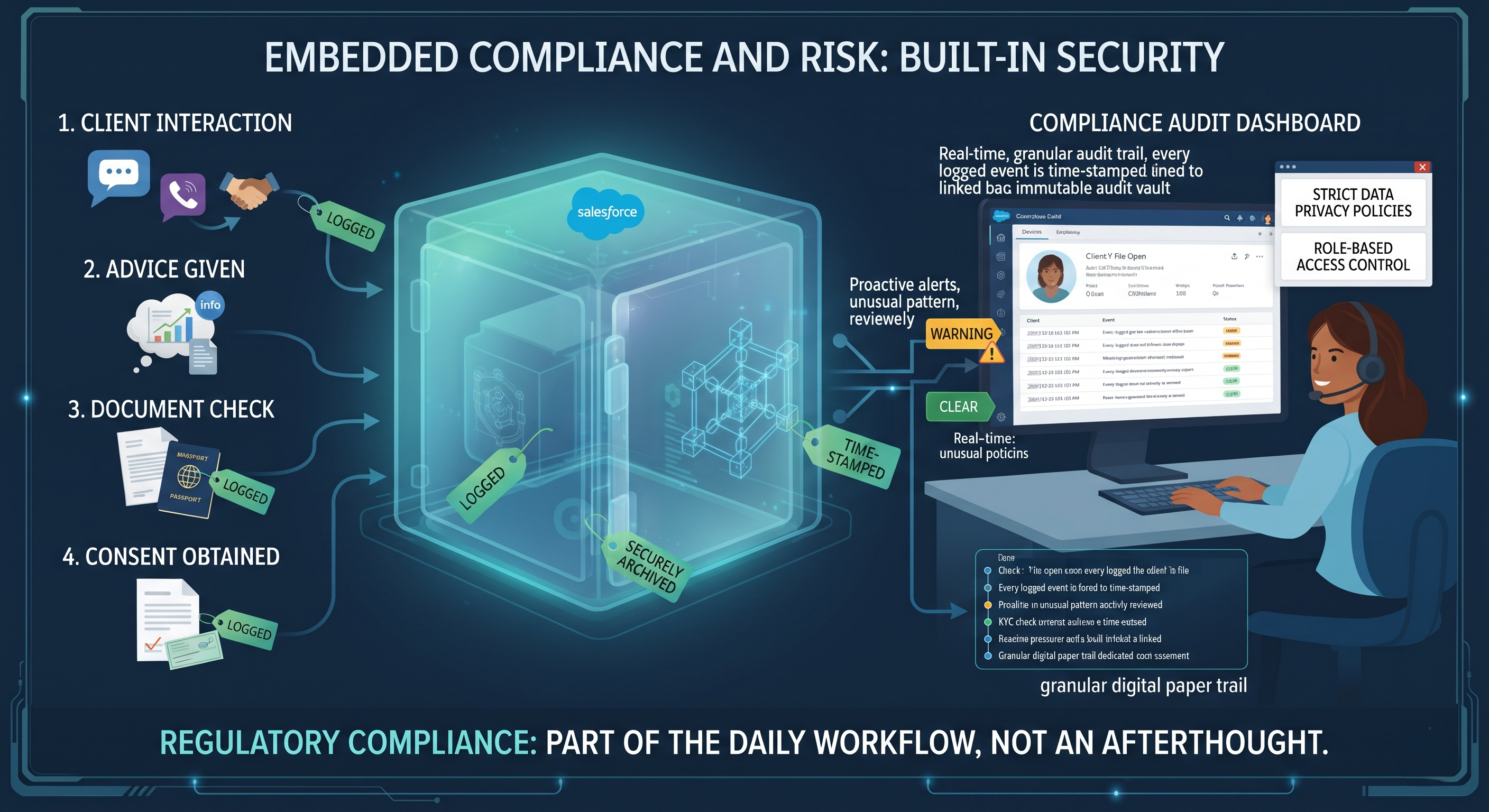
The financial services industry is the most heavily regulated part of the global economy. Institutions must comply with local and international requirements imposed by anti-money laundering legislation, privacy law, consumer protection statutes and inflexible audit demands. Compliance has historically been viewed as a reactive, manual add-on that added administrative overhead and slowed business processes.
“We embed compliance into the fabric of the institution so that regulatory compliance is part of the daily workflow, not an afterthought,” he said.
Every client interaction, every advice we give, every consent we obtain and every document we check is logged, time-stamped and securely archived in Salesforce. The granular digital paper trail facilitates audit and regulatory reporting while reducing the chances of expensive compliance issues and human error.
Financial institutions can also set up strict data privacy policies, control access based on roles, and encrypt sensitive financial data using security and governance tools that are built into the platform. Compliance officers can use advanced audit trails and regular monitoring to proactively detect unusual account activities, irregular transaction patterns, or missing customer documentation, thus stopping these issues from becoming systemic vulnerabilities.
“Salesforce enables financial institutions to innovate rapidly and bring new digital products to market safely, with strong governance and compliance protections to protect the institution and its customers.
AI Revolution: Agents + Forecasts
Cloud CRM and workflow automation were game changers. Artificial intelligence is the latest wave of financial services tech. The financial world produces a vast amount of structured and unstructured data on a daily basis, which makes it a prime area for the application of machine learning algorithms and generative intelligence. Salesforce is leading the way in introducing safe, enterprise-scale artificial intelligence into the daily workflows of finance professionals.
Salesforce’s predictive analytics and generative intelligence enable banks to anticipate customer needs and reduce operational complexity. Artificial intelligence algorithms for wealth management can also give proactive recommendations based on the behaviour of the market and the diversification of the portfolio. Advisors are automatically prompted to rebalance a client’s portfolio, follow up after a market drop, or talk about retirement planning strategies.
Autonomous AI agents are changing the way we do customer service and operations. The days of old school rule-based chat bots that left customers in frustrating loops are long gone. Today’s agentic artificial intelligence systems, powered by Salesforce, can think, act and speak naturally with customers, all meticulously following institutional security protocols.
These digital assistants can authenticate users securely, resolve disputes on transactions, handle requests for card replacement and walk customers through complex application forms across mobile and web channels.
Critically, these AI agents are not operating in isolation, but are closely integrated with the bank’s core systems and human staff. If an autonomous agent cannot fulfilll a customer request or requires human interaction, the system will gracefully transfer the conversation to a human agent, along with a full summary of the interaction and suggested next steps.
Internally, compliance teams also use AI to scan communications for potential insider trading or compliance violations, and to improve fraud detection by analysing behavioural anomalies across millions of transactions in real time.
Driving Collaboration Across The Enterprise Ecosystems
Financial institutions are complex ecosystems with multiple departments, external partners, independent brokers and 3rd party vendors. Most times, a mortgage loan officer will have to call in an insurance specialist, a wealth adviser and a credit risk analyst to close a large commercial deal. Deals stall, communication breaks down and the customer is on a disjointed, frustrating journey as teams work in isolation.
Salesforce offers a shared digital workspace that connects internal departments and external partner networks to collaborate and helps to drive collaboration across the enterprise. Built-in collaboration features allow teams to co-author documents, share real-time updates on active deals, assign tasks, chat instantly about client accounts and more – all without leaving the platform.
Salesforce Partner Communities expands the secure CRM ecosystem to organisations that depend on independent broker networks, dealer channels or external mortgage partners. External partners will have their own portals to register deals, track commission structures, submit loan applications and access marketing collateral, all with strict data separation and security permissions.
The enterprise ecosystem purrs with synchronised precision and shared accountability, reaching out seamlessly to the entire network, no matter where an interaction begins – be it a digital self-service portal, a physical branch, an independent broker or a wealth advisor.
Impact Measurement: Growth of ROI and Efficiency
Salesforce’s strength in the global banking and financial services industry is not due to being a new technology, but because it makes a real business difference. Margin erosion, rising operating costs and stringent capital requirements are constant challenges for financial institutions operating in highly competitive markets. The substantial financial and operational benefits of a single, consolidated platform such as Salesforce.
Salesforce users report dramatic drops in cost to win new customers, faster deal closures and big jumps in employee productivity. Automation of repetitive administrative tasks such as manual data entry, document verification and routine status updates, can save thousands of hours for frontline staff and free them up to focus on valuable client advisory and relationship building activities.
Often these operational efficiencies translate into tangible reductions in administrative overhead, quicker loan processing times and lower cost-to-income ratios.
And hyper-personalized, timely product recommendations can boost up cross-sell and up-sell conversion rates. They give advisors and customer service reps a full 360-degree view of their customers, making them trusted financial advisors — not just order takers.
The enhanced advice capability will deliver increased customer lifetime value, reduced churn and drive sustainable long term revenue growth in an increasingly crowded financial market place.
Conclusion: The Future of Connectivity with Banks
Banking and financial services have always been evolving, fuelled by changing consumer expectations, regulatory changes and rapid technological innovation. Institutions that wish to prosper in the digital economy can't operate with legacy infrastructure and siloed operations. To remain relevant, financial service providers need to be agile, intelligent and laser-focussed on the customer.
Salesforce has become the catalyst and platform of choice to enable this monumental industry evolution. From uniting fragmented data silos and delivering personalised financial architectures, to simplifying complex onboarding and lending processes, building in strong compliance standards and harnessing trusted artificial intelligence, Salesforce is helping banks re-imagine what is possible.
Looking ahead, the top financial institutions in the market will be the ones that combine human expertise with intelligent automation. Financial institutions that use Salesforce to deliver unified, empathetic, lightning-fast financial experiences won’t just survive the digital age’s disruptions; they will set the gold standard for customer success in the global financial ecosystem.
With the continuing growth of the industry, human wisdom together with intelligent automation will be what defines the industry leaders. For those professionals who wish to make a profitable career for themselves in this fast-growing industry, they can begin by undertaking sfdc training online and get practical knowledge of it. Those financial institutions that will take advantage of Salesforce to develop unified, empathic, and fast financial experiences will not only survive the disruptions of the digital era but set the benchmark in terms of client success in the global financial environment.