
IBM DataStage: The Enterprise Data Engineering Skill Hidden Behind Data
Last updated on Sep 18, 2026
The Data Problem Behind What Customers See
When a customer places an order through a company website, the order is confirmed, the customer is charged the inventory is. The customer receives a shipment notification a few minutes later. From the view of the company website, this looks like an ordering process. However, behind the scenes, many systems may record information. Be updated. Customer details can be stored in a CRM database; payment details may live in a system; inventory information may exist elsewhere and the shipping notification may come from yet another application.
When a business requires that information to live in a place, simply copying data from one system to another is not sufficient. The applications use structures, terms, formats, and rules. Customer_ID is not the same as Client_Number, and data must pass through conversions before it can be used reliably.
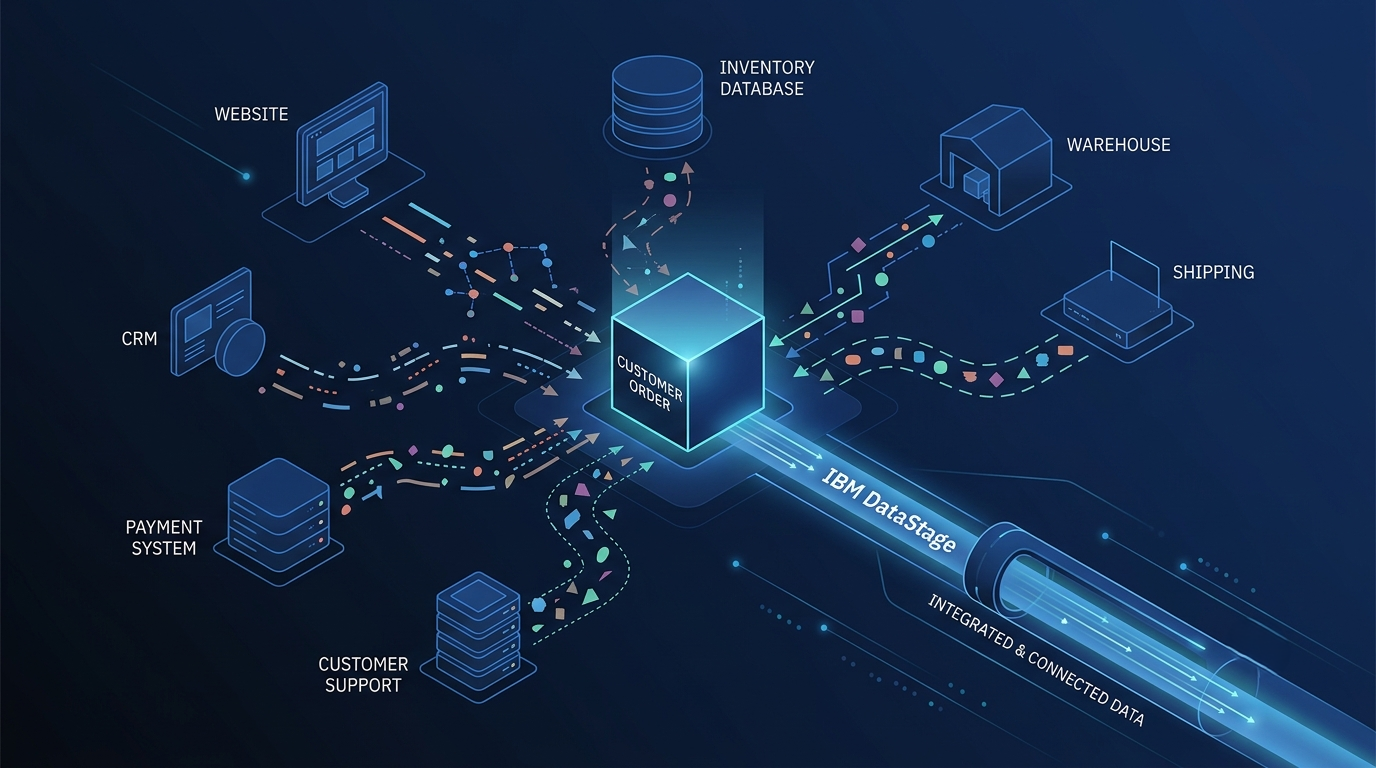
Enterprise data integration becomes an enabler for businesses at this point.
IBM DataStage was built to solve this problem of extracting, transforming and loading data from sources into systems where this information can become reports, analytics, applications, and business processes. IBM describes IBM DataStage as an ETL and ELT platform that can process volumes of data across hybrid and multicloud environments.
Consider an enterprise that processes millions of transactions each day. Such an organization cannot manually verify that the information copied from one system to another matches in all respects. Therefore, a pipeline must be built where data undergoes transformations, follows business rules and is subject to rigorous control and auditing before it reaches its destination. IBM DataStage operates in the invisible world of data, where information becomes the foundation for business processes, analytics and applications.
Information From Everywhere: Beyond Traditional Databases
Modern companies realize that databases are no longer the keepers of information inside an enterprise. Applications, cloud platforms, APIs, files, enterprise systems, customer platforms, connected devices and operational technologies all provide data. Some of this data arrives on a schedule while other data must be processed immediately. These differences create challenges for enterprises. Having information does not automatically mean having better data. Organizations struggle to extract value from a collection of reports.
Data integration is therefore essential for turning data into an usable consistent format. Data engineers build ETL (extract, transform, load) and ELT (extract, load, transform) processes that combine sources of information into integrated insights. Depending on system architecture, performance, cloud environment and data volume information may first need to be extracted transformed into a format and loaded into a destination system or loaded first and then transformed.
For a data engineer entering this field it is more important to understand where data originates in what condition it exists what the business intends to do with it and how to respond if it does not behave as expected.
What Happens to Data in a DataStage Pipeline?
A company receives transaction data about customers from three sources. One database contains customer information another contains transaction details and a third holds product data. Using IBM DataStage this information can be combined into a view for analytics or a reporting data warehouse. What may look like a data integration task hides many transformations and validations that occur as data moves through a pipeline.
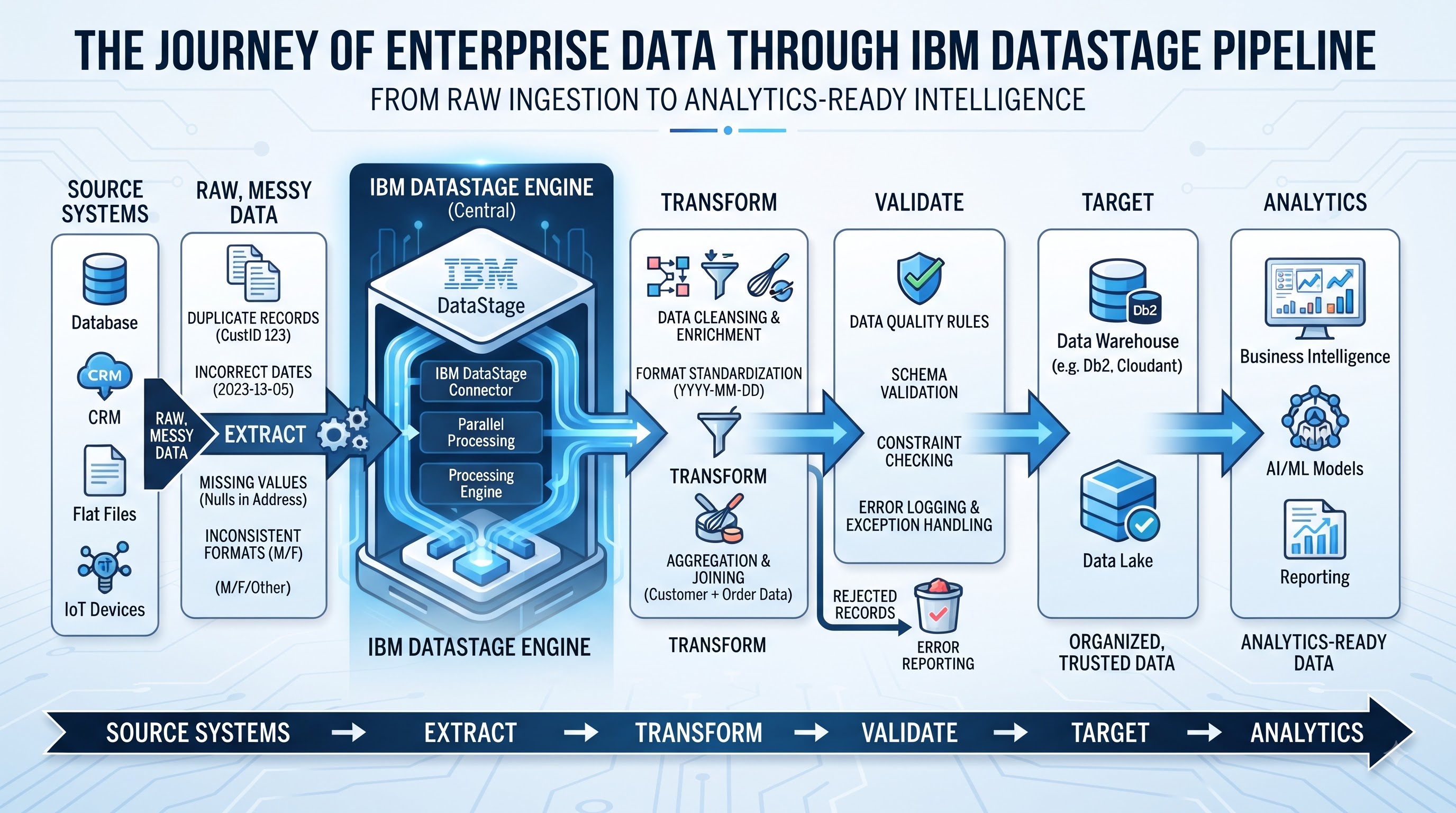
The process often begins by retrieving data from its sources. Records can then be filtered, joined, sorted, transformed and enriched based on business logic and requirements. Some stages of an IBM DataStage pipeline may discard records that do not meet criteria while other stages may enrich customer information with transaction data and prepare it for reporting.
The ability to control transformations ultimately decides whether data can be trusted downstream.
Consider a situation where a customer record contains a phone number or customer ID or where a transaction has an invalid date. A designed pipeline will have rules, for handling such records. These records can be rejected, sent for review or corrected using transformation rules so that they pass all downstream validations. Without controls and transformations unreliable data can easily enter downstream processes.
This is also why debugging becomes a skill for anyone working with data integration. A pipeline can stop working because of a problem in the database an issue with source data, a transformation rule, a schema error or an overall performance issue. The ability to understand the implementation of a pipeline has to be paired with an understanding of business logic in order to troubleshoot effectively. In words a data pipeline is not simply a series of stages but a controlled process governed by specific rules and expectations.
What Makes Enterprise DataStage Different?
Processing a data set on a local PC can seem relatively straightforward. At the enterprise level however a data pipeline has to be able to process millions or even billions of records and must meet requirements about performance, reliability, security and availability. A data pipeline that runs a batch of 10,000 records is not necessarily ready to process a million records ten times faster.
This is why parallel processing is often a deciding factor in the performance of enterprise data pipelines. Of processing records in a serial manner a sufficiently powerful system can divide the workload and execute instructions in parallel thereby making better use of resources and accelerating performance. Architecture, configuration, data volume and system resources all contribute to how a data pipeline can be optimized.
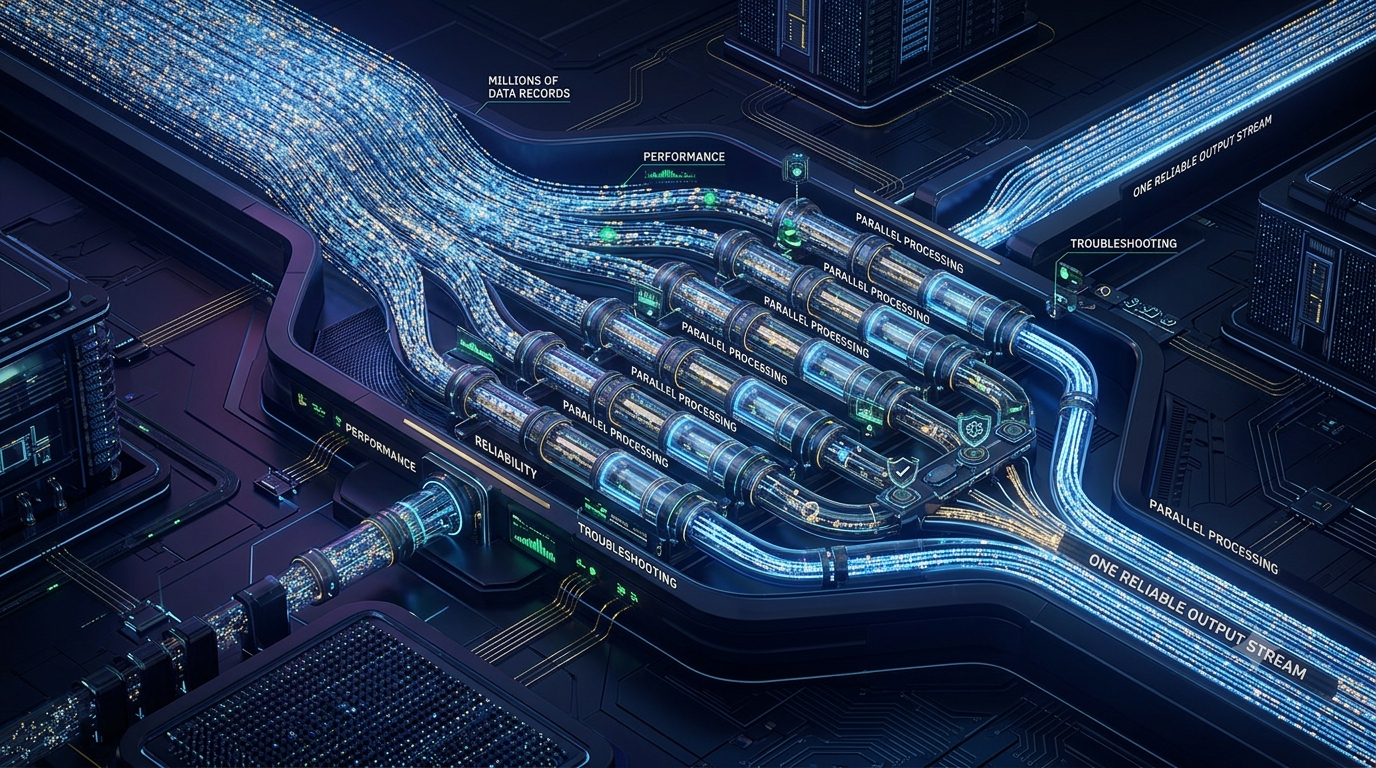
At the enterprise level performance is often not a nicety. A necessity. Similar considerations apply to reliability. A daily batch data pipeline that fails midway through processing can result in reports the next day or downstream analytics becoming unreliable. Duplicate records in a customer analytics data pipeline can lead to numbers and developers and engineers spend a significant amount of their time investigating failures and making their data pipelines more reliable.
A practical understanding of how transformations work in DataStage becomes critically important in these scenarios. Engineers and developers need to be familiar with the behaviors of transformations and the potential impact they can have. Understanding databases and how they interact with a DataStage data pipeline can also be a factor in troubleshooting as can practical experience with operating systems, scripting and general IT expertise. In essence, working with DataStage at the enterprise level often means being a generalist with a skillset that extends beyond the tool itself.
DataStage in the Age of Cloud and AI
The data world surrounding enterprise applications continues to evolve. Companies are no longer placing all workloads in a data centre. Some workloads remain on‑premises either due to legacy reasons or regulatory requirements while others are deployed in private clouds. This creates scenarios where information must move between different environments.
DataStage continues to evolve in this environment with IBM offering a variety of options for data integration both within watsonx.data integration and at the level of platforms. In ways this reflects a larger trend, where data integration and ETL/ELT processes are beginning to span beyond a single database environment. Enterprises use a mix of databases cloud platforms and hybrid infrastructure and data now resides in a variety of locations.
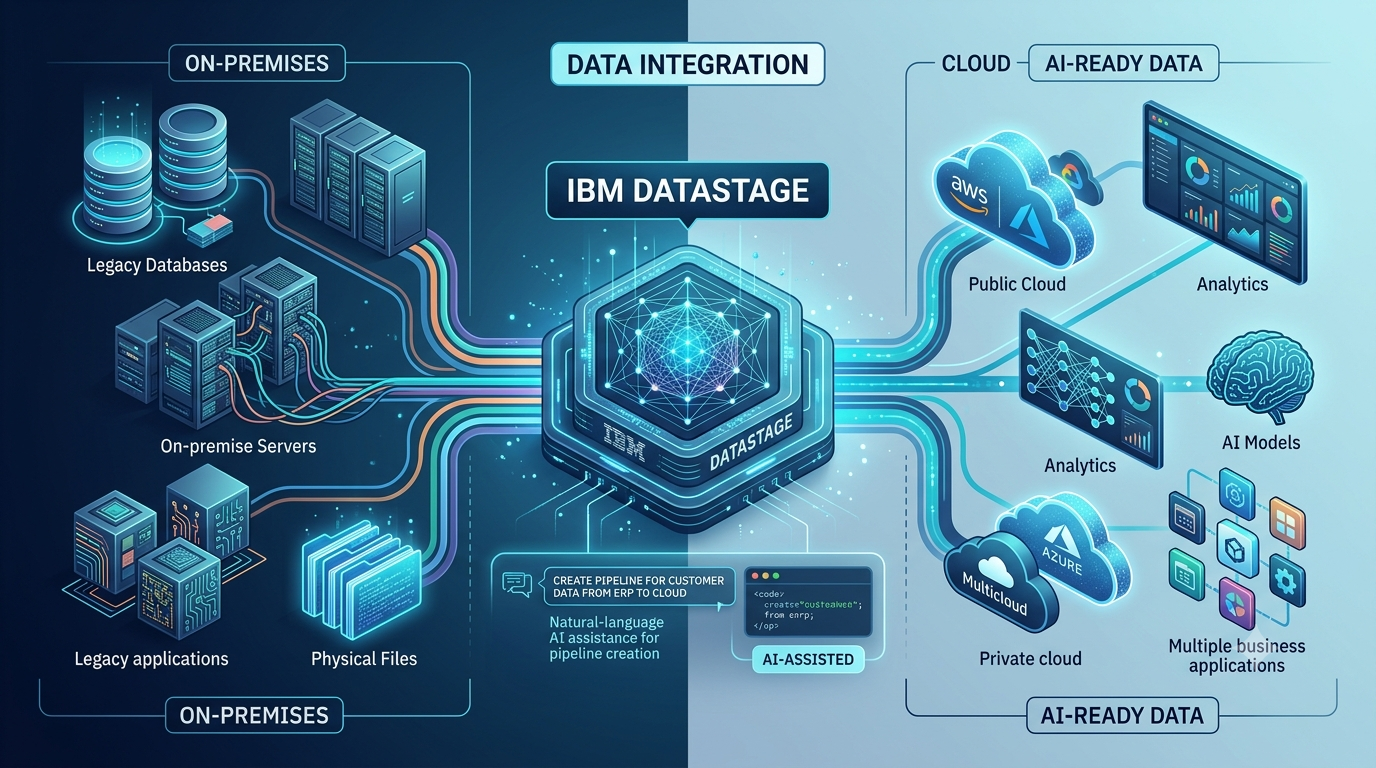
Clouds are changing where data lives. The ability to connect this data remains critically important.
Artificial intelligence adds yet another layer of complexity to this equation. An AI model may be sophisticated. Its accuracy will ultimately be driven by the data it is trained on and the context in which it is deployed. IBM has seen fit to introduce natural language assistance around DataStage, where instructions about what a user wants to accomplish can be turned into ETL/ELT pipelines. This reflects a trend around using AI to accelerate parts of the data engineering process.
It is important to recognize, however, that traditional data engineering expertise is unlikely to disappear simply because AI‑assisted tools become available. A data engineer still needs to understand the context and requirements behind a use case, the data involved, and what transformations may be necessary. AI can assist with accelerating tasks, but it is unlikely to replace the need for people who understand why a particular transformation should exist. Looking ahead the role of DataStage in enterprises will likely be increasingly focused around hybrid and multicloud environments, AI‑ready data, governance, and data quality.
Real-World Applications, for a DataStage Developer
In a day a DataStage developer does not spend all their time inside the DataStage environment. The day often starts with a talk about a report problem or a brand new business process. The DataStage developer then has to locate where the needed data lives, learn how to pull it decide what changes are needed and decide where the data must end up.
SQL plays a role for DataStage. Inside companies, databases keep the data. A DataStage developer might need to look at table layouts, see how tables connect, check data write queries or find out why results do not match what business expects. Skills in Linux, scripting, scheduling, database administration and troubleshooting are just as vital as DataStage skills.
In short, the technical work of a DataStage engineer never stands alone. It always serves a business goal, so knowing this is very important. When a business analyst walks to a DataStage developer. Says a sales report is wrong, the problem may not be in the DataStage pipeline. The DataStage developer must investigate. There could be duplicate rows in the source a join, a changed business rule, or a step that got dropped. The cause must be found before fixing.
For someone looking to take datastage training this shows why knowing theory is not enough. Practical experience with databases, reporting and analytics helps a DataStage developer see the picture. Building pipelines, handling errors, investigating SQL issues and fixing DataStage pipelines give more insight than books. Just as DataStage certification helps, real data work stays essential.
Beyond ETL: Where Does DataStage Fit?
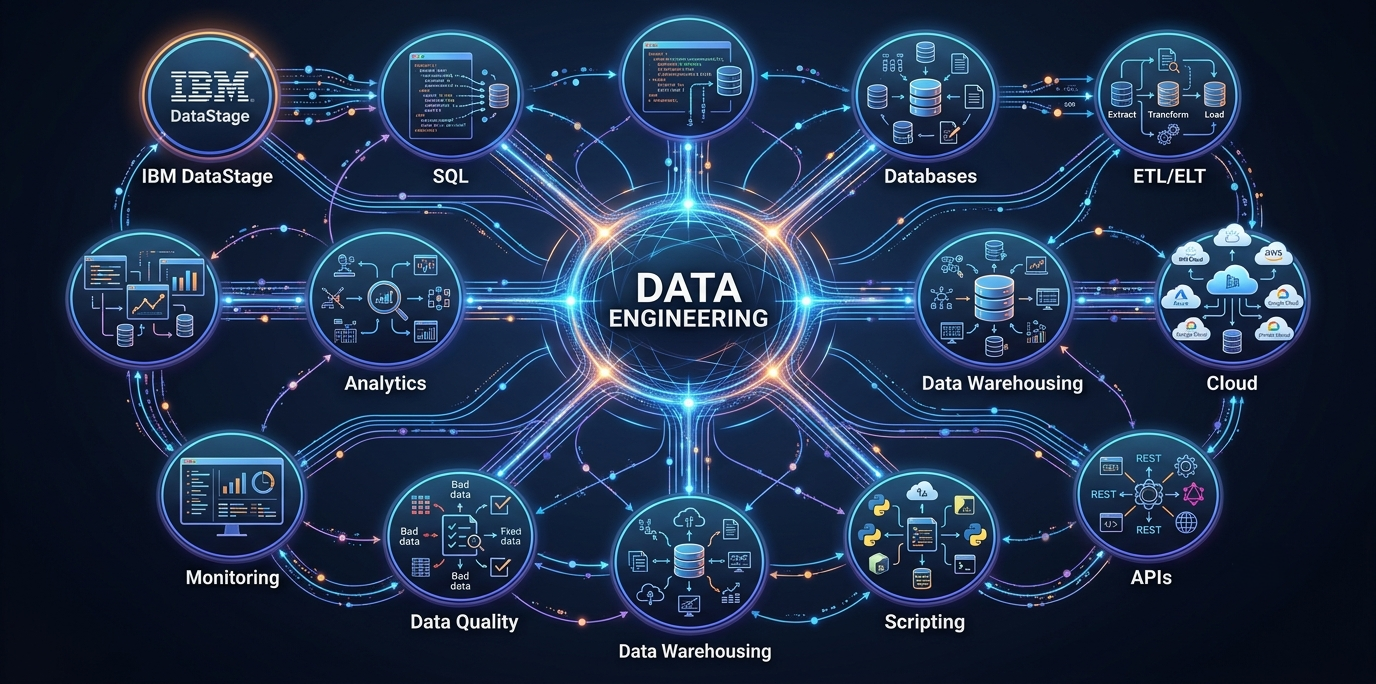
DataStage should not be seen as a tool. Anyone wanting to master this field should also know SQL, databases, data warehousing, ETL/ELT, cloud services, APIs, scripting, data quality, and monitoring. A wider view helps when fixing problems and understanding why pipelines behave a certain way. It also lets engineers look at DataStage features in context. Instead of asking what a stage can do they should ask why that feature exists, where the data comes from, what assumptions were made, and how the data will be used later.
A well‑structured datastage course should expose students to the world where DataStage works, not just show isolated tricks. Hands‑on pipeline building is more useful than theory. DataStage for beginners should start with ideas about working with data, beyond the tool. The same applies to ibm datastage training: in practice, pipelines rarely stand alone. Engineers need to see the bigger system that uses them.
The bigger lesson is that data engineering gets attention than the apps people use daily. Customers see websites, mobile apps, dashboards, and recommendation engines. They rarely know that these experiences would not exist without the data engineering foundation. That is why DataStage remains vital in enterprise data engineering conversations: companies need applications and analytics and that trust comes from reliable data underneath.