
If Your Company Ran Like an Airport, ServiceNow Would Be the Control Tower
Last updated on Oct 8, 2026
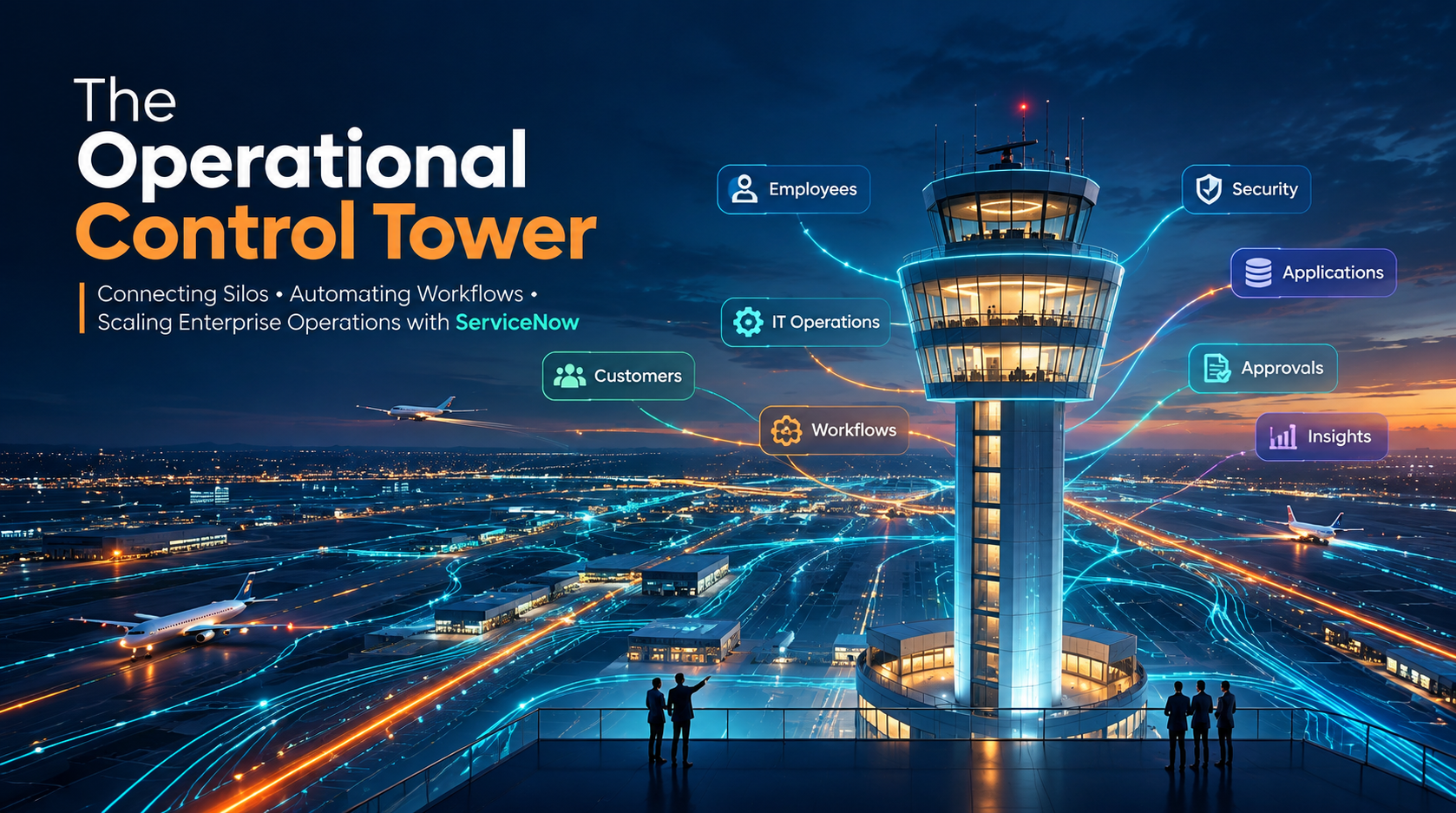
Visualize yourself on an observation deck of an airport at the peak of its working hours. Planes from all over the world are coming in from different angles. Fuelers are driving on the tarmac in the right direction. Baggage handlers are working according to their time schedules. People are moving through the gates. Each unit of equipment and each employee act purposefully. Everything above ground is managed by a central control tower which ensures the effective performance of the airport.
Next, let’s investigate how the modern-day enterprise operates. Most medium or big companies do not act like organized airport command centres. Instead, they act like an airport, where the baggage handlers speak different radio frequencies, flight crews communicate via private chats, air traffic controllers monitor arrivals using a notepad, and emergency ground crews stay waiting for an email chain to update. IT manages requests in isolation; HR manages onboarding requests with different spreadsheets; Facilities manages physical infrastructure requests using old systems; while Security operates from a corner and tries to solve audit trails.
When enterprises do not have a centralized command function, delays become the norm. There are lots of digital silos in enterprises, requests get lost in inboxes, and leaders make decisions based on outdated operational reports. In order to overcome these problems, organizations need one platform that connects data from different divisions and automates business processes as well as controls business operations across all departments.
Clearing the Tarmac: Why Digital Silos Are Holding Modern Enterprises Back
A business consists of many elements that work together. However, many companies today still cannot overcome difficulties arising from the segmentation of processes. In short, when a sales department signs a deal, the HR department starts onboarding a new employee manually, the IT department assigns computer equipment manually, and the finance department organizes payroll processing manually. Each team operates in its own application, resulting in time loss when handing over information from one department to another and leading to significant financial losses.
What happens behind the curtain is that the friction accumulates slowly due to manual work done through emails and double data entry. As a result, people spend time on so-called operational work and do not manage to focus on strategically important tasks. In the absence of an accurate operational data flow, business leaders cannot understand where their resources get stuck. ServiceNow helps to solve this problem by becoming the main operational hub connecting different software programs used for the enterprise’s daily activities.
Air Traffic Control: The Importance of Centralized Operations to Prevent Operational Collision
In air traffic control, two aircraft cannot be on the same flight path, otherwise a disastrous disruption will take place. In the world of companies, operational collisions are occurring on a daily basis, when teams introduce changes independently, without taking into account their effect on infrastructure, policies, or workflows shared among them. Thus, a sudden update released by IT can cripple an HR portal or another major application utilized by customers during peak trading hours.

Achieving real-world operational visibility is the only antidote to enterprise drift and unforeseen downtimes. If every division keeps track of the changes, incidents, and requests pertaining to the services in their own system, then it becomes easy for managers to understand how various processes within the organization influence each other. The Configuration Management Database (CMDB) from ServiceNow provides the required platform for monitoring every digital asset, application and service dependency within the company.
By employing a preventive orchestration strategy, uptime can be maintained as well as minor errors are prevented from developing into more serious problems for the businesses. The platform sends a notification regarding the issue to the right team, informs all concerned parties and executes the script for the solution. Consequently, even employing automation for managing incidents and requests leads to a lower need for human interference and means time to recover (MTTR) is significantly decreased.
The establishment and maintenance of these significant processes might be possible thanks to IT specialists who have gone through the servicenow admin course educational course.
The Flight Crew in Charge of Operations: Empowered Certified Administrators for Powering the System
A cutting-edge control tower is only functional when monitored by air traffic controllers managing the radar equipment. In the process of modernizing the business, certified system administrators become pilots and operators working on the equipment. They set the company's workflows and security rules, build service catalogs, and make sure that their platform is flexible enough to face the challenges of the growing company.
It is impossible to transform raw technological capabilities into business results without having qualified administrators. The absence of structured administration leads to the messed up configuration of the system, poor user acceptance, and stalling processes in the company due to flawed rules.
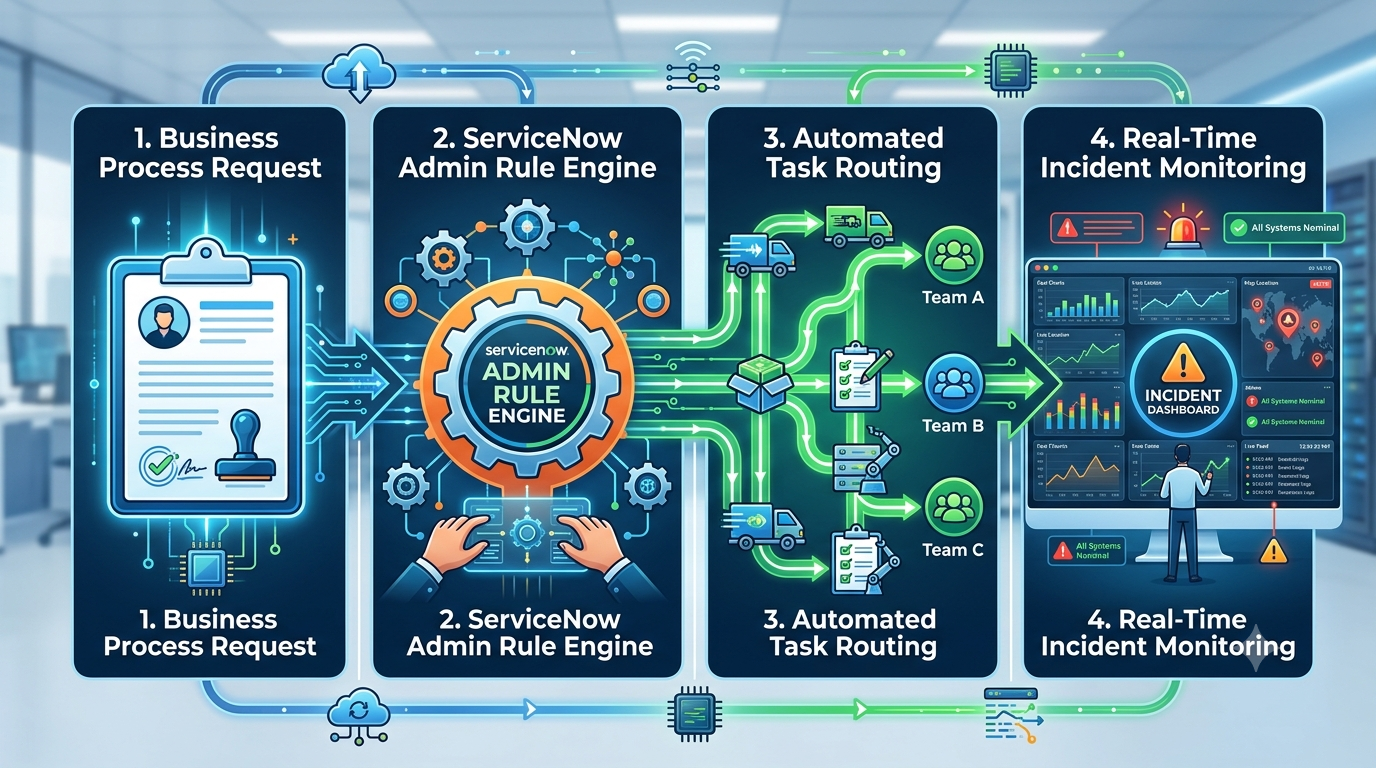
Putting resources into professional qualifications results in an immediate increase in operational efficiency. Companies that recruit certified specialists or train their employees build a solid operational foundation. Experts with servicenow administrator certification prove an in-depth knowledge of working with various database systems, automating repetitive processes, and supporting IT infrastructure health in complex environments.
Seamless Arrival of Employees: Providing Smooth Enterprise Services
For a working professional, going through office services often amounts to being in an unstaffed airport on a rainy day. In order to get connected to different things such as a new laptop or report a maintenance problem, or maybe change the tax refund form, one has to go through so many processes and fill in the forms in irrelevant platforms which usually creates a wrong impression about their work and slows things down in all the departments. Platforms with user-friendly employee portals transform the provision of services as it allows an employee to have just one window to find everything they need in a workplace. Instead of doing so much research in an attempt to find out which department handles which issue, one just needs to use one program with the possibility of using self-service and virtual agents.
Common Service Catalog: Employees place their requests for hardware, software, HR support, or help in facilities through one common interface.
Automated Request Fulfillment: Organizational workflows activate automatic approvals for standard items that deliver hardware orders directly to procurement.
Virtual Agent Support: Conversational bots powered by artificial intelligence manage normal queries about policies and solve ordinary tickets round the clock.
Interdepartmental Onboarding: HR, IT, Facilities, and Security departments manage new employees’ onboarding automatically, enabling them to be provided with necessary technical facilities and access to systems from day one.
The improvement of internal service delivery has a direct impact on employee satisfaction and retention. Once workers are able to handle technical problems and requests within seconds, they take less time for exploration of the corporate environment and more time for producing real value for clients.
Radar-Level Governance: Ensuring Safety and Following the Law
Airports have some of the most stringent security guidelines in the world because any failure in protocol has serious consequences. Similarly, enterprise IT processes have to comply with laws regarding data protection, threats of cyber attacks, and strict compliance rules. Using manual spreadsheets and separate logs to handle the governance process will expose organizations to big fines and risks.
Automated compliance allows companies to implement the rules of conduct easily wherever needed. Instead of gathering the audit records manually at the end of the quarter, the software will make automatic records of any policy change, system update, access request, or chain of approvals in real time.
Proactive risk management ensures that organizations remain secure while simultaneously maintaining operational effectiveness. Security Operations (SecOps) and Governance, Risk, and Compliance (GRC) modules allow the prioritization of vulnerabilities according to their importance in the business context, applying security patches automatically and being able to show compliance records from cloud and local infrastructure. By taking a hands-on servicenow administrator course operational teams acquire the skillset required for establishing role-based access control, developing secure data policies, and creating automated compliance reporting dashboards.
Scaling for Super-Hub Expansion: Advancing the Company Through Automation and AI
Airport efficiency needs to be ensured through sophisticated airport operations that make use of advanced techniques for scheduling, baggage handling, as well as radar technology. Likewise, businesses capable of rapid expansion have to rely on AI and automation in order to winterize their business procedures. Predictive data usage changes the nature of IT management from corrective assistance to strategizing and planning operation. New technological capabilities empowered by machine learning allow predicting interruptions in the operation of the system, detecting deviations based on the previously collected statistical information.
Incident Management
Traditional Operation Procedures: In the traditional process of operations, teams only act on issues when informed by users. They are not proactive in their operations since their responses are solely based on tickets raised by users.
ServiceNow Control Tower: At ServiceNow, our extensive monitoring systems identifies any anomalies that may affect operations. Automated systems save organizations downtime.
Service Delivery
Traditional Service Management: Service requests originate from different channels such as mailing systems, phone calls, and web forms, which means employees meet difficulties in tracking services.
ServiceNow Control Tower: ServiceNow controls all service requests through a self-service application accessible to the employees.
Collaborative Workflows
Conventional Operations: Transferring tasks between divisions (namely HR, IT, Facilities, and Finance) typically involves laborious manual email transfers causing management gaps and high rate of human errors.
ServiceNow Control Tower: Synergized electronic pathways efficiently streamline task transmissions throughout departments, thus ensuring that transfers are effortless and mistake-proof.
Supervision and Audits
Conventional Operations: Compliance divisions waste hundreds of hours manually aggregating, gathering, and verifying the data laid out in spreadsheets when the time for performing audits comes.
ServiceNow Control Tower: Continuous automatic logging records every action relating to policy changes, system modifications, and approval processes in real time enabling managers immediate access to the audit trail and current risk position.
Smart Route Planning: Using Predictive Artificial Intelligence and Automated Decision Engines
The modern air traffic control system does not depend solely on the eye of the operator; it also employs automated trajectory algorithms and predictive conflict detection tools to forecast weather conditions, optimize flight paths, and prevent mid-air congestion far ahead of time. The same approach is necessary for modern-day digital enterprises. Mere manual processing and rules-based operations lead to difficulties in coping with the demand for service or responding to emergency situation affecting infrastructure.
Employing predictive analytics and machine learning transforms operational decision-making from a process of guessing into a science of determining the outcome accurately. By analyzing past incidents, performance indicators of the platform, and bottlenecks in the workflow, predictive engines classify incoming requests according to the particular service type, direct the tickets to the team that has successfully dealt with similar cases in the past, and identify possible problems/or weak points of the service before it harms the users.
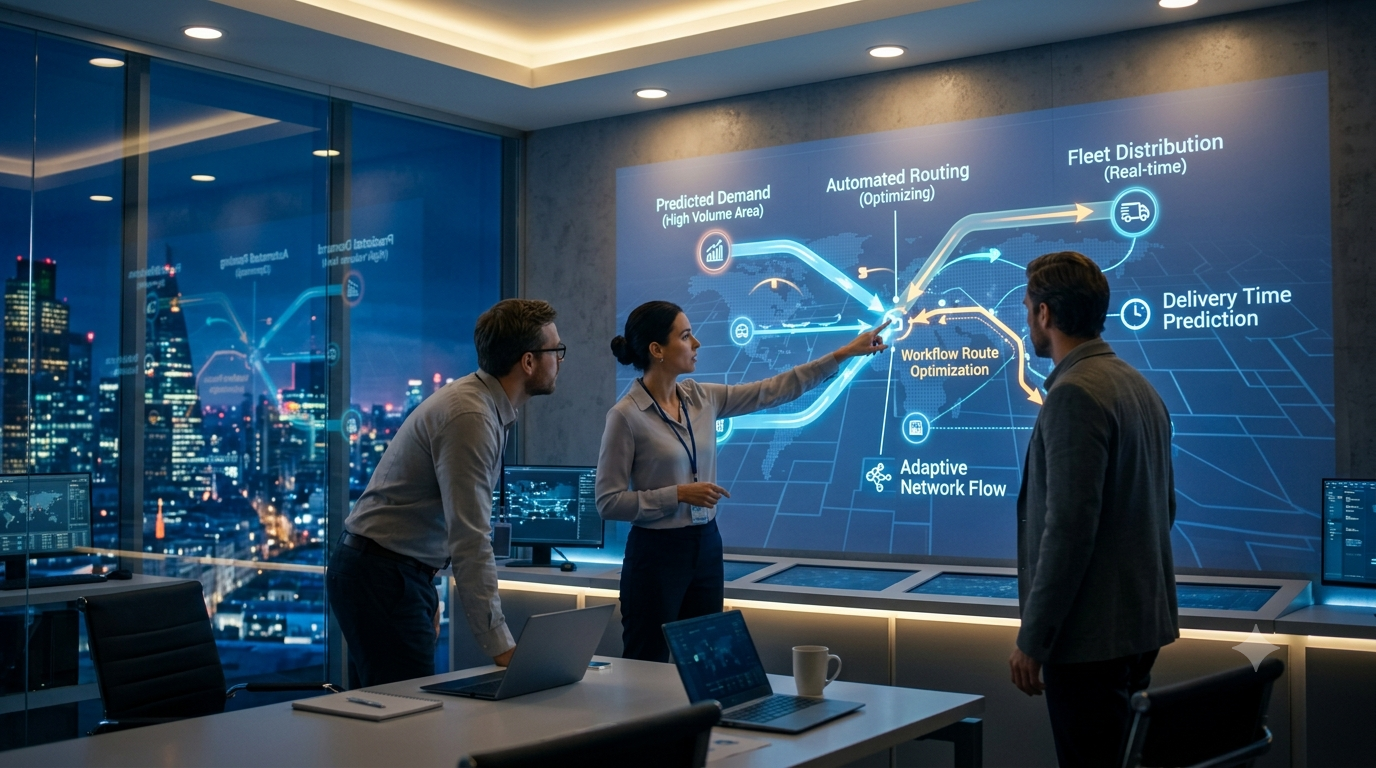
Utilization of automated workflow intelligence reduces administrative burden and speeds up the process in all parts of the company. Virtual agents can manage substantial number of routine inquiries using natural language processing.
Structured Ground Operations: Forming Enterprise Environments Outside the Core System
An airport control tower operates at the crosspoint for constant and quick information flow among outside fuel providers, catering companies, local emergency personnel, and international transportation authorities. An enterprise service platform cannot play its true role in terms of change in tasks if it does not have communication with its business software environment. Modern organizations use many special-purpose solutions, starting with ERP software and ending with CRM systems and an array of specific developer tools.
Enterprise integration systems create firm connections between different software solutions and make it possible to have data transfer without the need to stop using current applications. Integration hubs allow data to be transferred in both directions between different old systems and specialized modern solutions and business management platforms. This approach enables the removal of duplicates, minimizes the need to copy data, and guarantees a clear audit trail among all integrated techniques.
The visibility you gain from end-to-end tracking through all third-party vendor networks protects business continuity and enhances operational resilience. When third-party vendors, cloud services, or supply chain software go down, centralized integration engines can immediately follow trail of dependencies to understand which processes are impacted inside the organization. Operations teams can then automatically reroute jobs or initiate contingency processes to ensure that the company continues to function as usual even when external systems are down.
Final Approach: Organizing the Digital Skies
To operate an enterprise in the modern world without a centralized platform is similar to trying to control a mega airport through megaphone announcements and handwritten notes. The number of services requested, demands for compliance, and the dependencies between departments overwhelm old-fashioned workflow methods that usually lead to lost time, employee dissatisfaction, and difficulties with running the business. By adopting ServiceNow as your company’s control tower, you eliminate scattered departmental tools of departments by uniting them in one central control center. With access to live monitoring, automatic troubleshooting, and consultants to administer systems, your company will get clarity and achieve the results necessary for surpassing competitors.