
Is a Workday Certification Worth It? Salary, Cost, and Career Path
Last updated on Jul 8, 2026
ERP and HCM solutions constitute the bedrock of any company’s infrastructural requirements. In terms of the biggest names in the sector, one solution that undoubtedly comes across as the best is Workday. Operating in the fortune 500 world of business, Workday controls the HR, Payroll, finance and talent management for thousands of organizations globally.
However, such a huge user base results in a lack of skilled workforce as the companies using Workday solutions always seek employees who can work with the system.
And this brings us to the extremely pertinent question of whether Workday Certification is really worth your while. The evaluation of a specialized workday hcm training online at OnlineITGuru will be the first step for professionals who would like to enter this profitable industry and gain insight into how this particular platform works, since earning Workday certification will be totally different from Microsoft, AWS, or Salesforce certification paths.
1. Reality of the Workday Ecosystem: “Gatekeeper” Approach
Before delving into salaries and costs, there is a need to discuss the structural mechanics of the Workday certification process. This is the most confusing issue for newcomers to the industry.
Workday Certificate Cannot Be Obtained Through Self-Funding
The only exception to this is Workday, unlike any other major cloud provider, where an individual person cannot just pay for a course, study the book and take the test to become certified in Workday. Workday uses the strict closed ecosystem approach.
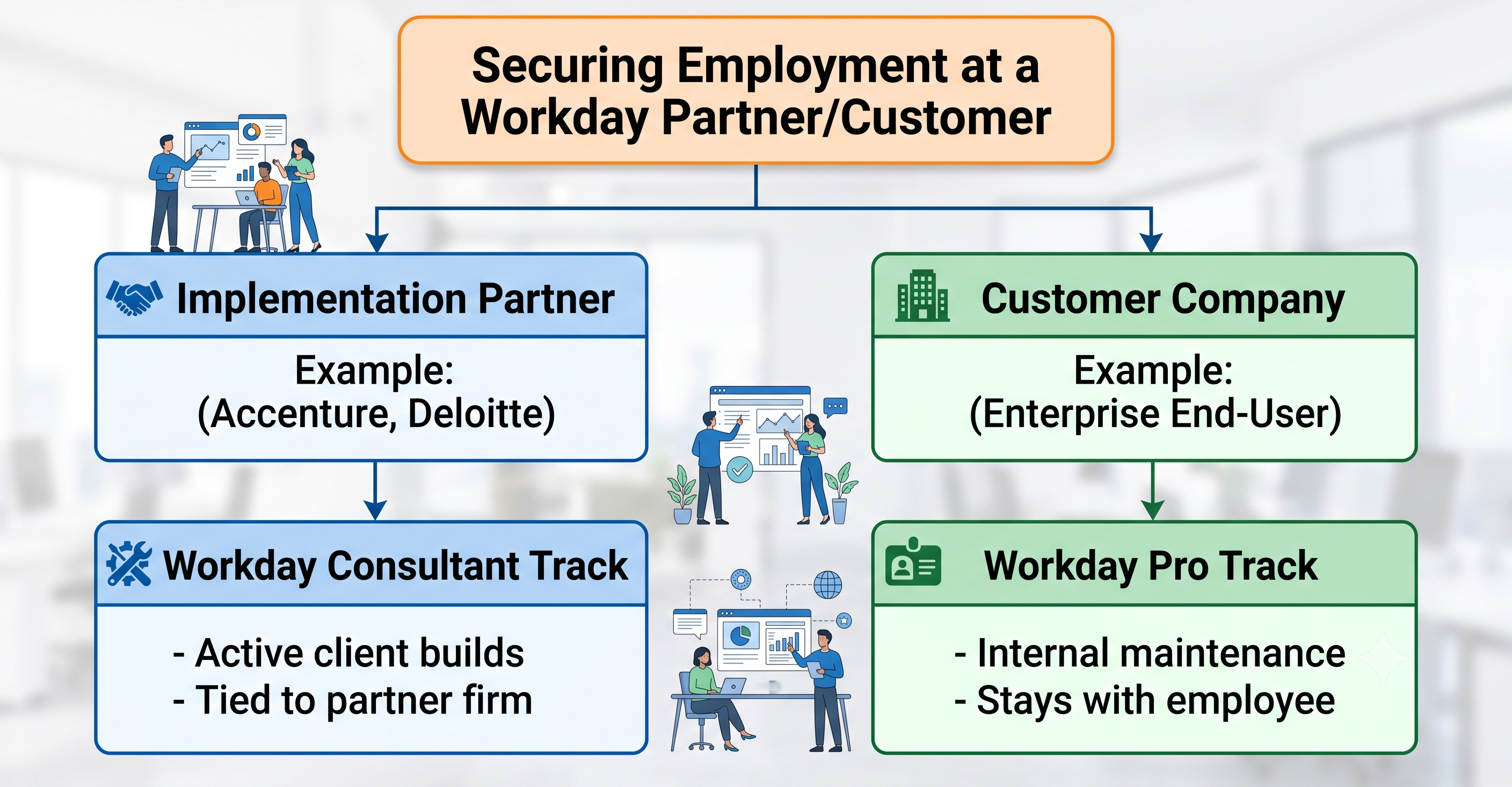
To become eligible for an official Workday certification examination, one must work at one of two places:
Workday Implementation Partner: These are global consulting and system integration companies such as Deloitte, Accenture, PwC, IBM, and KPMG. Certifications obtained in this case are called Workday Consultant Certifications.
Workday Customer: These are the organizations (e.g. Netflix, Walmart, Salesforce), which license Workday solutions to automate their business operations. Certifications obtained in this case are called Workday Pro Certifications.
If at the moment one is working as a freelancer, a standalone developer or is a student, then you are not eligible to use official Workday training tenants (the training playgrounds) or take an exam. One should get a job at a partner or customer company first.
2. Tracks within Ecosystem: Consultant Certification and Workday Pro
The Workday ecosystem carves out your career development into two entirely different tracks. Each of them is equally valuable yet serves a specific purpose.
The Consultant Certification
This one can be regarded as the benchmark of the Workday industry since consulting firms are bound to hire certified consultants when implementing the system at their clients'.
The Catch: It is linked directly to your partner organization, and upon leaving Accenture for a non-Workday partner boutique agency, you lose your certification.
The Scope: The majority of the consultants work intensively on designing, data migrations and integrations via Workday Studio or developing custom EIBs (Enterprise Interface Builders).
The Workday Pro Certification
Realizing that customer companies need internal specialists to manage the system after its implementation, Workday launched the Workday Pro certification.
The Catch: It requires your employer to register you via the Workday Training Coordinator at their company.
The Advantage: Unlike the partner track, Workday Pro certifications are yours, and once you switch from one Workday customer to another, you remain an exceptionally desired candidate among internal HRIS departments.
3. True Cost of Workday Certification
Since people cannot buy any exam on their own, the "cost" of a Workday certification has to be seen with respect to sponsorship and training units provided by companies.
The Financial Investment
In order to sponsor an individual, the company buys the training units in Workday.
The price of one training course is usually somewhere around $800 per training unit (which is equivalent to ₹60,000 to ₹80,000 in India).
A full certification path consisting of core courses, specialization labs, and the final exam usually comes at the price of between $2,500 and $4,000 (or roughly 正式 ₹80,000 to ₹2,500,000 depending on the level of specialization of the module and localized regional pricing packages).
If you failed your exam and needed to retake it in order to achieve the required score (80%), you would have to pay $650-$800 to take the exam again. Nevertheless, sometimes, during particular industry events, such as the annual Workday DevCon, there is a special discount on proctored exams of up to $99 in order to motivate employees to continue their certification process.
"Hidden" Non-Financial Cost
Since the employers have to spend so much money, they never certify anyone for free. As soon as they spend thousands of dollars on your certification, they make you sign a clawback agreement or a retention bond, meaning that if you quit the company in 12-24 months after your certification, you will have to reimburse all of the costs of your training.
Warning About the Scam on Third-Party Training: Due to the high revenue potential of Workday, there is a plethora of independent institutions offering "Official Workday Certification Package" at a reduced price (starting from ₹25,000 to ₹2,00,000). They are scams. While the independent centers are able to teach you about the Workday in theory, they do not have access to the live environment of Workday and cannot certify you officially.
You must identify proper skill development tools such as an accredited workday hcm training online by OnlineITGuru. Visiting workday training is preferred, as you would learn real aspects of the configuration and fundamental design of the software from professionals instead.
4. Career Paths and High Demand Modules
Workday isn't one system, but a suite of numerous modules. Career and specialization path depends greatly on the choice of the particular track.
Foundational Track: Core HCM
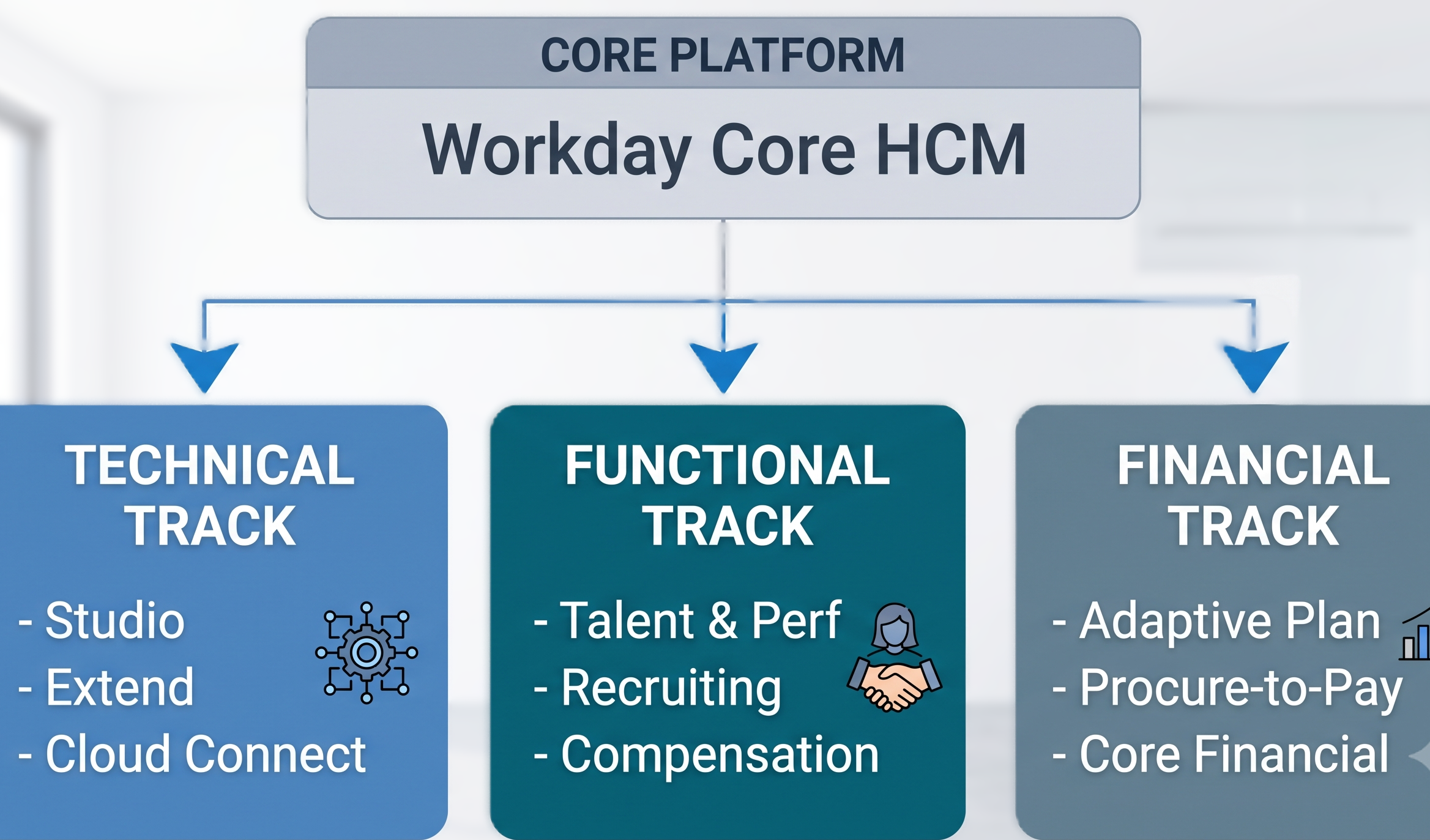
This is where everyone working with Workday starts. The Human Capital Management (HCM) deals with fundamental architecture of the software, such as organizational units, staffing, jobs and security groups. This is a base for all more advanced specialization paths.
High Income Track: Integrations and Workday Studio
If your background involves software development, Java or XML – this is the area where the billable rate will be the highest.
Workday Studio: Graphical development environment for creation of complex integrations with external legacy systems.
Workday Extend: Platform for creating completely custom applications within Workday UI using its security context.
Business Operations Track: Financial Management
Workday is actively stealing the market from conventional financial systems, such as Oracle and SAP. Workday Financials specialists specialize in financial framework, treasury, purchasing and Adaptive Planning. Due to the precision requirements of financial data – certified Financials consultants get a very high premium.
Specialized Functional Tracks
They cover particular lifecycle stages of employees management:
Benefits & Advanced Compensation: Deals with complex bonus schemes, equity awards, benefits and dependencies.
Payroll & Time Tracking: Highly localized tracks (US Payroll, UK Payroll) that involve tax legislation, compliance and calculation automation.
5. Workday Salary Expectations: The Financial ROI
The closed ecosystem ensures limited supply and high demand for talent. As such, Workday professionals receive salaries significantly above those seen in the IT and HR industries' averages.
Estimates in the US Market
In North America, the knowledge of Workday directly correlates with being in the top salary range:
HRIS Analyst / Consultant (0-2 years of experience): $75,000 – $95,000
Workday Administrator / Consultant (3-5 years of experience): $105,000 – $135,000
Workday Architect / Integration Builder (more than 6 years): $150,000 – $190,000+
Independent Contract Consultants: Their bill rate per hour falls between $90 and $160+.
Estimates in the India Market (Major IT Cities)
The Indian market has become the center of Workday support and configuration deliverables and is associated with substantial salary hikes after certification:
Systems Engineer / Analyst: ₹5,50,000 – ₹8,50,000
Certified Workday Consultant (3-5 years of experience): ₹11,20,000 – ₹16,000,000
Senior Consultant / Team Lead (6-9 years of experience): ₹17,00,000 – ₹22,00,000
Workday Practice Director / Enterprise Architect: ₹28,00,000+
Certification Premium: Based on the hiring trends in the industry, it appears that for the same job description, a certified person (Workday Pro or Consultant) earns 35% to 50% more than someone without the certification and equivalent experience.
6. Strengths and Weaknesses of a Workday Career
To see whether such a career is worth choosing for yourself, take into account the structural strengths and weaknesses of pursuing it on this platform.
The Strengths (The Pros)
Excellent Job Security: Having invested millions of dollars to implement Workday into their system, enterprises don’t switch platforms easily. The need for ongoing maintenance provides you with amazing job security.
Protected Competition: As no individuals can buy and pass a certification exam on their own, the pool of candidates is deliberately kept limited. This way, you don’t compete with millions of untrained people.
Upward Movement: Workday lies on the crossroads between a business strategy and corporate data. It is easy for analysts to become directors of HR Ops, corporate finance, or even enterprise cloud architecture.
The Weaknesses (The Cons)
Golden Handcuffs: Being dependent on the employers’ support to acquire certifications, you might feel trapped by expensive training if you happen to work in a place you don’t like.
High Maintenance: Workday regularly updates its system several times a year introducing new AI setups. To maintain your certification, you must participate in regular release training and take proctored recertification exams.
Ecosystem Dependency: The applicability of your skill is contingent on the success of only one company. In case clients change the product or the platform instructions, all the configurations that you have done in Workday become worthless.
7. Beyond the Credential - The release cycle
One of the misconceptions among beginners is that clearing the certification exam brings an end to the studies. In Workday, certification does not mean the end; rather it marks the start of a continuous and rigorous learning process.
Twice-a-year feature release
Workday does not leave any choice to users regarding upgrading to the latest version. Every time a new version is released in the Workday lifecycle, the users must do the necessary "What's New" training.
"The Architect" Mentality: An experienced consultant does not simply learn how to press the new buttons; he or she thinks through the consequences of changing a payroll module for time tracking or absence module. Such a systemic approach is what makes the difference between a $100k consultant and a $200k architect.
The Era of AI-first Configuration
With the arrival of Workday Sana AI, the work of consultants shifts from "configuration of features manually" to "orchestration of AIs". In 2026, the art of being a good consultant is understanding how and when to delegate automation of some processes (say, detection of anomalies in the expense reports) to AI and where to put the hard-coded rules instead.
8. "Cultural Fit" for Implementation Partner Roles
However, if you dream of joining the Implementation Partners (Deloitte, Accenture, etc.) and earning hefty paychecks, certification by itself will not do the trick. You will have to prove the "consulting DNA."
The "Client-Facing" Skillset
Implementations of Workday rarely involve pressing buttons in the tenant. They require discovery. During the first weeks of work at the client, you interview different stakeholders who probably do not even know what they really want. You have to translate the following:
"I need my managers to properly approve the expenses" (Client jargon)
Into: "I will set up a Business Process (BP) in Workday with 3 stages of approval, plus an additional condition rule that will kick off an audit in case of spending more than $500" (Technical translation).
Your certification testifies to your knowledge of the software, but your ability to speak human languages when translating business needs into configuration is what makes your reputation.
9. How to Get a Job in the "Hidden" Job Market for Workday Professionals
The need for Workday specialists is so strong that most good jobs are not even advertised through job sites such as Indeed and LinkedIn.
The Recruiter Hierarchy
As there is a high salary at stake, Workday recruiting firms function as the top recruiters. These recruiters have an exclusive relationship with the Global HR Directors. If you want to work in this elite environment, you need to:
Fine-Tune Your LinkedIn Profile for the Workday Algorithm: Instead of mentioning "Workday Experience" as your expertise, you need to list "Workday HCM," "Workday Security Groups," "Workday Studio," "Report Writer," and "Calculated Fields."
Get In the "Community": Officially, Workday Community is an internal portal for all their clients and partners. You won't get access to this until you start your employment with Workday. However, you need to join the local Workday User Group (WUG). These are the networking groups of professionals who exchange ideas and find out about the hidden jobs in the market.
The "Contract-to-Hire" Model
Companies use consultants on a contract basis during the major implementation project (lasts between 6 to 18 months). This is one of the most brilliant ways to get experience. Although you may not be a certified professional yet, you can work with Lead Consultant in order to get enough hands-on experience for taking the certification test later.
10. The Ethics of “The Clawback” and Career Mobility
We discussed the “Clawback Agreement” before, but the topic needs more attention for the people who plan to spend much time in the field.
There is an unwritten principle of “pay-to-play” within the industry. The companies which provide the best training program usually have the highest turnover rates since they understand that after training the professional becomes worth 30-40% more on the market.
If you are a junior analyst, do not worry about the clawback. If you sign a deal to work in the company for two years to get a $5,000 training program, you are basically giving two years to earn for your entire career. By the end of these two years, you will be experienced enough to move to another company and earn a raise which would make the original debt negligible.
11. Strategic Roadmap: Your 12-Months Roadmap to Become a Workday Expert
Should you be starting with a blank slate today, then this is the roadmap to transform yourself from interested to certified professional.
Phase 1: The Foundation (Months 1-3)
Target: Find yourself a job in an "HRIS Assistant", "Data Analyst", or "Junior System Administrator" position in a firm which uses Workday or intends to use it. In order to impress your potential employers prior to being sponsored, it is advisable to search for a free workday courses online course with OnlineITGuru which will give you a basic idea of how the operations work.
Goal: To understand the corporate jargon of the firm. While you may not be involved in the configuration, become the one who takes on the task of data entry/testing when there is a system upgrade.
Phase 2: The Soft-Launch (Months 4-6)
Target: Make sure that your intentions are known to your manager. "I'm very keen on learning the administration part of Workday. How should we go about it?"
Goal: Ensure that your company registers you for the "HCM Fundamentals" training course. This is your way into the system.
Phase 3: The Certification Drive (Months 7-9)
Target: Select a specialization (such as Advanced Compensation or Core Integration).
Goal: Devote yourself to studying the documentation on the Workday Community portal with religious zeal. Utilize the sandbox environment as your own lab. Do not simply follow the tutorial but intentionally break the configuration and observe the errors the system throws.
Phase 4: The Career Leap (Months 10-12)
Target: Having passed the certification exam, make sure that your LinkedIn profile reads "Certified Workday HCM Consultant".
Goal: Get ready for the flood of recruitment inquiries. Decide now whether to stay in the firm to ensure career stability or move to an Implementation Partner for a "baptism by fire".
13. The Final Verdict: Is a Workday Certification Worth It?
The numbers speak for themselves in regards to obtaining a Workday certification: it creates a structural firewall against career and wage growth stasis. At the time when AI is automating administrative tasks at an unprecedented rate, the role of a Workday professional evolves from the mere data administrator into the Enterprise Systems Architect—the manager of the virtual infrastructure connecting recruiting, payroll, accounting, and corporate strategy.
While the closed nature of the system and the fact that you must be sponsored by the employer in question to even attempt certification are definite barriers to entry, they guarantee the protection of your investment from market saturation.
In the end, whether it is "worth it" or not depends entirely on where you currently are in your career path:
For Established IT & HR Professionals: Yes. If your employer will support your Workday Pro or module track certification—grab it right away. This is possibly the highest ROI career move in today's corporate enterprise computing environment.
For Switchers from Outside the Ecosystem: Yes, but with strategy. Don't look for independent vouchers and avoid being duped into taking some online training courses. Instead, try getting hired in an entry-level job position (e.g. junior HR administrator, data analyst, or IT helpdesk engineer) at the enterprise using Workday. Learn their business workflows and let them know about your interest in the systems architecture. Now that you have decided to plan your entry into this exclusive system, taking up the introductory workday courses online offered by OnlineITGuru would be just the right thing to do."
You will earn not only certification but entry into an elite international guild of high-paying specialists that the modern economy just cannot do without.