
Is ServiceNow a Good Career Choice in 2026? Skills, Roles, Certifications, and Career Roadmap
Last updated on Sep 18, 2026
To pick a technology to learn can be unexpectedly challenging. Every few months, it seems there is something new to pick up, another platform to get familiar with, or yet another 'in-demand' certification to invest time and money into.
For a student or someone beginning to transition into a better technology role, this can cause confusion. Someone can dedicate months to learning something only to find out that they did not really enjoy it, or discover they have prepared for an area that was completely different to what they expected.
ServiceNow is a platform that has seen a lot of adoption in the enterprise technology space. It is used for IT service management, automating internal operations, managing work requests, customer service, security operations, and connecting various digital elements of businesses.
However, knowing that enterprises are adopting it is rarely enough to determine its value to an individual. The more interesting questions are about what one can do after learning it, what skills are required, and whether there is a reasonable pathway from a complete novice to an employable candidate. For someone looking to transition into ServiceNow, that is where the conversation needs to begin.
Why ServiceNow Is Generating So Much Interest in the IT Industry
Walk into the IT department of large enterprises, and you will not fail to notice an overwhelming set of technologies. There may be a system dedicated to employees, customers, IT support, security operations, finances, applications and their approvals, and reporting to name a few. Each of these systems may perform their task exceptionally well, but bringing them all together under a common umbrella is rarely intuitive.
A simple request from an employee can be used as an example. An employee may request a laptop, an email, a particular application, and permission to access some internal systems. Traditionally, employees may need to chase different teams to give approvals or to help them complete the request. Approvals may take the form of emails, spreadsheets, or other applications. Someone has to remember what approvals are required, who should receive the request, and if the request has actually been completed.
This is the problem that ServiceNow helps solve. Instead of asking each team to handle the request differently, an organization can create a structured workflow that will help the employee track the request as it goes from one approver to another. Those involved in the process can see what is happening, while the employee knows whether the request has been completed. That sounds simple enough, but at enterprise scales, it is absolutely invaluable.
This is not all that ServiceNow is used for. The platform has grown substantially over the years to also cater to areas such as customer service, human resources, governance risk and compliance, and application development. This diversification is what has given ServiceNow appeal across multiple professions , An IT professional may have a different experience to a developer or a business analyst. Someone with a technical background may find greater comfort in the development side of ServiceNow, while someone with a background in administration or business processes may be more interested in the configuration side. Someone with no direct background in either may be instantly drawn to the interesting array of work. The technology itself is interesting, but the value is built on the problems it can help solve for businesses.
What Does a ServiceNow Professional Actually Do?
The first lesson for someone searching for ServiceNow jobs is that there is no singular ServiceNow career. The roles and responsibilities vary greatly depending on the job.
A serviceNow administrator deals primarily with maintaining and upgrading the platform. They focus on keeping the system organized and accessible to authorized users. This requires an understanding of the applications, record and list configuration, data maintenance, access control, workflows, and general troubleshooting. It is rare for them to walk into the platform and instantly change something. A good administrator should understand the implications of their actions, especially at enterprise scales. While a minor update may only impact a record, it can also bring a number of other dependent processes to a halt.
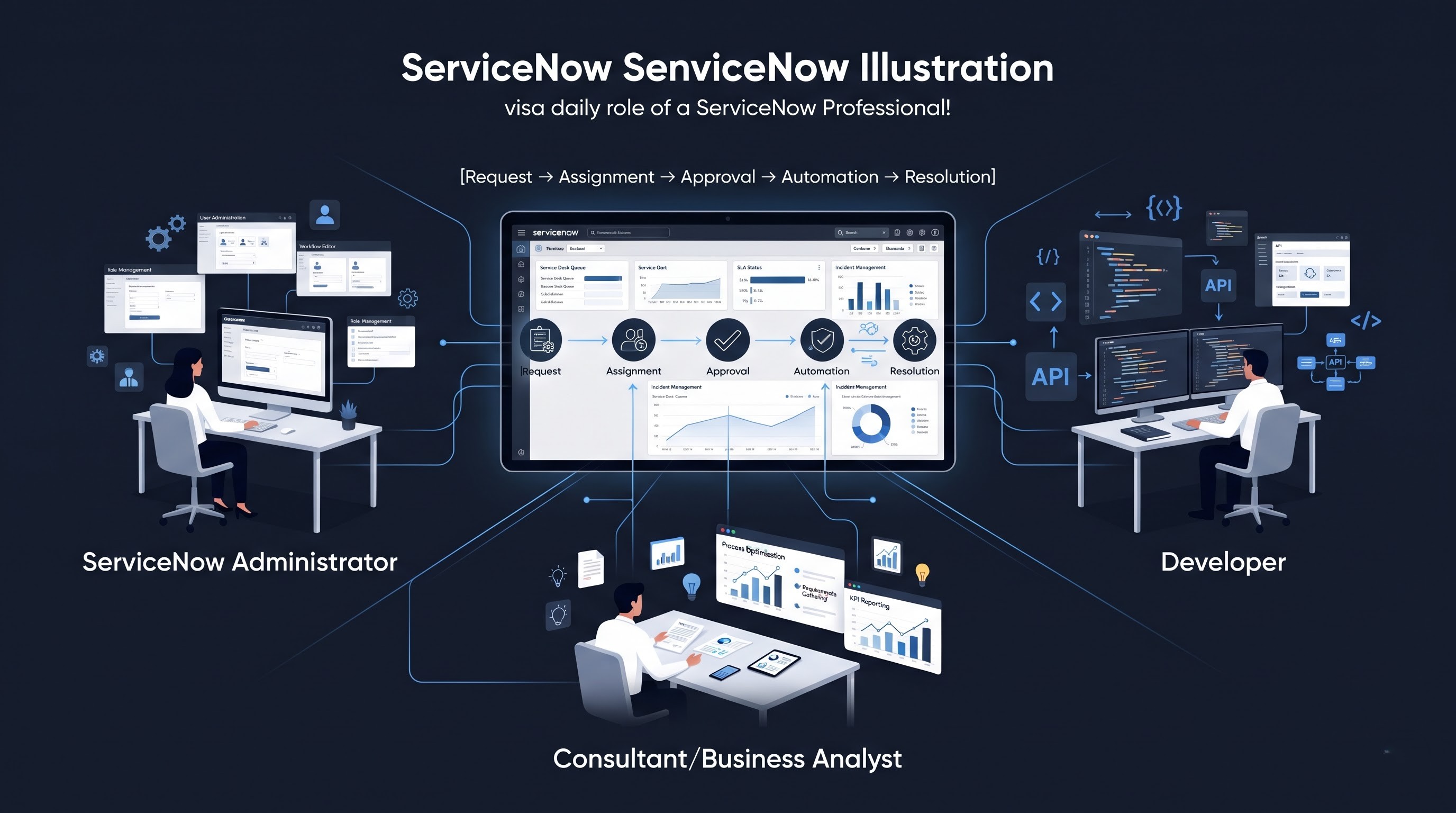
Administrators form only one part of the ServiceNow professional space. Moving further into the development space, developers work extensively with scripts, APIs, and other tools to help drive the platform beyond its out-of-the-box capabilities. This requires a good understanding of programming concepts such as JavaScript and related concepts.
Then there are the consultants and business analysts.
They may not be directly interacting with the platform as much as developers do, but they understand the requirements needed to solve a business problem. For example, a client may request that their approvals process be reworked since it is extremely slow at the moment. The consultant has to determine what the actual requirement is and how it can be delivered by recommending a combination of configuration and development.
That is the main difference between a technical and a business-facing role. It is not always about coding or not coding. It is about the problems you want to solve. Some may enjoy the process of configuring the system and fixing relatively simple tickets. Others may be more interested in writing scripts or complex queries. Some may want to engage in direct client-facing conversations and understand the requirements better than most technical people in the conversation. All of these fit inside the ServiceNow space, but the skills needed can vary widely.
ServiceNow Career Roles You Can Explore
The administrator space often serves as an entry point into the ServiceNow ecosystem. This allows a candidate to get familiar with the platform and understand its inner workings. They can also learn about the fundamental elements of the platform from a configuration perspective, such as creating and maintaining records, maintaining user groups and access controls, and more.
For someone who enjoys technical processes but are not interested in spending their day writing large-scale applications, this can be the perfect fit. Developers represent another avenue. They work with the ServiceNow platform at a much deeper level, often building applications, plugins, and scripts for specific purposes. They work extensively with APIs, scripts, and other tools, and as such, require an understanding of programming languages like JavaScript and related concepts. They are likely to be more familiar with advanced concepts than administrators or consultants.
Then there is the space of a consultant.
They need to understand both the business and the technology sides of ServiceNow. They are often the people who engage directly with clients, understand their requirements, and are able to translate these requirements into a technical specification. For example, a company may find that their employees tend to request dozens of similar things every month. The consultant has to determine why this is happening before they can recommend a solution. Are the employees asking for these things repeatedly because the process requires them to? Perhaps certain approvals need to be resubmitted even when everything is correct, or perhaps there is a step that is automatically skipped due to a misconfigured business rule in ServiceNow. This is what makes a consultant's role so interesting, and also such a valuable area to be in. Businesses rarely invest in technology for its own sake. They want to improve their operations somehow, and a consultant has to determine what these improvements are and how ServiceNow fits into this.
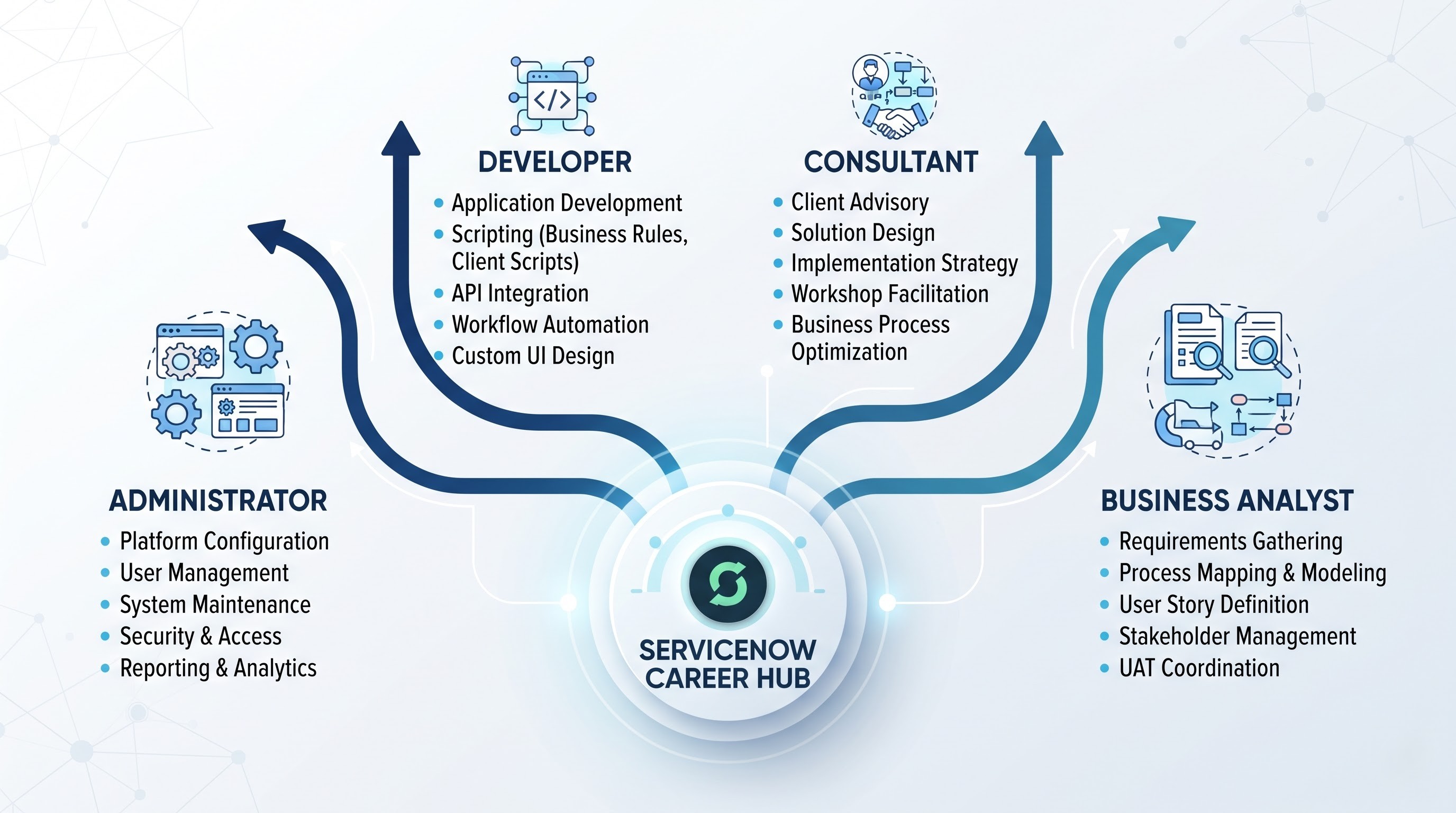
A business analyst can fill a similar role to a consultant, but their responsibilities are slightly more focused. They may spend a lot of their time going through client requirements, documenting processes, and working with developers to turn these requirements into actual working code. Finally, there are roles that are more focused on particular areas of ServiceNow. These can include roles in ITSM, Customer Service, HR Service Desk, Security Operations, and more. It is important to note that the roles mentioned at the start of this post are simply a snapshot of the available opportunities, and that an individual's experience and skills can allow them to evolve into different spaces.
Your first role is rarely a permanent fixture. You may begin as an administrator, but quickly realize that you enjoy development more. You may come from a more technical background, but find that your business analyst skills are far better. These dynamics are all part of growing into a career.
Skills You Need to Start a ServiceNow Career
A novice often makes the mistake of learning the technology while ignoring the underlying concepts.
ServiceNow is not that hard to learn, provided you understand the concepts behind ITSM, ITIL, or other concepts that the platform is built upon. Incidents, problems, changes, service requests, knowledge management, service level agreements, configuration items, and approvals are only some of the concepts that are relevant when working with ServiceNow. A good grasp of these concepts makes the process of learning ServiceNow significantly less intimidating. Someone who understands these concepts is also likely to have an upper hand against competitors who may have gone through lengthy qualification exams but lack a fundamental grasp of why they are doing certain activities. A basic knowledge of the platform is another important skill.
A beginner should be familiar with tables and records, forms and lists, users and groups, roles, applications, notifications, service catalogs, and more. Understanding the basics provides a solid foundation for more advanced concepts. More importantly, it allows a beginner to be more productive when they are allowed to experiment. Someone may watch a tutorial that demonstrates how to create a new request, but building a similar request on their own is likely to highlight areas that the tutorial failed to elaborate on.
This is where experience plays an important role. Someone who watched a video on building a workflow may assume that they fully understand how a workflow is built, but they may find themselves struggling when they need to actually do it. Something may not fire, or the notification may not be delivered to the right person. They may not have had the experience of encountering these errors and as such, struggle to troubleshoot them. Someone who has had the experience of building a workflow may ask themselves, "why is X happening?", instead of blindly looking for the button that they missed.
The technical skills required to begin a career in ServiceNow should be straight forward. Anyone with a basic understanding of computers should be able to grasp the concepts behind tables, lists, forms, and fields. For those more interested in development, a good grasp of JavaScript, APIs, and related concepts should prove to be sufficient. These concepts need not be mastered immediately, but they should form a part of the long-term learning goals.
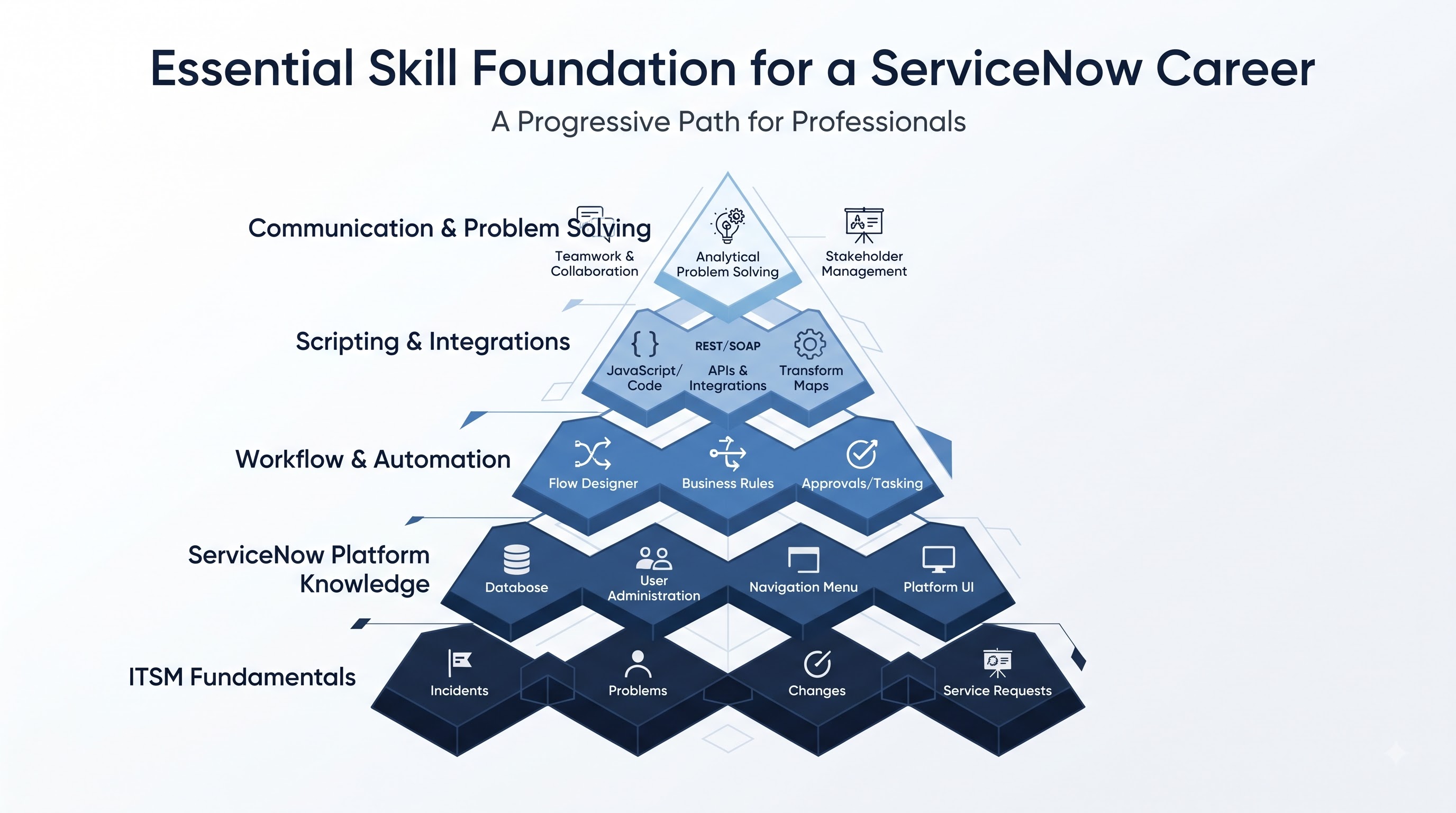
Finally, there is a set of soft skills that is often overlooked. A ServiceNow professional rarely works in complete isolation. They may need to explain a ticket resolution process to an employee, explain technical concepts to a manager, or discuss requirements with a business analyst. Someone who is technically competent but unable to communicate may find themselves unable to explain the same solution to different people. While learning ServiceNow, it is important to ensure that you do not ignore the underlying concepts, the practical skills, and the overall explanation of a particular process. That is much closer to what the actual job will be like.
Starting with a ServiceNow Admin Course
ServiceNow administration represents a good entry point into the ServiceNow world. It allows students to understand the basic concepts of the platform without diving straight into development. However, merely taking a course is rarely sufficient.
A good servicenow administrator course should give students enough exposure that they understand how the platform behaves when they are actually interacting with it. Watching someone demonstrate something can create the illusion of understanding. In reality, a student may have no idea why a particular process is behaving the way it does.
Consider this hypothetical situation. Instead of building a service request by watching a trainer demonstrate it, a student builds it themselves. They create the request, add the necessary fields, configure it to notify the right people, and add an approval step. They test it, and everything works as intended. Then, they break it deliberately to see if they can understand what went wrong. That type of experience may take longer than simply watching someone else do it, but it gives a much-needed practical insight that can help a student progress faster.
A good beginner's learning path should cover the fundamentals of ServiceNow administration, including an understanding of users and groups, roles, tables, forms, lists, data, access controls, notifications, service catalogs, workflows, and platform configuration. It should also include an understanding of ITSM concepts so that students understand exactly why they are doing these activities.The learning environment is just as important. A student who has no prior experience with enterprise platforms can be instantly overwhelmed by the sheer number of options and modules that ServiceNow provides. It is not that they are unable to learn these concepts, it is simply a matter of realizing that there is a lot to learn at the beginning. This is where patience becomes a valuable skill.
There are concepts that only begin to make sense after someone has seen them two or three times. It is completely normal for someone to experience these challenges. You are learning a platform, as well as a methodology that businesses use to structure their processes. Trying to rush the process will only lead to shallow knowledge. A slower but more practical approach will leave you with something that you can apply directly.
ServiceNow Certifications and Their Role in Career Development
Certification is often one of the first things that students consider when they decide to learn a new technology. They are an attractive prospect due to the fact that they act as proof of a particular skill. You can always add them to your resume and professional media to make it clear that you have invested effort and time into becoming proficient with the technology. For students that wish to pursue a career in servicenow administrator certification represents a good stepping stone. However, certification should always be kept in context.
Passing a certification exam demonstrates to potential employers that you have studied and understood the concepts that the certification covers. However, it rarely demonstrates actual practical experience with the technology. This can be a deal-breaker for freshers, since they will be competing against other freshers. Consider this hypothetical situation.
An employer is interviewing two candidates. Both have the same certification. However, one of them has no actual practical experience, while the other has some practical projects that they can discuss. The certification is a good indicator of knowledge, but the second candidate has the advantage of being able to demonstrate their experience and skill. That is not to say that certification should be ignored. It simply means that practical work should begin as soon as possible.
When studying servicenow administrator concepts, it is a good idea to combine theory with actual practice. If you are learning service catalogs, build one. If you are learning about roles and permissions, build a practice environment and experiment with them. If you are learning about workflows, build an end-to-end request with approvals and test it thoroughly. You can also keep records of the projects that you complete. They do not need to be large-scale enterprise projects. However, they should demonstrate your understanding of the concepts that you are learning. This can be useful later if you need to discuss what you know during an interview, since a certification may indicate knowledge but say little about your practical skills. Certification can act as a good motivator, but it should not be your ultimate learning goal.
ServiceNow Career Roadmap for Freshers and IT Professionals
Starting from scratch can be the most daunting situation for anyone. You may look at ServiceNow job descriptions and see an overwhelming set of skills. You may look at training programs and see an overwhelming set of modules. It all adds up to a single realization - that what used to be a manageable learning curve has exploded into something unapproachable.
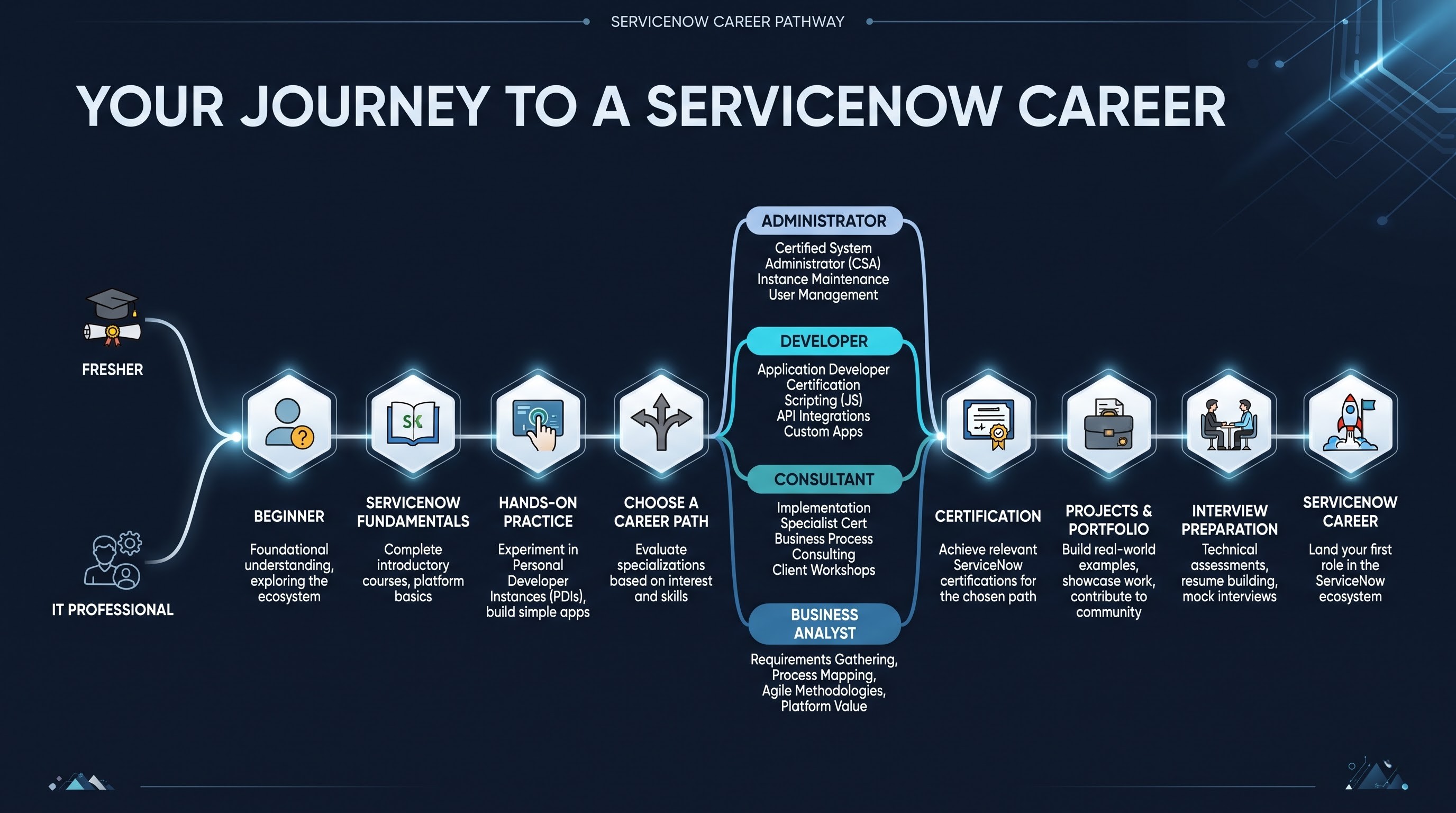
The situation is not as bad as it looks. The best way to begin is to learn the fundamentals of IT service management and enterprise workflows. Learn what businesses are trying to achieve when they begin looking at incidents, requests, changes, problems, and employee services.
Then, learn ServiceNow. Get sufficiently familiar with the fundamentals of the platform that you stop spending hours wondering where everything is. Learn where records are stored, how users and roles work, how applications fit into the bigger picture, and how changes to the platform affect the overall experience. Once fundamentals are covered, move onto building. Start small, but build something interesting. Create a service request. Build a request with approvals. Configure notifications to be sent to the right people. Set up access controls so that only the right people can see sensitive data. Test everything thoroughly. Then, explore other options. Once the fundamentals are familiar, you can explore different areas of ServiceNow and see what interests you. Are you better at configuration? Administration is a good fit. Are you curious about what happens behind the scenes? Development should prove to be significantly more interesting. Are you interested in requirements and communication? A career in consulting or business analysis may be a good fit for you.
As an IT professional, there are additional advantages. You likely have some relevant experience that can help you accelerate your learning. Someone that works in technical support is likely to understand incidents, requests, and approvals better than someone with no experience with enterprise technology at all.They will also find it easier to engage with certain concepts that are relevant to their profession. Similarly, developers and business analysts will recognize some concepts that are likely to help them get up to speed faster. Eventually, certification can become a part of your learning goals, followed by more substantial projects, interview preparation, and job applications.
There is one final thing to keep in mind when starting a career in ServiceNow. You will likely feel like you are making very limited progress at times. You may spend a few hours trying to understand how a workflow behaves, only to find that your grasp of the concept is still limited. You may read the same concept twice, and have only a superficial grasp of it. You may look at someone else who appears to know much more than you, and feel like it will take forever for you to reach that point. It will not. Everyone begins somewhere. That confident person at the ServiceNow interview likely spent months struggling with concepts that you have not even encountered yet. What you see is what they have learned. Everything else is what they still need to do.
A career in technology will rarely follow an exponential growth trajectory. You will grow to understand one concept, then apply that concept to learn another, and eventually grow to a point where you can actually contribute meaningfully to a project.