
Know These 10 MongoDB Components Before You Build Your Next Program
Last updated on Oct 7, 2026

The process of building scalable applications involves the use of architectures in the database that are capable of handling rapidly-changing rules of business, adapted data structures, and performance requirements for systems that should process information in real time. For many years traditional database management systems have been the foundation for software development. However, they have in a number of cases become the hurdle in the complex systems created by their rigid table organization, difficult mapping of data attributes and complicated scaling processes.
Unlike other database systems, MongoDB introduced a revolutionary document-oriented approach that aligns with object-oriented programming and persistent data.
When building with MongoDB, engineers often run into performance bottlenecks, memory leaks, unexpected latency, and replication delays, all while ignoring MongoDB's inner workings. To truly master MongoDB, one must first learn how query planners work, how the consensus algorithm chooses a primary node, and how a memory-mapped storage engine saves data onto a hard drive. The article below will outline 10 critical components of MongoDB, which every engineer or application developer must obtain in order to successfully build the next database-supported application. Knowing how the established concepts work will help software engineers write efficient database queries, gain full control over the cluster configurations, and develop infallible backend software.
Document & BSON Specification: The Core of Versatile Data Storage
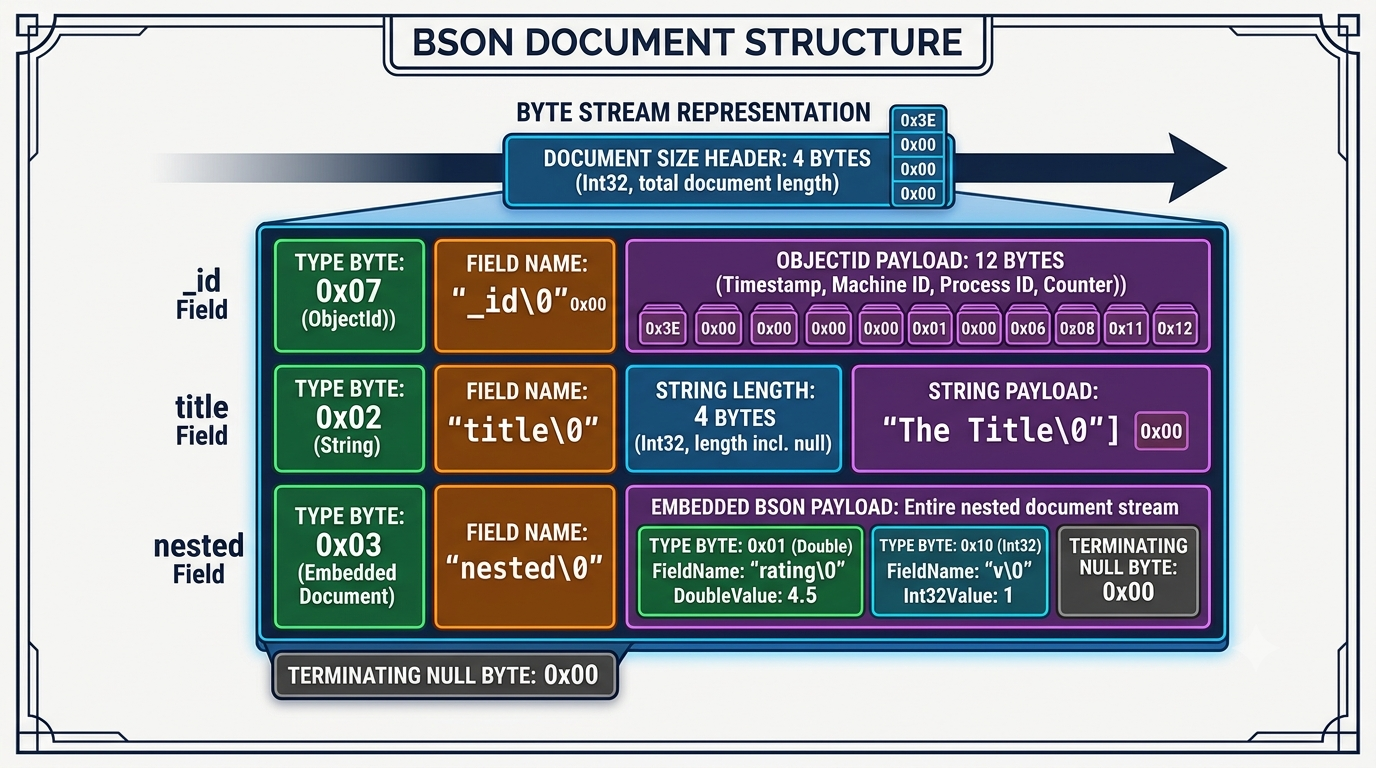
MongoDB's technology is based on a document that affects its data structure. It does away with conventional rows and columns with "space-saving" JSON elements that are self-descriptive. Interestingly, even though developers work with MongoDB using JSON, all data is saved through BSON. Although BSON makes it possible to work with JSON documents, the two varieties are fundamentally different; for instance, BSON is based on binary encoding. The biggest problem with using standard JSON is that it works with only a limited number of primitive types: strings, numbers, booleans, arrays, objects, and nulls. Developers often have to use various strings to store complicated primitives such as decimal numbers. BSON fixes the problem by offering new native data types, including ObjectId, Date, BinData, and others.
Knowledge of BSON stands at the core of the technique capable of improving the performance of network, memory, and storage systems used in production cases. Each document inside a MongoDB collection contains the header of a specified length along with the bytes of the name of the field recorded in the document. Since long field names will increase the overall document size and the amount of memory occupied, there is no way to avoid the correlation between the length of a field name and the size of the document in bytes, either on the disk or in memory. While using the BSON header, the system makes the procedure of searching documents and checking their fields fast. The entire document won’t have to be decoded in order to get access to the information. Moreover, the limitation on the maximum allowed size of the entity in MongoDB is 16 MB. In other words, there is no way for the user to claim unlimited access to information because it will exceed the amount of used memory and, thus, make the transmission difficult. In case a software engineer wants to complete an in-depth mongodb training online , it is important to understand the principles with the right platform.
Collections and Dynamic Schemas: Managing Unstructured Information on a Large Scale.
In MongoDB, collections are similar to tables in conventional relational DBMSs since they are treated as logical containers for sets of related BSON (binary JSON) documents. The key difference, however, is that MongoDB tables are schema-less, whereas relational tables employ strict column definitions, schemas, and predetermined data types. This architecture of dynamic schema provides a lot of flexibility for development teams since it allows the software to develop over time without any need for expensive database migrations or complicated live alter-table procedures. The documents stored in the collection can have different sets of fields, attributes, nested structures, and data types.
While enterprise-grade applications exhibit inherent flexibility, they still require proper limitations that guarantee data integrity, fulfil business requirements and deny any invalid data from getting stored permanently. MongoDB makes a perfect combination between dynamic flexibility of collections and strict enterprise rules with the help of Schema Validation based on JSON Schema standards. System architects have the possibility to create simple validation rules to any collection with the help of normal $jsonSchema operators that let apply certain rules in order to control existence of fields, conformity of data types, numeric ranges and regular expressions while writing data. This hybrid scheme gives organizations a chance to apply rigid frameworks for the most important parameters (e.g. account ID, transactions, time) while keeping other fields flexible. Additionally, those who are interested in a full course related to mongodb programming usually learn about some specific types of collections such as Capped Collections related to FIST log data storage forms, Time Series Collections applied for data injection and Clustered Collections, simplified technique of data storage placement. A storage engine is the fundamental underlying engine responsible for the persistence of the data, its physical input/output (I/O) to disk, its concurrent transactions, and page caching in MongoDB. WiredTiger has been the default, production-ready storage engine since MongoDB version 3.2, superseding the earlier MMF1 engine, and advancing the enterprise capabilities of MongoDB to a great extent. With the introduction of Wired Tiger, modern database engineering fundamentals have been incorporated into MongoDB. These include document-level concurrency control, adaptive memory management, built-in compression, and write journals capable of logging transactions in a resilient manner. Unlike its older counterparts, which used either collection- or database-level locks and thus prevented useful execution from happening during multiple queries being made simultaneously, WiredTiger allows performing thousands of concurrent transactions on individual documents within one collection setup without blocking one another.
Wired Tiger Storage Engine: The High-Performance Database Engine
The storage engine is the fundamental system component responsible for ensuring data persistence, physical disk input/output (I/O), and transactional concurrency along with memory page caching in MongoDB. Since the release of MongoDB version 3.2, Wired Tiger has become the default commercial-level storage engine replacing the obsolete MMF1 engine and significantly enhancing the database’s capabilities. Wired Tiger introduces modern principles of database technology to MongoDB, such as detailed document-level concurrency control, adaptive memory management, built-in encoding, and fail-safe write-ahead logging through write journals. In contrast to previous storage systems employing collection-level or database-level locks which had a considerable effect on the throughput of write operations performed simultaneously, Wired Tiger is capable of executing thousands of modifications of separate documents in the same collection at the same time without interfering with each other.
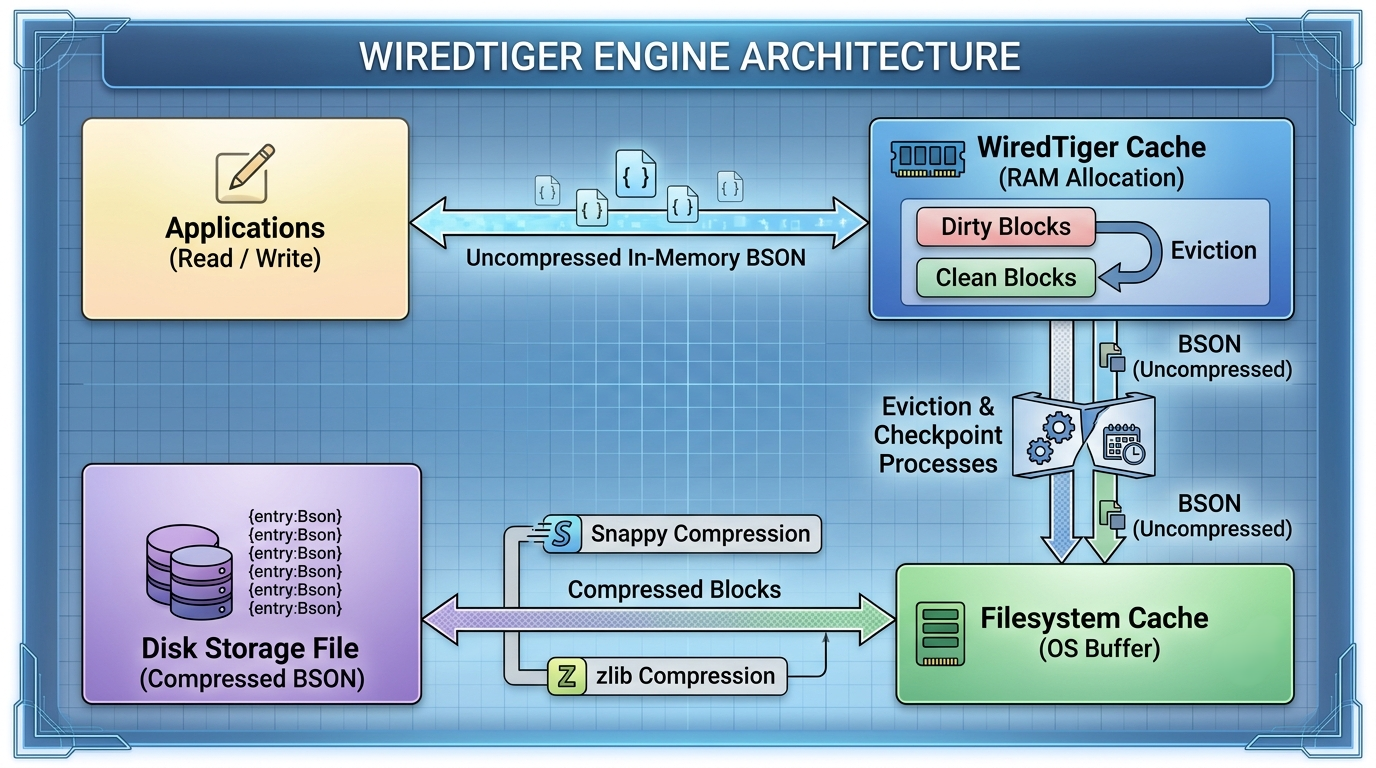
Wired Tiger’s architecture is built around its dual-tier memory caching system where memory is distributed between Wired Tiger’s internal cache and the file system cache provided by the operating system, with Wired Tiger by default assigning almost 50% of the total amount of available RAM—which is one gigabyte less than the actual amount to the internal cache where it keeps uncompressed BSON objects that are available for fast query execution. During the automatic checkpointing process, which occurs every minute or after two gigabytes of dirty data, the information is written to the disk, thereby ensuring the data is available for recovery. In order to ensure efficient use of the storage memory and minimize disk I/O operations, Wired Tiger employs compression algorithms such as Snappy or zlib. The considered topics are important for database and system administrators who need to eliminate any unexpected disk latency spikes and lack of memory in high-performance database clusters.
B-Tree Indexes & Indexing Strategies: Accelerating Data Retrieval
I have seen that without indexes running a database query forces MongoDB to perform a collection scan (COLLSCAN). MongoDB then reads every document in the collection from disk into memory one after another to check if it matches the search criteria. When a collection contains millions or billions of records a collection scan slows the system down uses a lot of disk bandwidth and creates CPU spikes. To achieve query times that're less than one millisecond MongoDB relies on B-Tree index structures. B-Tree indexes keep ordered paths that point directly to the location of each document, on disk. By creating indexes on attributes that are queried often MongoDB can walk B-Tree paths in time (O(N)) replacing a broad collection scan with a precise index scan (IXSCAN) and allowing MongoDB to fetch the needed document directly.
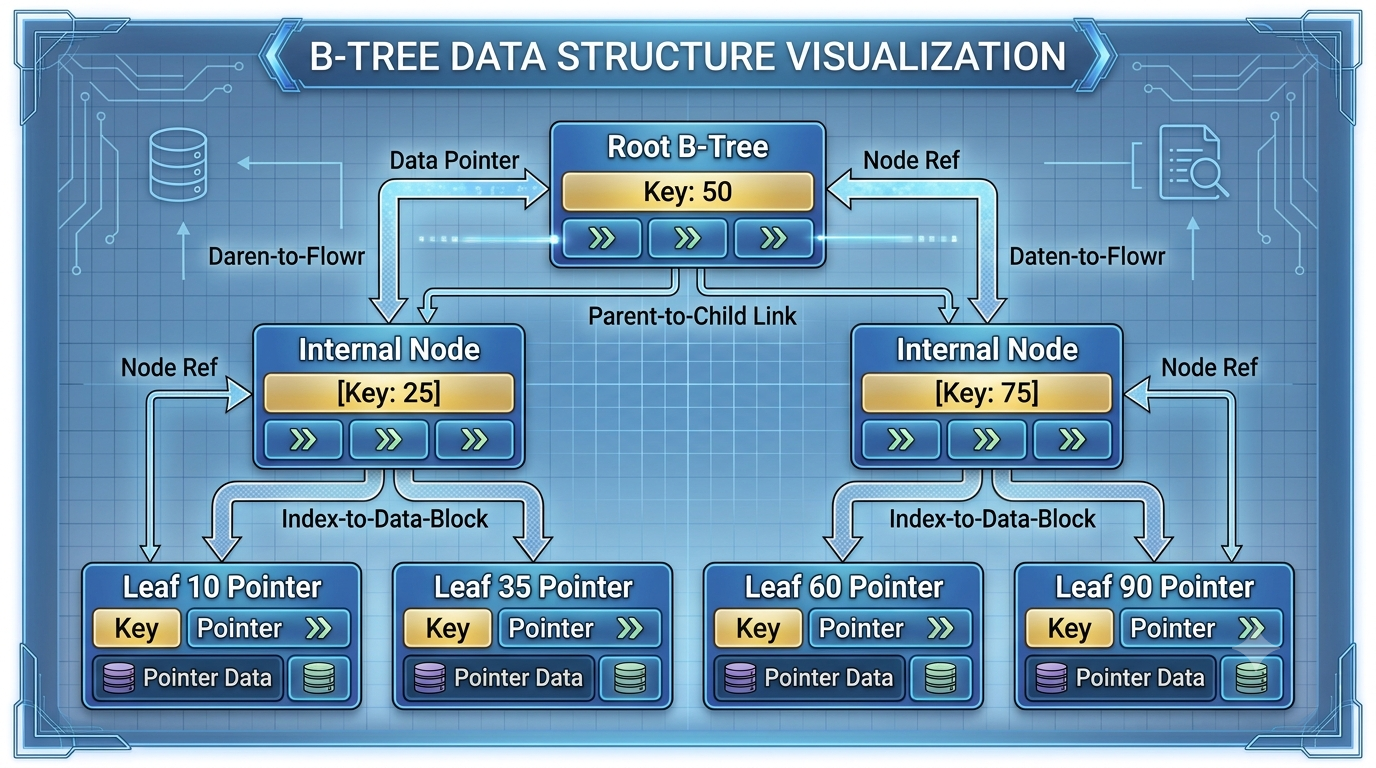
MongoDB provides a number of indices tailored to different patterns of access from simple single-field indices to elaborate compound indices, multikey indices for array fields, partial indices filtered by expressions, TTL indices for some documents that expire automatically, and geospatial indices (2dsphere) for geographical applications. This whole collection of documents comes along with a set of rules for creating efficient compound indices known as the ESR Rule (Equality, Sort, Range), which implies that compound index keys have to be organized according to the principle that equality conditions are on the top of the hierarchy, sort parameters are second, and range filters are placed last. Moreover, experienced developers are trying to use covered queries, making it possible to retrieve all required fields using only the index without looking up the document in storage. In the case of the covered query, the whole request would be fulfilled by MongoDB from the in-memory cache without making any expensive document calls. However, it is worth noting that every index present in the collection adds to the complexity of insert and update operations.
Replica Sets and Consensus Architecture: High Availability and Fault Tolerance
Availability, fault tolerance and automated disaster recovery are part of the core design in MongoDB. These features are built directly into the system through Replica Sets. A Replica Set is a group of connected mongod database instances. All instances in a Replica Set hold the data. This setup ensures that if one node fails, another can take over without needing tools or causing application downtime. In a typical production Replica Set, there is one node and at least two Secondary nodes. The Primary node handles all write operations. When an application sends a request, it goes only to the Primary. The Primary processes the change. Records every state-changing operation in its local oplog. This oplog keeps track of all changes made to the database.
The Secondary nodes continuously read the Primary’s oplog. They pull the operation entries. Apply them to their own data. This replication happens either asynchronously or synchronously. As a result all Secondary nodes stay up, to date with the Primary. If the Primary node fails one of the nodes automatically steps in and becomes the new Primary. This process is smooth and happens without interrupting the application.
The Replica Set mechanism ensures that data remains available and consistent. It supports availability by reducing downtime. It enables fault tolerance by having backup nodes ready to take over.. It supports automated disaster recovery by maintaining a synchronized copy of data across multiple nodes. This architecture is designed to keep systems running, when failures happen.
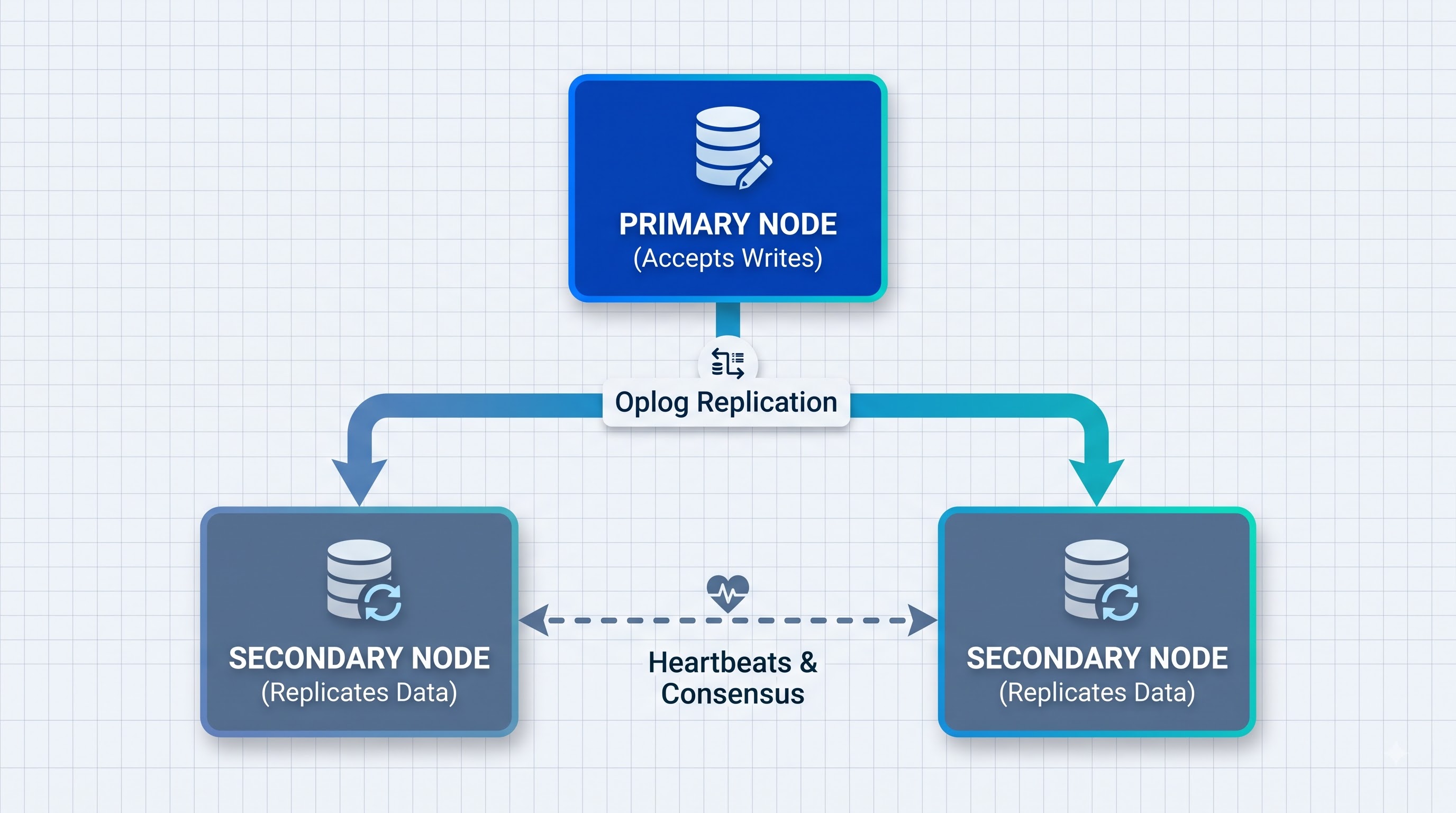
I see that the true power of a MongoDB Replica Set is found in its automated failover mechanisms. These mechanisms are driven by an implementation of the Raft consensus algorithm. Every node in a MongoDB Replica Set keeps a heartbeat signal with its peers every two seconds. If a Primary node in a MongoDB Replica Set stops responding because of network partitioning, hardware failure or power loss for longer than a set threshold ten seconds then the remaining Secondary nodes in a MongoDB Replica Set start an automated election. The cluster in a MongoDB Replica Set checks priorities, network connectivity and oplog freshness. It then chooses a Primary node in a MongoDB Replica Set, giving the system write capabilities again automatically within seconds. Application drivers that talk to a MongoDB Replica Set automatically see topology shifts. Move database traffic without dropping active connections. Developers who study a mongodb online course learn practical skills. They learn how to set replica set read preferences in a MongoDB Replica Set, how to set write concerns such as w: "majority" in a MongoDB Replica Set and how to handle edge cases in a MongoDB Replica Set, such as replication lag and uncommitted data rollbacks.
Sharding Topology and Cluster Routers: Horizontal Expansion and Partitioning
It becomes necessary to move away from vertical scaling when the amount of data reaches terabytes or the level of throughput exceeds the processing capabilities of a single server. MongoDB suggests a different approach by using horizontal partitioning known as sharding, which deals with unlimited demands in scaling. Sharding allows proper distribution of chunks in respect to their data to several independent replica sets, which facilitates the functioning of memory pools, storage capacity, and processing of tasks without limitations. There are three key components in the functioning of a MongoDB Sharded Cluster:
Shard Nodes: These are separate replica sets that hold subsets of data of the sharded cluster.
Config Servers: They are dedicated replica sets that store important cluster metadata, routing tables, chunk boundaries, and general information concerning the cluster.
Mongos Routers: Those are stateless lightweight query routers that serve as the entry point for all application traffic. Mongos Router receives all application queries, gets the cache from Config Servers, sends queries to appropriate Shard Nodes and returns the results to the client.
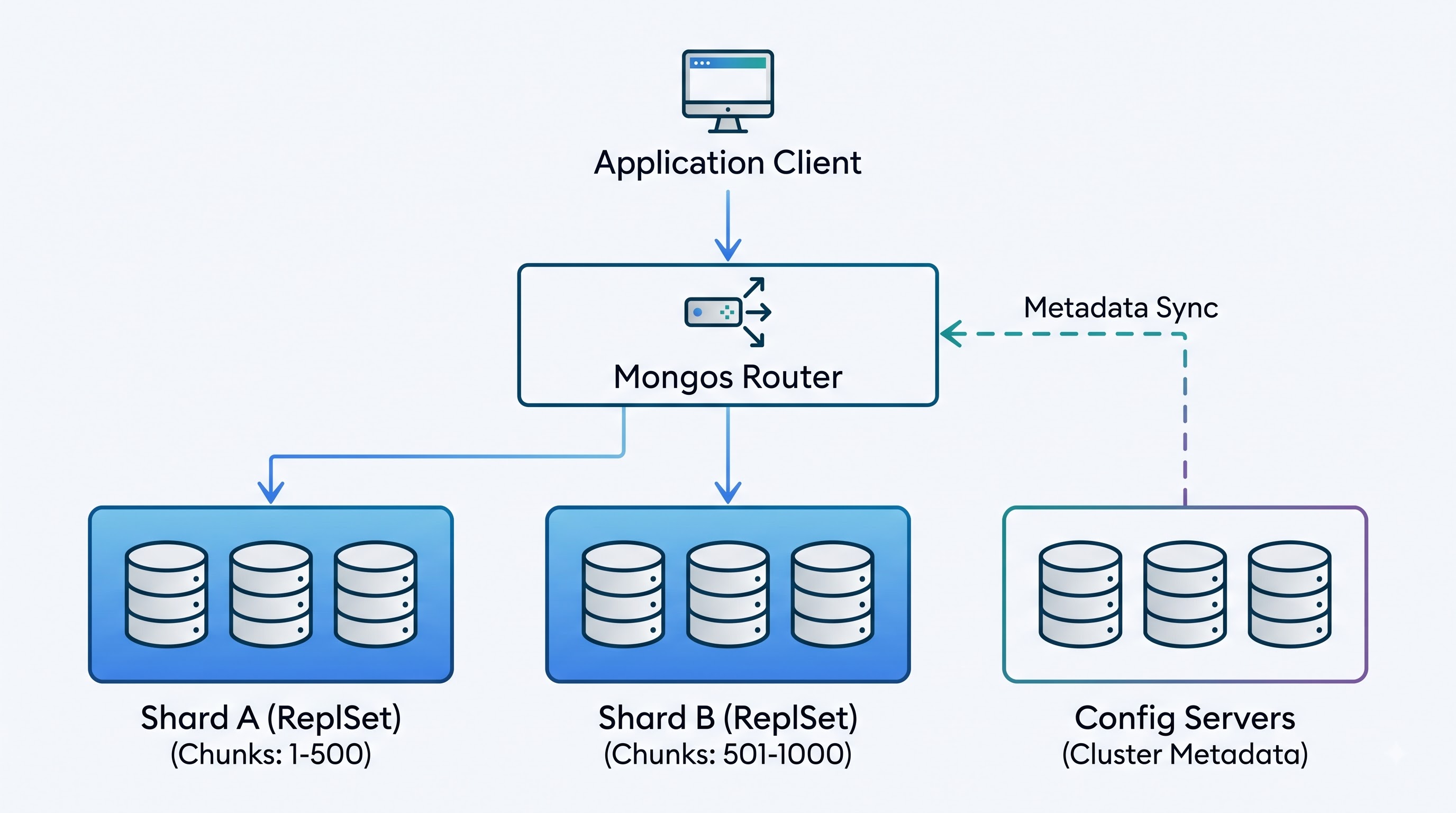
Choosing the right Shard Key is the most crucial factor for a successful deployment of sharded clusters. The Shard Key determines how documents will be spread out over all the shards using a process of partitioning that is either based on ranges or on hashing. A wrong Shard Key—for instance, one based on a constantly growing timestamp, or a low-cardinality field indicating statuses—will lead to serious issues of hot-spotting: practically, in this case all writing requests will go to one single shard while others will remain idle. On the other hand, a good Shard Key with a high cardinality will help distribute documents uniformly. And the capability to use good Shard Keys will bring about the possibility to make targeted range queries that will go to the needed shards without the need to write a cumbersome scatter-gather query.
The Aggregation Framework and Pipeline Processing for Real-Time Data
In MongoDB, data analysis, reporting, and transformation are done by the Aggregation Framework—a powerful data processing pipeline based on data-flow principles. Rather than extracting raw documents from permanent storage and applying complicated transformations in application code, developers create multi-stage pipelines that run in the database cluster itself. The documents go through various processing stages, where the documents get modified, filtered, transformed, or aggregated into new documents.
The aggregation engine has a range of built-in pipeline stages and functional operators that manage different types of analytical tasks:
Filtering and Shaping: Stages like $match, $project, $unset and $addFields help engineers limit the data they work with and create document structures in real time.
Relational Joins: The $lookup stage makes it possible to do joins between different collections in the same database. This lets developers run left joins look up documents in arrays and handle correlated subqueries.
Grouping and Aggregations: Stages such as $group, $unwind, $bucket and $facet do real-time math operations, analysis break apart arrays and create detailed reports with multiple dimensions.
Behind the scenes, MongoDB's query optimizer looks at aggregation pipelines before they run and makes improvements. For example if a $match stage comes after a $sort stage the optimizer changes the order so that $match runs first. This reduces the number of documents before sorting, which saves memory. Putting $match and $sort stages at the start of a pipeline lets the database use existing B-Tree indexes avoiding disk reads completely. Knowing about pipeline memory limits—like the 100-megabyte RAM limit for each stage—and using disk-spill features or memory-efficient operators are skills, for backend engineers working with large amounts of data.
The MongoDB Query Planner and Execution Engine: Optimizing Query Execution
The execution of every query on MongoDB is assisted by the Query Planner and Execution Engine, a smart subsystem that is responsible for finding the quickest and most resource-efficient way to retrieve the required documents. When a certain query command is sent by the application, the query planner analyzes and evaluates the conditions of the query, checks the catalog of B-Tree indexes present in the system, and creates planned execution proposals. If the query planner finds several indexes that may be employed, then it will proceed to the empirical evaluation stage known as plan testing. In the process of plan testing, the engine executes the previously planned proposals and compares the processing speeds, number of keys evaluated, and performance in document retrieval. The proposal that is the quickest and needs the least number of keys becomes the best one, while all the other proposals are rejected.
In order to prevent the process of costly empirical testing for each query from being repeated, MongoDB saves its winning plan in its in-memory Query Plan Cache. This way, all future identical queries are automatically executed on the basis of the cached winning plan instead of being analysed at the time of execution. The cache works until there are any modifications that were made in the collection structure, indexes that are created or removed or when the database process is restarted. By appending the .explain("executionStats") method to the query operations, software developers can easily look at the decisions of the query planner. The explanation() JSON output can be analysed to see the following important metrics:
Stage: Refers to whether or not the query was executed by index scan (IXSCAN), collection scan (COLLSCAN) or fetching phase (FETCH).
totalKeysExamined: Shows the total number of B-Tree index entries scanned by the engine.
totalDocsExamined: Indicates how many BSON documents have actually been read from the disk or memory cache.
nReturned: Clarifies exactly how many documents matching the query were read to the application.
An optimal query achieves a 1:1 ratio between totalKeysExamined, totalDocsExamined, and nReturned. When totalDocsExamined vastly exceeds nReturned, developers must refine their indexing strategy to eliminate inefficient memory access patterns.
Change Streams: Creating Real-Time Applications Based on Events
Contemporary software architectures have become increasingly dependent on operating according to the principles of event-based activity, real-time analysis, instant notification systems, and microservice synchronization of information. Traditionally, developers have implemented real-time monitoring of databases by continually polling database tables after a certain period. This approach has come with a lot of drawbacks, namely serious query overhead, increased disk latency, and delays in event processing. In contrast, MongoDB does away with all polling methods and allows developers to obtain information about data changes in real time without wasting any resources. The peculiarity of change streams is that they are built on the infrastructure of Oplog provided by the replica set and deliver data about all data changes throughout the databases and clusters.
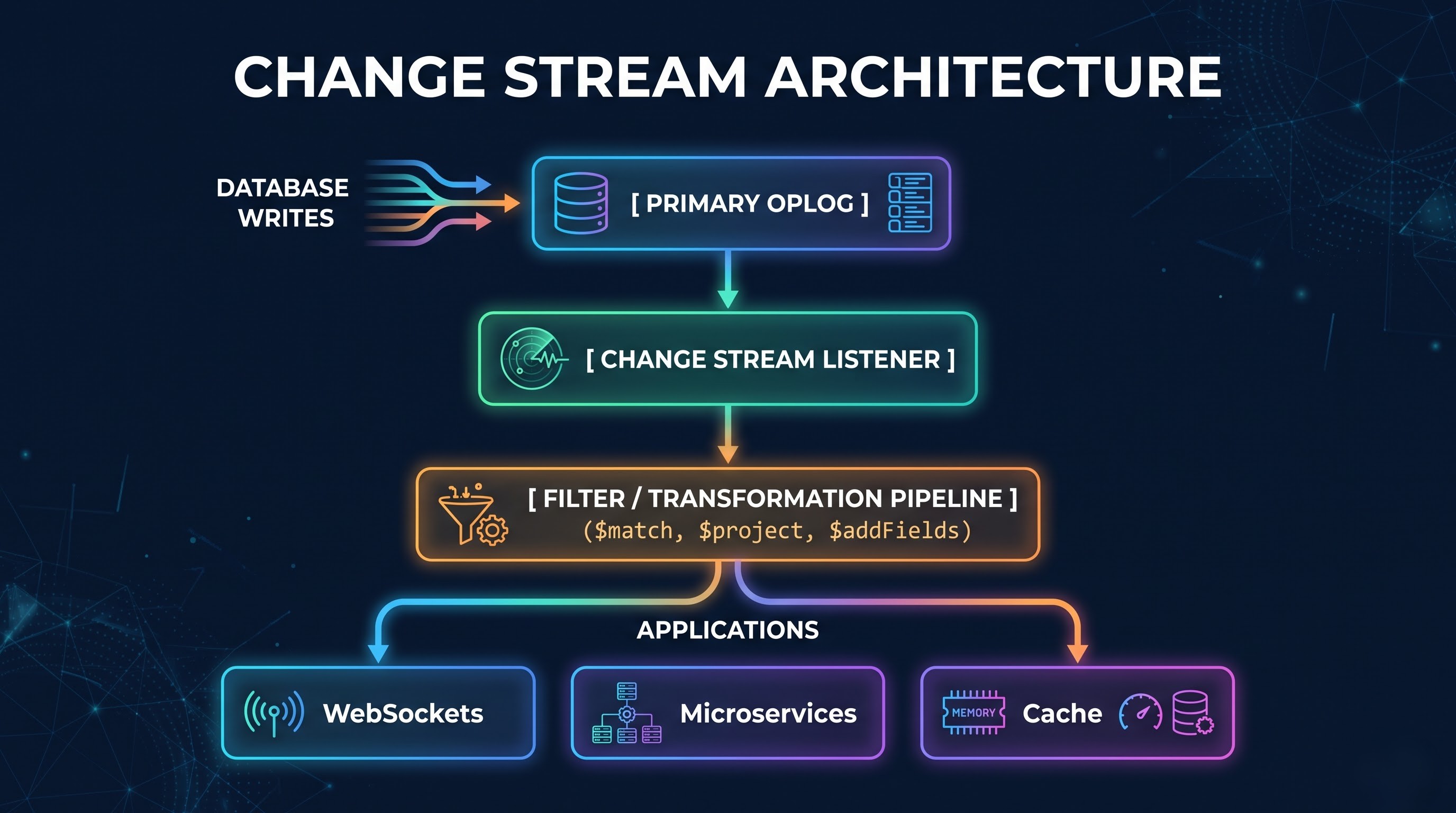
Change streams inform connected applications immediately when any changes in documents occur, such as insertion, modification, replacement, or deletion. This leads to the generation of structured notifications containing both modified delta and snapshots of the original and the new document. Moreover, it becomes possible for applications to execute the same operators used within the Aggregation Framework and process changes on the database level. This means that microservices can see only the relevant notifications from change streams without collecting excess information. It should be noted that change streams are reliable. Each event from change stream contains a unique resume Token, which is used by the driver to reconnect in case of connection problems. When the network connection is restored, MongoDB continues sending events as usual without losing any messages or duplicating some notifications.
Safety and Control of Access: Protection of Corporate Data
Protecting sensitive data in databases is essential for modern software systems. MongoDB offers an elaborate, multi-tiered system for data protection while it is being stored, transmitted, and processed. This system of security starts with Authentication that checks the identity of companies that want to connect to the database. mongodb full course, offers reliable authentication systems that meet high business needs, including SCRAM (Salted Challenge Response Authentication Mechanism), verification of x.509 certificates, integration with systems of LDAP directories, and application of the Kerberos protocol. After the process of authentication is completed, authorization is applied using Role-Based Access Control (RBAC). Instead of granting application services with unlimited permissions providing total access to the database, administrators assign precise roles based on the operations that can be performed by the application. Aside from access control, enterprise database situations necessitate tight encryption policies enabling them to meet the requirements of global regulations like HIPAA, GDPR, and PCI-DSS.
Encryption in transit: All of the network interactions that take place between application drivers, mongos routers, replica set nodes, and administrative tools are encrypted employing TLS/SSL encryption protocols used in the industry.
Encryption at rest: The WiredTiger storage engine allows for built-in transparent filesystem encryption, which is based on AES-256 block ciphering used for encoding raw database files, keys, logs, and temporary storage files on physical disks.
Client-side field-level encryption (CSFLE) and in-use encryption: MongoDB provides a Client-Side Field Level Encryption technology for challenges related to data privacy, which means that all of the crucial data pieces such as social security numbers, credit card information, and health data are being encrypted at the client application level and only after that they are sent via the network and stored in the database memory and keep the data private.
To sum up the conclusion of Designing Resilient MongoDB Systems.
In order to develop production-worthy applications using MongoDB, the developers have to go beyond the basic tutorials on the use of CRUD for the understanding of the key components of this tool which influence the performance, fault tolerance, and scalability. In addition to getting to know how such notions as BSON serialization, Wired Tiger memory caching, B-Tree indexing, replica set consensus algorithms, and sharding topologies function together, it is necessary to hope that the developers will possess sufficient knowledge for making their systems resistant to the surging volume of data.
Developers can make use of the principles of optimizing long-lasting aggregation pipelines, improving the work of compound indexing (using ESR), as well as protecting the data with Client-Side Field Level Encryption, and they will be safe in their ability to create stable and fast applications.