
Managing Employee Lifecycles in Workday HCM Processes
Last updated on Nov 25, 2026
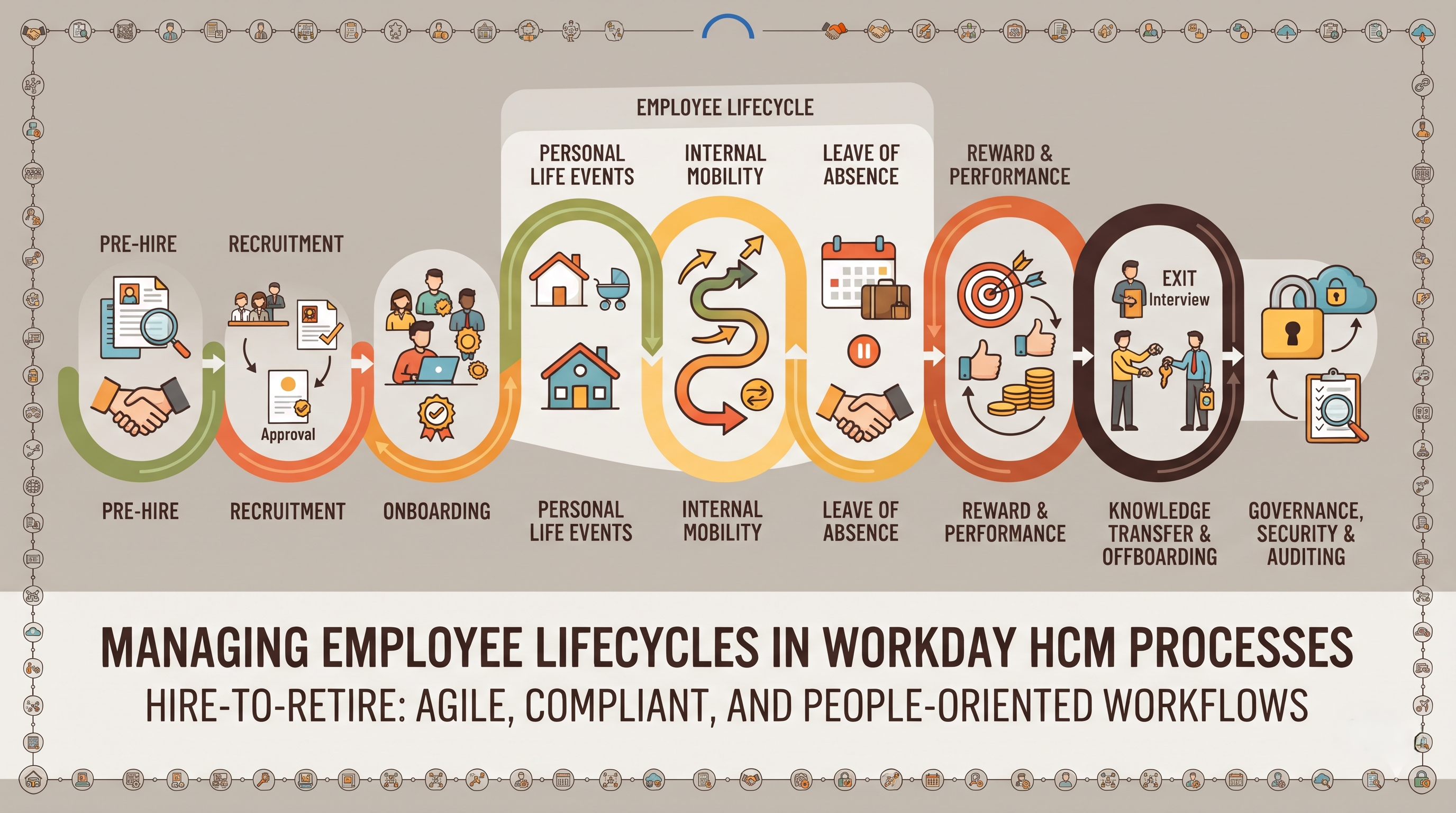
Contemporary enterprise human resources is far more than static personnel files. Onboarding a candidate to the day they retire or leave an organization creates cascading administrative, financial, operational and compliance requirements at every stage of a person’s career—starting from the moment they sign an offer letter. Organisations would monitor these milestones using disconnected legacy systems, non-integrated spreadsheets and email chains. These disparate approaches often resulted in data discrepancies, slow system provisioning, payroll errors and poor employee experiences. Workday Human Capital Management is different. It encompasses the entire hire-to-retire process in a single object-oriented cloud architecture based on the Workday Business Process Framework.
Workday HCM sees each workforce transition as a choreographed series of actions, approvals, notifications and downstream integrations, not merely a standalone data entry task. Business rules are directly embedded in configurable workflows ensuring that every lifecycle event is always executed consistently in global regions but in compliance with local statutory regulations and organisational hierarchies. People in HR management, enterprise architecture, and various other functional areas who wish to design and develop flexible, compliant, and people-oriented processes must understand how the processes on Workday are managed, governed, and automated, which are some of the important topics included in workday hcm training.
Business Process Model of the Architectural Foundation’s Supervisory Organisations
To understand how Workday handles employee lifecycle events, you need to understand the structure that those events are built upon. Workday’s design of organisations is based on the Supervisory Organization, unlike traditional HR systems where employees are primarily organised by legal entities or inflexible departments. Supervisory Organization – a hierarchy of workers reporting to a particular manager. This is a living hierarchy that drives security permissions, reporting rollups and approval routing. All hiring, transfers, promotions and terminations take place within the framework of a supervisory organization, which automatically aligns authority and accountability with established reporting lines.
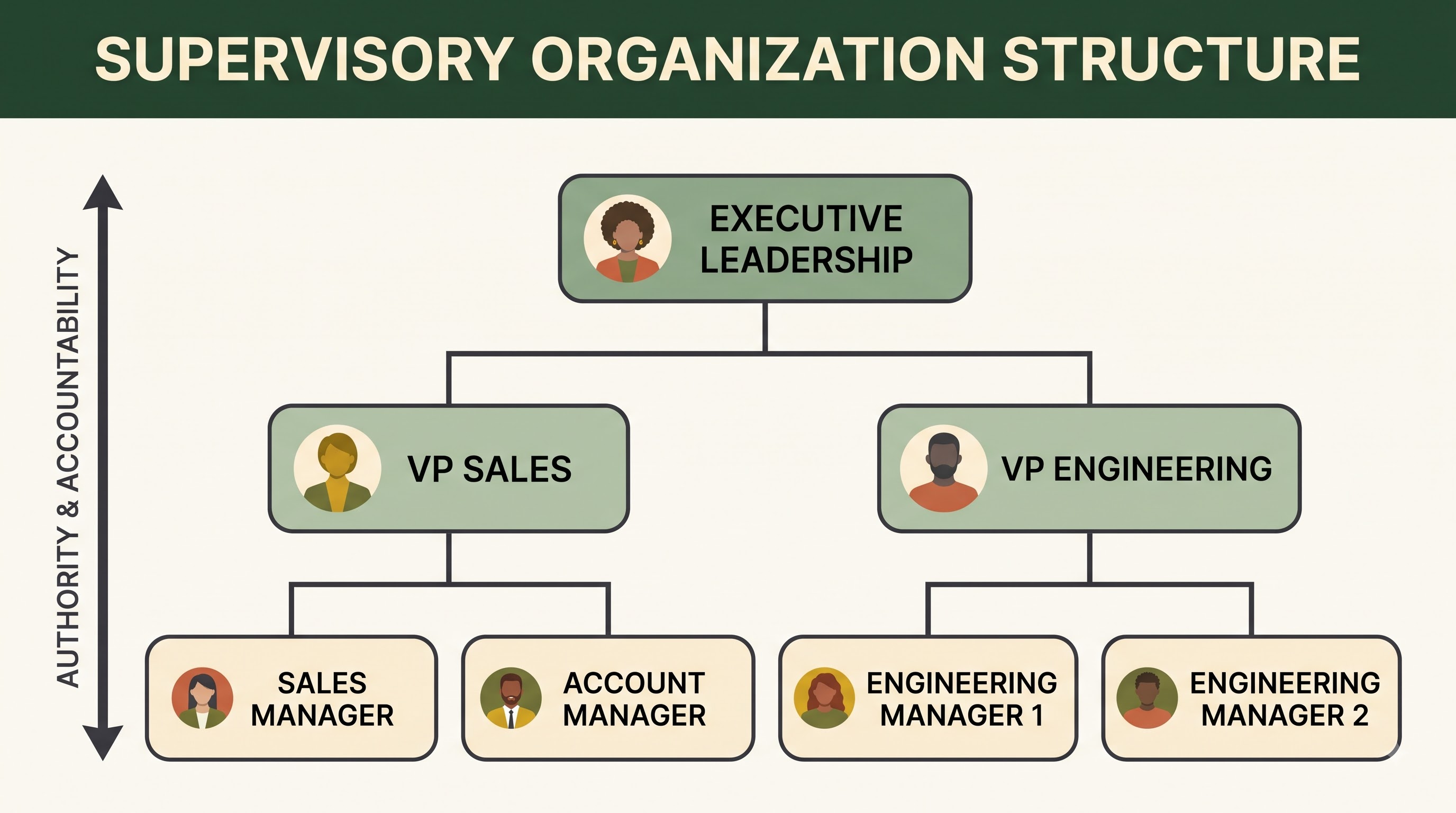
This organisational structure is the basis of the Workday Business Process Framework. “We don’t hard-code workflow steps into software, but we provide a declarative, configurable engine, where the admins will decide on the response to a particular situation, those who should respond to that situation, the sequence in which tasks are done, and under what circumstances some tasks are done—all covered extensively in an advanced workday hcm course at OnlineITGuru.
Most importantly, Workday's business processes utilise condition rules and routing rules to ensure precision at scale. Condition rules look at attributes of the worker, the position or the transaction itself (country, type of worker, management level, percentage change in compensation, etc.) to decide whether a particular step is required. For example, a rise of less than five percent may only require approval by the department head, while a rise of more than ten percent automatically requires review by a vice president as well as additional review by a compensation partner. Routing rules then determine exactly which users have the assigned security roles in the affected supervisory organization, so tasks are delivered to the right inbox without human intervention.
Workday also has subprocesses. When the lifecycle event reaches a milestone, it can automate the spinning up of secondary workflows. When a manager completes a job change transaction, the core process can initiate onboarding tasks, benefit eligibility checks and compensation reviews in parallel or in strict sequence. The interlinked design eliminates redundant data entry, provides a complete audit trail for every approval and time stamp, and ensures that decisions made earlier in the HR process flow immediately into downstream systems such as payroll, time tracking and IT.
Pre-Hire Orchestration & Recruiting
The employee lifecycle starts long before an employee’s official first day on the job. Workday HCM helps you move from external candidate to active employee, connecting Workday Recruiting and Core HCM with a seamless data flow. The lifecycle begins with position management or the creation of a job requisition when a hiring manager identifies a workforce need. When Position Management is used, a position seat must be approved in the supervisory organization before a requisition can be posted – headcount and budget discipline is enforced upfront.
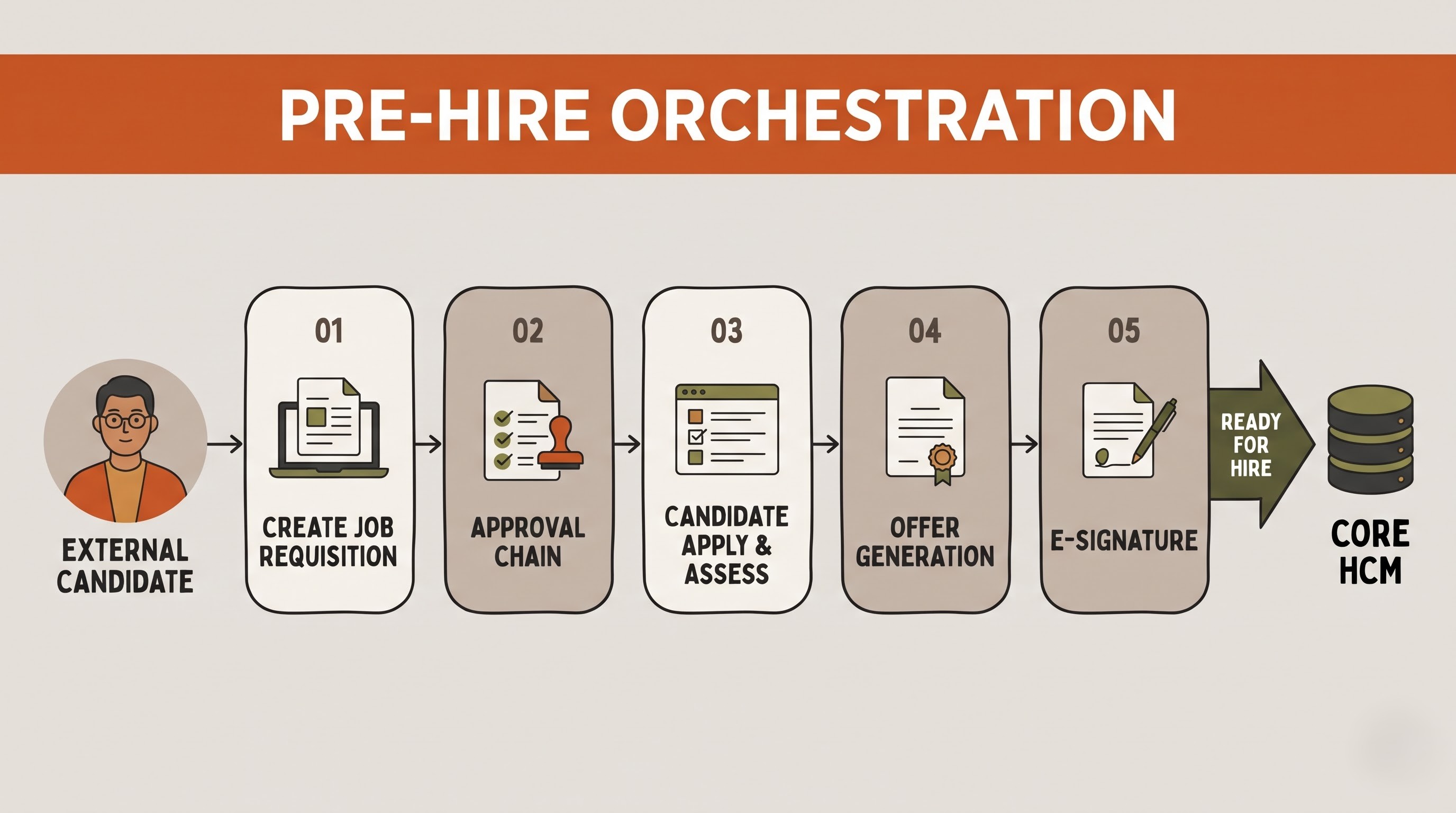
“Once a requisition is approved, candidates apply, go through interview stages and are assessed on the same unified platform.” When a preferred candidate is identified, an Offer business process is initiated. This workflow allows recruiters and hiring managers to collaborate on proposed base pay, bonus targets, equity grants and start dates. Condition rules ensure that the proposed package is within the established compensation grades and budget constraints. After internal approvers approve, the system creates a dynamic offer letter with the precise terms of the proposal already populated and sends it to the candidate for an e-signature.
The Ready for Hire business process links recruitment and core HR as soon as the candidate accepts the offer. Workday brings the candidate record directly into the Hire business process, eliminating the need for an HR coordinator to re-type personal details, contact information and job attributes from an applicant tracking system into a core HR database. During this transition, background check integrations and pre-employment screening steps can be executed as automated gated steps, holding off on final hire confirmation until all compliance clearances are received. Organisations can reduce time-to-hire and eliminate transcription errors at the point of entry by integrating the processes of requisition approval, offer generation and pre-hire validation.
Recruitment & Onboarding Journeys
When the Hire business process is run, Workday converts the candidate to a worker, assigns the worker to a supervisory organization and position, sets up the worker's compensation profile, and creates the employee identification record. Once the account is created, Workday typically triggers the Onboarding business process as a child sub-process of the Hire workflow. Workday doesn’t see onboarding as a one-day orientation but rather a customised, multi-stage journey that begins during pre-boarding and goes through an employee’s first ninety days.
Different populations have very different onboarding experiences and so organisations create different onboarding paths that are driven by condition rules. Bringing on a full-time external hire is a lengthy process that includes tax withholding elections, entry of government identification, emergency contact information, setting up direct deposit, acknowledgements of policies, and statutory employment eligibility verification (e.g., Form I-9). Alternatively, the contingent worker or independent contractor takes a more direct route, focusing on non-disclosure agreements, compliance training and equipment provisioning, and bypassing the benefit elections and payroll tax steps. Similarly, an internal employee moving into a new role will have a lightweight onboarding sequence focusing only on role specific training and introductions to the team.
Workday Onboarding shares the responsibility among many stakeholders at the same time, so administrative readiness never slows productivity. On or before day 1, the new hire completes self-service activities via a mobile device or desktop portal. Meanwhile, to-do steps tell IT admins to provision laptops and software licenses, tell facilities teams to assign workspace access, and prompt the hiring manager to schedule introductory meetings and assign an onboarding buddy. As the employee reviews documents, new hires can electronically sign and read employee handbooks, intellectual property agreements and code-of-conduct policies directly within their Workday inbox, with signed copies automatically archived in their worker profile. That coordination means that when a new hire walks in the door (or logs in remotely) on day one, their tools, access and initial learning plans are ready to go.
Personal Life Events and Basic Employment Maintenance
As part of their ongoing employment, employees are often subject to many regular updates that need to be recorded accurately without adding an undue burden to HR operations teams. Through Workday’s intuitive self-service interfaces, workers and managers can initiate these maintenance transactions, and data governance is happening in the background. Life events include marriage, birth or adoption of a child, change of address or legal name change. There are certain business processes that tie personal data changes to compliance and benefits administration.
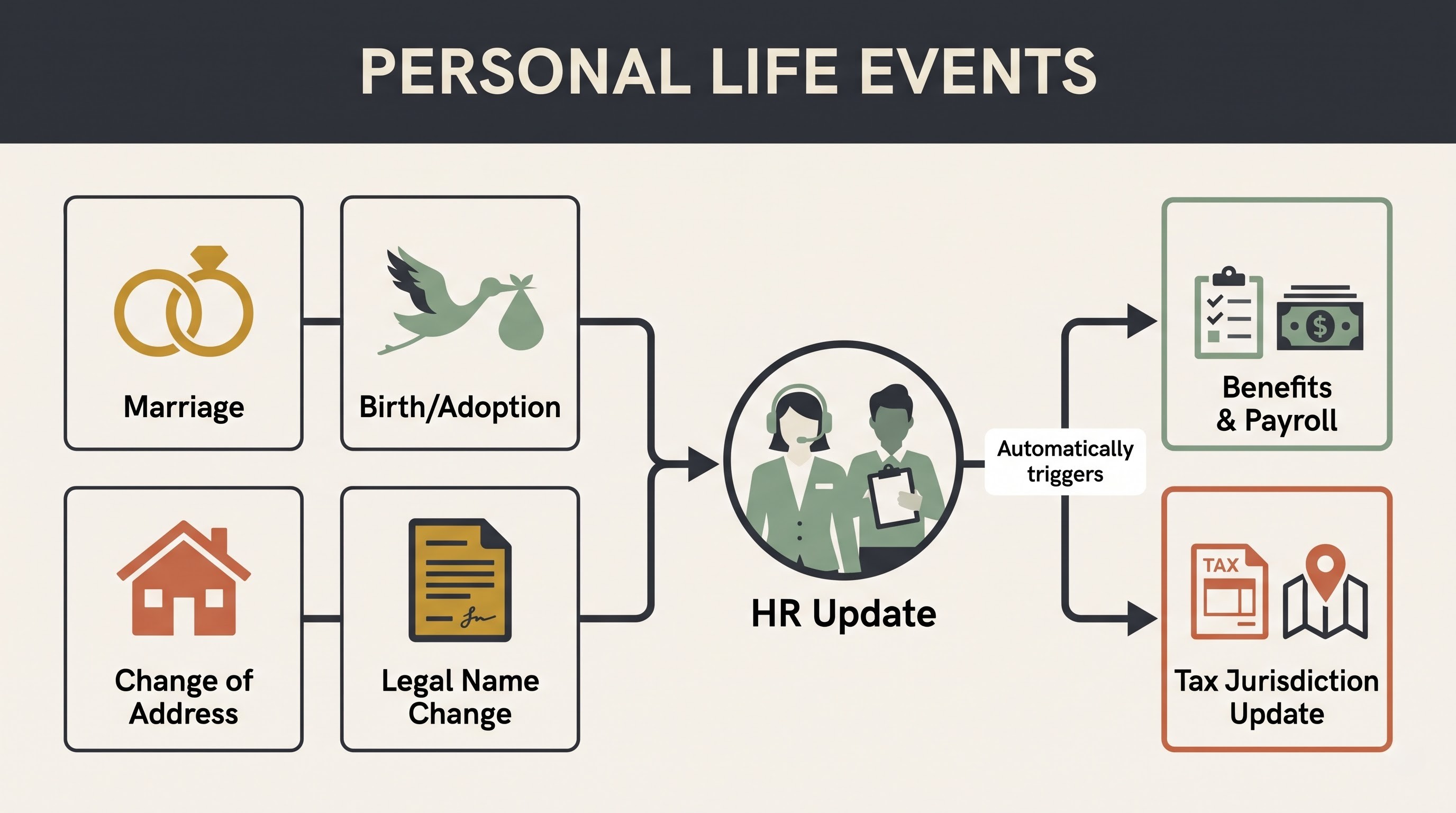
For example, if the employee submits a Change Personal Information or Change Contact Information transaction that shows an interstate move, Workday compares the new residential address to company operating locations and tax jurisdictions. If a move crosses state or national borders, condition rules can route the transaction to payroll and tax specialists for review to ensure income tax withholding and local labour compliance are kept accurate. If the employee also reports a qualifying life event, such as marriage or childbirth, the business process automatically fires the Change Benefits business process. The employee receives an inbox task that is time sensitive and includes updated plan options, dependent enrolment fields, and coverage costs. Integrated carrier connections securely push approved enrolment updates to insurance providers, eliminating the need for manual file uploads.
And the same structural rigour applies to administrative events in the manager function. Targeted business processes are needed to complete probation periods, extend contracts for fixed-term workers, modify work schedules and transfer location. Workday keeps its master data clean and auditable across thousands of concurrent employee records by embedding validation rules into the entry screens – say, disallowing future-dated effective changes that conflict with existing transactions, or requiring supporting documentation for some status updates.
Internal Mobility: Procedures for Promotion, Transfer and Job Change
Internal mobility is important for career progression and organisational agility as employees move up within the organization. All of these workforce movements are brought together in Workday’s flexible Change Job business process – whether it’s a merit-based promotion, a lateral move into a new department, an interim leadership role, or a move to an international subsidiary. Instead of separate, rigid workflows for each slight variation of movement, Change Job dynamically updates the required steps, approvals and downstream sub-processes based on job change reasons and condition rules.
In a Change Job event: When a manager or HR business partner initiates a Change Job event a standard reason is selected that applies, for instance Promotion, Lateral Transfer, Demotion, Reorganisation or Relocation. You enter the effective date and the target supervisory organization, job profile, location and work shift. Workday immediately compares the current worker attributes to the proposed state to determine the exact scope of change. If the move is between two supervisory organisations, the automatic approval routing includes both the losing manager and the gaining manager so that both can see and plan for the transition smoothly.
The real power of the Change Job framework lies in orchestrating cascading updates between related modules. If the promotion includes a change in job level or scope, the Change Job process automatically calls the Propose Compensation Change subprocess. In this step, the initiator views the employee’s current salary in relation to the pay range of the new job profile so that informed compensation decisions can be made utilising built-in compa-ratio metrics. In addition, Workday will automatically review new benefit plan eligibility and update time-tracking rules effective as of the effective date if the role change impacts union eligibility, overtime exemption status, or benefit class. Identity management integration which comes after this step involves recognizing the job change event and updating system permissions to revoke access from the old department and grant access to the new one.
Leave of Absence and Absence Management
Day-to-day workforce operations and extended absences represent key touchpoints in the employee lifecycle with significant legal, financial and operational implications. Workday’s core HCM engine includes time tracking, absence management and extended leaves, eliminating the sync gaps that occur when timekeeping is in a separate third-party application.
For routine time off (e.g. vacation, sick or personal leave), the Request Absence business process checks available accrual balances against organisational accrual rules and carry over limits in real time. Workday checks team staffing calendars and routes the request to its direct manager for approval. Once the approval is done, it updates the projected payroll hours immediately.
Longer leave of absence, such as parental leave, medical disability, military service or sabbaticals, are much more nuanced in their governance due to statutory protections and payroll complexity. The Request Leave of Absence business process applies criteria including length of service and hours worked in the prior twelve months to determine eligibility under statutory frameworks like the Family and Medical Leave Act or regional equivalents. When you approve the leave request, the employee’s worker status is updated, recurring allowances are paused or adjusted, and billing adjustments for benefits are triggered if the leave is unpaid. Coordinate statutory pay or short term disability supplements with payroll.
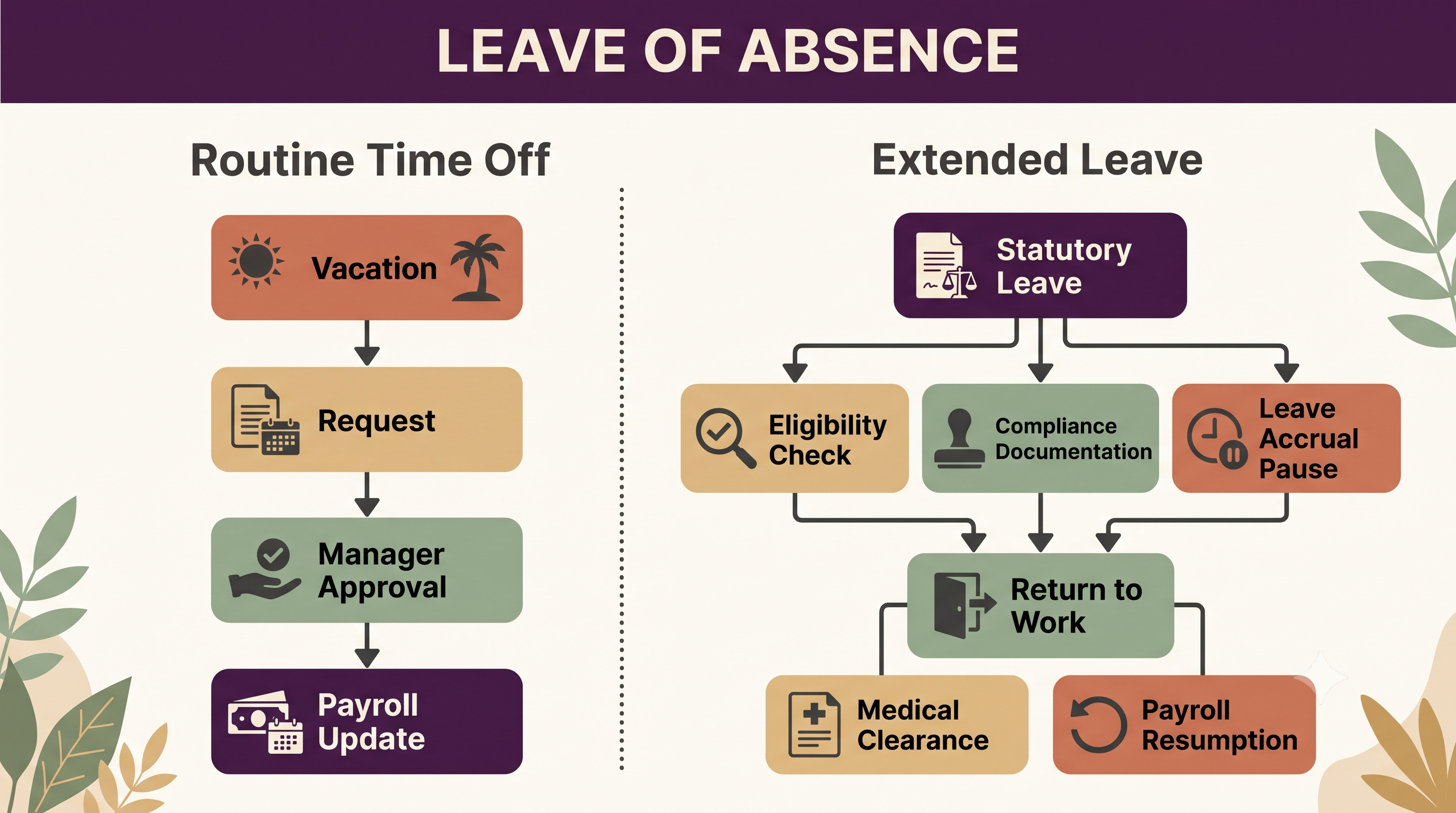
Another important one is the Return Worker from Leave business process. Verification to return an employee to active duty must be coordinated between HR, management and payroll. Depending on the type of leave involved, the reactivation process for returning employees may require a medical clearance that proves their fitness for work before reactivating their access passes, resuming payment into their payroll accounts, and determining any leave benefits. It is possible to help employees with personal issues and fulfill all obligations at the same time if departures and returns are managed as business processes.
Reward cycles, performance and continuous development
Employee lifecycle management is more than transactional change, it is the ongoing cycles that track performance, reward contributions and build organisational abilities. Workday embeds talent management and compensation planning directly into the underlying worker record, so that performance outcomes and skill-building are actively leveraged to drive career advancement and reward decisions.
You can configure Performance Review business processes to conduct annual or semi-annual performance reviews. The workflow walks employees through self-assessment, solicits multi-rater feedback from peers, requests managers to evaluate goal achievement and competencies, and pushes final ratings through calibration steps to align teams by leadership. Because goals and feedback are always saved on the worker profile, managers assess actual accomplishments during the review period, rather than relying on recent memory.
As compensation review cycles are initiated, Workday launches shared participation workflows that cascade merit, bonus and equity budgets through the supervisory chain of command. Managers can see all of the performance rating, market positioning and time in role for each direct report all on one worksheet, proposing awards within real-time budget guardrails. Leadership approves the cycle. Workday generates personalised compensation statements for employees and updates base pay and payroll inputs on the effective date without manual batch imports.
Workday Learning and Talent Development add ongoing skill development to performance and rewards. Specific learning assignments can be triggered by lifecycle events. For example, a Change Job event that moves an individual contributor into their first people management role would automatically enrolll them into leadership fundamentals training. Succession planning tools can help HR and executives identify key roles and assess the readiness of internal talent pools, and link development plans directly to future leadership pipelines.
Knowledge Transfer for Terminations and Offboarding
The last stage of the employee life cycle – whether it’s a resignation, retirement, end of a fixed term contract or a forced termination – requires speed, accuracy, empathy and tight security. When done poorly, organisations can experience serious cybersecurity breaches, unrecovered physical assets, payroll overpayments and legal compliance risks. Workday’s Terminate Employee business process and Offboarding subprocess meet these challenges.
Once the termination is initiated, the workflow captures the termination category, the primary reason, the date the resignation was notified, the last day of work, and the official termination date. The type of departure instantly changes the process flow through condition rules. Voluntary resignation with 2 weeks notice goes through a manager acknowledgement, HR review and an exit interview survey step, leaving plenty of time for knowledge transfer and workstation collection. Involuntary termination for cause, however, triggers an expedited security path that prompts IT security and facilities to disable single sign-on access and badge access, and to compute final pay according to stringent statutory payout deadlines.
Offboarding handles enterprise-wide cross-functional closeout tasks through Workday. To-do steps alert IT and asset management teams to retrieve laptops, mobile devices, corporate credit cards and security keys tracked against the worker’s profile. Business process reassignment rules automatically reassign open inbox tasks, pending approvals and supervisory responsibilities from departing managers to their designated successor or next-level leader so ongoing business operations never stall in an inactive queue.
When the termination event is complete, Workday updates carrier integrations to terminate active coverage and generate continuation coverage notices (e.g. COBRA), if applicable. The final payroll will also include unused vacation payouts, severance terms and final hours worked. Workday keeps the historical worker record, even after exit, in an inactive status that allows for accurate alumni reporting, helps rehire eligibility checks to determine if the person returns as a boomerang employee down the road, and ensures full audit compliance for statutory retention periods.
Governance, Security and Audibility throughout the Lifecycle
Every year, thousands of sensitive employee lifecycle transactions are processed, requiring a commitment to data privacy, role-based security and regulatory governance. At Workday, the security model is built into the fabric of the business processes, rather than being added as permissions to separate screens. Business process security policies define which security groups can initiate, approve, view or rescind a transaction for each step of a business process. Business process security groups can be Manager, HR Partner, Compensation Partner, Payroll Administrator or Employee as Self.
Workday security roles are scoped to supervisory organisations and locations, so an HR Partner assigned to the engineering division in Europe can see and approve job changes for workers in that particular organisational branch, but is completely restricted from seeing executive compensation records in North America. Field-level security also ensures that sensitive attributes, such as national identification numbers, bank account details, reasons for medical leave, and disciplinary notes, are visible only to those whose specific functional duties require them to see these.
Equally important is Workday’s immutable audit framework. Every event in a business process has a complete, tamper-proof record of who performed the transaction, the before and after values, all the condition rules that were evaluated, who approved or sent back each step, and the exact timestamp of all actions. When internal auditors or external regulators examine compliance with Sarbanes-Oxley controls, GDPR data governance standards or equal pay regulations, HR and compliance teams can pull the full life cycle lineage of any worker record in seconds. Workday also offers correction and rescind features that let authorised administrators cleanly reverse incorrect transactions or alter historical effective dates, automatically recalculating downstream impacts and logging every adjustment.
Conclusion
Managing employee lifecycle events is one of the most important tasks for any modern enterprise today. Every transition – whether the buzz of a new hire offer, the complexity of an international transfer, parental leave, a merit promotion, or a smooth offboarding – impacts operational efficiency and the human experience of work. Workday HCM brings these disconnected administrative tasks together with cohesive, intelligent and auditable journeys via its unified data core, supervisory organization hierarchy and highly configurable Business Process Framework. Business organizations that harmonize their activities based on their strategic plans, involve themselves in necessary workday hr training of their people in working hours, and provide instructions for self-service to both their managers and staffs can go beyond being just administrative HR functions and create flexible work forces that continuously develop.