
Mastering Business Analysis: A Deep-Dive Guide to the Modern BA Role and Training Architecture
Last updated on Jul 9, 2026

In a corporate environment dominated by rapid digitization, cloud migration, and data-driven decisions, the connection between abstract corporate strategy and its concrete technological implementation has now become one of the most crucial structural elements of a corporation. Such a connection is ensured through the efforts of the Business Analyst (BA).
Instead of being a mere administrative link between the two, the contemporary BA serves as a strategist, requirement engineer, and catalyst of change, ensuring the translation of complex visions of stakeholders into a well-defined, systematic engineering pipeline that results in technologies with high business value.
The business analyst classes online program by OnlineITGuru has been structurally designed keeping in view such a situation. Based on their comprehensive 15-module, 30-hour course structure, this article seeks to understand the key structural elements of business analysis, the necessary tools, Agile-Scrum methodology, practical cases, and the overall career path of aspirants.
Part 1: The Anatomy of Modern Business Analysis
To understand why specialized training is crucial, we must first break down the fundamental DNA of what a Business Analyst does in today’s corporate environment. The overarching goal of business systems analysis is the systematic identification, documentation, validation, and lifecycle management of key corporate requirements.
Requirement Clarification: What Is It? First of all, Requirement is the key element of this field. A requirement is essentially a condition or capability needed by a user to solve a problem or achieve an objective, or a capability that must be met or possessed by a system to satisfy a contract, standard, or specification. Business analysis categorizes these into a strict hierarchy:
Business Requirements: High level goals, objectives and need statements from the enterprise point of view (e.g., “Increase customer retention rate by 15% through the use of a digital onboarding platform”).
Stakeholder Requirements: The individual needs of a certain target user group or corporate entity that serve as a link between high level business requirements and low level design of the system.
Solution Requirements: Specific technical specifications of the system to be implemented to satisfy stakeholder needs. Solution requirements are further divided into:
Functional Requirements: The things that the system has to do (e.g., “The system is expected to provide an automated EMI calculation report to the user via email within 30 seconds after the application approval”).
Non-Functional Requirements (NFRs): System qualities concerning how the system has to behave in terms of security, scalability, performance and availability (e.g., “The application page is supposed to load within 2 seconds when 10,000 users access it simultaneously”).
Transition Requirements: Skills needed for the transition from the current state of the company to the desired state.
These are the individuals or groups who have such requirements and are called the Stakeholders. Management of stakeholders is one of the hardest tasks for a BA. They range from C-level executives financing the project to end users who would be interfacing with the system on a daily basis along with database administrators, compliance officers, and third party vendors. The BA has to get them profiled, perform influence vs interest mapping and conduct requirement elicitation sessions while not losing sight of the scope due to conflicting interests.
Business Process Modeling (BPM)
Prior to writing any line of code, it is imperative that a Business Analyst understands how the business processes currently operate and how they need to operate in an ideal state. This is accomplished through Business Process Modeling (BPM).
BPM makes use of diagrams to illustrate workflow diagrams, data flow diagrams, and process flow. Using notation methodologies like BPMN (Business Process Model and Notation) , a BA would prepare As Is model (the way it is now with all the operational inefficiencies) and To Be model (how it is supposed to be in an optimized manner removing all the friction with the help of software application).
Part 2: Unpacking the Curriculum Architecture
OnlineITGuru has divided the learning of 30 hours into 15 modules, which takes learners from fundamentals to advanced tools and execution framework. This business analyst classes online is designed specifically for that to fulfill present market requirements. The below is an analysis of this architecture
1. Foundational IT Project Knowledge & Enterprise Diagnostics
The first module of OnlineITGuru's curriculum helps learners get acquainted with the real-world infrastructure and enterprise diagnostics of IT. A BA cannot function without understanding these aspects; he or she has to conduct a diagnosis of the whole business landscape. It requires assessment of corporate strategies, gap analysis, identification of organizational weaknesses, and justification of projects through a business case.
It also covered how to conduct Enterprise Diagnostics, including investigation of current architectures of businesses, technical feasibility, and organizational readiness. This way, BAs will have a clear idea about how the software framework fits into the corporate environment.
2. SDLC Methodologies
Much of the life cycle of work that a Business Analyst does involves moving around in different methodologies used in software engineering. In this context, there is heavy focus on SDLC Methodologies and Models where classical models will be compared against modern iterative approaches:
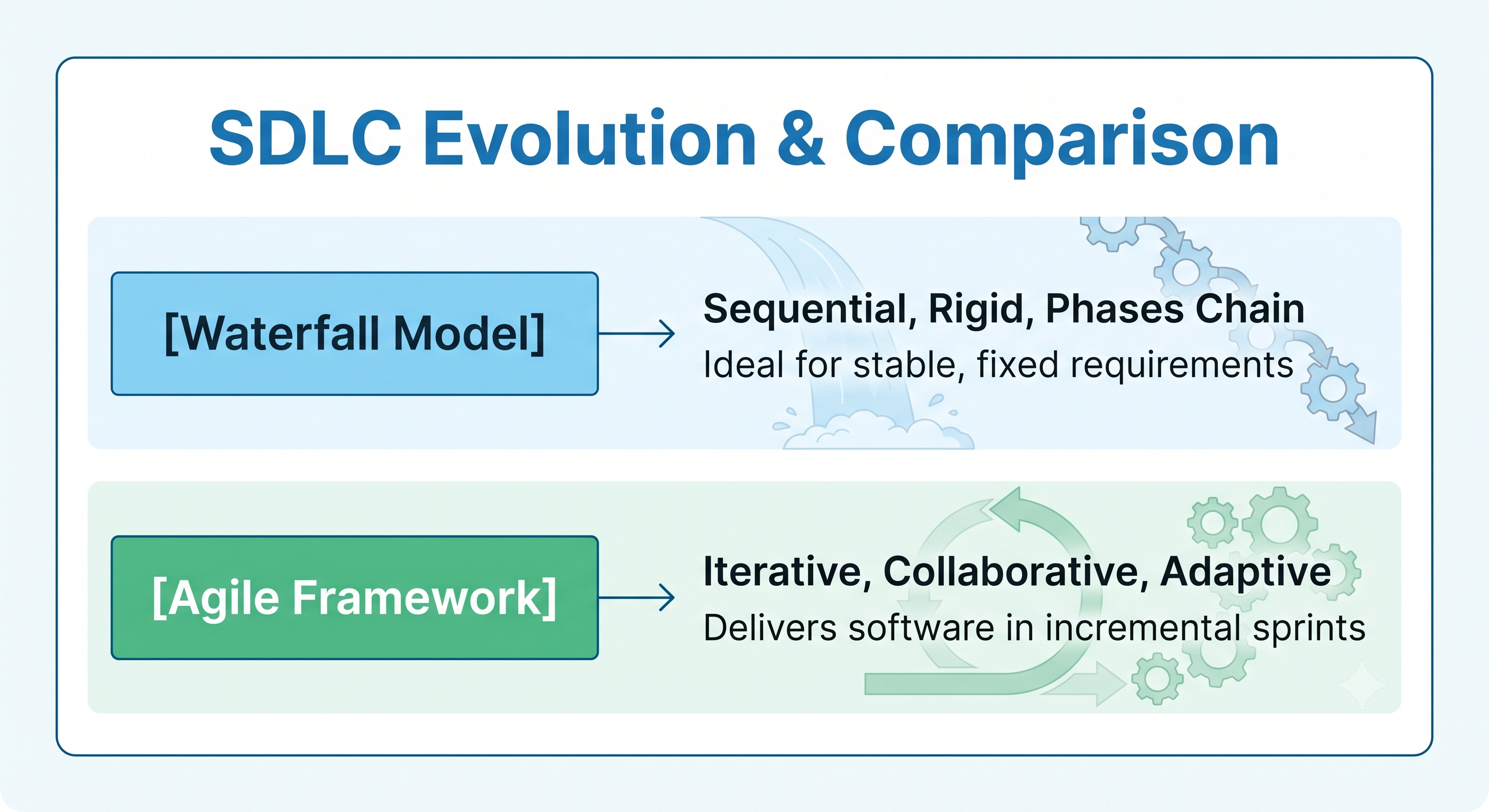
There will be a detailed dissection of each approach to ensure that the BAs have an understanding of which documentation process to use in a regulated Waterfall team and in a fast-paced Agile team respectively.
3. Requirements Engineering: Initiation and Gathering Stages
After setting the life cycle frame work, the focus in training will move towards requirements gathering. This is a phase that requires a balance between great interpersonal skills and analytics. BAs will go through different requirement gathering techniques:
Conducting structured interviews: Holding focused individual sessions with domain experts.
Joint Application Design (JAD): Highly collaborative workshop in which users, stakeholders, and developers get into the same room in order to fasten the consensus.
Brainstorming & Documentation Review: Analyzing existing legacy systems, SOPs, and regulations in order to identify implicit requirements.
Prototyping: Using simple mock-ups that trigger user reaction prior to big development efforts.
4. Managing the Requirements with UML (Use Case & Activity Diagrams)
The gathered requirements need to be transformed into concrete technical specifications. In order to do this, UML is used in this training as a technical language of requirements description. UML stands for the transformation of conversational language into code.
Use Case Diagrams: It is a way to visualize the interaction between the external actors (users or other systems) and the system itself. Use case diagrams provide a graphical description of the system boundaries and of the functionality provided by the system.
Activity Diagrams: They act basically as sophisticated flowcharts depicting the flow of control and data through activities. Exception flows, conditions, parallel execution forks are all easily supported by activity diagrams.
5. Architectural Paradigms: MVC
To become a first-rate Business Analyst, a person must have an adequate knowledge of software architectures, for communication with engineering staff will be significantly easier in such a case. This course will teach you about Model-View-Controller (MVC) Architecture.
Having acquired an insight into how a system separates data logic (Model), interface layout (View), and routing rules (Controller) into separate modules, the BA is able to provide much better requirement documentation and understand how to distinguish UI modifications from deeper changes in core data schema. In this way, engineers get more chances to understand requirements and implement them faster.
Part 3: Modern BA Digital Ecosystems
A modern business analyst’s success is dependent on his/her proficiency in special platforms. The OnlineITGuru curriculum concentrates on three particular digital ecosystems, which rule the modern enterprise processes – JIRA, Tableau, and test tools basics.
1. Agile Scrum project management through JIRA
With more firms embracing the Agile methodology around the world, Atlassian JIRA has become the de facto tool for workflow and requirement management. Through this course, students will get practical experience on how to manage Agile processes in JIRA:
Epic & Story Management: How to document company-wide epics in a detailed manner and further subdivide them into smaller and actionable User Stories. User stories should adhere to a rigid formula: "As a [Type of User], I want to [Perform an Action] so that [Achieve a Specific Value]."
Formulation of Acceptance Criteria: Setting precise criteria for user stories with help of various frameworks like the Given When Then syntax (Behavior Driven Development), which clearly defines how much work has been done by an engineer.
Backlog grooming and Sprint mechanics: Grooming of the product backlog, story points estimation (e.g., Planning Poker) and configuration of Sprint board, burndown chart and velocity index.
2. Business Intelligence & Visualizing Data using Tableau
In today’s corporate strategies, data plays a vital role. In such a scenario, it becomes crucial for a BA to be able to mine the dataset, recognize the patterns and then use them to create visual representations that will help in decision making. The training covers the use of Tableau for this purpose.
The learner will be made aware of connecting to different data sources, designing data schema, cleaning the raw data and creating informative executive dashboards. Through visualizing the data, a BA will be able to justify their business case through actual data trends rather than just by using intuition.
3. Software testing and user acceptance testing (UAT)
Completion of a project by engineers doesn’t imply that the code has been compiled and it’s ready to go. It’s important to note the importance of quality control and quality gateways that occur in the form of Introduction to Testing courses and User Acceptance Testing (UAT).
The course helps students to understand the main aspects of test planning, test cases development, and defect management. Particularly, it emphasizes that the BA is responsible for the UAT stage, when the BA serves as an advocate for the user and helps him/her to use the system developed by the engineer. The aim of this process is not only to make sure that the code is compiled, but it also works in solving operational issues of the business.
Part 4: Experiential Learning through Real World Projects
Theoretical learning is not enough to become a competent Business Analyst. The main aspect of the training program is practical learning in the form of the completion of capstone projects in various industry verticals.
Case Study 1: Hospital Billing Management System
The Domain: Healthcare Informatics & Revenue Cycle Management (RCM)
The Business Problem: The enterprise-level hospital group is suffering from substantial revenue leakages, lengthy billing cycles, and many errors in the claims generated for Outpatient (OP) billing. The problem with the legacy system is its heavy dependence on the manual data entry from the paper chart, resulting in time loss and leading to claims' rejection by the insurance company.
The BA Role: The student will take on the role of Lead Systems Analyst and design a superior and fully automated OP Billing System.
Milestones for Implementation:
Requirement Analysis: JAD meetings will be held with the management of the hospital, medical coders, and billers to recognize the issues of non-compliance (ICD-11, HIPPA).
Process Improvement: It is necessary to map the existing manual billing process (As-Is) and find out where errors occur. To develop a better billing process (To-Be), including the validation code automation will be required.
UML Modeling: It is needed to create Use Cases diagrams showing the interaction between the medical coders, billing clerks, insurance verification engine and the database of the system.
JIRA Management: Requirement analysis will be done and broken up into the corresponding Sprint Backlog. User version will be made-up for claim validate and payment gateway automation.
Case Study 2: Blood Bank Management System
The Domain: Health Care Logistics, Emergency Services, and Supply Chain Automation.
Business Problem: In emergencies, hospitals find it difficult to locate any available blood component within distributed donation centers. Manual systems make it extremely challenging to keep track of eligibility windows, real-time inventory management, and expiry date of each component.
The BA’s Task: To design a digital network of connected donors, blood centers and hospital emergency rooms in one system.
Execution Milestones:
Stakeholder analysis: Determine the diverse set of stakeholders, identifying access requirements and information needs of each stakeholder such as lab technician, emergency room doctor, and volunteer donor.
Functional Analysis: Design functional requirement specifications for the real time matching engine that matches rare blood component requests with available inventory in near proximity.
Activity diagrams: Design the activity flow of the system to determine how the inventory level changes from drawing the blood bag, testing it, storing and finally dispatching it.
Analytics Tableau: Create a dashboard for the control room which would provide insight about the status of blood inventories in several cities to help with supply chain management of blood stock.
Case Study 3: Digital Onboarding Smart Account Application
The Domain: FinTech, Banking Systems, & KYC/AML.
The Business Problem: A group of retail banks loses its customers to digital native companies because they need to visit a branch office and provide documents physically when opening an account. This process currently takes between three and five business days, which leads to high dropout rates.
The BA’s Job: Design an architecture for the "Smart Account Application" platform, where customer onboarding will be switched from a lengthy and prone-to-errors paper-based process to fully automated one.
Execution Tasks:
Compliance Compliance: Collect the necessary regulations in regards to AML/KYC digital verification.
MVC Architecture Definition: Describe all the necessary data capturing points (Model), the user interfaces design (View), and the validation routing rules (Controller) required to communicate with governmental systems.
NFRs Definition: Provide non-functional requirements for end-to-end data encryption standards necessary to protect the personal information of clients when transferring data.
UAT Test Case Development: The test cases will be created for the user acceptance testing, ensuring that the biometric and digital signatures function without any problems across multiple mobile platforms.
Case Study 4: E-Loan Automation Platform
Domain: Consumer Finance, Loans, and Risk Management Technologies.
The Problem for the Company: The process of credit assessment, asset checking, and EMI calculation in the lending operation is completely manual. It takes a few weeks to complete this process, thereby increasing the cost of doing business and human bias in risk assessment.
The BA’s Role: Build a complete automation process that will automate the whole process from customer query to automatic credit rating and automatic EMI computation.
Execution Steps:
Rule Creation: Capture the mathematical algorithms that will be used in developing the automated credit assessment process on the back end of the system.
UML Sequencing: Build sequence diagrams illustrating the steps of communication between the consumer front end, external credit bureaus, internal risk engines, and the Core Banking Systems (CBS).
Exception Designing: Illustrate the exact process of handling borderline credit application cases that will need manual assessment by the credit officer.
Jira Sprints Delivery Process: Use multiple sprint deliveries to deploy the calculation engine and ensure validation of the core payment schedules and interest calculation tables early during the launch process.
Part 5: Corporate Career Path and Career Market Development
The value of a full BA course is quite practical. Corporate demand for qualified Business Analysts will stay relevant as companies have a continuous need for optimization of their investments in digitalization.
Market Mechanics of the Global Market
According to statistics shown in current employment tendencies and research on company payments, certification of Business Analysts provides substantial premiums in global tech centers.
Average Adjustments of Salaries: According to data from the online hiring ecosystem of OnlineITGuru, an average salary increase for upskilled specialists in the sphere of BA is 75%.
Potential Salaries: Leading enterprises’ business systems architects and consultants in their network earn salaries up to $120,000 USD per year.
Ecosystem of Partner Network: Today, modern companies understand that poor requirement management is the main reason of IT projects failures. As a result, global service integrators, consulting firms, and product companies like Accenture, Ernst & Young (EY), Capgemini, Upstox, Persistent Systems, TCS, Wipro, and Infosys are always looking for certified specialists by organizing hiring runs.
Path to Career Development for Professionals
The scope of the Business Analyst career path is broad, with obvious advancement opportunities in executing roles as well as in leading executive positions:
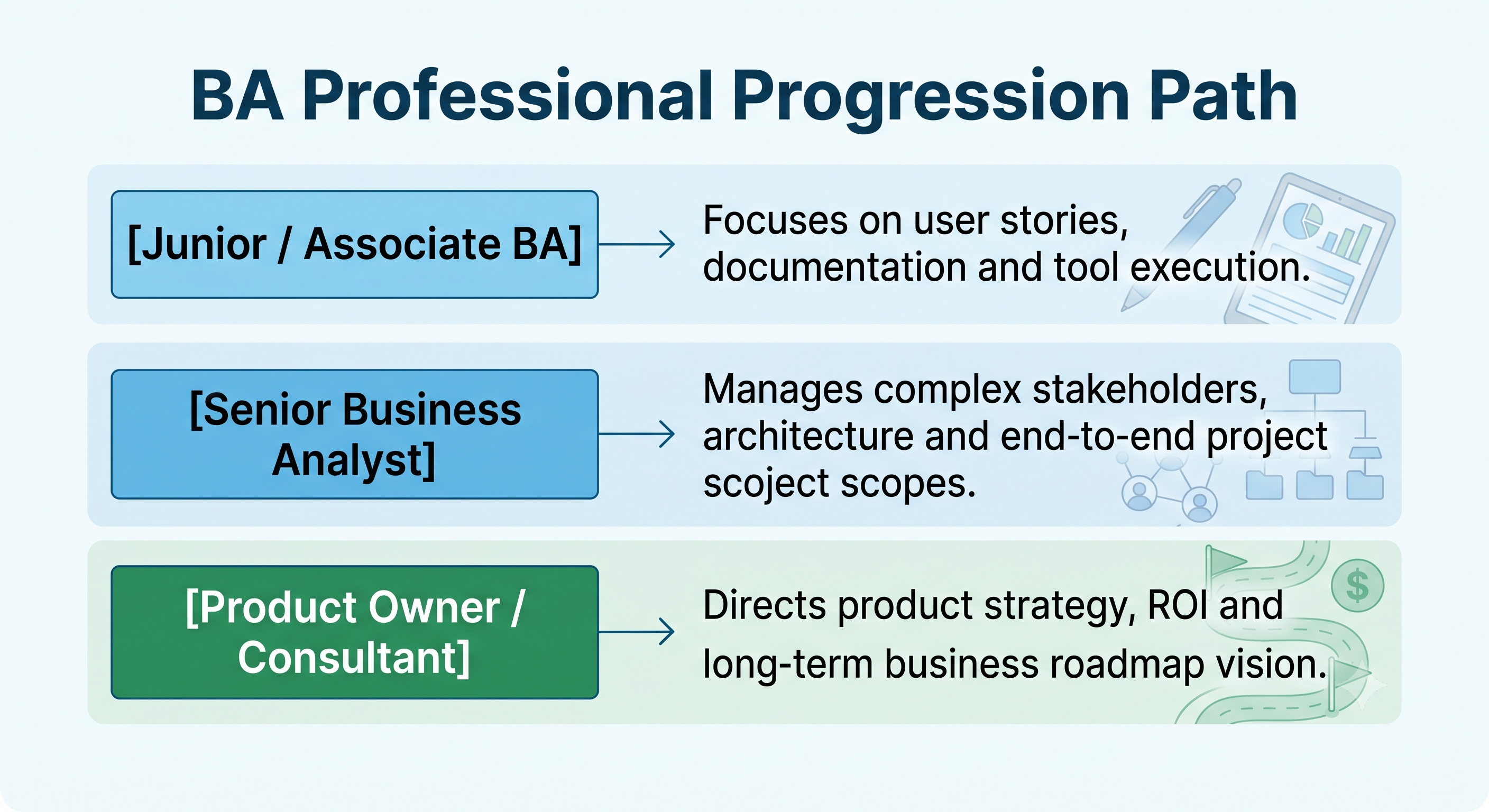
With experience and expertise in their particular industry sector, one can advance into very specialized career tracks in consulting, such as a Healthcare IT Consultant, FinTech Systems Architect or ERP Specialist, advising corporations on their digital transformation strategies worth millions of dollars. For people who wish to enter such a career path, taking ba online training is definitely the best way to start.
Part 6: Evaluation of the Course
The ba online training offer a well-balanced educational experience connecting theoretical design with practical tools needed today.
Through the integration of the basics of business process engineering and technology skills such as JIRA, UML Modeling, MVC, Tableau, and UAT, the course will enable the learner to convert theoretical analytical capabilities into a highly organized, market-ready toolset.
In light of immersive capstone case studies in health care, finance, and logistics industries, as well as an extensive enterprise recruiting network, the program provides a definite path for anyone who would wish to become a successful business analyst.