
Mastering Salesforce Administration: Essential Skills Guide
Last updated on Oct 31, 2026

In fact, there are some changes regarding the field of Salesforce Administrator responsibilities. Now, it cannot be regarded as a helpdesk job, where a person's duties include only password resets, creation of text fields, and designing page layouts. With the competitive environment in the modern business world in which there is competition in any field of business, the Salesforce Administrator has an important role to play in the connection between the business strategy, processes, and technicality.
As the companies make money and improve the customer experience and the efficiency of operations through automation, cloud ecosystem, and artificial intelligence, Such experts have high demand in this area. Anyone who wishes to acquire these skills through professional means needs to take up an appropriately structured salesforce admin online training.
This guide will give you the information about what skills and competencies you should develop in order to become a Salesforce Administrator.
The Emergence of the Modern Salesforce Administrator Role
In order to understand all the tasks in the field, it is important to look through the history of the Salesforce platform. Firstly, it is crucial to say that the company implemented Customer Relationship Management software for the creation of electronic files of customers' contacts and sales funnels. Therefore, the job of the administrator included maintenance of the system and making sure that all fields were named and accessible.
Now, Salesforce evolved into the comprehensive cloud platform which includes different features such as sales, services, marketing, commerce, analytics, integration, and even artificial intelligence. Therefore, the tasks of the administrators have nothing to do with the maintenance of the system any longer. Instead, the tasks of the role of the administrator include those of the product manager, business analyst, and enterprise architect.
The tasks of the modern administrator include prediction of the needs of the company, scalable solution of eliminating friction, privacy compliance, and digital transformation projects implementation.
Core Technical Competencies
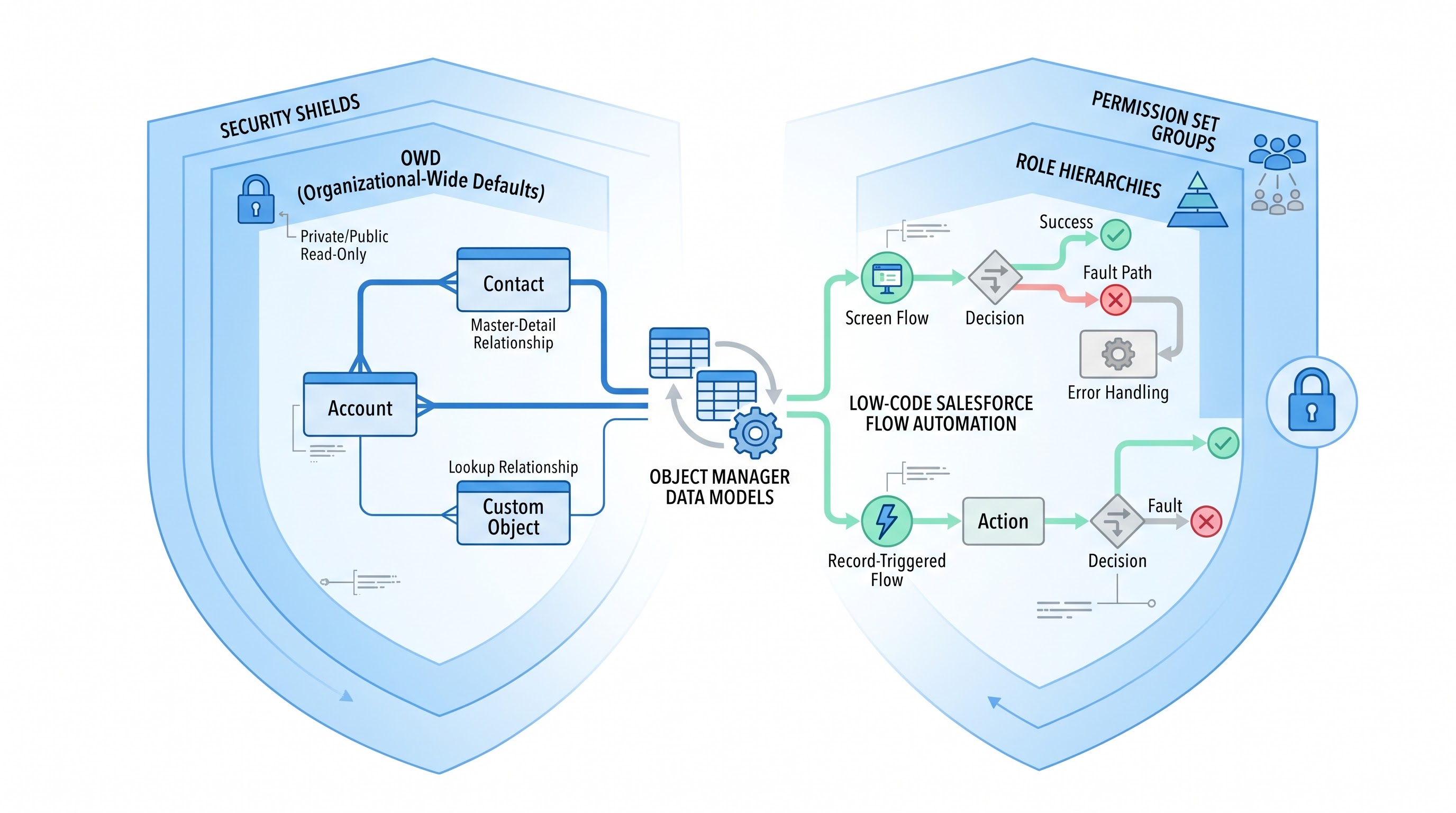
The understanding of how to deal with technical elements of Salesforce platform is the basic prerequisite that forms the basis for administrator’s career. The following core technical competencies will help you design your environment in accordance with your workflow without writing any custom code.
1. Platform Configuration & Customization
As the major force driving all the administrative activities, the ability to configure Salesforce user interface, data model and application becomes the crucial competence for any administrator. Being able to work freely with Setup menu, Object Manager and Lightning App Builder is the must-have requirement.
Data Model & Object Design: Either the ability to develop your objects and fields, or knowledge about various relationships such as Master-Detail, Lookup and Many-to-Many junction objects is required for efficient data management. The poor data model designed from the beginning will limit you considerably in the future.
Optimization of User Interfaces: Optimization of user interfaces in line with organizational profiles and permission groups will allow the sales representatives, customer support representatives, and marketers to have access to only the necessary portion of the data. Context-specific page creation through Lightning App Builder will allow avoiding visual noise.
Management of AppExchange Packages: Organizations nowadays use various external apps to make Salesforce features work in order to make agreements, documents, and connect phone systems to Salesforce. For a Salesforce administrator it is crucial to know how to evaluate and test these packages, manage API limits, space, and licenses.
2. Workflow Automation
These days, when Salesforce administrators are mainly engaged in Workflow Rules and Process Builder, are over. Modern workflow automation includes Salesforce Flow that is a very flexible low-code product.
Workflow Automation with Salesforce Flow: A Salesforce administrator should be able to automate workflows with the help of Screen Flows, Record-Triggered Flows, and Schedule-Triggered Flows including the tasks of automatic tasks assignments, territory routing of leads, synchronous record updates, and notifications.
Errors Handling and Proper Debugging: Automation requires appropriate planning and anticipating certain errors that are bound to disrupt the business processes. Good administration skills will ensure implementation of fault paths in flow, debug logs and the sequence of their activation in order to avoid infinite loops, governor limits and other crashing errors.
Implementation of Approval Process: An approval process will be established to include various stages needed by the company to approve discounts, conditions of contracts, special pricing and reimbursement of expenses in order to ensure compliance with the corporate and financial policies of the company.
3. Security, Access Control and Identity Management
Any threat to the enterprise data will be considered as a serious problem. The slightest error may lead to leakage of sensitive data, non-compliance with policies and regulations and huge loss of trust from customers to the company. It is a highly responsible job for the administrators to protect sensitive data of the enterprise.
Organizational-Wide Defaults (OWD): Basic access to the data for all objects in order to provide access to the necessary data.
Access Structures and Role Hierarchy: The implementation of special access structures that would ensure flexible allocation of the required access to information by the regional groups, operation managers and executive managers and at the same time prevent any unauthorized access to all departments.
Profiles, Permission Sets, Permission Set Groups: In accordance with the best practices of security it is necessary to move forward beyond the inflexible profiles and use the permission sets architecture.
Identity, Authentication and Session Security: Two-factor authentication, single sign-on and strong session security to protect the company environment from any unauthorized access and cyber attacks.
4. Data Management, Migration and Governance
There is an old saying “garbage in – garbage out”. However, when talking about enterprise software solution the saying takes on new meaning because all forecasts and reports will be created based on the database accuracy.
Data Migration and Mass Operations: Knowledge of the techniques of mass operations with the help of such tools as Data Import Wizard, Salesforce Data Loader and other migration tools to insert, update, upsert and export millions of records.
Avoid Duplicates and Keep It Hygienic: Creating advanced duplicate and match rules so as to avoid dirty data and data fragments. Data auditing, archiving historical data, and bulk cleaning of data will be some of the tasks.
Formula-Based Validation Rules: Creation of formula-based validation rules so as to establish guidelines for entering data into the system. For example, in situations where there is need for the special formatting of the international telephone numbers and zip codes, or situations requiring mandatory fields for opportunity closure, validation rules come in handy to ensure data integrity.
5. Advanced Reporting and Dashboards
Executives don't go through the raw data base tables but depend on visual information for making key decisions.
Report Types: Creating customized report types which make use of cross filters, bucket fields, and summary formulas in order to generate business metrics out of complex data.
Executive Dashboards: Creating customized dashboards which measure pipeline velocity, conversion rate, case close time, and team KPIs. The administrator should set up proper permissions for the dashboards so that performance metrics in relation to clearance levels are generated.
Analytical and Business Skills
However, having purely technical skills will not always be sufficient to achieve professional success. It is important for a true professional Salesforce Administrator not only to possess great technical skills but to understand how the business operates and how to transfer the business strategy to the technical configuration.
1. Business analysis and requirements gathering
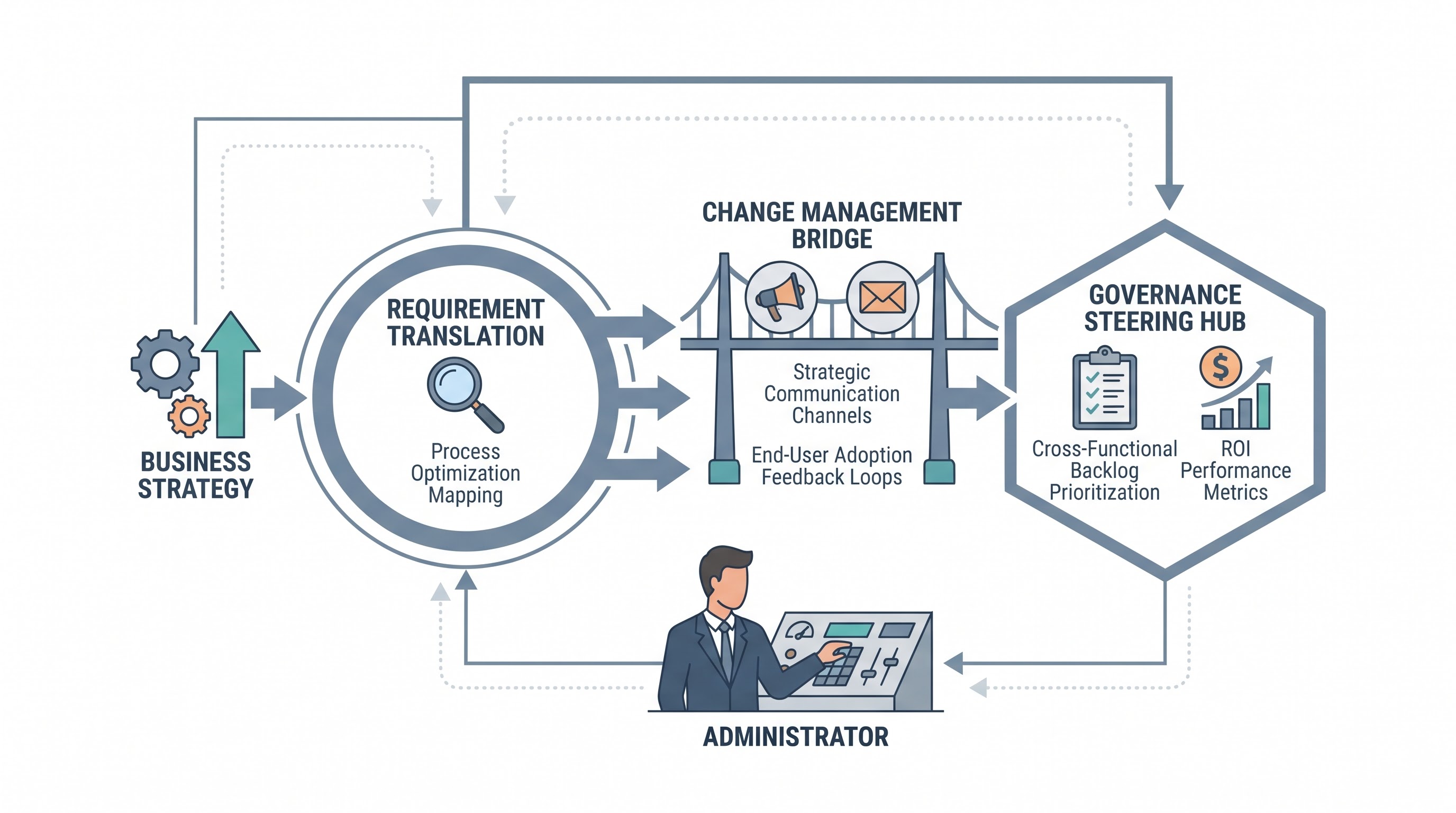
Administrator interacts with department managers, sales vice presidents, and customer service managers that explain their problems using non-technical language.
Requirement translation to technical solution: Administrator must know how to ask the right questions to identify the problem from business perspective because in some cases user wants to have something simply to make the process flow better and not because of technical reasons.
Process mapping and optimization: Creation of the current process map of the business processes and identification of the process bottlenecks within Salesforce prior to any configuration.
2. Change Management & End-User Adoption
No matter how well your platform such as Salesforce is, if your end users are not happy with the platform and revert to using excel and sticky notes, then you have failed in your mission.
Change management is an important concept that ensures your end users adopt the change.
Strategic Communication: Ensuring that all stakeholders are informed of all the platform updates, maintenance windows and feature launches through perfectly written release notes, newsletters and webinars.
Training Programs: Creating role based training programs, video tutorials and cheat sheets to ease adoption for new hires.
Feedback System: Creating an effective communication channel where your end users can report bugs, suggest features and provide feedback on any issues.
3. Project Management & Organizational Skills
Your task list as a Salesforce administrator never stops. Balancing support tickets, bug fixes and projects at the same time requires you to have strong organizational skills.
Prioritization Strategies: Learning to prioritize urgent support tickets and strategic initiatives.
Professional Deployment: Ensuring the process of professional deployment by carrying out the development of the new configurations in the sandbox and then deploying them in the production environment using the change sets or DevOps. It will make sure that there is no risk of disaster in production environment that could potentially ruin the whole company.
Interpersonal and Soft Skills
The reason why administrators operate in all the departments such as sales, marketing, finance, customer success, and the executive department in an organization is because of the level of proficiency in their interpersonal skills.
Effective Communication Skills
Technical data cannot be understood by the people in the business sector. A good administrator is capable of explaining the technical issue in business language. However, a good administrator should also be a good listener and should be capable of analyzing the user complaints into troubleshooting.
Systematic troubleshooting and resilience
This step may come at any stage of the process where the admin is involved in any kind of activity. All sorts of unexpected malfunctions of automation, permission error faced by the user or issues with data integration that lead to exceptions will surely require the administrator to stay cool and apply systematic, analytical troubleshooting. Analyzing the problem, checking developer logs, collecting research from the knowledge base and testing the hypothesis in the sandbox will be a great troubleshooting routine.
Continuous learning mindset
The Salesforce environment is famous for its dynamic nature and size. Three releases of features are available yearly, and there is an evolution in functionality, automation and user experience in the platform all the time. Besides all of these, the arrival of enterprise technologies such as artificial intelligence, data clouds and orchestration platforms that change industry standards also happens. The admin should understand the importance of continuous learning.
Proof of Certification and Expertise in Relation to Career Advancement
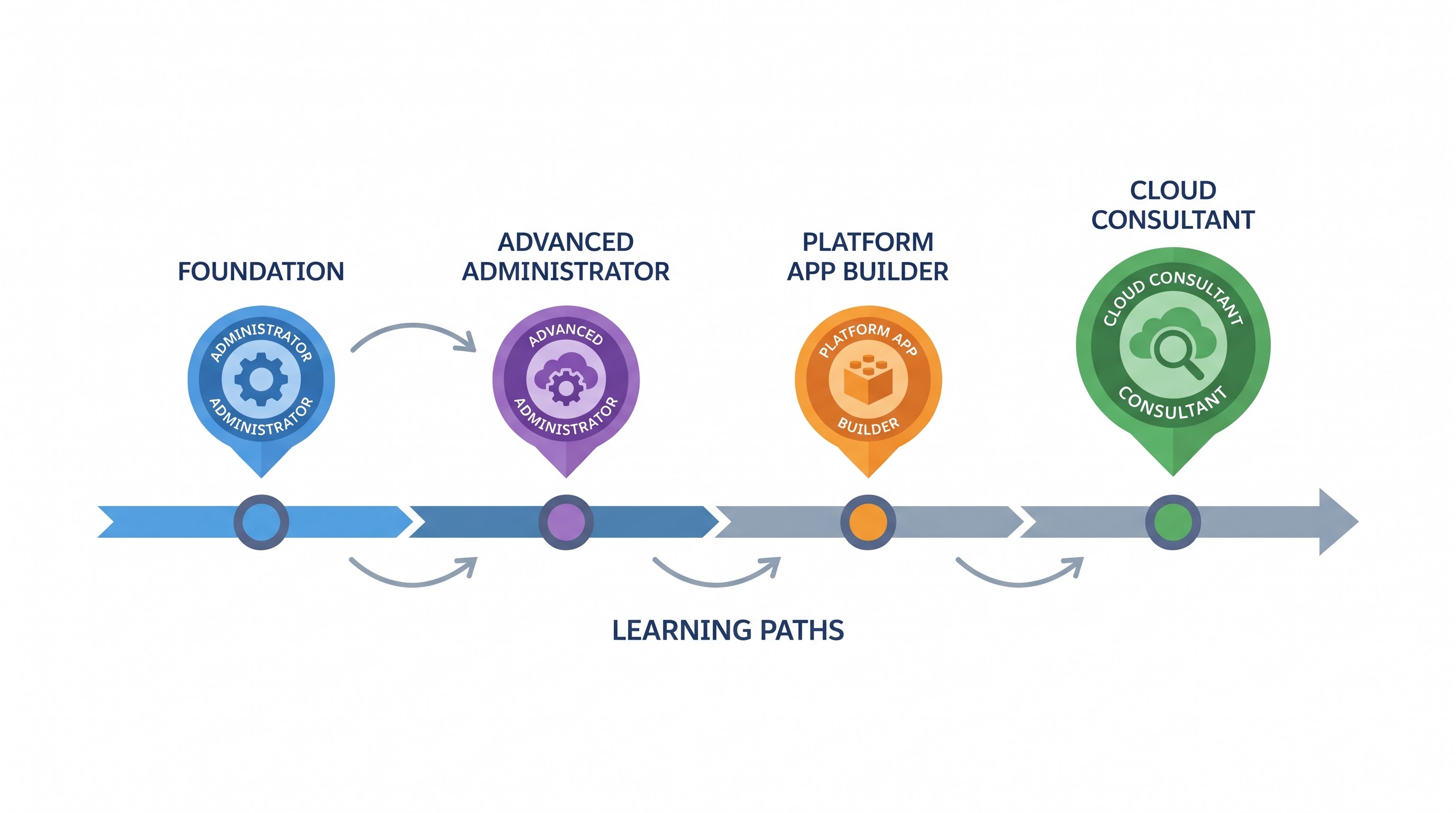
While nothing can substitute practical experience, the certificate is universally acknowledged as proof of proficiency, professionalism, and technical skills. The certificate serves as evidence to the employer about the skills demonstrated by the person in many fields within the platform. The person is able to prepare for the exams through joining a salesforce administrator course online that has been verified to meet all the objectives of the exam.
Salesforce Certified Administrator: The most elementary certificate showing that the candidate has mastered platform configuration, security, data management, and automation.
Salesforce Certified Advanced Administrator: Certificate aimed at proving skills in advanced configuration, automation, duplicates management, auditing, and solving problems in the organization.
Platform App Builder: A certificate that shows the development of custom enterprise applications, data modeling, business logic implementation, and customization of the interface without any coding.
Cloud Consultancy Certificates Related to Specific Business Units: A certificate related to specific business units (Sales Cloud Consultant, Service Cloud Consultant, etc.) that allows focusing on certain verticals.
Strategic Alignment and Stakeholder Management Mastery
Although the routine tasks of configuration and ticketing are necessary for success, the real excellence of a Salesforce Administrator is being a strategic consultant for executive leaders. Making the connection between technical capabilities and profits requires stakeholder management skills and cross-functional expectation management, as well as ROI demonstration.
When a new requirement for modification of the CRM comes from the executive leadership, the great Salesforce Administrator does not only execute the change but performs a thorough impact analysis that demonstrates how the proposed modification will influence automation, data model, integration endpoints, and licenses. The administrator proposes different options and explains their implications through the lens of business. Such strategic consulting forms trust in the organization and contributes to keeping Salesforce synchronized with the growth strategy.
Apart from that, good administrators organize formal governance committees or steering groups. Cross-functional teams hold regular meetings and consider enhancement requests, backlog prioritization, usage statistics, and resource allocation. In such a way, administrators avoid rogue customizations and ensure that system enhancement helps to reach KPIs.
Transitioning into the Future with Artificial Intelligence and Data Cloud
As a result of continuous upgrades of Salesforce technologies including artificial intelligence, prompt engineering and data ingestion within its product suite, the field of administration looks absolutely different from what we have known so far. Contemporary administrator should know about all technological innovations which are developed to increase productivity of humans and make customer experience more personalized.
For this purpose, he or she should be aware of how to configure, monitor and secure the latest innovations including trusted framework for generative AI. Furthermore, the administrator should possess skills of managing the datasets, establishing the boundaries of the type of information available to AI and auditing its actions.
In addition, owing to combination of customer data sources within one platform by companies, the administrator needs to manage the processes of data ingestion, identity resolution and triggering events. Adoption of these technologies will ensure that the administrator cannot be substituted in the modern world.
Transformational Change: From Systems Mechanic to a Valuable Business Partner
The true Salesforce Administrator Elite is far beyond the individual who just knows how to click on some buttons and Navigating around the setup menus, object manager, and lightning app builder is the essential pre-requisite. In order to understand such complex architectural concepts via hands-on labs, there are no shortages of professionals who opt for the salesforce administrator training online.
In addition to the highly professional abilities in terms of configuring the system and automating the processes by means of no-code/low-code technologies, the solid control of data governance and security and problem-solving and communication skills become crucial. This very combination of technical and business skills provides the true development pathway.
Continual Development and Added Value
The Salesforce environment is marked by its constant changes and innovations. Having three major platform releases every year along with innovations in such fields as artificial intelligence, prediction analytics, and data architecture, being static means moving backward. An honest Salesforce administrator will never stop studying, getting updated with his or her certificates, exploring new possibilities of automation with the help of such tools as Salesforce Flow and others that may be used in business.
Nevertheless, the set of technical skills and competences of a Salesforce administrator is not the main thing that distinguishes an average administrator from an excellent enterprise architect. It is the ability to add value to business processes that makes the difference.
Leadership Skills Development Approach
It is only through the continuous improvement of all these diverse skills, through the exceptional ability to stay adaptively up to date in the face of constantly changing technologies, and through continuous striving to make the connection between technology skills and organizational objectives that the administrator becomes what he actually becomes – an entirely new professional identity. The administrator ceases being confined to the limitations of an administrative position that revolves around answering help desk calls and bug fixes.
This is how a respected advisor and a strategic partner of the organization is born. It is in this transformed position that the Salesforce Administrator makes sure not just of survival but also of definition and implementation of the technology along with making money from the customers.