
Modern Architecture of MongoDB: Enterprise Document Storage to Distributed Infrastructure
Last updated on Sep 2, 2026

For decades, traditional databases forced application developers to map complex object-oriented code into rigid rows and tables. As software applications expanded to handle unstructured data formats, massive global traffic, and continuous schema updates, this rigid relational model created persistent development bottlenecks. MongoDB solved these constraints by introducing an architecture centered around flexible document storage, enabling software engineers to manage data in structures that mirror modern application logic.
Understanding MongoDB’s core mechanics requires looking beyond basic data operations to explore its underlying storage mechanics, index optimization, distributed network topologies, and transactional guarantees. The following seven architectural domains define how MongoDB operates as a scalable database platform for enterprise applications.
Document Storage Mechanics and the BSON Protocol
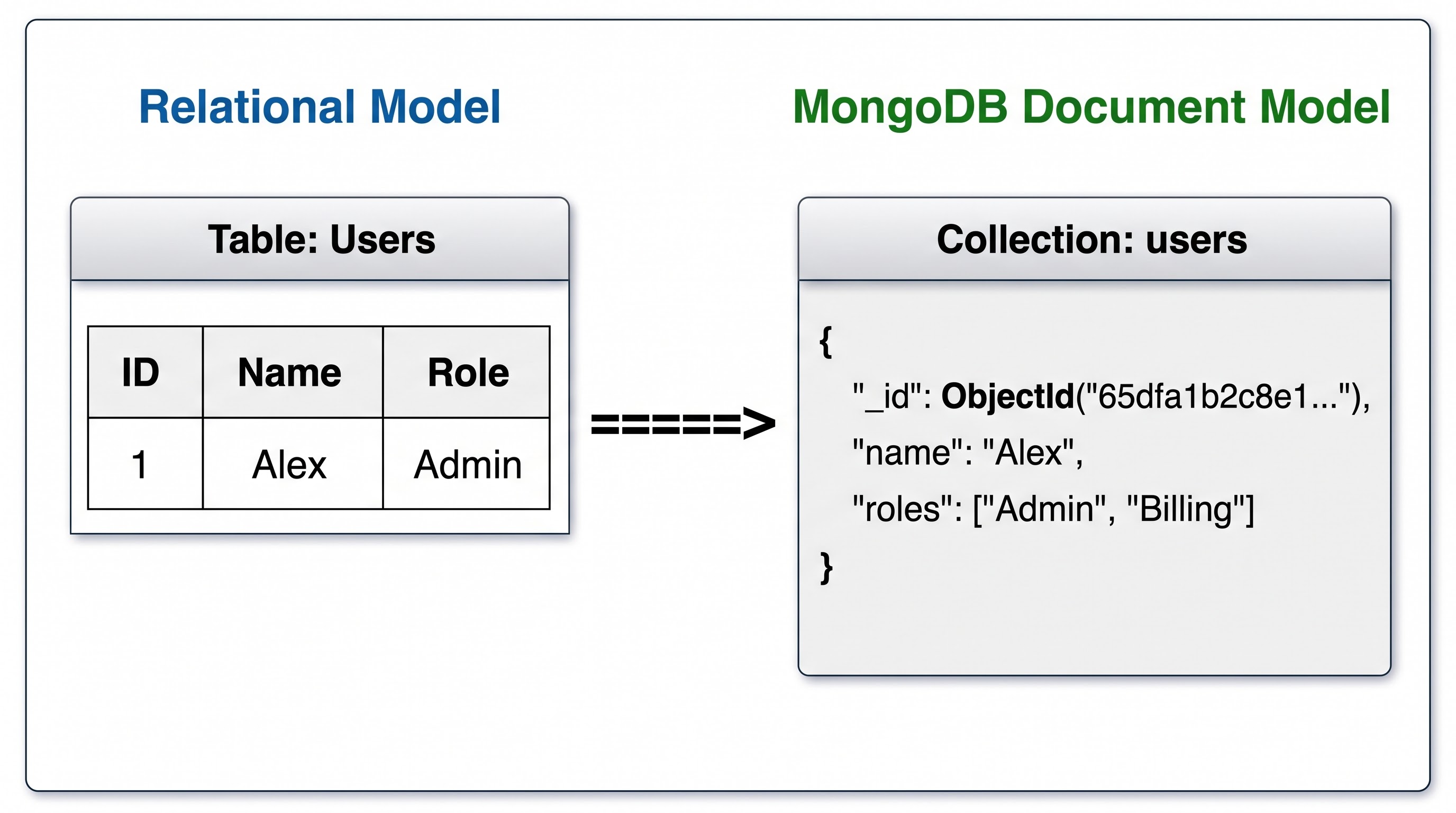
MongoDB organizes data into documents grouped within collections, replacing the traditional table-and-row format. While developers interact with data using standard JSON syntax, the underlying engine converts and stores all information as BSON (Binary JSON). This binary format extends standard JSON capabilities by adding native support for specialized data types—such as high-precision decimals, 64-bit integers, raw binary objects, and 12-byte unique ObjectIds—while optimizing storage layout for rapid machine parsing. Because BSON explicitly encodes data types and element lengths within the payload, database query processors scan and locate individual fields without reading through entire document strings.
The primary operational advantage of this document model is its dynamic schema design. Unlike relational engines that enforce strict structure across every row, MongoDB allows
Strategic Data Modeling and Storage Efficiency
Designing efficient schemas in MongoDB requires shifting focus away from relational Third Normal Form normalization toward matching the specific read and write patterns of the host application. Database architects face a primary modeling choice: embedding child data directly within a parent document versus referencing records across separate collections. Embedding consolidates related data into a single contiguously stored BSON document, enabling the database engine to retrieve complete data structures through a single disk I/O operation. This pattern delivers optimal performance for one-to-few relationships and frequently co-accessed datasets, though architects must manage growth to avoid exceeding the engine's hard 16-megabyte document limit.
Referencing, conversely, mimics traditional relational foreign keys by storing identifier pointers across collections. This pattern prevents data duplication and keeps parent documents small when handling unbounded arrays or complex many-to-many relationships. Advanced MongoDB data modeling combines these concepts through established patterns, such as the Bucket Pattern for organizing time-series data or the Subset Pattern for caching frequently viewed array data inside parent documents while offloading secondary details. By tailoring data structures directly to application access paths, developers eliminate unnecessary computational joins and maximize system memory efficiency.
Memory Architecture and WiredTiger Engine Mechanics
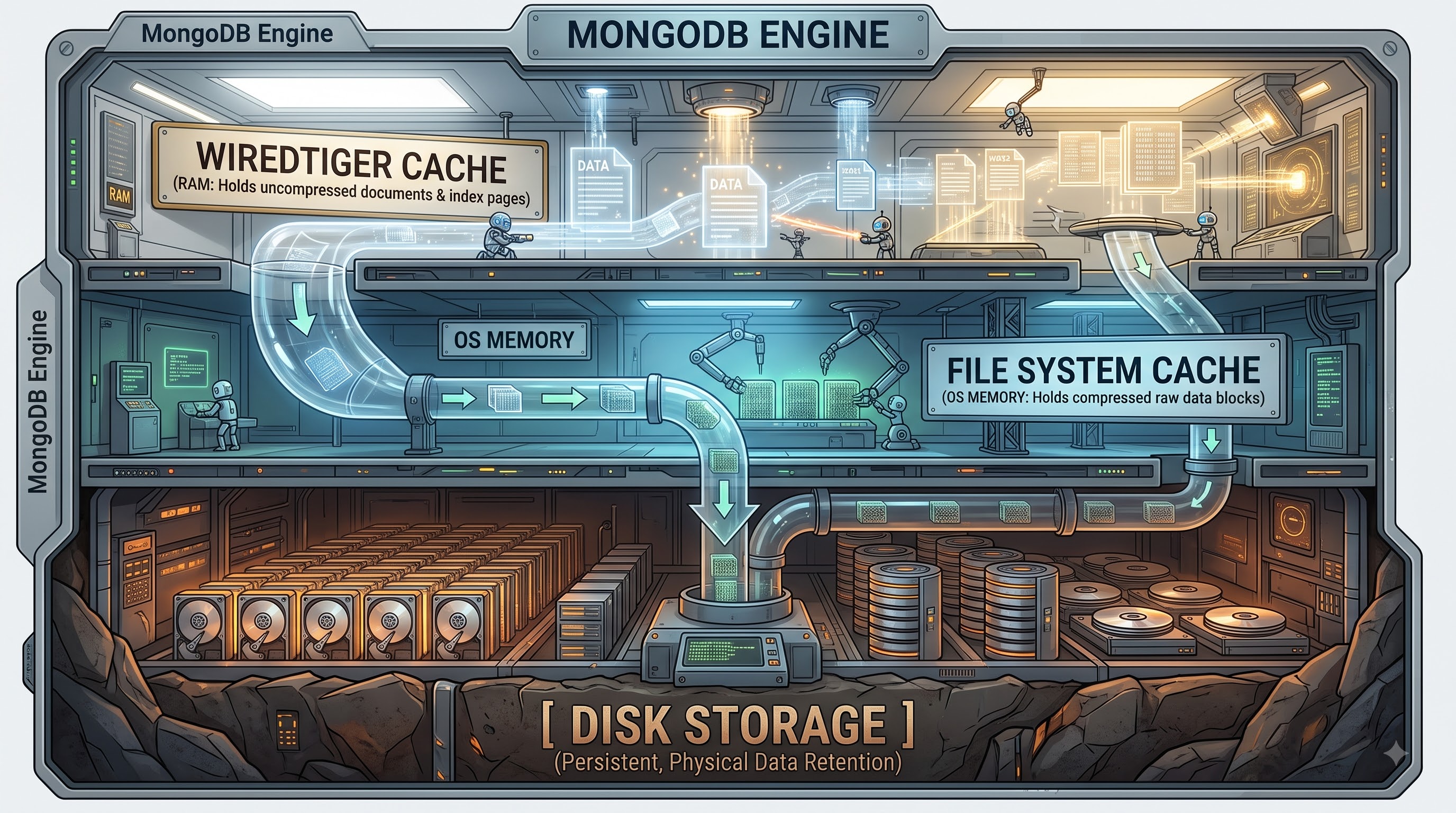
The operational performance of a MongoDB deployment depends heavily on its core storage engine, WiredTiger. WiredTiger manages memory allocation, disk I/O, concurrency, and data compression. By default, the engine reserves approximately half of available system RAM for its uncompressed internal cache, keeping active BSON documents and B-Tree index pages readily available for rapid execution. Raw storage space is further optimized on disk through transparent Snappy or Zlib block compression, significantly reducing physical storage footprints and minimizing disk bandwith saturation during large data scans.
Concurrently processing thousands of operations without performance degradation requires advanced locking mechanisms. WiredTiger utilizes strict document-level concurrency control, allowing simultaneous write operations to different documents within the same collection. To maintain absolute data integrity across unexpected server crashes, the engine uses an internal write-ahead journal alongside scheduled system checkpoints. Operations write to an in-memory journal buffer that commits to persistent disk every 100 milliseconds, while full database checkpoints flush modified memory pages to disk at regular intervals, ensuring clear recovery points.
Index Engineering and Query Path Optimization
Querying large datasets efficiently without overloading hardware requires well-designed index strategies. Without an index, MongoDB executes a full collection scan, inspecting every document sequentially to fulfill a request. By constructing B-Tree indexes over target fields, the database engine narrows query execution down to precise index key lookups. Engineers build specialized indexes to match query demands, including compound indexes covering multiple parameters, multikey indexes automatically indexing individual array elements, geospatial indexes for spatial coordinates, and TTL (Time-To-Live) indexes for automated data expiration.
Maximizing compound index performance requires strict adherence to the ESR (Equality, Sort, Range) ordering standard. Index keys must be defined starting with fields evaluated for exact equality, followed by fields used to sort the output, and ending with fields filtered over numeric or temporal ranges. Structuring indexes in this precise sequence allows MongoDB to evaluate exact conditions, return pre-sorted keys directly from the index tree, and apply range boundaries without performing memory-intensive in-memory sorting operations. Engineers continuously evaluate index effectiveness by analyzing query execution plans to ensure key-to-document examination ratios remain highly performant.
High Availability via Replica Set Topology
Enterprise deployments demand continuous uptime and data redundancy, which MongoDB delivers natively through Replica Sets. A replica set is an interconnected cluster of nodes running identical database instances. Exactly one node acts as the Primary, receiving all incoming write operations and logging every data modification to its internal operations log (oplog). Secondary nodes continuously monitor and stream this oplog, applying the incoming operations to their local datasets asynchronously to maintain identical state across the cluster topology.
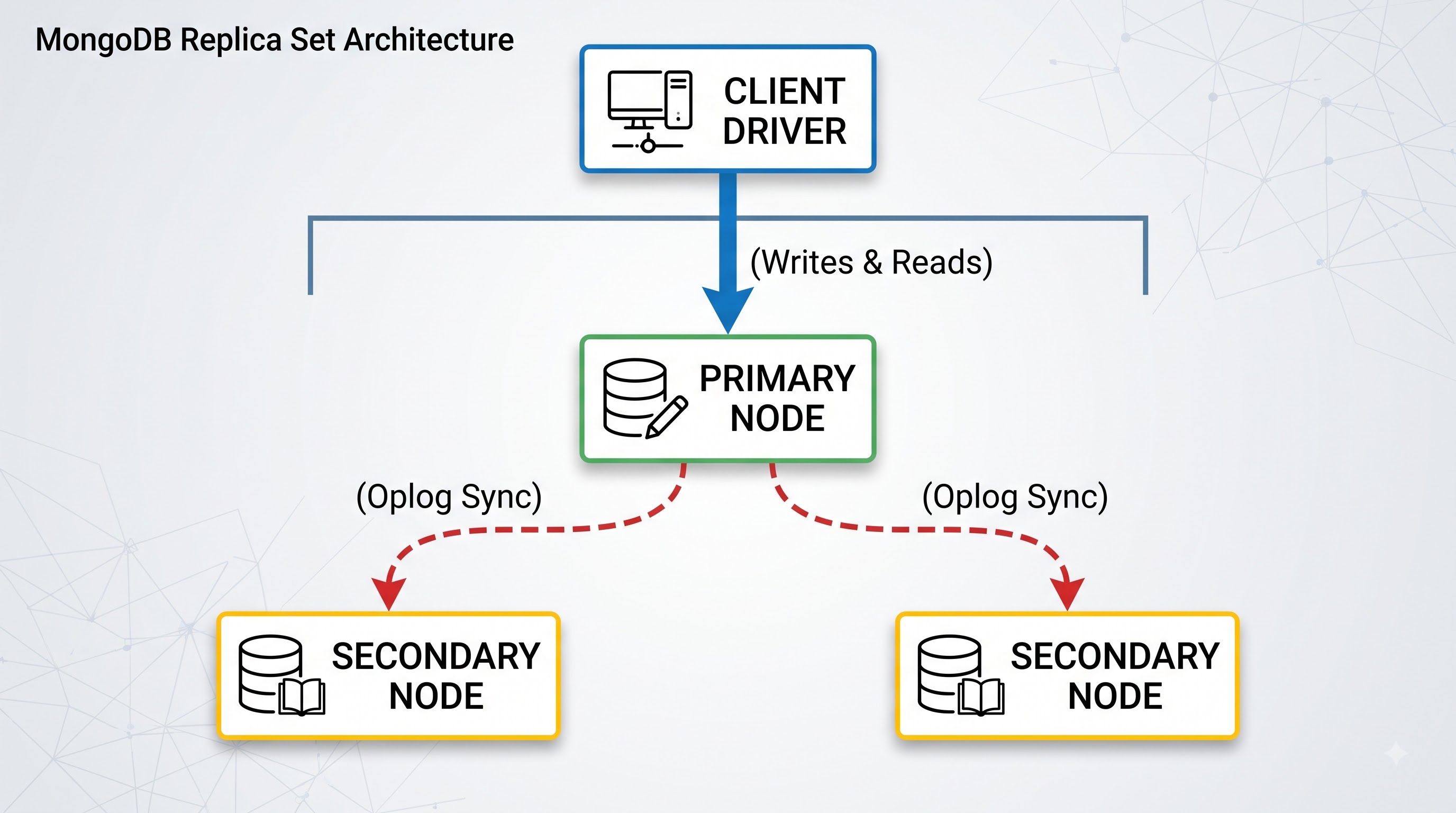
If a Primary node experiences hardware failure, network isolation, or becomes unresponsive, the remaining Secondary nodes trigger an automated consensus election. Within seconds, a eligible Secondary is promoted to Primary without manual administrative intervention, keeping application disruptions to a minimum. Developers configure operational consistency by declaring explicit Write Concerns and Read Concerns. Setting a write concern to require majority node acknowledgment guarantees that data is durably stored across multiple physical locations before returning a success signal, protecting critical data against rollbacks during failover events.
Horizontal Scaling and Cluster Sharding
When a database grows beyond the CPU, memory, or disk boundaries of a single server node, MongoDB scales horizontally through a cluster architecture known as Sharding. Sharding distributes large collections across multiple distinct replica sets, called shards, ensuring no individual machine bears the full load of database storage or query processing. Central to this architecture are mongos query routers, which act as stateless interfaces for incoming traffic. Routers consult centralized Config Servers to determine exact data locations and route operations directly to the appropriate target shard.
Data distribution across a sharded cluster is determined by a selected Shard Key. Choosing an effective shard key requires analyzing application query patterns to prevent uneven data distribution and write bottlenecks. Ranged sharding organizes data based on contiguous value ranges, which optimizes range-based reads but risks creating write hotspots when paired with monotonically increasing values. Hashed sharding uses an internal hash algorithm to scatter incoming writes evenly across all available shards, maintaining balanced resource utilization across the global cluster footprint.
Multi-Document ACID Transactions and Enterprise Security
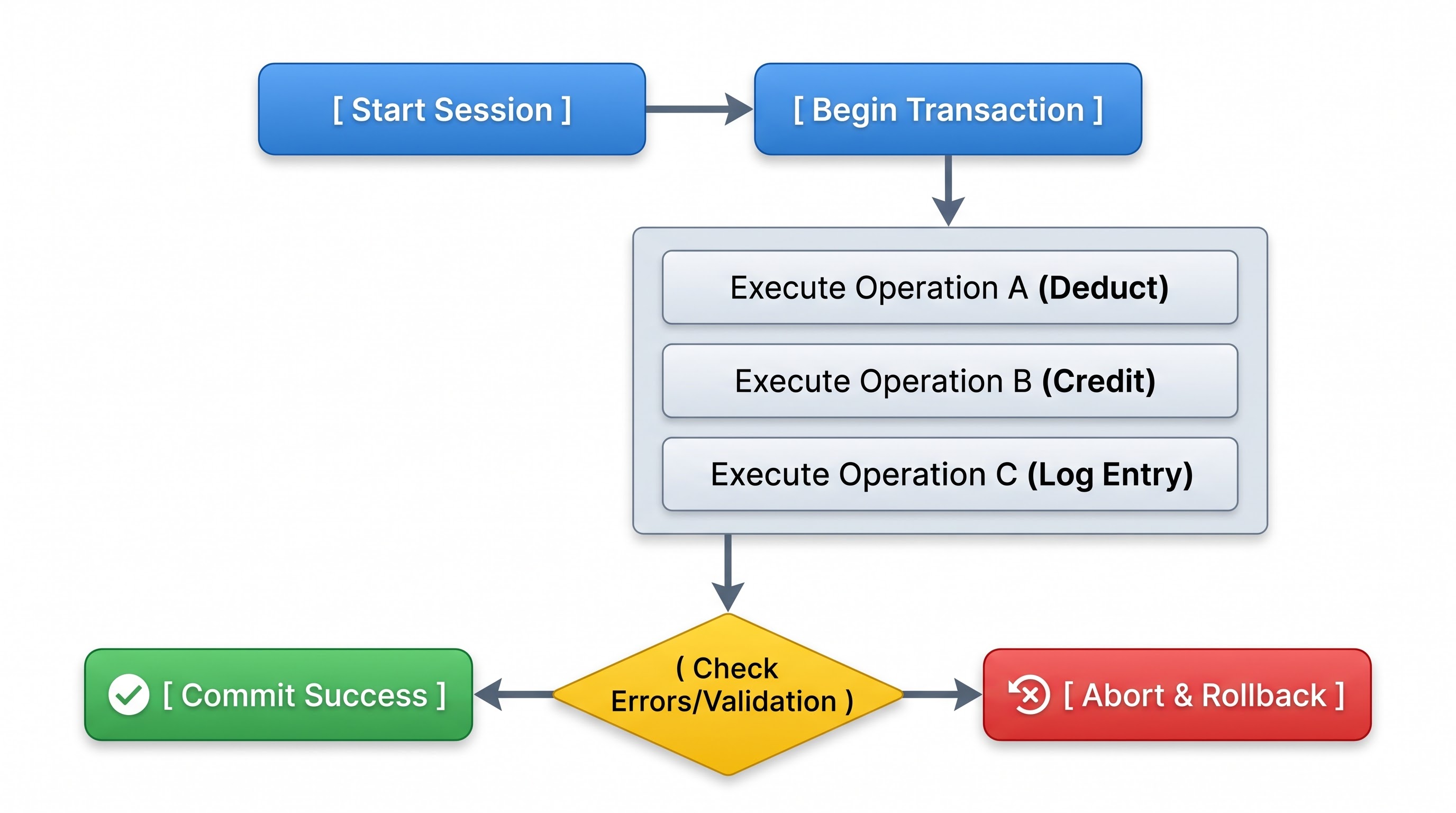
While single-document modifications in MongoDB are inherently atomic, complex transactional workflows—such as financial account transfers or multi-inventory updates—require strict multi-document ACID compliance. MongoDB supports distributed ACID transactions across single replica sets and sharded clusters. Utilizing WiredTiger's internal multi-version concurrency control (MVCC), transactions execute within snapshot isolation boundaries. Operations within an active session read from a consistent snapshot of the data, ensuring that uncommitted writes remain isolated until the transaction explicitly commits across a majority of nodes.
Enterprise database security requires defense-in-depth measures across network, access, and storage layers. MongoDB protects sensitive data through Role-Based Access Control (RBAC), restricting administrative privileges to verified identities authenticated via SCRAM, x.509 certificates, or centralized LDAP services. All network traffic between application drivers and database nodes is protected using TLS encryption, while stored data is encrypted at rest using enterprise key management. Through specialized client-side encryption mechanisms, sensitive fields can be encrypted before leaving the client application, ensuring that confidential information remains fully protected throughout its operational lifecycle.
For developers and system architects aiming to master these underlying distributed systems, enrolling in a dedicated mongodb course provides the structured technical framework needed to manage enterprise clusters and optimize complex database workloads effectively.
Native Vector Search and Generative AI Integration
Modern software architectures increasingly rely on artificial intelligence and Large Language Models (LLMs) to power semantic search, recommendation engines, and context-aware agents. Historically, organizations maintained separate database stacks—an operational database for application data and a dedicated vector database for high-dimensional vector embeddings. MongoDB unifies these architectures by integrating native Vector Search capabilities directly into the operational database environment. Vector embeddings generated by machine learning models are stored directly inside standard BSON documents alongside traditional operational fields.
By leveraging Hierarchical Navigable Small World (HNSW) indexing graphs, MongoDB executes vector similarity searches within the native aggregation pipeline. This single-stage execution allows applications to perform hybrid queries—combining semantic similarity matching with strict operational metadata filters (such as user permissions, categories, or price ranges) in a single request. Unifying operational data with vector storage eliminates complex real-time ETL pipelines between databases, reduces system architecture complexity, and provides low-latency context retrieval for Retrieval-Augmented Generation (RAG) applications. Engineers looking to gain practical experience building AI-driven document architectures often explore practical mongodb classes to learn vector indexing best practices and pipeline optimization techniques.
Real-Time Stream Processing and Change Streams
To support modern event-driven architectures, databases must react dynamically to data changes as they occur rather than relying on inefficient periodic polling. MongoDB provides native event-streaming capabilities through Change Streams, allowing applications to subscribe to real-time data modifications across individual collections, entire databases, or complete sharded clusters. Change Streams utilize the underlying replica set operations log (oplog) to emit structured BSON change notifications whenever documents are inserted, updated, replaced, or deleted.
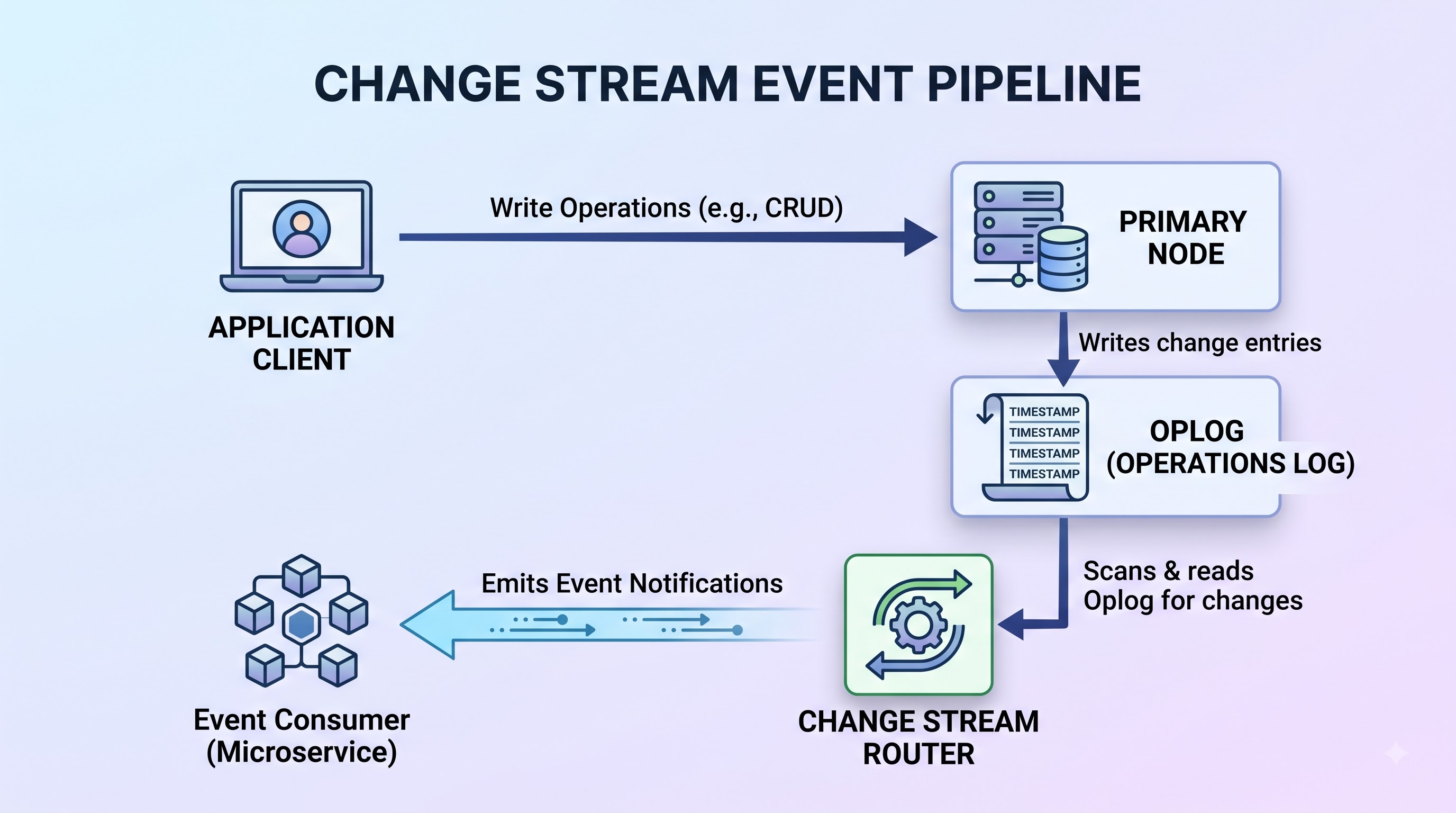
Applications can filter and transform these change notifications in real time by passing aggregation pipeline stages directly into the stream listener. This allows microservices to trigger downstream workflows—such as invalidating application caches, dispatching notification webhooks, or syncing analytics platforms—only when specific fields or conditions are met. Because Change Streams inherit the durability and high availability of MongoDB’s underlying architecture, event delivery remains resilient against node failovers. Mastering real-time data processing and change stream integration is a core component of comprehensive mongodb training, equipping developers to design responsive, decoupled microservice systems.