
Modern Software Architecture: APIs vs ETL
Last updated on Oct 6, 2026
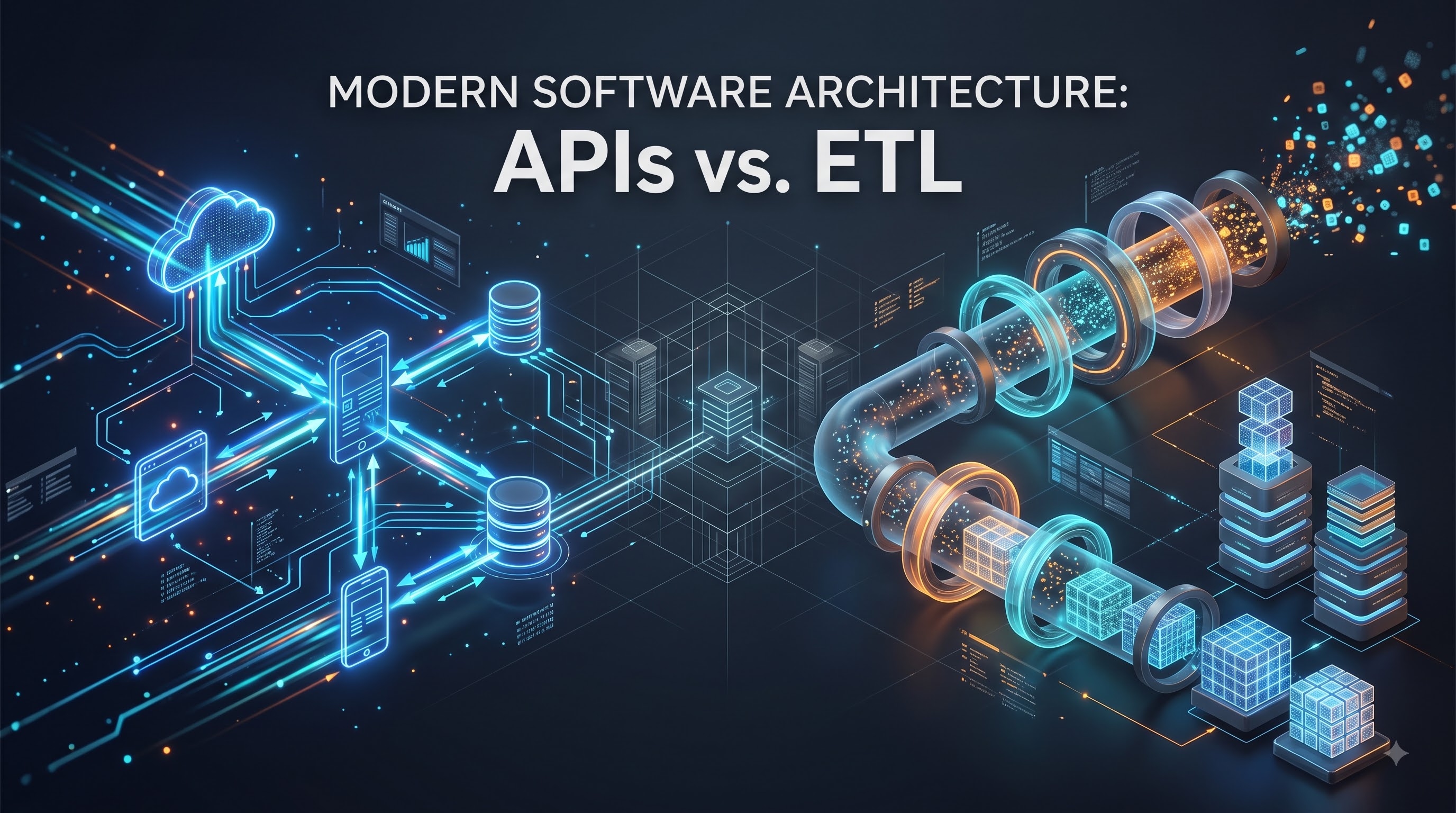
The Real Question Is Not API or ETL
Modern software systems rarely work as applications. A typical business may have a customer relationship platform, an e-commerce website, a payment system, an HR platform, a data warehouse, mobile applications, analytics tools and several internal databases running at the time. All of these systems need to exchange information. They do not always need to exchange it in this way. This is where software architecture becomes important. One of the common decisions architects and developers face is whether information should move through APIs or through ETL processes. At first the difference may appear simple. APIs are generally associated with real-time communication while ETL is associated with moving and transforming data in batches. In projects however the decision is more complicated because it depends on timing, data volume, system requirements, reliability, security and how the information will ultimately be used.
The growth of cloud applications has made this decision more important. Businesses now use applications more than ever. These applications often come from different vendors. A company might store customer information in one system, orders in another payments and reporting data in a centralized warehouse. Connecting these systems is not simply a matter of making data available. The architecture must determine when the data should move, which system should control it how changes should be handled and what should happen when something fails.. Etl solve parts of this problem. Understanding that difference helps organizations avoid building integrations that work technically but create problems later.
Understanding Modern Software Architecture
Software architecture is essentially the way the major parts of a software system are organized and connected. It defines how applications communicate, where information is stored, how services depend on each other and how the system behaves when traffic increases or something goes wrong. Good architecture is not about choosing technologies. It is about making decisions that match the needs of the business.
In environments, applications were often built around a few systems. Data could remain inside a database and integration was sometimes handled through direct database connections or scheduled file transfers. Modern environments are different. Applications are frequently distributed across cloud platforms, private infrastructure, SaaS products, mobile applications, and external services. This creates a network of systems that must communicate without becoming tightly dependent on each other.
This is why integration has become more than just a development task. When one system changes, the effect on systems needs to be controlled. When thousands of transactions arrive at once, the architecture needs to remain stable. When information is delayed, the business needs to understand whether that delay matters. APIs and ETL are two approaches for managing these requirements. They operate according to different principles.
What Is an API?
An API, or Application Programming Interface mulesoft online training provides a defined way for one software application to communicate with another. By requiring one application to understand the structure of another application, the API exposes specific operations or information that other systems can use.
For example, imagine a shopping application that needs to display a customer’s current order status. By accessing the internal database of the order management system, the shopping application can request the information through an API. The order system receives the request and processes it. Returns the information. The important point is that an API usually supports communication between applications at the moment it is needed. A request can be made, processed, and answered within seconds or even less depending on the architecture. This makes APIs especially useful for customer-facing applications, mobile apps, payment systems, authentication services and other situations where current information is important.
APIs also create a layer of separation between systems. The application requesting information does not necessarily need to know how the other system stores its data internally. This abstraction makes systems easier to evolve because internal implementation details can change without breaking every application.
Why APIs Matter in Modern Applications
APIs have become central to application development because businesses increasingly depend on specialized systems. By building every capability internally, organizations can connect services that already provide functions. A payment provider can handle payments, a messaging service can handle notifications and a customer management platform can maintain customer records.
APIs allow these connections to happen in a controlled manner. APIs can determine which information is available, which people can access it and which operations are allowed. Authentication and authorization mechanisms can limit access while monitoring and logging help organizations see how APIs are being used.
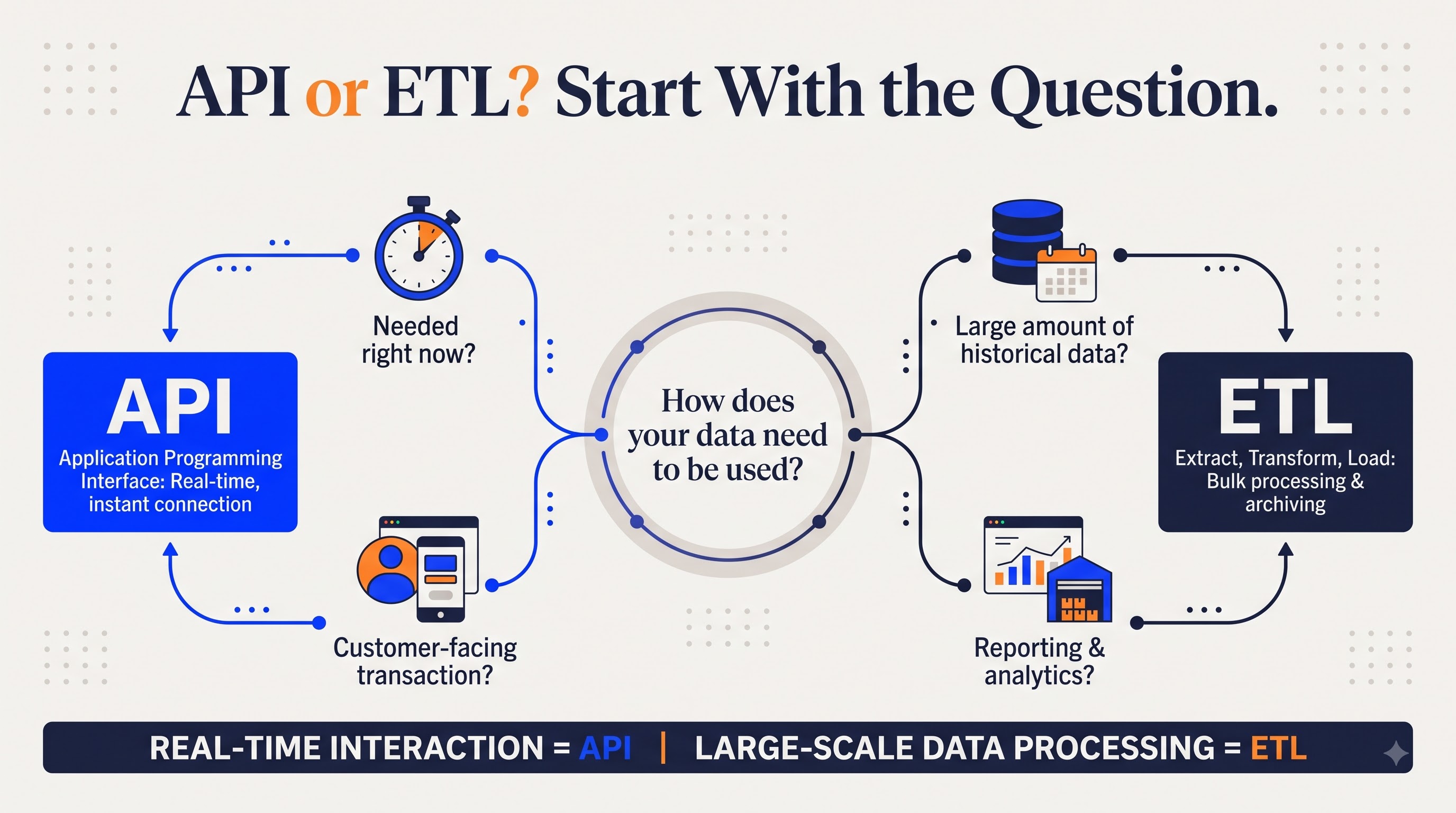
Another big benefit is that APIs can support real‑time workflows. Think of a travel booking app. When a customer picks a flight the app may need to check seat availability. Waiting for a data transfer would not work because availability can change each minute. The API can ask for the information from the system and give the result while the customer remains on the booking page. This does not mean every API interaction must happen instantly. Some APIs can start processes, where a request begins an operation and the final result comes later. Still APIs are usually built for application‑to‑application interaction of moving amounts of historical data.
What Is ETL?
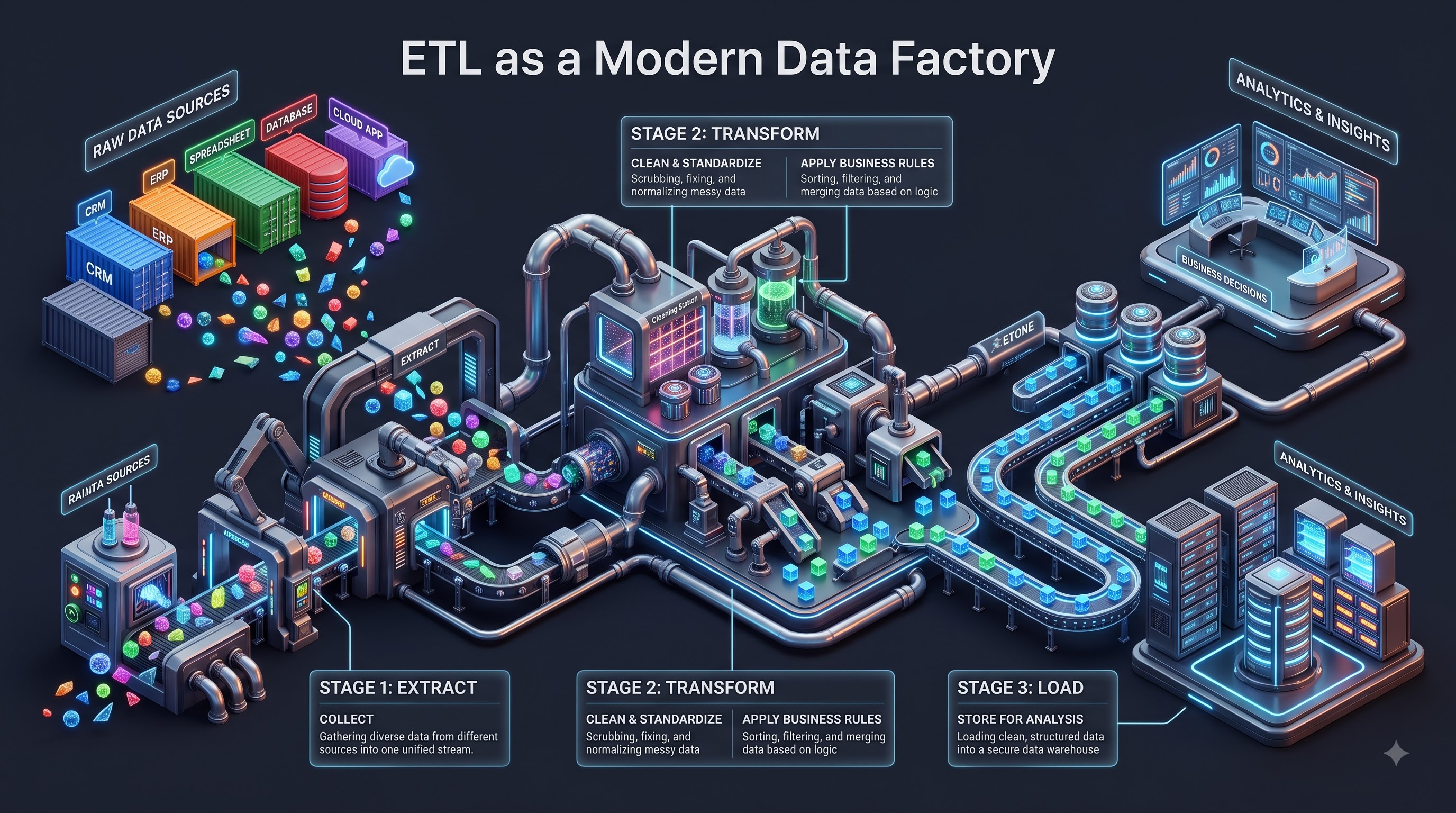
ETL means Extract, Transform, Load. ETL is a process that takes data from one or more sources, turns that data into a structure and puts it into a destination system.
The extraction stage gathers information from sources such as databases, applications, files, or other systems. The transformation stage gets that information ready for its purpose. Data may need to be cleaned, made consistent, filtered, combined, calculated, or converted into another format. Finally, the processed information is loaded into a destination such as a data warehouse or analytical database.
The main purpose of ETL is usually not to answer an application request. Instead, ETL is often used to prepare amounts of data for reporting, analytics, business intelligence, historical analysis or central data management. Imagine a company that has customer data spread across five applications. Each system may use formats for names, addresses, dates or customer identifiers. The ETL process can gather information from these systems, make the values consistent, combine related records and put the result into an environment. This makes ETL especially useful when the organization needs to understand amounts of data instead of just retrieving one current record.
APIs vs. ETL: The Fundamental Difference
The way to see the difference is to look at the question each approach is designed to answer.
An API often answers: Can I talk to this system and get or send information now?
ETL often answers: Can I gather information from sources, prepare it and move it somewhere so it can be analyzed or used later?
This distinction is more helpful than saying APIs are modern and ETL is old. Both approaches remain relevant because they solve problems. Suppose a bank's mobile app needs to show a customer's account balance. A real‑time API is a choice because the app needs information when the customer opens the account screen. Now think about the bank's analytics department. It may need five years of transaction data from millions of accounts to spot spending patterns. Moving that dataset through individual API requests would be inefficient. A large‑scale data pipeline or ETL process would be more suitable. The architecture should therefore be based on the purpose of data movement of the popularity of a technology.
When APIs Are the Better Choice
APIs are usually a choice when applications need to talk to each other and when information must be available right when it is requested. Customer‑facing applications are an example. If a customer places an order, the website may need to talk to inventory, payment, shipping, and notification services. APIs are also useful when a system needs to expose business capabilities. By giving another application access to internal databases, an organization can expose controlled operations through APIs. This approach can improve security. Reduce coupling.
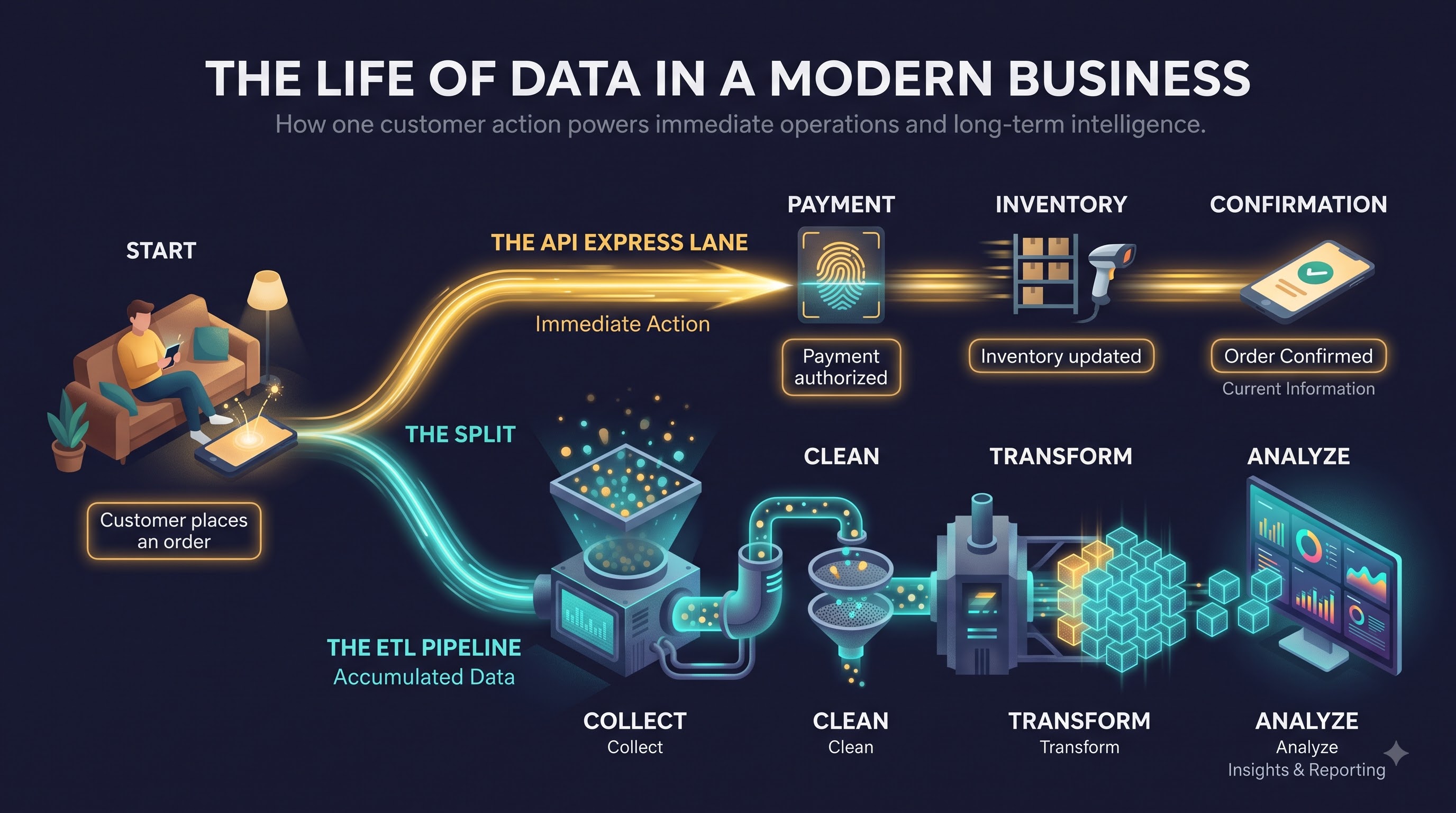
Another advantage shows up when the amount of information per interaction is small. An app may need a customer's profile, an order status or a product price. Sending the needed information is usually more efficient than sending entire datasets. APIs are also useful when different applications need access to the capability. A company may have a website, app, partner portal, and internal app that all need customer information. A well‑designed API can provide an interface while letting each app use the information in its own way.
However, APIs should not always be seen as the solution to every integration problem. A design that creates thousands of API calls for datasets can become expensive, slow, and difficult to maintain.
When ETL Is the Better Choice
ETL becomes particularly useful when the goal is data consolidation, analytics, reporting or large-scale transformation. Organizations often have data distributed across systems that were designed for business functions. Bringing this information together requires more than connecting applications. For example a company may want to compare sales performance with marketing spending, customer retention and support activity. The required information could exist across platforms. An ETL process can collect the data, transform it into structures and load it into an environment designed for analysis. ETL is also useful when historical information matters. Analytical systems often need snapshots or records of how data looked at a point in time. Operational APIs are generally designed around application needs while ETL pipelines can be designed to preserve and process datasets.
Large data volumes are another factor. If an organization needs to process millions of records, moving each record through API requests may create unnecessary overhead. Batch-oriented processing can handle datasets efficiently. This is one reason ETL remains important in organizations that have adopted native architecture. The technology used to implement the pipeline may have changed. The underlying requirement for extracting, transforming and loading data has not disappeared.
The Role of Transformation in Integration
One of the differences between API communication and ETL is the role of transformation. Data rarely arrives in a consistent format. Imagine two systems that store information about customers. One system might use "first_name" and "last_name," while another might store the name in a field. One system might show dates in one way while another uses a different way. One system might use customer IDs, while another identifies customers by email address.
If these systems need to work, the information may need to be changed. APIs can definitely do changes when an integration layer is between systems. However, ETL processes are made for preparing data a lot. Changes can include fixing repeated records, changing types of data, making values, joining data sets, removing parts of data, calculating new pieces of data and using business rules. In analytics places these steps are often needed because bad data can make results wrong.
The question about the way things are built is not just if changes are needed. It is how many changes are needed, where they should happen and if they should happen away or as part of a bigger data plan.
Real-Time Integration vs. Batch Processing
Time is one of the things to think about when comparing APIs and ETL. Real-time integration is important when waiting could affect the person using the system or the business decision. Payment approval, account checking, inventory checks, access, and tracking orders in time are examples where up-to-date info might be needed. Batch processing works differently. Handling each change right away, data is gathered and then handled at specific times or in big groups. A company might process sales data every hour or once a day depending on what they need for reports.
Not every business task needs up-to-date data. If a finance team only needs a sales report, making a complicated real-time integration may cost more and be harder to handle without giving benefits. This is a lesson: real-time does not always mean better. Real-time systems often need handling of problems trying again, being able to grow, monitoring, and being consistent. If the business can work with some delay, batch processing may be easier and more trustworthy.
Where MuleSoft Fits Into the Picture
Integration platforms help companies handle the trouble of connecting programs, APIs, data sources and business tasks. MuleSoft is one example of a platform that can be used to build and manage these connections. By treating every connection as a separate custom task, companies can make connections that can be used again and create consistent ways to talk to each other. This becomes useful as the number of systems grows. Connecting two programs might be simple. Connecting twenty or fifty systems can quickly become hard if every program talks directly to every program. A better way to connect can make this easier by creating ways to talk and controlled ways to share.
For people starting in integration, learning how these ways of building work is more important than remembering details about the platform. A mulesoft course can help people learn about things like API-led connectivity integration steps, changes in security and how to talk between programs while also showing how different systems fit together.
API-Led Connectivity and the Modern Integration Approach
One idea in integration is API-led connectivity. By making a separate way to connect every program, companies can design APIs around things that can be used again.
For example customer details can be shared through a service than making a new way to get customer data for every program. Different places can then use the service based on what they need.
This way can make the system easier to handle because the way to connect is around the service. This way also encourages using the things again. If another program needs the customer service there may not need a new way to connect. The idea is not to stop using ETL. API-led connectivity and ETL can both be part of the system. APIs can help programs talk to each other while data paths can move data to analysis places. The two ways can help each other when the work each does is clear.
Why Point-to-Point Integration Becomes a Problem
Point-to-point integration happens when programs are directly linked. At first this may seem easy. If Program A needs data from Program B developers make a link. The problem comes as the number of systems grows. With systems the number of links can go up fast. Each link might have ways to be sure who is using it, different ways to change the data, different ways to handle errors, different ways to explain what it does and different ways to keep it working.
A change in one program can then affect programs. Developers may need to understand the links before they can safely change a program. Centralized ways to connect, using the services and well-designed data paths can make this easier. The goal is not to remove every link but to stop the way things are connected from becoming a group of dependencies.
Data Quality: The Problem Behind Many Integration Failures
Technology is often blamed when an integration fails. Data quality is usually the issue. Two systems might work together but exchange data that is missing, not the same or wrong. Think about a customer who's in the company's systems three times because their name was written differently in different places. An API can get all three records. An ETL process can move them into a data store. Neither way decides which record is the one.
Data rules and ways to check the quality need to be part of the way things are built. Companies should say who is in charge of data, what checks to do, what ways to identify the data, what ways to write it and what steps to take to fix it. This is especially important when APIs and ETL are used together. Real-time systems might need up to date data while analysis systems need old data. If the data is not good both places can have results.
Security Considerations
Security needs to be thought about no matter if a company uses APIs ETL or both. APIs need rules about who can use them, what they can do, how to keep data safe, how to stop many requests, what to check when data comes in and how to keep track of what happens. Public APIs need care because they might be used by many people and some might try to do bad things. ETL processes also handle data so they need rules. Data may move between systems places and analysis tools. Who can see it, how to keep it safe, how to manage passwords and checking what happened are all important along the way.
Where the data also matters. A company should know where sensitive data is when it is being taken and changed and who can see it. Security can't just be added at the end. It needs to be part of the way the data moves.
Performance and Scalability
How fast something works can greatly affect the choice. APIs are usually built for things or quick interactions while ETL processes are made for large amounts of data. An API can grow by adding copies of the program using caching load balancing or other ways to handle more work.. Even well built APIs can become a problem when there is more traffic.
ETL processes have a challenge. They might need to handle millions or billions of pieces of data in a time. How to get data quickly, how to process it at the time, how to split it up, how to change it and how fast the place where it goes can all be important. Neither way is automatically better at growing. How the system is. What it has to deal with will decide how well it can grow.
The Growing Importance of Integration Skills
I have noticed that as companies use cloud programs, the need for people who can connect them is increasing. People are expected to know how the programs talk to each other, not how the programs work on their own.
That is why integration knowledge covers areas: APIs, databases, data changes, authentication, cloud tools, message monitoring and how to design the way things are built. Someone working in this area needs to know why a certain way to connect is right of just knowing how to set up a way to connect. For people learning and working in this area, training can help when the goal is to get knowledge about connecting programs and using APIs. The bigger lesson is that the tools are just part of the skill. People who are good at integration understand what the business needs first. Then they choose the way to do it.
Can ETL Work Together?: Sure. In the ways of building things the best answer is not to pick one and ignore the other. I have seen that APIs and ETL can do jobs in the place. A program might share data through APIs. That data can then be collected by a data path. Changed for analysis. At the time an analysis system might make insights that are then shared with working programs through APIs.
For example an online shop might use APIs to process customer orders and talk to inventory and payment systems. At the time a data path might collect order history, customer habits marketing data and product work for analysis. This way the working programs can stay focused on doing business while the analysis parts handle amounts of history. The best ways of building things see APIs and ETL as tools with their jobs instead of as competitors fighting for the same place.
How to Choose Between APIs and ETL
I always ask: Does the place that gets the data need it now or can it wait? If the answer is now an API or another way to connect in real time may be right. If the data can be handled ETL or another way that uses batches may be better.
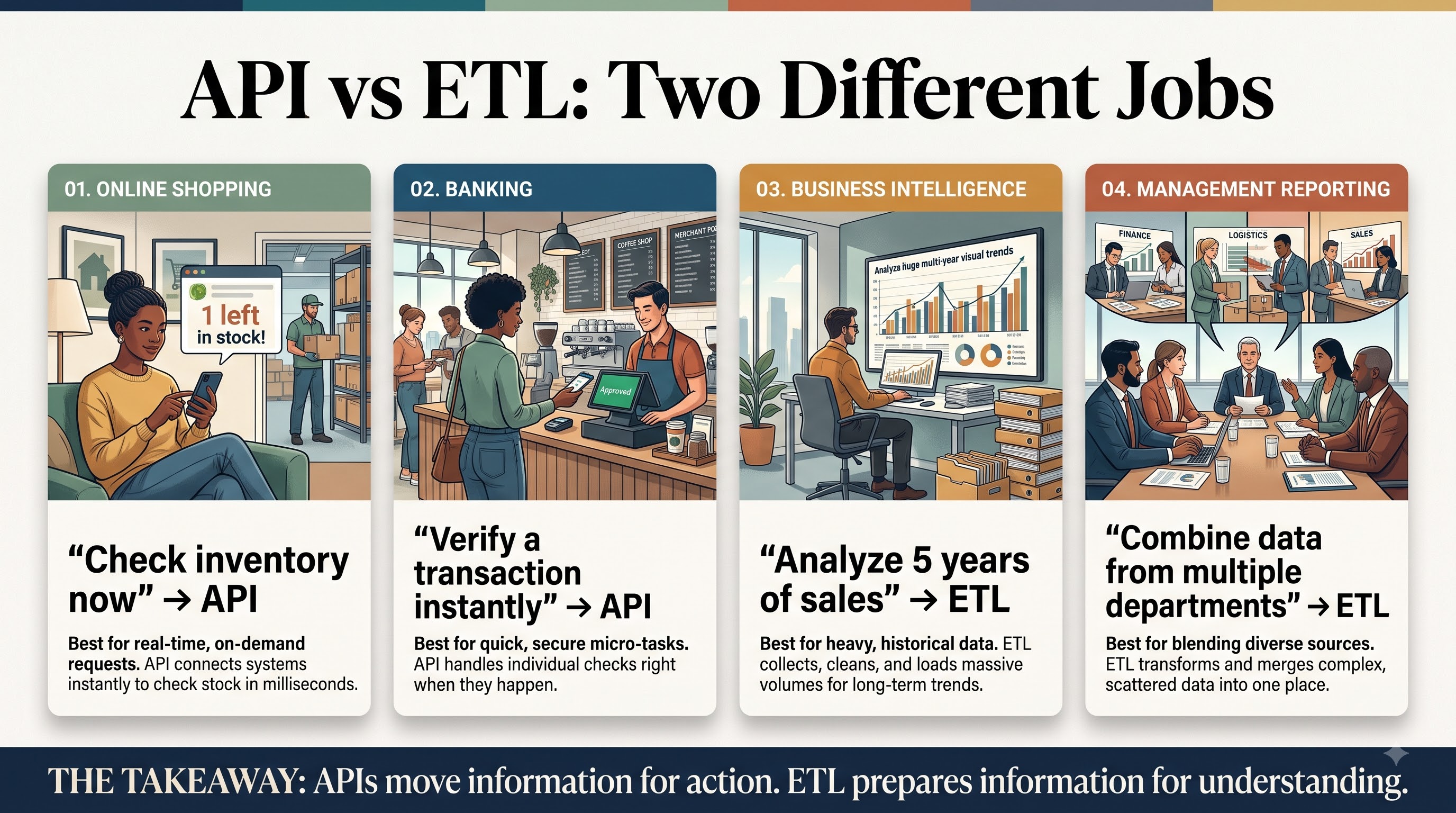
I notice that small and focused exchanges are often right for APIs. Large historical data is often better handled by a data path. If the data needs cleaning, joining, standardizing, or looking back, a data path may be better. If only a small change is needed during a program interaction, an API connection may be enough. Finally, architects should think about how reliable it is, how safe it is, how much it costs, how easy it is to keep going, how well it can grow, and who is in charge. A solution that works in one way may be hard to keep going when the company grows. The way things are built should be checked based on what the systems need, not just what they do today.
Why Learning the Difference Matters
Knowing about APIs and ETL is helpful for people who do not build connections directly. Programmers, data workers, business analysts, architects, and tech leaders often have situations where data needs to move between programs. Knowing the difference helps people ask the questions. Instead of just asking which tool to use, they can ask what the data is, for how it is needed, how much data is involved, how it should be changed, and what happens if the connection fails. Those questions lead to the way things are built. mulesoft online training can be a way to learn about integration concepts, API architecture, and platform-based approaches while getting to know the words used in today's software environments.. Real understanding comes from applying these ideas to business problems instead of looking at the technology as a set of separate features.
The Future of Modern Software Architecture
The future of software architecture will probably not be one way to integrate. Companies are going towards places where APIs, event-driven systems, streaming platforms, data pipelines, cloud services and AI applications all work together. Real-time systems will still need APIs and event-based communication. Analytical systems will still need data pipelines. AI applications will need access to both real-time business information and big sets of data.
This means that integration architecture will become more important. I see that companies will need systems that can talk to each other quickly without getting stuck together and data platforms that can handle a lot of information without losing quality or security. I think the job of architects and integration professionals will change from connecting systems to creating information flows across a more spread-out technology world.
Choose the Pattern, Not the Trend
I think the argument between APIs and ETL should not be seen as a fight where one technology has to take the place of the other. APIs and ETL both solve problems.
APIs are really helpful when applications need specific and often real-time communication. ETL is useful when companies need to gather, change, put together, and look at large amounts of data, especially old information. The real skill in architecture is knowing when each method is right. A customer ordering something may need an API-based process. A company looking at five years of orders may need a data pipeline. A modern company may need both working side by side. I believe the best architecture is not always the most high-tech one. The architecture fits the business need, handles the work that is expected, keeps the data safe, stays easy to manage, and can grow with the company.
I see that as software environments become more spread out, this difference becomes more important. APIs will keep connecting applications in time, while ETL and new data pipelines will keep turning scattered data into useful business knowledge. Learning how mulesoft training and these methods work together is one of the bases of software architecture.