
MongoDB Atlas in 2026: Why It’s Growing and Why Companies Are Going Cloud
Last updated on Sep 17, 2026
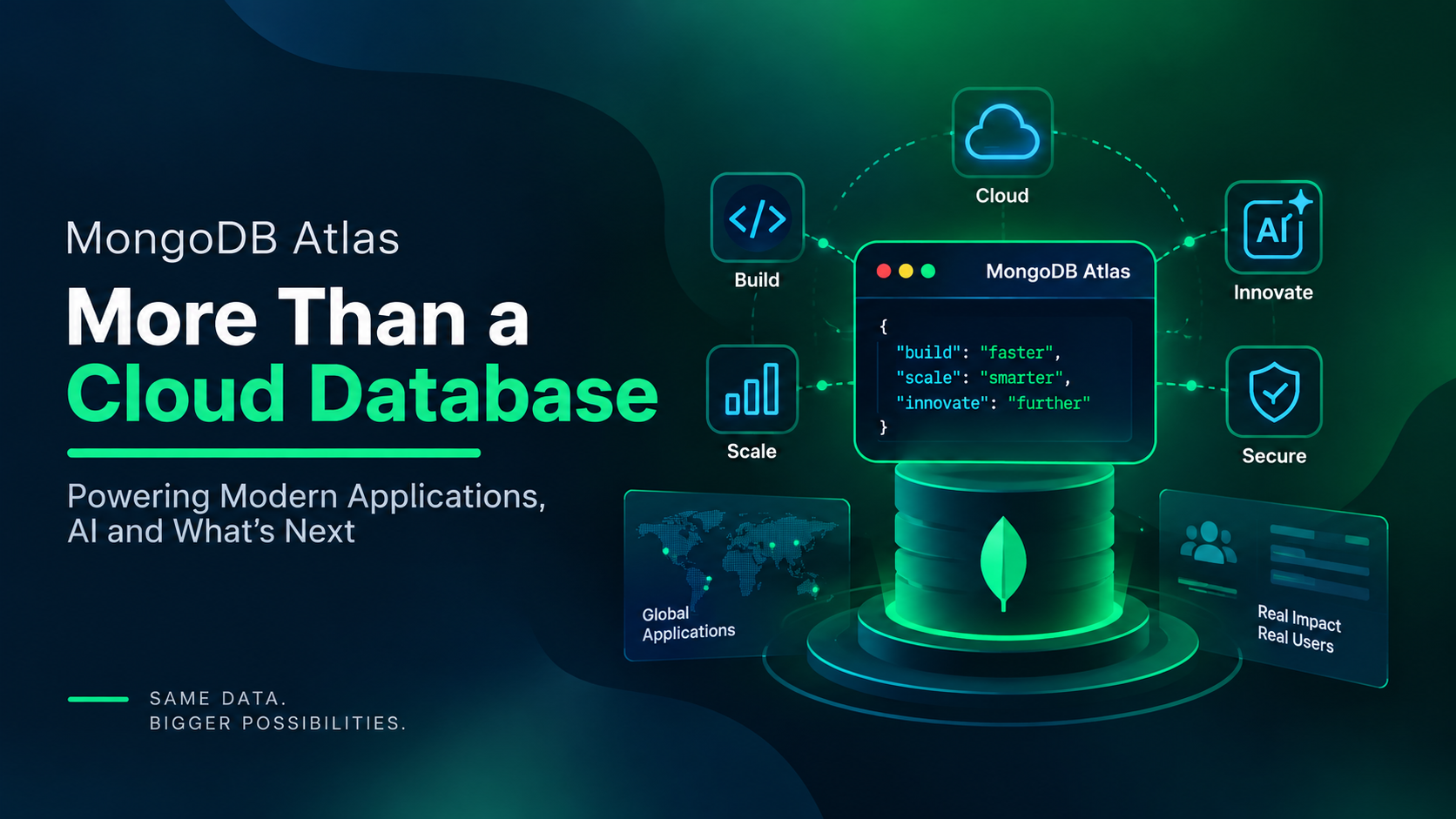
MongoDB Atlas Is Evolving Beyond Just a Cloud Database
The first thing that comes to mind when someone mentions MongoDB Atlas is a cloud database. This is true, but the problem is that it does not tell us why it has grown so much to become a significant part of MongoDB’s business. Atlas is not simply a means for hosting a MongoDB database in the cloud; it is part of the environment in which modern applications are developed, maintained, and scaled. This nuance is often overlooked by focusing only on Atlas as a database.
The way in which companies develop software is vastly changing. A few years ago, a developers’ team could focus on developing the application, the database connection, and the application’s server. Nowadays, the applications can be developed to serve users worldwide, communicate with multiple APIs, process real-time data, work with artificial intelligence, and scale instantly to accommodate a sudden increase in users. The database at the center of these operations is required to evolve.
This is where Atlas becomes useful. MongoDB manages much of the underlying database infrastructure through its cloud platform, so that development teams do not have to spend all their time dealing with servers and routine maintenance. The practical benefit is not that developers no longer need to think about databases. It's that they can spend more of their time solving application and business problems rather than continually managing infrastructure.
That sounds like a small distinction, but it matters when a company has dozens or even hundreds of applications. Every additional database environment can mean more configuration, monitoring, backups, updates, security considerations and operational work. A managed service can take some of that repetitive responsibility away and give teams a more consistent way to work.
Atlas also fits naturally into the development style used by many modern applications. MongoDB's document model gives developers flexibility in how application data is represented, while Atlas provides the cloud environment around it. This combination is one reason the platform has moved beyond being viewed simply as a hosted database.
There is another change happening at the same time. Businesses are no longer looking at databases only as places to store information, they increasingly expect them to participate in how applications search, analyze and use that information. AI is a major reason for this, and it's one of the areas where Atlas is attempting to extend its role.
So, when we talk about Atlas, the bigger story is not simply 'more companies are using MongoDB in the cloud'. It's about how the role of a database is changing as application development itself changes.
Why Businesses Are Moving Their Databases to Atlas
A company does not normally move its database to a cloud platform simply because the word 'cloud' sounds modern. There's usually a practical reason behind the decision. Maybe the existing infrastructure is becoming difficult to maintain, maybe the development team needs to release applications faster, maybe the business is expanding into new markets and needs a database environment that can support users across different regions. In many cases it's a combination of all three.
Managing a database internally can take more effort than people outside the technology team realize. Someone has to think about capacity, backups, monitoring, upgrades, security, availability and what happens if something goes wrong at an inconvenient time. None of these responsibilities disappear simply because the application is working perfectly today. They remain in the background waiting for the next increase in traffic or infrastructure problem.

A managed platform changes the amount of work that the development team has to directly handle. The attraction of Atlas is therefore not convenience. It's about reducing some of the operational workload surrounding the database. Developers can still make important decisions about how their data is structured and how the application interacts with it, but they don't have to build the entire database infrastructure themselves.
Scalability is another reason businesses consider platforms like Atlas. Imagine a company launching a new online service. In the beginning the application may have only a few thousand users. If the product suddenly becomes popular, however, the workload can change very quickly. Planning infrastructure for that possibility is difficult because the company does not know exactly how much traffic it will receive.
Cloud platforms give businesses more flexibility in dealing with changing workloads. A growing SaaS company, for example, may need more resources as its customer base expands. An online retailer might experience unusually high traffic during a major sale. A global application might need infrastructure closer to users in different regions. These are not unusual situations anymore.
There is also a human side to this. Engineering teams are expensive resources and companies naturally want them working on things that create value. If skilled developers are spending too much time maintaining infrastructure instead of improving the product the business eventually starts looking for ways to remove that unnecessary workload.
This is also influencing how people learn database technologies. Someone looking at mongodb training today may not be interested in learning database commands in isolation. They may want to understand how MongoDB works inside a real application, how Atlas is deployed, how indexing affects performance or how the database can support modern AI features. The skill is becoming less about memorizing database syntax and more about understanding where the database fits into the complete technology stack.
That is important for MongoDB because developer familiarity can eventually influence business adoption. A developer who already understands the technology is more likely to consider it for a new project. If that project grows the technology can grow with it.
AI Is Changing the Growth Story for MongoDB Atlas
AI has changed the database conversation in a way that would have been difficult to predict a few years ago. Previously most applications could treat their database and AI system as separate components. The application stored information in its database while the AI model handled the intelligence. Today developers are finding that the two have to work much more closely together.
The reason is simple. An AI model is only as useful as the information it can access when it needs to answer a question or complete a task.
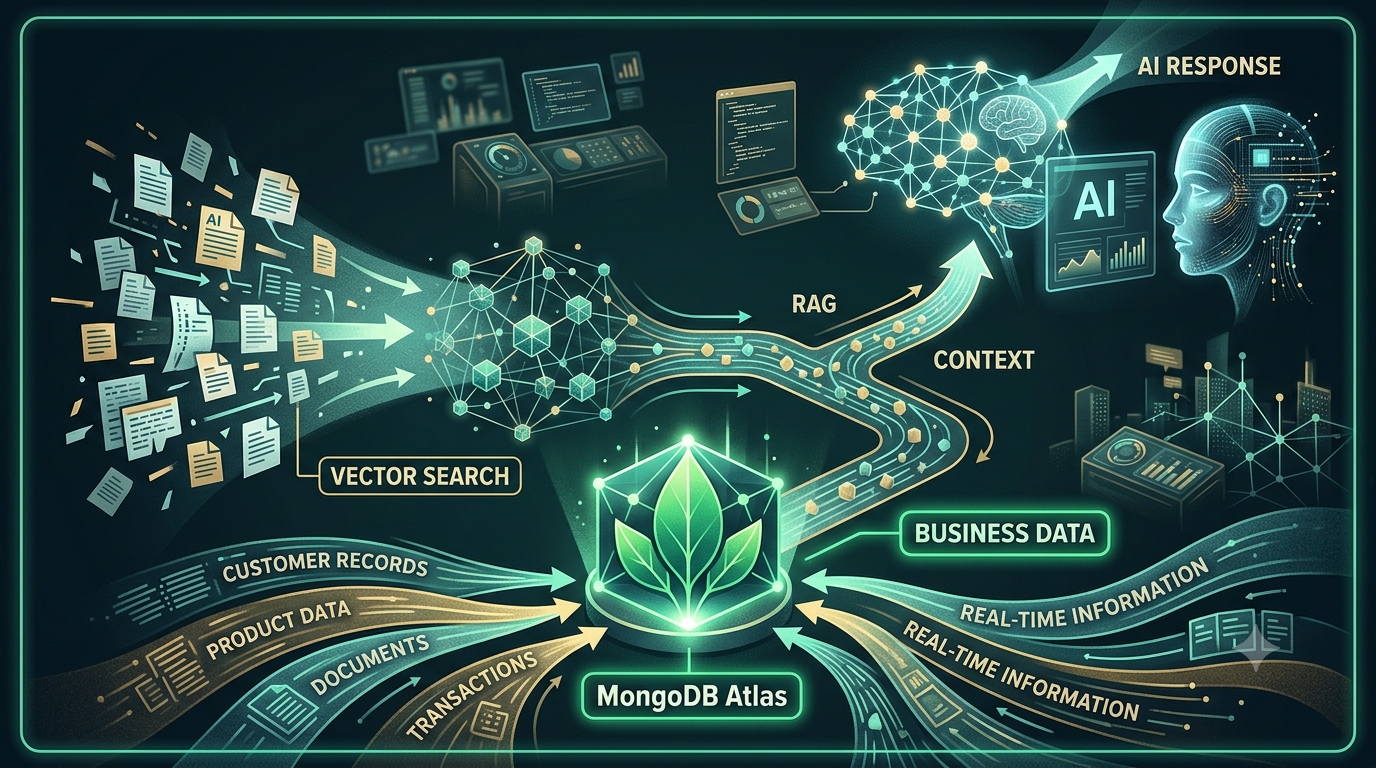
Consider a company's customer-support system. The company may have thousands of product documents, support tickets, customer records, billing details and internal policies. An AI model can generate a well written answer, but that does not mean it automatically knows the company's latest information. The system needs a way to find the right information and give it to the model as context.
This is where RAG, or Retrieval-Augmented Generation comes in. Instead of expecting the AI model to know everything, the application first searches the company's data for information related to the user's question. That information is then passed to the AI model which uses it to generate a response.
MongoDB Atlas Vector Search is relevant to this process because it allows applications to perform semantic searches using vector representations of data. The important idea behind vector search is that the system can look for meaning and similarity. Rather than an exact match of words.
For example suppose a customer asks "Why did my payment go through twice?". The company's documentation may not contain those exact words. It may discuss duplicate charges, payment retries or billing transactions instead. A semantic search system can help identify information that is conceptually related to the question. This may sound technical, but the business use case is quite straightforward. Companies want their AI applications to answer questions using their own information rather than producing generic responses. That means their operational data is increasingly important to their AI strategy. And this is where Atlas gets an interesting opportunity. The same platform that stores the data used by an application can likewise become part of the system that retrieves information for its AI features. That can simplify the architecture in some situations because developers do not necessarily have to treat application data and AI retrieval data as entirely separate worlds.
It also gives MongoDB another reason for customers to use Atlas. A company may initially adopt Atlas because it wants a managed cloud database. Later, that same company may start adding AI powered search, recommendations, customer support or other intelligent features. The database then becomes involved in more parts of the application. That does not automatically guarantee growth, of course. AI is a competitive market and rapidly changing. But it gives MongoDB an opportunity to make Atlas relevant to a new generation of applications rather than relying only on traditional database workloads.
MongoDB Atlas and the Rise of AI Agents
AI agents take the idea of AI powered applications one step further. A normal chatbot may answer a question, but an AI agent is designed to work towards a goal. It may need to retrieve information, use tools, make decisions and interact with different systems before completing the task.
That makes access to business data extremely important.
Think about an employee asking an internal AI assistant to find customers whose contracts are about to expire and prepare a summary for the sales team. The assistant would need access to customer records, contract information, dates and possibly other business data. Simply having a powerful language model is not enough.
An AI agent needs access to the right data at the right time, which makes the database an important part of the agent architecture.
This is one reason technologies such as the Model Context Protocol (or MCP) have attracted so much attention. MCP provides a standardized approach for connecting AI systems with external tools and sources of information. MongoDB has also been working in this area including capabilities that allow AI systems to interact with MongoDB Atlas environments.
The interesting part is what this means for application architecture. In a traditional application developers write the logic that determines what the application should do. The application then reads from or writes to the database according to that logic.
With an AI agent system some decisions can be made dynamically. The agent may determine what tool it needs, retrieve relevant information and then decide what to do next. The database remains the source of important business information, but the way that information is accessed can become much more dynamic.
This also creates a completely different set of concerns for businesses. Giving an AI system access to company data is not something an organization can approach casually. There have to be clear permissions around what the agent can see and what it can change. Authentication, authorization, monitoring, governance and data protection become essential.For example, an AI assistant that can read product information may be useful. An agent that can automatically change product prices, modify customer records or delete information is a very different proposition. The more powerful the system the more its access needs to be carefully controlled.
That is why the AI agent story around Atlas should not be reduced to another technology buzzword. The real opportunity is connecting AI systems with useful enterprise data while keeping that connection controlled and reliable.
If businesses successfully adopt this type of architecture, databases could become even more important in AI applications. Rather than sitting quietly behind the application, they would become one of the key sources that agents depend on when making decisions or performing tasks.
Why Developers Matter to the Atlas Growth Story
Businesses may sign contracts and executives may approve technology decisions, but developers are the people who live with a technology once it has chosen. They build the application, connect the APIs, create the data models, troubleshoot problems, optimize queries and deal with the small issues that never appear in a product presentation.
That is why developer experience matters so much in the database market.
MongoDB has long been associated with a document approach that many developers find convenient when building applications. Rather than forcing every piece of information into a traditional relational structure, developers can work with documents that often resemble the way application objects are represented.
That flexibility can be useful when application requirements change frequently. A product may start with a relatively simple data structure but later introduce new fields or functionality. A development team may prefer having room to evolve the data model rather than redesigning an entire relational schema every time the application changes.
Atlas takes that developer experience into the cloud. The value is not simply that developers get a MongoDB database online, it's that the database, cloud infrastructure, management tools and development workflow can be brought together in one environment.

This is also why practical learning around MongoDB continues to matter. A person searching for mongodb course options today may want more than basic database commands. They may want to understand document modeling, indexing, aggregation, application integration, cloud deployment, performance and perhaps AI related capabilities as well. The expectations placed on developers have changed too. A modern developer may be working with a database in the morning, an API in the afternoon and an AI service later the same day. Technology stacks are becoming more connected and developers increasingly need to understand how individual components work together.
This can benefit platforms that offer a relatively smooth development experience. If developers can experiment with a technology, build a prototype, connect it to a real application and move that application towards production without constantly changing tools, adoption can naturally happen. There is another interesting part of this story. A technology does not always enter a large organization through a top down decision. Sometimes a developer or small team uses it for a project, the project works well and eventually the technology finds its way into other parts of the company.
Developer adoption can therefore become the starting point for wider enterprise adoption.
For MongoDB Atlas, maintaining that connection with developers will remain important even as the company focuses more heavily on large organizations. Enterprise customers may bring significant workloads, but developers are the people building those workloads.
Atlas Growth Comes With a Changing Competitive Landscape
It's easy to talk about the growth of MongoDB Atlas without mentioning the other database technologies competing for the same customers. The database market is not standing still and businesses have many choices. Different applications require different approaches. Relational databases such as PostgreSQL and MySQL remain widely used, particularly for systems that depend heavily on structured relationships, SQL and complex transactional workloads. Cloud providers also have their own database services while other technology companies offer specialized platforms for search, analytics, real time workloads and AI applications.
So the question for MongoDB is not simply whether companies are moving to the cloud, but why a company would choose Atlas when it already has other cloud database options available. MongoDB's answer increasingly involves the combination of its database model, managed cloud infrastructure, developer ecosystem, search capabilities and AI related features. The idea is to provide a platform that can support the application as its requirements change. But businesses also have to consider cost. Cloud services can reduce infrastructure management, but that does not mean they are automatically cheap. As an application grows companies need to understand how much compute, storage, networking and other resources they are consuming. A database that works well for a small application may need careful optimization once the workload becomes much larger.
Existing infrastructure is another factor. Large companies rarely start from zero. They may already have relational databases, legacy applications, internal tools, cloud contracts and teams with years of experience in particular technologies. Replacing those systems can be expensive and disruptive. For that reason, Atlas does not necessarily have to replace every database inside an organization to become valuable. It can be used for particular applications or workloads where its architecture makes sense.
AI makes this competition even more interesting. There are specialized vector databases, search platforms, cloud AI services and other technologies competing for different parts of the AI application stack. MongoDB's approach is to bring more of those capabilities closer to the operational data that applications already use. That could be useful for developers who do not want to build an architecture from a collection of completely disconnected services. But businesses will still evaluate each technology based on their own requirements, existing infrastructure, cost, security needs and technical expertise. The market is therefore moving towards a more blended environment. The traditional boundaries between a database, search engine, cloud platform and AI data layer are becoming less obvious. Atlas is participating in that change, and how well it handles that convergence will matter to its future growth.
Where MongoDB Atlas Could Go Next
The future of MongoDB Atlas lies not in databases but in the business application layer on top of them. Enterprises want to build out distributed cloud applications, embed AI within products, and get increasingly better insight from their data. That’s a radically different use case for a database platform than what we’ve seen before.Take an online ordering application. The database might hold product information, pricing, customer data, order information, and inventory records. Suddenly, the company wants to bring in an AI shopping assistant that understands what a customer is asking for, finds the relevant product information, and delivers that to the user.
The database becomes the lifeline for the AI application embedded within the company’s software.
The same goes for customer support — an enterprise might want to bring in an AI assistant that requires access to the company’s documentation and customer data to answer questions. A business analyst tool within an enterprise might want to bring in an AI agent to find the relevant record or help generate a report. In all these cases, the ability of such an application to deliver value turns on the ability of the application to access relevant information from the underlying database — and the willingness of the database to let it do so safely and efficiently.
MongoDB Atlas has plenty of room to grow in this space. Vector search, generative AI applications, agent-oriented middleware, real-time data access, and cloud infrastructure all come together to give businesses the tools they need to make their applications more intelligent. But beyond all this technology-driven thinking, there’s one essential reality that underlies all these arguments. Interesting as it is, new functionality doesn’t sustain long-term adoption. Businesses ultimately care about whether this sort of technology has value — does it solve a real-world problem, or merely act as an intriguing intellectual exercise? Does it scale up and perform reliably, or is it barely functional in limited circumstances? Does it have reasonable economics, or is it cost-prohibitive? Are its tools so simple to use that they extend the lifetime of a project or so complex that they demand constant expensive retraining?
Ultimately, MongoDB Atlas’s long-term future depends on its ability to convert these interesting innovations into economic value for real-world businesses. That’s why I find the current growth story more compelling than the generic “MongoDB is benefiting from the shift to cloud” argument. Enterprises already know they should move their applications to the cloud; the more interesting question is what they’ll do with all that cloud infrastructure once they get it.
Atlas is poised at the crossroads of both trends. It combines the familiar database features businesses have come to expect from MongoDB with additional functions that allow the platform to act as a center for search, AI, cloud applications, and development. The shift also redefines the skill set that developers are expected to learn, as mongodb classes will have to teach more than just the fundamentals of databases and software development to adapt to the change. More notably, the future of the database seems to be moving away from the traditional on-premise tools towards more managed cloud offerings that provide increased flexibility and scalability.
However, the more interesting prospect is that Atlas is positioned to be less as a separate unit within the application stack and more as part of a greater system that serves as an application development platform. The future of databases is predicted to evolve from being separate, specialized units towards fully integrated systems that include search, AI, cloud applications, and other functions as equal components. As such, MongoDB Atlas is an intriguing prospect that positions itself well to serve the needs of modern businesses that want to transform their application development methodologies.
This is a crucial point. Businesses are looking not to store data in an isolated database but to build cloud-native applications with database functions embedded within them. It’s a radically different approach to building and maintaining software, one that puts much greater responsibility and power in the hands of developers. That’s why I think MongoDB’s future depends on its ability to evolve and adapt to the way enterprises are using databases today and will use them in the future. If AI agents become commonplace, if semantic search becomes a standard feature in customer-facing applications, and if enterprises increasingly move to cloud-based application stacks, the role of the database will fundamentally change. MongoDB Atlas seeks to position itself at the leading edge of that transition.
Whether it succeeds will determine whether MongoDB has a future as a database company.