
MongoDB’s Flexible Schema Trap: When Flexibility Backfires
Last updated on Sep 8, 2026

In the late 2000s, software engineering experienced a collective reaction against the rigid constraints of relational database management systems. For decades, relational databases forced engineering teams to mold dynamic domain models into rigid, tabular schemas. Altering a table containing hundreds of millions of rows required scheduled downtime, migration scripts executed with bated breath, and complex relational mappings that slowed down product velocity.
When document-oriented architecture emerged, it felt like an operational release valve. The ability to serialize a document directly from application memory down to the persistence layer without an Object-Relational Mapping (ORM) layer promised frictionless product iteration. Developers could add a field to a document on Friday afternoon without running a single structural database migration command.
Yet, ten years into production adoption, a recurring paradox plagues modern development teams: applications built on document databases often start out fast, but gradually suffer from degraded query performance, memory consumption spikes, and erratic API latencies.
The issue is rarely the storage engine itself. Instead, the root cause lies in a fundamental misunderstanding: treating schema flexibility as an excuse to avoid schema design altogether.
The Illusion of the "Schemaless" Database
The most dangerous misconception in modern software architecture is the belief that choosing a document database eliminates the need for schema governance. In reality, there is no such thing as an application without a schema; there are only applications where the responsibility of enforcing the schema has been silently shifted from the database engine to the application code.
When a team chooses to write arbitrary structures into a collection without a defined modeling strategy, they do not erase structural complexity—they merely decentralize it. Instead of the database engine validating data types and required attributes upon write, every service, background worker, and microservice consuming that collection must now contain conditional logic to handle missing keys, unexpected null values, or mutated data types.
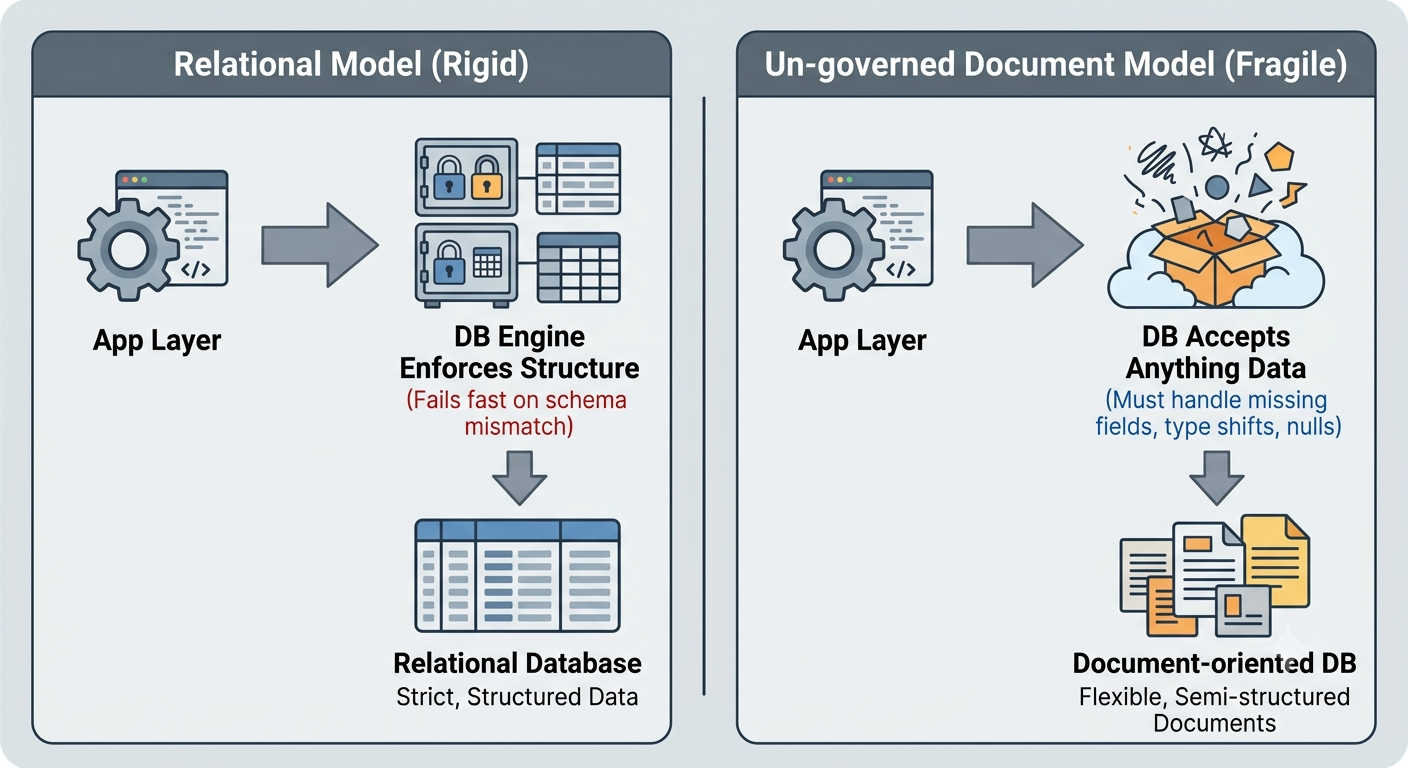
Consider an e-commerce order management system designed during an initial sprint. Early documents might store customer addresses as a single nested string containing the street, city, state, and postal code together. Six months later, an international expansion team requires structured address components to compute country-specific taxes. Without a migration strategy, new documents are written with a nested object containing separate fields for street, city, state, zip, and country.
The database accepts both document structures without complaint. However, the analytical pipelines, shipping integration workers, and display logic now contain defensive branching statements to inspect whether the address property is a raw string or an object before attempting to extract the postal code. When hundreds of fields undergo similar ad-hoc mutations across years of feature releases, the codebase becomes brittle. The agility gained in month one is consumed by application-level edge cases in month eighteen. Schema flexibility is a mechanism for controlled structural evolution, not a license for structural anarchy.
Modeling for Access Patterns, Not Real-World Entities
In relational schema design, the primary objective is normalization: breaking data into discrete entities to eliminate redundancy and maintain third normal form (3NF). An order belongs to a user, contains line items, and references a product catalog. Each entity resides in its own table, connected via foreign keys. Query performance is optimized secondary to normalization via indexes and join strategies.
Document database modeling flips this paradigm upside down. You do not design documents based on how entities exist in the real world; you design documents based on how your application reads and writes data. When engineers trained in relational paradigms attempt to build on a document store, they frequently fall into one of two anti-pattern extremes: Over-Normalization or Naive Denormalization.
The Over-Normalization Pitfall
Engineers create a collection for Users, a collection for Orders, a collection for Products, and a collection for Line Items. To display an order summary page, the application executes multiple round-trip queries or complex multi-collection aggregation lookup pipelines.
Because document databases prioritize horizontal throughput over relational multi-table join algorithms, executing high-frequency lookup operations across massive collections introduces network latencies and CPU bottlenecks.
The Naive Denormalization Pitfall
Engineers nest every conceivable piece of related data inside a single monolith document. An author document contains all published articles, each article contains all reader comments, and each comment contains user profile metadata. While this allows a single read operation to fetch everything, it introduces two severe failure modes:
The Hard Document Size Limit: Documents hitting the maximum allowable byte size will fail writes outright.
Working Set Memory Bloat: The default storage engine must pull the entire document into RAM even if the query only needs a single scalar field. Fetching a large document to display a user's display name rapidly starves the database cache of space for active indexes.
The core architectural decision in document modeling is choosing between Embedding (storing related data inside the same document) and Referencing (storing an identifier that points to a document in another collection).
The Hidden Mechanics of BSON and Memory Allocation
To understand why improper schema design degrades performance, one must look below the surface abstraction layer down to how data is stored on disk and loaded into memory.
Document databases store data internally as Binary JSON (BSON). Unlike plain text formats, BSON includes field type indicators, string lengths, and explicit byte offsets to allow fast traversal of nested structures. However, BSON carries structural overhead that impacts both storage efficiency and memory consumption. As developers learning through a mongodb course often discover during performance-tuning modules, these structural mechanics directly dictate system throughput under high load.
In BSON, field names are stored explicitly inside every single document. If a collection contains 500 million documents and includes a long field key like transaction_authorization_status_code, that string key is duplicated 500 million times across disk and memory.
In a relational database, field names exist once in the table metadata; in a document store, field names are payload data. Using long field names multiplied across hundreds of millions of records can consume gigabytes of unnecessary storage and cache memory. Furthermore, updates to embedded documents can trigger expensive memory reallocations. When a document grows beyond its allocated disk space due to array pushes or new field additions, the storage engine must reallocate contiguous space on disk, mark the old space for garbage collection, and rewrite the entire document.
If an application performs thousands of random document expansion operations per second, disk I/O spikes and fragmentation degrades read performance.
Unbounded Arrays: The Quiet Killer
The most frequent architectural failure in document database implementations is the unbounded array. An IoT platform records temperature readings from sensor nodes. The initial schema appends every reading into an array inside the sensor document. In testing, this schema performs exceptionally well because readings are fetched in a single network request.
However, after six months in production, active sensors accumulate millions of array items. The document size approaches the hard ceiling limit. Updating the array requires rewriting megabytes of data for a single 10-byte metric insertion. The memory cache becomes saturated with bloated documents, dropping overall query throughput. The resolution requires applying the Bucket Design Pattern. Instead of maintaining one infinitely growing document per sensor, the schema creates bucket documents that store metrics for a constrained time window (e.g., one hour or one day) or up to a fixed item limit (e.g., 500 entries).
By capping the array length, document sizes remain predictable (~15-20 KB), memory utilization stabilizes, and range queries execute across indexed bucket boundaries.
Indexing Strategies Beyond Equality Matching
Indexes in document databases operate on B-Tree data structures similar to traditional relational engines. However, because documents contain nested structures, polymorphic types, and arrays, index design requires distinct considerations.
The ESR Rule (Equality, Sort, Range)
When designing compound indexes, the order of fields in the index definition dictates query execution efficiency. The established standard for field ordering is ESR:
Equality: Place fields that undergo exact match filters first in the index.
Sort: Place fields used to order the result set second.
Range: Place fields subjected to range filters (such as greater-than, less-than, or list matching operators) last.
For example, if a query searches for active users in a specific region, orders the results by their last login date, and filters for users registered after a certain date:
First Index Field (Equality): Region/Status filter
Second Index Field (Sort): Last Login field
Third Index Field (Range): Registration Date range filter
If the range field is indexed before the sort field, the database engine must scan index keys across the range and perform an expensive in-memory sort operation. If the memory required for this sort exceeds internal memory thresholds, the query fails entirely.
Multikey Indexing Overhead
When an index is created on an array field, the database constructs a Multikey Index, generating an index entry for every single element inside that array. If a document contains three array fields, creating a compound index across all three arrays is explicitly forbidden due to index explosion risks (where a single document could generate thousands of index keys).
Engineers must monitor index storage footprint. Each index consumes RAM inside the storage cache. If total index sizes exceed available memory, disk paging occurs, causing system-wide latency spikes. Dropping unused or redundant indexes is a primary maintenance task.
Schema Governance in a Distributed Team
As engineering organizations expand, the "anything goes" approach to document insertion breaks down. Multiple microservices writing to shared collections without boundary validation introduce silent corruption.
Modern document database architectures handle this through Schema Validation rules implemented directly at the database engine level via structured validation definitions.
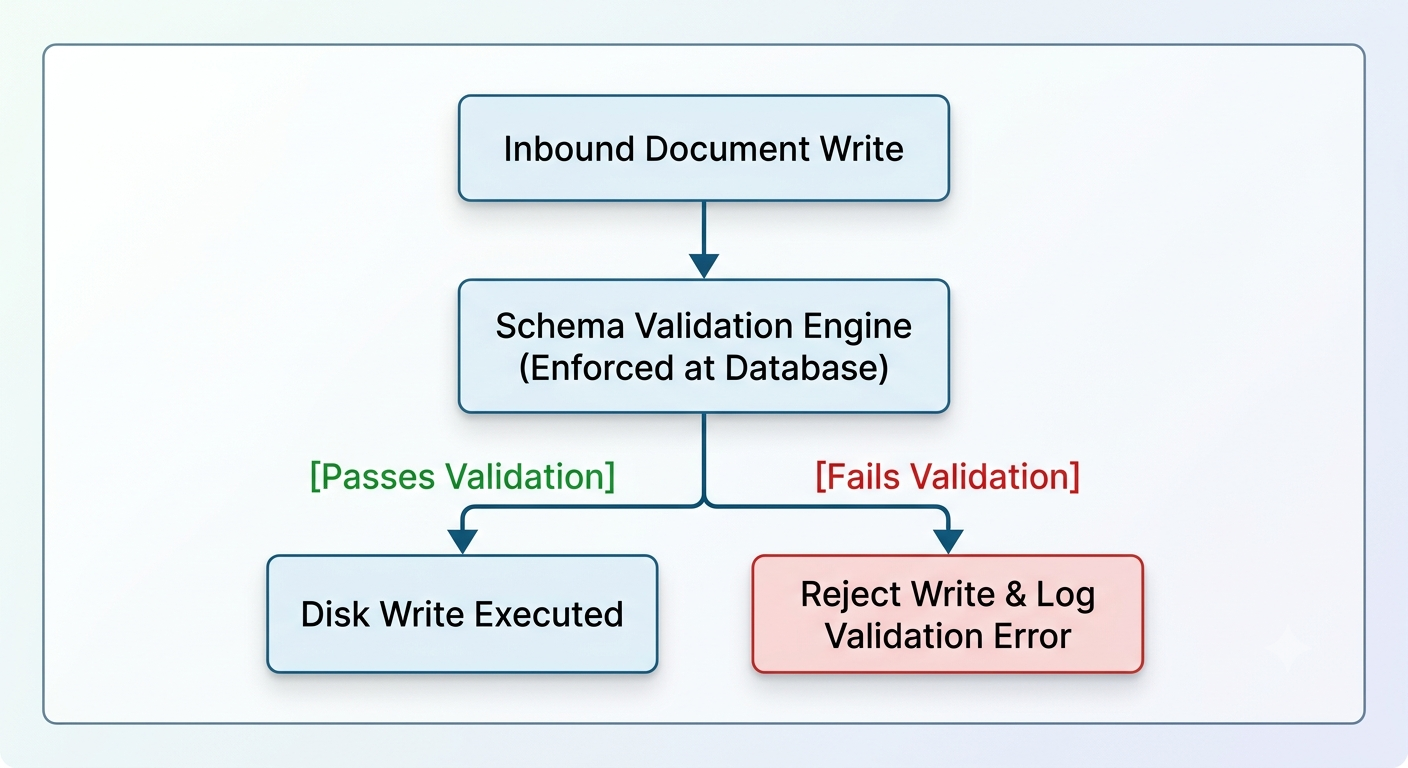
By applying database-level schema validation, teams preserve the capability to store flexible properties while guaranteeing that critical business invariants are strictly enforced on write:
Required core fields (such as account IDs, user tiers, and balances) must be present.
Data types for monetary balances, timestamps, and identifiers are strictly verified.
Specific namespaces (such as a metadata sub-document) are explicitly designated to remain fully flexible for dynamic key-value pairs.
This configuration achieves structural stability: core domain properties are strictly validated for data type and presence, while designated namespaces remain fully flexible for custom payload expansion. For engineering departments navigating complex technical decisions, investing in structured mongodb training provides teams with the foundational principles required to implement robust schema governance, manage concurrency, and prevent production anti-patterns.
Real-World Operational Scenarios
Analyzing real-world production incidents illustrates how small schema design choices manifest as large-scale system failures.
Scenario A: The Microservice Latency Spillover
What Happened: A SaaS platform experienced sudden, intermittent 5-second API timeouts during peak traffic hours. The database CPU utilization climbed to 100%, though write operations remained low.
What People Assumed: The team assumed the database cluster needed vertical scaling (more CPU/RAM) or that the network throughput was saturated.
What Was Actually Happening: An analytics dashboard executed a regular summary query using an aggregation pipeline with multiple lookup operations across collections. The pipeline joined a Tenant collection with an un-indexed Activity Logs collection containing 80 million documents. The operation forced full-collection scans on every join pass, locking cache memory and queuing real-time API transactions.
The Structural Fix: The team applied the Extended Reference Design Pattern. Frequently queried tenant attributes (such as tenant name and subscription status) were denormalized directly into the Activity Logs documents during ingestion. The heavy cross-collection lookup join was eliminated entirely, reducing query latency from several seconds down to a few milliseconds.
Scenario B: The Black Friday Document Explosion
What Happened: An e-commerce platform experienced database write rejections during a promotional flash sale. Write errors stated that documents exceeded storage boundaries.
What People Assumed: Developers suspected a database engine bug or corrupt driver connections.
What Was Actually Happening: The order document schema stored every inventory modification event and customer audit trace inside an embedded array named audit_trail. High-frequency automated retries during the flash sale generated thousands of audit entries per order. Select order documents reached the document size limit, causing write transactions to crash.
The Structural Fix: Audit traces were separated into an independent Audit Events collection, linked via an order identifier field. The primary order document returned to a stable, bounded size (~4KB), eliminating write rejections entirely.
Technical Trade-Offs in Document Systems
Engineering is the discipline of managing trade-offs. No single database model solves all data requirements cleanly. Adopting a document database requires explicit acknowledgement of architectural compromises.
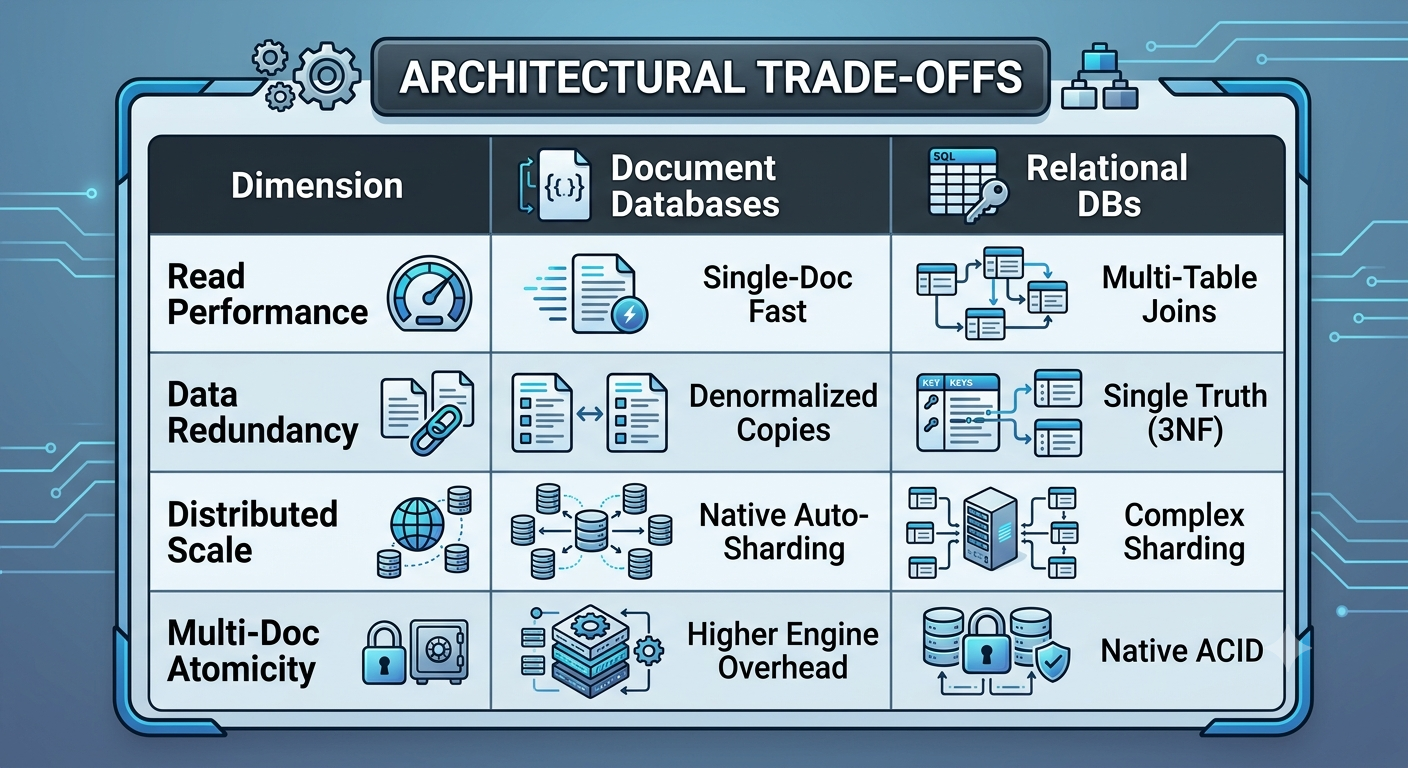
Read Speed vs. Update Complexity (Denormalization Trade-off)
Embedding related data inside a single document optimizes read performance. Fetching a document and its child entities requires a single disk seek and network payload. However, if that embedded data is updated (e.g., a user updates their profile picture or display name), every single document containing that denormalized copy must be updated.
When to Denormalize: When the data is read frequently (1,000:1 read-to-write ratio) and changes rarely (e.g., product titles, country codes).
When to Reference: When the data changes frequently or is shared across thousands of independent entities (e.g., user account balances, dynamic inventory counts).
Developer Velocity vs. Governance
In early-stage development, omitting database-level schema constraints accelerates feature velocity. However, as the engineering team grows from 3 to 30 developers, the lack of enforced constraints introduces operational risk. Implementing strict schema validation rules slightly slows down migration execution but prevents production application crashes caused by unexpected payload mutations.
Single-Document Atomicity vs. Distributed Transactions
Document databases provide native atomic operations at the single-document level. All updates to embedded sub-documents and arrays inside a single document succeed or fail together atomically. While modern document databases support multi-document transactions, distributed transactions incur performance costs. They lock multi-document sets across replica nodes, increasing tail latency.
If your core domain model requires continuous, high-frequency multi-document ACID transactions across dozens of collections, your domain model may be inherently relational, or your document boundaries are drawn incorrectly.
Strategic Shift in Document Architecture
The transition from relational tables to document databases represents far more than a swap in database tools. It is a fundamental shift in how applications handle structural complexity. Flexibility is not the absence of structure; it is the freedom to evolve structure intentionally.
When teams fall into the trap of viewing document stores as loose collections of unstructured data, they trade short-term convenience for long-term operational fragility. The systems that scale reliably over years are not those that avoid schema design, but those that design around access patterns, treat memory constraints with respect, and enforce governance at system boundaries. Understanding these tradeoffs through hands-on practice or structured mongodb classes allows engineering teams to systematically build resilient access patterns rather than relying on trial and error in production.
Document architecture demands more design discipline than relational systems, not less. When approached with architectural intentionality, the document model provides unmatched scaling performance and organizational agility. When approached with negligence, the system eventually demands payment for the debt incurred on day one.