
MongoDB Transactions: Managing Multi-Document Operations
Last updated on Nov 25, 2026
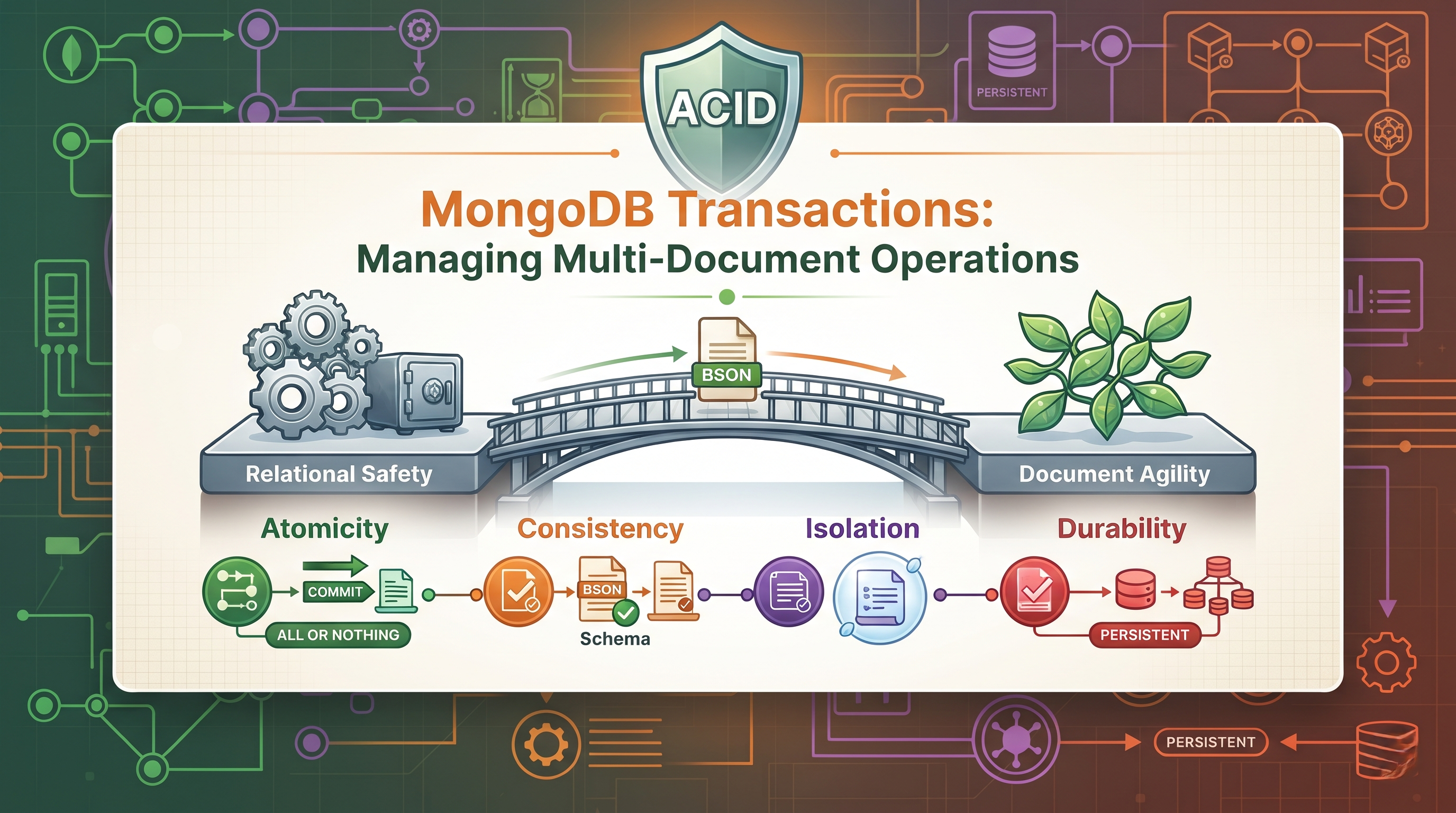
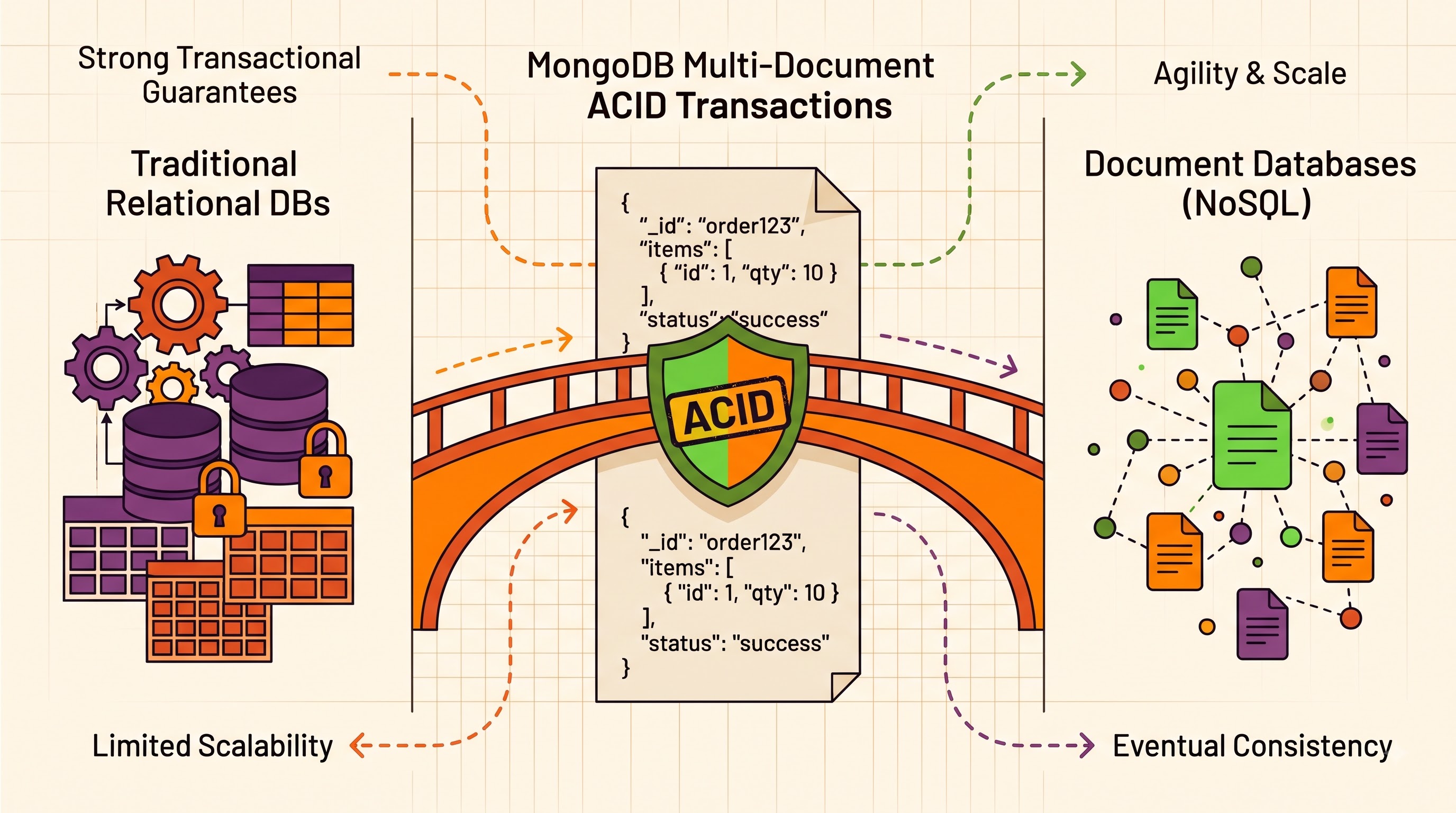
Modern distributed applications need to scale out while keeping their data perfectly intact. For years developers have had to make an architectural trade off. Do you want a traditional relational database with strong transactional guarantees, but lose flexible schema design and effortless sharding? Or do you want a document database that provides agility and scale, but with eventual consistency across multiple records? MongoDB broke this binary choice with the introduction of multi-document ACID transactions, allowing engineering teams to combine the ergonomic power of the document data model with the ironclad safety of relational transactional semantics.
Knowing how to open and commit a session is not enough for managing multi-document operations in MongoDB effectively. You must have a deep understanding of MongoDB’s document-first design philosophy, the internals of the WiredTiger storage engine, the specifics of distributed consensus in replica sets and sharded clusters, and the operational discipline necessary to keep high-throughput systems fast and resilient.
Data Integrity in MongoDB: A Journey
To understand why multi-document transactions exist, and how to deploy them, it’s first important to look at how MongoDB changes data at the single-document level. MongoDB was built from the ground up on the idea that data that is used together should be stored together. With embedded subdocuments and arrays, developers are able to nest related entities inside rich, hierarchical BSON structures. Complex business objects can be modelled within a single database record.
MongoDB doesn’t write operations on a single document in MongoDB are atomic. If your update changes one scalar field, shoves into three nested arrays and increments a couple of counters at the same time, then that whole update either works or it fails. Moreover, single document writes are guarantyd to be fully isolated and durable without distributed coordination locks. If you design your schema correctly, for eighty to ninety percent of operational workloads, you won't need multi-document transactions.
But in real life enterprise domains there will be cases when embedding everything into a single document is neither practical nor safe. Documents are limited to a hard maximum size of sixteen megabytes , unbounded array growth leads to significant performance degradation , and many-to-many relationships across different business aggregates can not be cleanly nested without massive data duplication . A single business event can involve mutating multiple distinct documents across different collections or even databases in financial ledgers, multi-warehouse inventory allocation, healthcare patient billing, and complex order fulfilment pipelines.
MongoDB tackled this very limit with the introduction of multi-document transactions for replica sets in version 4.0, and then full-fledged distributed multi-document transactions across sharded clusters in version 4.2. Since then, each release has steadily improved transaction performance, memory efficiency, and operational ergonomics, being ready for use in important applications. Those individuals who wish to gain practical and applied knowledge about this should be informed that there is a mongodb online course.
Core Architecture and ACID Guarantees
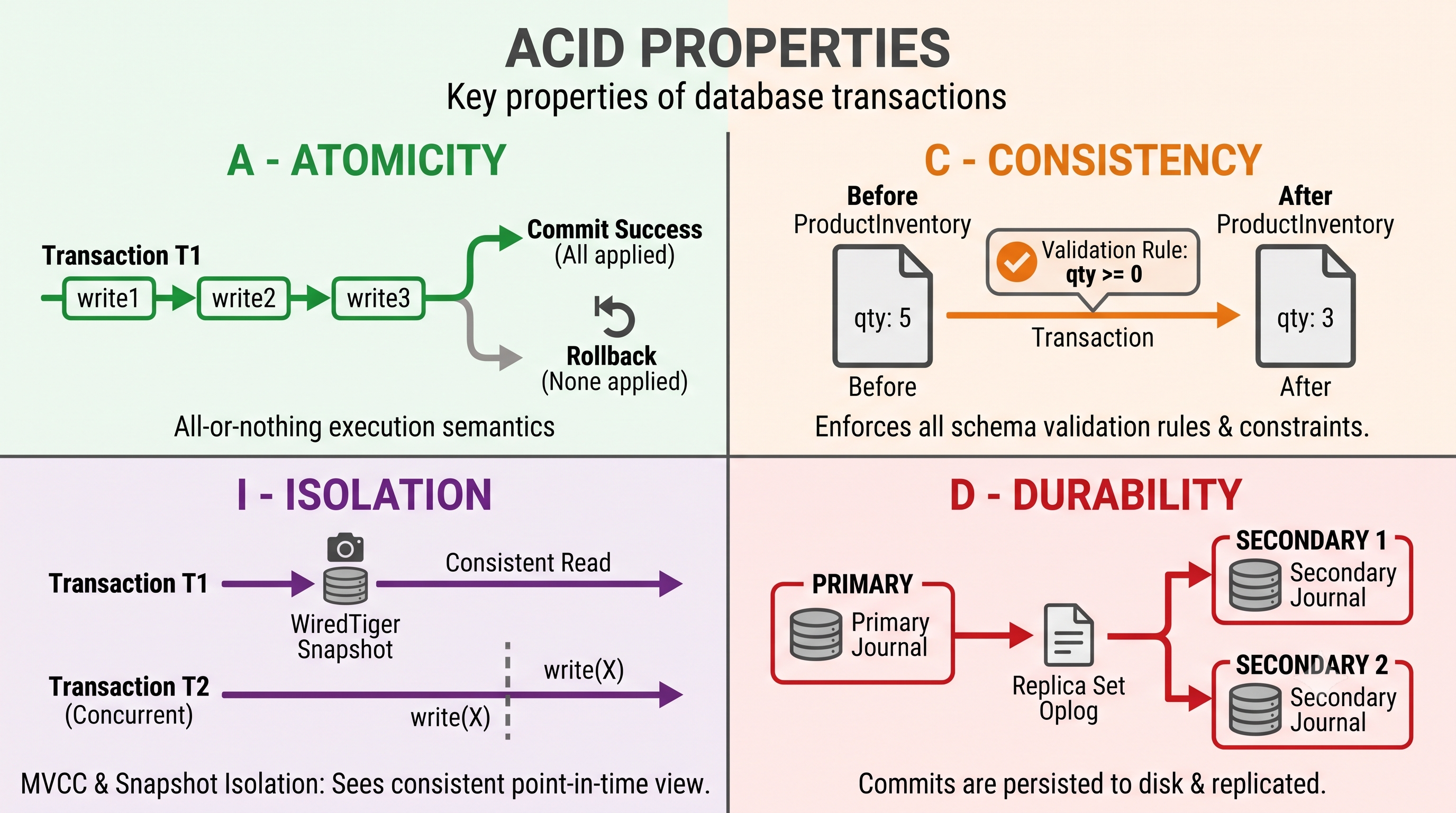
Multi-document transactions MongoDB enforces all four classical ACID properties—Atomicity, Consistency, Isolation and Durability—on every read and write operation tied to that transaction’s logical session.
Atomicity Without Frontiers
Atomicity provides all-or-nothing execution semantics. If a transaction updates forty individual documents and involves five collections across two databases, then all of the writes are permanently applied to the database, or none of them are. If there is an application error, a network partition that disconnects the client, a primary node stepping down in the middle of a flight, or if a validation rule fails on the thirty-ninth document, MongoDB aborts the transaction and rolls back all previous changes. External readers never see a half-applied state.
Schema Validation and consistency
Consistency guarantees that a transaction moves the database from one valid state to another without violating defined invariants. All of the collection-level JSON Schema validation rules, the unique index constraints, and the document structural rules are enforced within a MongoDB transaction. If any of the modified documents’ final state violates a unique key constraint or a schema validator check, the transaction cannot commit and automatically rolls back.
WiredTiger’s Snapshot Isolation
Isolation describes how concurrent operations interact with data that is not yet committed. MongoDB: Multi-Version Concurrency Control or MVCC is used for isolation in the WiredTiger storage engine in MongoDB. WiredTiger takes a consistent point-in-time snapshot of the data when a transaction begins and issues its first read or write. Any subsequent read in that transaction sees the database exactly as it was at that point in the snapshot, fully protected from concurrent writes committed by other clients after the transaction started. In contrast, any changes that are not committed in the transaction are not visible to readers outside the transaction until the commit protocol completes. This removes dirty reads, nonrepeatable reads, and phantoms in the transaction boundary.
Replication and Durability Contract
Durability: Once a transaction commits, its effects cannot be lost due to power loss, hardware crashes, or node restarts. MongoDB achieves durability by writing the transaction commit records to the WiredTiger journal on disc, and replicating the operations of the transaction through the replica set oplog. With majority write concern configured, a transaction does not report success to the client until the primary node and a voting majority of secondary nodes have persisted the transaction’s oplog entries to their local journals. However, even if the primary server suffers catastrophic hardware failure milliseconds after commit, the new primary still has the entire transaction.
How MongoDB Performs Multi-Document Transactions
Under the hood, MongoDB employs logical sessions, optimistic concurrency control, and distributed commit protocols to coordinate multi-document transactions without degrading into traditional pessimistic locking bottlenecks.
Causal Consistency and Logical Sessions
MongoDB multi-document transactions must be run within the framework of a logical client session. A session is a global tracking envelope that ties individual operations together over network round trips. When an application begins a session and starts a transaction, the MongoDB driver assigns a unique session identifier and a monotonically increasing transaction number. And every subsequent read, insert, update or delete must be explicitly tagged with that session reference. If a client disconnects or closes a session with a transaction not committed, the server immediately aborts the open transaction and reclaims its resources.
Optimistic Concurrency and Write Write Conflicts
Legacy relational engines rely heavily on pessimistic read locks, which block readers from accessing rows that are being modified. MongoDB uses optimistic concurrency control powered by WiredTiger’s document level locking. When a transaction updates a document, WiredTiger takes an exclusive intent lock on the document. Other transactions can still read the old committed version of that document from their own historical snapshots without waiting.
However, if a second concurrent transaction tries to change the same document while the first transaction holds that write lock, WiredTiger immediately detects a write conflict. MongoDB aborts the conflicting transaction immediately with a transient write conflict error instead of letting the second transaction hang indefinitely and risking complex deadlock chains. It keeps the lock hold times predictable and cleanly pushes conflict resolution into the application’s retry loop.
Atomic Replication and Oplog Entry
For the WiredTiger transaction, MongoDB buffers all write operations made during a transaction in memory in a single replica set until the client issues the commit command. No writes are made to the replication oplog during execution. When the commit command is received, MongoDB validates all constraints and atomically applies the changes to the storage engine and writes a special single applyOps oplog entry that contains the full batch of operations (or a linked chain of oplog entries if the transaction exceeds the sixteen-megabyte BSON limit). Secondary nodes replay these grouped operations atomically, ensuring that secondaries never expose partial transaction states to secondary readers.
Two Phase Commit in Sharded Cluster
A single replica set can no longer guarantee atomicity for transactions that span documents across two or more shards in a sharded cluster. The mongos query router here is the transaction coordinator and it performs a distributed Two-Phase Commit across all the participating shards.
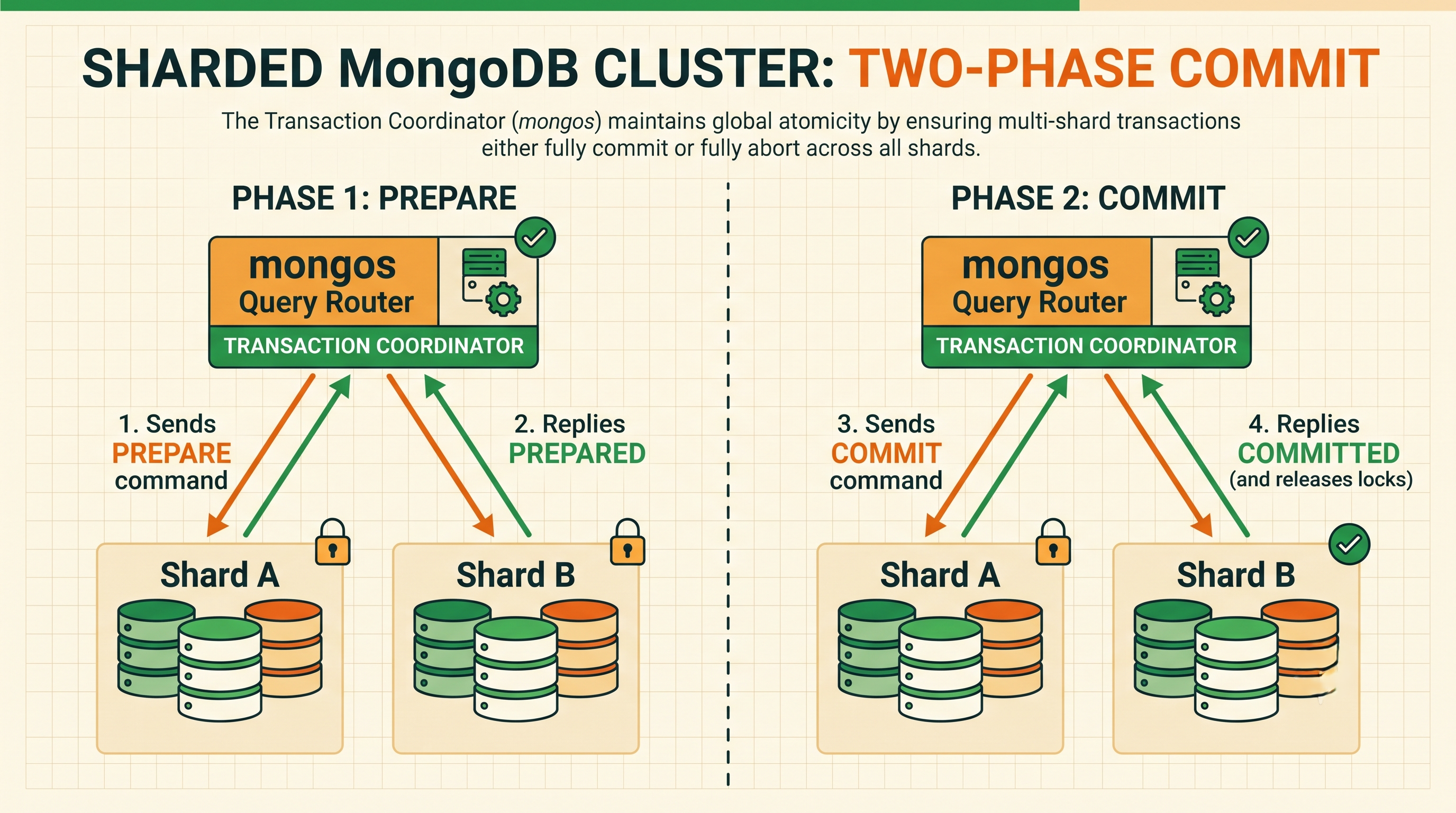
The coordinator asks each participating shard to enter a durable prepared state for its local transaction state during the prepare phase. Each shard writes a prepare entry in its oplog , replicates that entry to a majority of its own replica set members , and holds all document locks while ensuring that it can commit regardless of any subsequent failures . Once all the participating shards have acknowledged readiness, the coordinator writes the global commit decision to disc and proceeds to the commit phase, where it sends messages to each shard to commit the transaction and release locks . If a shard cannot prepare or a conflict happens, the coordinator tells all shards to roll back, thereby maintaining global atomicity in the distributed cluster.
Tuning Consistency Read Concerns, Write Concerns, and Read Preferences
Developers often misunderstand that starting a transaction will automatically enforce the strictest possible consistency over a distributed cluster. What that means is that the transactional guarantees you get in MongoDB are a function of three tunable configuration settings at the transaction level: read concern, write concern and read preference.
Limitations on Read Preference
All operations in a multi-document transaction must route to the primary member of each replica set involved. Thus, transactions that include reads must have a read preference of primary. Transactional reads are not allowed to be routed to secondaries, because secondaries replicate data asynchronously and cannot participate in active write lock acquisition or provide guarantees of up-to-the-millisecond visibility of concurrent primary mutations.
Read Concern Levels
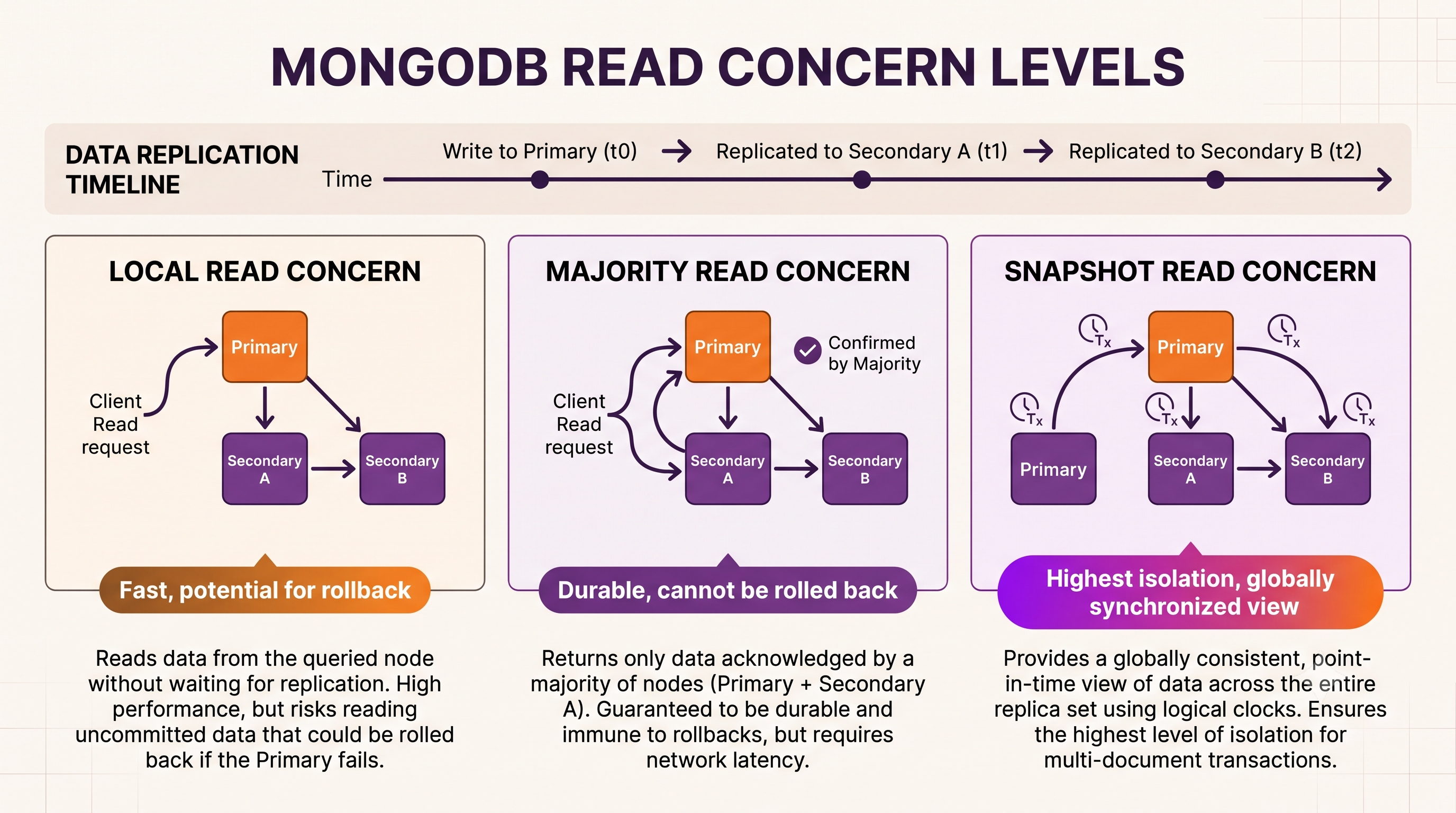
The transaction-level read concern determines the isolation and durability guarantees of the data read within the transaction:
Local Read Concern: Returns the most recent data on the primary available at the start of the transaction. In theory, although fast, data read under local read concern could be rolled back if the primary crashes before replicating those prior writes to a majority of secondaries.
Majority read concern: Guarantees that all data read by the transaction is acknowledged by a majority of replica set members and cannot be rolled back. This prevents the transaction from making business decisions based on uncommitted writes that could be lost during a fail-over.
Snapshot Read Concern: The highest isolation guarantee, providing that all reads over single or multiple shards see a globally synchronised, majority-committed point-in-time snapshot. The snapshot read concern on sharded clusters uses synchronised cluster logical clocks to ensure that the data read from Shard A and the data read from Shard B correspond to exactly the same logical instant in time.
Write Concern Levels
The transaction level write concern specifies the number of replica set members that must acknowledge the transaction’s persistence before the commit operation returns success to the application. Individual operations within the transaction cannot specify their own write concerns; write concern applies only at commit time.
The universal best practice for financial and mission critical transactions is to use majority write concern. This guarantees that the commit record for the transaction is written to the primary's on-disk journal and replicated to a majority of voting nodes before the transaction is considered complete by the application. With a write concern of one the commit is acknowledged as soon as the primary has written it in memory. This reduces the commit latency slightly, but it also makes committed transactions susceptible to rollback if the replica server fails before replication occurs. Finding the right balance between replication durability, failover security, and latency of the cluster is one of the core issues discussed in mongodb dba course.
Robust Transaction Processing Design
Transient network blips and primary elections and concurrent write conflicts are always going to be a part of distributed systems. Robust MongoDB transaction implementations will lean on structured error handling and idempotent execution patterns.
The Core API The Callback API
MongoDB drivers provide two distinct programming interfaces for working with transactions: the Core API and the Callback API.
The Core API gives developers the ability to manually control each step of the lifecycle: explicitly starting a transaction, doing operations, calling commit and calling abort within catch blocks. The Core API is flexible, but shifts the entire responsibility for retry logic, error label inspection, and commit confirmation loops onto the application developer. If you miss an edge case (e.g. unknown commit result due to a network timeout), you can end up with duplicate execution or unhandled failure.
A Callback API was introduced to eliminate boilerplate errors and wraps the entire transactional workflow into a single driver-managed helper function. The developer just supplies a callback function that contains the business logic, and the driver will automatically begin the transaction, execute the callback, commit the result and handle transient retries transparently. For nearly all production use cases, the Callback API is strongly preferred as it includes battle-tested retry semantics which are maintained directly by MongoDB's driver engineering teams.
Handling Transient Transaction Errors and Unknown Commit Outcomes
If the transaction fails due to a transient error, such as a write conflict with another concurrent session or a primary step-down during an election, MongoDB adds a specific error label to the exception called TransientTransactionError. If this label is present, then the whole transaction has been safely aborted on the server, and the application should retry the whole transaction block from the start, using exponential backoff with jitter to avoid thundering-herd collisions.
Another important type of error occurs in the commit phase itself. If the client sends the commit command and then a network interruption drops the connection before the server's acknowledgement returns, the driver receives an error called UnknownTransactionCommitResult. In this state, the client does not know whether the server has successfully committed the transaction or aborted it. The driver instead re-tries the commit operation itself (instead of blindly re-running the business logic, which might double-charge a customer if the commit actually succeeded). Further, as MongoDB maintains transaction numbers on a per-session basis, retrying the commit command is fully idempotent: if the transaction has already committed, the server immediately returns success; if it aborted due to a transient error, the server surfaces the transient error so the outer loop can safely re-execute the transaction.
Data Modelling Strategy: When to Embed vs When to Use Transactions
The golden rule of MongoDB data modelling is still valid: design your schema in such a way that you will not need multi-document transactions. They are a powerful tool for true multi-entity invariants, not a crutch to re-implement normalised third-normal-form relational schemas inside a document database.
Situations When Transactions Are Necessary
Double-Entry Financial Ledgers and Transfers: To move funds between user accounts, the system debits one account document, credits another account document, and inserts an immutable audit ledger document. All users cannot be stored in one document, so a multi-document transaction is required to prevent creation or destruction of money in case of partial failures.
Multi-Item E-Commerce Order Checkout: A customer buys five different products. The system needs to create an order document, decrease inventory counts for five distinct product catalogue documents, apply a promotional coupon usage limit on a campaign document, and log a payment authorisation. If inventory is insufficient for the fourth item, the entire checkout needs to rollback cleanly.
Cross-Entity Workflow State Transitions In systems such as healthcare, logistics, or ERP systems, the movement of a shipment or medical record may require coordinated updates across patient profiles, insurance billing records, and compliance audit logs that belong to different bounded contexts.
Uniqueness Constraint Enforcing for Various Fields: At times, there might be a need to establish some look-up collections for enforcing some uniqueness constraints or relationships between the collections. The transactions will always ensure perfect synchronization between the main and look-up collections.
When Schema Redesign is Better than Transactions
One-to-Few Bounded Relationships: Keeping a customer’s shipping addresses, phone numbers or recent order status history in the customer document itself removes cross-collection joins and transactions entirely.
Parent-Child Line Items: An invoice and its line items, or a blog post and its metadata tags, are naturally grouped together as a single aggregate document. This is transactional; the invoice total is updated and a line item is added atomically in a single document write with no transactional overhead.
Event-Driven Outbox Patterns When an update to a primary business document needs to trigger downstream notifications or analytics updates that do not need immediate synchronous consistency, writing an event payload into an embedded outbox array on that same document allows single-document atomicity while letting background workers process downstream side effects asynchronously.
Conclusion
MongoDB’s multi-document ACID transactions bridge the gap between flexible document modelling and strict relational integrity. MongoDB uses WiredTiger’s snapshot isolation, replica set majority consensus and distributed Two-Phase Commit coordination to empower engineering teams to build financial ledgers, high-volume order management engines and complex multi-entity workflows without compromising horizontal scalability.
Architectural balance is the key to mastering MongoDB transactions. Make single-document atomicity via careful embedding your first class building block, and only use multi-document transactions for true cross-aggregate invariants where partial updates are unacceptable. Keep transaction scopes small, use the driver’s Callback API for resilient retries, pick shard keys to minimise distributed coordination, and monitor the health of the WiredTiger cache. For those who seek lab assignments and a curriculum, the correct best mongodb online course can be both time-saving and helpful in the learning process.