
MuleSoft API Architecture That Actually Scales: From First Integration to Enterprise Network
Last updated on Sep 25, 2026
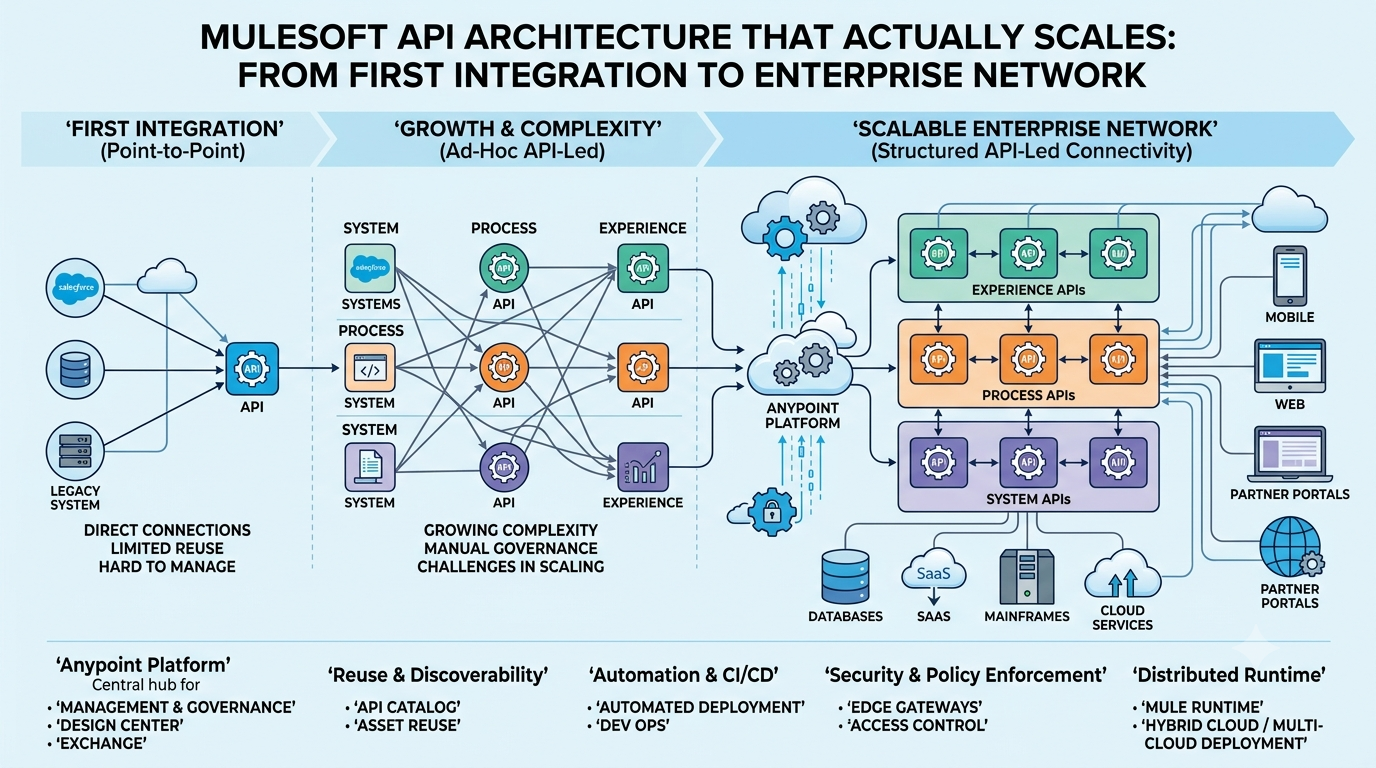
Building the first API integration is rarely the difficult part. A team connects an application, exposes the required data, tests the flow, and moves on to the next requirement. The real challenge appears months later, when more applications start depending on those same integrations. A CRM gets connected to an ERP, a mobile application needs customer information, a partner portal requires order data, and suddenly the API landscape is much larger than anyone originally planned.
This is where architecture starts to matter. A MuleSoft implementation can work perfectly well from a technical perspective and still become difficult to maintain if responsibilities are unclear, business logic is scattered, or every new application requires another custom connection.
A scalable API architecture is therefore not simply about adding more APIs. It is about making each connection purposeful, reusable, understandable, and flexible enough to survive business changes. For professionals looking to build these skills, a muleSoft course can provide the technical foundation needed to understand API-led connectivity and approach real-world integration challenges with greater clarity.
Build APIs Around Business Needs, Not Technical Layers
One common mistake when planning an API-led architecture is starting with the technology instead of the problem. Teams may immediately ask whether a requirement belongs in a System API, Process API, or Experience API. Those layers are useful, but they should support the business requirement rather than become the requirement themselves.
A better starting point is to understand what the application or business process actually needs. Suppose an organization wants to build a customer service application. The application may need customer information, recent orders, payment status, and delivery details. Instead of beginning by creating several APIs simply because different backend systems exist, the team can first identify the business capabilities involved and then determine how MuleSoft should expose and combine them.
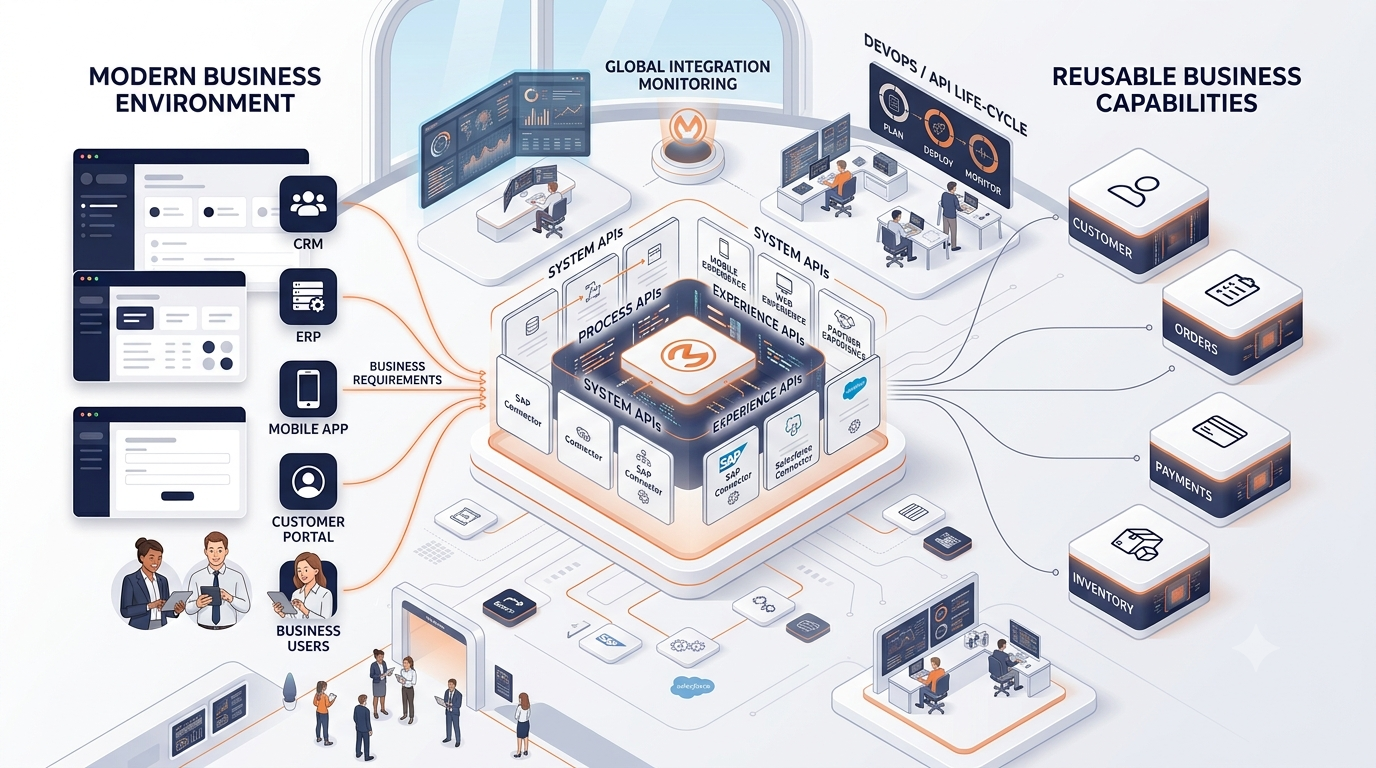
This approach also prevents unnecessary architecture. Not every small requirement needs multiple API layers. Sometimes a straightforward integration is enough. In other situations, separating system access from business orchestration creates significant long-term value. The important question is not, “How many API layers should we create?” It is, “What responsibility needs to be separated, reused, or protected?” That small change in thinking can have a major effect on the architecture.
Give Every API One Clear Responsibility
As an integration environment grows, unclear ownership becomes one of the biggest sources of confusion. An API that initially handled one simple task may gradually collect additional transformations, business rules, validations, and consumer-specific requirements. Eventually, changing one part of the flow can affect several applications.
A clearer approach is to give every API a well-defined job.
System APIs can provide controlled access to underlying systems such as Salesforce, SAP, databases, or other applications. They create a layer between consumers and the technical details of those systems. A consumer should not need to understand how a particular backend stores its customer records. Process APIs can combine information or coordinate business processes. For example, creating a complete customer order view might require information from a CRM, inventory system, and payment platform. The process layer can bring those pieces together around a meaningful business operation.
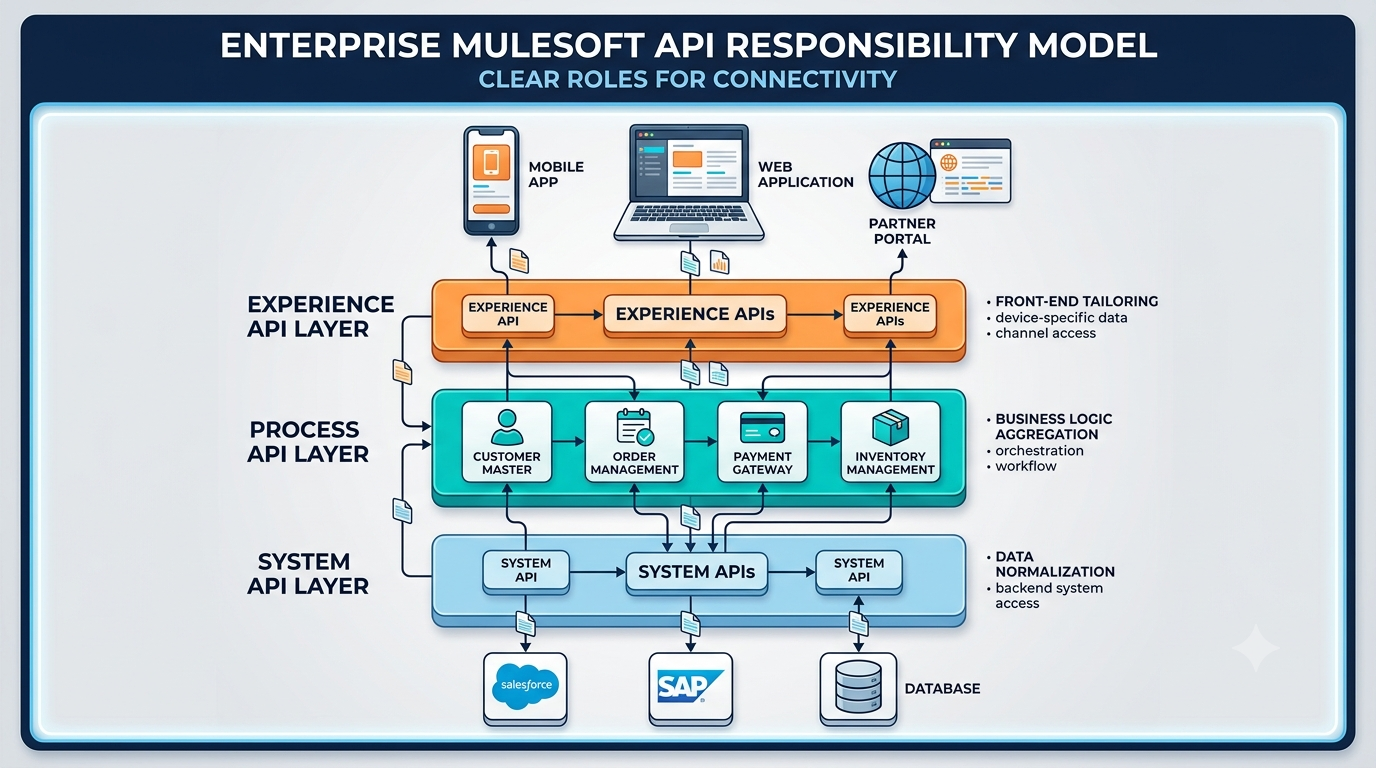
Experience APIs can then shape information for a particular consumer. A mobile application may require a compact response, while a web portal may need additional information and a different structure. The purpose of these boundaries is not to create more components for the sake of architecture. It is to make responsibilities easier to understand. When developers can quickly answer the question, “What is this API responsible for?” they can also make changes with greater confidence.
Design for Reuse Without Creating Unnecessary Complexity
Reuse is one of the biggest attractions of API-led connectivity. Instead of repeatedly connecting every application directly to every backend system, organizations can create reusable capabilities that different consumers can access. But there is an important difference between an API that could be reused and one that is actually useful for reuse. Imagine a team creates an endpoint specifically for one mobile application's screen. The endpoint works perfectly, but another application cannot easily use it because the response contains consumer-specific fields and logic. Technically, it is an API. Practically, it has very little reuse value. Useful APIs are designed around capabilities that make sense beyond one immediate request. Clear resource names, predictable contracts, meaningful responses, documentation, and consistent behavior all contribute to reuse.
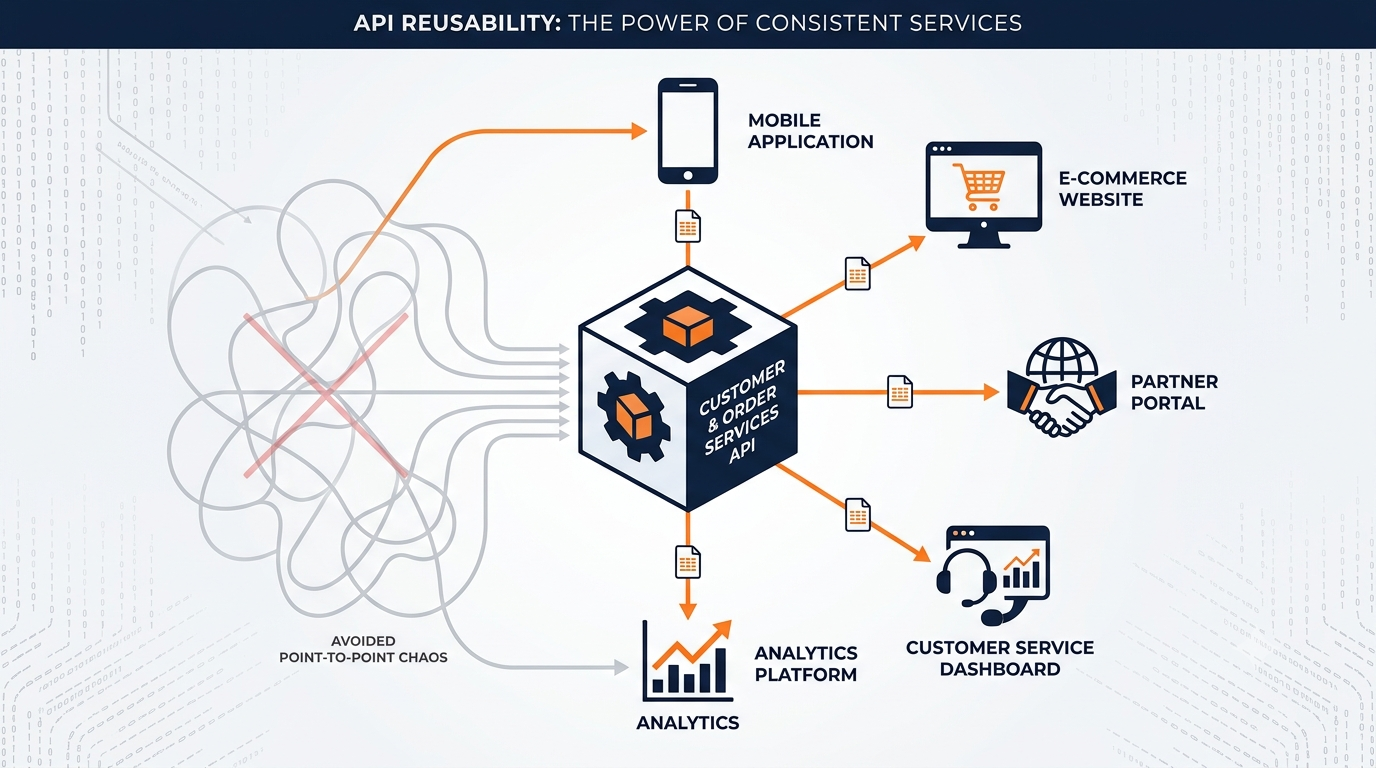
However, reuse should not become an excuse for building overly complicated APIs. Trying to make one endpoint satisfy every possible consumer can result in confusing contracts and unnecessary flexibility. A better approach is to identify capabilities that genuinely have multiple consumers and design those capabilities carefully. Reuse should reduce duplication, not introduce another layer of complexity.
This is particularly important in enterprise environments, where the same customer, product, order, or payment information may eventually be needed by several applications.
Keep Data, Transformations, and Business Logic in the Right Place
Data transformation is unavoidable in most integration projects. Different systems rarely represent information in exactly the same way. One application may use customer_id, another may use customerNumber, while a third may require a completely different structure.
The challenge is deciding where those transformations should happen.
When transformations and business rules are scattered across multiple flows, an otherwise simple integration can become difficult to follow. A developer investigating an issue may need to inspect several APIs just to understand how one field changed between the source and destination. Consider an order placed through an online store. The storefront may send a simple order request, while the backend system requires customer information, product identifiers, pricing details, shipping information, and internal codes. Some transformation is necessary. But the architecture should make it clear which layer owns that transformation and which layer owns the actual business decision.
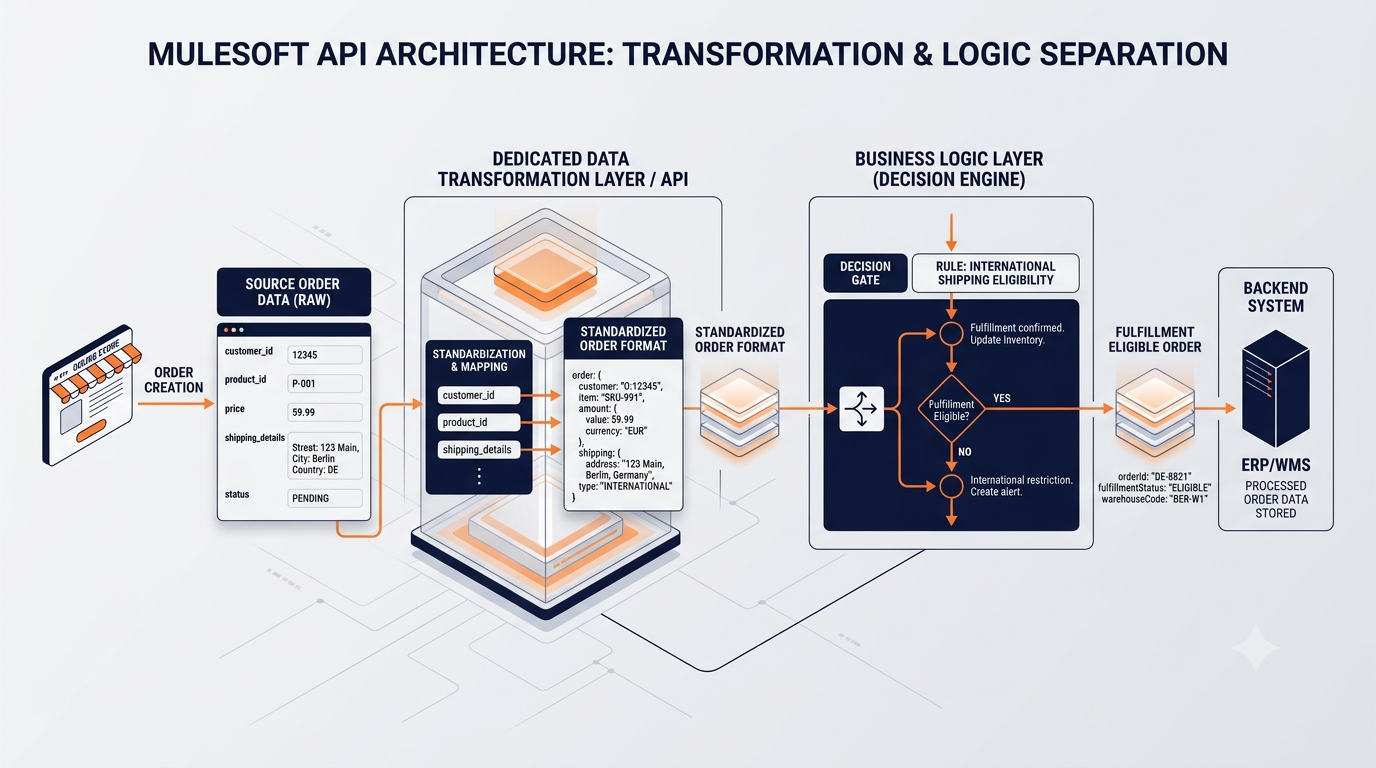
For example, converting a backend-specific field into a standardized API response can belong near the boundary where that backend is exposed. A business rule such as deciding whether an order qualifies for a particular fulfillment process is a different responsibility.
Keeping those concerns separate makes the flow easier to understand. It also helps developers identify problems faster because each part of the integration has a clear role. It creates another important benefit when systems change. If a backend application is replaced later, developers should ideally be able to change the system-specific integration without rewriting every consumer that depends on the business capability. Understanding these architectural boundaries is also an important part of muleSoft certification, where practical knowledge of API-led design and integration patterns goes beyond simply knowing individual platform features.
Make Your APIs Ready for Change
Business requirements rarely remain fixed. A customer portal that initially needs five fields may eventually need ten. A company may replace its CRM, introduce a new payment provider, expand into another region, or launch a mobile application with completely different requirements.
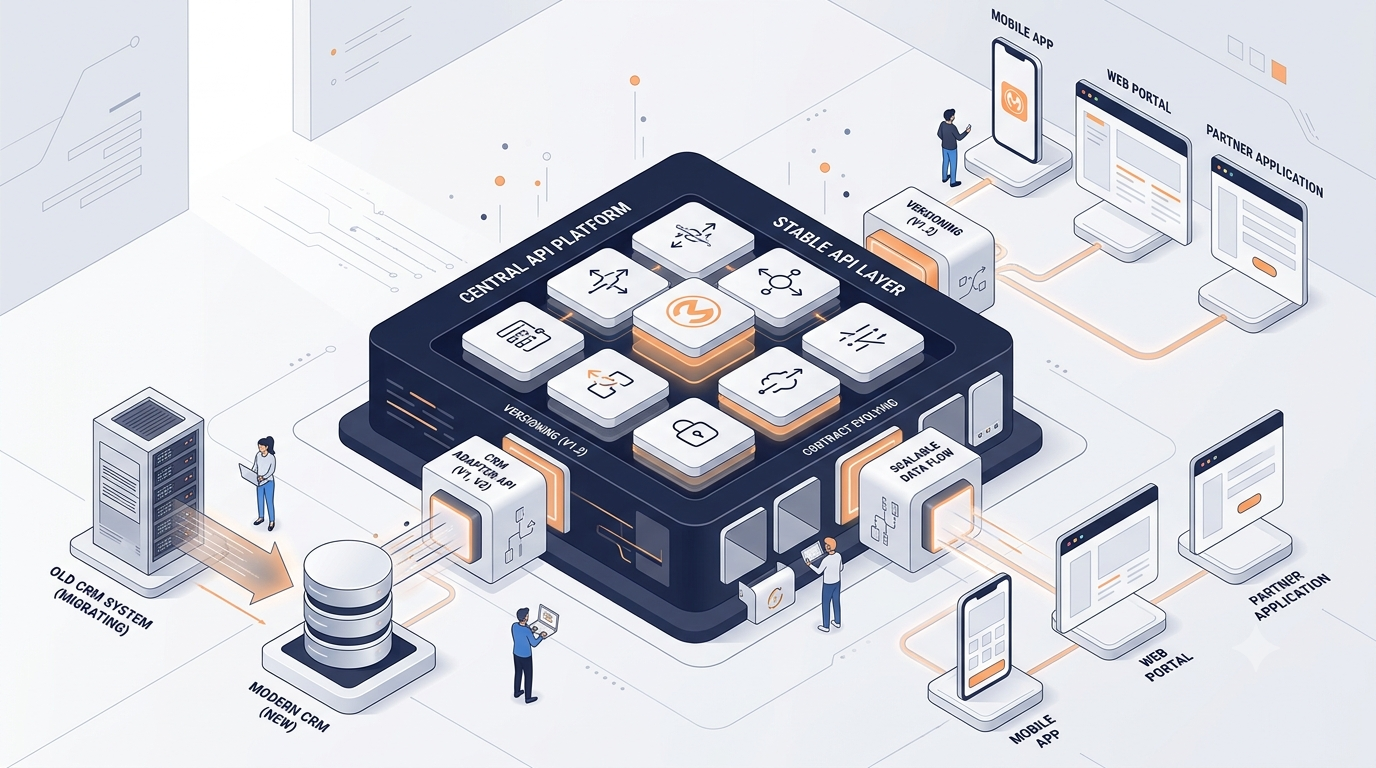
Good API architecture anticipates change without trying to predict everything.
One useful principle is to avoid exposing unnecessary backend details through public-facing contracts. The more tightly an API mirrors an underlying system, the more likely consumers are to become dependent on that system's internal structure. Versioning also becomes important when contracts need to evolve. Changes should be planned so that existing consumers are not unexpectedly broken. Clear documentation and communication around API changes can be just as important as the technical implementation.
At the same time, designing for change does not mean creating a complicated architecture full of hypothetical features. Overengineering can be just as problematic as underengineering. The goal is balance. Build the capabilities that have a real purpose today, create reasonable boundaries around them, and leave enough flexibility to adapt when the business inevitably changes. That approach keeps the architecture practical while still giving it room to grow.
Treat Security, Errors, and Monitoring as Part of the Architecture
An API architecture is not complete simply because requests successfully move from one application to another. Production systems also have to deal with failed requests, unavailable dependencies, unauthorized access, slow responses, duplicate operations, and unexpected data. Security should therefore be considered from the beginning rather than added after the integration is complete. Authentication and authorization determine who can access an API and what that consumer is allowed to do. Sensitive information should also be handled carefully throughout the integration flow.
Error handling is equally important.
Suppose an order API depends on an external payment service. What happens when that service is temporarily unavailable? Should the request be retried? How many times? What response should the consumer receive? Could retrying create a duplicate transaction?
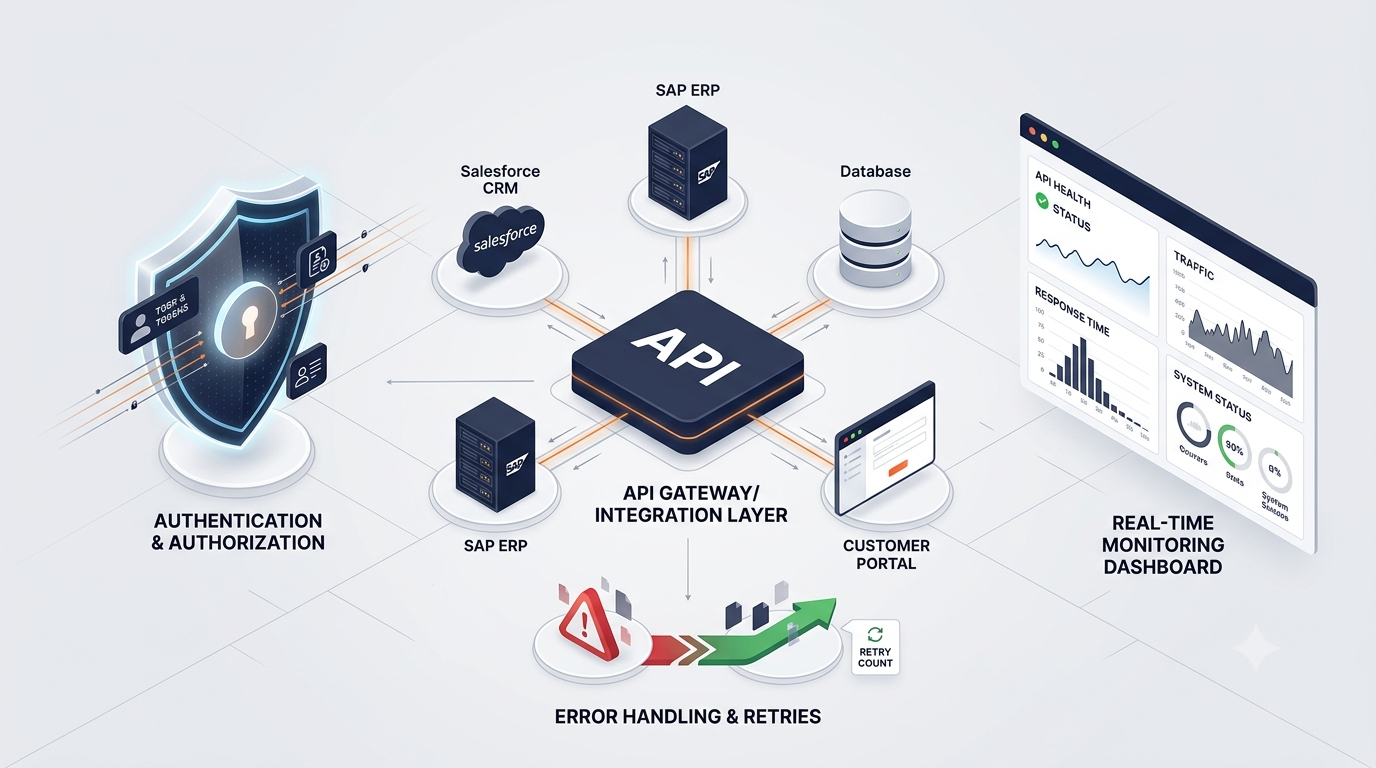
These are architecture questions, not simply coding details. Monitoring provides another important layer. Developers need enough visibility to understand where failures are occurring and how integrations behave in production. Meaningful logs, appropriate metrics, alerts, and traceability can significantly reduce the time required to diagnose problems. An API that works only when everything goes perfectly is not truly production-ready. A mature architecture considers both the normal path and the failure path.
Build a MuleSoft Architecture That Gets Easier to Grow
The real test of an API architecture comes when the next requirement arrives. Imagine an organization already has APIs exposing customer information, order data, inventory, and payment capabilities. A new customer mobile application now needs to display a personalized order summary.
With a well-organized architecture, the team can reuse existing capabilities and create only the additional experience-specific logic required by the mobile application. Without those boundaries, the team may create another direct connection to the CRM, another connection to the order database, and another custom payment integration. The new application works, but the overall architecture becomes more fragmented.
Over time, every new application repeats the same pattern.
This is why scalability should be viewed beyond infrastructure and performance. An API architecture should also scale organizationally and operationally. Developers should be able to understand existing integrations, reuse appropriate capabilities, introduce new consumers, and replace backend systems without causing unnecessary disruption. The strongest API landscapes are not necessarily the ones with the largest number of APIs. They are the ones where each API has a clear reason to exist and where existing capabilities can support new business requirements. That is the real value of an API-led approach.
Conclusion: The Goal Isn't More APIs. It's Better Connections
MuleSoft can provide the technical foundation for building a connected application environment, but architecture decisions ultimately determine how useful that environment becomes over time. A scalable approach starts with business requirements, gives APIs clear responsibilities, encourages meaningful reuse, keeps transformations and business logic in appropriate places, and prepares integrations for change. Security, error handling, and monitoring then ensure that those APIs remain reliable once they move into production.
For professionals building their integration skills, muleSoft training can also provide a strong foundation for understanding these architectural concepts and applying them to real-world integration scenarios. Learning the platform is important, but knowing how to make practical architecture decisions is what helps turn technical knowledge into useful solutions. The objective is not to create an impressive collection of APIs. It is to create an integration environment where applications can connect to the capabilities they need without repeatedly rebuilding the same connections. When that happens, every new integration does more than solve one immediate requirement. It becomes another building block that can support what comes next.