
MuleSoft Exchange: Managing and Reusing APIs and Connectors
Last updated on Nov 10, 2026
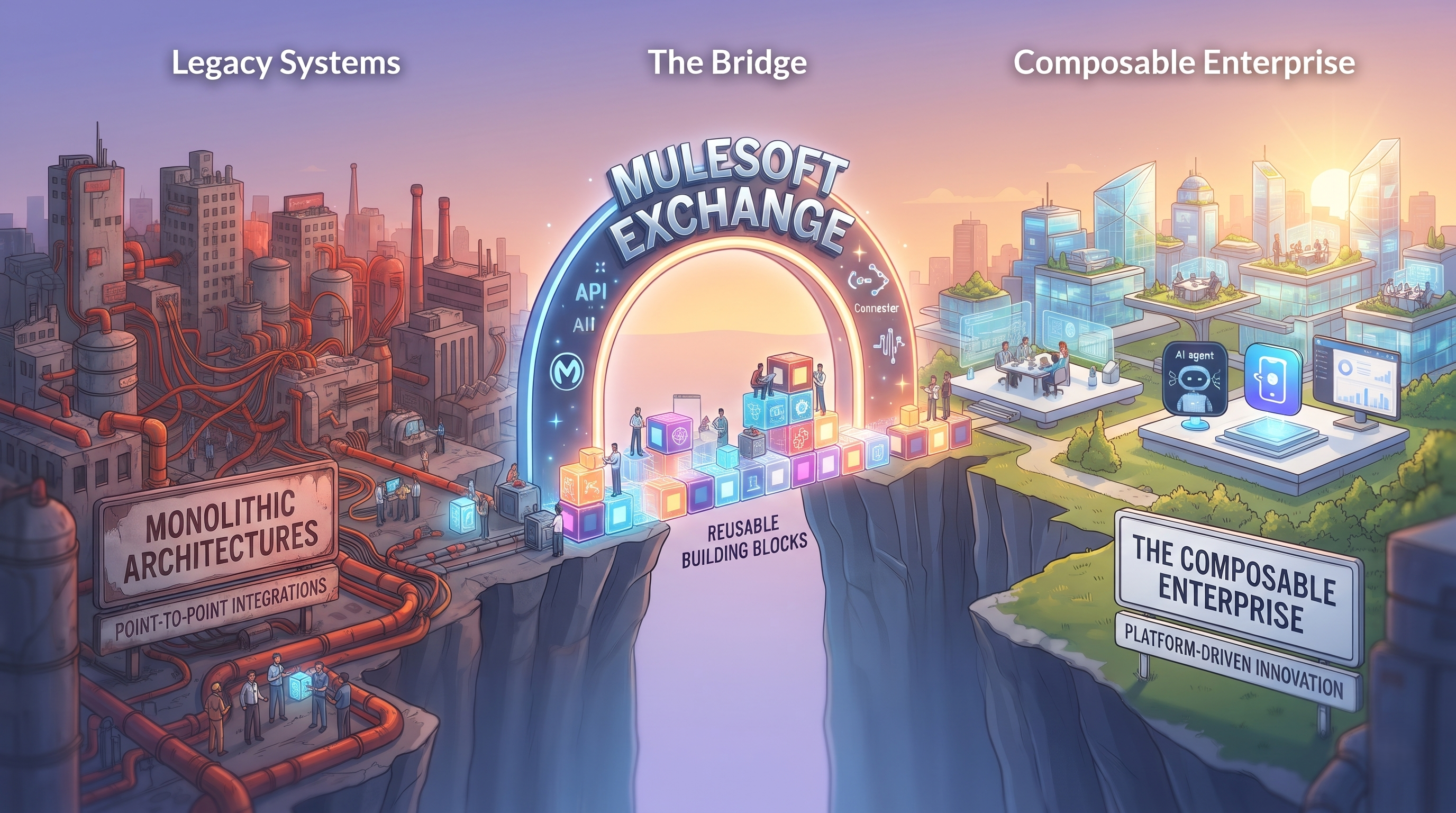
Introduction to the problem of enterprise integration
Today’s enterprise architecture is experiencing an unprecedented explosion of disparate data sources, SaaS applications, legacy on-premises systems and microservices. Organisations are pressured to deliver digital initiatives faster, simplify customer experiences, and operationalise real-time data insights. But this velocity often runs into a hard architectural bottleneck:
integration silos. Previously, enterprise development teams would create custom point-to-point integrations for each new project. These fragile integrations led to complex, unmaintainable webs of code that were often referred to as “spaghetti integration.” If one source system changed, multiple downstream applications would break, forcing organisations to spend an outsize portion of their IT budgets simply maintaining existing integrations rather than innovating.
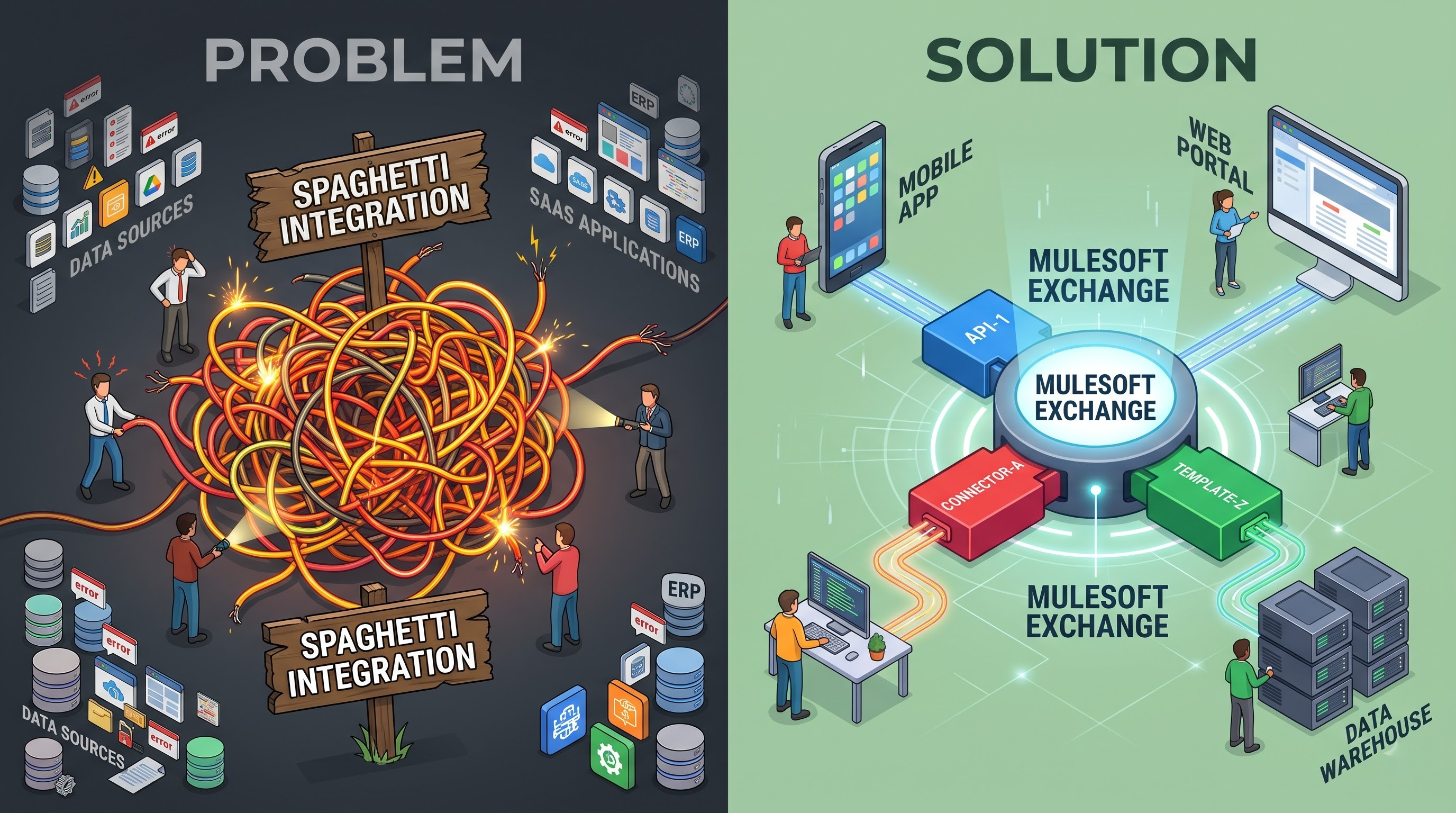
To break this cycle, today’s IT leaders are moving toward a composable enterprise model. Composable enterprise is the packaging of business capabilities into modular, reusable building blocks, which are exposed through Application Programming Interfaces (APIs). This approach opens up development to a wider audience, empowering teams to build new digital products off of existing capabilities rather than reinventing the wheel.
MuleSoft Exchange is at the heart of this paradigm shift in the MuleSoft Anypoint Platform. Exchange is the center, marketplace and single source of truth for an organization’s entire integration ecosystem. It is meant to store, share, discover and manage reusable enterprise assets, from custom REST APIs and RAML fragments to pre-built connectors, integration templates and AI agents. MuleSoft Exchange brings these assets into a central location to connect producers and consumers and foster a collaborative culture of reusability which dramatically reduces project delivery timelines and operational redundancy.
For developing expertise in these compositional architecture practices and understanding how to work around platforms such as Anypoint Studio and Exchange, most professionals register for an mulesoft course.
Asset Reusability as a Strategic Imperative

Reusability is not just a technical optimisation, but a key economic and strategic driver of modern software engineering. In traditional software development lifecycles, teams frequently replicate work. Two independent business units within the same global enterprise might build separate integrations to connect to exactly the same core Customer Relationship Management (CRM) or Enterprise Resource Planning (ERP) platform. Every team has its own authentication routines . Each team parses errors on their own and develops their own error handling strategies . Duplication leads to wasted engineering time, inconsistent data governance and a larger attack surface for security vulnerabilities.
Moving to an asset-driven model of reuse, aided by tools such as MuleSoft Exchange, shifts organisations from siloed project delivery to platform-driven product delivery. In this model, an API or connector is treated as a product with a defined lifecycle, clear documentation and dedicated versioning. A developer who needs to retrieve customer data or initiate a financial transaction doesn’t write code from scratch. Instead of fighting with Exchange, they look for an enterprise-approved asset, review its specs and add it to their workspace in minutes.
The velocity has important implications on total cost of ownership. Development cycles go from months to weeks, or days. Maintenance overhead drops off a cliff, as well. If an underlying back-end system is upgraded or a security protocol changed, IT teams simply need to update the centralised API or connector that is published in Exchange. With version updates, the fix is automatically pushed out to downstream applications. There’s no need to locate and patch a dozen individual point-to-point scripts. In the end, asset reusability moves IT from a cost center to a flexible driver of business growth.
Core Architecture & Anatomy of MuleSoft Exchange
To understand how MuleSoft Exchange delivers this level of operational efficiency, one must look at its architectural foundations. Exchange is deeply embedded throughout the Anypoint Platform, where design, development, management and discovery all come together.
Exchange is, fundamentally, a searchable repository that indexes a wide variety of digital resources. Unlike simple document storage tools, Exchange knows the semantic structure of integration assets. It can parse API specifications, read data schemas, extract endpoint definitions and render interactive documentation automatically.
Classes of Assets
Exchange has a broad range of artefact taxonomies, ensuring that every layer of an integration project is covered:
APIs: Complete RAML (RESTful API Modelling Language) and OpenAPI (OAS) specifications including resource paths, methods, query parameters and response payloads.
Connectors: Pre-built modules that let you talk to external endpoints including databases, messaging queues, SaaS platforms, and enterprise applications.
Templates: Pre-built integration templates that address common architectural patterns such as Salesforce to SAP account synchronisation or batch data migration.
Functional Mule applications demonstrating how to implement specific patterns, error handling routines or connector configurations.
Enterprise Governance: Policies, RAML fragments, Data Types, Documentation portals. Custom Artefacts.
The Publishing & Consumption Lifecycle
The lifecycle in Exchange is based on continuous collaboration. Producers (enterprise architects, center for enablement (C4E) teams, and lead developers) create assets based on organisational standards and then publish them to Exchange. When published, these assets are automatically validated and human-reviewed where required by governance policies.
Consumers, including application developers and citizen integrators and line-of-business technologists, search Exchange by keyword, tag or category. They evaluate the asset by checking its documentation, checking sample payloads, and testing endpoints right in the browser with built-in mocking services. When the customer is happy, they can either drop the asset directly into their IDE (like Anypoint Studio) or reference it through build tools like Maven.
API-Led Exchange and Connectivity
API-Led Connectivity is the architecture vision that MuleSoft is pursuing. This methodology considers integration as a conscious, layered network of APIs rather than a single point-to-point code exercise. The working catalogue of this three-level architecture is Exchange:
[ Experience APIs ] -> Expose channels (Web, Mobile, Partner Portals)
[ Process APIs ] Orchestrate business logic across systems
[System APIs] -> Unlocking core data from underlying monoliths and databases
System API
System APIs provide an abstraction of complex core systems such as legacy mainframes, SAP ERPs or proprietary databases at the foundational layer. They expose the underlying data in a canonical, standard format. When an organization publishes System APIs to Exchange, any developer needing access to core enterprise data will interact with a secure, governed interface rather than query the databases directly. This helps keep core systems from being overwhelmed and isolates changes in the backend from frontend applications.
API Processes
Process APIs are above the system layer. These assets integrate and orchestrate data from one or more System APIs to support specific business processes like calculating customer lifetime value, processing an order fulfilment workflow, or onboarding a new employee. Exchange Publishing Process APIs helps stop business units from rewriting the same orchestration logic over and over because Process APIs encapsulate core business logic.
APIs experience
The top layer is Experience APIs which customises data to the consumption channel that requires it. The same underlying data often needs to be shaped differently and optimised for different payload and performance constraints for a mobile application, a customer-facing web portal, and a partner dashboard. That’s where experience APIs come in. They are published to Exchange, which provides frontend developers with clean, purpose-built endpoints that speed UI development.
APIs in Exchange: Governance, Versioning and Collaboration
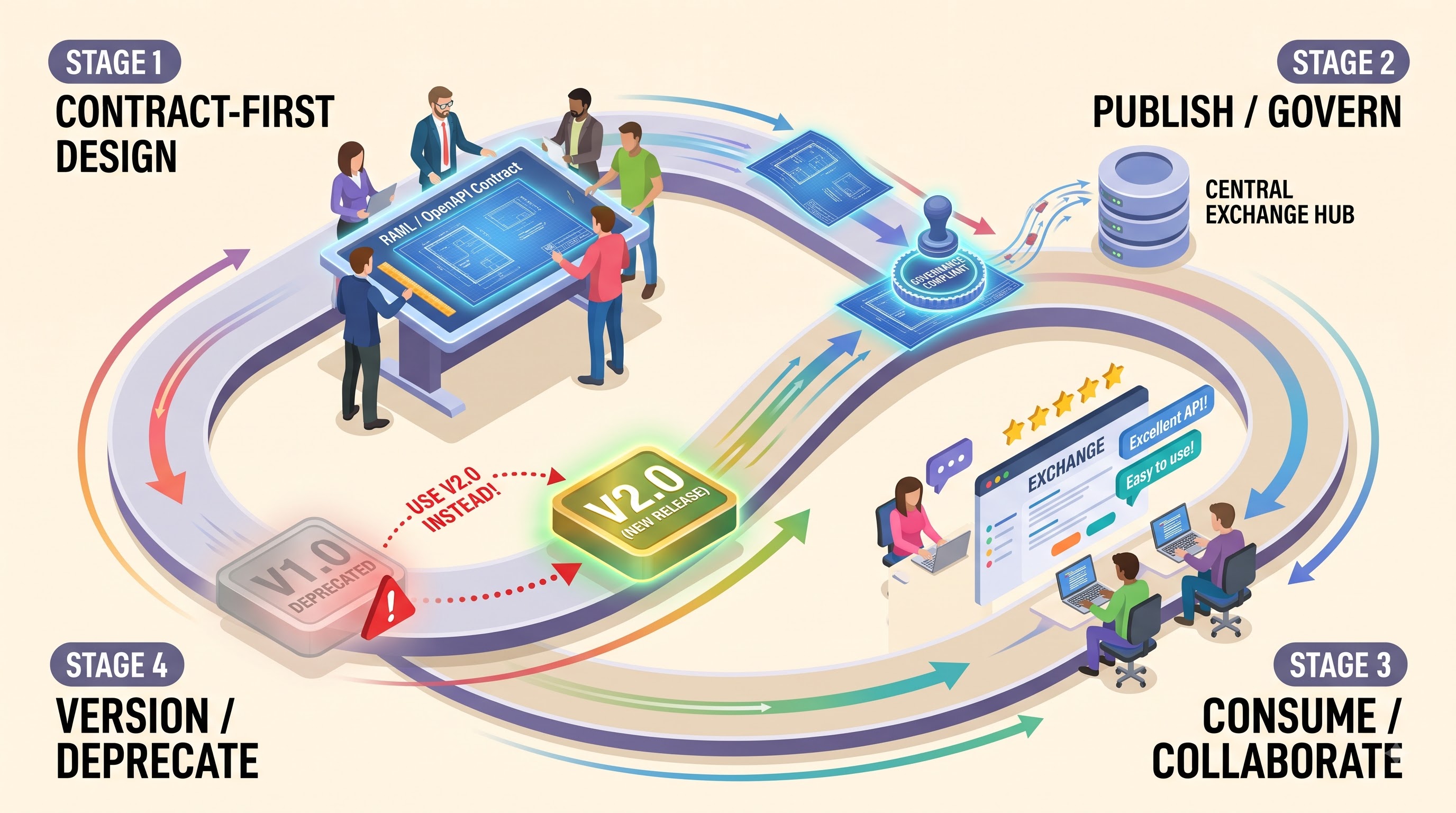
Enterprise APIs need to be well governed, but not at the expense of developer agility. With MuleSoft Exchange you get powerful tools that help you enforce quality, security and consistency across all of your published assets.
Contract-First Design and RAML Fragments
The design-first (or contract-first) approach is one of the cornerstones of modern API management. Architects design the API contract in RAML or OpenAPI specifications before a single line of integration code is written. Exchange makes this possible by allowing teams to publish these specifications early in the development lifecycle.
Exchange also supports RAML Fragments, reusable parts of API definitions like data types, security schemes, resource types and traits. As an example, an enterprise may want to define a standard error response schema or an OAuth2 security scheme once as a fragment, publish it to Exchange and have all development teams import it into their API specifications. This makes sure that each API created by the enterprise is consistent.
Asset Lifecycle States and Semantic Versioning
APIs and connectors have to change as business needs change. Uncontrolled updates can break downstream client applications and cause catastrophic production outages. Exchange uses Semantic Versioning (Major.Minor.Patch) to handle changes transparently.
Major versions are breaking changes that require client migration.
Minor releases add new functionality that is backward compatible.
Patch releases include bug fixes and are backward compatible.
It also enables publishers to assign lifecycle states to assets e.g. Draft, Published, Deprecated or Archived. Deprecation of an API means consumers browsing Exchange get clear visual warnings and recommended alternative assets so they can avoid ageing technology without suffering abrupt operational failures.
Reviews, Ratings & Social Collaboration
Enterprise software development is collaborative by nature. Exchange adds social features like those in app marketplaces today. Users can rate assets, write reviews, report bugs and ask questions directly on the asset’s page. This feedback loop allows publishers to continue improving their assets, address edge cases, and learn who is consuming their services. C4E teams can monitor these interactions to identify high-value assets that deserve promotion to the enterprise and low-performing assets that require refactoring.
Dealing with Connectors: Extending Enterprise Reach
Custom APIs execute custom business logic. Connectors are out-of-the-box integrations that enable Mule applications to communicate with external platforms. The MuleSoft ecosystem also offers hundreds of certified connectors to popular enterprise software, from Salesforce to ServiceNow, SAP, Workday, Amazon Web Services, Microsoft Azure, Google Cloud, and many database systems and messaging protocols.
Out-of-the-Shelf or Custom Connectors
Exchange offers ready-made connectors that greatly reduce the development effort. Rather than writing complex low-level integration code to handle SOAP envelopes, REST protocols, authentication handshakes and connection pooling for a third-party SaaS platform, a developer simply drags a certified connector onto their canvas, configures credentials and starts mapping data.
But many companies still use proprietary internal systems, legacy protocols or specialised industry-specific software that lacks a public connector. Using the Mule SDK, MuleSoft Exchange lets organisations build and publish Custom Connectors. Once built and published to Exchange, a custom connector is instantly available to all developers in the enterprise and is just as easy to use as certified, out-of-the-box connectors. This means that special enterprise logic is encapsulated once, and reused globally.
Connector Governance & Security
Connectors often deal with sensitive enterprise credentials, API keys, and Personally Identifiable Information (PII). Exchange is the key governance checkpoint for these modules. IT administrators can restrict which connectors are available to certain business units, enforce compliance policies, and approve only security-vetted versions of connectors for use in production applications. If a third party library used in a connector has a vulnerability, security teams can use Exchange analytics in order to quickly identify which applications in the enterprise are using that particular version of a connector and move quickly to remediate.
Center for Enablement (C4E) and Exchange

Implementing MuleSoft Exchange is more than simply provisioning software licenses. It is a cultural shift in the organization. Many enterprises create a Center for Enablement (C4E) to drive this transformation. A C4E is an inner-source community instead of the traditional top-down Command and Control IT governance groups that often become bottlenecks.
The C4E is responsible for seeding Exchange with core assets, establishing naming conventions, setting documentation standards, and collecting high quality templates. C4E views internal developers as customers of digital products, creating an environment that values and acknowledges code sharing. The C4E needs a metrics dashboard to measure success: How many assets were reused, how many consumers adopted the asset, how fast was the asset published, and how much is the C4E accelerating project delivery across business units? Exchange provides the metrics dashboard.
Building a good internal source environment would involve training of the engineering team. In most cases, it is common for the majority of companies to opt for a mulesoft training program because it ensures that the developers are able to work with the integration patterns, APIs, and assets immediately from the outset.
Optimizing Exchange Effectiveness: Best Practices
In order to benefit fully from the MuleSoft Exchange, there are best practices that an organization should take into consideration, which include:
Complete Documentation: Publishers need to ensure that the assets have adequate descriptions, authentication, request samples, and expected responses. Take full advantage of Exchange’s support for Markdown and interactive mocking services.
Foster a Discover-Before-Build Culture: Development teams must be required to look for existing Exchange solutions before starting any new integration projects. If there is an asset that meets eighty percent of a requirement, it should be extended, not rebuilt from scratch.
Implement rigorous curation and tagging. A cluttered repository leads to low adoption. The C4E should have strict rules for categorisation, tagging and naming of assets so assets can be easily found.
Track Asset Usage and Deprecation Cycles: Leverage the analytics that Exchange makes available to periodically scan for unused or stale assets. Define clear deprecation timelines to safely deprecate legacy integrations.
CI/CD Pipelines Integration with Exchange: Automate publishing Automatically build, test and publish integration specs and custom connectors to Exchange via CI/CD pipelines (e.g. Maven, Jenkins) so that the repository always reflects the latest production-ready artefacts.
Summary
In today’s digital economy, speed-to-market and operational efficiency, and agility are the ultimate factors that determine business survival. In a world where technology moves at lightning speed and SaaS ecosystems sprawl, monolithic architectures and custom point-to-point integration strategies are no longer viable.
Organisations are under constant pressure to innovate and continuously improve, while at the same time maintaining stability, security and governance across increasingly complex digital environments. Traditionally, engineering teams spent valuable time and resources building custom integrations, writing redundant code, and solving the same connectivity problems in silos across different business units over and over again. This led to brittle environments, expensive maintenance and slowed digital transformation initiatives.
MuleSoft Exchange is the definitive operational center for addressing these integration challenges. Exchange centralises the discovery, management and reuse of APIs, connectors, templates and integration assets to enable enterprises to break down data silos and achieve a truly composable architecture. Exchange is not a collection of standalone projects. It is a collaborative marketplace of digital building blocks that are shared, versioned, and managed as enterprise products. With disciplined governance, semantic versioning, contract-first design, and a vibrant inner-source culture championed by a Center for Enablement, organisations can transform their IT delivery model.
MuleSoft Exchange ultimately frees engineering from redundant, repetitive coding and toward high-value innovation so enterprises can deliver exceptional digital experiences faster, safer and at a scale previously thought impossible.
For developers and architects aiming to get expertise in this technology and develop their career in enterprise integration, undergoing structured mulesoft online training is essential for gaining the right skills to develop and publish their assets in MuleSoft Exchange.