
MuleSoft Integration Architecture: Choosing Between Anypoint MQ and Apache Kafka for Event Pipelines
Last updated on Aug 26, 2026
Enterprise architectures have changed forever, moving from the traditional centralized model to the more advanced event-driven framework. In traditional integration models, synchronous communication models like REST and SOAP combined with HTTP were sufficient for point-to-point communications. But as corporate IT environments moved toward hybrid-cloud, SaaS, and edge computing approaches, it became increasingly clear that an old synchronous communication model was a hindrance rather than an advantage. A host of issues, including cascading failures, thread pool exhaustion, latency amplification, and fragile consumer connections have made the transition to event-driven architecture necessary.
In this context, the main challenge of architecture becomes not simply the realization that systems should be decoupled but the importance of choosing the right communication system behind it. Large companies frequently evaluate two very powerful yet very different messaging systems, namely MuleSoft’s very own cloud messaging system, Anypoint MQ, and the popular event streaming system, Apache Kafka.
In terms of asynchronous communication capabilities, both methods operate on different principles. While Anypoint MQ relies on the methodology of transient brokered work queues for B2B transactions using Anypoint technology stack, Apache Kafka is built by creating an immutable commit log for high speed stream processing combined with an unlimited storage of events. Learning the differences in approaches is one of the essential goals of any mulesoft developer course, as the right choice lies in good understanding of the models, their scalability and cost of operations.
Architectural Principles Explained: Message Queues vs. Commit Logs
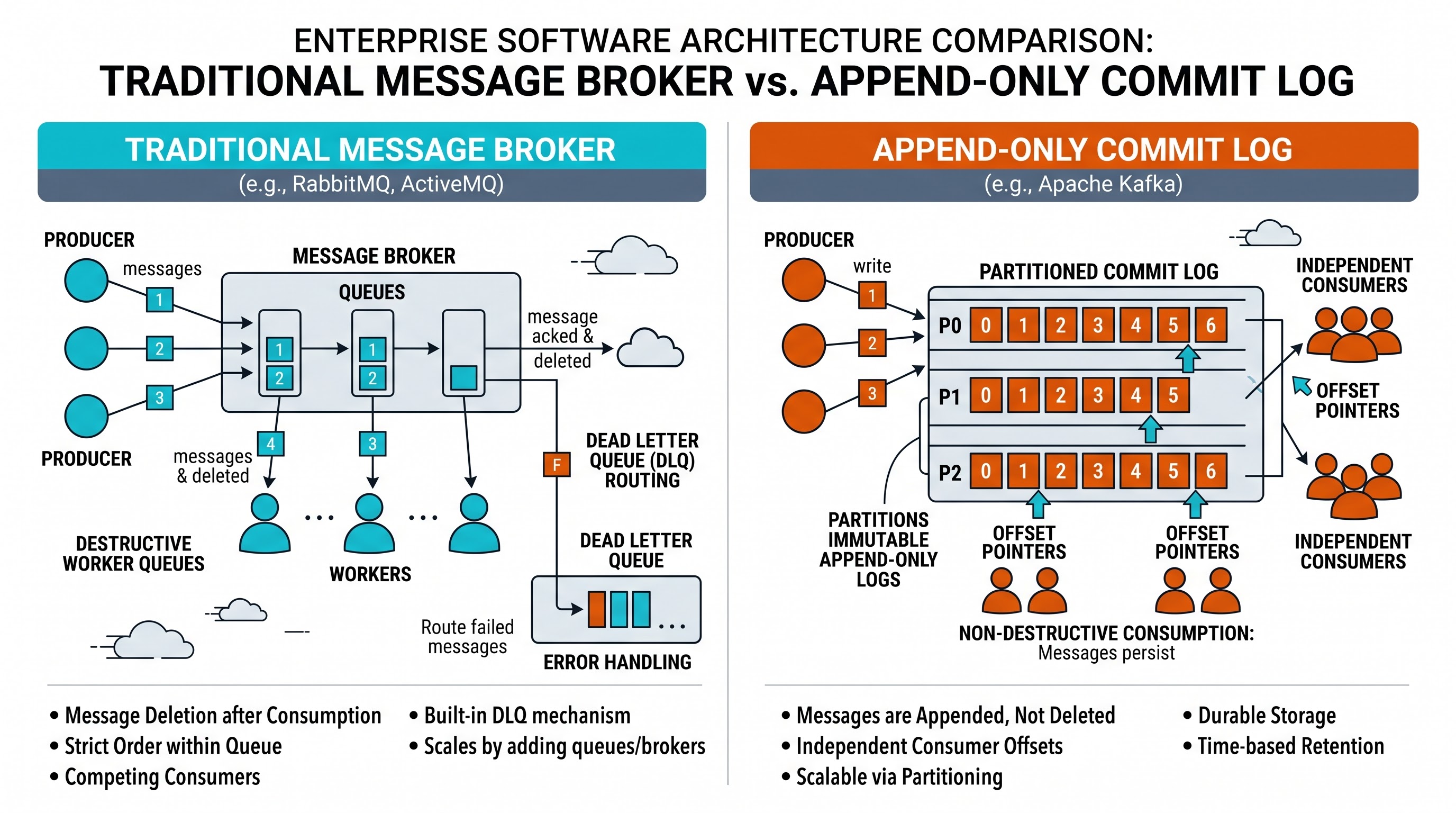
Before making an architectural choice, it is necessary to understand the mechanical differences between a standard message queue and a distributed commit log.
The Broker Model: the Durable Work Queue and Intelligent Brokers
Anypoint MQ is classified as being one of the conventional kinds of software that forwards messages. In the defined design, the primary broker possesses a degree of intelligence, keeping in mind user information related to the status of messages read, locked, acknowledged, or rejected.
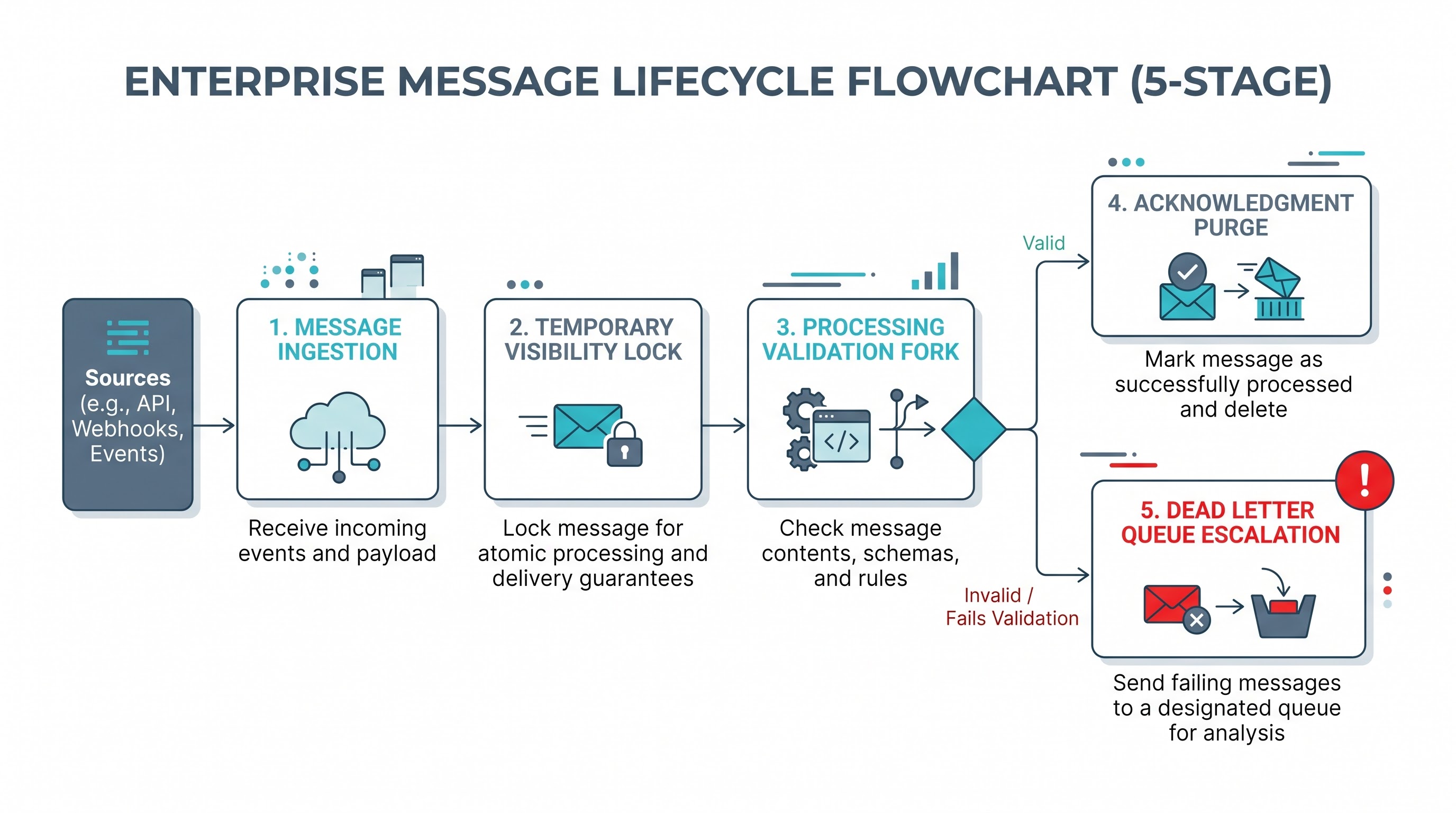
Process of managing lifecycle of messages in the broker, such as Anypoint MQ, proceeds with the help of temporary status:
First of all, messages are loaded into particular queues or redirected through the exchange before arriving at predefined queues.
As a next step, the broker locks the message (bad to other employees) in the case a user (consumer) asks for smth (messages).
Provided the consumer has managed to conduct the processing successfully, it sends back the informative note about the completion of the operation, which leads to deleting the messages from the database.
Otherwise, in case of unsuccessful processing, the message goes back to an option of retransmission, whereby the message is directed to the next consumer and may reach the Dead Letter Queue (DLQ) in case the retries exceed the allowed maximum.
This is a fatal approach as far as the reading process is concerned. After being read and confirmed, the data disappears from the broker. The key idea behind this design is the distribution of jobs between different workers: different jobs must go to different consumer workers, so they will be processed correctly and all of them will be deleted right away.
The commit log which is distributed: one way or another
Apache Kafka does not use intelligent brokers and destructive reads. Instead, Kafka is built in the form of a distributed, write-only commit log.
The process begins with producers publishing their event logs into a specific topic. Each topic has partitions replicated across a set of broker nodes in the cluster for fault-tolerance purposes.
Every time an event is appended to a partition, it is assigned an immutable identifier that grows monotonically and is called an offset.
Messages are not removed after they are consumed. Multiple independent consumer systems may read the same partition at different rates.
The broker takes a back seat regarding the intermediate states of messages. The consumers keep track of their own position in the log by committing their latest offset back to the internal topic of Kafka
Event logs remain on brokers for a certain period of time according to some retention policy (having been read zero or one million times). It is a non-destructive and replayable log approach. The main design goal is continuous publication of events; at which, an unchangeable stream of state changes occurring in real time can be obtained and analyzed.
It is a log model which does not cause damage to the system and can be replayed over and over again. The main goal is continuous publication of events. The language is completely different and describes quite well that the log is an immutable stream of real-time data which can be used by an unlimited amount of downstream consumers.
A thorough examination of Anypoint MQ: inherent flexibility of MuleSoft
Anypoint MQ is a service for messaging in the clouds offered by MuleSoft. It is a multi-tenant cloud-native platform and runs on the infrastructure built by AWS. It serves the purpose of standard message queueing and FIFO queueing, as well as publish-subscribe, and it does not require clients to manage the infrastructure by themselves (e.g. install patches, configure clustering protocol, manage usage of disk on brokers).
Core Architecture and Queue Processing
Anypoint MQ has two types of operating primitives: Queues and Message Exchanges.
Standard Queues provide high-availability, optimal message ordering, and at least once delivery. They deliver messages among competing worker threads or different instances of CloudHub applications. Standard queues experience occasional duplications under transient network partitions whereby messages may have different orders of arrival.
FIFO (First-In, First-Out) Queues provide strict delivery order and exactly-once processing at the broker level. FIFO queues utilize Message Deduplication IDs to remove duplicates from incoming payloads within the defined deduplication window. Moreover, FIFO queues use Message Group IDs to ensure the sequential processing of messages pertaining to a specific entity (for example, a single Customer ID). Understanding how these queue types work and how to configure them is the first step in achieving mcd level 1 certification.
Message Exchanges use the publish-subscribe pattern. The publishers send their payloads to the exchange. The exchange then transmits the message copies to the relevant queues. It allows different applications to receive the same event without the publisher being aware of the final recipients of the message.
Patterns of Reliability and Flow Control in Mule Runtimes
Anypoint MQ is strongly integrated with the Mule runtime through the Anypoint MQ Connector which offers a number of advantages for flows and error handling.
Mule flows take control over message lifecycles using immediate, auto, or manual acknowledgment modes. In manual mode, the developers do not send the acknowledgment until all the orchestrations across systems, such as ERP commitment and database updates, have been successfully accomplished. If sub-flow exceptions are not handled properly, a non-acknowledgment will be sent automatically. Real exercises in structured mulesoft classes often encounter precisely these examples of transactional flow control.
Visibility Timeout: When the Mule worker gets the message from the Anypoint MQ, it is placed into an invisible state. In the case of the worker crash, visibility timeout passes, and another acting Mule worker will get the message as well.
Dead Letter Queue (DLQ) Offloading: The Anypoint MQ provides a DLQ routing possibility. The developer sets a threshold for maximum redelivery attempts, and when it is crossed, every message which has been causing exception processing is sent automatically to a dead letter queue.
Elastic Scalability without Operations: Using the Anypoint MQ leaves no challenge in having to care about the balancing of cluster topologies, calculating the number of the needed partitions, and the size of disk volumes.
Limits and Operational Constraints
Although Anypoint MQ is low on technicalities, it still has limitations that make it not suitable for large-scale environments:
Payload Limitations: The technology has a limitation on the payload it can transmit, which stands at a maximum of ten megabytes, which means that most of the implementations will involve smaller payloads for processing JSON and XML.
Retention Limits: Messages cannot be stored indefinitely, with 14 days as the maximum time for keeping non-delivered messages.
Message Replay Impossibility: Once the message has been acknowledged and deleted, it cannot be delivered again. It cannot also revive the state of the system in the event of an application failure that corrupts its records.
Throughput Limits: Anypoint MQ can handle thousands of transactions per second, but it does not have the capability to handle millions of transactions and work in high throughput telemetry environments.
Discovering its Great Possibilities: Overview of Apache Kafka
Apache Kafka has been initially created by LinkedIn and contributed to the open-source community to help with the challenges of real-time collection and distribution of massive logs over the Internet scale. Apache Kafka is far from being just a message broker; it is also a highly scalable, durable distributed storage system that was built from scratch to support massive writes and parallel streaming processing.
Structure, structure of partitions, and the model of parallel processing
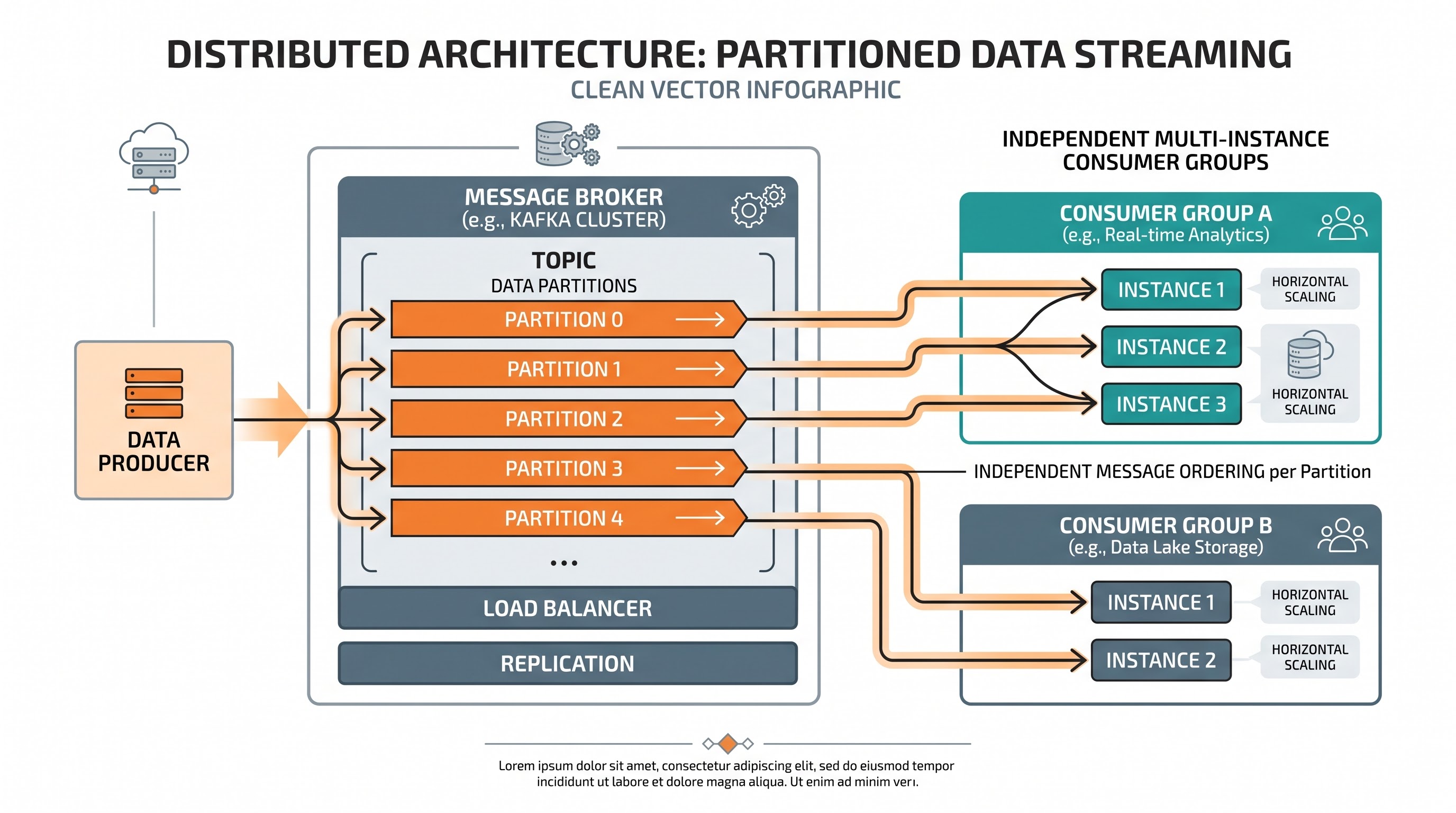
Kafka internals work with partitions, which enable the scalability and parallelism:
Topics and Partitions: A topic in Kafka is divided into one or more partitions across broker nodes. The producer, while creating the event, generates the hash for the key of the event (e.g., ID of a sensor or account) to decide the partition to which the record belongs.
Event Ordering inside a Partition: The strict ordering of events by Kafka can be done only inside one partition because global ordering is not provided. The state modifications of any entity will be always sent to the same partition using consistent hashing.
Consumer Groups: Kafka uses horizontal scalability through consumer groups. Several consumer instances form a group, and Kafka's group coordinator assigns certain topic partitions to each consumer that is active. Hence scalability is determined by the number of partitions: if a topic has sixteen partitions, then a consumer group can consist of up to sixteen active consumers who receive and process messages from the topic partitions.
Offset Management and Replayability
Kafka's offset management represents its most transformational feature:
Deterministic Cursor Management: Consumers manage their position in a partition by means of an integer offset. When messages are read by a consumer, it makes periodic commits of its current offset to Kafka.
Non-Destructive Consumption: Because the consumption process does not destroy or remove the messages from the log, consumers operate in a way that is completely independent of each other while consuming the very same topic.
Time Travel & Historical Re-consumption: In instances where a particular integration process introduces an error, the application can be fixed and rolled back to the offset for a particular timeframe, after which point messages can be consumed again.
Event Sourcing and State Reconstruction: Downstream stores, materialized views, or caches can restore their whole state from scratch by reading a Kafka topic starting from the offset zero.
The Ecosystem: Schema Registry, Connect, and Stream Processing
Kafka boasts an extensive open-source and commercial ecosystem that allows it to rise above simple message transport:
Schema Governance: Thanks to tools such as Confluent Schema Registry and Apicurio, Kafka ensures strict data contracts by means of Apache Avro, JSON Schema, or Protocol Buffers. This means that producers will be unable to send invalid events, while consumers will be shielded from breaking changes in API structure due to the presence of forward and backward compatibility mechanisms.
Stream Processing Engines: With tools such as Kafka Streams, Apache Flink, and ksqlDB, users are able to perform real-time windowing, stateful aggregations, stream-table joins, and complex anomaly detection over the data flows even before it ever reaches integration.
Log Compaction: Another great thing about Kafka is that it can be configured to store only the freshest value for every key within a partition indefinitely.
The significant capabilities of Apache Kafka are accompanied by a noteworthy level of operational complexity and maintenance challenges:
Infrastructure Maintenance: Self-managed Kafka clusters need careful monitoring of the available brokers, disk space, shrinkage of the allocated memory for JVM (Java Virtual Machine), performance of the operating system memory cache and pace of the network process. Even the managed clusters must keep in mind the goal of achieving a certain level of partition number, throughput of the cluster, and networking configuration.
Consumer Rebalancing Problems: Joining or leaving the consumer group induces the process of rebalancing of the Kafka consumers. This happens if the process of consuming data is disturbed and stuck because the worker thread is taken too much time waiting for data.
Architectural Inflexibility: Planning of the Kafka cluster’s development should take into account that once a topic has been partitioned in a specific way it means that execution of the coming partitioning strategy may lead to certain disturbances in the data flow since it will break the ordering process for the keys that were already consumed in a certain way.
A Comparative Analysis of Technical and Architectural Dimensions
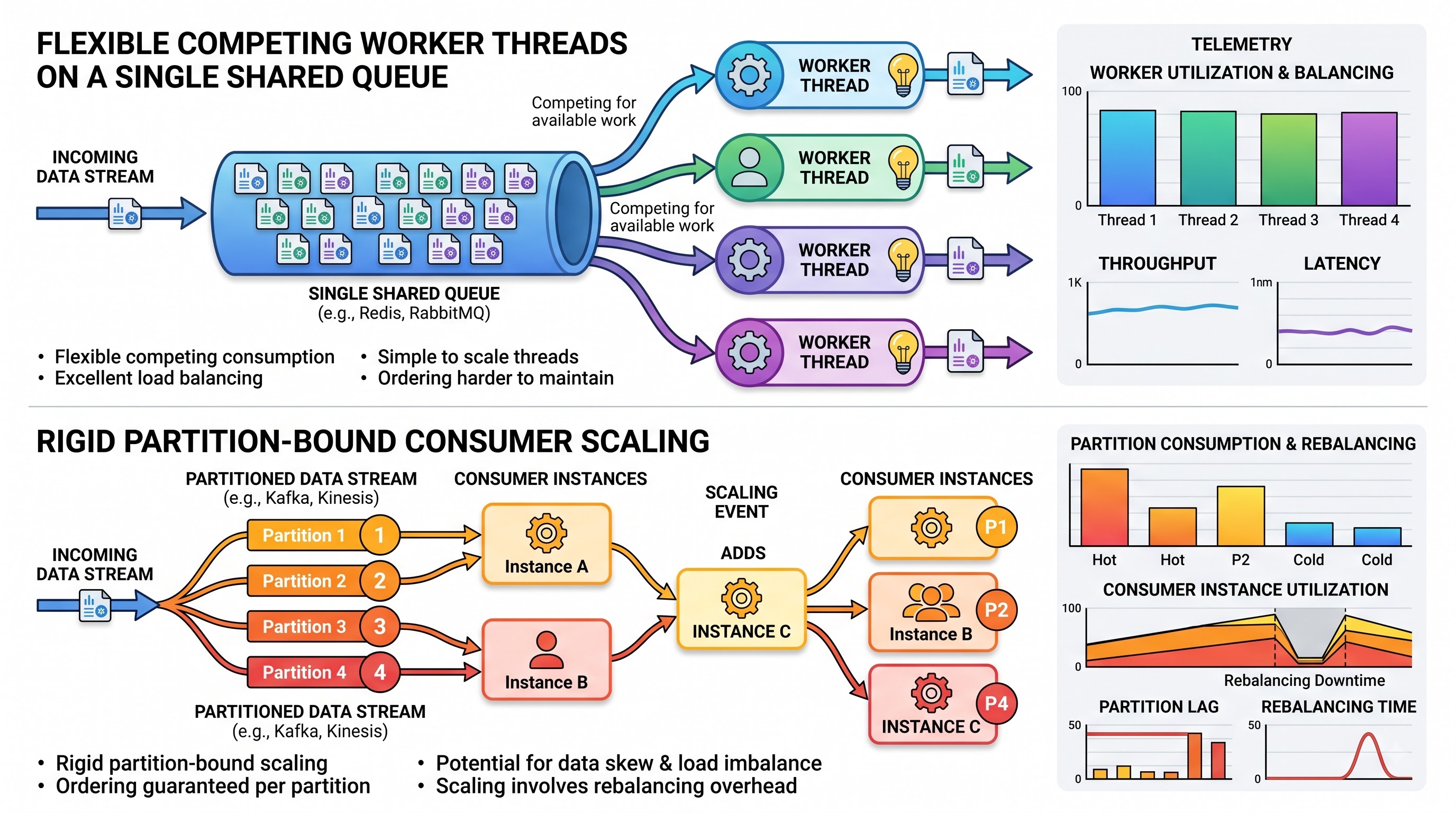
Choosing between Anypoint MQ and Apache Kafka necessitates a multi-faceted approach that includes looking at delivery semantics, concurrency models, failure modes, and management of the respective software.
Delivery Semantics and Acknowledgements
In delivery semantics and transactions, Anypoint MQ and Kafka adopt entirely different approaches:
With Anypoint MQ, any kind of acknowledgement is given depending on the messages consumed. If an application is consuming ten messages simultaneously in ten threads, for example, then thread five will be able to acknowledge the message, independently of thread four. Should thread four fail, then only message four will need re-queuing. This is what makes Anypoint MQ particularly useful in business orchestrations that are very complex because in that case, the time taken to process individual transactions may widely vary.
In Kafka, acknowledgments are based on offset and are very basic. Each time a consumer commits offset 50, it means that all the offsets before 50 are processed. For example, an error in processing of the 48th message will cause the consumer to restart processing of the entire partition if there is an issue with message 48. The only alternative is implementing separate architectures for processing messages and sending the message to a secondary error topic instead of waiting for the broker to take care of every single error.
Ordering Guarantees and Concurrency Scaling
Concurrency scaling of Anypoint MQ is independent from routing of data. An application can easily scale into thousands of threads on a single regular queue. The broker will transfer a message to the first available thread. Ordering in FIFO queues is done via the use of Message Group IDs; if a queue has events for many customers with different IDs, the available threads can process customers’ messages simultaneously, without first planning out all physical partitions.
Kafka correlates concurrency with physical partitions. In order to make a consumer application parallel with 64 processes, the target topic must have at least 64 partitions. It should be noted that there is no global order that would make ordering possible in different partitions; it is guaranteed only in one partition. Thus, if integration of related records must go in the order, the producer needs to implement a partitioning key to make the corresponding records fit into one partition.
Latency Characteristics and Throughput Capabilities
Kafka was designed to allow both low millisecond latency, and even below milliseconds at the same time. Thanks to the fact that the information is recorded directly onto sequential disk structures and the operating system page cache as well as zero-copy networking are being used, Kafka brokers are able to handle millions of read and write requests per second in a cluster with minimum CPU utilization.
Anypoint MQ follows standard cloud API latency requirements, which is typically tens of milliseconds. The requests passing through HTTP/REST channels and being encrypted by TLS are managed by a multi-tenant control plane in case of Anypoint MQ.
The Anypoint MQ technology is transient by design, which means that its operating principle resembles that of a transit buffer. It receives information, processes it via consumers, and then removes it forever. Therefore, it can never serve as a repository of information or a register of events.
Kafka works as a permanent, distributed log. Its messages can be stored forever in various tiers of storage, for example, in local SSDs, which drivers may employ to move data to Amazon S3 for prolonged storage. The technology allows utilizing event-sourcing systems where the event log becomes the only immutable information source for the business.
Under What Circumstances Should One Use Anypoint MQ?
Anypoint MQ is effective for those focus areas of integration that require transactional business processes as the primary aspect.
1. Integration Topologies that are Purely Based on MuleSoft
It is possible to create an integration solution that functions completely within CloudHub or Runtime Fabric (RTF) in which case Anypoint MQ is best for speed of implementation and is also quite easy to operate.
There is no need to worry about problems like configuring firewalls, establishing VPC peering connections or updating external authorities dealing with broker authentication.
Thus, everything from role/property based access control (RBAC) to environment segregation (Developer, QA, and Production) to monitoring of client applications and queues is managed directly in the Anypoint Platform.
The integration thus makes use of Anypoint MQ connector thus making it fast and easier to configure the platform for the users.
2. Work Queues and Worker Mode Processing
If the main purpose for integration is to distribute discrete work items over several units, then Anypoint MQ is efficient.
This may be seen in such applications as asynchronous order processing, invoice creation, notifications, or rendering PDFs.
In those cases, every message covers a separate command or instruction. The time it needs to complete independent tasks varies considerably (e.g., invoice creation can take from two hundred milliseconds to thirty seconds depending on the number of lines).
Anypoint MQ automatically balances the workload among its available threads. While a task is being executed the other independent tasks can still be running in parallel, which would not happen in one of the partitions of the event log.
3. Zero-Operation and Serverless Architecture Requirements
For companies with the serverless approach and an unwillingness to maintain IT infrastructure, Anypoint MQ is a perfect choice.
There is neither broker updating, nor cluster size designing, nor partition capacity estimation, nor disk balancing, nor OS-level security fixings.
The amount of capacity increases spontaneously with growing need without any intervention of operational staff.
4. Granular Failure Isolation and Native Dead Letter Routing
In situations where failure of one message cannot prevent the processing of other messages:
If message number fifty has invalid data, Anypoint MQ detects the failure, increases the number of delivery attempts, and puts message number fifty aside for processing.
The rest of the workers will continue with subsequent messages without disruption.
As soon as the maximum number of delivery attempts is reached, the problematic message will get into a dead letter queue and can be analyzed, amended, and sent to processing.
Acquiring a mule soft certification provides effective implementation strategies for both Anypoint MQ workflows and external Kafka streaming patterns by integration architects and developers across enterprises.