
Navigating Enterprise AI Strategy: A Complete Business Analyst Course
Last updated on Aug 13, 2026
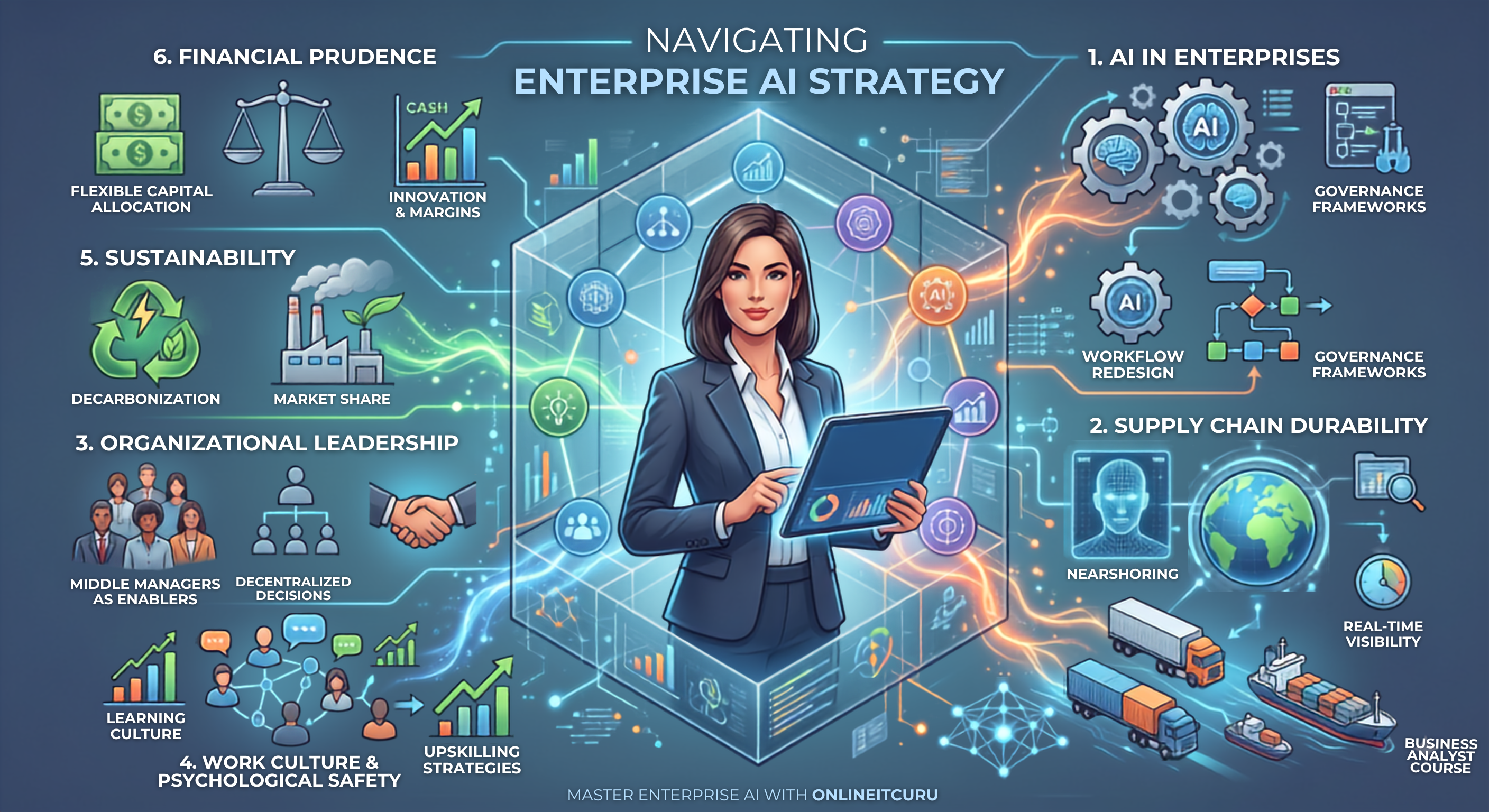
The New Strategic Baseline
The global business environment is witnessing a major change in strategy. For a long time, business strategy has been based on an understanding of business cycles, gradual technological adoption, and linear international growth. Today, leadership teams are faced with an unpredictable environment, involving rapid technological breakthroughs, changing trade routes, transformations of the workforce, and ongoing unfavorable macroeconomic trends.
In such conditions, the five-year strategic plans lose their significance tremendously quickly. The key problem for the executive management is not about answering the question of when to change, but about ensuring the structural flexibility sufficient for endless transformations without harming normal operations. The companies that excel are characterized by shifts from reactive crisis management to proactive resilience.
A leader must reconsider the way of value generation, keeping the firm’s competitive advantage sustainable. This paper outlines major components of the organizational strategies affecting enterprises including operationalization of AI, supply chain infrastructure modernization, leadership models review, and financial discipline alignment with innovation.
Realities of AI in Enterprises
From Pilots to Full Scale Implementation
The conversation about AI in enterprise has significantly developed over time. Indeed, the early phase of running pilots, testing various proofs of concepts, and trying to obtain benefits from AI technologies is over and now there is a need in implementation of the technology. Executives no longer wonder if AI can be of value in business but how it should be applied to business processes to get measurable results.
To achieve full-scale implementation of AI, the companies should drop the use of the fragmented and department-based tools and adopt centralized data architecture and unified governance models. Independent AI initiatives lead to creation of operational silos, inconsistent data policy, and security risks. The enterprise-wide implementation requires consistent infrastructure enabling smooth interaction of AI tools, machine learning models, and analytical platforms across departments.
The True Value of AI Lies in Workflow Redesign
Artificial intelligence can help organizations with more than just cutting down on the workforce. Proper implementation of advanced automation and predictive analytics can help eliminate tasks that lack any real value so that employees can focus on more complicated tasks such as solving problems and managing relations with clients.
Predictive models, for example, are used for analyzing numerous transactions in financial operations and for identifying irregularities in those transactions, forecasting cash flow needs, and planning the allocation of working capital. Intelligent systems are also useful in customer relations, as they use behavioral signals to provide customers with personalized services as well as to predict changes in customers’ behavior. The main thing here is to make sure that the algorithmic speed of machines is used properly by human beings along with their own analytical skills.
Addressing Data Fragmentation and Governance Issues
Data quality is the biggest issue affecting the deployment of AI in enterprises. Many companies have huge amounts of proprietary data but the data is often inaccessible in outdated data stores, has different formats, and is processed according to unclear governance rules.
[Legacy Data Silos] ----> (Data Cleansing & Integration) ----> [Unified Governance] ----> [Scalable AI Engines]
In order to reap the advantages of their data, the leaders should elevate the data architecture as a strategic priority. Specialists trained in an online business analyst program can offer expertise in building integrated governance frameworks by connecting the technical data teams with the business strategy execution.
Government Structural Adjustment of Supply Chains for Durability and Localization
Transition from Just-in-time to Smart Durability
For the last four decades, international supply chain management has been ruled by only one principle i.e. cost minimization achieved through just-in-time project implementation. Global production chains have successfully operated due to long and fragile trade routes contributing to the decrease in inventory cost. Nevertheless, recent political instability, trade risks, energy price rise, and climatic catastrophes have revealed all the drawbacks of this hyper-lean system.
Modern business models emphasize operational adaptability along with cost-effectiveness. Companies are transforming their supply chains in such a way that they are able to withstand any outside influences and remain functional at the same time.
Nearshoring, Multisourcing, and Emerging Trade Corridors
Companies are beginning to implement nearshoring strategies and geographic diversification. By decreasing the distance to supply chain partners, companies reduce their risks related to maritime shipping interruptions and can respond to changing local demands faster than ever before.
As a consequence, the patterns of international trade are also changing. New trade routes that appear in the developing countries of South and Southeast Asia, Latin America, and the Gulf region create new possibilities for supply and finance management and expansion in the markets. Successful companies try to establish a strong foothold in these business corridors that would allow them to develop their supply bases and access an expanding local customer market.
Concurrently, there are transformations in global trade patterns. Emerging markets, especially in South/Southeast Asia, Latin America, and the Gulf, have developed new trade routes, providing various options for manufacturing, capital flow, and market expansion. Progressive businesses strive to position themselves properly in the new promising routes to diversify their suppliers and explore expanding markets in the regions.
Digital Twin Implementation and Real-Time Visibility
An efficient management of a diversified and regionalized supply network requires sophisticated tools for visibility. Leading companies use digital twin technology, which is a virtual representation of a real supply chain capable of modeling possible situations, controlling the movement of the goods, and identifying the bottlenecks in real-time.
By linking digital twins with real-time data from IoT transport sensors, customs systems, and weather monitoring systems, operational teams can foresee disruptions in advance by several days or weeks. If there is a delay in the main ports or an interruption in the production process of any supplier, the management can promptly reroute the cargoes, modify the schedule of production, and activate alternative suppliers.
Upgrade of the organizational structure and leadership
Making middle managers into the strategic enablers
With the organizations getting flatter and implementing agile practices, the usual duties of middle management as a task supervisor and administrative gatekeeper are disappearing. In the leading companies, middle managers act as the strategic enablers instead. Middle managers’ role becomes implementing the operational strategy into practice instead of supervising the operation.
The standard management practices regarded middle management merely as a conduit for the directives relayed downwards from the executive board to the lower layers of the organizational hierarchy, but the contemporary management theories describe these managers as the people who bridge the gap between executive plans and activity on the lower level.
For this transformation to succeed, one needs to invest heavily in capacity building. Training team leads in practical business analyst skills allows these professionals to take care of analytics, coordinate multi-functional projects, and convert high-level company objectives into processes that keep the organization running. By taking up a flexible business analyst online, those in the field can upgrade their skills while on the job.
Turning the performance appraisal system of the former type into the system of continuous synchronization of the objectives.
One of the biggest shortcomings of an annual performance review is that it makes one assessment annually. It is obvious that this frequency cannot cope with the need for constant adaptation of the company to the new situations in the market. The traditional performance evaluation is focused mostly on the mistakes made by an employee and does not show him the path for improvement.
Top companies are replacing yearly evaluations with systems for continuous feedback. The benefits of these systems include quick and easy check-ins, peer feedback and the ability to create objectives in real-time. Continuous performance management enables managers and employees to refocus when priorities change in the organization, identify skills deficits and address any sub-optimal behavior before it affects the results of their project.
Decentralizing Decision-Making to Increase Speed and Flexibility
Centralization policy can slow down the progress of organizations in the market. If all the operational decisions have to go through many levels of approval, organizations often miss good chances in the market and their front-line staff loses motivation.
To speed up their work, organizations apply the principles of decentralized making to empower people to take decisions despite potential risks.
Work Culture, Human Capital, Psychological Safety
Psychological Safety as Operational Performance Driver
The concept of psychological safety—known as the collective perception that teams operate in a risk-free atmosphere—has transitioned from HR jargon into an important indicator of company performance. In a world marked by volatility and complexity, companies can neither afford to operate within organizational cultures marked by a prevalence of fear, as workers will simply mask mistakes and avoid expressing opposing viewpoints.
Organizations that boast a healthy amount of psychological safety benefit from being able to easily uncover emerging issues, solve their issues before any serious damage is done, and implement innovations. On the other hand, companies with unhealthy levels of psychological safety prefer to conceal information about errors only to encounter major troubles later.
Psychological safety manifests itself in team operations through premature reporting by employees, and employees in such companies spread their trusts and ideas everywhere.
By Implementing Customized Upskilling Strategies
Companies can Bridge the Skills Gap, the growing use of digital technologies and AI has resulted in increased disparity between available talent and skills needed to perform roles. Hiring talent externally is rather expensive and not always feasible due to the competitive landscape of the labor market.
Rather than opting for general training programs, innovative businesses implement focused upskilling programs. As an example, OnlineITGuru offers a specialized online ba analyst course that enables organizations to fill their skills gaps by teaching employees practical skills such as data modeling, requirements gathering, and AI workflow implementation.
Fostering Retention in Hybrid and Distributed Environments
Today, companies have taken hybrid, remote, and co-located solutions as their permanent workplace models. In terms of benefits, flexible arrangements attract the workforce and maintain employee satisfaction but raise problems with team alignment, organization cohesion, and corporate culture.
In order to retain top talent within a distributed team, it is essential to go beyond the use of basic remote tools. Leadership should focus on setting intentional touchpoints for shaping the culture as well as ensuring transparent communication and evaluating performance according to specific objectives and outcomes. When measuring results, employees can be evaluated based on their output and the impact made instead of visibility.
5. Incorporating Sustainability into the Strategy
The concept of ESG is Changing from Compliance to Values
In recent years, ESG has evolved from an optional PR operation to being considered a key factor in business strategy development. Stakeholders now approach the issue of sustainability performance as an indicator of effective operations, risk management, and long-term viability.
Modern firms do not see sustainability as a compliance cost anymore. In their strategy firms utilize sustainability innovations aimed at reducing resource consumption and waste production, thus obtaining profits and entering new markets.
Economic and Operational Effectiveness of Decarbonization
In decarbonizing factories and businesses, capital needs to be allocated methodically. The approach begins with finding and implementing measures with the most impact and return—such as modernizing energy systems of buildings, improving logistics routes, and changing to energy-efficient machinery.
Once organizations start addressing the emissions of their supply chains, it is of utmost importance for them to acquire accurate data. Advanced carbon accounting systems track emissions throughout first-, second-, and third-tier suppliers through detailed carbon accounting. Thus, procurement leaders are able to find inefficient suppliers, negotiate better contracts, and reduce risks connected with carbon regulations and border adjustments.
Compliance and Sustainability into Market Share
With increasingly strict regulations globally about ESG disclosures and green taxonomy standards, companies operating internationally deal with mandatory demands for reporting concerning carbon footprint, water consumption, risks of human rights violations, and integrity of the supply chain.
The international regulations leading to the implementation of automated audits and carbon tracking result in sustainable certifications. Such compliance helps companies achieve the preferred Tier-1 vendor position in high-value RFPs.
Corporations investing in well-established compliance and reporting systems can win the confidence of clients around the world. Clear sustainability reports provide added credibility in dealing with corporate clients and help ensure long-term contracts as well as defend shares in markets from competitors which cannot adapt to the progressive standards.
Financial Prudence and Preservation of Margins in the Slow-Growth Environment
Dealing with the Constant Influence of Structural Cost Factors
Economic cycles characterized by low growth rates, stable interest rates and high costs of raw materials impose strict requirements on financial discipline on businesses. When the growth of revenues slows down in the core markets, it is the operational efficiency of processes that makes the difference when it comes to expansion of profit margins.
Effective cost pressure management requires distinguishing between valuable expenditures and operation inefficiencies. Uniform budget cuts generally hurt revenue-generating processes and impede growth. Rather, clever financial management should help remove inefficiencies, minimize administrative burdens, and renegotiate relationships to allow freeing up funds for investments in core technologies, R&D, and enhancement of profitability.
Flexible Capital Allocation Strategies for Volatile Markets
An unpredictable business environment calls for flexible capital allocation strategies. Fixed annual budgets may lock the capital in stages of investment that have lost feasibility due to changes in the market.
Leading CFOs now prefer to apply innovative phased capital allocation methods. This means utilizing the budget on stages depending on the effectiveness of a project. If a project performs well in the market, further funding can be provided immediately, and in case of any shifts in the business environment, the initiative can be canceled with no major losses incurred.
Achieving Long-Term Innovation Along with Short-Term Cash Flow
To sustain market positioning requires striking a balance between the short-term cash flow situation and long-term research and development investments. Organizations that reduce spending on innovation during economic crises often end up with obsolete products and losing the competitive edge.
The disciplined capital allocation mechanism enables companies to assign resources into three different categories:
Performance of the Core Business: Assigning 60 percent of the overall funds to securing and sustaining and improving the core revenue generator(s).
Adjacencies and Scale: Investing 25 percent of capital in embraced programs, penetration into adjacent geographical markets, and sophisticated automation.
Sustained Innovation: Appropriating 15 percent of the capital for modernization interventions, trialing new technologies, and trying out innovative business models.
Such a diversified pool will ensure the current enterprise generates sufficient income for future expansion and thereby eludes being exposed to liquidity issues and strategic paralysis.
The Leadership Affair: Strategic Agility and Emotional Intelligence
Analytical and Human Qualities in Leadership
In light of the present-day market trends dominated by data-based analyses and algorithmic decision-making, the importance of the humanistic traits in leadership is steadily rising. While analytic models can discover trends in the market, make forecasts, and pinpoint inefficiencies, they do not possess high-profile leadership qualities such as the ability to create an inspiring vision or manage a team to a common objective.
Therefore, modern executive leadership requires the combination of quantitative knowledge of analytics with emotional and strategic intelligence, which includes such qualities as managing talent with empathy, creating a clear vision of the future, etc.
Essential Strategic Abilities for Executive Groups
To deal with the complexities of the modern corporate world, executive groups have to develop six essential strategic capabilities:
1. Anticipation: Constantly tracking changes in peripheral markets, shifts in regulations and emerging technology trends to track warnings before they disrupt the industry.
2. Constructive Criticism : The idea is to criticise the beliefs, legacy models and practices of the institution to find out the strategic flaws.
3. Processing information – understanding and making sense of information that comes from different sources that are ambiguous and complex.
4. Acting Well: Making strategic decisions where there is not complete information, but where speed and risk considerations are important.
5. Organizational Alignment: Creating agreement and cross-functional momentum regarding the strategic initiatives across matrixed global structures.
6. Continuous Institutional Learning: Considering successes and mistakes as important data to fine-tune operational execution.
These abilities create a constant process of feedback: expectation results in the useful problem, that affects the understanding, and gives rise to successful performance, as well as is used for obtaining institutional knowledge.
In conclusion, a continuous institutional change is a necessity for achieving a long-lasting competitive advantage.
The convergence of the process of entering AI technology to the business, restructuring of the supply chain, modernization of the management system and establishment of sustainable operations are crucial for radical changes in corporate functioning.
In the next decade, successful businesses will not be the ones who survived the crises only, but the ones whose operations are aimed at the continuous adaptation to the changing conditions. A combination of proficiency in technology, strict control over finances and compassionate attitude toward people create a good base for the achievement of success in managing the firms in a complicated environment.
Achieve Mastery in Enterprise AI Strategy at OnlineITGuru
With organizations shifting to AI-based processes and decentralized decision-making, there is an increasing demand for trained Business Analysts. If you are searching for excellent ba training programs or wishing to enhance your skills through an online BA analyst course, OnlineITGuru offers practical and industry-relevant training. Learn how to become a certified business analyst online with OnlineITGuru.